

How to Write an Email to Sell a Product: Data-Backed Guide With Real Examples
The average sales rep sends 344 cold emails to land a single meeting. That's not a typo - it's the finding from an analysis of 28M+ outbound emails. But top performers book 8.1x more meetings from the same volume. The difference isn't sending more. It's writing better ones.
Here's the thing: most advice on writing product sales emails stops at "book a demo," as if every product is a SaaS platform with a 14-day trial. Whether you're cold-emailing a VP of Engineering, running abandoned cart flows for a DTC brand, or following up after a trade show - the playbook changes completely depending on context. We've pulled benchmarks, frameworks, and real templates for all of it.
The Short Version
Stop pitching in the first email. Data across 28M+ emails shows pitching kills reply rates by up to 57%. Lead with a relevant problem, not your product.
Keep it under 80 words. Top-performing cold emails run 3-4 sentences. Use PAS (Problem, Agitate, Solve) for cold outreach, AIDA for warm leads.
Verify your list before sending. High bounce rates - especially above 2-3% - torch your domain reputation. Run every list through verification first. Prospeo catches invalid addresses, spam traps, and honeypots with 98% accuracy before you hit send.
Why Most Product Sales Emails Fail
The gap between average and elite isn't volume. It's skill. Top performers get 4.2x more replies and 2.1x higher open rates than the median rep, sending the exact same number of emails.
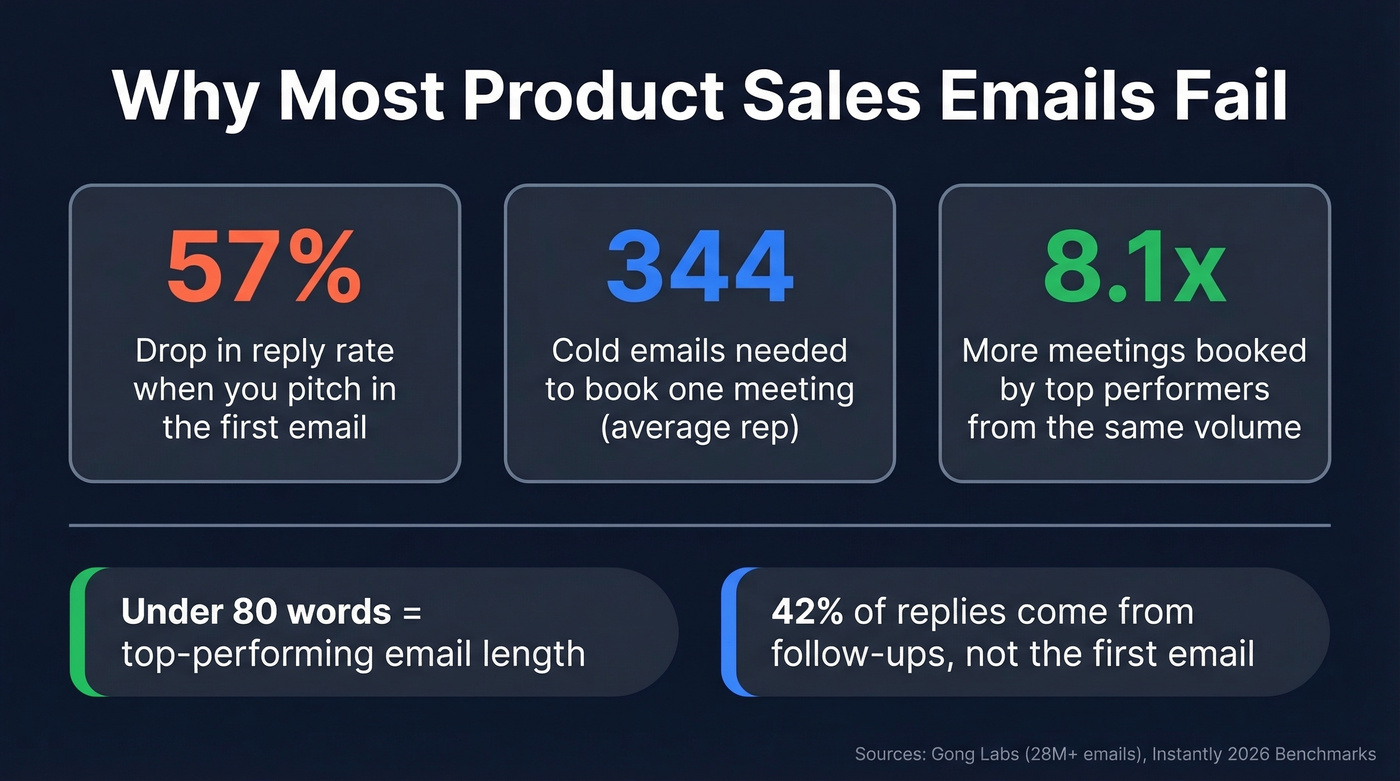
The single biggest killer? Pitching too early. When reps lead with product features or a demo request in the first email, reply rates drop by up to 57%. That's not a marginal difference - that's the difference between a pipeline and a graveyard. Even the best sales pitch for any product falls flat if it shows up before the prospect cares.
The other mistake is length. Teams craft beautiful 200-word emails that nobody reads. The data is clear: emails under 80 words outperform everything else. Executives spend roughly 9 seconds reading a cold email. If your first sentence doesn't earn the second, nothing else matters.
And here's a stat that should change how you think about sequences: 42% of cold email replies come from follow-ups, not the initial send.
Anatomy of a Selling Email That Converts
Subject Line
An analysis of 5.5M emails by Belkins makes the findings unambiguous. Personalized subject lines hit a 46% open rate versus 35% without personalization. Question-format subject lines matched that 46% mark. The sweet spot for length is two to four words.
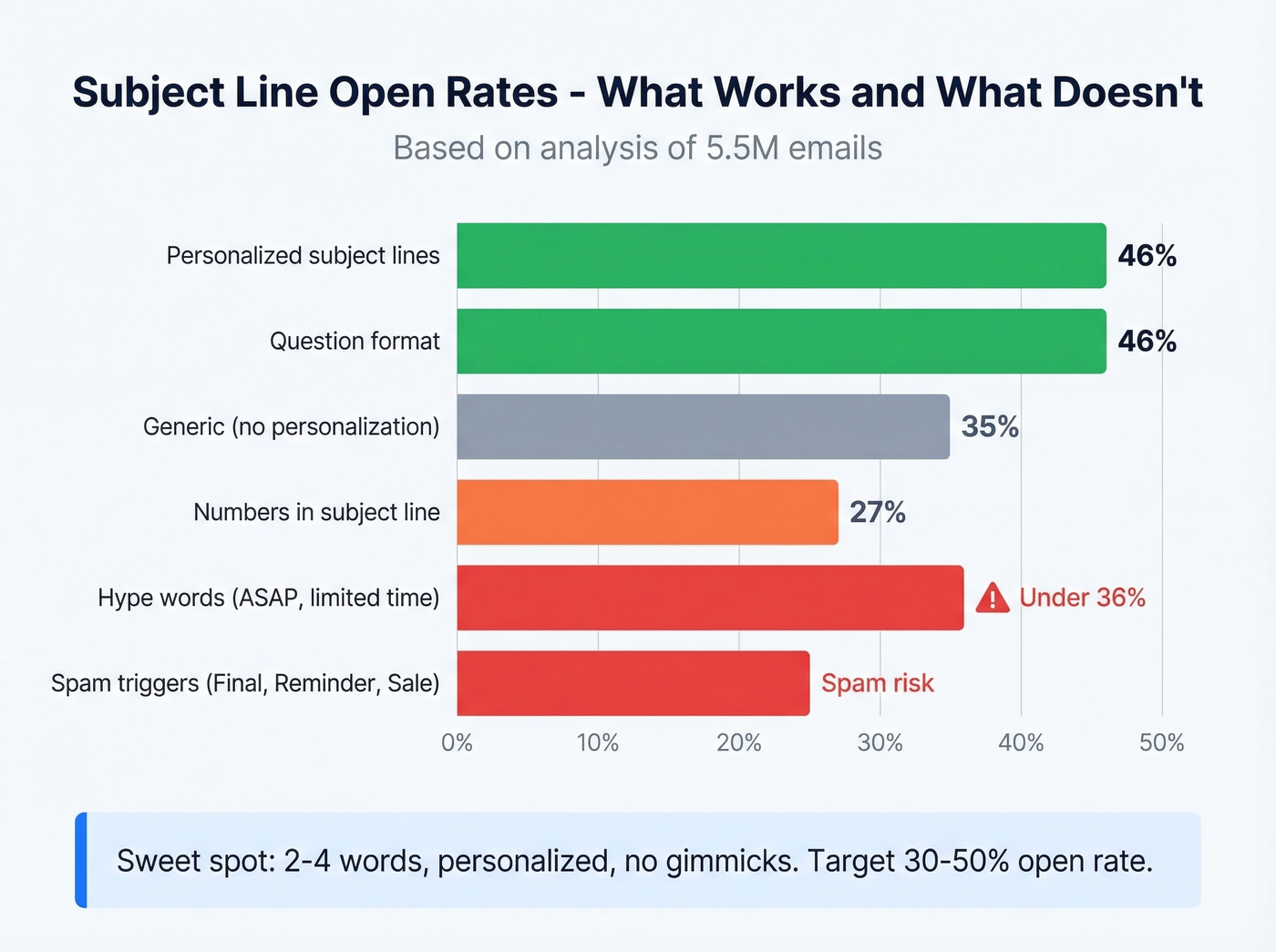
What tanks open rates: hype words. Terms like "ASAP," "limited time," or generic greetings like "Hello, friend" correlate with sub-36% open rates. Words to avoid include "Final," "Reminder," "Sale," "Complimentary," and "Solution" - HubSpot flags these as spam triggers. Numbers in subject lines don't help either - 27% open rate with numbers versus 28% without. Keep it short, make it personal, skip the gimmicks.
One practical tip: A/B test subject lines on 50-100 emails before rolling out a variant. You're targeting a 30-50% open rate. If you're below 30%, the subject line is the problem. If you need ideas fast, pull from proven subject lines and adapt them to your ICP.
Opening Line
Executives decide whether to keep reading in under 3 seconds. Your opening line carries more weight than everything else combined.
Personalization beyond [FIRST NAME] is what separates good from great. Reference a specific trigger: a recent funding round, a job change, a podcast appearance, a piece of content they published. "Saw you just raised a Series B - congrats" beats "Hope you're doing well" every single time. We've seen this firsthand across hundreds of campaigns - generic openers get ignored, specific ones get replies. If you want a system for this, use a repeatable sales prospecting techniques workflow.
Body Copy
Keep it under 80 words. 2026 benchmark data from Instantly confirms this is the top-performing length for cold outreach. Research across 28M+ emails aligns - 3-4 sentences perform best.
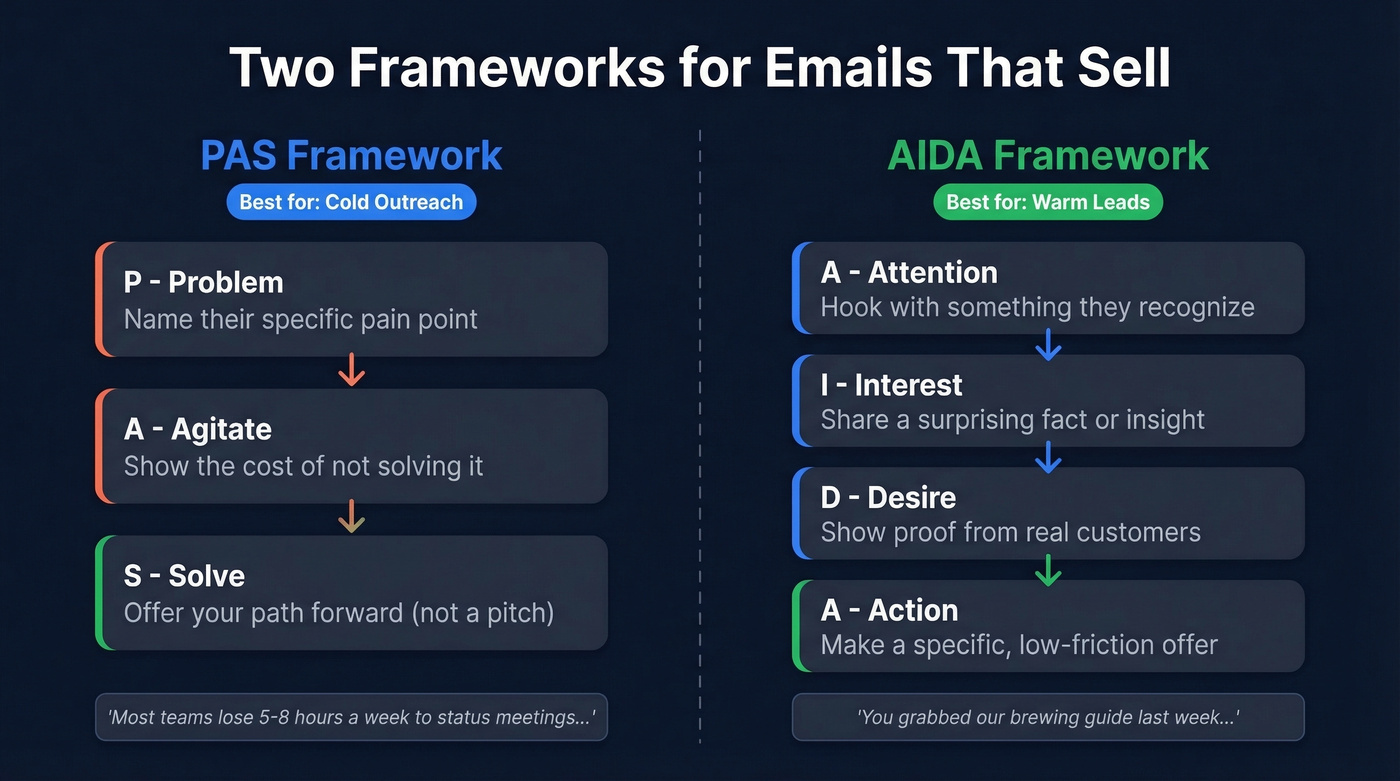
The body has one job: connect the reader's problem to your solution without sounding like a pitch. Two frameworks handle this well - PAS for cold outreach, AIDA for warm leads. More on those below. For deeper structure and examples, see our guide to email copywriting.
Call to Action
Asking "Does this sound interesting?" doubles your success rate compared to a specific CTA like "Can we book 15 minutes Tuesday?" That's based on Gong Labs internal testing data.
The principle is simple. Make an offer, not a meeting request. Offer a benchmark, an insight, a relevant case study. Let the prospect decide the next step. Low-pressure CTAs outperform aggressive calendar links consistently. If you want more patterns, use these email call to action rules.
Two Frameworks for Emails That Sell
PAS (Problem, Agitate, Solve)
Best for cold outreach where you need to create urgency with someone who doesn't know you. You name their problem, twist the knife slightly, then offer a path forward.
Example - SaaS product (project management tool):
Subject: Missed deadlines?
Hi Sarah,
Most engineering teams lose 5-8 hours a week to status update meetings that could've been a dashboard. That time compounds - by Q4, you've burned 200+ engineering hours on alignment, not building.
We built Trackline to replace those meetings with real-time project visibility. Notion and Monday don't do this well.
Worth a look? Here's a 2-min demo: [link]
That's 62 words. Problem first, agitation second, solution third. No pitch in the opening line.
AIDA (Attention, Interest, Desire, Action)
Best for warm leads - people who've visited your site, downloaded a resource, or attended a webinar. They already know you exist. Now you need to move them. If you want to map this to funnel stages, use the AIDA sales funnel breakdown.
Example - physical product (premium coffee subscription):
Subject: Your morning upgrade
Hi James,
You grabbed our brewing guide last week - thanks for that. Here's what most people miss: single-origin beans lose 40% of their flavor within two weeks of roasting.
Our weekly roast ships within 48 hours of roasting. Subscribers tell us it's the first time their home coffee matched what they get at specialty shops.
First bag is $9 (normally $18). Want in? [link]
Attention (the guide callback), interest (the freshness fact), desire (the subscriber proof), action (the offer). Seventy-one words total.

Your sales email is only as good as the inbox it lands in. A 35% bounce rate doesn't just kill that campaign - it torches your domain for every future send. Prospeo's 5-step verification catches spam traps, honeypots, and invalid addresses with 98% accuracy, so every carefully crafted email actually reaches a real person.
Stop writing perfect emails to dead inboxes.
Product Sales Email Templates With Examples
Cold Outreach (First Touch)
Subject: Quick question about [specific process]
Hi [Name],
I noticed [Company] just [specific trigger - expansion, new product launch, job posting for X role]. When teams hit that stage, [specific problem] usually becomes a bottleneck.
We helped [similar company] cut [metric] by [result] in [timeframe]. No pitch - just curious if that resonates with what you're seeing.
Either way, happy to share the case study.
Why it works: No product pitch in the first sentence. Leads with observation, not features. The CTA is low-pressure - "curious if that resonates" instead of "book a call." This approach avoids the 57% reply-rate penalty that comes with leading with a pitch. To build the full motion, start with a B2B cold email sequence.
Follow-Up (After No Reply)
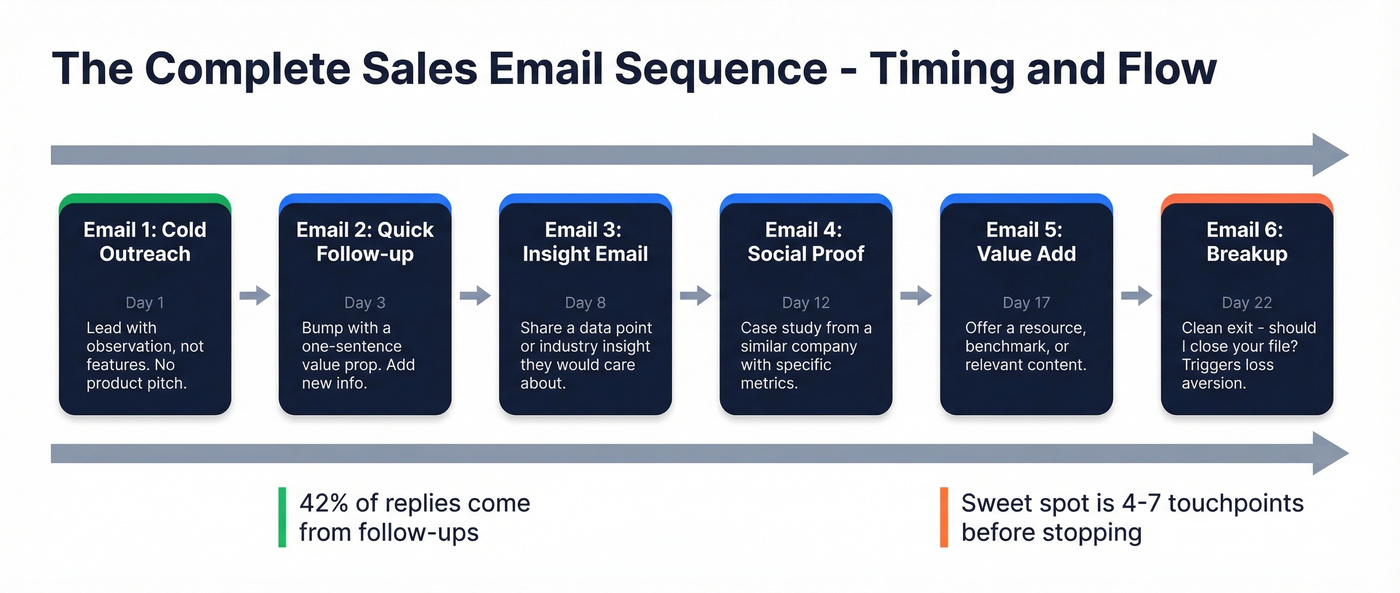
Most reps give up after one email. That's a mistake - 42% of cold email replies come from follow-ups.
2-day follow-up:
Subject: Re: Quick question about [specific process]
Hi [Name], bumping this up - I know inboxes are brutal. The short version: [one-sentence value prop]. Worth 5 minutes?
5-day follow-up:
Subject: One more thought
Hi [Name], I wanted to share one thing I didn't mention - [specific insight or data point relevant to their industry]. If timing isn't right, no worries. But I figured it was worth one more note.
Each follow-up adds new value instead of just "checking in." The 5-day version leads with an insight, not a guilt trip. Spacing at 2-3 days apart prevents inbox fatigue while keeping you top of mind during the 4-7 touchpoint window where most sequences perform best. If you want more options, use these sales follow-up templates.
Social Proof Email
Subject: How [similar company] fixed [problem]
Hi [Name],
[Similar company in their industry] was dealing with [specific problem]. After switching to [your product], they saw [specific metric improvement] in [timeframe].
I'm not saying you have the same issue - but the pattern is common enough that it might be worth a conversation.
Happy to share the full breakdown if useful.
Specificity beats generic claims. "Reduced churn by 23% in 90 days" is infinitely more compelling than "we help companies grow." The soft CTA ("if useful") respects the reader's autonomy, which drives higher response rates than a hard ask.
Post-Demo Closing Email
Subject: Next steps for [Company]
Hi [Name],
Great conversation yesterday. You mentioned [specific pain point from the call] - here's the ROI breakdown we discussed: [one-line summary or link to custom proposal].
Based on what [similar company] saw (a [X]% improvement in [metric] within [timeframe]), I think you'd hit [specific outcome] by [quarter].
Want to loop in [stakeholder they mentioned] for a quick alignment call this week?
This one works because it references specific details from the conversation, proving you listened. It ties their stated pain to a concrete outcome with a timeline, and the CTA names a specific next step without being pushy - it advances the deal by involving the buying committee.
The Breakup Email
Subject: Should I close your file?
Hi [Name],
I've reached out a few times and haven't heard back - totally fine. I'll assume the timing isn't right and close out your file.
If anything changes, I'm here. One thing worth bookmarking: [link to relevant resource].
All the best.
Don't send this after two emails. The 4-7 touchpoint sweet spot means you should exhaust your sequence first. But after five or six touches with no response, a clean exit often generates more replies than another follow-up. The psychology is loss aversion - "closing your file" triggers a response from prospects who were interested but busy.
Post-Sale Nurturing Email
Subject: Getting the most from [product]
Hi [Name],
You're about three weeks in - most teams at this stage have hit [common milestone] but haven't explored [underused feature].
[Similar customer] found that activating [feature] cut their [metric] by [result]. Here's a 90-second walkthrough: [link]
Also - we just published [relevant resource]. Thought of you given your focus on [their stated priority].
Post-sale emails protect revenue. They reduce churn by demonstrating ongoing value and position you for expansion conversations. Leading with a usage insight rather than an upsell pitch keeps the relationship consultative.
Crafting a Sales Pitch for Executive Buyers
C-level execs are 30.2% less likely to reply than non-execs. They spend about 9 seconds reading your email. Subject lines with 1-4 words perform best. Reply rates drop sharply past 100 words.
Let's be honest: if your average deal size is under $10K, you probably don't need to email the C-suite at all. Directors and VPs have budget authority for most mid-market deals. Save the CEO email for six-figure deals where executive sponsorship actually matters.
When you do email executives, lead with their priority, name the problem, describe the status quo, offer a new perspective, then close with a low-pressure ask. This is also where enterprise B2B sales fundamentals matter most.
Example - email to a VP of Revenue:
Subject: Pipeline math
Hi [Name],
Most Rev leaders I talk to are trying to hit 140% pipeline coverage this quarter. The bottleneck is usually data quality - reps waste 30% of dials on bad numbers, and bounce rates above 2-3% quietly kill domain reputation.
We've helped teams like [company] cut bounce rates from 35% to under 4% while tripling connect rates.
Worth seeing how the math works for [Company]?
That's 68 words. Priority first, problem second, proof third, soft close. No "I'd love 15 minutes of your time."
Ecommerce Emails That Sell Products
Every other guide on this topic treats "sell a product" as synonymous with "book a B2B demo." But if you're selling physical products, the playbook is completely different. Automations generate up to 30x more revenue per recipient than one-off campaigns, according to Klaviyo's benchmark data. That single stat should reshape how you think about ecommerce email.
Welcome Flow
Klaviyo's benchmarks show welcome flows average $2.65 revenue per recipient, with the top 10% hitting a 10.53% placed order rate. Brands like Otherland nail this by combining brand storytelling with a first-purchase incentive - typically 10-15% off, delivered immediately after signup.
Don't just send a discount code. Tell the brand story in email one, showcase bestsellers in email two, then hit the discount reminder in email three. That three-email welcome sequence outperforms a single blast every time.
Abandoned Cart
This generates more revenue per recipient than any other automated flow. Abandoned cart emails average $3.65 RPR versus $0.11 for standard campaigns - roughly 33x more revenue per recipient.
Timing matters. First cart email at 1 hour, second at 24 hours, third at 48-72 hours with a small incentive. Always three emails, never one.
Product Launch / New Arrivals
The subject line "New Arrivals" is lazy. "The jacket that sold out in 4 hours is back" creates urgency. "We made this from deadstock fabric" tells a story. Both outperform generic announcements by a wide margin.
Creative patterns that work across top-performing brands: GIF product rotation, grid layouts showing variety, single hero product with bold color, and material storytelling. Lululemon, Kotn, and Banana Republic all execute these well in different ways.
Post-Purchase
Post-purchase emails hit a 61.68% open rate - the highest of any automated flow.
The sequence that works: email one is order confirmation (immediate), email two is a usage tip or recipe (day 3-5), email three is a review request (day 7-10), email four is a cross-sell (day 14). Each email earns the next open.
2026 Benchmarks: What "Good" Looks Like
| Metric | Average | Top Quartile | Elite (Top 10%) |
|---|---|---|---|
| Reply rate | 3.43% | 5.5%+ | 10.7%+ |
| Sequence length | 4-7 touches | 5-6 touches | 7 (new value each) |
| Email length | <80 words | 50-75 words | 3-4 sentences |
| Best send day | Mon-Thu | Tue-Wed | Wednesday |
| First-email reply share | 58% | - | - |
| Personalized subject open rate | 46% | - | - |
| Generic subject open rate | 35% | - | - |
One caveat: open rates are increasingly unreliable post-Apple Mail Privacy Protection. Apple MPP pre-loads tracking pixels, inflating open rates across the board. Mailchimp acknowledges this limitation in their benchmark reporting. Reply rate is the only metric that matters for cold outreach in 2026. If you're optimizing for opens, you're optimizing for noise.
Deliverability Checklist Before You Send
Brilliant copy sent to bad emails is wasted. Worse - it actively damages your ability to send future emails. Here's the checklist we run before any campaign goes live.
Authentication (non-negotiable):
- SPF, DKIM, and DMARC configured on your sending domain. If you don't know what these are, your IT team does. Don't skip this. (If you need a quick diagnostic, start with how to verify DKIM is working.)
Infrastructure:
- Use a secondary domain for cold outreach. Never your primary business domain. If cold email goes sideways, your company's transactional email - invoices, password resets, support - stays protected.
- Rotate 2-3 mailboxes per domain. Max 30 cold emails per mailbox per day.
- Consider disabling open tracking on cold campaigns. Tracking pixels can trigger spam filters on new domains and inflate your metrics with false positives anyway. If you want the technical why, see email tracking pixels.
Warm-up ramp:
| Week | Daily Volume | Notes |
|---|---|---|
| 1-2 | 5-10/day | Warm-up only, no cold |
| 3-4 | 15-20/day | Mix warm-up + cold |
| 5-6 | 30-40/day | Mostly cold, some warm-up |
| 7+ | Max 50/day | Split 25 warm-up + 25 cold |
Content rules for first touch on new cold domains:
- Plain text only. No links, images, or attachments.
- Keep bounce rate under 2%. Spam complaints under 0.1%. If either spikes, pause immediately and validate your list. (More detail: email bounce rate.)
Verify your list before loading it into your sequencer. A 35% bounce rate doesn't just kill that campaign - it damages your domain reputation for every future email. One of our customers, Meritt, saw their bounce rate drop from 35% to under 4% after switching to verified lists through Prospeo's 5-step verification. Free tier gives you 75 verifications per month - enough to test before committing. Compliance (non-negotiable):
Every sales email must include a physical mailing address and a working unsubscribe link under CAN-SPAM. If you're emailing EU contacts, you need a lawful basis under GDPR - typically legitimate interest for B2B cold outreach. This isn't optional, and "I didn't know" isn't a defense.
The templates above work - but only when you're emailing the right person. Prospeo gives you verified emails and direct dials for 300M+ professionals, with 30+ filters to find the exact decision-makers who match your ICP. At $0.01 per email, building a targeted list costs less than the coffee you drank writing the copy.
Find verified emails for every prospect on your list.
FAQ
How long should a sales email be?
Under 80 words for cold outreach, per 2026 benchmark data. Research across 28M+ emails confirms 3-4 sentences perform best. For executives, aim for 50-100 words - reply rates drop sharply past that threshold.
How many follow-ups should I send?
Four to seven touchpoints is the sweet spot. 58% of replies come from the first email, but follow-ups generate the remaining 42%. Space them 2-3 days apart, and make sure each touch adds new value - a case study, an insight, a relevant data point. Skip this if you're doing ecommerce flows; those follow a completely different cadence.
What's the best framework for a product sales pitch by email?
Use PAS (Problem, Agitate, Solve) for cold outreach where the prospect doesn't know you. Use AIDA (Attention, Interest, Desire, Action) for warm leads who've already engaged with your brand. For ecommerce, automated flows outperform one-off blasts by 30x in revenue per recipient.
What tools do I need to send product sales emails?
Three categories: a verified prospect list (tools like Prospeo give you 98% email accuracy with a free tier), a sequencing tool like Instantly or Smartlead from ~$30/mo, and a CRM to track replies (HubSpot's free tier works). That's the minimum viable stack - add intent data and enrichment later.