

How to Write Email Subject Lines That People Actually Open
Your team's "45% open rate" is probably closer to ~25-30%.
Apple's Mail Privacy Protection pre-fetches tracking pixels for 46% of email clients, inflating open rates across the board. HubSpot highlights a study of 80,000+ email marketing accounts where open rates jumped by 18 points after MPP rolled out. The industry benchmark sits at 42.35% - a number HubSpot publishes confidently but that includes a massive chunk of MPP-driven phantom opens. So the metric most marketers obsess over is, at best, directionally useful and at worst a vanity number masking real problems.
Here's the thing: the subject line still matters enormously. Knowing how to write email subject lines that earn genuine attention is one of the highest-leverage skills in marketing and sales. But the game has shifted. The best subject line in the world won't save you if your list is full of dead addresses, and a "good" open rate means nothing if privacy software fabricated half of it. What you write in that subject line and what you measure after someone sees it both need to change.
We've spent years watching outbound teams agonize over word choice while ignoring the infrastructure underneath. This guide is the corrective: real data from 5.5 million emails, practitioner-tested patterns, and the metrics that actually tell you what's working.
The Short Version
If you're pressed for time, here's what a 5.5-million-email study and practitioner experience actually support:
- Keep it to 2-4 words. That length hit a 46% open rate - the highest of any word count tested.
- Personalize with a name or specific reference. Personalized subject lines pulled 46% opens vs. 35% without, and reply rates jumped from 3% to 7%.
- Ask a real question. Question-form subject lines matched that 46% open rate, outperforming every other format.
- Stop obsessing over "spam trigger words." Your sender reputation and list quality matter 10x more than whether you typed "free."
- Measure reply rates and click-to-open rate, not opens. Open rates are broken. CTOR and replies tell you what's actually working.
What 5.5 Million Emails Reveal
Belkins analyzed 5.5 million cold emails sent between January and December 2024, in partnership with Reply.io. It's one of the largest public datasets on subject line performance available, and the findings contradict a lot of conventional wisdom.
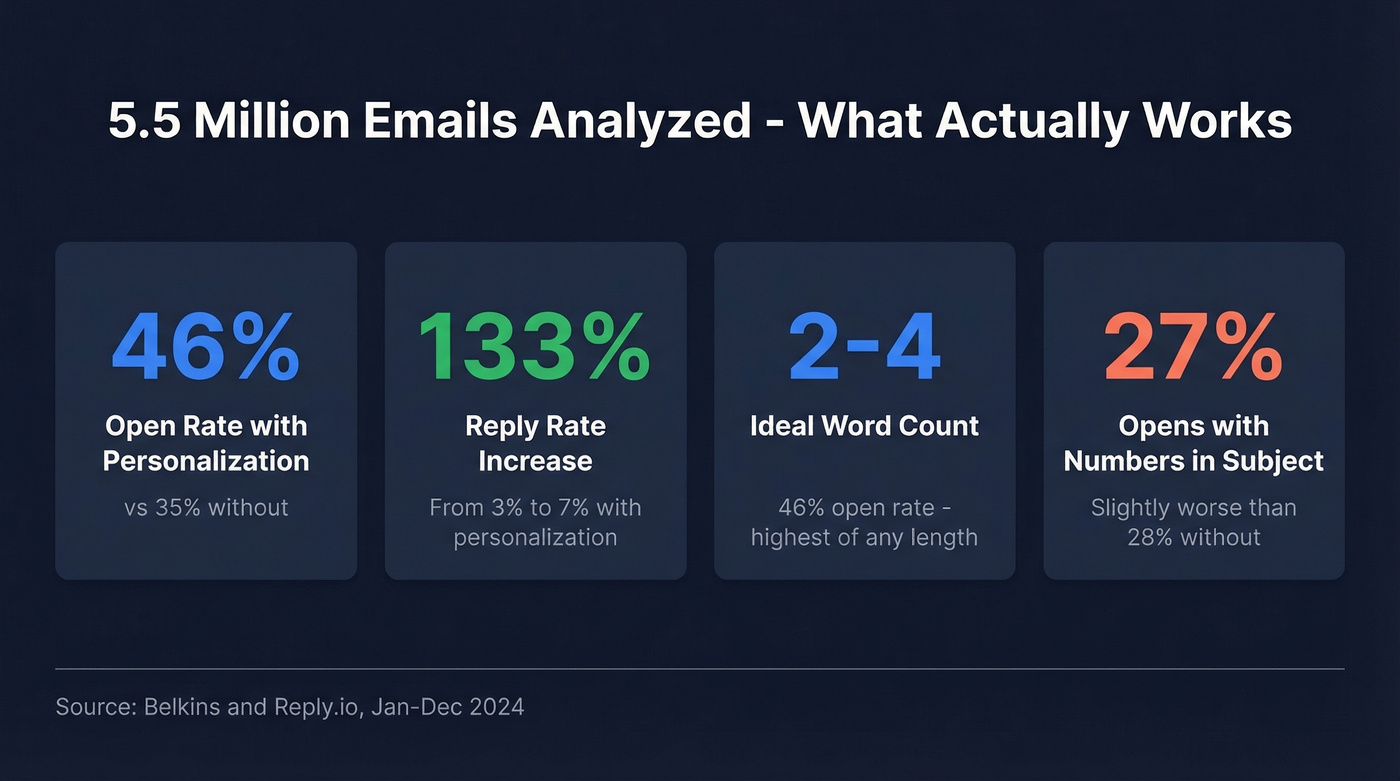
Personalization was the single biggest lever. Subject lines that included the recipient's name or a specific reference hit a 46% open rate versus 35% without - a 31% lift. More importantly, reply rates jumped from 3% to 7%, a 133% increase. Opens are nice. Replies pay the bills.
Question-form subject lines matched that 46% open rate, making them the top-performing format in the study. In our experience, questions create a micro-commitment - the reader's brain starts answering before they've decided whether to open. That psychological pull is hard to replicate with statements.
Numbers in subject lines actually hurt slightly. Lines with numbers averaged 27% opens versus 28% without. It's a small gap, but it runs counter to every "use numbers!" tip you've read. The data suggests specificity matters, but numerical specificity in the subject line itself doesn't move the needle. Save the numbers for the body copy.
Length told a clear story. Two to four words was the sweet spot at 46%. One-word subject lines underperformed at 38%, and performance dropped steadily after seven words - nine words hit 35%, ten words 34%. But before you start counting words obsessively, read the next section.
Ideal Subject Line Length
The honest answer: length explains almost none of the difference in performance. Phrasee's analysis estimates that subject line length accounts for roughly 0.1% of open rate variance. That's not a rounding error - it's a signal that what you say matters infinitely more than how many characters you use to say it.
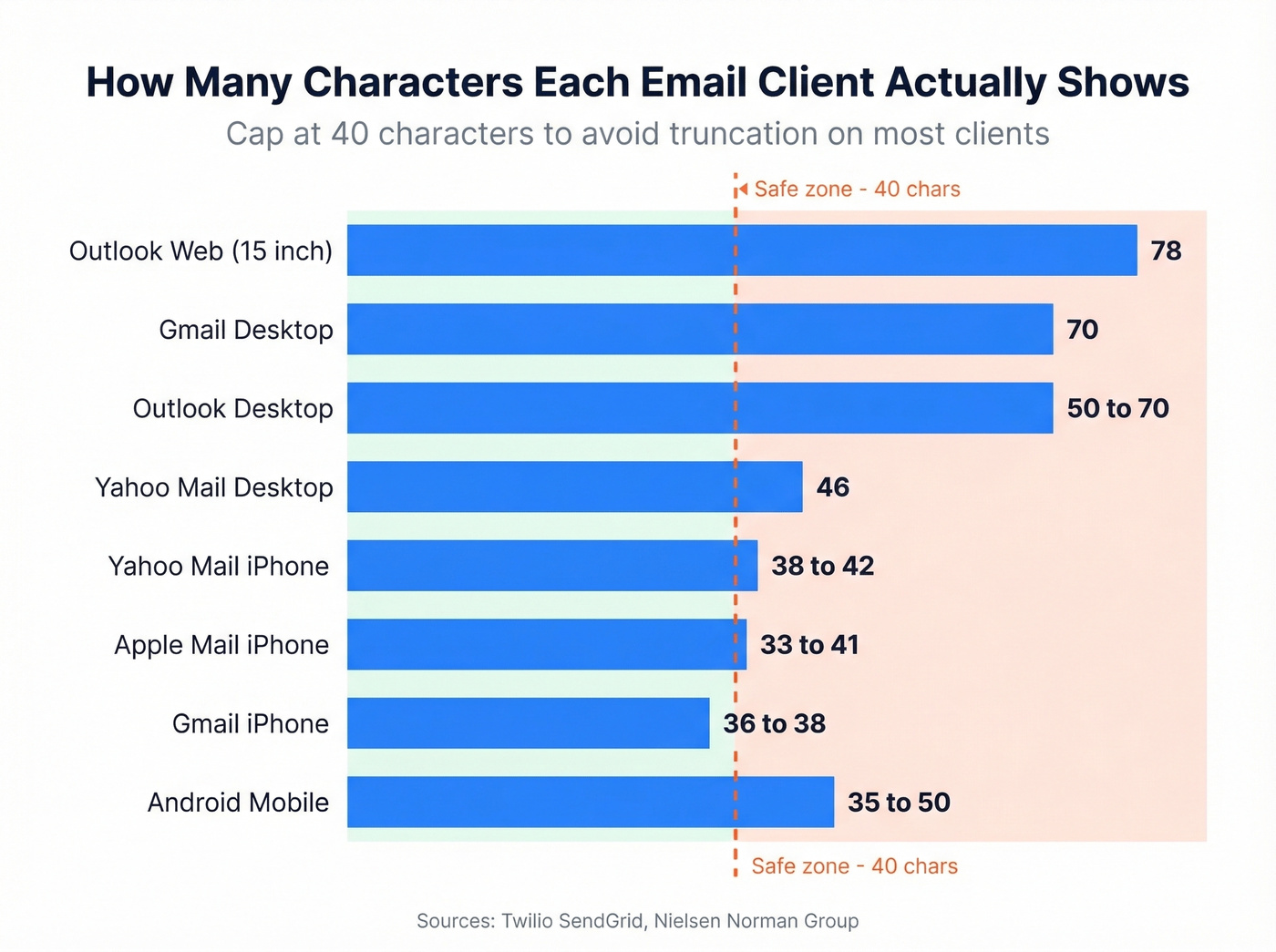
That said, truncation is real. Here's what each client actually displays:
| Email Client | Platform | Chars Shown |
|---|---|---|
| Gmail | Desktop | ~70 |
| Gmail | iPhone | ~36-38 |
| Outlook | Desktop | 50-70 |
| Outlook | Web (15") | ~78 |
| Yahoo Mail | Desktop | ~46 |
| Yahoo Mail | iPhone | ~38-42 |
| Apple Mail | iPhone | 33-41 |
| Android | Mobile | 35-50 |
Sources: Twilio SendGrid, Nielsen Norman Group.
Capping at roughly 40 characters avoids truncation across most clients. That's a reasonable guardrail, not a law. The real takeaway is simpler: front-load your key message. If the first three words don't earn the open, the rest won't save you - because on mobile, the rest might not even show up.
Crafting Subject Lines That Convert
Marketing Email Examples
Question-form subject lines dominated the dataset, so let's start there. These patterns consistently perform across marketing sends:
Questions: "Still thinking it over?" / "Ready for Q3?" / "What changed since Tuesday?"
Benefit-first: "Your pipeline report is ready" / "3 seats left at early pricing" / "New filters, same plan"
Curiosity gap: "This broke our dashboard" / "We almost didn't ship this" / "The metric nobody tracks"
Social proof: "How 50 SDRs hit quota" / "What 200 SDRs told us" / "Fastest-growing teams do this"
Notice what's missing: numbers in the subject line itself. The data says they slightly hurt. Use specifics in the body - keep the subject line human.
If you want more patterns to swipe, start with these subject line examples and adapt them to your audience.
Cold Email Examples
Cold email is a different animal. One SDR on r/b2bmarketing shared patterns that align with what we've seen work across dozens of outbound campaigns:
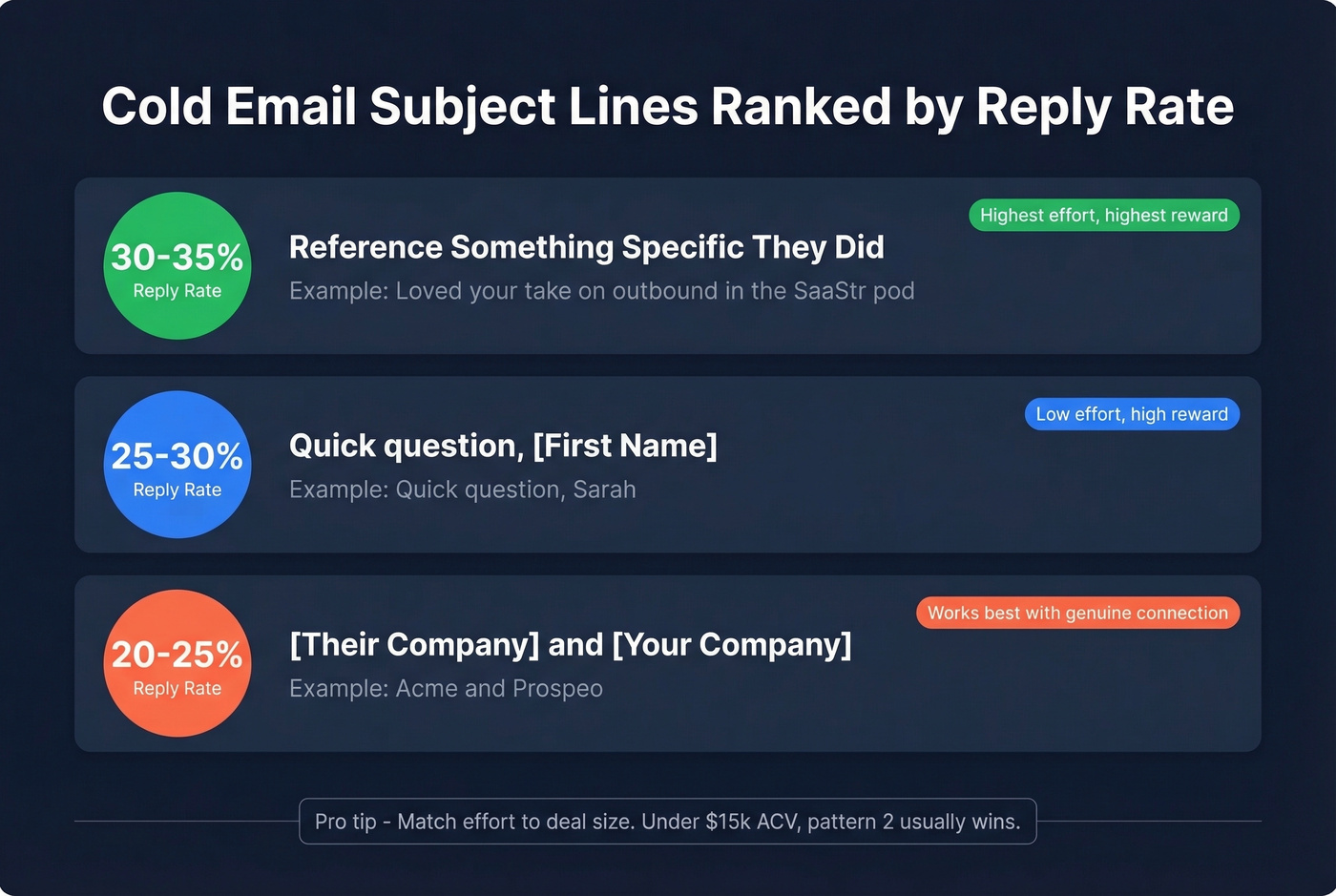
"[Specific thing they posted about]" - ~30-35% reply rate. This requires actual research. Reference a podcast appearance, a blog post, a company announcement. It's the highest-performing pattern because it proves you did the work.
"Quick question, [First Name]" - ~25-30% reply rate. One caveat: the email must contain a real question. If "quick question" opens a three-paragraph pitch, you've burned trust permanently.
"[Their Company] and [Your Company]" - ~20-25% reply rate. Works best when there's a genuine connection point - shared market, complementary product, mutual customer.
Timing matters too. Tuesday through Thursday, 9-11am in the recipient's timezone, consistently gets the most engagement. (If you want a deeper breakdown, see our data on the best time to send cold emails.)
One more thing: if your average deal size is under $15k, you probably don't need hyper-personalized subject lines referencing someone's podcast appearance. A clean "Quick question, Sarah" with a tight two-sentence email will outperform a researched subject line paired with a five-paragraph essay every time. Match your effort to your deal size.
If you're building a full outbound motion, pair these with a solid B2B cold email sequence and a few proven cold email follow-up templates.

Personalized subject lines lifted reply rates 133% in that 5.5M email study. But personalization starts before the copy - it starts with accurate data. Prospeo gives you 98% verified emails with 50+ data points per contact, so every subject line lands in a real inbox attached to the right person.
Stop writing perfect subject lines for dead addresses.
Mistakes That Kill Open Rates
Some subject line mistakes don't just hurt opens - they damage your sender reputation over time, compounding into a deliverability problem that no amount of copywriting can fix.
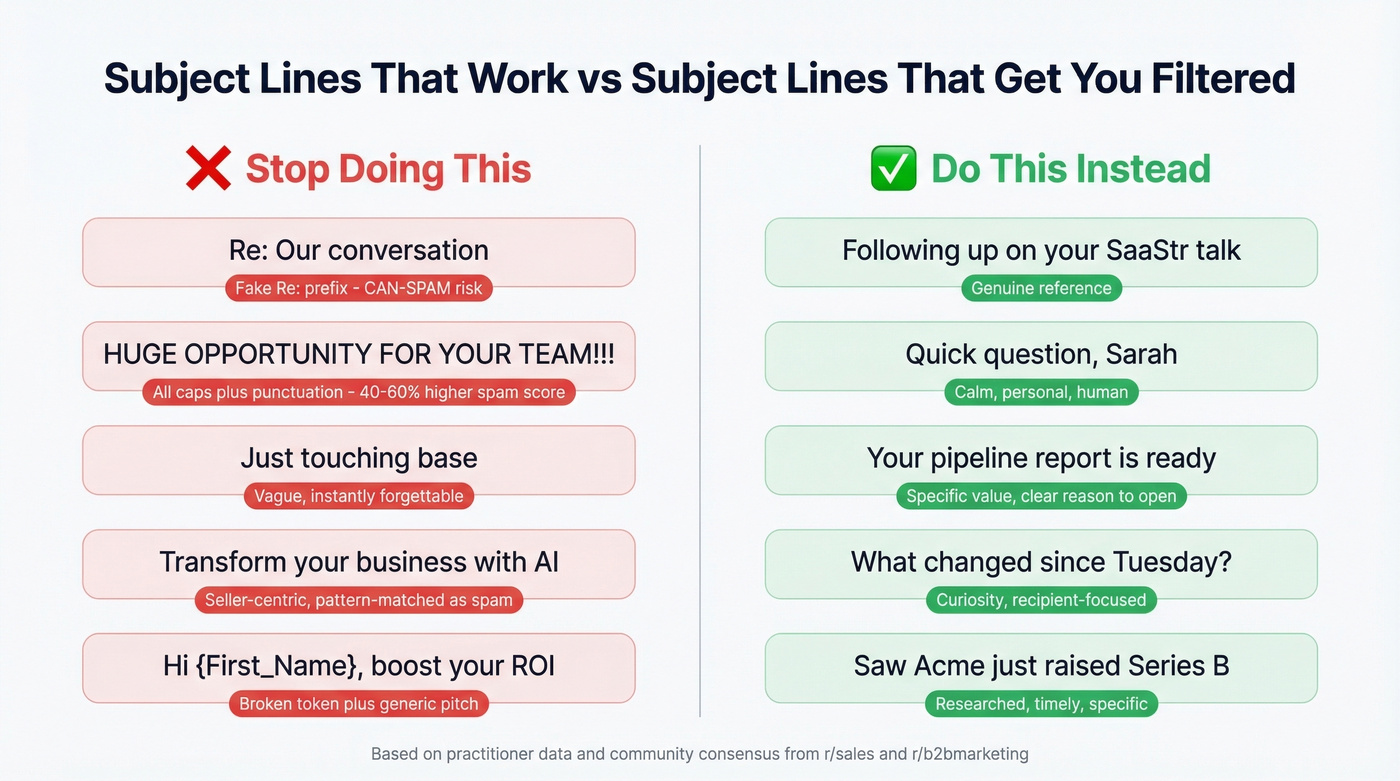
Fake "Re:" or "Fwd:" prefixes. This isn't just sleazy - it's a CAN-SPAM compliance risk. The law prohibits misleading subject headings. We've watched teams tank their domain reputation with this trick, and the recovery takes months.
ALL CAPS and excessive punctuation. A VerticalResponse analysis found that ALL CAPS combined with heavy punctuation increases spam scores by 40-60%. Your subject line screaming "HUGE OPPORTUNITY!!!" is going straight to junk.
Vague openers. "Touching base" and "Following up" tell the reader nothing. They're the email equivalent of a cold call that opens with "How are you today?" - instantly forgettable, instantly deleted. If you need better options, borrow a few lines from these sales follow-up templates.
Seller-centric framing. "Boost your ROI" and "Transform your business" get filtered by both spam algorithms and human pattern recognition. The consensus on r/sales is that these phrases are effectively invisible now - people's eyes slide right past them.
Broken personalization tokens. "Hi {First_Name}" is worse than no personalization at all. If you're running personalization, test your merge fields before every send. One broken token in a batch of 500 emails doesn't just look sloppy - it trains recipients to ignore you.
"Spam Trigger Words" Are Mostly a Myth
Every email marketing guide has a list of "words to avoid." Free. Urgent. Act now. Limited time. The problem? Modern spam filters don't work that way anymore.
Litmus reports that 70% of emails show at least one spam-related issue - but the issues that matter are sender reputation, authentication infrastructure, engagement signals, and list quality. Not whether you typed "discount" in the subject line. Gmail, Outlook, and Yahoo are looking at your domain history, your SPF/DKIM/DMARC setup, and whether recipients actually engage with your messages.
Here's the distinction that matters: deliverability is about reaching the inbox. Delivery is about not bouncing. You can have 100% delivery and still land in spam. If your bounce rate is above ~5%, your subject line is irrelevant - you've got an upstream data quality problem that needs fixing first. (For a full breakdown, see our email deliverability guide and how to improve sender reputation.)
The fastest way to improve email performance isn't rewriting your subject line - it's cleaning your list. Prospeo's 5-step verification process catches spam traps and honeypots with 98% accuracy, refreshing data every 7 days. Meritt went from a 35% bounce rate to under 4% after switching. That's not a subject line fix. That's a data quality fix that made every subject line they wrote actually reach someone.
The Metric That Actually Matters
Apple Mail accounts for 46% of email clients. Mail Privacy Protection pre-fetches tracking pixels regardless of whether the recipient opens the email. That means a huge chunk of your list is generating phantom opens.
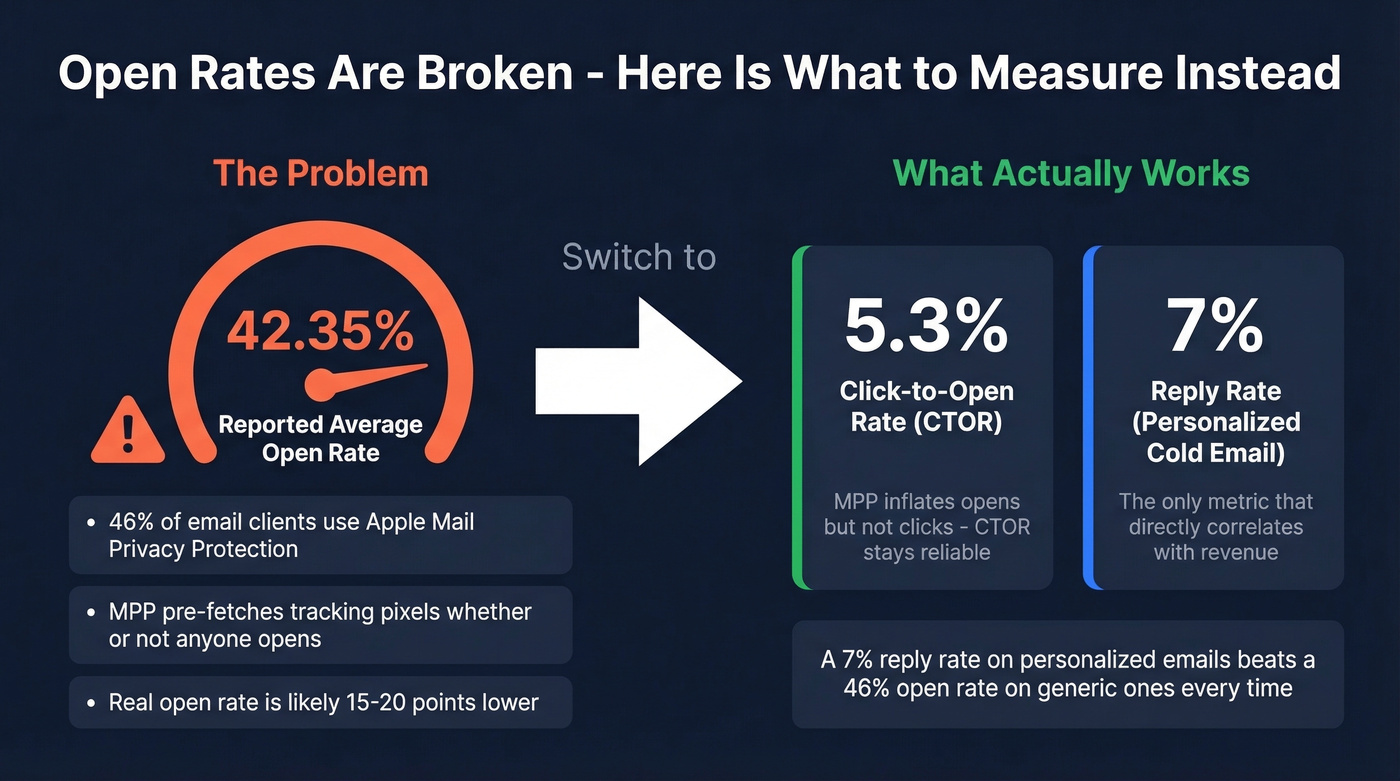
HubSpot's 2026 benchmark puts the average open rate at 42.35% - but that number is inflated by MPP. Your real open rate is often 15-20 points lower.
Click-to-open rate is a better indicator. The average CTOR sits at 5.3%, and MPP inflates opens, not clicks - so CTOR is far more reliable. (If you want to standardize reporting, use this click rate formula.) For cold email, reply rate is the only metric that matters. A 7% reply rate on personalized cold emails beats a 46% open rate on generic ones every day of the week.
A/B Testing Without Overthinking It
Most teams either don't test subject lines or test everything at once and learn nothing. Here's a framework that actually works:
Test one variable at a time. Length first, then personalization type, then format. Changing three things simultaneously tells you nothing.
Minimum ~1,000+ recipients per variant. Anything less and you're reading noise, not signal.
Measure CTOR or reply rate, not open rate. Opens are unreliable. Clicks and replies aren't.
Run for a full send cycle before calling a winner. If you send on Tuesdays and Thursdays, wait until both days have completed before comparing.
Document what you learn. The biggest waste in A/B testing isn't running bad tests - it's running good tests and forgetting the results three months later. We keep a shared spreadsheet with every test, the winner, and the margin. Boring? Sure. But it compounds.
Look, we've seen teams run 20 subject line tests before checking whether their send times, segmentation, or list hygiene were the actual problem. Fix the foundation first. Test the copy second. Knowing how to write email subject lines is only half the equation - the other half is making sure your testing infrastructure gives you trustworthy data. If you're scaling outbound, it also helps to align subject line tests with your broader sales prospecting techniques and personalized outreach.
Your subject line earns the open. Your list quality decides if it ever arrives. Teams using Prospeo cut bounce rates from 35%+ to under 4% - because every email is verified on a 7-day refresh cycle, not stale data from six weeks ago.
Fix the list before you fix the subject line.
FAQ
How long should an email subject line be?
Two to four words hit a 46% open rate in a 5.5-million-email study - the highest of any length tested. Cap at roughly 40 characters to avoid truncation on mobile clients. That said, length accounts for only 0.1% of open rate variance; what you say matters far more than character count.
Do emojis help email subject lines?
Emojis can lift open rates in B2C marketing emails when used sparingly - one per subject line, max. In cold B2B email, they tend to hurt credibility and can trigger spam filters on certain domains. Test with your specific audience before committing to them as a pattern.
How do I know if my emails are reaching the inbox?
Monitor bounce rates, spam complaints, and inbox placement - not just open rates, which Apple MPP inflates. If your bounce rate exceeds ~5%, verify your list before changing anything else. Real-time verification that catches invalid addresses, spam traps, and honeypots is the fastest fix.
What makes a good cold email subject line?
Personalization is the single biggest lever - use the recipient's name, reference something specific about their company, or ask a genuine question. Personalized subject lines drive a 133% increase in reply rates versus generic ones. Pair that with a clean, verified contact list and you've covered the two factors that matter most.