

How to Build a HubSpot Sales Pitch That Actually Converts
79% of buyers say most sales presentations are ineffective. Nearly four out of five pitches land flat. Meanwhile, 96% of prospects have already researched your company before you even open your mouth, which means the old "let me tell you about us" opener is dead on arrival. The question a lot of reps ask - "how do I actually build a HubSpot sales pitch that stands out?" - has a real answer. It starts with structure, not charisma.
Three Things That Separate Pitches That Convert
- A repeatable framework. HubSpot's 6-part structure (Problem → Value statement → How we do it → Proof points → Customer stories → Engaging question) gives every pitch a spine. Memorize it.
- Modern buyer context. Your prospect already knows what you sell. Your pitch needs to show you understand their problem, not recite your feature list.
- Clean data upstream. A brilliant email pitch means nothing if 20% of your sends bounce. Verify your list before you hit send.
What a Sales Pitch Means in 2026
HubSpot defines a sales pitch as a condensed sales presentation explaining the nature and benefits of your business - ideally delivered in under two minutes. The reality is messier than that.
71% of prospects prefer independent research over talking to a rep. Over 80% of B2B sales interactions now happen through digital channels, buyers use an average of 10 interaction channels (up from 5 in 2016), buying committees average 7 people at mid-sized firms, and 81% of revenue leaders say deals are more complex than ever. Buyers spend only 17% of their total buying time meeting with potential suppliers. Your pitch gets a sliver of their attention, not a stage.
Here's the disconnect that kills most reps: 84% of buyers expect salespeople to [act as trusted advisors](https://www.salesforce.com/news/stories/future-of-sales-research-2022/), but 59% say reps don't bother learning their specific challenges. Your pitch isn't a monologue anymore. It's a 60-second window to prove you've done your homework - delivered across email, video, calls, and chat. The reps who treat it like a performance lose. The ones who treat it like a conversation win.
HubSpot's 6-Step Pitch Framework
HubSpot's pitch-building framework breaks every pitch into six parts:
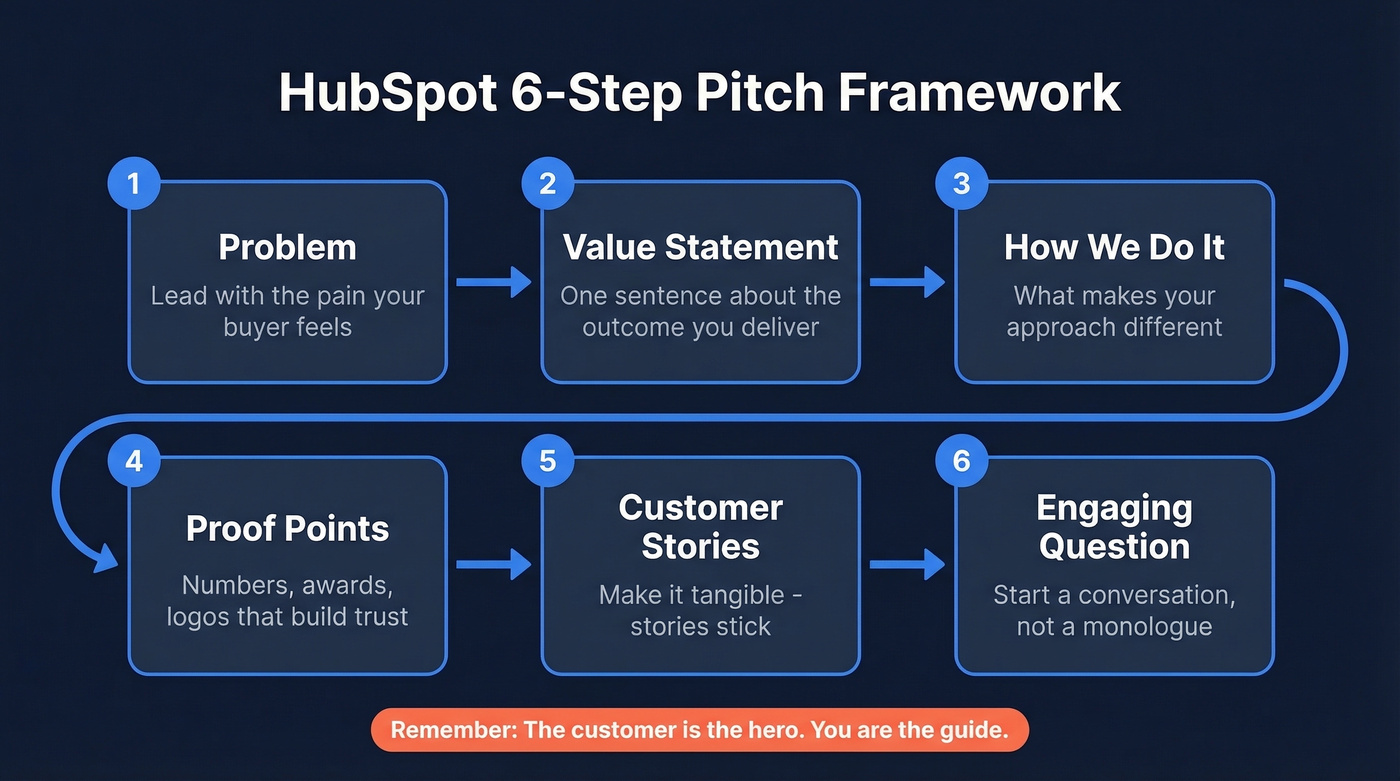
- Problem. Lead with the pain your buyer actually feels. "Your SDRs are spending hours a day on manual research instead of selling." A stat, a question, or a quick anecdote all work here. (If you need more ways to source pain fast, borrow from proven sales prospecting techniques.)
- Value statement. One clear sentence about the outcome you deliver - no jargon. "We cut that research time so reps spend their day in conversations."
- How we do it. What makes your approach different from the three competitors they've already evaluated? Be specific.
- Proof points. Numbers, awards, logos.
- Customer stories. Make it tangible. Stories stick where stats slide off.
- Engaging question. End with something open-ended that starts a conversation. "What would it mean for your team if reps got 2 hours back every day?"
HubSpot explicitly warns against becoming a "me monster" - making the pitch about your company instead of the buyer's world. The customer is the hero. You're the guide.
Full Pitch Example (60 Seconds)
Here's all six steps in a realistic cold call opener. Use this as a template and swap in your real details:
"When teams scale their SDR org, a common problem is reps losing hours a day to manual prospecting. [Problem] We help teams cut that time dramatically so reps spend more of the week in live conversations. [Value] The difference is we verify contacts in real time, so reps aren't chasing dead emails. [How we do it] For example, Meritt tripled weekly pipeline from $100K to $300K in 90 days. [Proof] And the story was simple: once deliverability stopped being a bottleneck, meetings started compounding. [Customer story] Worth a quick 15 minutes to see if the same approach fits your team?" [Engaging question]
That's the entire framework in under 60 seconds. Adapt the specifics, keep the skeleton.
Adapting by Channel
The framework stays the same; the delivery changes.
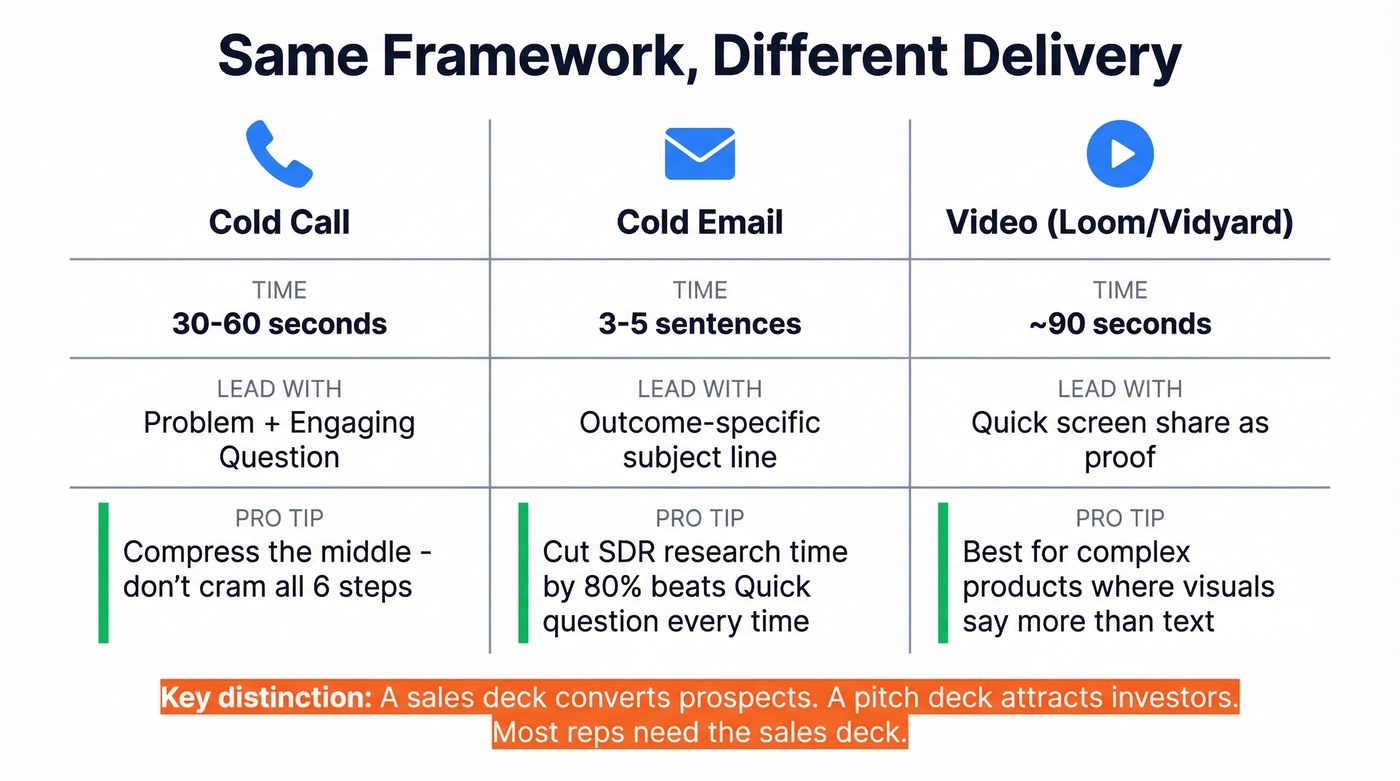
Cold call: You have 30-60 seconds. Lead with the problem and the engaging question, compress the middle. Don't try to cram all six steps into a voicemail - nobody listens that long. (If you're building a repeatable calling motion, use a cold calling system.)
Cold email: Three to five sentences max. Your subject line should point to a specific problem or outcome. "Cut SDR research time by 80%" beats "Quick question" every time. We've tested both, and outcome-specific subject lines consistently pull 2-3x the reply rate. (For more options, swipe from these cold email subject line examples.)
Video (Loom, Vidyard): You can stretch to ~90 seconds and show a quick screen share as your proof point. This works especially well for complex products where a visual demo says more than a paragraph of text. (If you're doing this at scale, see our Loom video cold email playbook.)
One thing worth clarifying: a sales deck converts prospects (challenges → solution → results). A pitch deck attracts investors (why invest?). Most reps need the sales deck. Don't confuse the two. (If you want to tighten the narrative, use these sales deck storytelling frameworks.)
The Problem-Insight-Solution Shortcut
If six steps feel heavy for a cold call, compress it. Name the problem, share an insight the buyer hasn't considered, then present your solution. Same logic, three moves. This works best for deals under $10K where you don't need to navigate a five-person buying committee.

A brilliant sales pitch means nothing if 20% of your emails bounce. Prospeo's 5-step verification delivers 98% email accuracy - refreshed every 7 days, not every 6 weeks. Meritt used it to triple pipeline from $100K to $300K/week while dropping bounce rates from 35% to under 4%.
Fix your data before you fix your pitch.
Pitch Mistakes That Kill Deals
Five mistakes we see repeatedly - and the one-line fix for each:
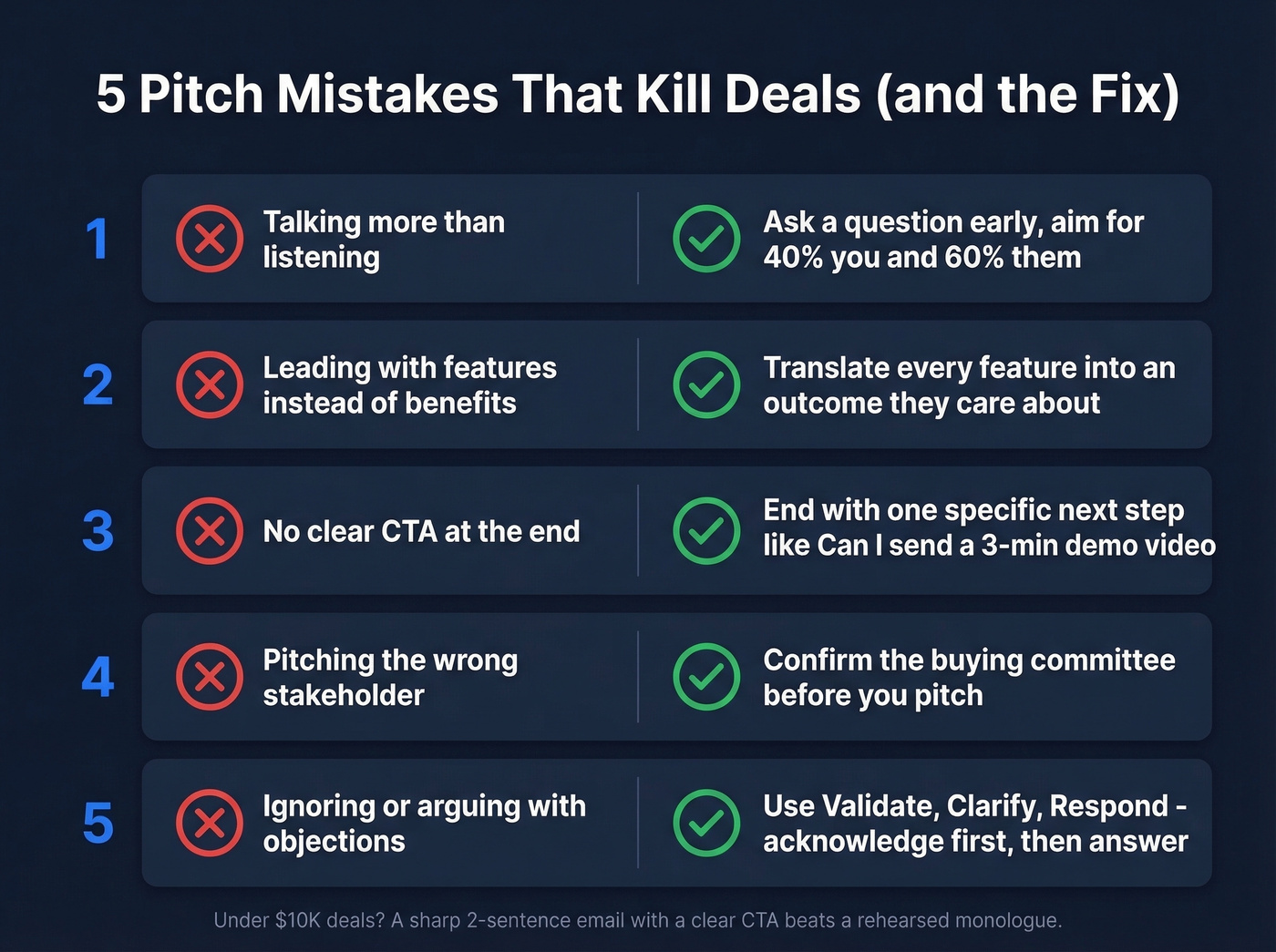
Talking more than listening. Ask a question early and let the prospect talk. The best pitches are 40% you, 60% them. (If you need better prompts, start with these discovery questions.)
Leading with features instead of benefits. Translate every feature into an outcome. "Real-time verification" becomes "your emails actually land."
No clear CTA. Every pitch ends with one specific next step. "Can I send a 3-minute demo video?" beats "let me know if you're interested." (More patterns here: email call to action.)
Pitching the wrong stakeholder. Confirm the buying committee before you pitch. A champion who can't sign is a dead end, and you'll burn weeks figuring that out the hard way. (This is where MEDDPICC economic buyer mapping helps.)
Ignoring objections. Use the Validate → Clarify → Respond framework. Acknowledge the concern, ask a clarifying question, then respond with a tailored proof point. Arguing kills deals.
Let's be honest: if your average deal size is under $10K, you probably don't need a polished 6-step pitch at all. A sharp two-sentence email with a clear CTA will outperform a rehearsed monologue every time. The framework matters most when deal complexity goes up and buying committees get bigger.
Using HubSpot Sales Hub for Repeatable Pitching
A great framework means nothing if every rep delivers it differently. Sales Hub turns your pitch into a system.
Email templates keep messaging consistent across the team. Sequences handle the multi-touch follow-up that reps always forget (or deprioritize when pipeline looks healthy). Snippets let you drop in industry-specific proof points without rewriting from scratch - build a library organized by vertical and deal size. (If you want plug-and-play follow-ups, use these sales follow-up templates.)
Meeting scheduling gives you a one-click CTA booking link, which removes the back-and-forth that kills momentum after a good pitch. And reporting dashboards are where you actually learn what works: which subject lines get opened, which CTAs get clicked, and which sequences book meetings.
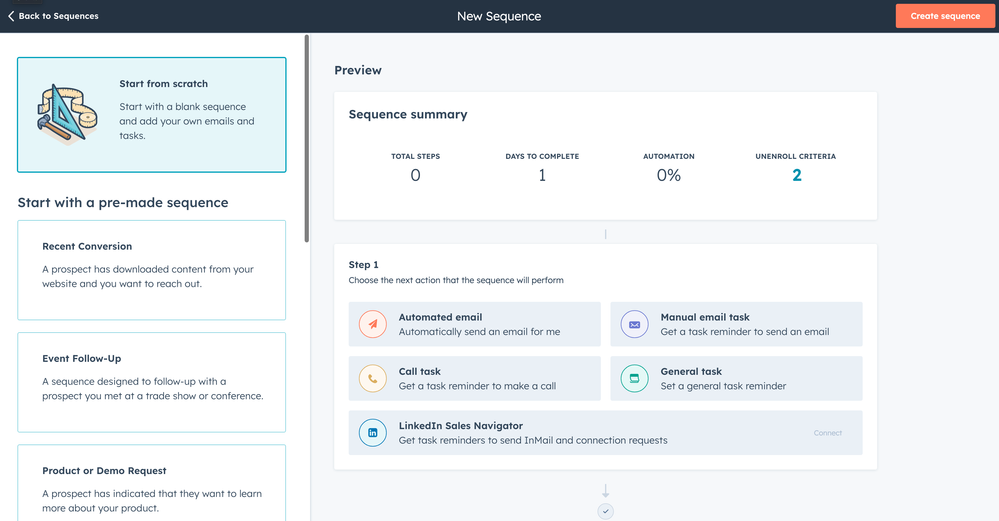
For larger teams, the Professional and Enterprise tiers add advanced automation and predictive lead scoring to prioritize the right accounts based on historical conversion patterns. (If you're formalizing this in RevOps, see our guide to lead scoring.)
| Tier | Cost | Best For |
|---|---|---|
| Free | $0 (2 seats) | Solo founders, tiny teams |
| Starter | $15/mo | SMBs running sequences |
| Professional | $90/seat + $1,500 onboarding | Mid-market, 10+ reps |
| Enterprise | $150/seat + $3,500 onboarding | Large orgs, AI scoring |
Pricing is from late 2025 - check HubSpot's pricing page for current numbers.
Skip the Enterprise tier unless you have 25+ reps and need predictive scoring. For most teams under 15 people, Starter or Professional covers everything you'll actually use.
Before You Pitch: Verify Your Data
You craft the perfect email pitch, load 200 prospects into a sequence, hit send - and 47 bounce. Your domain reputation takes a hit. 69% of cold email senders report performance declining year over year, and bad data is a massive driver of that decline.
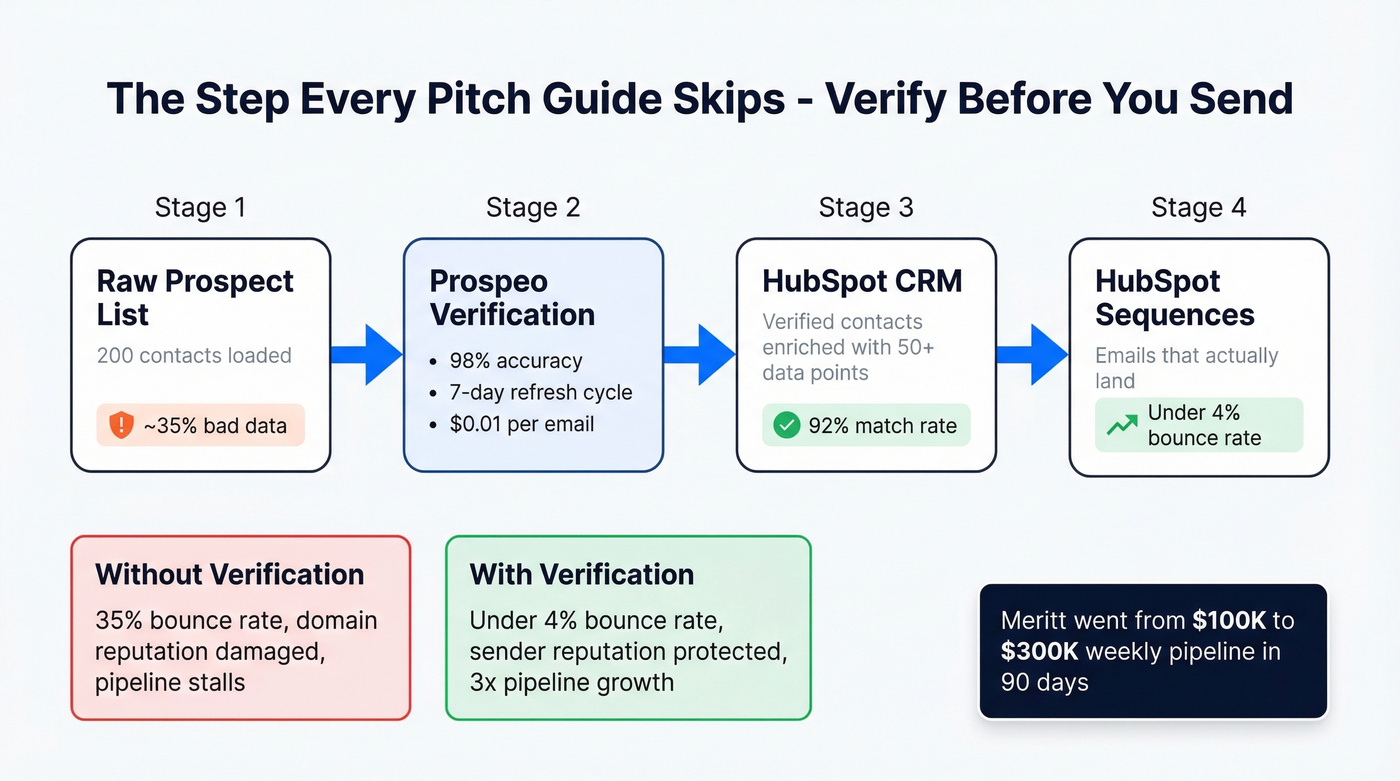
This is the upstream step every pitch guide skips. In our experience, the difference between a sequence that books meetings and one that tanks your sender reputation comes down to what happens before you write a single word of copy. (If you’re troubleshooting deliverability end-to-end, start with this email deliverability guide.)
Prospeo verifies emails at 98% accuracy with a 7-day refresh cycle and integrates directly with HubSpot, so verified contacts flow straight into your sequences. The free tier gives you 75 verified emails per month - enough to test before you commit. Meritt used this exact workflow and saw bounce rates drop from 35% to under 4% while tripling their weekly pipeline. (Benchmarks and fixes: email bounce rate.)
HubSpot sequences only work when contacts are real. Prospeo enriches your CRM with 50+ data points per contact at a 92% match rate - for roughly $0.01 per email. No contracts, no sales calls, integrates natively with HubSpot.
Stop pitching dead inboxes. Enrich your HubSpot contacts now.
FAQ
How long should a sales pitch be?
HubSpot recommends one to two minutes for verbal pitches. Email pitches should run three to five sentences max. The goal is to start a conversation, not close the deal in a single message. If you're going longer, you're monologuing.
What's the difference between a sales deck and a pitch deck?
A sales deck converts prospects by walking through challenges → solution → results. A pitch deck attracts investors by answering "why should I invest?" Most reps need a sales deck - don't model your prospect presentation after a fundraising deck.
How do I personalize a pitch for different industries?
Swap the problem statement and proof points, keep the structure identical. A pitch to a fintech CFO leads with compliance risk; the same pitch to a SaaS VP of Sales leads with pipeline velocity. Build a snippet library in HubSpot with industry-specific proof points so reps can swap them in without rewriting from scratch.
How do I keep email pitches from bouncing?
Use a verification tool before loading contacts into HubSpot sequences. Keeping bounce rates under 5% protects your sender reputation and ensures your pitch actually reaches inboxes. The consensus on r/coldemail is that anything above 5% bounce starts hurting deliverability fast - and once your domain's flagged, it's a long road back.