

Ice Breaker Sales Scripts: Data-Backed Openers for Every Channel
It's 9 AM. You've got 47 dials to make before lunch, a CRM full of names you half-recognize, and zero enthusiasm for "Hey, how's your day going?" The ice breaker sales opener you pick in the next three seconds determines whether you get 30 seconds of attention or a dial tone.
Most reps guess. The data says they're guessing wrong.
An analysis of 300M+ cold calls found that the most common opener - "Did I catch you at a bad time?" - is also the worst, with a 2.15% success rate. Meanwhile, 82% of buyers say they'll accept meetings from proactive outreach. The gap between those two numbers is the entire game.
What You Need (Quick Version)
You don't need 50 icebreakers. You need three - one per channel - and the discipline to personalize each in 15 seconds.
Cold call: Permission-based opener. "I know I'm calling out of the blue - do you have 30 seconds so I can tell you why?" That hits an 11.18% success rate in the 300M-call dataset.
Cold email: Lead with a specific trigger event and keep the body under 80 words. (If you want more ready-to-send options, use these sales follow-up templates to keep momentum after the first touch.)
LinkedIn: Commonality-based connection request, under 300 characters. Shared industry, mutual connection, or something they published.
None of this works if your contact data is stale. A perfect opener sent to a dead email or disconnected number is just wasted craft - especially if you’re not using data enrichment services to keep records current.
What Makes an Opener Work
Most sales training overcomplicates this. Three principles separate openers that book meetings from openers that get hung up on.
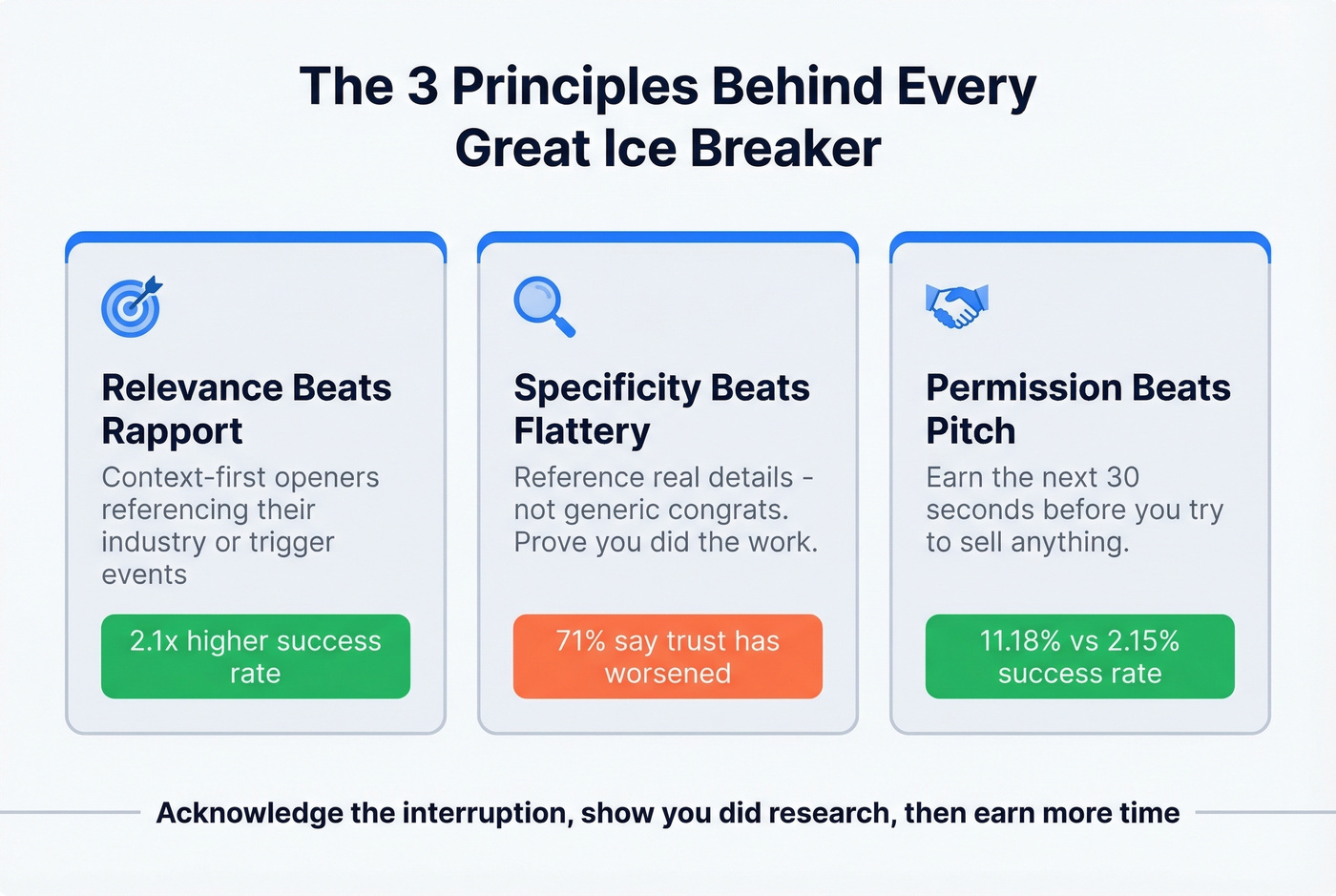
Relevance beats rapport. Nobody wants to talk about the weather with a stranger who's about to pitch them. Context-first openers - referencing their industry, a recent trigger event, or a peer who's using your product - outperform generic rapport-building every time. Stating your reason for calling yields a 2.1x higher success rate than diving into small talk. (This is a core idea in data-driven selling.)
Specificity beats flattery. "Congrats on the funding!" is noise. "Saw you closed $12M from Sequoia - guessing the next hire is a VP of Sales?" is a conversation. Seventy-one percent of Americans say interpersonal trust has worsened over the past two decades. Vague flattery triggers that distrust. Specificity signals you did the work.
Permission beats pitch. Earn the next 30 seconds before you try to sell anything. The permission-based opener works because it acknowledges reality - you're interrupting someone's day - and gives them agency. That tiny act of respect is what separates an 11.18% success rate from a 2.15% one.
Cold Call Openers (With Success Rates)
The Rankings
Here's what the 300M-call dataset actually says. These aren't opinions.
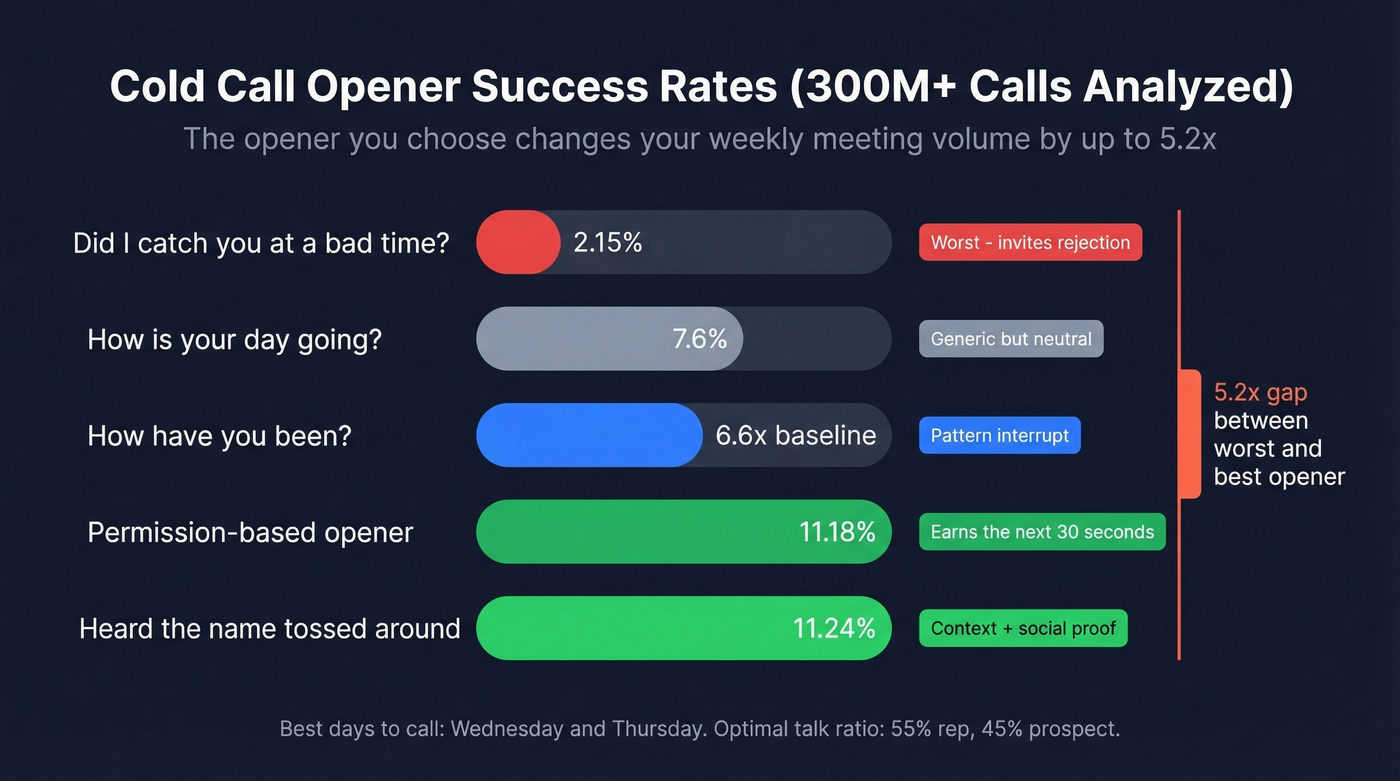
| Opener | Success Rate | Why It Works (or Doesn't) |
|---|---|---|
| "Did I catch you at a bad time?" | 2.15% | Invites rejection (-40%) |
| "How've you been?" | 6.6x baseline | Pattern interrupt |
| "How's your day going?" | 7.6% | Neutral but generic |
| Permission-based opener | 11.18% | Earns next 30 seconds |
| "Heard the name tossed around" | 11.24% | Context + social proof |
The gap between worst and best is about 5.2x. That's not marginal - it changes your weekly meeting volume.
A few more benchmarks worth knowing: successful cold calls have reps talking about 55% of the time (not more), the best days to call are Wednesday and Thursday based on analysis of 110K+ calls, and monologues on successful calls run 53 seconds versus 25 seconds on unsuccessful ones. Longer monologues work, but only when you've earned the right to deliver them. (If you’re building a repeatable motion, see this cold calling system.)
Personalized Cold Call Scripts
Permission-based: "Hey [Name], I know I'm calling out of the blue. Do you have 30 seconds so I can tell you why, and you can decide if it's worth continuing?" Use this as your default. It works across industries, and we've seen it consistently outperform everything else in our team's testing.
Pattern interrupt: "Hey [Name], how've you been?" This one feels weird - you don't know them. That's the point. It breaks the "sales call" pattern and gets a real response instead of an automatic brush-off.
Now picture this: you're calling a VP of Sales who just posted about hiring challenges on social media. Instead of a generic opener, you go with - "Hey Sarah, saw you're scaling the team in EMEA. I've been talking to a few VPs dealing with the same pipeline gap when they expand internationally. Wanted to see if that's on your radar." That's the context-first approach, and it works best when you've done 60 seconds of research beforehand. A personalized opening like this outperforms any template because it proves you understand their world before you ask for anything. (More ways to do this consistently: sales prospecting techniques.)
Referral-based: "[Mutual connection] mentioned you're the person to talk to about [topic]. Got a quick minute?" Referral openers consistently outperform cold openers. Even a loose connection helps.
Reason-stated: "Hey [Name], I'm calling because [one-sentence reason tied to their world]. Does that resonate, or am I off base?" Stating the reason immediately drives a 2.1x higher success rate - don't bury it.
Cold Email Icebreakers
The Constraints That Matter
Keep subject lines at seven words or fewer. Keep the body under 80 words - elite performers who stick to that length can exceed 10% reply rates. Maintain a 1:2 ratio of "I/my" to "you/your." The email is about them, not you. (For more tested options, pull from these cold email subject line examples.)
Don't ask for a meeting in email one. Personalize with something specific: personalized cold emails get 29% higher open rates, but only when the personalization is real, not a mail-merge token. You've got about six seconds once someone opens your email. The first line is the entire audition. (If you’re scaling outreach, this AI cold email outreach playbook can help you keep quality high.)
Strong vs. Weak First Lines
Weak: "Congrats on the recent funding round!" Strong: "Saw you closed $18M from a16z - guessing scaling the SDR team is next on the list."
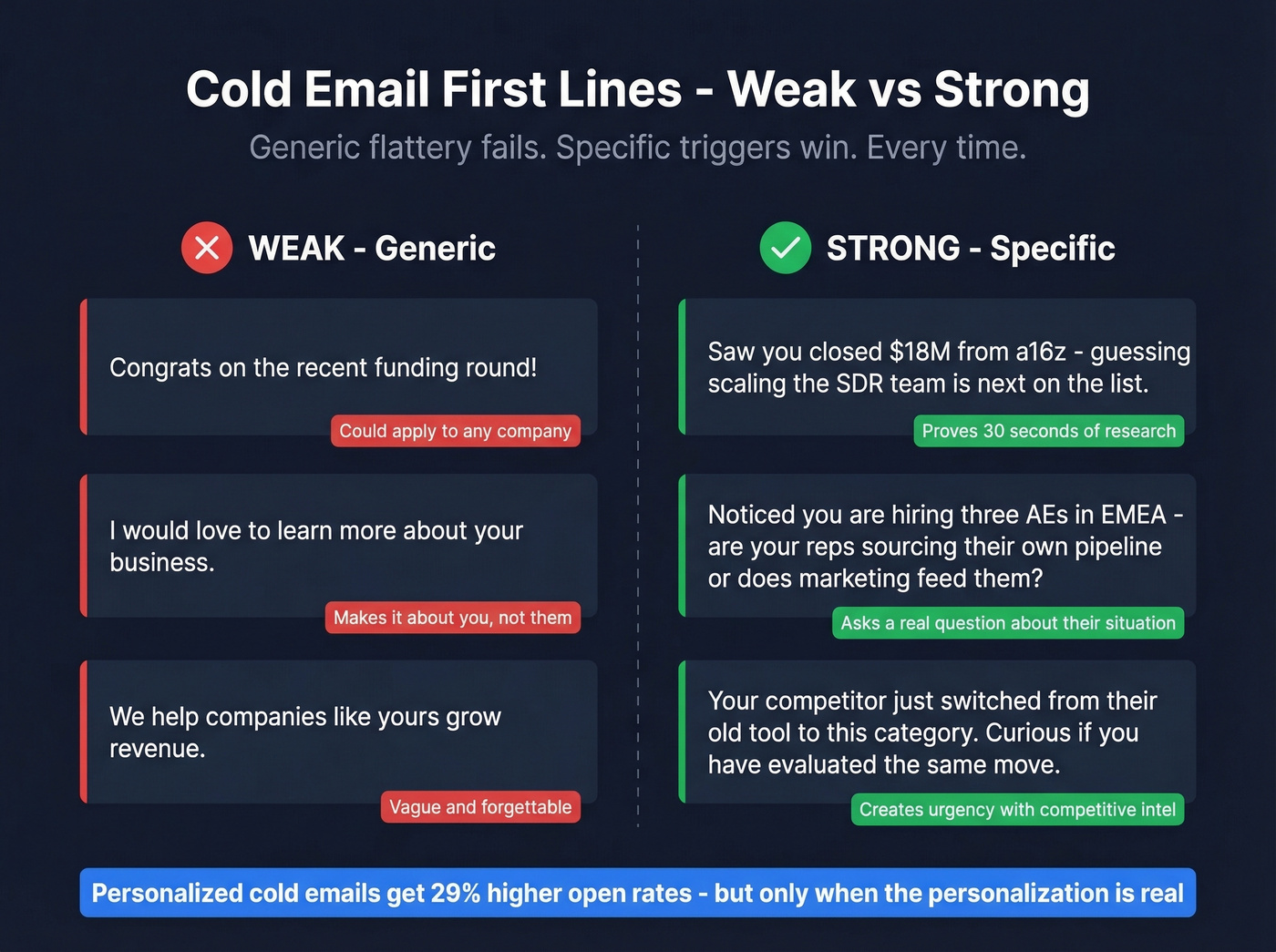
The weak version could apply to any funded company. The strong version proves you spent 30 seconds on their Crunchbase page. That specificity is what earns the next sentence.
Weak: "I'd love to learn more about your business." Strong: "Noticed you're hiring three AEs in EMEA - are your current reps sourcing their own pipeline, or does marketing feed them?"
Weak: "We help companies like yours grow revenue." Strong: "Your competitor [X] just switched from [old tool] to [your category]. Curious if you've evaluated the same move."
The pattern is consistent: generic flattery fails, specific triggers win. Every strong first line references something the prospect actually did, said, or is experiencing right now.

A perfect ice breaker sent to a dead email or disconnected number is wasted craft. Prospeo gives you 98% verified emails and 125M+ direct dials with a 30% pickup rate - so your best openers actually reach real people.
Stop perfecting scripts for contacts that don't exist anymore.
LinkedIn Icebreakers
LinkedIn's Hard Limits
Connection request notes max out at 300 characters. InMail bodies cap at 2,000 characters. But here's the number that matters: messages under 600 characters are 50% more likely to get a response.
Shorter wins. And the cardinal rule: don't sell in the connection request. The connection request is about getting accepted. The selling happens after. (If you’re running multi-touch, sequence management matters more than most teams think.)
Templates That Get Accepted
Testing over 1M+ invite messages consistently shows 65%+ connection rates using commonality-based approaches. Here's what that looks like in practice.
For a shared industry connection: "Hey [Name] - fellow [industry] person here. Been following how [their company] is approaching [trend]. Would love to connect." For a mutual connection: "[Mutual name] and I were just talking about [topic]. Your name came up. Would be great to connect." Both work because they answer the prospect's first question - "Why should I accept this?"
If you've engaged with their content, say so directly. "Your take on [specific post topic] was sharp - especially the point about [detail]. Connecting to follow more of your thinking."
For role similarity: "Running [similar function] at [your company] - always good to compare notes with someone doing the same at [their company]." Every template leads with what you have in common, not what you want to sell. The pitch comes later, in a follow-up message, after they've accepted.
Skip the LinkedIn icebreaker entirely if you can't find a single piece of commonality. A blank connection request actually outperforms a generic one that screams "I'm about to pitch you."
Meeting and Discovery Openers
Once you've booked the meeting, the icebreaker game changes. You're no longer fighting for attention - you're setting the tone for a real conversation. (If you want a tighter structure, use these discovery questions to guide the conversation.)
Agenda-setting opener: "I've got a few things I'd love to cover, but before that - what would make this a great use of your 30 minutes?" This immediately flips the dynamic. You're not pitching; you're collaborating.
Research-based opener: "I spent some time on your [recent initiative/announcement]. Before I make assumptions, can you walk me through what's driving that?"
Here's how the honest opener sounds in practice:
Rep: "I'll be upfront - I don't know enough about your situation yet to know if we're a fit. Can I ask a few questions to figure that out?" Prospect: "Sure, go ahead." Rep: "Great. What's the biggest bottleneck in your outbound right now - is it pipeline volume, conversion, or something else?"
That candor disarms the buyer's natural defensiveness faster than any rehearsed pitch.
Mistakes That Kill Deals
The data on what not to do is just as useful as the scripts. These come from analysis of 1M+ B2B sales calls, and I've watched reps make every single one of them.
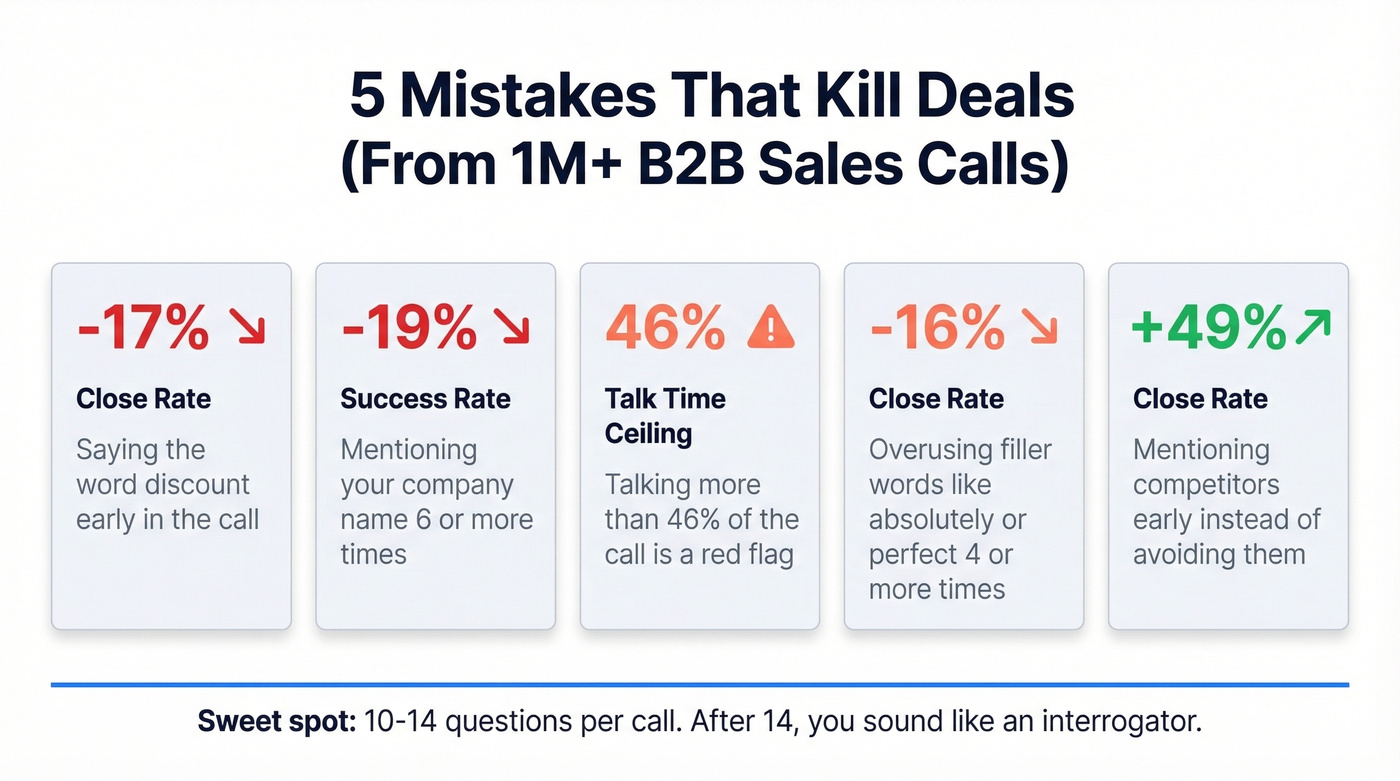
Saying "discount" early drops your close rate by 17%. It signals desperation before you've established value. Mentioning your company name six or more times decreases success by 19% - you're there to talk about their problems, not your brand.
Talking more than 46% of the time is a red flag. Top reps listen more than they speak. Mid-performers talk up to 68% of the call, and it shows in their numbers. The sweet spot for questions is 10-14 per call; after 14, returns diminish and you start sounding like an interrogator.
Two more that are easy to fix: overusing filler affirmations like "absolutely" or "perfect" four or more times drops close rates by 16%, and waiting to mention competition is a mistake - bringing up competitors early increases close chances by 49% versus mentioning them late. Don't avoid the elephant in the room.
Most of these mistakes happen because reps are nervous and fall back on autopilot. The fix isn't more scripts - it's fewer scripts and more genuine curiosity about the person on the other end. (If you want a broader skill stack, start with sales communication.)
Let's be honest: if your average deal size is under $10K, you probably don't need a 47-step multi-channel sequence with AI-generated personalization. You need three solid openers, clean contact data, and the willingness to actually listen when someone picks up.
Good Scripts Need Good Data
You can spend 20 minutes researching a prospect, craft a perfect context-first opener, dial the number - and it's disconnected. We've all been there. B2B contact data decays at roughly 2.1% per month, which means about 22.5% of your database goes stale every year. Reps lose 27.3% of their productive time to bad data, and that's time you can't get back. (If you’re fixing your stack, compare options in best contact management software.)
Your ice breaker sales strategy gets one shot. Make sure it reaches a real person. Prospeo gives you access to 143M+ verified emails on a 7-day refresh cycle with 98% email accuracy, plus 125M+ verified mobile numbers that hit a 30% pickup rate. Search by 30+ filters, export verified contacts, and push them straight into your outbound tools via native integrations with HubSpot, Salesforce, Instantly, Lemlist, or through Zapier and Make.
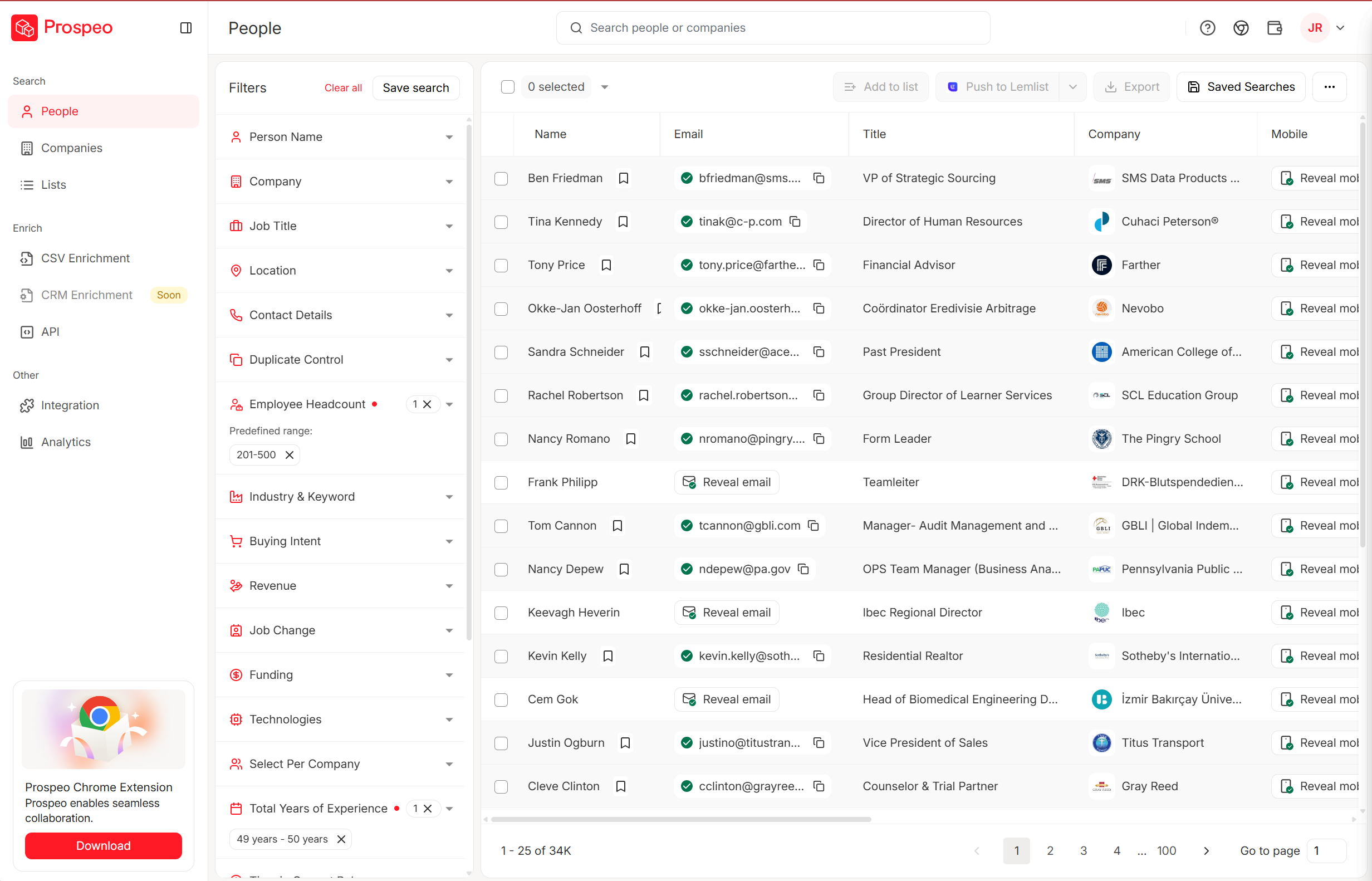
Specific openers need specific data. Prospeo's 30+ search filters - including job changes, funding events, and headcount growth - give you the trigger events that turn generic icebreakers into 11%+ success rate openers. All refreshed every 7 days.
Turn every cold call into a context-rich conversation for $0.01 per lead.
FAQ
What's the best ice breaker for sales calls?
Permission-based openers hit 11.18% success rates across 300M+ analyzed cold calls. "I know I'm calling out of the blue - do you have 30 seconds?" works because it acknowledges the interruption and earns attention. State your reason for calling immediately after - that alone drives a 2.1x higher success rate.
How long should a cold email be?
Under 80 words. Elite performers keep messages short, specific, and focused on one idea - and can exceed 10% reply rates. Lead with a relevant trigger event that proves you did your homework. Personalized emails get 29% higher open rates, but only when the personalization references something specific.
How do I make sure my opener reaches the right prospect?
B2B contact data decays at 22.5% per year - roughly one in five contacts in your CRM is already stale. Use a verified data source with a weekly refresh cycle and 98%+ email accuracy. Prospeo refreshes records every 7 days versus the 6-week industry average and verifies both emails and mobile numbers so your carefully crafted opener doesn't bounce or hit a disconnected line.
What's a good universal icebreaker for any sales channel?
Lead with a specific observation about the prospect's business, then ask a question. "Noticed [specific thing] - curious how you're handling [related challenge]?" works across calls, emails, and LinkedIn because it proves relevance in one sentence. Pair it with verified contact data so the message actually lands.