

Ideal Account Profile: The Scoring System Your ICP Is Missing
Your SDR has 200 accounts to work this month. She books 8 meetings - six from the same 30 accounts. The other 170? Noise.
An ideal account profile isn't a paragraph on a strategy slide. It's a scoring system that tells your team exactly which accounts deserve time and which ones don't. It takes your ICP - the firmographics, technographics, intent signals, buying committee structure, and disqualification criteria - and scores everything on a 100-point scale so every account gets a tier and reps know who to call first.
What Is an Ideal Account Profile?
Most teams have an ICP. Few have one that works in production. An ICP is a blueprint: a description of the company most likely to buy and stay. An ideal account profile takes that blueprint and adds buying readiness signals, scoring weights, and tier thresholds so it becomes something your team can actually execute against.
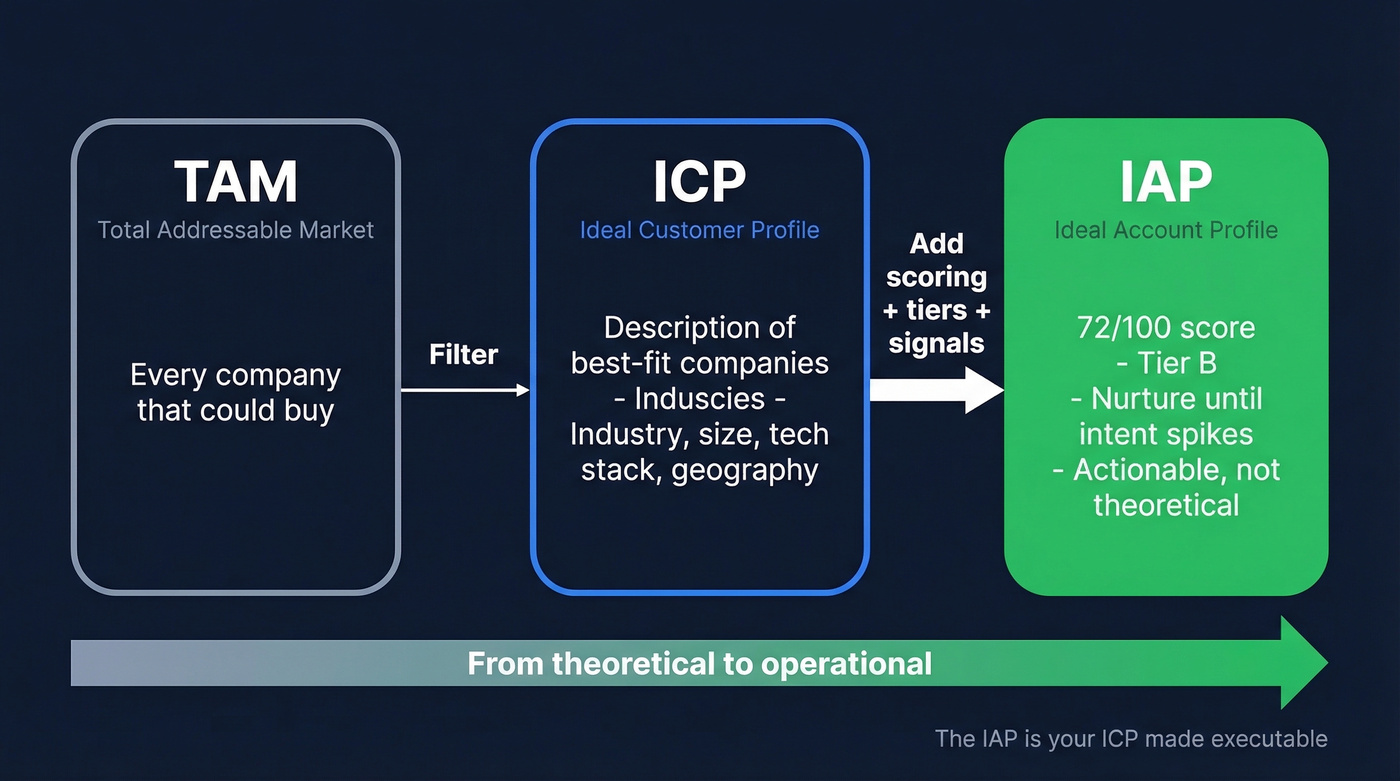
Here's the difference in practice. Your ICP says "mid-market SaaS companies with 200-1,000 employees using Salesforce." Your IAP says that account scores 72 out of 100, sits in Tier B, and should get nurture sequences until intent spikes. One is a definition. The other is a system.
Gartner's framework draws the line clearly: your ICP describes the account, buyer personas describe the individuals inside it, and your TAM is every possible company that could buy. An IAP lives at the account level - not the person level, not the market level. The goal is to build a prioritized list your team can run against, not a theoretical description that sits in a deck nobody opens.
What to Include in Your Profile
A profile without a scoring rubric is just a wish list. Here's what belongs in yours, building on Gartner's attribute taxonomy and adding operational fields most teams miss:
- Firmographics - Industry, company size, geography, growth stage, business model. The baseline filter most teams already have.
- Technographics - CRM platform, marketing automation, sales engagement tools, data stack. If your product integrates with Salesforce but the account runs HubSpot, that's a scoring factor, not a footnote.
- Intent signals and trigger events - Pricing page visits, review-site research activity on G2, content engagement, funding rounds, hiring surges. ZoomInfo's three-layer model of firmographics + technographics + intent is a useful mental framework here.
- Buying committee structure - B2B buying committees average five decision makers. Define the roles you need access to: champion, economic buyer, technical evaluator, end user, blocker.
- Psychographics and business situation - Risk tolerance, innovation appetite, regulatory environment. Harder to quantify, but these separate good-fit accounts from great ones.
- Disqualification criteria - The piece most teams skip entirely. Build a "non-ICP" list: incompatible tech stack, revenue below threshold, industries with historically low adoption. Knowing who not to pursue saves more time than knowing who to pursue.
How to Build One
1. Mine your closed-won deals. Pull 50-100 closed-won accounts from the last 12 months. Tag every attribute: industry, size, tech stack, deal size, sales cycle length, retention rate. The patterns emerge fast.
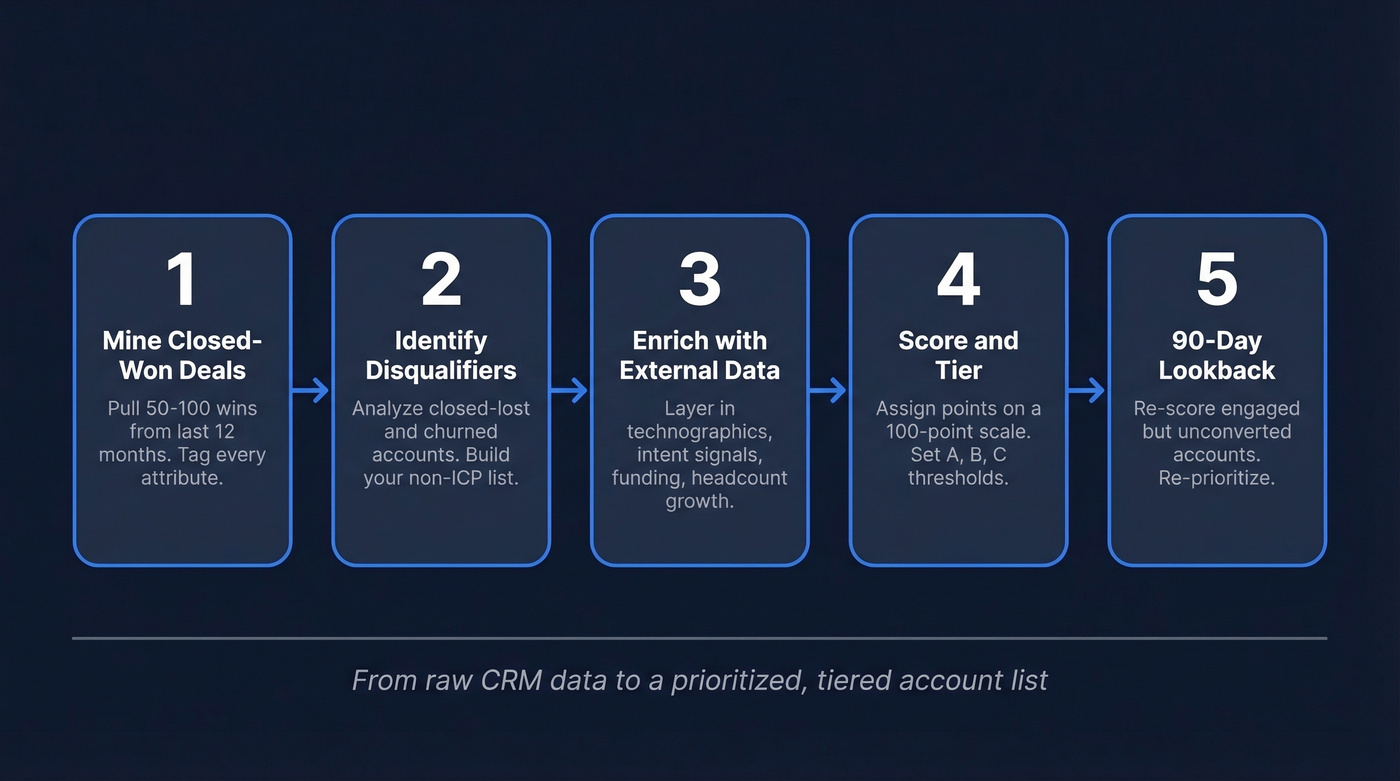
2. Identify your disqualifiers. Look at closed-lost and churned accounts with the same rigor. What do they share? Incompatible infrastructure? Wrong growth stage? Build your "non-ICP" list from real losses, not assumptions.
3. Enrich with external data. Your CRM tells you what happened. External data tells you what's happening now. Prospeo's 30+ search filters cover buyer intent across 15,000 topics, technographics, job changes, headcount growth by department, funding, and revenue - so you can find accounts matching your profile and pull verified contacts at those accounts. Data refreshes every 7 days, which means you're never scoring against stale information.

4. Score and tier. Assign point values to each attribute using the template below. Set tier thresholds: A, B, and C. Every account gets a number and a tier.
5. Apply the 90-day lookback. Check your CRM and website analytics for accounts that engaged in the last 90 days but didn't convert. These are warm accounts that were likely misrouted or undertouched. Score them against your new profile and re-prioritize.

Your ideal account profile needs fresh data to score against. Prospeo refreshes 300M+ profiles every 7 days - not every 6 weeks - so your firmographic, technographic, and intent scores reflect reality, not last quarter's snapshot.
Stop scoring accounts against stale data. Start with a free search.
Account Scoring Template
Most ICP guides stop at "define your profile." They never tell you how to rank accounts against it. That's the gap. A 100-point scoring rubric closes it.
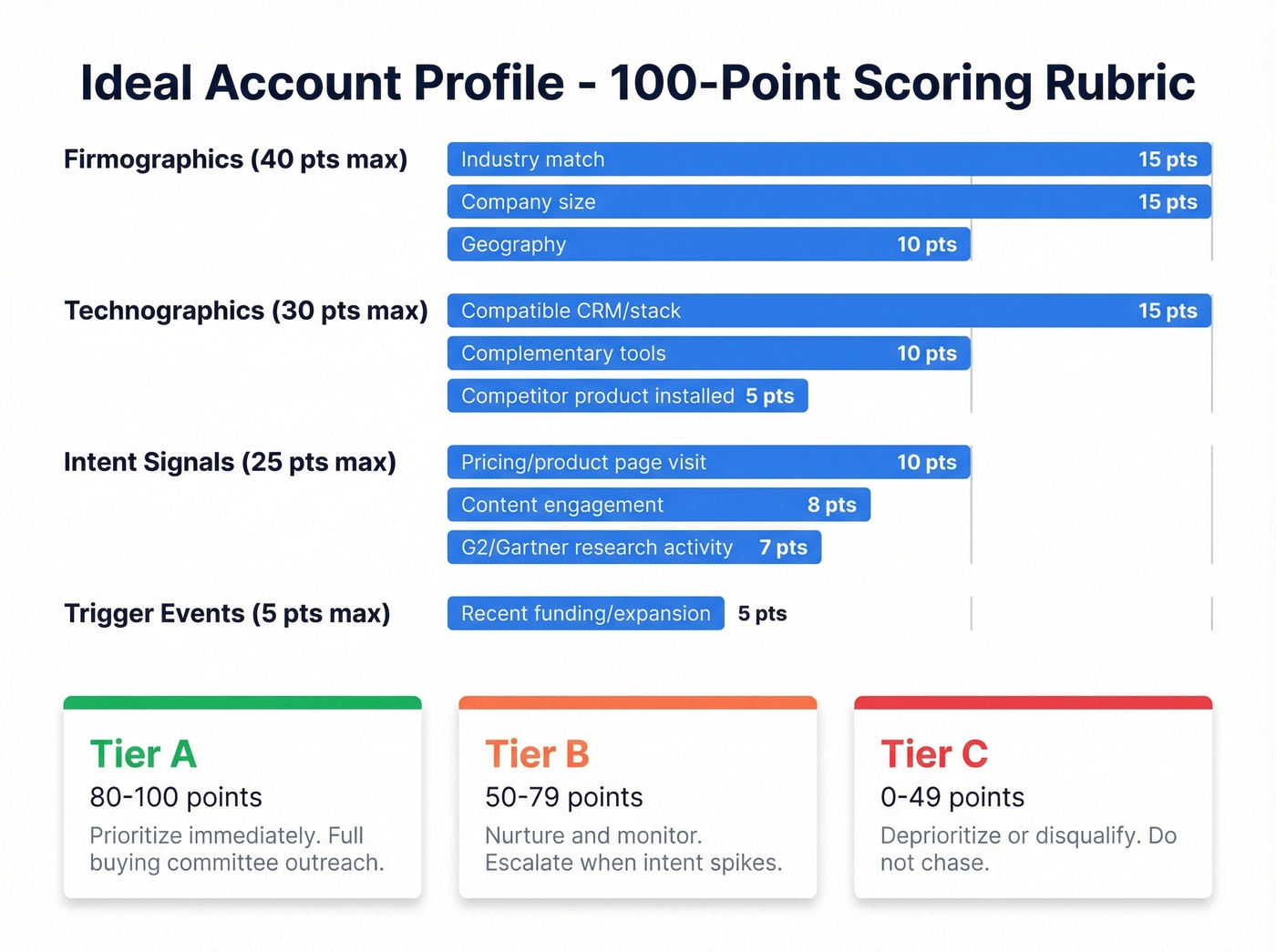
| Category | Attribute | Max Points |
|---|---|---|
| Firmographics | Industry match | 15 |
| Firmographics | Company size | 15 |
| Firmographics | Geography | 10 |
| Technographics | Compatible CRM/stack | 15 |
| Technographics | Complementary tools | 10 |
| Technographics | Competitor product installed | 5 |
| Intent | Pricing/product page visit | 10 |
| Intent | Content engagement | 8 |
| Intent | G2/Gartner research activity | 7 |
| Trigger events | Recent funding/expansion | 5 |
| Total | 100 |
Tier A (80-100): Prioritize immediately. Full buying committee outreach, personalized plays, dedicated AE ownership. In our experience, these top-tier accounts close at 1.5-2x the rate of Tier B with cycle times 15-20% shorter. If you need a repeatable outbound motion for these accounts, borrow from account-based selling best practices.
Tier B (50-79): Nurture and monitor. Automated sequences, intent-triggered alerts, periodic check-ins. When intent spikes, escalate to Tier A treatment. Tighten your sequence management so Tier B doesn't become a graveyard.
Tier C (0-49): Deprioritize or disqualify. Don't waste outbound cycles here. If they inbound, great - but don't chase them.
Validate quarterly. Compare win rates, deal sizes, and cycle times by tier. If Tier B is outperforming Tier A, your weights are wrong.
Here's the thing: most teams agonize over getting the weights perfect on day one. Don't. A rough scoring model applied consistently beats a perfect model that lives in a spreadsheet nobody opens. Ship it, measure for 90 days, then recalibrate.
You've defined your tiers. Now fill them. Prospeo's B2B database lets you filter by buyer intent across 15,000 topics, tech stack, headcount growth, funding, and 25+ more attributes - then pulls verified emails at 98% accuracy for $0.01 each.
Turn your 100-point scoring rubric into a pipeline today.
Operationalize and Measure
A scoring rubric sitting in a spreadsheet isn't operational. You need three layers working together: ICP fit scoring as a baseline filter, intent scoring to gauge whether they're in-market right now, and engagement scoring to track whether they've interacted with your brand. When all three converge on the same account, move fast. (If your team is still scoring people instead of accounts, start with lead scoring and then level up.)
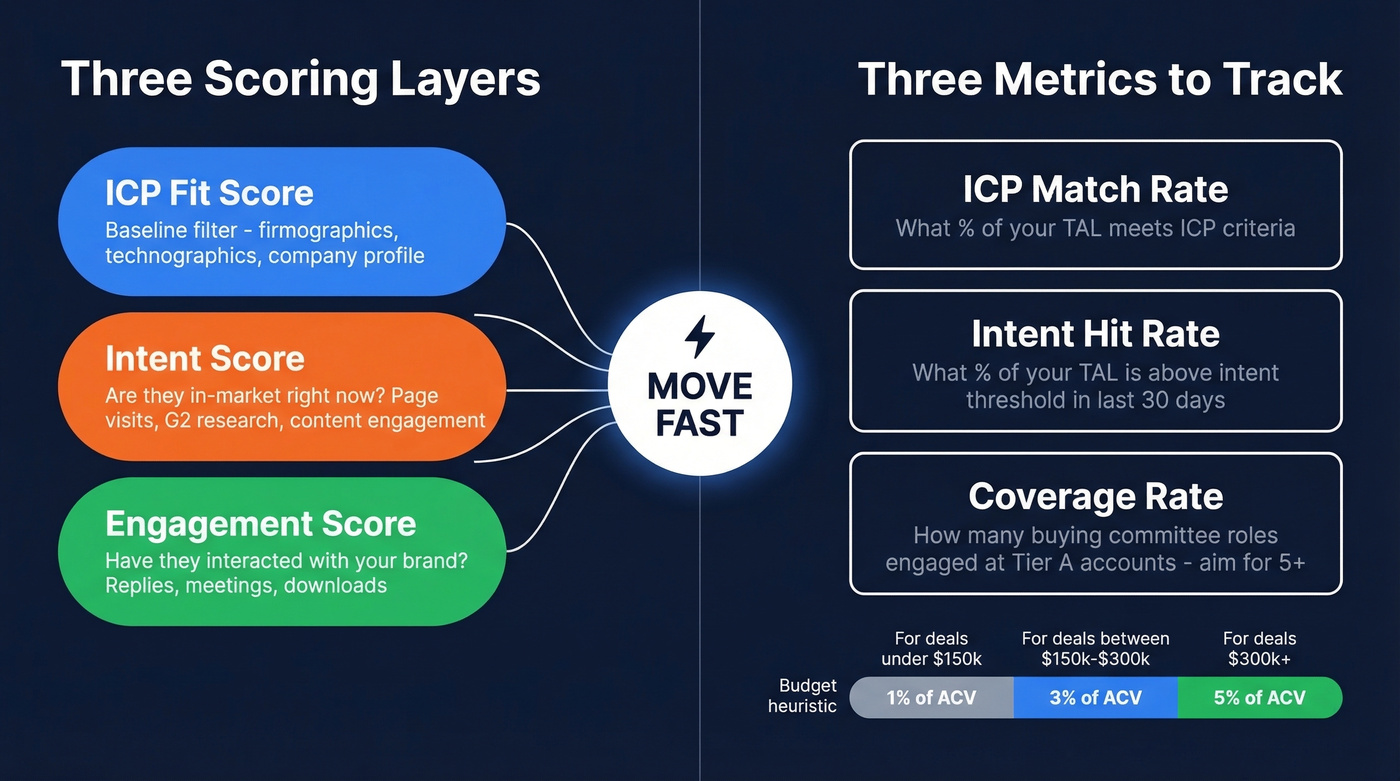
Track three metrics to know if your profile is working:
- ICP match rate - what percentage of your target account list actually meets ICP criteria. If you're struggling to define the baseline, use an Ideal Customer Profile Template.
- Intent hit rate - what percentage of your TAL is above intent threshold in the last 30 days. For a cleaner system, align this with identifying buying signals.
- Coverage rate - how many of the required buying committee roles you've engaged at Tier A accounts. Aim for five or more. If you're missing the money role, review MEDDPICC Economic Buyer.
For budget allocation, we've found a reliable heuristic: spend 1% of ACV on accounts under $150k, 3% for deals in the $150k-$300k range, and 5% for anything above $300k. This keeps your per-account investment proportional to the deal's upside. Smartsheet's case study on building in-market segments by aligning buying signals to key personas is a textbook IAP in action that drove measurable pipeline lift.
Finding Accounts at Scale
Once your scoring rubric is live, the next challenge is identifying accounts that actually match it. Manually researching companies one by one doesn't work when your TAM runs into the thousands.
The most effective approach combines your CRM's closed-won patterns with enrichment tools that surface firmographic, technographic, and intent data in real time. Filter your total addressable market through your scoring criteria, rank the output, and feed Tier A accounts directly into your sales engagement platform. This is where a well-built ideal account profile pays for itself - it turns a vague market into a prioritized queue that reps can work through systematically, rather than guessing which accounts to call next. If you need a repeatable way to build and refresh lists, see how to automate target account lists.
Common Mistakes
Fairytale personas. Built in a conference room without talking to sales or customers. The consensus on r/b2bmarketing is blunt: these "collect dust." The fix is dead simple - interview your five best customers and your five worst churns. The profile writes itself.
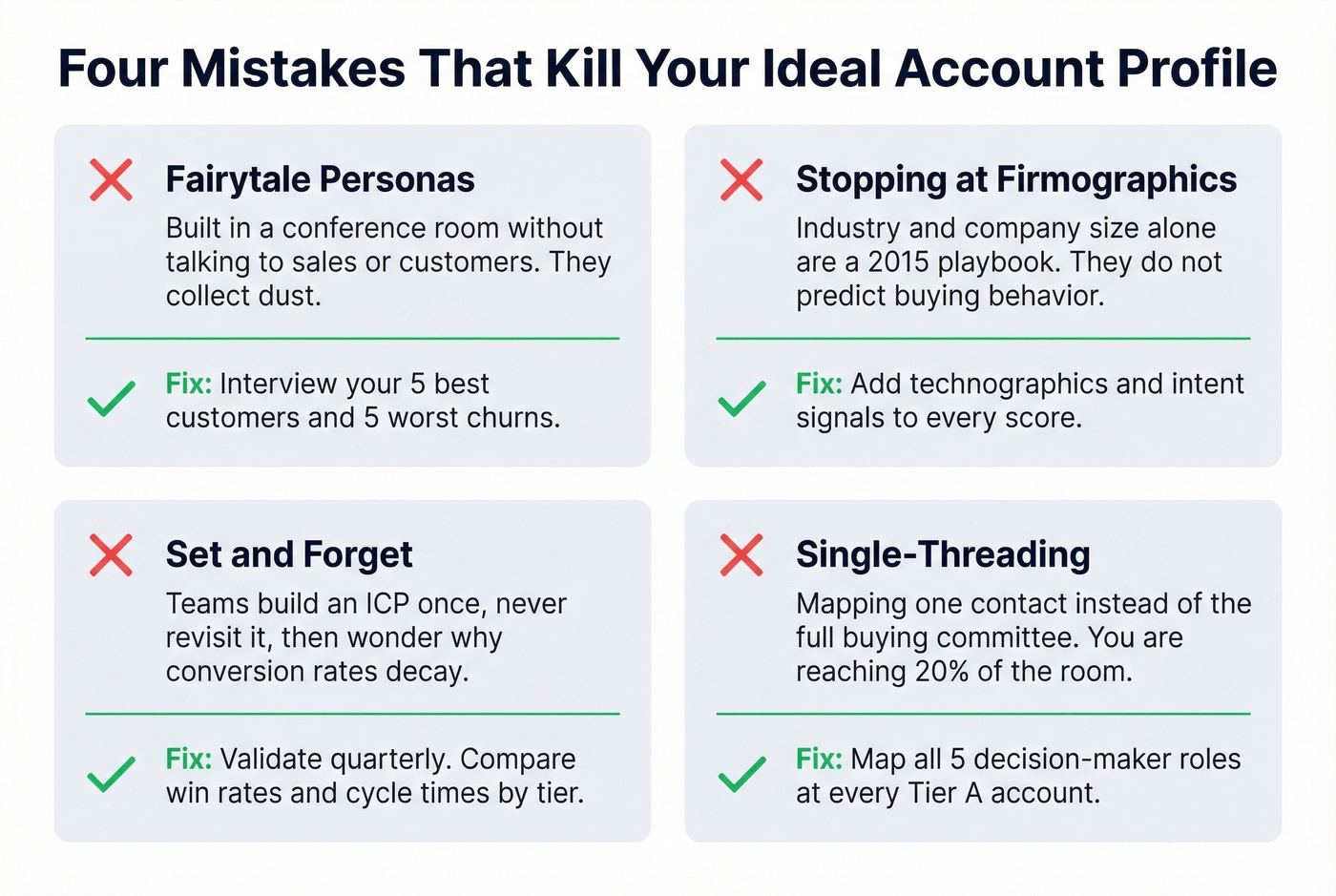
Stopping at firmographics. If your IAP doesn't include technographics and intent signals, you're working with a 2015 playbook. Industry and company size alone don't predict buying behavior anymore. If you want a deeper breakdown of the data types, start with firmographic and technographic data.
Set-and-forget. Markets shift. Your profile should shift with them. Reddit threads on r/b2b_sales consistently flag this: teams build an ICP once, never revisit it, and wonder why conversion rates decay quarter over quarter.
Single-threading. Mapping one contact instead of the full buying committee. With five decision makers on average, reaching one person is reaching 20% of the room. Skip this mistake if you want to skip losing deals at the 11th hour because a stakeholder you never engaged vetoes the purchase.
FAQ
Is an ideal account profile the same as an ICP?
They overlap, but an IAP adds scoring, tier thresholds, and buying readiness signals on top of a standard ICP. Think of it as your ICP made operational - every account gets a number and a priority tier instead of a vague "good fit" label.
How often should you update your profile?
Quarterly at minimum. Compare win rates, deal sizes, and cycle times by tier. If Tier B accounts are closing faster than Tier A, your scoring weights need recalibration - the market has shifted underneath you.
What tools help build an ideal account profile?
Start with your CRM for closed-won pattern analysis. For enrichment - technographics, intent data, verified contacts - Prospeo covers all three with 30+ filters, 300M+ profiles, and a 7-day data refresh cycle. Clay and ZoomInfo also offer enrichment, though at higher price points.
How many accounts should be in Tier A?
Keep Tier A to 10-15% of your total target account list. If more than 20% of accounts score 80+, your thresholds are too generous. Tighten the criteria so reps can realistically give each Tier A account the attention it deserves.