

5 B2B Ideal Customer Profile Examples You Can Steal Today
Your SDR team booked 40 meetings last month. Six turned into qualified opportunities. The other 34? Wrong-fit accounts that were never going to close.
Here's the thing: companies aligned around a tight ICP grow revenue up to 2.5x faster than teams who spray and pray. And 94% of buying groups have already ranked their preferred vendors before talking to sales. If you're not showing up for the right accounts at the right time, you're not even in the running.
Below are five complete, filled-out ICPs across SaaS, Healthcare, Manufacturing, Fintech, and Professional Services - each with firmographics, technographics, disqualification criteria, and a one-paragraph ICP statement. Plus a 100-point scoring rubric and a data provider table so you can actually find companies that match.
What Makes a Strong B2B ICP
The best ICPs fit on one page. They're company-level documents - not buyer personas, not target audience definitions.
| Concept | Level | Purpose |
|---|---|---|
| Target Audience | Broad market | Who could buy |
| ICP | Company | Who should buy |
| Buyer Persona | Individual | Who signs the check |
Your ICP defines the organization. Your buyer persona defines the human inside it. Conflating the two is the most common mistake we see, and it's the reason most ICP documents end up as shelfware that nobody references after the offsite where they were created. If you need a refresher on the terminology, see Ideal Customer Profile vs buyer persona.
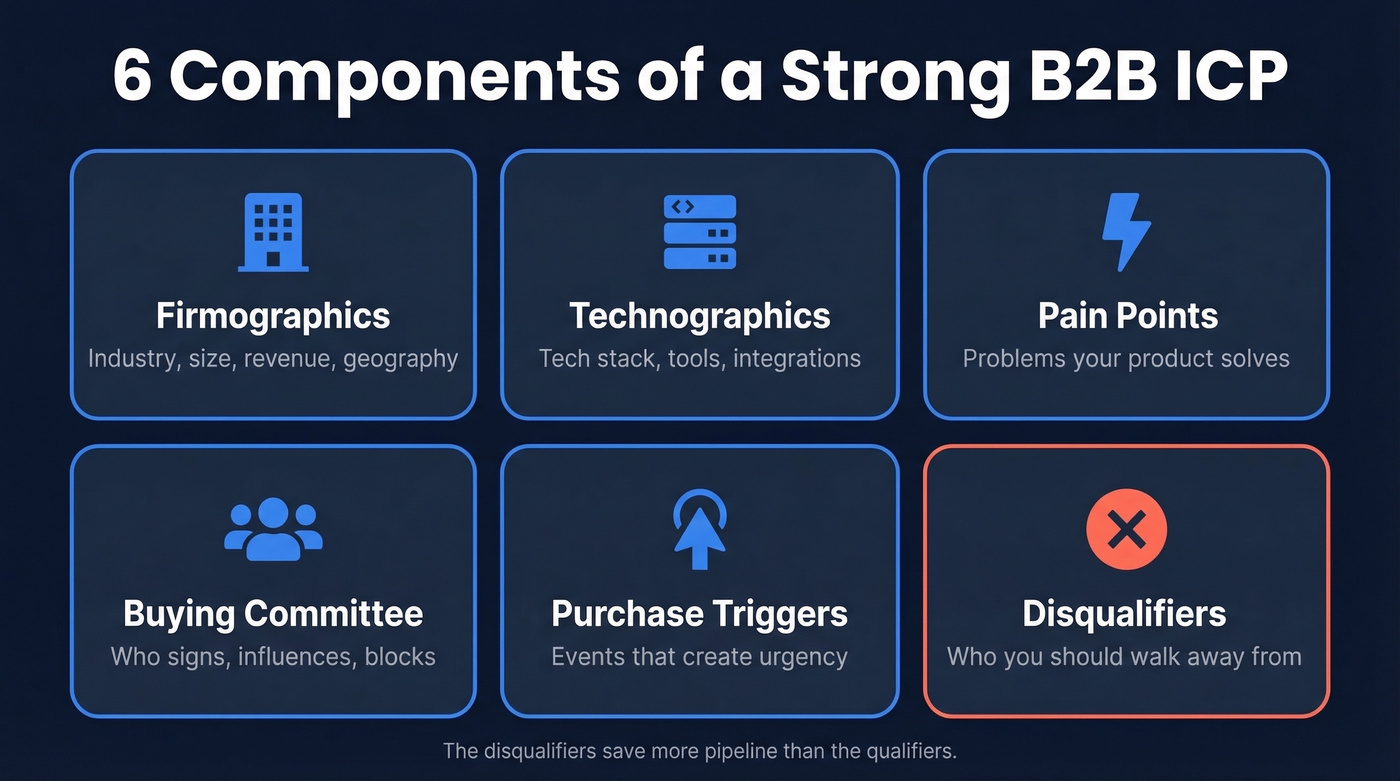
A strong ICP includes six components: firmographics, technographics, pain points, buying committee structure, purchase triggers, and - critically - disqualification criteria. That last one separates useful profiles from aspirational wish lists.
5 Complete ICP Examples by Industry
SaaS (Help Desk Software)
Firmographics: B2B SaaS companies in the US and Canada. ARR $20M+. Customer service team of 10+ agents. Customer base is primarily SMBs requiring hands-on training and support.
Technographics: Currently uses Zendesk or Freshdesk (migration-ready). Integrated with Salesforce or HubSpot CRM.
Pain points: Ticket resolution times increasing as customer base scales. Current tool lacks AI routing or self-service portal.
Buying committee: VP of Customer Success, Head of Support Operations, CTO.
Disqualifiers: Recently signed a 3+ year contract with a competitor. Fewer than 500 active support tickets/month.
ICP statement: Our ideal customer is a B2B SaaS company in North America with $20M+ ARR and a growing customer service team that's outgrowing Zendesk or Freshdesk - and needs AI-powered routing to keep resolution times from spiraling.
Healthcare (Clinical Software)
Firmographics: Hospitals, ACOs, and large physician groups. Financial strength to support a $250K average deal size. Initially within a 100-mile radius for high-touch onboarding, expandable later.
Technographics: Runs Cerner or Siemens systems with a strong reference base. Avoids Epic customers - integration credentialing is a 12-month barrier.
Pain points: Clinical workflow inefficiencies. Manual data entry across disconnected systems. Compliance documentation gaps.
Buying committee: CIO, CMO, CMIO. A warm introduction signals an "innovative mindset" org open to startups.
Disqualifiers: Currently in merger talks. Purchased a competitor product within the last 12 months. Sales cycles in healthcare stretch up to two years for enterprise accounts, so "Goldilocks" sizing avoids the largest systems where deals die in committee.
ICP statement: Our ideal customer is a hospital or ACO with the financial strength to support a $250K deal, running Cerner or Siemens systems, within our initial geographic radius - and not on Epic, in merger talks, or locked into a competitor contract.
Manufacturing (NIR Spectroscopy)
This one's a niche example, but it illustrates something important: even in highly specialized markets, a well-defined ICP with expanded buying committee titles can unlock accounts you didn't know existed.
Firmographics: Small-to-medium animal feed mills in the US and Canada. After refinement, expanded to include animal feed analysis laboratories.
Technographics: Uses manual or outdated NIR analysis equipment. No existing long-term service contract with a competitor.
Pain points: Inconsistent feed quality measurements. Regulatory compliance pressure. Lab throughput bottlenecks.
Buying committee: Head of Operations, Feed Mill Supervisor, Lab Manager, QA Manager, Lead Scientist. The refined ICP expanded titles to include Lab Compliance Manager and Lab Technician.
Outcome: Expanding the buying committee titles alone uncovered 500+ new decision-makers and led to 15+ device purchases.
Disqualifiers: Facilities with fewer than 50 employees (deal economics don't work). Companies mid-acquisition. The ICP also includes "rising stars" - non-decision-makers today who'll grow into buyers within the 6-18 month sales cycle.
ICP statement: Our ideal customer is a North American animal feed mill or analysis laboratory with outdated NIR equipment, regulatory pressure, and no locked-in competitor contract.
Fintech (Compliance/KYC Platform)
Firmographics: Regulated financial institutions - banks, neobanks, payment processors, lending platforms. 50-500 employees. Transaction volume of 10K+/month.
Technographics: SOC2 and ISO 27001 required. Currently uses legacy AML/KYC tools with manual review workflows. Integrated with core banking platforms.
Pain points: False-positive rates above 30% on transaction monitoring. Manual review backlog growing. Regulatory audit findings in the last 18 months.
Buying committee: Head of Compliance, CTO, CFO.
Disqualifiers: In-house compliance engineering team of 10+ (they'll build, not buy). Pre-revenue startups without regulatory obligations yet.
ICP statement: Our ideal customer is a regulated financial institution processing 10K+ monthly transactions, drowning in false positives from legacy AML tools, and facing audit pressure that makes "build it ourselves" too slow.
Professional Services (B2B Marketing Agency)
Firmographics: B2B companies with $5M-$50M revenue. No in-house marketing team beyond 1-2 generalists. Growth-stage - actively investing in pipeline.
Technographics: Uses HubSpot or Salesforce CRM. Has basic marketing automation but isn't running multi-channel campaigns.
Pain points: CEO or Head of Sales is personally running demand gen. Pipeline is founder-dependent. No content engine or SEO presence.
Buying committee: CEO/Founder, Head of Sales.
Disqualifiers: Has an in-house agency or creative team. Recently hired a VP of Marketing (they'll want to build internally first). Annual marketing budget under $60K.
ICP statement: Our ideal customer is a B2B company between $5M-$50M in revenue where the founder is still the primary pipeline generator, the CRM has data but no automation, and there's budget to outsource what they can't staff.
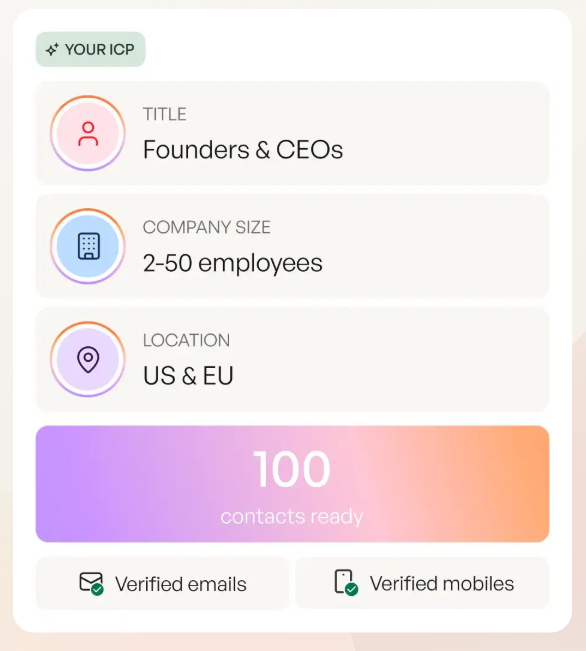

You've got firmographics, technographics, and disqualifiers defined. Now you need to actually find companies that match. Prospeo's B2B database has 300M+ profiles with 30+ search filters - including buyer intent, technographics, headcount growth, funding, and job changes - so you can turn that ICP doc into a live target account list in minutes.
Stop building ICPs that collect dust. Start filling pipelines that close.
ICP Scoring Rubric (100 Points)
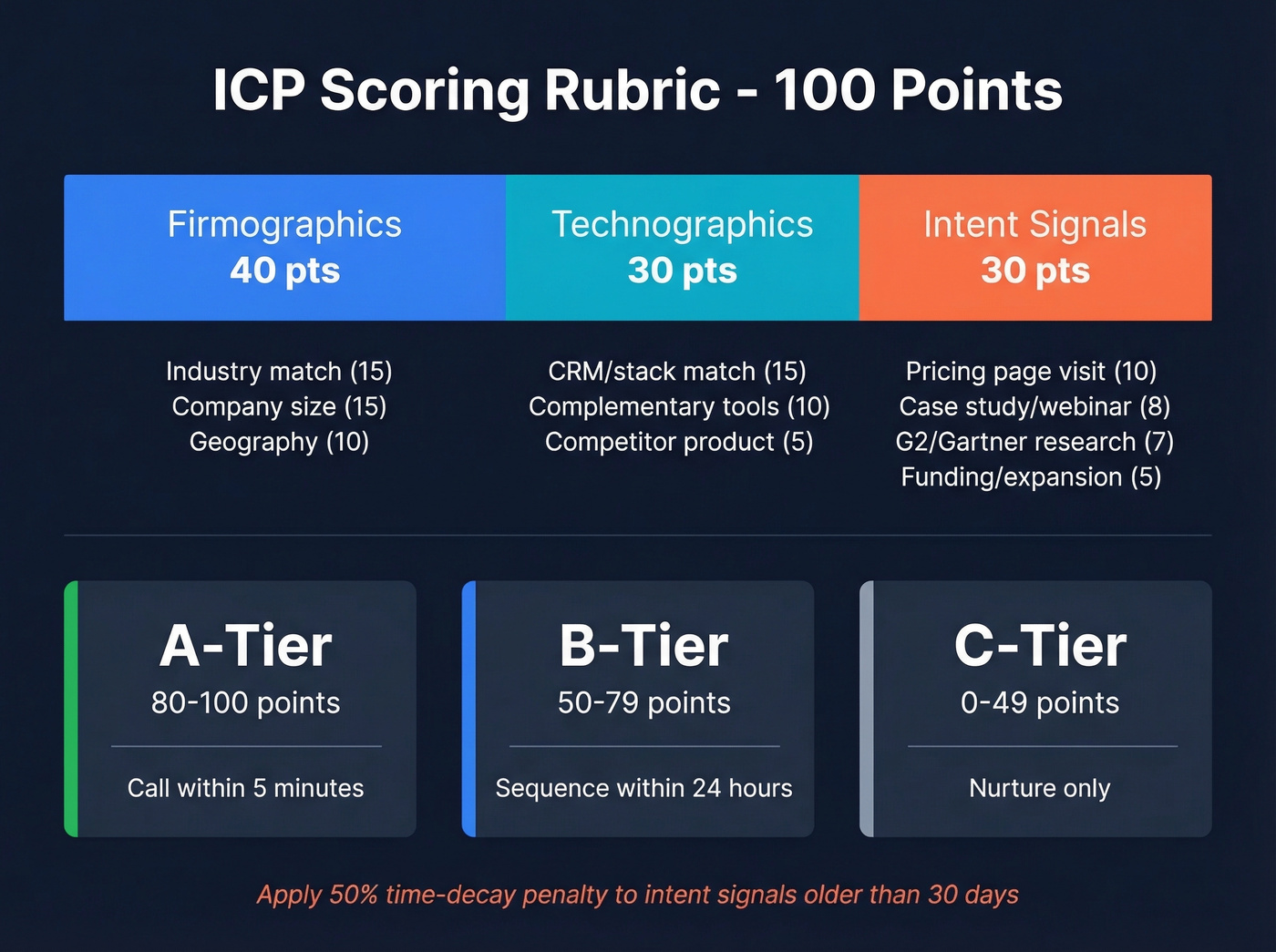
Having an ICP document is step one. Operationalizing it so every account in your CRM gets a score and a routing rule is where pipeline actually improves. We've seen this 100-point rubric work across dozens of implementations, especially when paired with a clear lead scoring model and consistent pipeline health reviews:
| Category | Criteria | Points |
|---|---|---|
| Firmographics (40) | Industry match | 15 |
| Company size | 15 | |
| Geography | 10 | |
| Technographics (30) | CRM/stack match | 15 |
| Complementary tools | 10 | |
| Competitor product | 5 | |
| Intent Signals (30) | Pricing page visit | 10 |
| Case study/webinar | 8 | |
| G2/Gartner research | 7 | |
| Funding/expansion | 5 |
Tier thresholds: A-tier (80-100), B-tier (50-79), C-tier (0-49). In our experience, Tier A accounts convert at 1.5-2x the win rate of Tier B, with 15-20% shorter sales cycles.
Intent signals carry 30 points for a reason. But those signals decay fast - a pricing page visit from last week is gold, while the same visit from six weeks ago is noise. Apply a 50% time-decay penalty to any intent signal older than 30 days. And set routing SLAs: accounts scoring 80+ get an SDR call within 5 minutes, 60-79 enter a sequence within 24 hours, below 60 go to nurture. Without SLAs, the scoring model is just a spreadsheet exercise that makes your ops team feel productive without actually changing outcomes. If you want a more complete system, pair this with identifying buying signals and a process for how to track sales triggers.
ICP Mistakes That Kill Pipeline
"Fairytale personas" built without customer interviews. If your ICP was created in a conference room without talking to customers and reps, it's fiction. The consensus on r/sales is blunt: these docs "collect dust." We've seen it firsthand - a team spent two weeks building a beautiful ICP deck, then nobody opened it again until the next QBR.
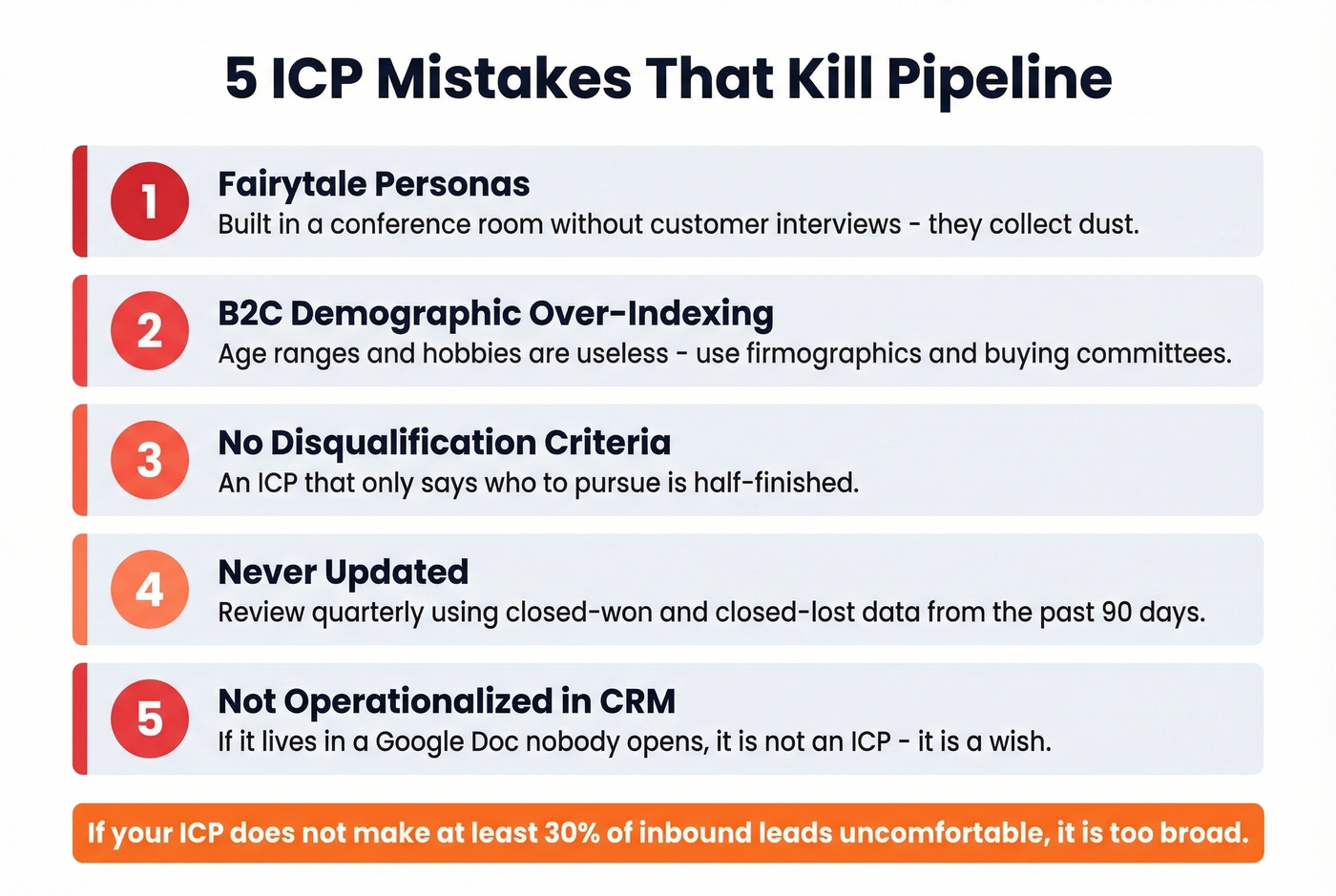
B2C-style demographic over-indexing. B2B profiles need firmographics and buying committee structure, not age ranges and hobbies. Skip the "Marketing Mary is 34 and likes hiking" nonsense.
No disqualification criteria. An ICP that only describes who to pursue is half-finished. The disqualifiers save more pipeline than the qualifiers.
Never updated. Review quarterly using closed-won and closed-lost data from the past 90 days. If your win rate shifts more than 10 points in a quarter, that's a signal to revisit immediately.
Not operationalized in CRM. If your ICP lives in a Google Doc nobody opens, it's not an ICP - it's a wish. Score accounts, tag them in Salesforce or HubSpot, and route accordingly. This is also where a lightweight sales process optimization pass can remove friction fast.
Let's be honest: most companies don't have an ICP problem. They have a disqualification problem. They know who they want to sell to. They just can't bring themselves to say no to the accounts that don't fit. If your "ICP" doesn't make at least 30% of your inbound leads uncomfortable, it's too broad.
Where to Get ICP-Matched Data
You've built the profile. Now you need to find companies that match it. The intent data market hit $4.49B in 2026, and there's no shortage of providers. Here's how the major ones compare:
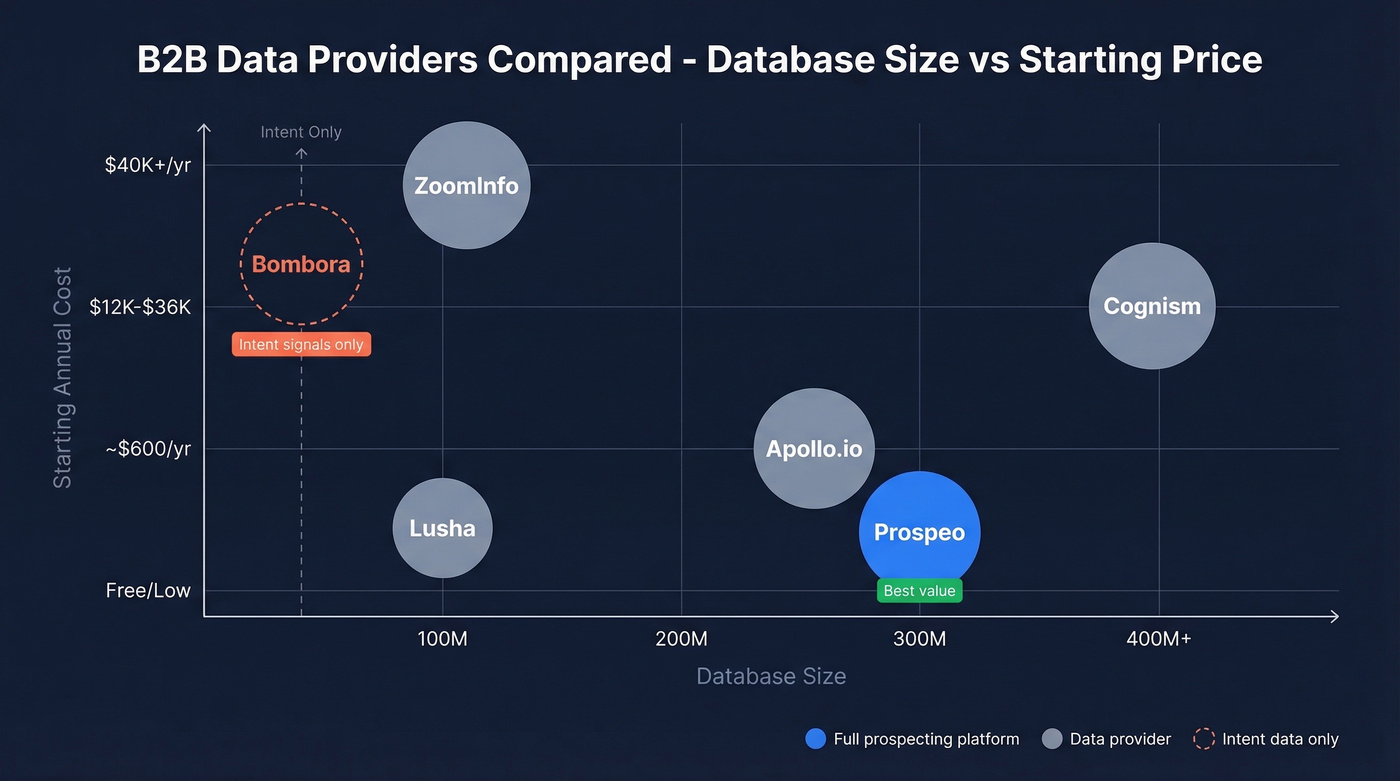
| Provider | Database Size | Starting Price | Best For |
|---|---|---|---|
| Prospeo | 300M+ profiles | Free tier; ~$0.01/email | ICP-to-list at lowest cost |
| ZoomInfo | 110M+ companies | ~$15K-$40K/yr | Enterprise GTM suites |
| Apollo.io | 275M+ contacts | $49/user/mo | SMB prospecting |
| Lusha | 100M+ profiles | $29.90/mo | Quick lookups |
| Cognism | 400M+ contacts | ~$1K-$3K/mo | EMEA coverage |
| Bombora | Intent signals | $12K-$40K/yr | Standalone intent data |
If your team already runs ZoomInfo or Apollo and you're happy with the data quality, there's no reason to rip and replace. But if you're paying $20K+ a year and still getting 15%+ bounce rates, it's worth testing a smaller provider against your actual ICP filters before your next renewal. For a broader shortlist, compare options in our guide to B2B company data and sales prospecting databases.
Your ICP scoring rubric is only as good as the data feeding it. Prospeo refreshes every 7 days (not the 6-week industry average), delivers 98% email accuracy, and returns 50+ data points per contact through CRM enrichment - giving you the firmographic and technographic signals you need to score accounts automatically.
Enrich your CRM with the data points your ICP scoring demands.
FAQ
How many ICPs should a B2B company have?
Most B2B companies maintain one core ICP plus 2-4 segments mapped to distinct product lines or verticals. More than 5 usually means your segments overlap and need consolidation - merge any two segments that share 70%+ of the same firmographic criteria.
How often should you update your ICP?
Review quarterly using closed-won and closed-lost data from the past 90 days. Major updates - new segments, revised scoring weights - happen 1-2 times per year. If your win rate shifts more than 10 points in a quarter, revisit immediately rather than waiting for the next scheduled review.
What's the fastest way to build a target account list from an ICP?
Use a B2B database with ICP-aligned filters for intent, tech stack, headcount growth, and firmographics, then export verified emails directly. With the right tool, you can go from ICP document to contact list in under 10 minutes without a sales call or annual contract.
What's the difference between an ICP and a buyer persona?
An ICP describes the company. A buyer persona describes the person inside that company who makes or influences the purchase decision. You need both, but the ICP comes first - it tells you which buildings to walk into, while the persona tells you which door to knock on once you're inside.