

Inbound vs Outbound Marketing Strategies in 2026: The Data-Backed Guide
Your VP of Marketing just dropped the question in Slack: "Should we double down on content, or hire two more SDRs?" You've got a board meeting in three weeks, a pipeline target that went up 23%, and a budget that didn't. The "it depends" answer won't cut it when you're choosing between inbound and outbound marketing strategies with real money on the line.
Here's the quick version:
- Inbound captures existing demand - efficient but slow to build. Outbound creates new demand - controllable but data-dependent.
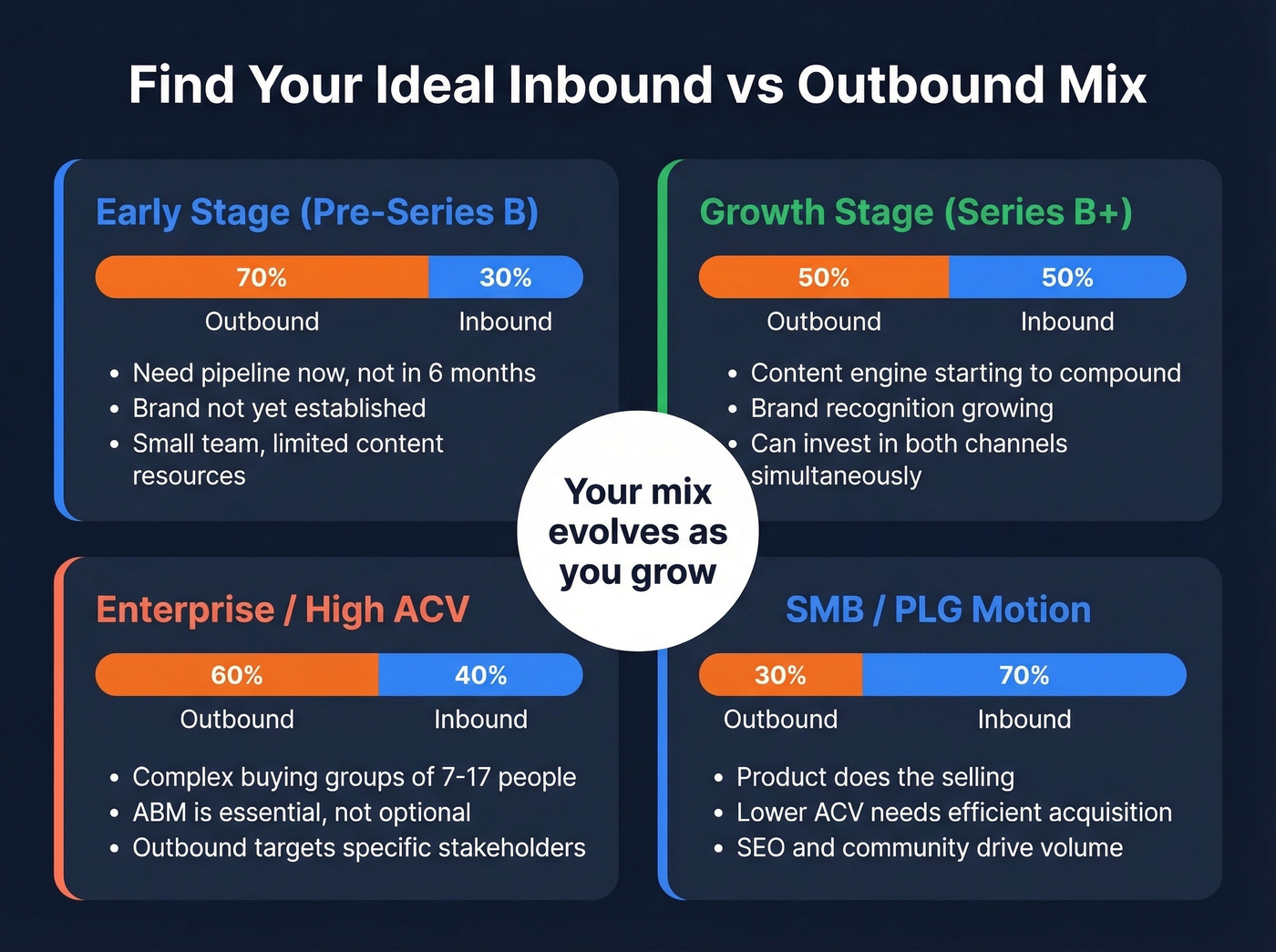
- Early-stage companies should lean roughly 70% outbound / 30% inbound. As brand and organic channels compound, flip the ratio.
- The real answer is ABM - inbound and outbound working the same accounts. 71.2% of organizations already run it.
Now let's get into why, with actual numbers.
How Inbound and Outbound Compare
The cleanest way to think about this: inbound captures demand that already exists. Outbound creates demand where there was none. Everything else - channels, tactics, tools - flows from that distinction.
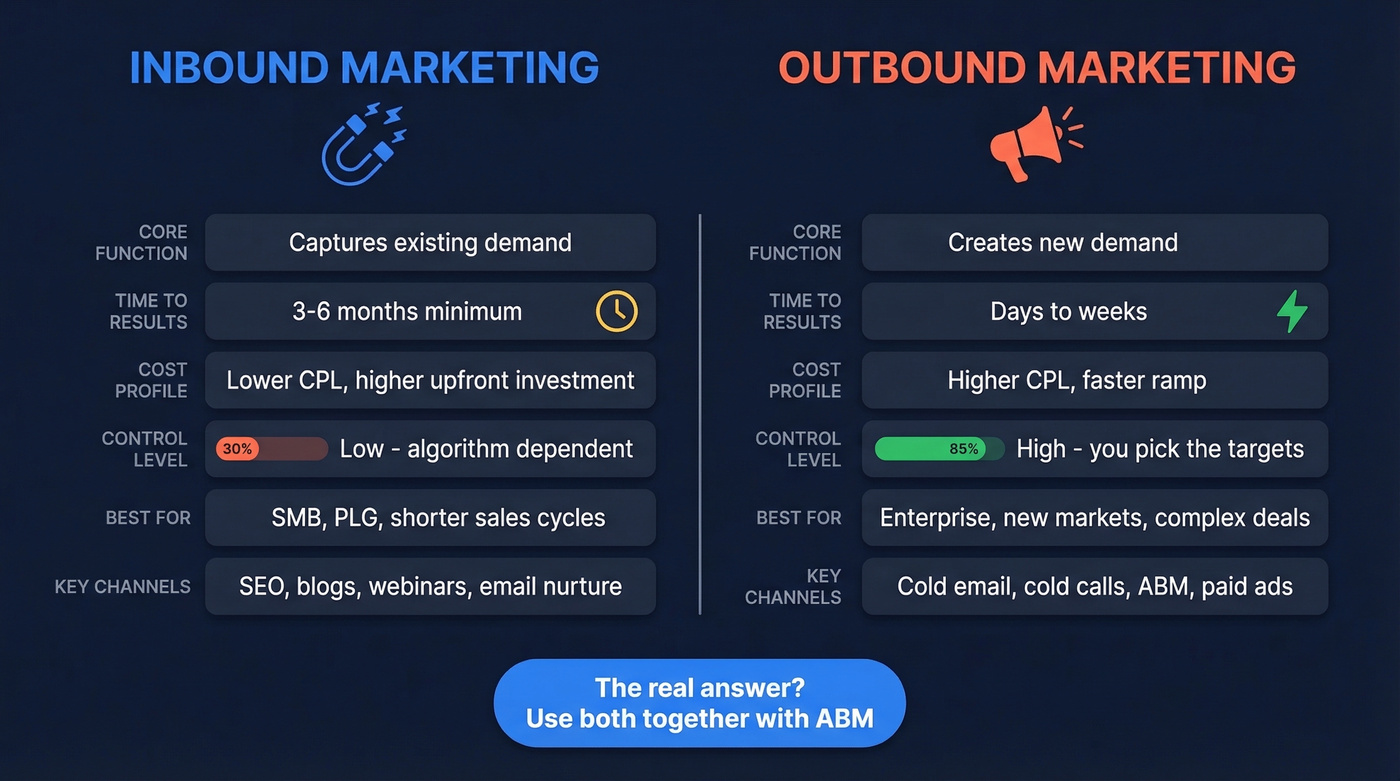
| Inbound | Outbound | |
|---|---|---|
| Core function | Capture existing demand | Create new demand |
| Examples | SEO, blogs, webinars, email nurture | Cold email, cold calls, ABM, paid ads |
| Cost profile | Lower CPL, higher upfront investment | Higher CPL, faster ramp |
| Time to results | 3-6 months minimum | Days to weeks |
| Best for | SMB and PLG, shorter cycles | Enterprise, new markets |
| Control | Low - algorithm-dependent | High - you pick the targets |
| Measurement | Multi-touch attribution, quantifiable digital metrics | Easier per-touch tracking, harder brand-lift measurement |
Neither is "better." But one is almost certainly a better fit for your current stage, deal size, and team.
What's Changed in 2026
The inbound-versus-outbound debate from five years ago is barely relevant anymore. Three shifts have rewritten the playbook.
Inbound is under real pressure. Over half of marketers say their content marketing strategy is only moderately effective or worse, per CMI research. Nearly 30% report decreased search traffic as consumers turn to AI tools for answers. Zero-click searches keep climbing. The SEO moat that worked in 2021 is eroding, and teams that built their entire pipeline on organic traffic are scrambling. Inbound still works, but the bar for "good enough" content has gone way up.
Outbound isn't billboards anymore. When people hear "outbound," they still picture Super Bowl ads and spray-and-pray cold calls. Modern outbound is targeted digital: tightly segmented cold email sequences, intent-driven ABM plays, programmatic retargeting, and strategic paid search. The tools have gotten dramatically better, and the data powering them has caught up. The old "outbound is interruptive" framing misses the point entirely.
First-party data is the new foundation. Third-party cookies are dying. Tracking pixels are getting blocked. The companies winning right now are building first-party data assets - email lists, CRM enrichment, product usage signals - and using those to fuel both inbound nurture and outbound targeting. If your strategy depends on third-party tracking, you're building on sand.
What Each Strategy Actually Costs
Let's kill the vague "inbound is cheaper" claim with actual data.
Cost Per Lead by Industry
FirstPageSage's 2026 CPL report breaks down paid vs organic cost per lead across industries. The gaps are revealing:
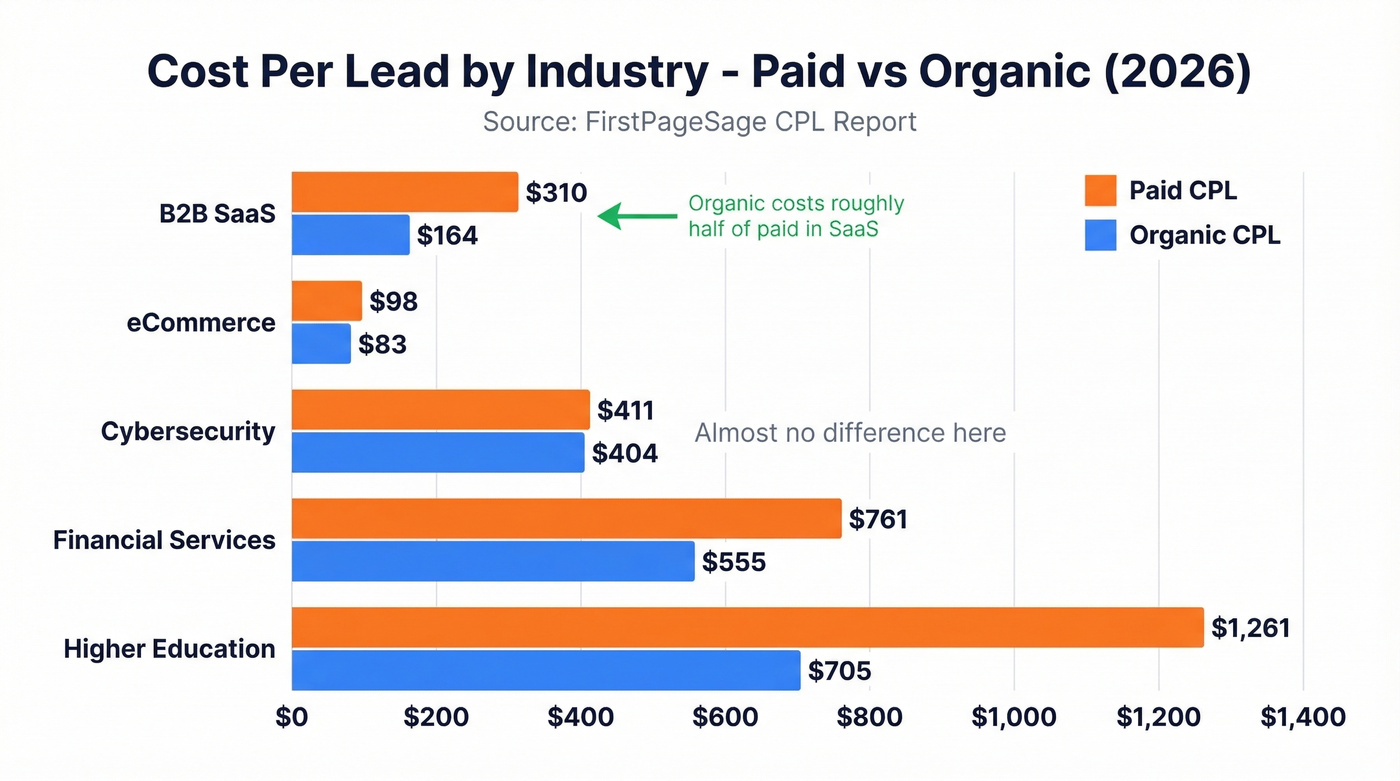
| Industry | Paid CPL | Organic CPL | Blended |
|---|---|---|---|
| B2B SaaS | $310 | $164 | $237 |
| eCommerce | $98 | $83 | $91 |
| Cybersecurity | $411 | $404 | $406 |
| Financial Services | $761 | $555 | $653 |
| Higher Education | $1,261 | $705 | $982 |
The gap varies wildly. In B2B SaaS, organic leads cost roughly half what paid leads do - a strong case for content investment. But in cybersecurity, organic barely beats paid. And in higher education, the absolute numbers are so high that neither channel feels "cheap." Your industry context matters more than any generic rule of thumb.
Channel ROI Rankings
HubSpot's State of Marketing Report ranks the highest-ROI channels differently for B2B and B2C. For B2B, the top three are website/blog/SEO, paid social, and social media shopping tools. For B2C, it's email marketing, paid social, and content marketing.
Paid clicks can range from $2 to $50+ per click depending on your audience, competition, and keywords - expensive, but the targeting precision can justify it for high-ACV B2B plays where a single closed deal covers months of ad spend. A retargeting campaign on someone who read your blog is both inbound and outbound. The lines have blurred, and the teams that obsess over categorization instead of results are the ones falling behind.
Modern Inbound Playbook
What Still Works
Content marketing isn't dead - it's just harder. Blogging and SEO still drive compounding traffic and leads when you commit to consistent, high-quality publishing and distribution. (If you need a tighter definition and examples, see content marketing.)
Slack's growth story is the textbook inbound play: free tier, viral product adoption, community-driven word of mouth, then enterprise upsell. By the time their sales team engaged a prospect, the product had already done the selling. That's inbound at its best - but it requires a product and brand that generates organic pull, which most companies don't have on day one.
Email nurture remains one of the highest-ROI inbound channels, with conversion rates around 2.8% for B2C and 2.4% for B2B. Those aren't flashy numbers, but they compound. A well-built email list is an owned asset that doesn't depend on Google's algorithm or an ad auction. The inbound plays that still work in 2026 share a common trait: they build owned audiences - email lists, communities, product-led loops. Anything that puts you at the mercy of a third-party algorithm is a rented channel, not a moat.
Where Inbound Breaks Down
Content saturation is real. Inbound typically takes 3-6 months to generate measurable traffic and leads. For a Series A company starting from scratch, that timeline is brutal when you've got quarterly pipeline targets breathing down your neck. We've watched early-stage teams burn six months waiting for SEO to kick in when they should have been running outbound from day one.
Ad costs keep climbing across major platforms, squeezing ROI on paid inbound. The r/SaaSSales consensus captures the frustration well: one poster called inbound "volatile" and "dependent on brand + marketing spend you may not have yet." If you're not already a recognized name in your category, inbound alone won't generate enough pipeline to hit aggressive growth targets. And here's the hidden risk nobody talks about enough - one Google core update can cut your organic traffic in half overnight.

The article makes it clear: outbound wins on speed and control, but only when your data connects you to real buyers. Bad emails kill deliverability and burn your domain. Prospeo delivers 98% email accuracy with a 7-day refresh cycle - so every cold email you send actually lands.
Stop debating strategy and start reaching decision-makers with verified data.
Modern Outbound Playbook
Cold Email Benchmarks
Average B2B cold email reply rates sit at 3-5.1%. Top-quartile performers hit 15-25%. The gap between average and great is enormous, and it comes down to three things. (For deeper benchmarks and examples, see cold email.)
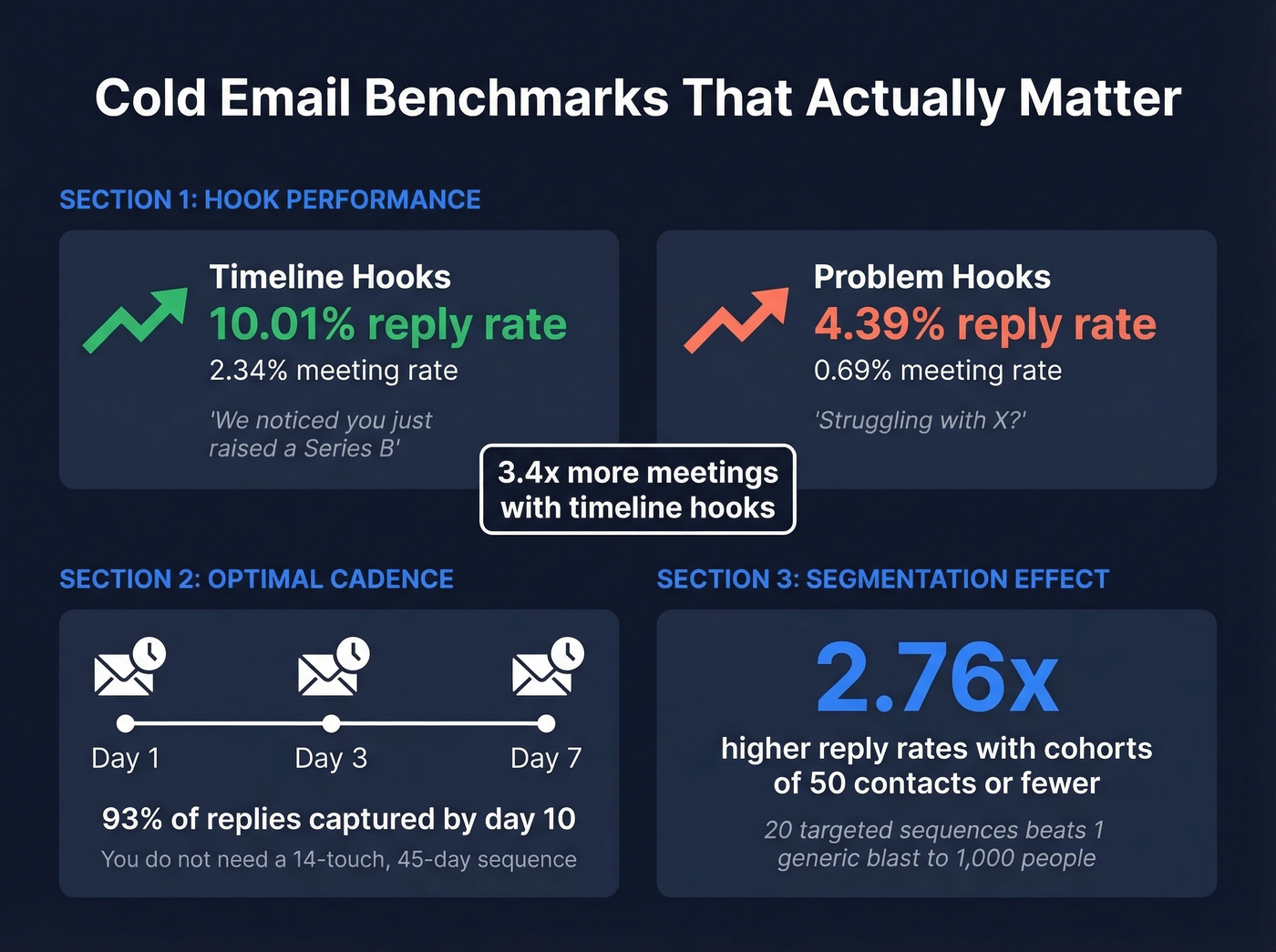
Hooks matter more than you think. Timeline hooks ("We noticed you just raised a Series B") generate a 10.01% reply rate and 2.34% meeting rate. Problem hooks ("Struggling with X?") only hit 4.39% reply and 0.69% meeting rate. That's a 3.4x difference in meetings booked - just from the opening line. In our testing, timeline hooks consistently outperform problem hooks by 2-3x regardless of industry.
Cadence is solved. A 3-7-7 sequence (email on day 1, follow-up on day 3, follow-up on day 7) captures 93% of replies by day 10. You don't need a 14-touch, 45-day sequence. Three good emails at the right intervals. (If you want ready-to-use follow-ups, use these cold email follow-up templates.)
Segmentation is the biggest lever. Cohorts of 50 contacts or fewer increase reply rates by 2.76x. Writing 20 highly targeted sequences beats writing one generic blast to 1,000 people. Every time. (A practical framework: intent based segmentation.)

Reply rates depend on reaching real people. Bounce rates above 5% damage your sender domain and kill both outbound and inbound email deliverability. Prospeo's 98% email accuracy and 7-day data refresh cycle mean you're emailing verified contacts at current companies - not burning your sender reputation on dead addresses. With 30+ search filters including buyer intent, technographics, and job change signals, you can build the tightly segmented cohorts that drive those 2.76x reply rate gains. (If you’re troubleshooting bounces, start with email bounce rate and then email deliverability.)
Why Outbound Feels Broken
Buying groups have exploded in complexity. Mid-market deals involve an average of 7 stakeholders. Large strategic deals? Up to 17 contacts involved. Single-threaded outbound - emailing one person and hoping they champion your deal internally - fails at these numbers. (This is where account-based selling becomes non-negotiable.)
One r/sales poster described their own buying behavior bluntly: "I'd research online, contact 3-5 vendors, ask my network - last thing I'd do is respond to a cold email." That's the reality for enterprise buyers.
Here's the thing: your outbound isn't failing because outbound doesn't work. It's failing because you're emailing addresses that bounce, targeting the wrong stakeholders, and single-threading into complex buying groups. Bad data doesn't just waste rep time - it damages domain reputation that takes months to rebuild.
The Hybrid Play: ABM
ABM isn't a third option. It's outbound and inbound working the same accounts simultaneously.
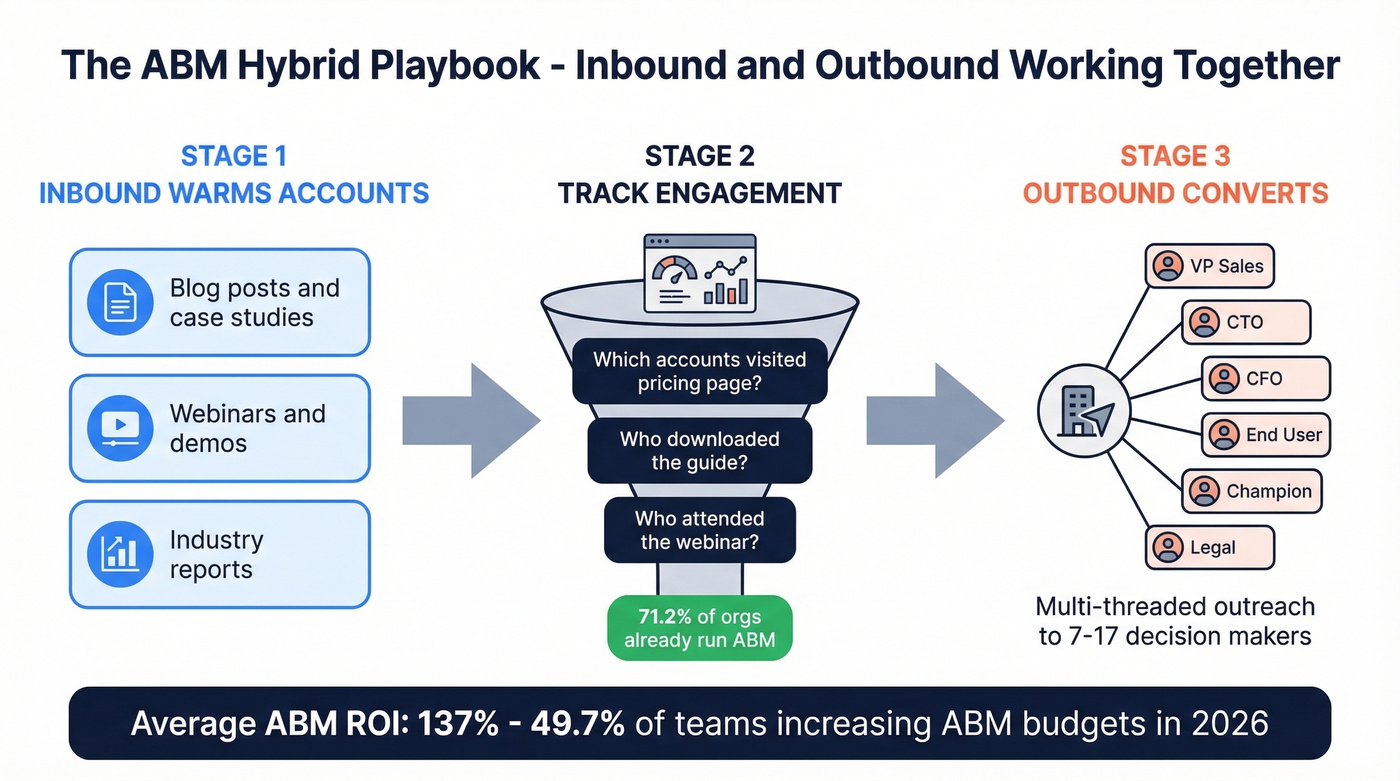
A survey of 771 marketers found that 71.2% of organizations already run ABM strategies, with an estimated average ROI of 137%. Nearly half say ABM delivers their highest ROI of any marketing strategy, which explains why 49.7% plan to increase ABM budgets in 2026. AI has accelerated adoption fast: 78.7% now incorporate it into ABM execution for personalization, predictive analytics, and targeting.
The practical mechanism: use inbound content - blog posts, webinars, case studies - to warm target accounts. Track which accounts are engaging. Then layer outbound outreach to specific decision-makers within those accounts, the 7-17 stakeholders who actually influence the deal. We've seen teams transform their pipeline by simply connecting their content engagement data to their outbound targeting. The content team creates demand. The SDR team converts it. That's the 2026 playbook, and it works because it respects how enterprise buyers actually buy - through multiple touchpoints across multiple channels over weeks or months.
Choosing Your Mix
Four variables determine your optimal split:
| Factor | Lean Inbound | Blend | Lean Outbound |
|---|---|---|---|
| Deal size | Under $5K / PLG | $5K-$50K | $50K+ enterprise |
| Sales cycle | Under 30 days | 30-90 days | 90+ days |
| Team | No SDRs | Small SDR team | Dedicated SDR org |
| Stage | Mature with brand equity | Growth | Early-stage |
Early-stage companies should run roughly 70% outbound / 30% inbound. You need pipeline control and can't wait 6 months for SEO to compound. As you grow and your brand generates organic demand, shift toward 50/50, then eventually 30/70 at maturity. One experienced practitioner on r/SaaSSales pushed back on this, arguing that any serious tech company should generate around 75% of leads through inbound, SDRs, and partners combined. That's a fair target for a mature company - but it takes years of brand-building to get there. You can't start there.
If you're closing deals under $10K with a product-led motion, you probably don't need enterprise-grade outbound infrastructure. A solid content engine, a free tier, and some targeted paid social will get you further per dollar. But for six-figure contracts with 90-day cycles, outbound with ABM is your engine, and inbound is the fuel that warms accounts before your reps reach out. (For the sales side of that motion, see enterprise B2B sales.)
Budget context matters too. A 6sense survey of 392 B2B marketers found that 52.3% increased marketing budgets, with a median increase of just 5%. Meanwhile, nearly 29% face higher pipeline expectations without any additional budget. Efficiency isn't optional - it's the constraint most teams are actually solving for.
A note on attribution: inbound channels produce cleaner digital metrics - you can track a blog visit through to a closed deal with multi-touch attribution. Outbound is easier to measure per-touch (reply rates, meetings booked) but harder to attribute brand-lift effects. The best teams measure blended CPL across both and resist the urge to over-credit whichever channel touches the deal last.
90-Day Implementation Roadmap
Month 1 - Foundation
- Define your ICP with specificity: industry, headcount, tech stack, job titles (use an ideal customer profile template)
- Publish 2-3 cornerstone content pieces targeting your ICP's top questions
- Launch your first cold email campaign to cohorts of 50 or fewer contacts
Month 2 - Iterate
- Analyze reply rates and CPL from Month 1
- A/B test hooks - try timeline hooks against problem hooks and measure meeting conversion, not just replies
- Start SEO optimization on cornerstone content: internal links, schema, keyword gaps
- Expand outbound to 3-5 ICP segments
- If reply rates are below 3%, fix data quality or targeting before touching messaging
Month 3 - Scale
- Layer intent data on outbound targeting to prioritize accounts showing buying signals (see identifying buying signals)
- Launch paid social retargeting on inbound website visitors
- Build an ABM pilot on your top 25 accounts - coordinate content and outbound touches
- Measure blended CPL across all channels
- Cut underperforming channels and double down on what's working
Skip the ABM pilot in Month 3 if you don't have at least one dedicated person who can coordinate between marketing and sales. Running ABM without that coordination just creates noise.
Running a hybrid inbound-outbound playbook? Your outbound side is only as strong as your contact data. Prospeo gives you 300M+ profiles, 30+ targeting filters including buyer intent and technographics, and 125M+ verified mobile numbers - everything you need to create demand where none exists, at $0.01 per email.
Fuel your outbound engine with data that actually converts.
FAQ
Is inbound or outbound better for B2B SaaS?
Neither alone. Early-stage SaaS should lean 70% outbound for pipeline control, shifting toward inbound as brand and organic channels compound. B2B SaaS CPL averages $310 paid vs $164 organic - inbound is cheaper per lead but takes 3-6 months to produce measurable results. The best SaaS companies run both, using outbound for enterprise expansion and inbound for PLG efficiency.
What's a good cold email reply rate?
Average B2B cold email reply rates sit at 3-5.1%, while top-quartile performers hit 15-25%. Timeline hooks generate 10.01% reply rates, a 3-7-7 cadence captures 93% of replies by day 10, and cohorts of 50 or fewer contacts boost reply rates 2.76x. Data quality is the prerequisite - bounce rates above 5% damage your sender domain.
How do you combine inbound and outbound?
Account-based marketing is the practical mechanism. Use inbound content to warm target accounts, then layer outbound outreach to specific decision-makers within those accounts. 71.2% of organizations already run ABM, with an average ROI of 137%. Connect your content engagement data to your outbound targeting so reps focus on accounts already showing buying signals.
What free tools support a hybrid approach?
Prospeo offers 75 free verified emails per month with 98% accuracy - strong enough to launch an outbound pilot without upfront cost. HubSpot's free CRM handles inbound lead tracking. Pair those with a free-tier sequencing tool like Lemlist or Instantly, and you've got a functional hybrid stack for under $100/month that covers both demand capture and demand creation.
What are the main differences between inbound and outbound marketing strategies?
Inbound captures demand that already exists through SEO, content, and email nurture. Outbound creates new demand through cold email, cold calls, and ABM. Inbound costs less per lead but takes 3-6 months to build. Outbound produces results in days but requires accurate data and strong targeting. Most high-growth companies in 2026 run both in a coordinated ABM motion rather than choosing one over the other.