

How to Increase Sales Volume: 7 High-Impact Levers (Prioritized)
You sent 2,000 cold emails last week. 600 bounced. You got 14 replies and booked 2 meetings. Your manager wants the plan for hitting quota, and your plan is... send more emails?
That math doesn't work. Only 16% of B2B reps hit their annual quota, 57% of sales professionals say cycles are getting longer, and reps spend 60% of their time on non-selling tasks. You don't need 21 tips to increase sales volume. You need three foundations executed consistently.
Quick version: Most sales volume problems come down to bad data wasting activity, not enough activity creating pipeline, and no follow-up system keeping deals alive. Fix those in that order. The rest is optimization.
What Is Sales Volume?
Sales volume gets confused with revenue constantly. They're not the same thing. Sales volume counts the units you sell - deals closed, subscriptions activated, products shipped. Revenue multiplies those units by price. You can grow volume while revenue drops (if you cut prices) and grow revenue while volume stays flat (if you raise prices).
Crunchbase puts it simply: sell 300 units a month at $20 each, and your annual sales volume is 3,600 units. Your revenue is $72,000. Both matter, but they move independently.
Sales Volume vs. Revenue
Volume is the activity metric. Revenue is the outcome metric. When someone says "increase sales volume," they usually mean one of two things: close more deals, or move more units. The strategies differ depending on which one you're solving for. For the rest of this article, we're focused on closing more deals - the B2B and B2C playbook for getting more customers through the door.
Gross vs. Net Sales Volume
Gross sales volume counts every sale. Net subtracts returns, cancellations, and promotional giveaways. The gap between gross and net tells you how much churn and buyer's remorse you're dealing with. If your gross volume is climbing but net volume is flat, you've got a retention problem masquerading as a growth story.
The Sales Volume Variance Formula
Sales Volume Variance = (Actual Units Sold - Forecasted Units) x Standard Price Per Unit
This is how you measure performance against plan. Zendesk's breakdown is worth bookmarking for the full formula context. The variance tells you whether you're beating or missing forecast - and by how much in dollar terms.
Break-Even Volume
Before you chase growth, know your floor. Break-even sales volume is the minimum number of units you need to sell to cover fixed and variable costs: Fixed Costs / (Price Per Unit - Variable Cost Per Unit). If your fixed costs are $50,000/month, your product sells for $200, and variable cost per unit is $50, you need 334 units just to break even. Every unit after that is profit. Knowing this number keeps your volume targets grounded in reality rather than wishful thinking.
The Funnel Math Behind Volume
Here's where most advice on growing deal count falls apart: it ignores the math. Sales cycles are 32% longer than they were in 2021, and cold email reply rates sit between 1-5%. Every stage of your funnel has a conversion rate, and those rates compound. Real B2B benchmarks tell the story:
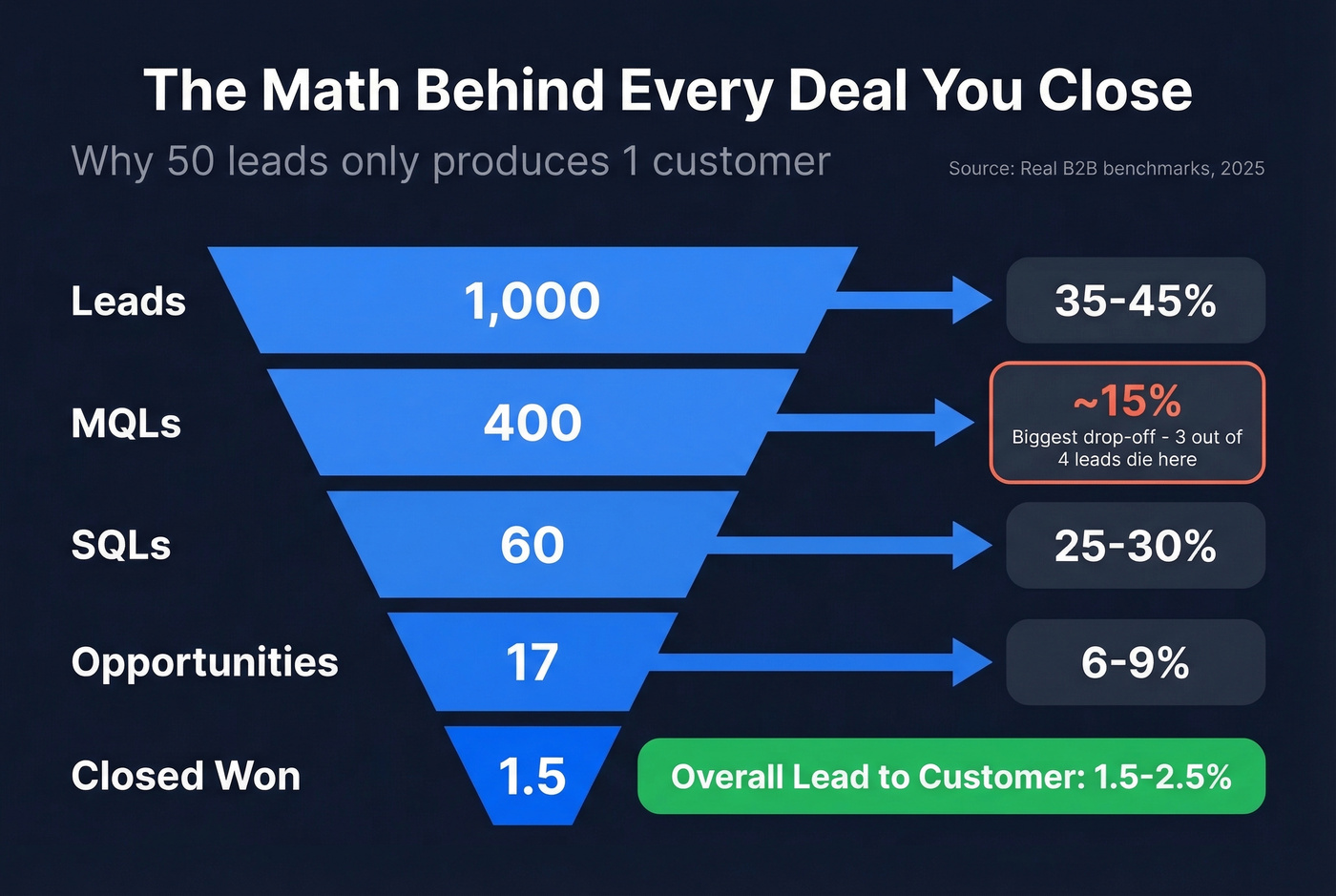
| Funnel Stage | Conversion Rate |
|---|---|
| Lead to MQL | 35-45% |
| MQL to SQL | ~15% |
| SQL to Opportunity | 25-30% |
| Opportunity to Closed-Won | 6-9% |
| Overall Lead to Customer | 1.5-2.5% |
The median B2B conversion rate sits at 2.9%. Legal services hit 7.4%. B2B e-commerce runs at 1.8%. If your lead-to-customer rate is 2%, you need 50 leads for every closed deal. Want 10 more deals this quarter? That's 500 more leads - or a meaningful improvement at one of those funnel stages.
One of the most painful drop-offs is MQL to SQL at ~15%. That's where marketing hands off to sales, and three out of four leads die. Fix that handoff and you move the entire funnel.
Sales Velocity - Connecting Volume to Revenue
Sales volume tells you how many deals you're closing. Sales Velocity tells you how fast your pipeline generates revenue. The formula from Monday.com connects the two:
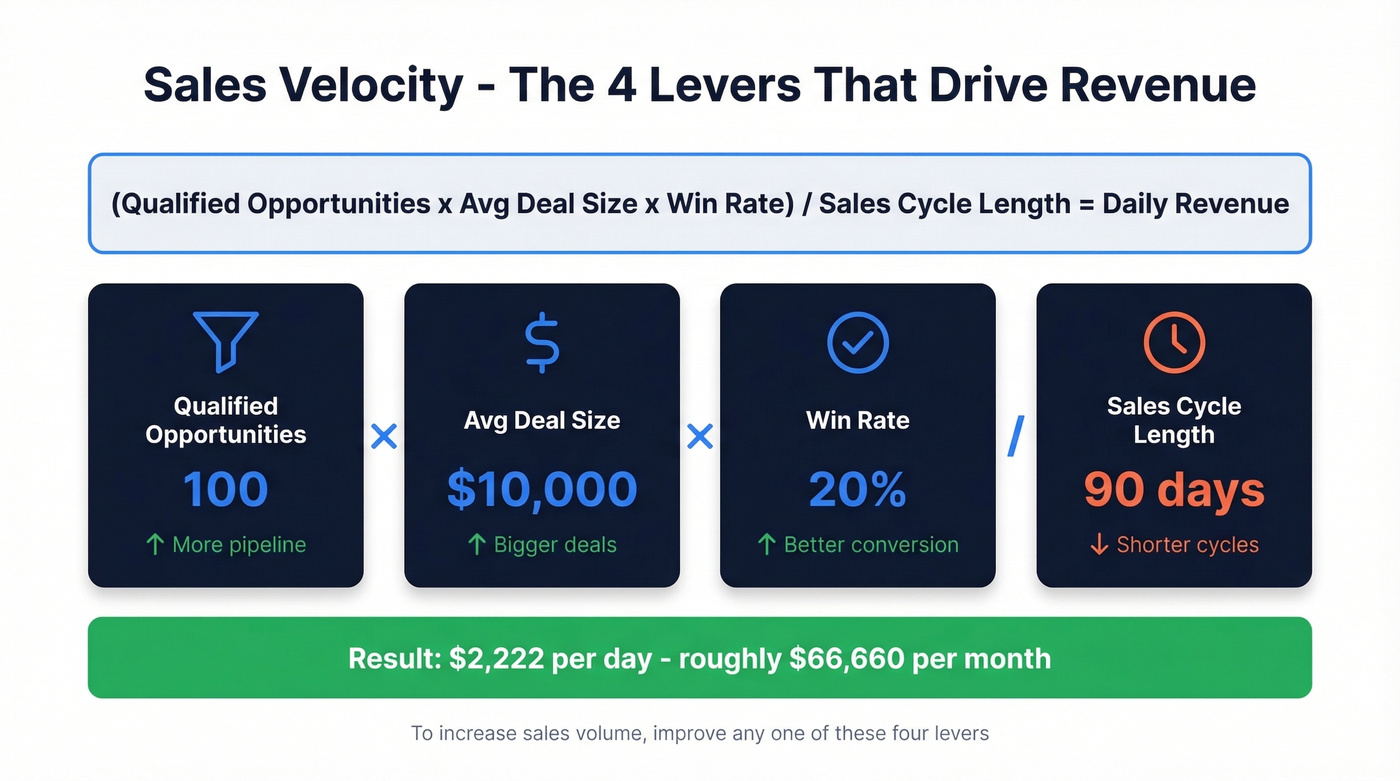
Sales Velocity = (Qualified Opportunities x Avg Deal Size x Win Rate) / Sales Cycle Length
Run the numbers: 100 opportunities x $10,000 average deal x 20% win rate / 90-day cycle = $2,222/day in pipeline velocity. That's roughly $66,660/month.
Win rates vary wildly by model. Enterprise software runs 20-30%. Transactional B2C hits 50-60%. Complex B2B sits at 15-25%. Nancy Kapoor of Grazitti Interactive breaks it into four levers: increase opportunities, increase deal size, improve win rate, and shorten the cycle. Every volume strategy maps to at least one of these.

You just saw the funnel math: 500 leads for 10 deals at a 2% conversion rate. Now imagine 30% of those leads bounce. That's 150 wasted touches - and a damaged sender reputation that tanks every future campaign. Prospeo's 98% email accuracy and 7-day data refresh mean your pipeline math actually holds up.
Stop scaling waste. Start scaling pipeline with verified contacts at $0.01 each.
7 Highest-Impact Levers to Increase Sales Volume
These are ordered intentionally. Each lever builds on the last. Don't skip to lever 5 if lever 1 is broken - you'll just optimize a leaky system.
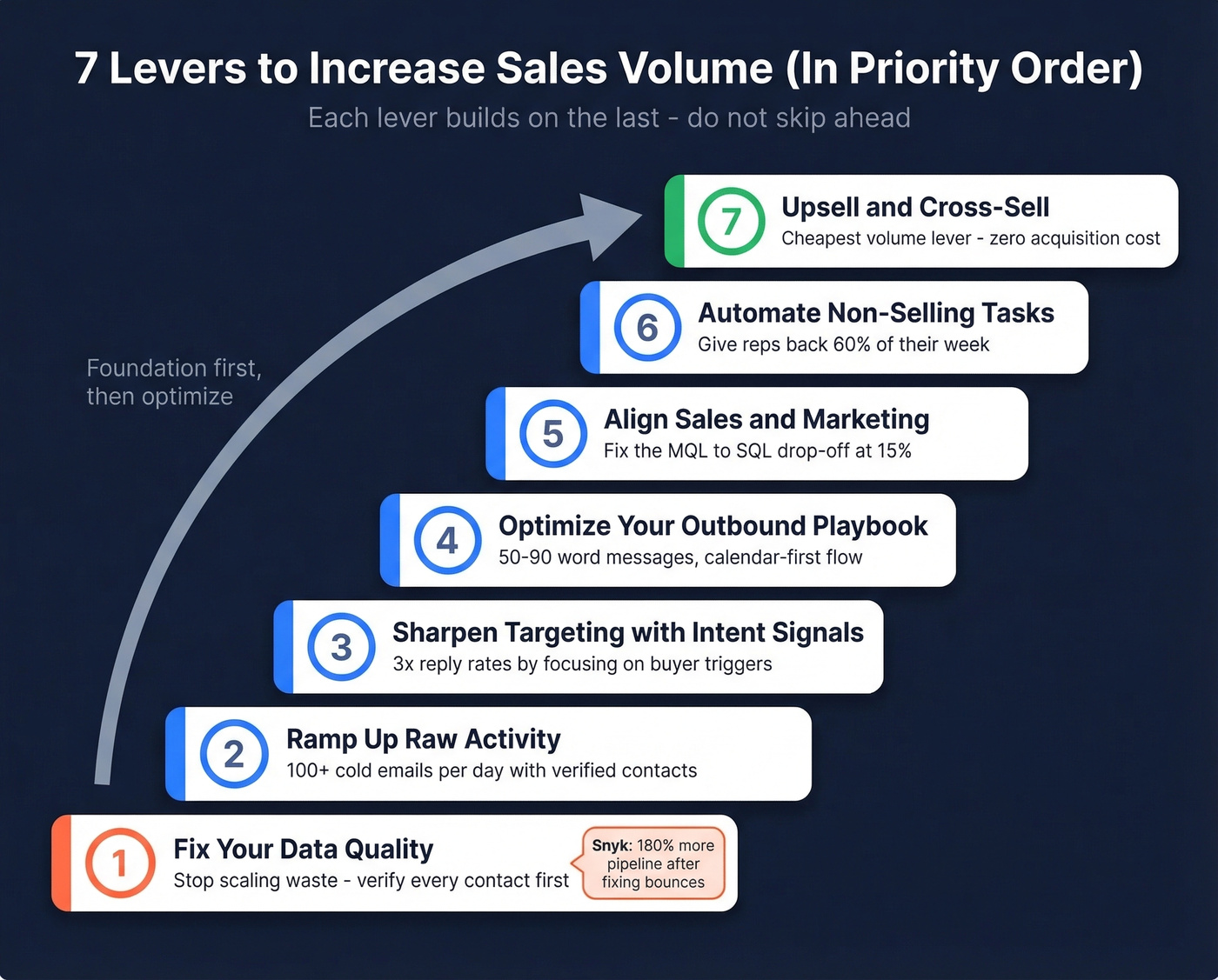
1. Fix Your Data Quality First
Garbage in, garbage out. If 30%+ of your emails bounce, scaling activity just scales waste. We've seen this pattern dozens of times: a team doubles their outreach volume and wonders why meetings didn't double. The answer is usually sitting in their bounce report.
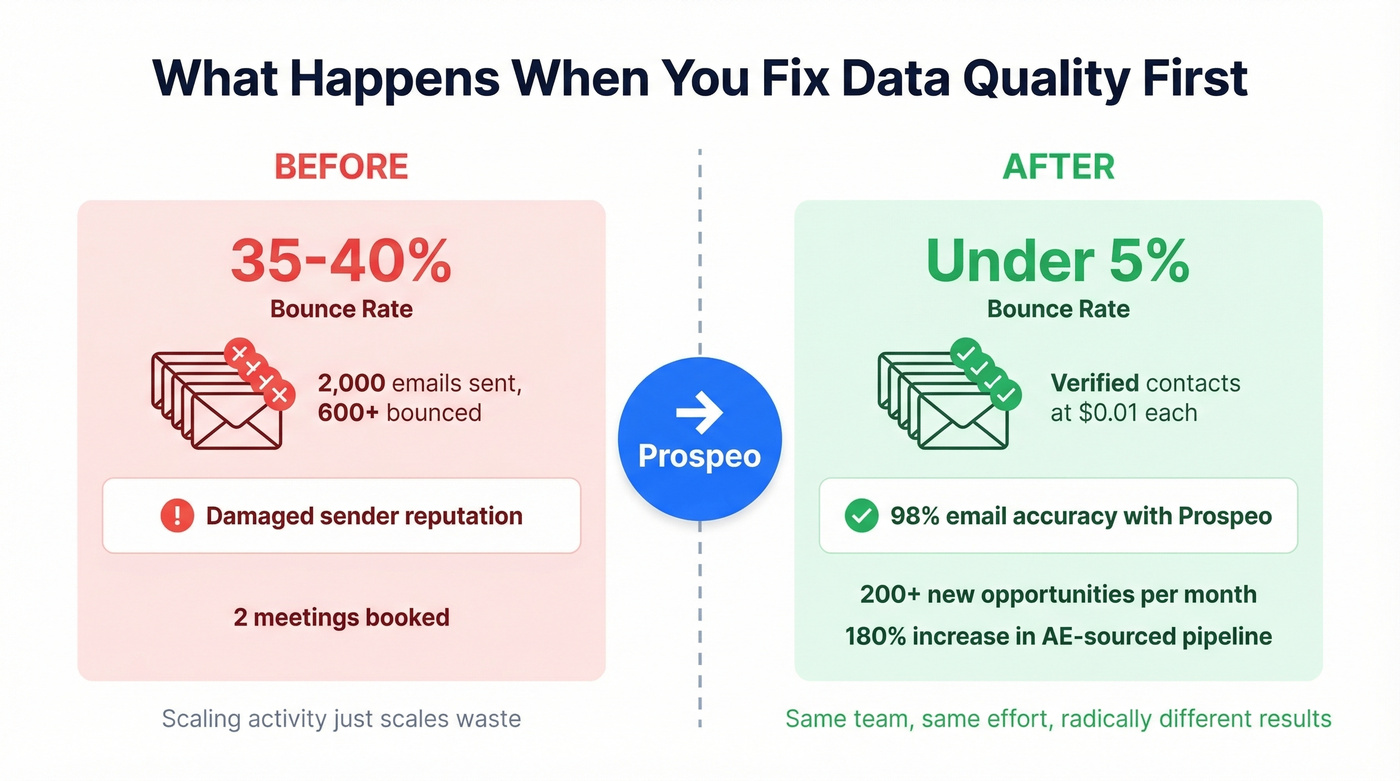
Snyk's sales team lived this. Their bounce rate was running 35-40% before they switched to Prospeo. After the switch, bounces dropped under 5%, and AE-sourced pipeline jumped 180% - over 200 new opportunities per month. The data quality fix alone unlocked that growth.
Before you scale anything, make sure every contact in your list is real. At roughly $0.01 per verified email, the cost of verification is negligible compared to the cost of bounced emails and a torched sender reputation. If you need a deeper playbook, start with email bounce rate benchmarks and fixes, then tighten your email deliverability fundamentals.
2. Ramp Up Raw Activity
The consensus on r/sales is blunt: new reps should prioritize volume of activity and comfort over consuming endless advice, podcasts, and books. The ones who ramp fastest just do more reps.
Baseline targets to aim for: 30 personalized messages per day on professional channels, 100+ cold emails per day with verified contacts, and consistent daily execution before you start optimizing scripts. Finesse comes after the baseline. Not before. If you want a menu of what to track, use these sales activities as your baseline.
Here's the thing: if your average deal is under $10K, you probably don't need a sophisticated ABM strategy. You need more at-bats. Volume solves most problems at the lower end of the market. Sophistication is for teams that have already maxed out their activity baseline and need to squeeze more from each touch.
3. Sharpen Targeting with Intent Signals
Brute-force volume works, but intent-led outbound can 3x your reply and conversion rates by focusing on fewer, higher-signal leads. Instead of blasting your entire TAM, build lists around triggers: job changes, funding rounds, tech installs, competitor research.
The shift from mass outreach to signal-based targeting is the single biggest efficiency gain in modern outbound. You'll send fewer emails and book more meetings. Bombora-powered intent data tracks 15,000 topics to surface buyers who are actively researching solutions like yours - that's the difference between cold outreach and warm outreach wearing a cold email's clothes. To operationalize this, build an ideal customer profile and layer in identifying buying signals.
4. Optimize Your Outbound Playbook
Groundleads' outbound research nails the tactical layer. Messages should be 50-90 words, offer-led, with two suggested meeting times. Include an inline scheduler. Set up reply coverage across time zones so momentum doesn't die overnight.
Measure meetings held and next steps created - not opens and clicks. Opens are directional at best. A "calendar-first" flow where every touchpoint makes it easy to book converts better than clever copy with no clear ask. If your sequences stall after the first touch, borrow these sales follow-up templates and tighten your sequence management.
5. Align Sales and Marketing on Lead Quality
That MQL-to-SQL drop-off at 15%? It's almost always a sales-marketing alignment problem. Marketing generates leads that sales doesn't trust. Sales ignores leads that marketing worked hard to create. The cycle feeds itself.
The fix is boring but effective: shared definitions of what qualifies a lead, SLAs on follow-up timing, and regular feedback loops. 94% of B2B marketers say trust is the key to success. That trust starts internally, between the teams that are supposed to be working together.
One underused alignment tool: video. 78% of B2B marketers now use video in their sales process, and brands combining video with expert voices are 2.2x more likely to be trusted by buyers. Sales teams that co-create video content with marketing - customer stories, product walkthroughs, objection-handling clips - close the trust gap faster than teams passing static PDFs back and forth.
6. Automate Non-Selling Tasks
Reps spend 60% of their time on non-selling tasks. That's not a rounding error - it's the majority of their week. AI adoption has exploded: 89% of revenue orgs now use AI, and sellers with AI tools are 3.7x more likely to hit quota.
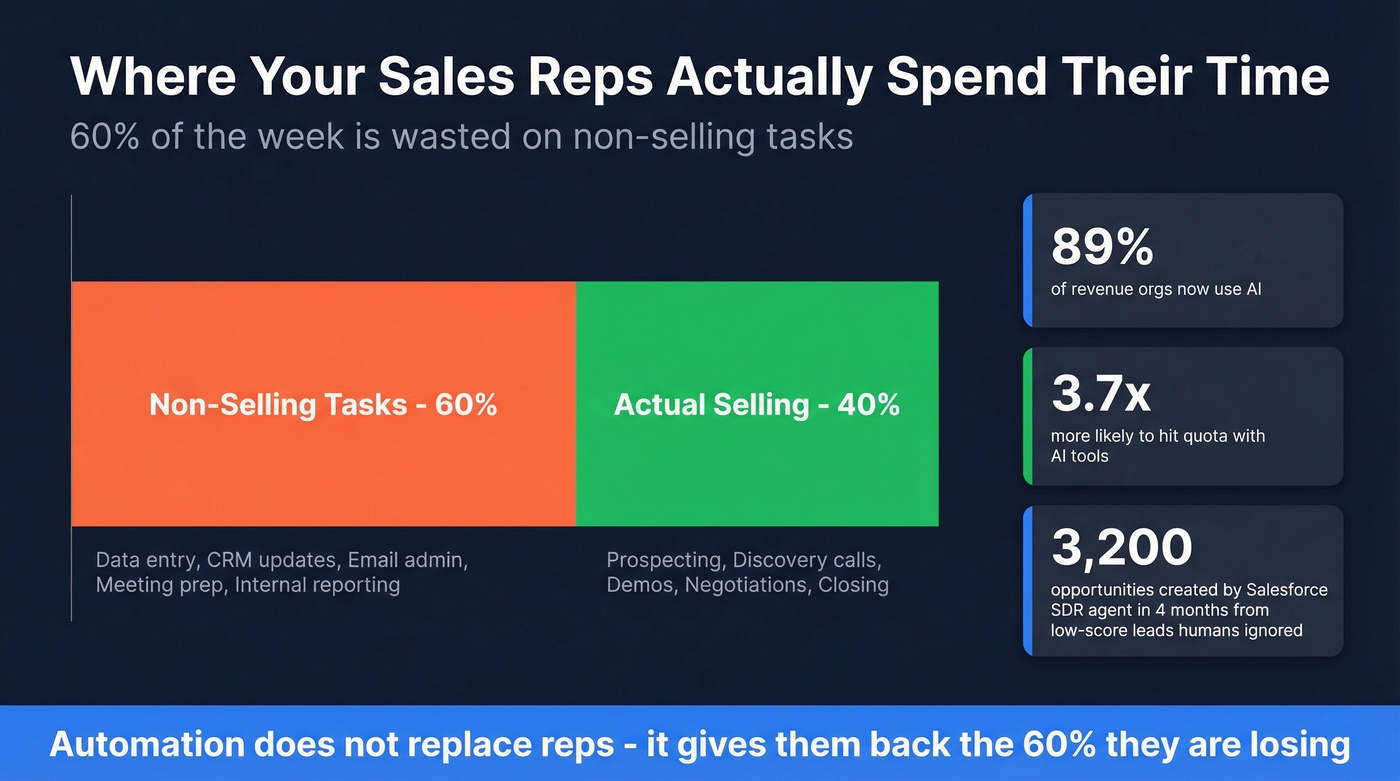
Salesforce's own SDR agent created 3,200 opportunities in four months by working low-score leads that human reps wouldn't touch. CRM automation, auto-enrichment, and sequence tools don't replace reps - they give reps back the 60% of their week that's currently wasted on data entry and admin. If you're evaluating tooling, start with SDR tools and auto sales CRM options (even outside dealerships, the workflows translate).
7. Upsell and Cross-Sell Existing Customers
This is the cheapest volume lever. No acquisition cost, no cold outreach, no trust-building from scratch. In B2B, it means connecting price to value and expanding within accounts - more seats, more departments, higher tiers. In B2C, it's bundles, suggestive selling, and visual merchandising. If you want the clean definitions and when to use each, see cross-selling vs up-selling.
A restaurant owner on r/restaurantowners framed it perfectly: some customers order just a coffee, others get a full meal plus dessert plus a second drink. The difference often comes down to staff scripting and in-store visuals - not the menu itself.
B2B vs. B2C Volume Playbooks
The levers above apply universally, but execution differs dramatically between B2B and B2C.
B2B: Pipeline-First
B2B deals involve 6-10 stakeholders on average, and Martal's data puts it at 13 decision-makers per deal. Volume in B2B isn't just "more leads" - it's multi-threading into accounts and running omnichannel sequences across email, phone, and professional channels.
The biggest quick win we see in B2B? Reactivating dead leads. That r/b2bmarketing thread recommends sending a special offer to ghosted prospects to re-activate deals fast. It's low-effort, high-signal pipeline already sitting in your CRM. And with 80% of buyer interactions now digital, your sequences need email, phone, and professional channel coverage - not just one.
B2C: Conversion-First
B2C volume is about conversion rate and average order value. The buying cycle is shorter, more emotional, and more transactional. Your levers are different: checkout optimization, loyalty programs, bundle pricing, and reducing friction at every step.
Pricing strategy deserves more attention than most B2C operators give it. Tiered pricing, charm pricing ($9.99 vs. $10), and strategic discounting on high-margin bundles can lift unit volume meaningfully without proportional margin loss. Pair that with scripted upsells at the point of sale - "Would you like to add X for $Y?" - and you consistently lift AOV in retail and food service.
Tools That Help You Sell More
The right stack depends on your model and budget. Here's what's worth your time in 2026:
| Tool | Category | Starting Price | Best For |
|---|---|---|---|
| Prospeo | Prospecting / Data | Free; ~$0.01/verified email | Verified emails + mobiles (98% accuracy) |
| Apollo.io | Prospecting / Data | Free (10K emails/mo); $49/mo | Budget all-in-one |
| Clay | Enrichment / Signals | $149/mo | Signal orchestration |
| Instantly | Cold Email | $30/mo | Sending at scale |
| ZoomInfo | Enterprise Data | $15K+/yr | Large enterprise teams |
| HubSpot CRM | CRM | Free; paid from ~$20/mo | Pipeline management |
| Salesforce | CRM | From ~$25/user/mo | Enterprise CRM + AI |
For a Series A team running outbound on a budget, the gap between $0.01 per verified email and $1 per lead is the difference between scaling and stalling. Skip ZoomInfo if your average contract is under $25K - the enterprise tools will eat your margin before they pay for themselves. If you're comparing providers, start with data enrichment services and sales prospecting databases.
Snyk's 50 AEs went from 35-40% bounce rates to under 5% - and AE-sourced pipeline jumped 180%. Stack Optimize built a $1M agency with sub-3% bounce rates across every client. The lever that moved the needle wasn't more activity. It was better data from 300M+ verified profiles.
Teams using Prospeo book 26% more meetings than ZoomInfo users. See why.
Mistakes That Kill Sales Volume
These are the patterns we see tank volume over and over:
- Over-optimizing before hitting baseline activity. You can't A/B test your way to quota if you're only sending 20 emails a day. Hit volume first, then refine.
- Ignoring data quality. If your bounce rate is above 5%, you have a data problem, not a messaging problem. Fix the list before you rewrite the copy.
- Treating every deal the same. A $5K deal and a $50K deal shouldn't get the same sales cycle. Velocity thinking means matching effort to opportunity size.
- Relying on gut over data. Only 48% of organizational decisions are based on quantitative analysis. The rest is vibes. Vibes don't compound.
- Ignoring rep tenure and territory design. Rep performance peaks at roughly 3 years and declines after 5. If your top performers are burning out or your territories are lopsided, no amount of process optimization will fix the volume gap. Rotate territories and invest in ramping new reps before the decline sets in.
FAQ
What is a good sales volume?
The median B2B conversion rate is 2.9% - legal services hit 7.4%, B2B e-commerce runs at 1.8%. Benchmark against your vertical first, then aim for 10-20% improvement per quarter. Consistent quarter-over-quarter gains compound faster than one-time spikes.
How do you calculate sales volume?
Total units sold in a given period. For performance tracking, use the variance formula: (actual units - forecasted units) x standard price per unit. Track both gross and net volume to catch hidden churn.
Sales volume vs. revenue - what's the difference?
Volume counts units sold; revenue multiplies units by price. You can grow one while the other shrinks, so healthy growth means both moving up together. Monitor them independently.
How does AI help increase sales volume?
AI automates the non-selling tasks eating 60% of rep time - data entry, lead scoring, sequence writing, and intent signal identification. Sellers using AI tools are 3.7x more likely to hit quota according to Vidyard's 2026 research.
What's the fastest way to boost deal count on a budget?
Fix data quality first - cutting bounces from 30%+ to under 5% - then hit consistent daily outreach targets. Most teams see measurable lift within 2-4 weeks from those two changes alone.