

Inside Sales Closing Techniques: What Actually Works on the Phone
It's 3:47 PM on a Thursday. You're on call number 28. The prospect picked up - already a minor miracle - and you've got maybe 90 seconds before they decide if this conversation is worth finishing. Field reps get handshakes and two-hour dinners. You get a phone line and whatever trust you can build before they alt-tab back to Slack.
Most closing guides weren't written for this reality. The average B2B close rate sits around 20%, reps spend roughly 30% of their time actually selling, and you don't need 14 techniques. You need three or four that you can execute cold, plus a repeatable structure for the last two minutes of every call. The rest is noise.
The Numbers You're Up Against
Only 43.5% of sales professionals hit quota. The average B2B deal takes 31 touchpoints across roughly 211 days, involves around five decision-makers, and 80% of deals need at least five follow-ups. Yet 44% of reps quit after one attempt.
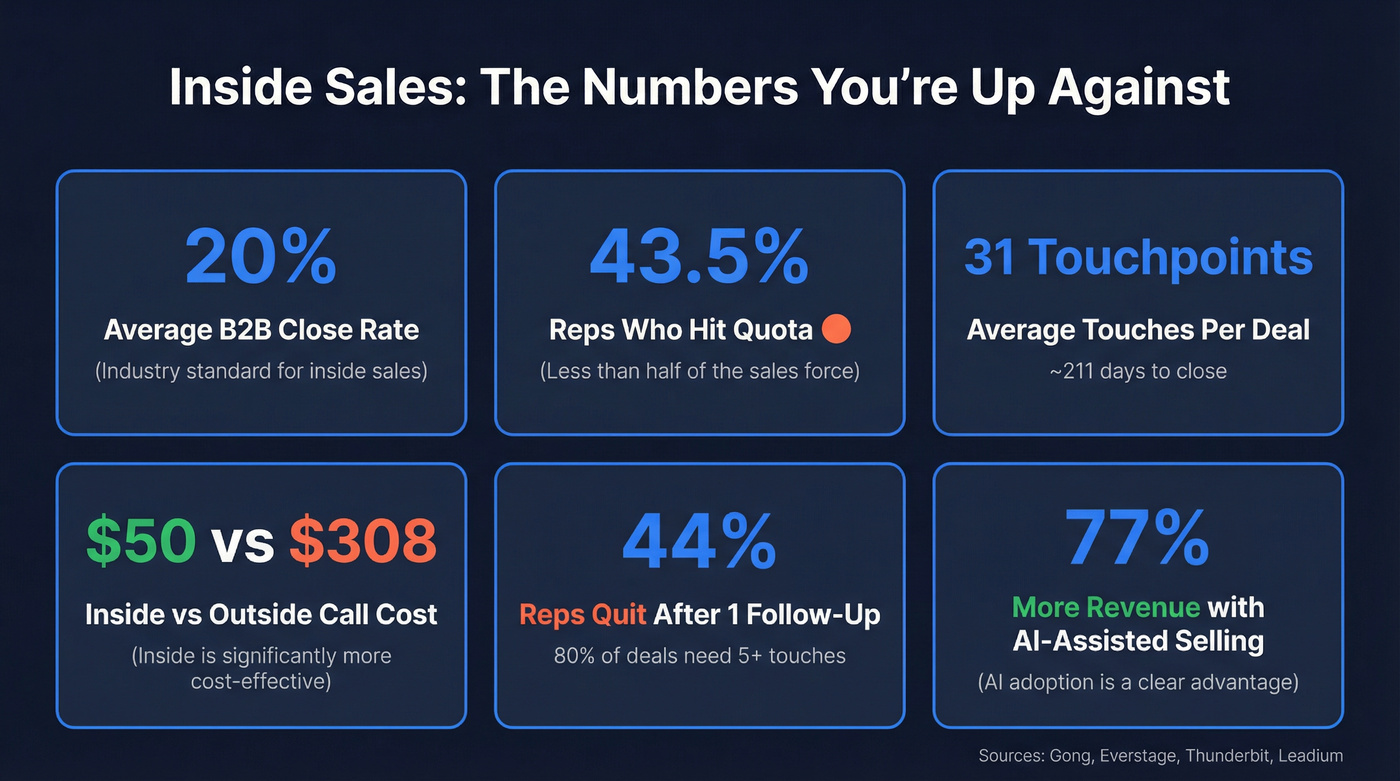
Here's the edge inside sales has: cost. An inside sales call runs about $50 versus $308 for an outside call. More at-bats for less money. And sellers who frequently use AI in their workflow generate 77% more revenue - a stat none of the old-school closing playbooks mention because they haven't caught up yet.
Let's be honest: if your team isn't combining AI-assisted research with verified contact data before every call block, you're running a 2019 playbook in a 2026 market. Speed and accuracy beat charm every time.
8 Closing Techniques for Phone and Video Selling
1. The Assumptive Close
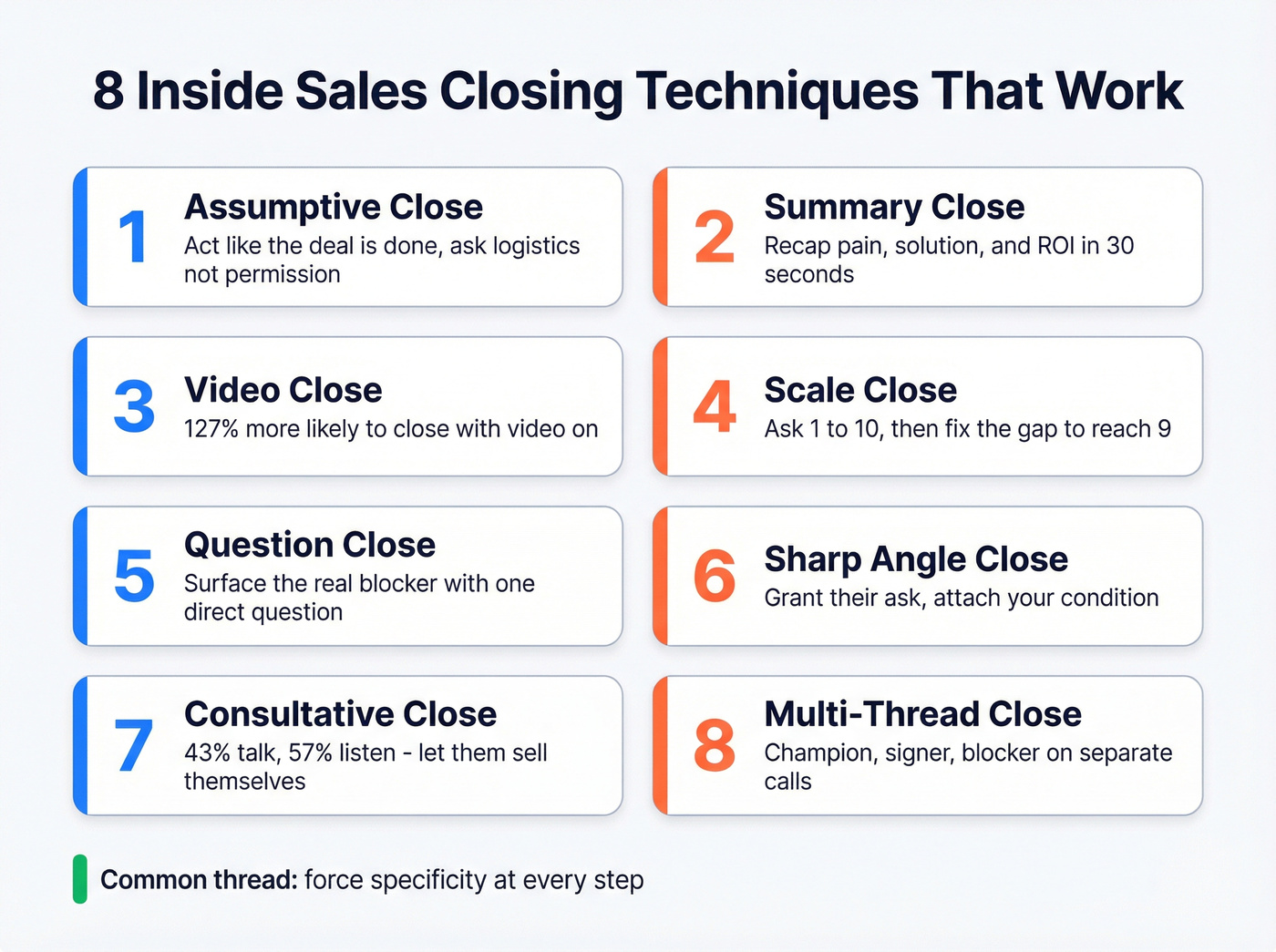
Act like the deal is already happening. "I'll send the contract this afternoon - does the billing contact prefer email or a shared link?" This is the single most effective close on the phone. Without body language, confidence carries the signal. We've watched reps transform their win rates just by cutting "so, what do you think?" from their vocabulary.
2. The Summary Close
Recap pain, solution, and ROI in 30 seconds, then ask for the yes. "We're solving the 4-hour manual enrichment problem, cutting list-building time by 60%, and ROI pencils out in month two. Ready to move forward?" On a phone call, this works because it reminds the prospect why they stayed on the line in the first place.
3. The Video Close
Turn your camera on. Deals are 127% more likely to close when video is used at any point in the process, and win rates jump 94% when the seller's camera is on. If you're still running closing calls audio-only, you're leaving money on the table.
We've seen reps flip a stalling deal just by saying: "Let me share my screen and walk through the proposal live." One visual walkthrough can do more than three follow-up emails.
4. The Scale Close
"On a scale of 1 to 10, how close are we?" Anything below an 8 gives you a natural opening: "What would get us to a 9?" This diagnoses objections without the awkward "do you have any concerns?" that makes prospects defensive. It's disarming because it feels collaborative, not confrontational.
5. The Question Close
Best used when you sense hesitation but can't pinpoint the blocker. "Is there any reason we wouldn't move forward this week?" forces the real objection to the surface. If there's a blocker, you'll hear it. If there isn't, you've just gotten implicit agreement.
6. The Sharp Angle Close
Picture this: the prospect asks for a discount, extra seats, or an extended trial. Instead of caving, grant it with a condition. "I can do that if we get the contract signed by Friday." Their ask becomes your closing mechanism. Skip this one if you don't have authority to make concessions on the spot - it backfires badly when you have to say "let me check with my manager" after committing. (If you want to go deeper on this, the concept of an anchor matters more than most reps think.)
7. The Consultative Close
The optimal talk-to-listen ratio is 43% talk, 57% listen. Ask what success looks like in six months and map your solution to their answer. Let the prospect articulate the value in their own words. Reps who monologue at 64% talk time lose more deals - period.
8. The Multi-Thread Close
Closed-won deals have 2x as many buyer contacts as closed-lost, and multi-threading boosts win rates by 130% on deals over $50K. With roughly five decision-makers per B2B deal and closed-won selling teams running 67% larger than lost-deal teams, single-threading is malpractice. Get the champion, the signer, and the blocker on separate calls. This is the technique that separates reps who close big deals from reps who close small ones. (If you need a system for this, start with account-based selling.)

Multi-threading a $50K+ deal means reaching the champion, the signer, and the blocker - all on verified direct dials. Prospeo gives you 125M+ verified mobiles with a 30% pickup rate and 98% email accuracy, refreshed every 7 days. Stop burning call blocks on wrong numbers.
Fill your call block with numbers that actually connect.
How to Run a Closing Call
A closing call is the final call where you expect a yes/no decision. Here's the structure we've refined across hundreds of deal reviews.
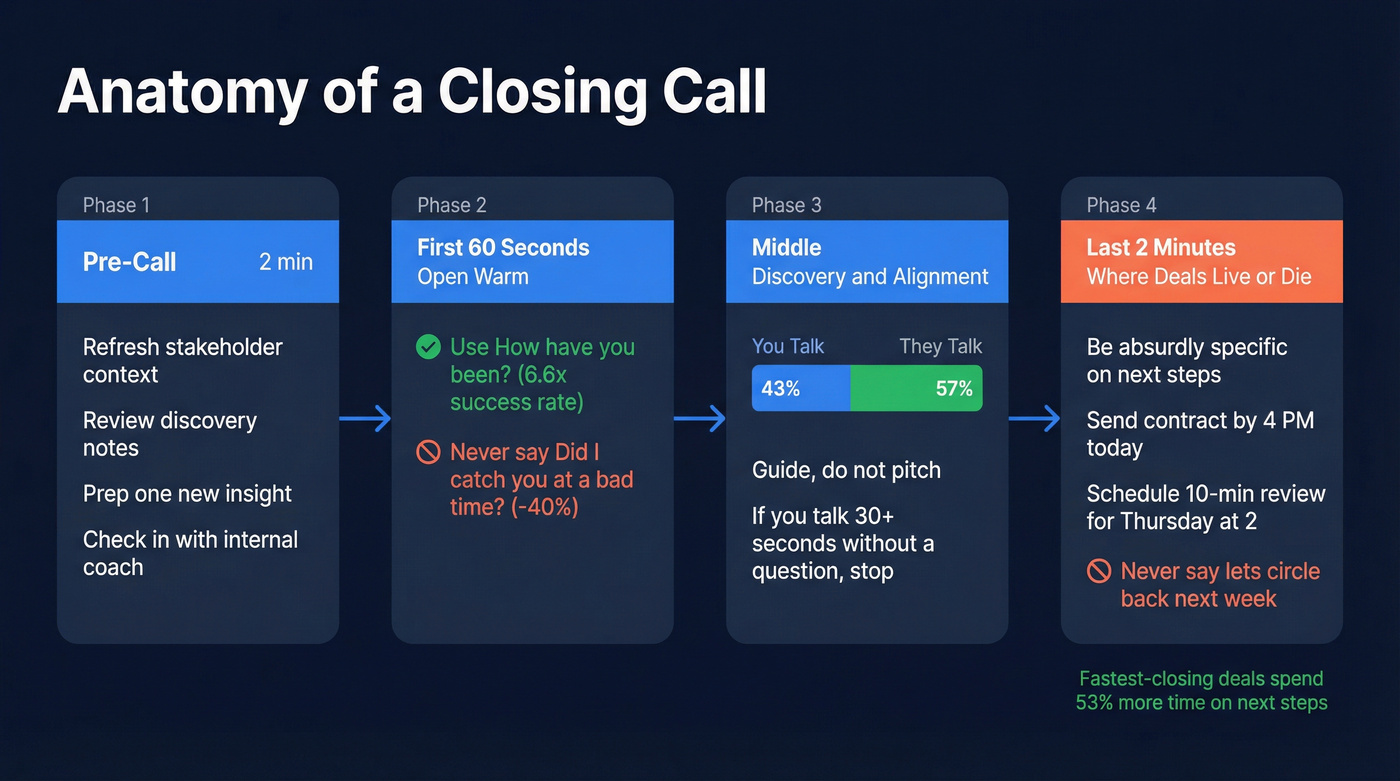
Pre-call (2 min): Refresh stakeholder context, review discovery notes, prep one insight they haven't heard. If you have an internal coach at the prospect org, check in first. (If your discovery is weak, fix it with better discovery questions.)
First 60 seconds: Open warm. Research shows "How have you been?" produces a 6.6x higher success rate on calls versus baseline openers. The principle applies doubly when you already have a relationship. Never open with "Did I catch you at a bad time?" - that drops your odds by 40%.
Middle: Maintain the 43/57 talk-to-listen ratio. Let the prospect articulate why this makes sense for their team. Your job is to guide, not pitch. If you catch yourself talking for more than 30 seconds straight without a question, stop.
Last 2 minutes: This is where deals live or die. The fastest-closing deals spend 53% more time discussing next steps in the first meeting. Be absurdly specific: "I'll send the contract by 4 PM today. Let's schedule a 10-minute review for Thursday at 2. Does that work?" Vague "let's circle back next week" is where pipeline goes to die. (For a full framework, see the steps to close a sale.)
Reach the Right Person First
None of these techniques matter if you're dialing dead numbers.
The average inside sales rep makes about 33 calls per day. Run a 200-prospect list and four wrong numbers by call 15 means you've burned more than a quarter of your first 15 dials on nothing - and your energy with it. We ran into this exact problem when testing outbound sequences last year: the technique was fine, the data was garbage, and the results reflected the data. If you're still building lists manually, tighten your sales prospecting techniques first.
Before your next call block, verify your list. Prospeo covers 125M+ verified mobile numbers and delivers a 30% pickup rate, with 98% email accuracy, all refreshed on a 7-day cycle. Starts free at 75 emails/month, roughly $0.01 per email after that, no contracts. Upload a CSV, verify in bulk, and make every dial count. (If you're comparing vendors, start with data enrichment services and best sales prospecting databases.)
Mistakes That Kill Inside Sales Deals
The biggest deal-killer is ending calls without specific next steps. "Let's talk soon" isn't a next step - a calendar invite is. If you need language that doesn't sound like a robot, keep a few sales follow-up templates handy.
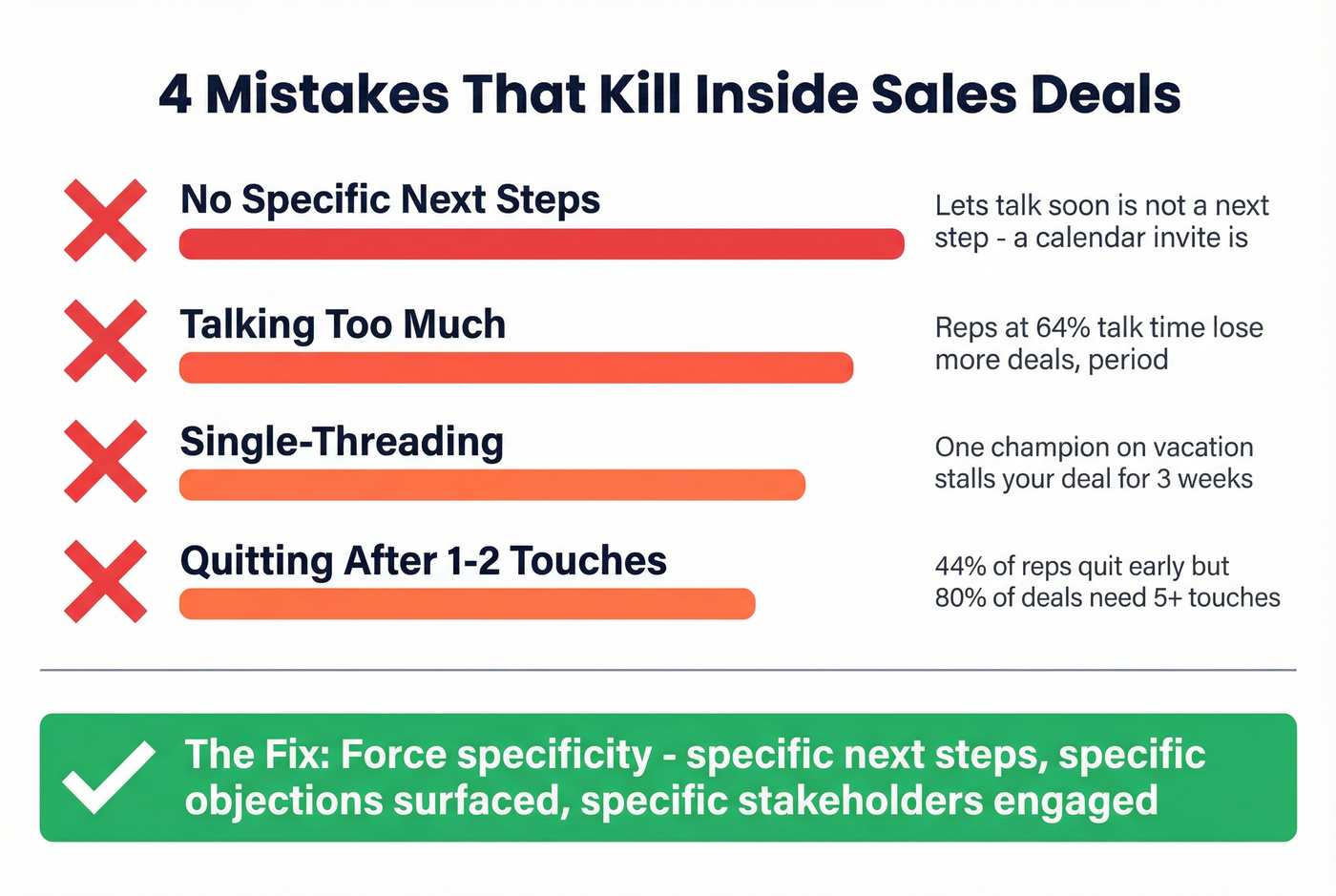
Second is talking too much. Reps who talk more than they listen lose more deals, full stop. Third, single-threading. One champion goes on vacation and your deal stalls for three weeks. The consensus on r/sales is always the same: lock next steps, stop single-threading, and never give up after one attempt. That last one matters more than people think - 44% of reps quit after one or two touches while 80% of deals need five-plus. (If you want the data behind persistence, read importance of follow-up in sales.)
Finally, ditch the script-reading. Scripts are training wheels, not a teleprompter. If you're reading verbatim, the prospect hears it. Record yourself on your next three calls and listen back. You'll cringe, but you'll also fix the problem fast.
The best inside sales closing techniques share a common thread: they force specificity. Specific next steps, specific objections surfaced, specific stakeholders engaged. Vagueness is the enemy of closed revenue.
Inside sales reps average 33 calls per day. Four wrong numbers by call 15 kills your momentum and your close rate. Prospeo's 7-day data refresh and 5-step verification mean your list is accurate when you pick up the phone - not stale data from six weeks ago.
Every dead dial is a closing opportunity you'll never get back.
FAQ
What's a good close rate for inside sales?
The average B2B close rate is roughly 20%. SMB deals close at 30-35%, enterprise closer to 15-18%, and SaaS hovers around 22%. Consistently above 25% means you're outperforming most teams.
How many follow-ups does it take to close a B2B deal?
80% of deals need at least five follow-up touches, and the average B2B deal requires 31 total across about 211 days. Most reps quit after one or two - which is why most miss quota.
What tools help inside sales reps close more?
A CRM for pipeline tracking, a conversation intelligence tool like Gong for call analytics, and a verified data platform for direct dials before every call block. Bad data kills close rates before technique even matters.
Does video actually improve close rates?
Yes - deals are 127% more likely to close when video is used at any stage, and win rates jump 94% when the seller's camera is on. Even one video touchpoint in a multi-call cycle measurably lifts outcomes.