

Inside Sales Success: The Numbers, Frameworks, and Fixes That Actually Work
It's Thursday afternoon. You've made 80 dials and had 3 conversations. Your manager asks why you only booked one meeting - then quotes a connect rate benchmark that hasn't been real in years.
Inside sales success in 2026 looks nothing like the playbooks most managers still run. The numbers have shifted, the channels have gotten harder, and the gap between top performers and everyone else keeps widening.
Quota attainment has hovered around 43% since early 2024 and shows no signs of recovering. Reps spend roughly 30% of their time actually selling - the other 70% disappears into admin, CRM hygiene, and internal meetings. Cold call connect rates have cratered from the double-digit ranges many VPs remember to 3-10% today. If you're hitting 5%, you're above average. Not underperforming. Above average.
Here's the stat that should reframe every conversation about team performance: 17% of reps generate 81% of revenue. The gap isn't closing. The game isn't broken, but the old rules are.
What You Need (Quick Version)
- Know the real benchmarks. A 3.43% cold email reply rate is average. 5.5% is top quartile. If your manager expects 15%, they're working from outdated data.
- Run a repeatable discovery system. SPIN for mid-market, MEDDPICC for enterprise. Pick one, drill it, coach to it weekly.
- Fix your data first. If your bounce rate is above 5%, your messaging doesn't matter - emails aren't landing. A data provider with 98% accuracy and a weekly refresh cycle solves this before you touch a single subject line.
- Keep your stack lean. Three tools beat thirteen. CRM, sequencer, data provider. That's it until you've earned complexity.
Benchmarks That Matter in 2026
Most "inside sales benchmarks" articles recycle outdated numbers. Here's what current data actually shows.
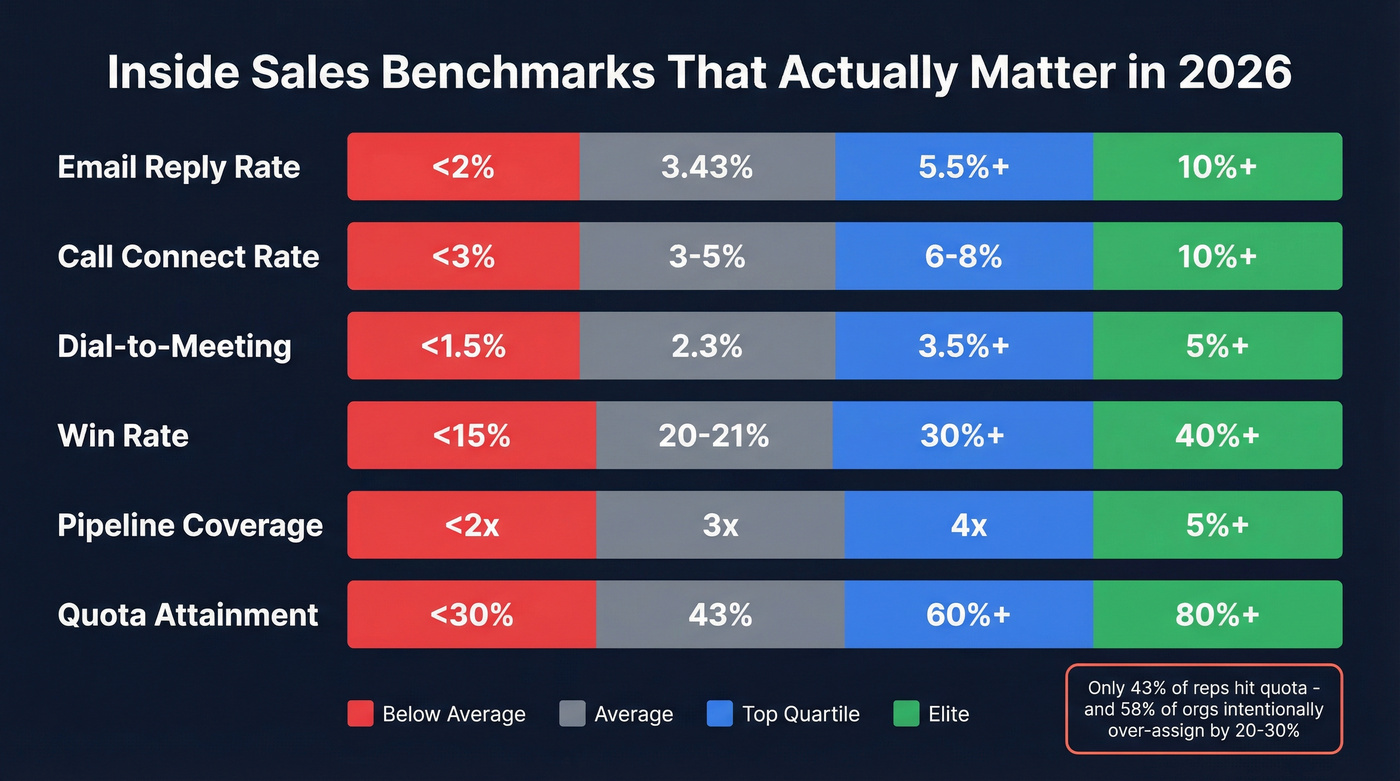
| Metric | Below Average | Average | Top Quartile | Elite |
|---|---|---|---|---|
| Email reply rate | <2% | 3.43% | 5.5%+ | 10%+ |
| Call connect rate | <3% | 3-5% | 6-8% | 10%+ |
| Dial-to-meeting | <1.5% | 2.3% | 3.5%+ | 5%+ |
| Win rate | <15% | 20-21% | 30%+ | 40%+ |
| Pipeline coverage | <2x | 3x | 4x | 5x+ |
| Quota attainment | <30% | 43% | 60%+ | 80%+ |
Email benchmarks come from Instantly's 2026 cold email benchmark report. Quota attainment is supported by RepVue's index data, and quota-design benchmarks draw from a cross-industry analysis of 100+ organizations.
A fully ramped SDR should target 10-20 qualified meetings per month. If that sounds high, it's because most reps are working with bad data and unfiltered lists - not because the number is unrealistic.
The quota attainment picture gets grimmer by role. SDRs attain at 53.2%, mid-market AEs at 40.1%, and enterprise AEs at just 38.2%. Across those 100+ organizations, 58% intentionally over-assign quotas by 20-30%. So if you're "missing quota," the quota itself might be the problem.
Two benchmarks most teams ignore but shouldn't: speed-to-lead under 5 minutes dramatically improves conversion - after an hour, conversion drops off a cliff. And pipeline coverage at 3-5x your number, tracked weekly, is the leading indicator that predicts quota attainment before the quarter ends. If you're below 3x halfway through the quarter, no amount of closing skill saves you.
Use the pipeline velocity formula to diagnose where you're leaking: (SQLs x avg deal size x win rate) / sales cycle length. That tells you which lever to pull.
Discovery and Qualification
SPIN for Mid-Market
Neil Rackham's research analyzed 35,000+ sales calls and found that top performers ask 4x more implication questions than average reps. That's the entire insight worth remembering about SPIN.
The flow: Situation questions gather context. Problem questions surface pain. Implication questions expand the cost of inaction. Need-payoff questions let the prospect articulate the value of solving it.
Most reps get stuck in Situation and Problem. They hear a pain point and immediately pitch. The money is in Implication - "What happens to your pipeline if that bounce rate stays at 35% for another quarter?" That's where urgency lives. The most common discovery failure we see is simple: reps talk too much. Top performers spend more time listening than pitching. If you're talking more than you're listening on a discovery call, you're pitching, not discovering.
MEDDPICC for Enterprise
When you're selling into buying committees of 6-10 stakeholders - and enterprise deals can involve 15-17 - you need a qualification framework that tracks the political landscape, not just the pain. MEDDPICC gives you that map: Metrics, Economic Buyer, Decision Criteria, Decision Process, Paper Process, Identify Pain, Champion, Competition.
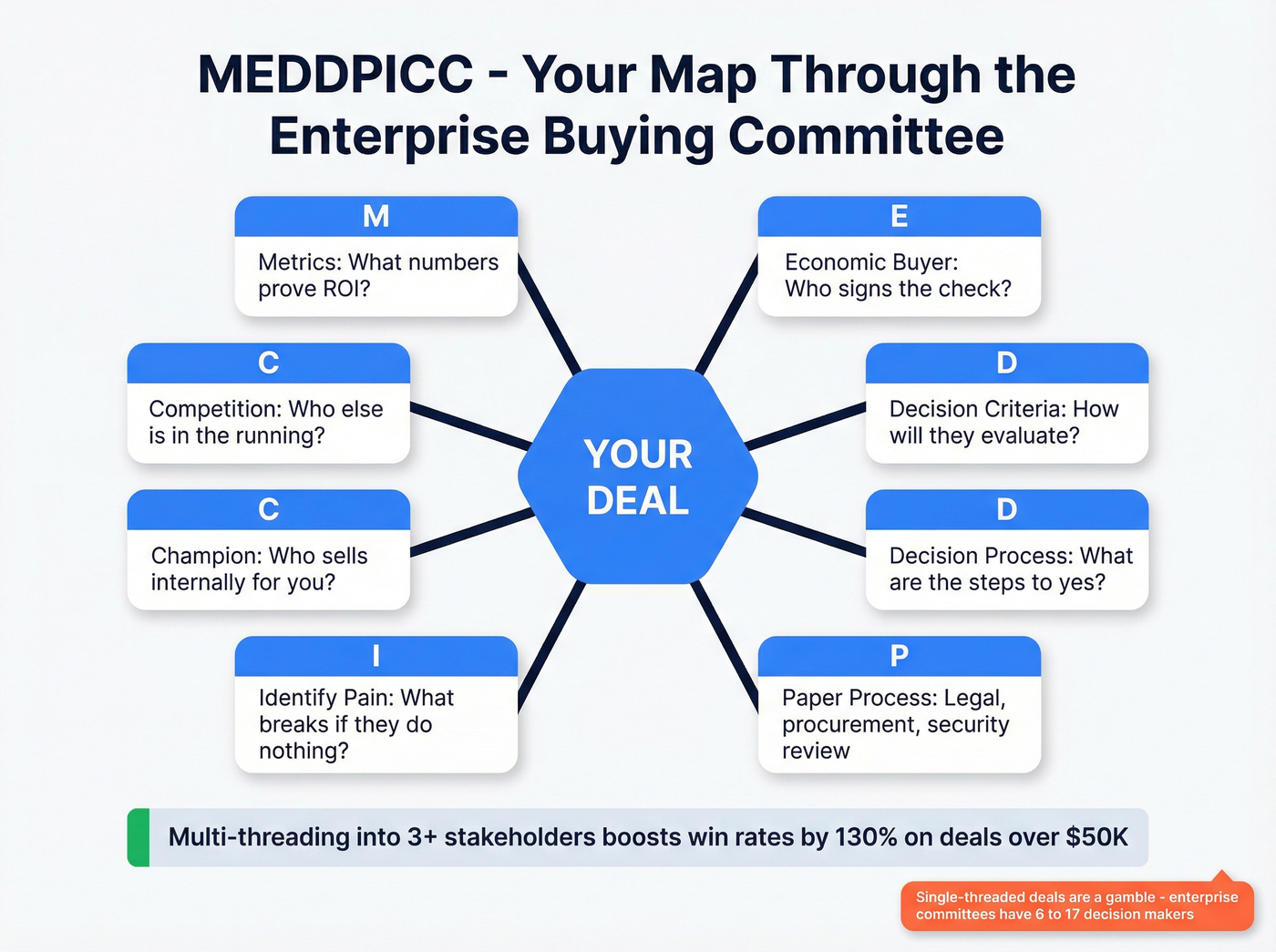
The critical insight is multi-threading. An analysis of 1.8M opportunities found that for deals over $50K, multi-threading boosts win rates by 130%. If you're single-threaded into one champion on an enterprise deal, you're gambling. MEDDPICC forces you to ask: who else needs to say yes.
If you want a tighter question bank for this, use MEDDIC discovery questions as your weekly coaching baseline.

Multi-threading into 6-10 stakeholders means nothing if your emails bounce. Prospeo's 98% email accuracy and 125M+ verified mobile numbers give inside sales teams the direct lines they need - refreshed every 7 days, not every 6 weeks.
Stop losing deals to bad data. Start reaching real buyers.
Building Your Outreach System
The Instantly benchmark data reveals a few non-obvious patterns worth building your cadence around.
If you're still building sequences from scratch, start with a proven B2B cold email sequence structure and iterate from there.
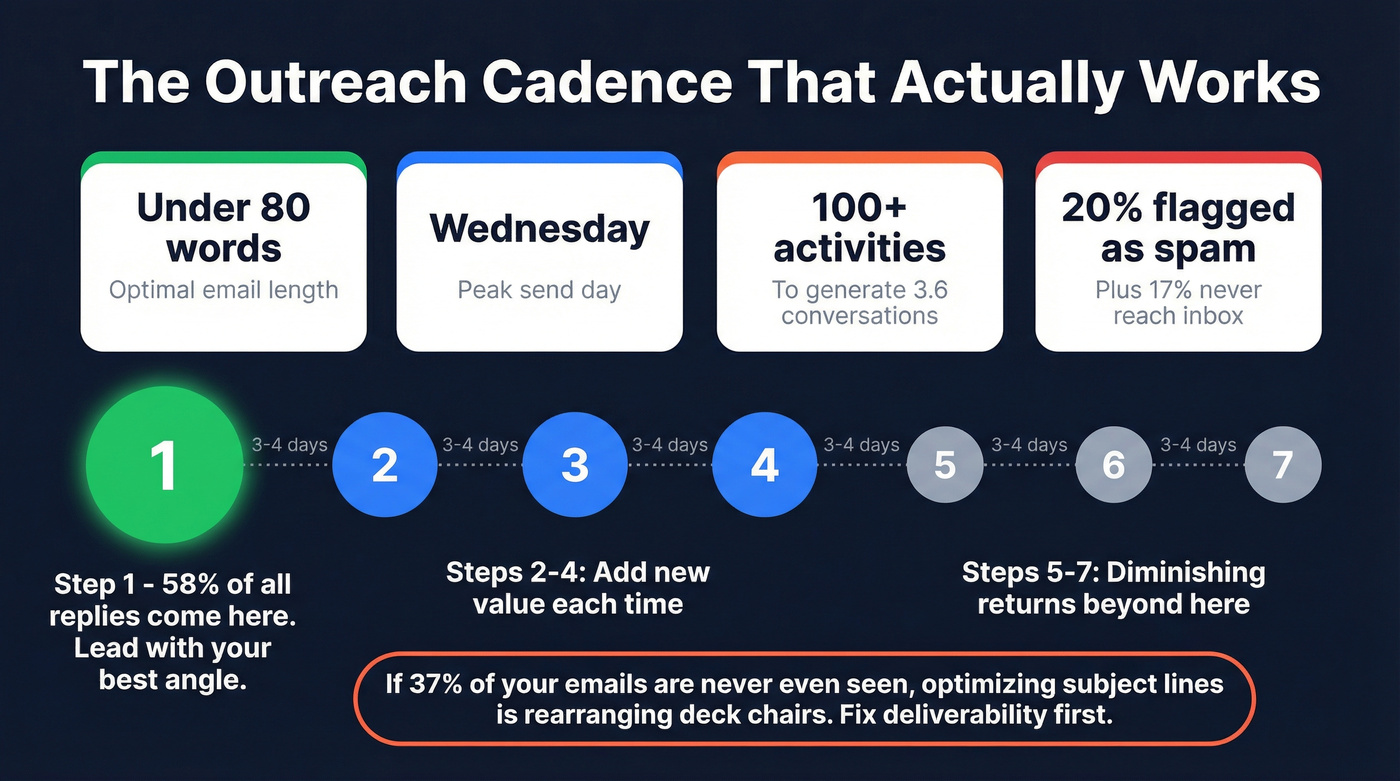
58% of replies come from step 1. Your first touch carries the majority of the weight - don't save your best angle for follow-up three. Build sequences of 4-7 touchpoints with 3-4 day spacing. Beyond 7 steps, returns diminish sharply unless each touch introduces genuinely new value.
Keep emails under 80 words. Wednesday is the peak send day. A/B test messaging weekly, not monthly. The average rep runs 100+ outreach activities per day to generate 3.6 quality conversations - that ratio sounds brutal, and it is, but it's the math. The teams that outperform don't necessarily do more volume. They do better targeting and cleaner data, which means fewer wasted touches.
When you need a fast way to improve reply rates without rewriting everything, pull from these sales follow-up templates and adapt them to your ICP.
One tactic worth stealing: send a short, personalized email to a VP, then CC their direct report with a note like "Thought [Name] might be the right person to evaluate this." It creates internal accountability and a reason for the direct report to respond. Simple, slightly uncomfortable, and it works.
Let's be honest about a number that doesn't get enough attention: roughly 20% of cold emails get flagged as spam despite legitimate intent, and 17% never reach the primary inbox at all. If a third of your emails aren't even being seen, optimizing subject lines is rearranging deck chairs.
Fix Your Data Before Messaging
This is the contrarian take that every competitor article misses. They tell you to write better emails. The email doesn't matter if it bounces.
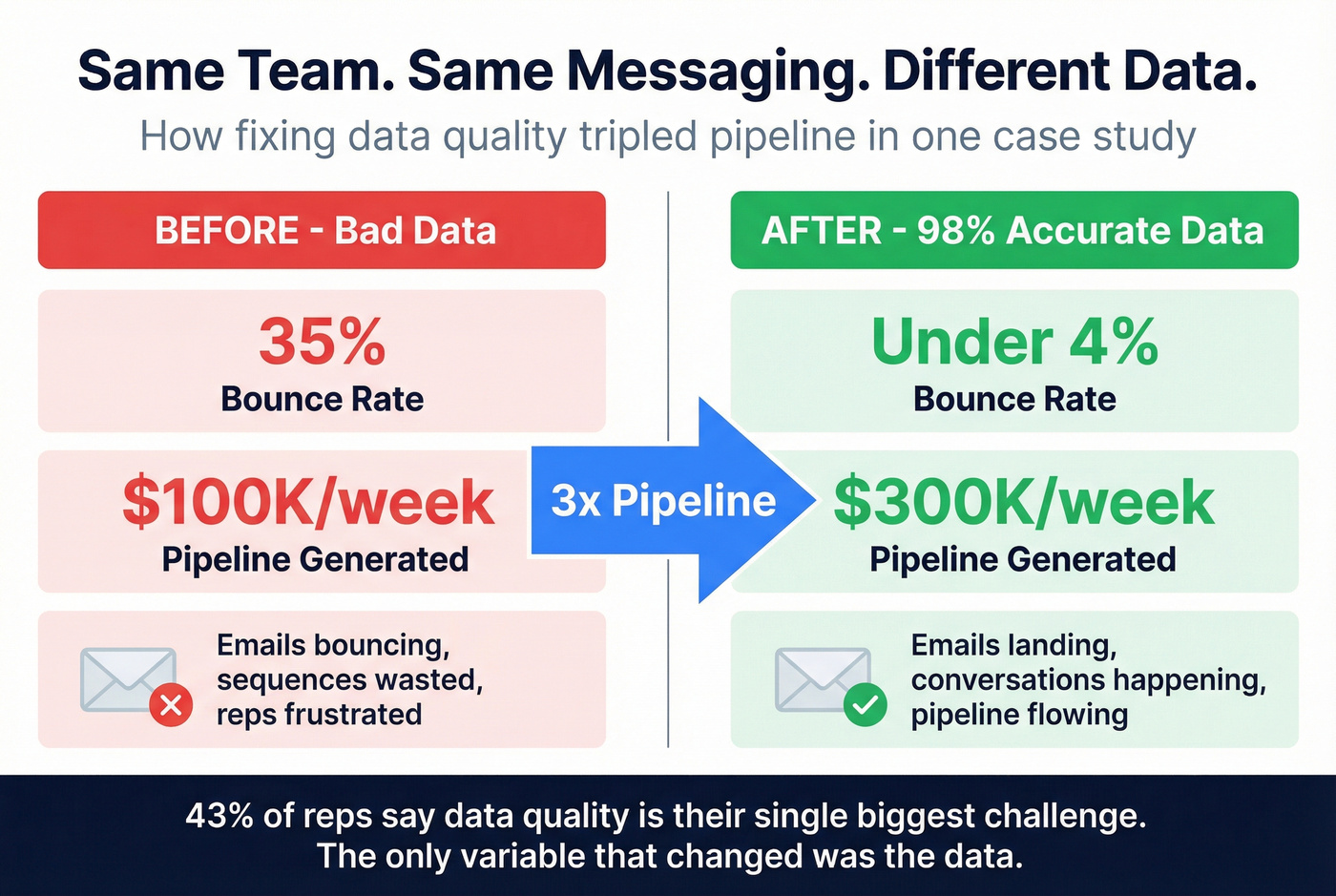
43% of reps cite data quality as their single biggest challenge. We've seen this play out repeatedly: a team rewrites their entire sequence, A/B tests for weeks, and sees no improvement - because their bounce rate was 30%+ the whole time. The messaging was fine. The data was garbage.
If you need a quick diagnostic and fix list, use this email bounce rate guide as your checklist before you touch copy.
Meritt is a good case study. Their bounce rate was 35%. Pipeline sat at $100K/week. After switching to a provider with 98% email accuracy and a 7-day refresh cycle, bounce rate dropped to under 4%. Pipeline tripled to $300K/week. Same team, same messaging, same market. The only variable that changed was data quality.
The 7-day refresh cycle matters more than most people realize. The industry average is six weeks. Stale data compounds fast - by week six, you're emailing people who've moved roles, changed companies, or had their contact details updated.
For teams where the average deal size is under $10K, you probably don't need a $30K/year data platform. But you absolutely need accurate emails and verified phone numbers. The math doesn't work otherwise - you can't afford to waste 30% of your outreach on bounces when your margin per deal is already thin.
If you're evaluating vendors, compare options in our roundup of data enrichment services.
Teams using Prospeo cut bounce rates from 35%+ to under 4% and book 26% more meetings than ZoomInfo users. At $0.01 per email, you fix your entire data layer for less than one wasted rep-hour.
Your messaging isn't broken. Your contact data is.
The Minimum Viable Tech Stack
The average sales team runs 5.6 tools. Most don't need more than three.
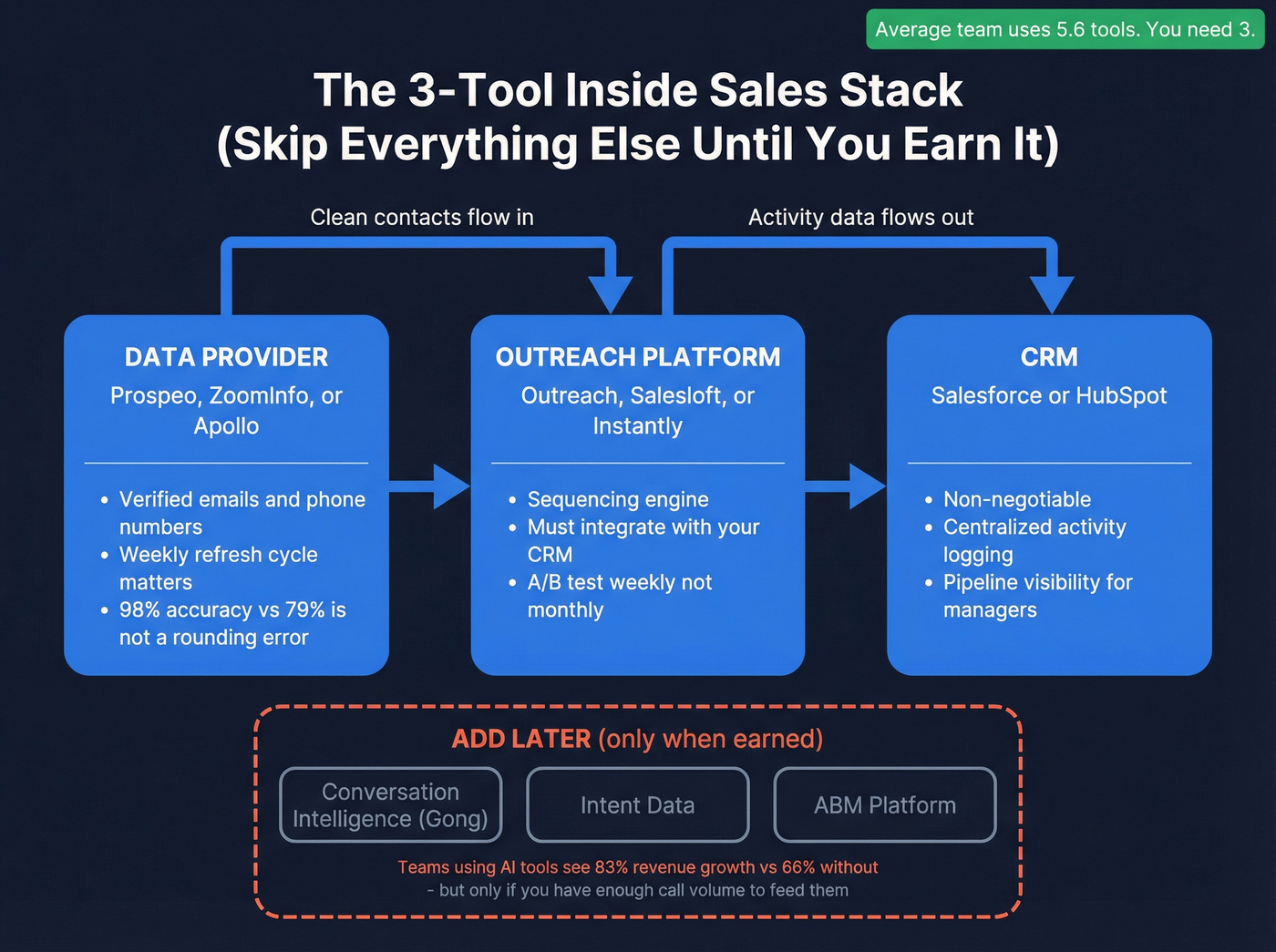
CRM - Salesforce or HubSpot. Non-negotiable. If reps aren't logging activity somewhere centralized, you have no pipeline visibility. (If you're standardizing your CRM language, see these examples of a CRM.)
Outreach platform - Outreach, Salesloft, or Instantly. This is your sequencing engine. Pick one that integrates cleanly with your CRM. If you're rebuilding your outbound motion, start with these sales prospecting techniques.
Data provider - Prospeo, ZoomInfo, or Apollo. Your sequences are only as good as the contacts feeding them. In our experience, the difference between 79% email accuracy and 98% accuracy isn't a rounding error - it's the difference between a 30% bounce rate and a sub-5% one.
Skip conversation intelligence tools until your team is running enough calls to generate useful data. Gong is the leading option, and Outreach's CI tool shortens sales cycles by 19%. Teams using AI-powered tools see 83% revenue growth versus 66% without. But adding CI to a team that makes 20 calls a week is buying a sports car for a dirt road. Earn the complexity first.
The Manager Playbook
Do this:
Run weekly 30-minute 1:1s focused on pipeline, not activity counts. Review 3-5 recorded calls per rep per week - that's where coaching actually happens. Set realistic ramp expectations: 3-5 months for SDRs, 4-8 months for AEs. Expecting full productivity in month two is how you burn new hires. Track pipeline coverage weekly at the rep level. If someone's below 3x with six weeks left in the quarter, intervene now - not at the forecast review.
If you want a simple onboarding structure that doesn't waste month one, use a 30-60-90 day plan for sales reps.
Stop doing this:
Job contamination - pulling reps off their core selling activities to handle whatever urgent issue arises - is the single fastest way to destroy productivity. Every time you yank a rep out of their prospecting block for "one quick thing," you're destroying their momentum and their numbers.
If reps are updating spreadsheets, chasing contract signatures, and fielding inbound support tickets, that's a management failure, not a productivity problem. And never let reps dial undifferentiated lists. Undirected prospecting - calling down a list with no ICP filtering, no intent signals, no research - burns out teams and tanks connect rates simultaneously.
If your team is struggling on the phones specifically, build a repeatable cold calling system instead of pushing raw volume.
Look, 58% of organizations over-assign quotas by 20-30%. If your team is "underperforming," audit the quota math before you audit the reps. The system might be broken upstream.
FAQ
What's a realistic cold call connect rate in 2026?
Expect 3-10% depending on list quality and local presence dialing. Consistently hitting 5% puts you above average. The old double-digit benchmarks still quoted in some orgs come from a different era of phone behavior - spam labeling and caller ID permanently changed the math.
How long does it take to ramp an inside sales rep?
Plan 3-5 months for an SDR and 4-8 months for an AE. Ramp time drops significantly when reps start with verified contact data instead of spending their first weeks cleaning lists. GreyScout cut ramp from 8-10 weeks to 4 weeks after improving their data quality - new reps booked meetings in their first month.
What's the most important KPI for inside sales teams?
Pipeline coverage at 3-5x quota is the leading indicator that predicts attainment before the quarter ends. Revenue, win rate, and activity metrics all matter, but coverage is the one number that tells you whether a rep has enough at-bats to hit their number. Track it weekly at the individual level.
How are outreach strategies shifting in 2026?
The biggest shift is from volume-first to accuracy-first outreach. Declining connect rates, tighter spam filters, and buyer fatigue mean cleaner data and fewer, better-targeted touches consistently outperform brute-force dialing and mass email blasts. Teams adapting early are the ones posting top-quartile numbers.