

Intro Email Format: Data-Backed Guide for 2026
You spent 20 minutes crafting the perfect intro email. Personalized opener, clever subject line, a CTA you workshopped with your manager. It bounced. Not "went to spam" bounced - hard bounced, because the email address was dead.
Here's the uncomfortable truth most intro email format guides won't tell you: format is actually your fourth priority, behind list quality, subject line, and length. Get those three wrong and the world's best copy won't save you. We've seen teams double their reply rates by fixing data before touching a single word of copy.
Let's fix all four.
The Quick Version
Short on time? Here's the framework that works in 2026:
- Use the CCVA structure: Context, Credibility, Value, Ask. Lead with them, not you.
- Keep it short: cold emails under 60 words, warm intros under 150.
- Send Monday-Thursday, 8-11 AM in the recipient's timezone.
- Verify your list first. An 11% bounce rate will tank your domain reputation faster than bad copy ever could.
- One CTA only. Emails with a single clear ask get 371% more clicks than those with multiple.
Everything below unpacks the data behind each of these.
Three Types of Introduction Emails
Before you pick a template, figure out which type you're actually sending. The format, length, and benchmarks are completely different for each.
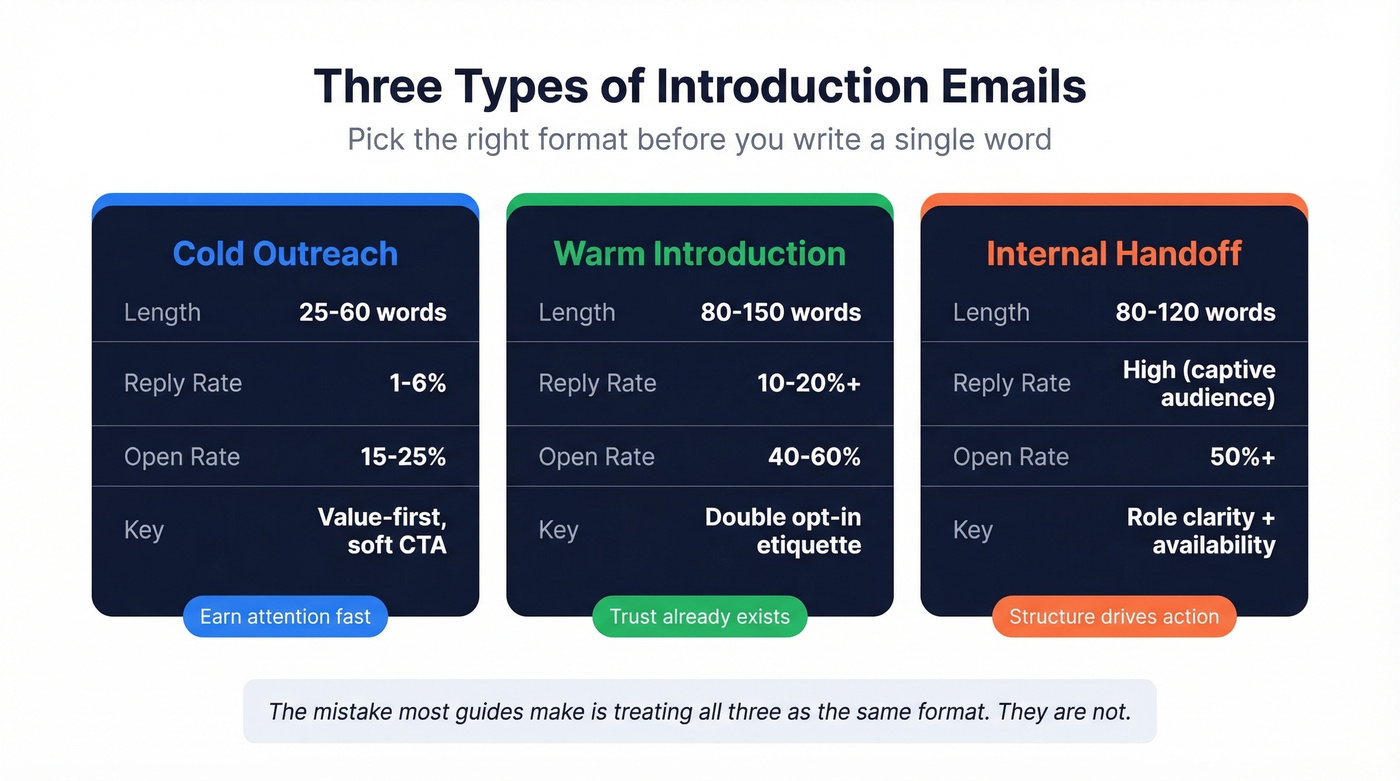
| Cold Outreach | Warm Introduction | Internal Handoff | |
|---|---|---|---|
| Typical length | 25-60 words | 80-150 words | 80-120 words |
| Reply benchmark | 1-6% | 10-20%+ | High (captive audience) |
| Open benchmark | 15-25% | 40-60% | 50%+ |
| Key difference | Value-first, soft CTA | Double opt-in etiquette | Role clarity + availability |
Cold outreach is a different sport from warm introductions. A cold email to a VP of Engineering needs to earn attention in under 60 words. A warm intro from a mutual connection can afford more context because trust already exists. An internal handoff - "meet your new CSM" - has a captive audience but still needs structure to drive action.
The mistake most guides make is treating all three as the same format. They're not.
The CCVA Framework
Every good intro email format follows the same four-step skeleton, whether it's 40 words or 140: Context, Credibility, Value, Ask.
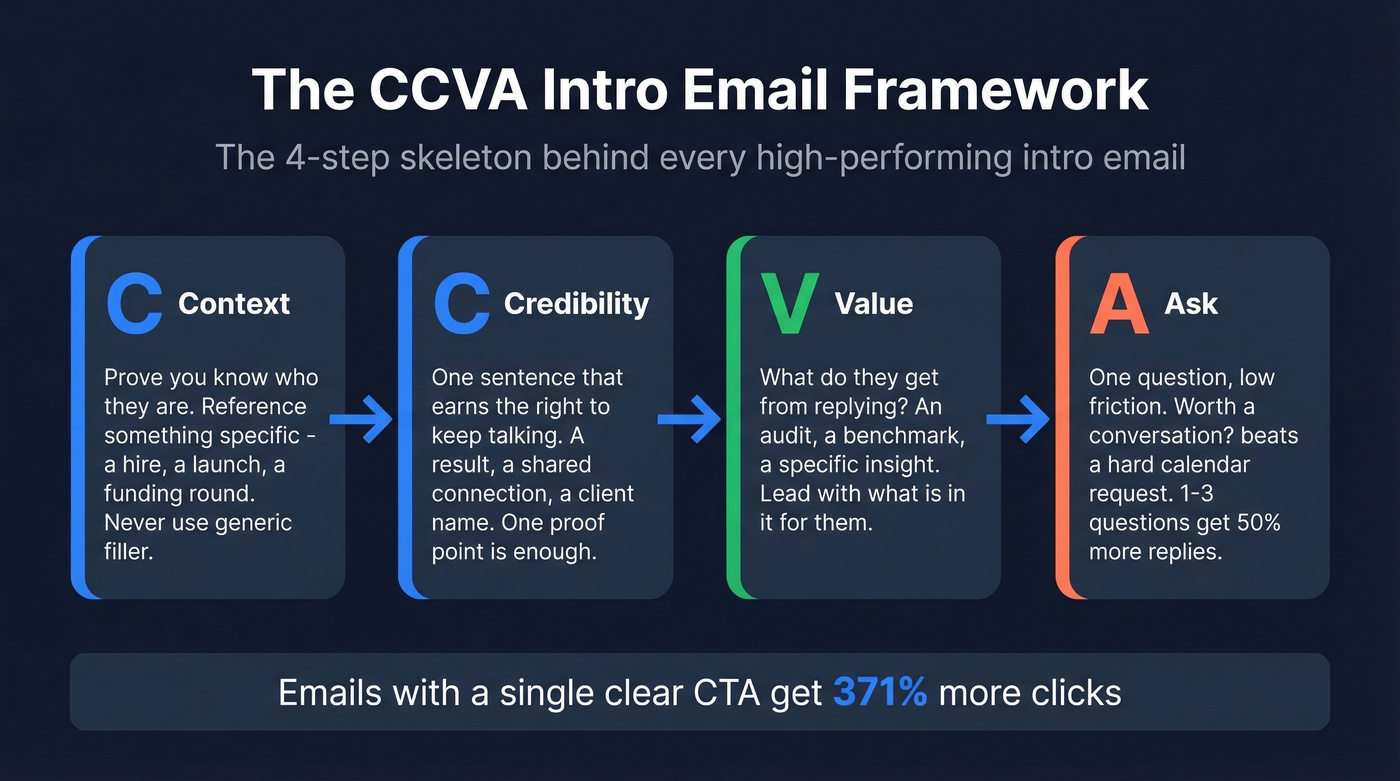
Context is the first line. It proves you know who they are and why you're reaching out. Not "I came across your profile" - that's generic filler everyone deletes. Reference something specific: a recent hire, a product launch, a funding round. Using "Hi [Name]" instead of a generic greeting boosts replies by up to 142%.
Credibility is one sentence that earns the right to keep talking. A relevant result, a shared connection, a recognizable client name. Don't overthink this - one proof point is enough.
Value is the offer. What do they get from replying? An audit, a benchmark, a specific insight. Lead with what's in it for them, not a paragraph about your company's founding story.
Ask is the CTA. One question, low friction. "Worth a conversation?" beats "Can we schedule a 30-minute discovery call next Tuesday at 2 PM EST?" (If you need help tightening asks, see Email Call to Action.)
Here's what this looks like at 47 words:
Saw you just opened a second SDR pod - congrats. We helped [similar company] cut their ramp time from 8 weeks to 4 by fixing their contact data pipeline. I put together a quick breakdown of what we found. Worth a look?
Cold emails with 1-3 questions get 50% more responses than those without any. The "Ask" step is where that question lives. And notice what's missing: "My name is..." Your name is already in the sender field. Don't waste your opening line on it.
One more thing - skip gendered titles like Mr./Ms. unless you're certain of the recipient's preference. "Hi Jordan" is always safer than "Dear Mr. Smith," and it reads more naturally anyway.
Ideal Email Length
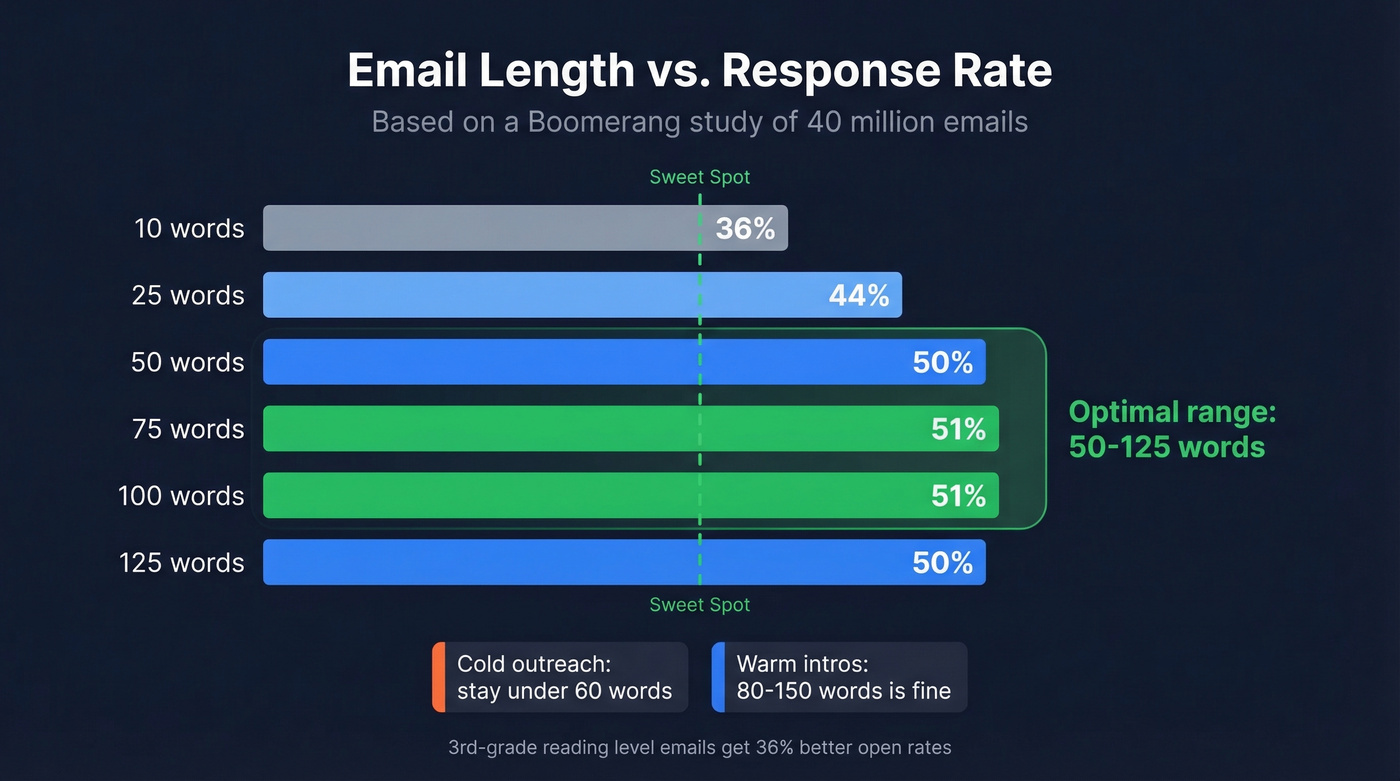
Length is one of the few variables with real data behind it. A Boomerang study of 40 million emails mapped word count to response rate:
| Word Count | Response Rate |
|---|---|
| 10 words | 36% |
| 25 words | 44% |
| 50 words | 50% |
| 75 words | 51% |
| 100 words | 51% |
| 125 words | 50% |
The sweet spot is 50-125 words for general emails. For cold outreach specifically, the practitioner trend has shifted shorter - 25-50 words for an initial touch, with follow-ups stretching to 30-150 words. (For a full sequence approach, use a B2B cold email sequence instead of one-off sends.)
There's also a floor. Emails under 20 words underperform because there isn't enough room for personalization, a value prop, and a question. Ten words gets you a 36% response rate - 14 percentage points lower than the 50-word mark.
One more data point that matters: readability. Emails written at a 3rd-grade reading level had a 36% better open rate than those written at a college level, and 17% higher response rates than high school level. Short sentences. Simple words. Nobody's impressed by your vocabulary in a cold email. (If you want a deeper breakdown, see Email copywriting.)
Warm intros can run 80-150 words comfortably. Cold outreach should stay under 60. Regardless of length, write like you're texting a smart colleague, not drafting a memo.

You just read that an 11% bounce rate tanks your domain faster than bad copy. Prospeo's 5-step verification delivers 98% email accuracy - so every perfectly formatted intro email actually lands in a real inbox. At $0.01 per email, fixing your data costs less than one bounced opportunity.
Stop perfecting copy that bounces. Fix your list first.
Subject Lines That Get Opens
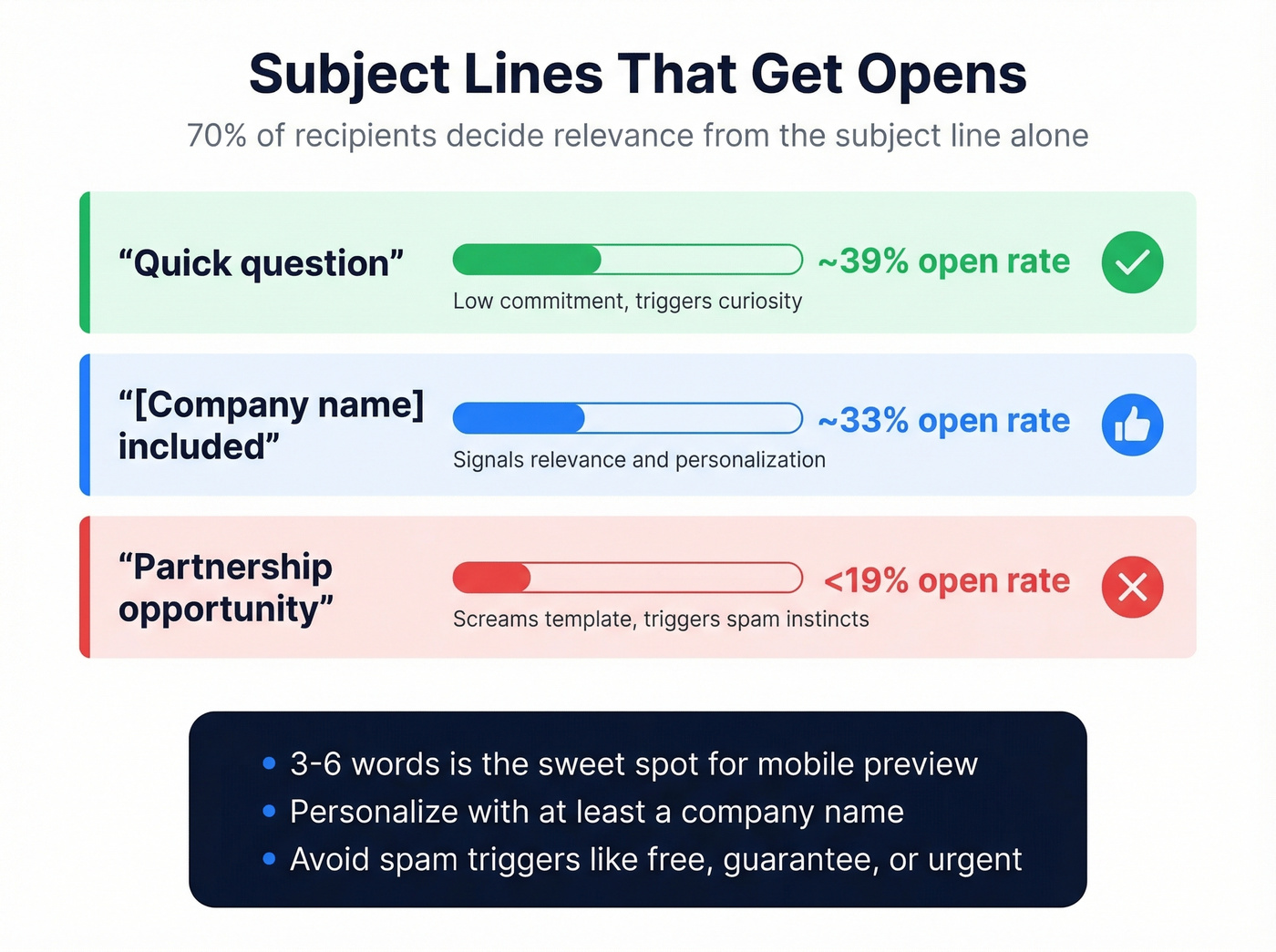
Nearly 70% of recipients judge whether an email is relevant based on the subject line alone. And 69% will mark an email as spam based purely on the subject. That makes the subject line the entire gatekeeping mechanism.
Here's what practitioner testing shows:
| Subject Line Type | Approx. Open Rate |
|---|---|
| "Quick question" | ~39% |
| Company name included | ~33% |
| "Partnership opportunity" | <19% |
Curiosity and specificity win. Salesy language loses. "Quick question" works because it's low-commitment and triggers curiosity. Including the recipient's company name signals relevance. "Partnership opportunity" screams template.
Three rules for subject lines in 2026: keep them short (3-6 words is the sweet spot for mobile preview), personalize when possible even just with a company name, and avoid spam triggers like "free," "guarantee," or "urgent." (Need options? Pull from these email subject line examples.)
Templates by Scenario
Cold Sales Introduction
This follows the CCVA framework at under 60 words. Soft CTA, value-first, zero fluff.
Subject: Quick question about [company]'s outbound
Hi [First Name],
Noticed [company] just posted 3 new SDR roles - scaling outbound fast. We helped [similar company] cut bounce rates from 35% to under 4%, which doubled their reply rates in 6 weeks.
Put together a quick teardown of what we changed. Worth a look?
[Your name]
No "My name is," no company history, no hard meeting ask. The entire email is about them.
Warm Networking Introduction
Warm intros follow double opt-in etiquette. Ask the person being introduced if they're open to the connection before you make it. Then send a "forwardable draft" the connector can pass along.
Subject: Intro - [Your Name] / [Their Name]
Hi [Connector],
Here's a quick draft you can forward to [Their Name]:
"[Their Name], [Connector] mentioned you're building out your data ops team. I've spent the last 3 years helping mid-market SaaS companies set up enrichment workflows - would love to compare notes if you're open to it. No pressure either way."
Feel free to edit however you'd like.
Keep warm intros under 150 words. The connector's reputation is on the line, so make it easy for them to say yes.
Third-Party Referral Introduction
When someone introduces you, respond within 24 hours. Acknowledge the connector, then move the conversation forward.
Subject: Re: Intro - [Your Name] / [Their Name]
Hi [Their Name],
Thanks for being open to connecting - [Connector] speaks highly of the work you're doing at [company]. I'd love to hear how you're thinking about [specific challenge]. Happy to share what's worked for teams in a similar spot.
Would a 15-minute call next week work?
If they don't reply within a week, let it go. Referral intros have a short shelf life.
New Role / Team Introduction
Internal intros need to answer three questions fast: who are you, what changes, and what doesn't.
Subject: Your new [role title] - quick intro
Hi team,
I'm [Name], stepping into the [role] starting [date]. I'll be handling [specific responsibilities]. [Previous person]'s work on [project] isn't going anywhere - I'm picking up where they left off.
I'll be setting up 1:1s over the next two weeks. In the meantime, I'm at [email/Slack] if anything comes up.
CSM / Account Handoff
Account handoffs are where relationships break. Include a bullet agenda and a calendar link so the customer doesn't have to do any work.
Subject: New CSM - [Your Name] at [Company]
Hi [Customer Name],
I'm [Name], your new CSM taking over from [Previous CSM]. I'd love to set up a quick 15-minute intro to cover:
- How you'd define success for this quarter
- Any open items from [Previous CSM]
- Your top priority for the next 30 days
[Calendar link] - grab any slot that works.
Follow-Up After No Reply
Wait 4-5 days. Keep it under 50 words. Add new value or reframe the ask - never just "bump" the thread.
Subject: Re: [Original subject]
Hi [First Name],
Figured the timing might've been off. Quick update: we just published [relevant resource/benchmark] that covers [their specific challenge]. Thought it might be useful regardless.
[Link]
Worth a quick look?
The worst follow-up is "Just checking in" or "Bumping this to the top of your inbox." Both say "I have nothing new to offer." Always bring something fresh - a 60-second Loom video, a relevant benchmark, a reframed angle. The consensus on r/sales is that structured follow-up sequences of 2-3 touches roughly double total reply rates compared to single-touch sends. (If you want plug-and-play copy, use these cold email follow-up templates.)
When to Send
Timing data splits cleanly between cold outreach and marketing emails. Don't mix them up.
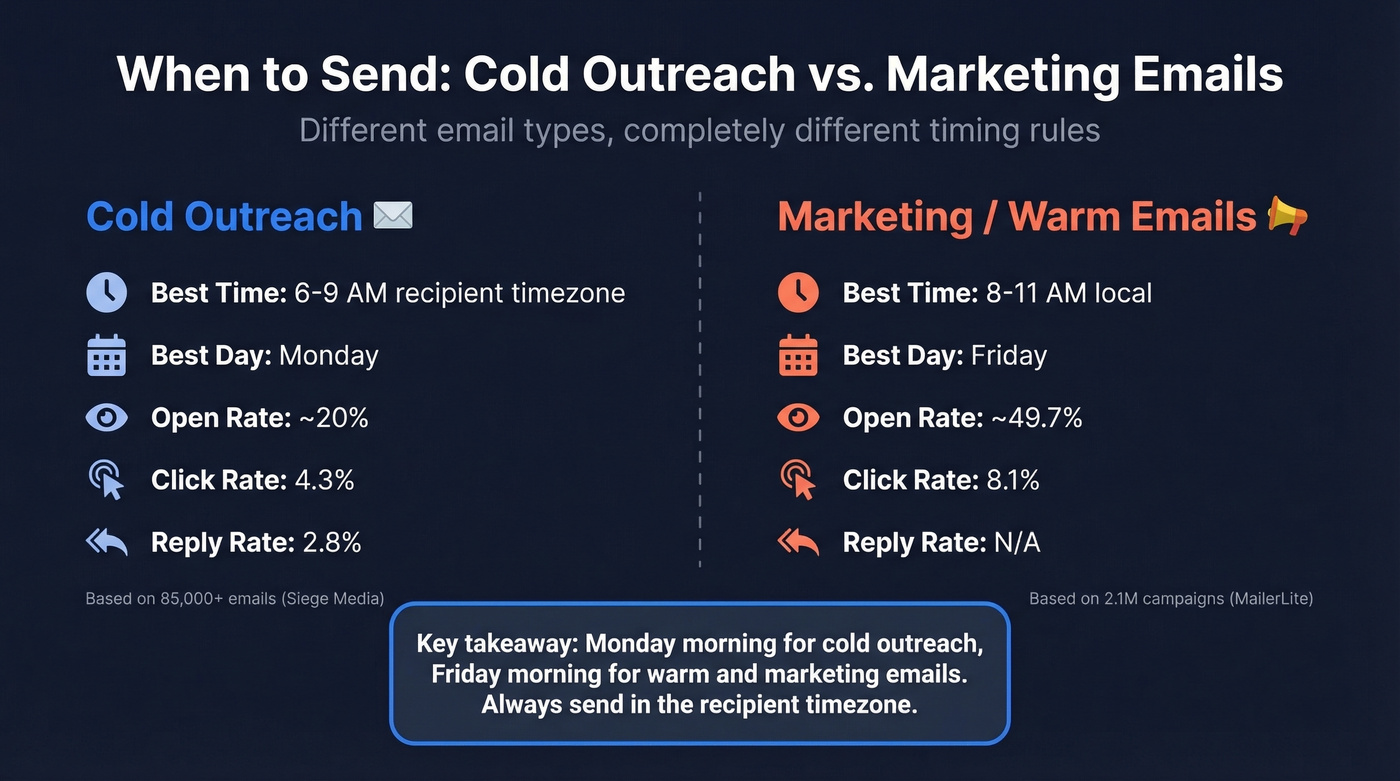
| Cold Outreach | Marketing/Warm Emails | |
|---|---|---|
| Best day | Monday | Friday |
| Best time | 6-9 AM recipient TZ | 8-11 AM local |
| Open rate | ~20% (Monday) | ~49.7% (Friday) |
| Click rate | 4.3% (Monday) | 8.1% (Friday) |
| Reply rate | 2.8% (Monday) | N/A |
| Source size | 85K+ emails | 2.1M campaigns |
For cold outreach, the Siege Media study of 85,000+ personalized emails found Monday mornings at 6-9 AM PST dominated. Tuesday morning was a close second. (More timing benchmarks here: best time to send cold emails.)
For marketing and warm emails, MailerLite's analysis of 2.1 million campaigns showed Friday had the highest average open rate at 49.72%. Weekday mornings between 8-11 AM local time were consistently the peak window.
The practical rule: send cold outreach early in the week, early in the morning. Save warm intros and marketing emails for later in the week.
Deliverability: The Part Most Guides Skip
Look - your intro email format is irrelevant if your data is bad. One practitioner on r/Entrepreneur documented their bounce rate dropping from 11% to under 2% after switching from purchased lists to manually verified contacts. Their reply rate doubled from 3% to 6% over 62 days. The copy barely changed. The data did.
If your average deal size is under $10k, you probably don't need a $30k/year data platform. But you absolutely need verified emails. Bad data doesn't just waste sends - it poisons your domain reputation for every future email, including the ones going to real prospects. (If you’re troubleshooting, start with email bounce rate benchmarks and fixes.)
Domain infrastructure matters just as much. That same team scaled from 3 sending domains to 7, capping each at 26 emails per day. Total stack cost ran about $420/month for sending tools, verification, and domains - generating 16 qualified leads per month. (To stay safe, follow email velocity limits.)
What to do:
- Verify every email address before it enters a sequence. No exceptions.
- Rotate sending domains to protect your primary domain's reputation.
- Cap daily sends per domain at 25-30.
- Format for mobile - 60%+ of emails are opened on phones.
- Use one CTA per email. One clear ask gets 371% more clicks than multiple.
What to avoid:
- Buying lists and sending without verification.
- Sending 100+ emails per day from a single domain.
- Ignoring bounce rates until your domain is already flagged.
We've tested several verification tools, and Prospeo's 5-step process catches invalid addresses, catch-all domains, spam traps, and honeypots before they hit your sequence - 98% email accuracy. Stack Optimize built their agency to $1M ARR using that data layer: 94%+ deliverability, bounce rates under 3%, zero domain flags across all clients. (For the full system view, see our email deliverability guide.)
Common Mistakes That Kill Replies
Too long. Emails over 150 words sharply reduce engagement. For cold outreach, over 60 words is already pushing it. Trim ruthlessly.
Generic first line. "I came across your profile" is the fastest path to the trash folder. Reference something specific - a recent hire, a product launch, a conference talk - or don't personalize at all.
Hard meeting ask on first touch. "Can we schedule a 30-minute call?" is high friction from a stranger. Use soft CTAs instead: "Worth a look?" or "Interested?"
Multiple CTAs. One clear ask gets 371% more clicks. The moment you add "also check out our blog" or "PS - we're hiring too," you've split attention and killed conversion.
Ignoring mobile formatting. Over 60% of emails open on mobile. Long paragraphs, wide tables, and tiny fonts all break on a phone screen. Keep paragraphs to 2-3 lines max.
Skipping list verification. This is the #1 silent killer. High bounce rates damage your sender reputation, which tanks deliverability for every email you send afterward - including the good ones. Skip this if you enjoy watching your domain slowly die.
Neutral tone. The 40-million-email study found that moderate positivity or negativity drove 10-15% more responses than completely neutral emails. You don't need to be dramatic, but having a point of view helps. Flat, corporate language gets flat, corporate results.
The CCVA framework works - but only when you're reaching the right person. Prospeo gives you 300M+ verified contacts with 30+ filters so you can reference that exact SDR hire, funding round, or headcount spike in your Context line. Real personalization starts with real data.
Write intro emails that land because every contact is verified.
FAQ
What's the best intro email format for cold outreach?
Use the CCVA structure - Context, Credibility, Value, Ask - in under 60 words. Lead with a specific observation about the recipient, add one credibility signal, state what's in it for them, and close with a single low-friction question. Emails with 1-3 questions get 50% more responses than those without.
What's the best subject line for an introduction email?
Short, personalized, and curiosity-driven. "Quick question" outperforms at roughly 39% opens. Including the recipient's company name lands around 33%. Avoid anything that sounds like a pitch - "Partnership opportunity" drops below 19%.
Should I follow up if I don't get a reply?
Always. Wait 4-5 days, keep the follow-up under 50 words, and bring something new - a relevant resource, a fresh angle, or a reframed ask. Never just "bump" the thread. Teams that send 2-3 structured follow-ups see roughly 2x the total reply rate of single-touch sequences.
What's the best day and time to send a cold intro email?
Monday through Thursday mornings between 6-9 AM in the recipient's timezone. Monday mornings had the highest reply rates at 2.8% across 85,000+ emails studied. For warm emails, Friday mornings between 8-11 AM showed the highest open rates across 2.1 million campaigns.
How do I make sure my intro email doesn't bounce?
Verify every email address before sending. Prospeo's 5-step verification catches catch-all domains, spam traps, and invalid addresses at 98% accuracy, keeping bounce rates under 3%. Bad data is the #1 reason good emails never arrive - and once your domain reputation drops, every future email suffers.