

How to Write an Introduction Email to a New Contact (That Gets a Reply)
B2B decision-makers receive 120+ emails daily. The average cold introduction email to a new contact pulls a 3.43% reply rate - about 97 out of 100 die in the inbox. The ones that survive follow a pattern, and it's learnable.
What You Need (Quick Version)
- Keep your email under 80 words. Lead with what's in it for them.
- Use one of the 5 templates below for your specific scenario.
- Verify the email address before you hit send. A bounce wastes everything.
Anatomy of an Intro Email That Gets Replies
Every effective introductory email has five parts. Skip one and the whole thing collapses.
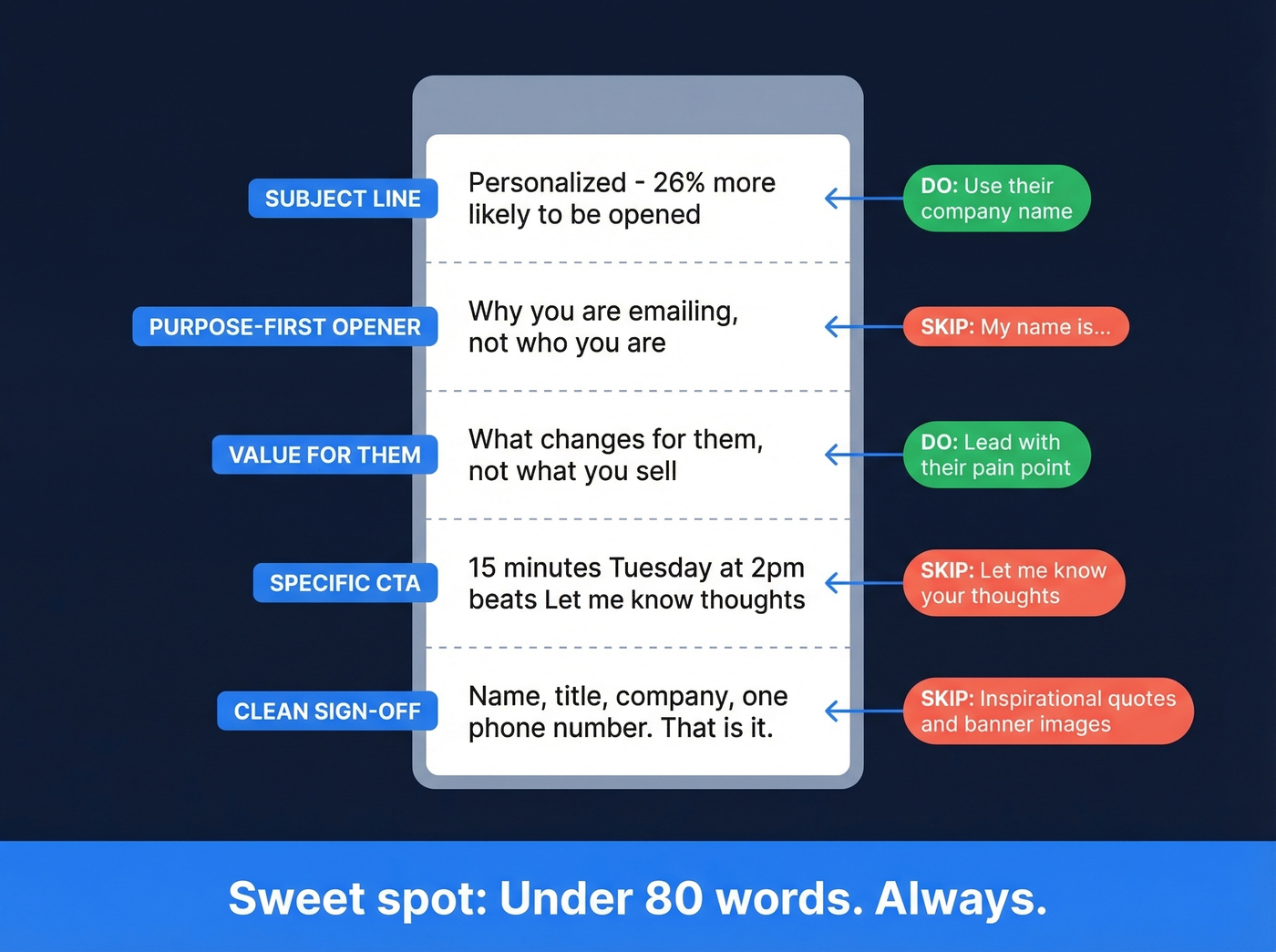
Subject line. Personalized subject lines are 26% more likely to be opened. Skip generic lines like "Quick Introduction" or "Touching Base." If you need ideas, borrow from these subject lines.
Purpose-first opener. Don't start with "My name is" - your signature handles that. The consensus on r/careerguidance is that it feels redundant, and some practitioners call lengthy background intros "tacky peacocking." If the standard format feels unnatural, go shorter and more practical, not longer. Open with why you're emailing in one sentence.
Value for them. One line explaining what changes for them. Not what you sell. (If you want a framework for this, see how to add value in sales.)
Specific CTA. "15 minutes Tuesday at 2pm?" beats "Let me know your thoughts." For more examples, use these email call to action patterns.
Clean sign-off. Name, title, company, one phone number. No inspirational quotes, no five-line disclaimers, no banner images that break on mobile.
Total length sweet spot? Under 80 words. Always.
5 Templates for Every Scenario
Cold Outreach to a Prospect
Subject: [Specific result] for [their company]
Hi [First Name],
[Their company] is [specific observation]. Teams in that position usually hit [pain point].
We helped [similar company] [result] in [timeframe]. Worth 15 minutes? [Calendar link]
[Your name]
This is the most common type of business introduction email - and the hardest to get right. You've got no mutual connection, so your homework has to carry the weight. One optional move we've seen work well: add a PS referencing something specific from their company page or recent news. In our testing, that single tweak lifted reply rates more than any subject line change. If you're building a full sequence, pair this with a B2B cold email sequence.
Warm Intro via Mutual Connection
Subject: [Mutual contact] suggested we connect
Hi [First Name],
[Mutual contact] mentioned you're working on [initiative]. I've spent [X years] doing [relevant thing] and thought there might be overlap.
Open to a quick call this week?
[Your name]
The mutual connection does the heavy lifting here. Keep your part short and resist the urge to over-explain your credentials.
Asking Someone to Introduce You
Subject: Could you intro me to [Target Name]?
Hi [Connector],
I'd love an intro to [Target Name] at [Company]. Here's a blurb you can forward:
"[Your name] runs [company]. They help [target's type of company] do [result]. Hoping to get 15 minutes on your calendar."
Totally fine if the timing isn't right.
Writing the forwardable blurb is the single highest-leverage move in this entire article. Here's the thing: in our experience, it's what separates intros that actually happen from intros that die in someone's to-do list. You're dropping the connector's effort to near zero, and that's the whole game.
Three-Way Connector Introduction
Subject: Intro: [Person A] <> [Person B]
Hi [Person A] and [Person B],
Connecting you two. [Person A] is [one-line context]. [Person B] is [one-line context]. I think there's a good conversation around [topic].
I'll let you take it from here.
Critical rule: use a double opt-in process. Ask both parties separately before connecting them - Fred Wilson popularized this back in 2009, and it's still the gold standard.
Post-Event Follow-Up
Subject: Following up from [Event] - [specific topic]
Hi [First Name],
Great talking at [Event] about [specific detail]. I mentioned [thing you discussed] - here's [resource/link].
Want to continue over a call next week?
[Your name]
Reference something specific. "Nice meeting you" with no detail signals you're mass-emailing everyone who scanned a badge. A strong post-event follow-up should feel like a continuation of the conversation you already started, not a cold pitch wearing a name tag. If you need more options, use these sales follow-up templates.

You just wrote the perfect introduction email - 80 words, specific CTA, personalized opener. Then it bounces. 97% of intro emails already fail. Don't let bad data kill the 3% that had a chance. Prospeo verifies emails at 98% accuracy with catch-all handling and spam-trap removal, so your first impression actually lands.
Fix the list first. The copy matters less than you think.
2026 Benchmarks
| Metric | Benchmark |
|---|---|
| Avg reply rate | 3.43% |
| Top 10% reply rate | 10.7%+ |
| Replies from 1st email | 58% |
| Replies from follow-ups | 42% |
| Open rates (cold) | 40-60% |
| Peak reply days | Tue-Wed |
| Recipients who never engage | 50.9% |
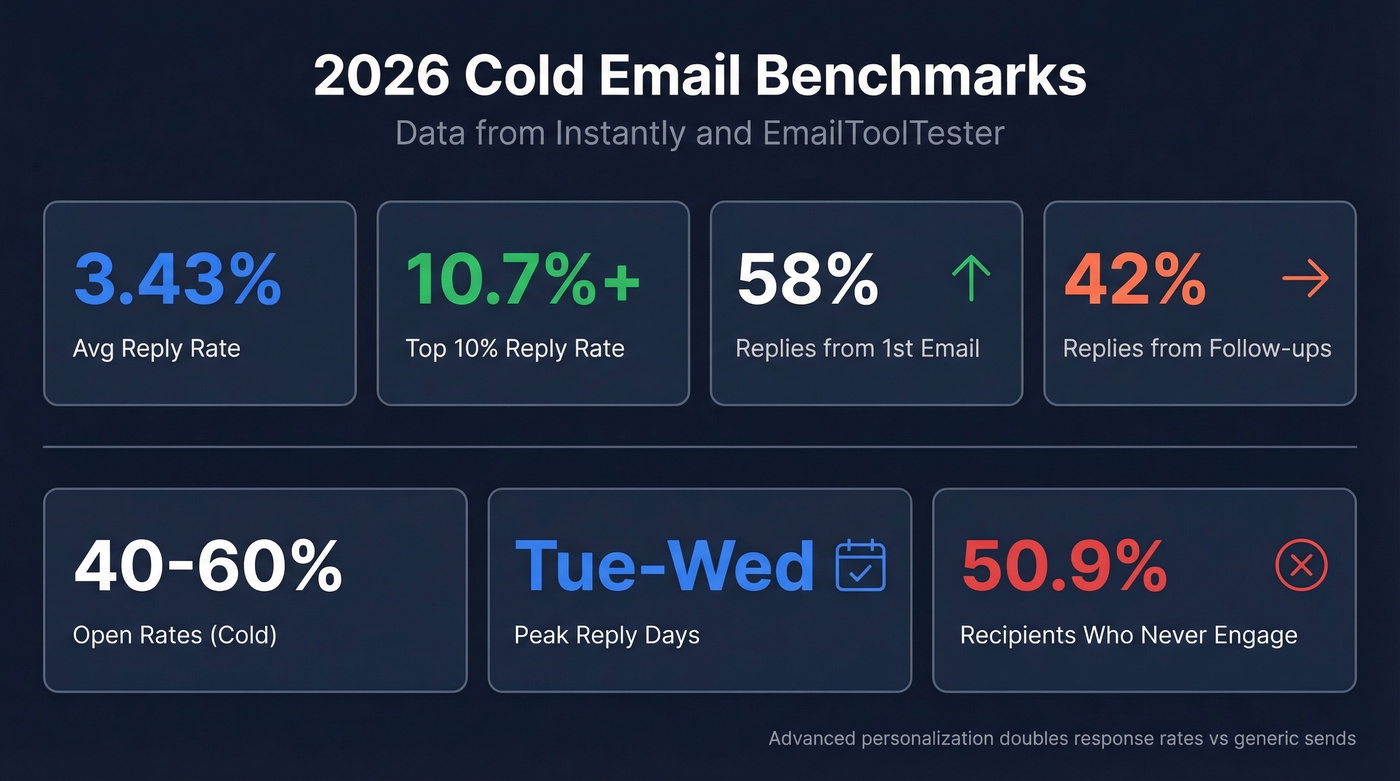
Data from Instantly's 2026 Benchmark Report and EmailToolTester's cold email survey of 1,800 people.
Advanced personalization doubles response rates compared to generic sends. And here's the number most people ignore: if your bounce rate exceeds 4%, your domain reputation takes real damage. Prospeo's real-time verification catches invalid addresses, spam traps, and catch-all domains at 98% accuracy - keeping bounce rates well under that threshold before your first sequence fires. (If you want the deeper mechanics, read the email deliverability guide and how to improve sender reputation.)
Hot take: Most teams obsess over subject lines and copy when their real problem is data quality. We've watched teams rewrite emails six times while sending to addresses that haven't been valid in months. Fix the list first. The copy matters less than you think.
Follow-Up Strategy
58% of replies come from the first email. That means 42% come from follow-ups, and most people never send one.
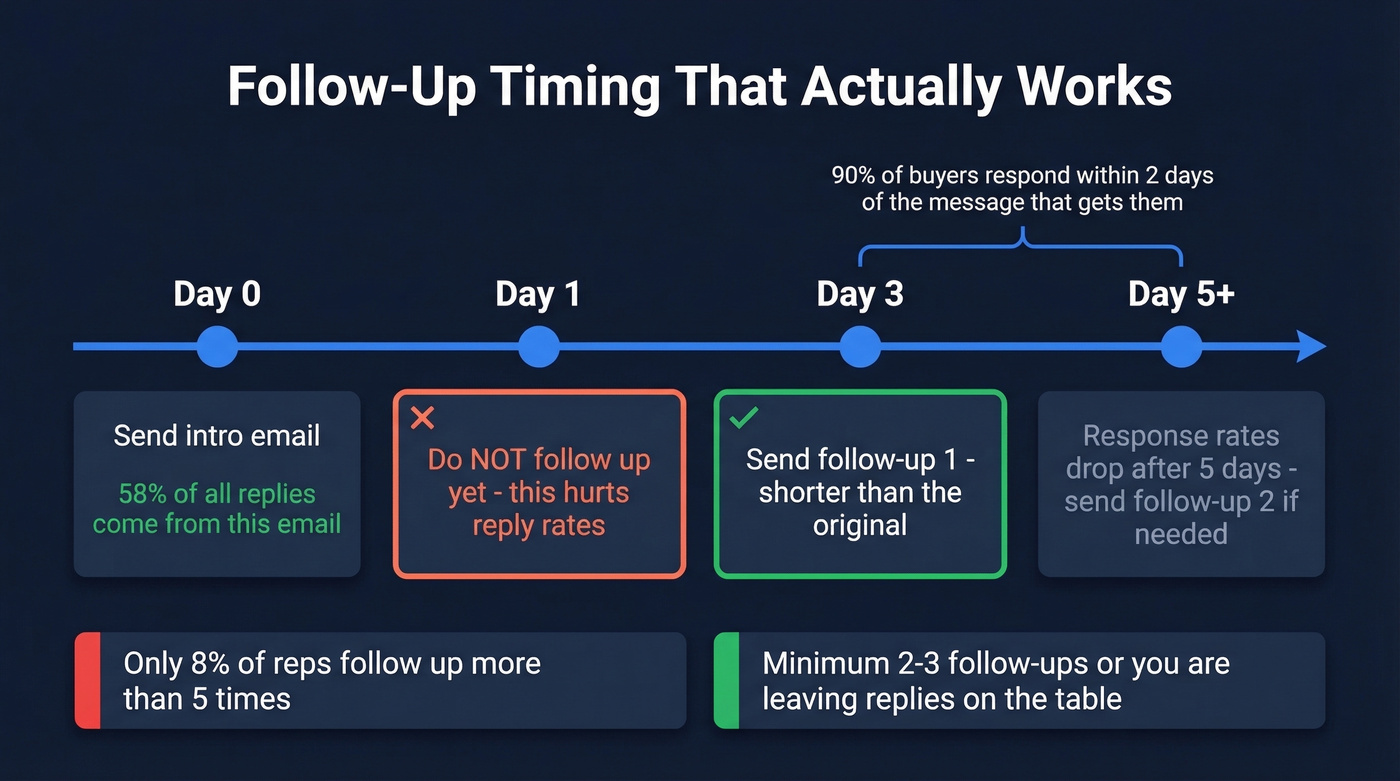
Send your first follow-up after 3 days. Not the next day - that hurts reply rates - and not after a week, because response rates drop after 5 days. Keep it shorter than the original. 90% of buyers respond within two days of the message that finally gets them, but only 8% of reps follow up more than five times. Two to three follow-ups is the minimum; anything less and you're leaving replies on the table. For more timing guidance, see when should you follow up on an email.
5 Mistakes That Kill Replies
- Opening with "My name is." Your signature says who you are. Use that first line for why you're writing.
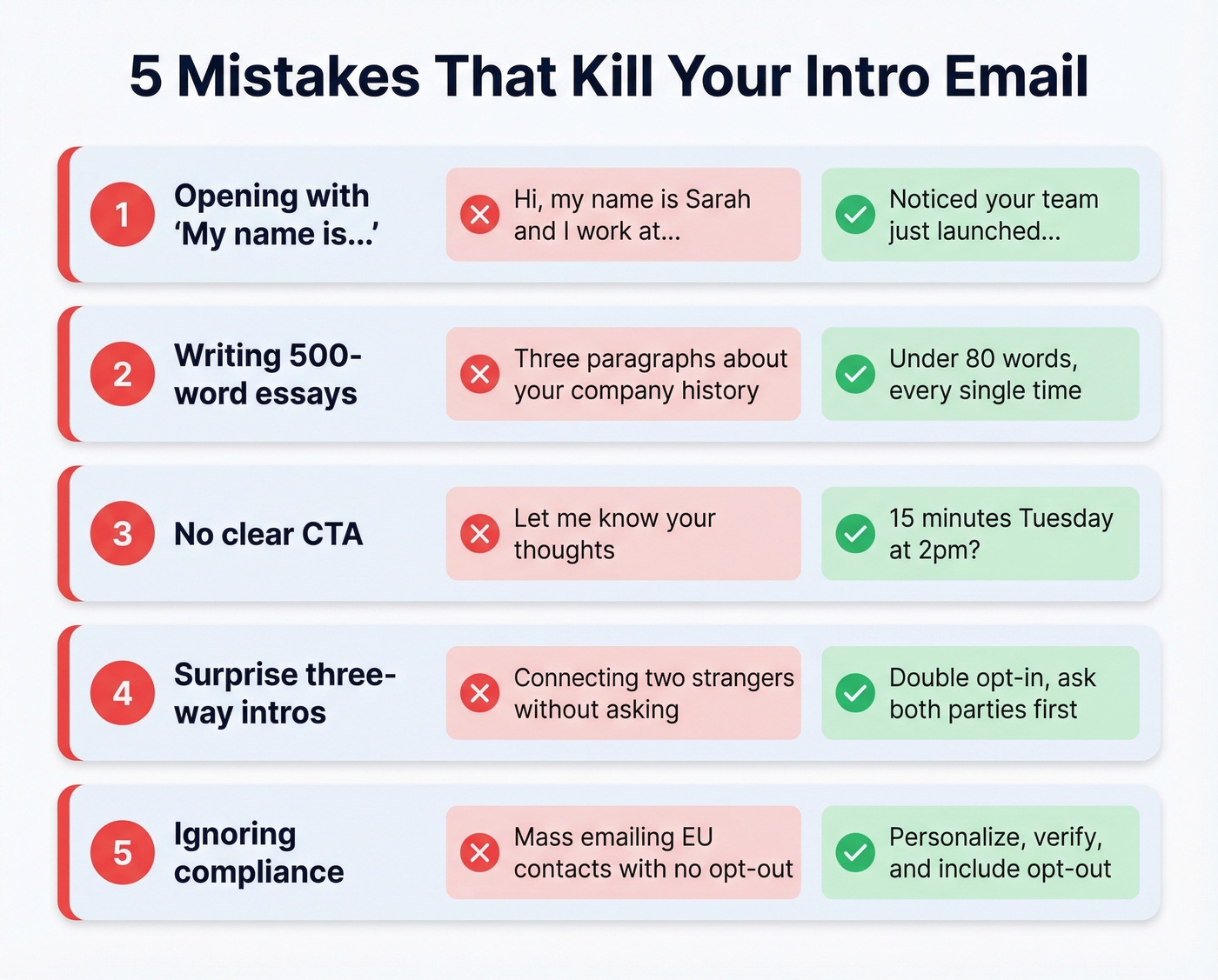
Writing 500-word essays. HubSpot documented the classic failure: long, admiration-packed messages that get zero replies. Under 80 words. If you want to tighten your writing, use this email copywriting guide.
No clear CTA. "Let me know your thoughts" isn't a call to action. A specific day and time is.
Surprise three-way intros. Connecting two people without asking either one first is an introduction ambush. Always double opt-in.
Ignoring compliance. In the EU, unsolicited emails without a legitimate interest basis can trigger GDPR complaints. Personalize, verify, and give recipients a clear way to opt out.
Before You Hit Send
Your intro email is irrelevant if it bounces. Job changes, company mergers, and stale data mean addresses go bad constantly. Verification isn't optional - it's step zero, and it's what separates the top 10% from everyone else. If you need a process, start with an AI email checker or learn how to check if an email exists.
Let's be honest: if you're spending 20 minutes personalizing an email to a VP of Sales and the address is dead, that's 20 minutes you'll never get back. We've seen entire outbound campaigns crater not because the messaging was bad, but because 15% of the list was invalid. One team we worked with cut their bounce rate from 35% to under 4% just by running verification before every send - and their reply rate nearly tripled.
Skip verification tools if you're sending fewer than 10 emails a month to people you already know. For anything beyond that, you need a system.

Cold outreach templates only work when you're reaching real people. Prospeo gives you 300M+ verified professional profiles with 30+ filters - job title, company size, intent signals - so your introduction email hits the right inbox on the first try. At $0.01 per email, one reply pays for thousands of lookups.
Stop rewriting emails and start reaching verified contacts.
FAQ
How long should an introduction email to a new contact be?
Under 80 words. Shorter emails consistently outperform longer ones in both cold outreach and networking contexts. Brevity signals respect for the recipient's time and forces you to lead with value instead of filler.
Should I follow up if I don't get a reply?
Yes - 42% of replies come from follow-ups, not the original message. Send the first after 3 days, keep it shorter than the original, and cap your sequence at 2-3 touches minimum.
How do I introduce two people over email without being annoying?
Use a double opt-in: ask both parties separately before connecting them. Send each person a short message explaining why you think the intro is valuable, and only proceed if both agree. This prevents "introduction ambushes" and protects your reputation as a connector.
What's the best way to verify emails before sending?
Use a dedicated verification tool rather than guessing. Catch-all domains, spam traps, and honeypot addresses aren't visible to the naked eye, and a single bad batch can tank your sender reputation for weeks.
What makes a networking email different from a sales email?
A networking introduction email focuses on mutual value and relationship-building rather than pitching a product. Lead with shared interests or a specific reason you'd both benefit from connecting, and keep the ask low-commitment - a 15-minute call or a coffee chat, not a demo.