

How to Write an Introduction Email to a Potential Client (With Templates That Actually Work)
You spent 20 minutes crafting the perfect introduction email to a potential client. You hit send to a big list of prospects. Zero replies. Not because the email was bad - because a chunk of those addresses bounced, some went to spam, and the rest landed in promotions tabs nobody checks.
The average cold email reply rate is 3.43%. That's brutal, but the bar is low. Beat it with the right fundamentals.
Here's the contrarian truth most copywriting guides won't tell you: stop obsessing over templates. The email that gets replies isn't the one with the cleverest copy - it's the one that reaches a real inbox, addresses a real person, and says something specific in under 60 words.
What You Need (Quick Version)
Three things move reply rates. Everything else is optimization on the margins.
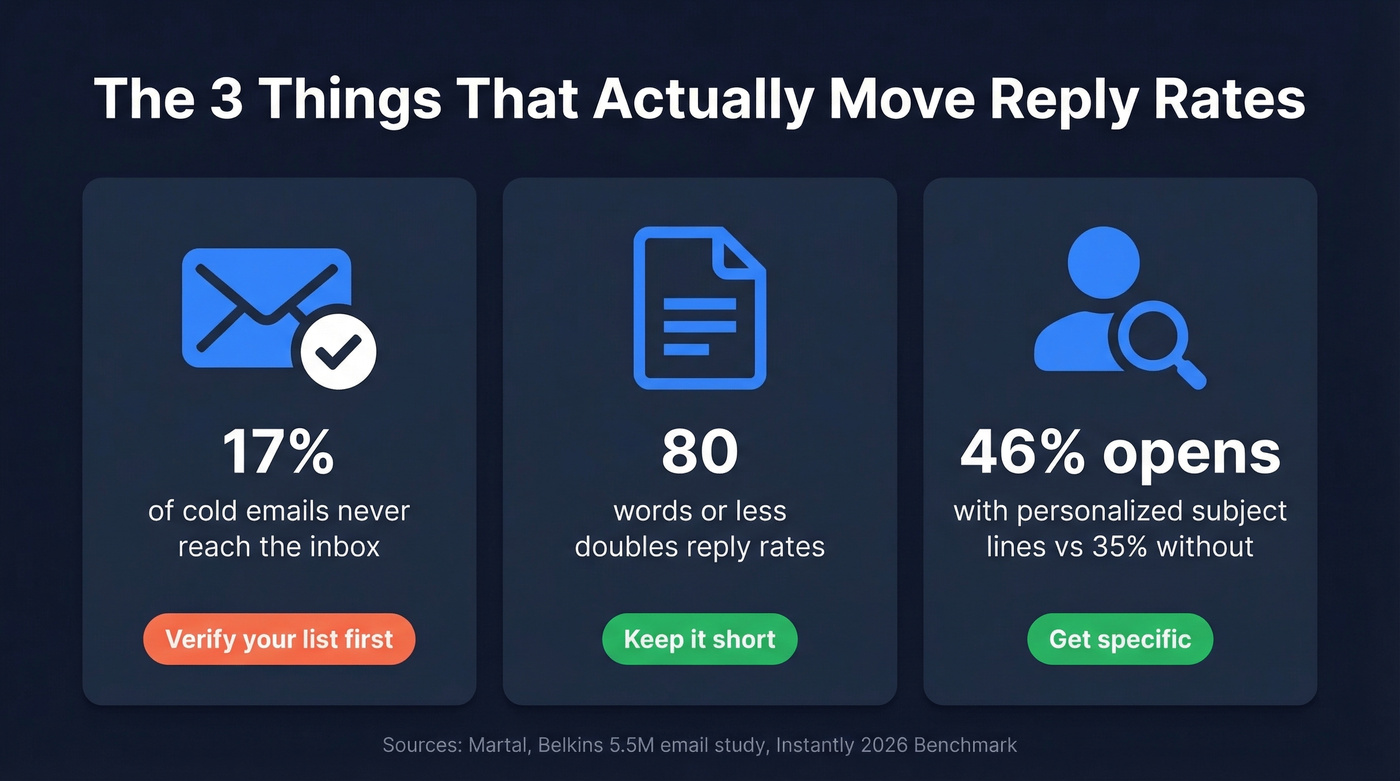
- Verified contact data. Roughly 17% of cold emails never reach the inbox. Verify your list before sending - otherwise you're writing into a void. (If you’re building lists from scratch, start with these sales prospecting techniques.)
- Emails under 80 words. One practitioner cut from 141 to under 56 words and doubled replies.
- A personalized first line. Personalized subject lines hit 46% open rates vs 35% without](https://belkins.io/blog/b2b-cold-email-subject-line-statistics). That's not "Hi {first_name}" - it's referencing something specific about the prospect's company or role.
Before You Write: Verify Your Data
Most guides skip straight to copywriting. That's a mistake.
Your business introduction email is only as good as the infrastructure behind it. Handle these before you send a single message:
- SPF, DKIM, and DMARC configured on your sending domain. Gmail has required this for bulk senders since Feb 2024; Outlook enforced it as of May 2025](https://instantly.ai/blog/spf-dkim-and-dmarc-deliverability/). Non-negotiable. (If you want the full checklist, use this email deliverability guide.)
- Secondary domain for cold outreach. Don't risk your primary domain's reputation. (More on this in tracking domain setup.)
- 21-day warmup on new sending domains before going full volume. (If you’re scaling, also watch email velocity.)
- Bounce rate under 2%. One Reddit user saw their bounce rate drop from 11% to under 2% after switching from purchased lists to manually verified contacts. Their reply rate doubled. (Benchmarks + fixes: email bounce rate.)
We've seen this pattern over and over: teams pour hours into copy, then torch their sender reputation on day one because half the list is garbage. Verify every address before you send. Prospeo's 5-step verification catches spam traps and catch-all domains at 98% accuracy, and the free tier covers 75 email verifications per month to test your first campaign. (If you’re comparing tools, see Bouncer alternatives.)

Anatomy of an Email That Gets Replies
Subject line. Keep it to 2-4 words. That length averaged a 46% open rate in Belkins' 5.5M-email study. Question-based subject lines are top performers - in one practitioner's testing, "Quick question" pulled 39% opens while "Partnership opportunity" limped in under 19%. Drop the marketing hype. A/B test your subject lines weekly. (Need ideas? Use these cold email subject line examples.)
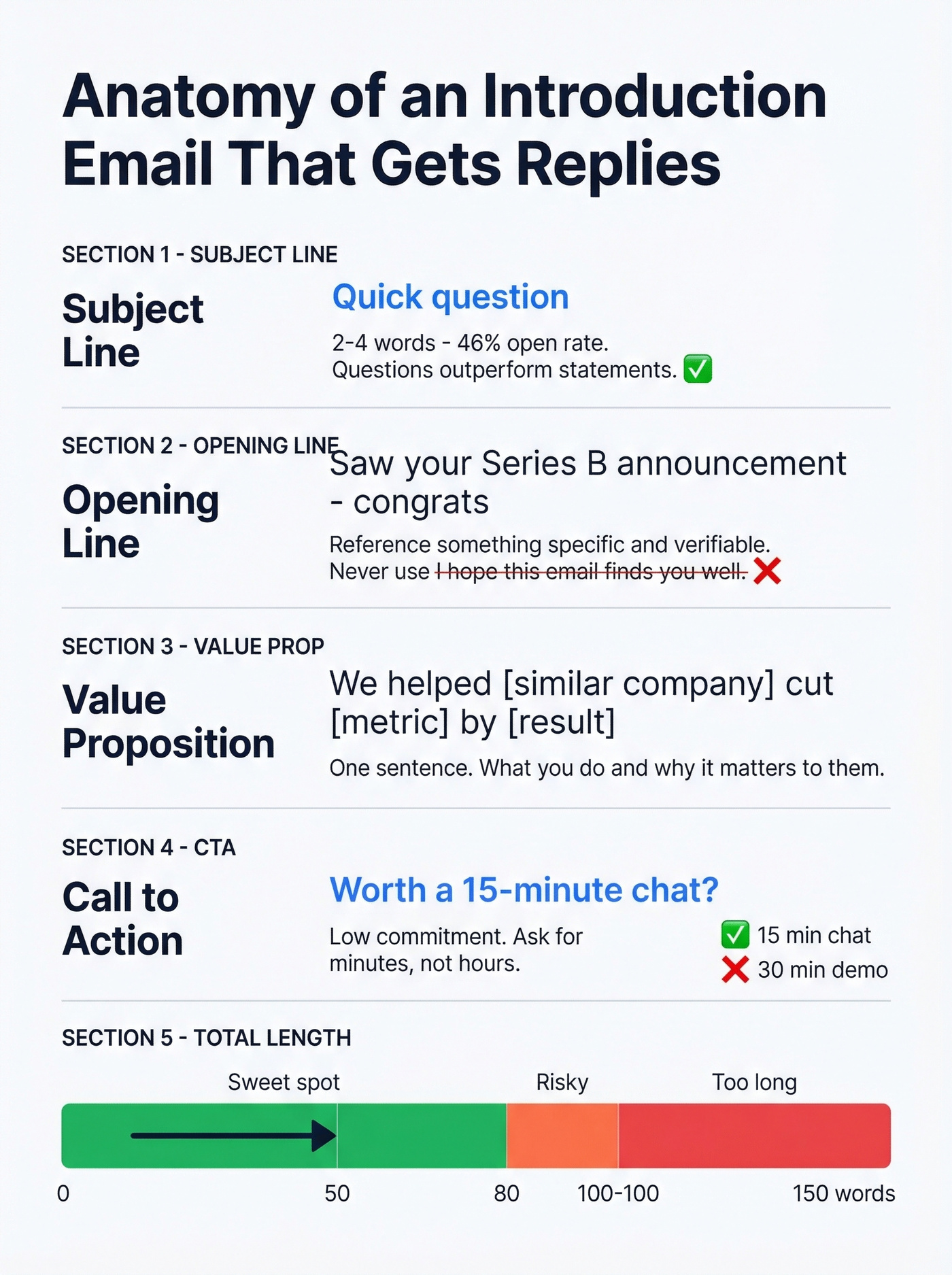
Opening line. This is where most emails die. "I hope this email finds you well" is an instant delete. Instead, reference something specific: a recent hire they made, a product launch, a podcast appearance. You spent 90 seconds on their website - show it. At scale, teams use AI to generate custom first lines from company websites and professional bios. One practitioner went from 2% to 8% reply rates this way, which tells you how much the opening line matters relative to everything else in the email. (More frameworks: personalized outreach.)
Value proposition. One sentence. What you do, and why it matters to them specifically. Not your company's origin story. Match the prospect's tone - a startup founder expects casual; a VP at a Fortune 500 expects professional. (If you want a deeper breakdown, see email copywriting.)
CTA. Low commitment. "Worth a 15-minute chat?" beats "Let me know when you're free for a 30-minute demo." You're asking for a conversation, not a marriage. (More examples: email call to action.)
Length. Under 80 words total. Shorter emails get more replies. Period.

You just read that 17% of cold emails never reach the inbox. Prospeo's 5-step verification - with spam-trap removal, catch-all handling, and honeypot filtering - delivers 98% email accuracy. That means your carefully crafted introduction emails actually land where they're supposed to.
Stop writing introduction emails into a void. Verify first.
Templates You Can Send Today
Cold Outreach (No Prior Connection)
Subject: Quick question
Hi {first_name},
Saw {company} just expanded into {market/launched X}. That usually creates {specific challenge your product solves}.
We helped {similar company} cut {metric} by {result} in {timeframe}.
Worth a quick chat this week?
{your name}
About 40 words - right in the sweet spot. The first line proves you did your homework, and the CTA asks for minutes, not hours.
Referral-Based Introduction
Subject: {mutual connection} suggested I reach out
Hi {first_name},
{Mutual connection} mentioned you're working on {initiative}. We helped their team with {specific outcome} - thought it might be relevant for {company} too.
Open to a quick call?
{your name}
Leading with a mutual connection shifts the conversation from cold to warm. In our experience, referral-based emails outperform pure cold outreach by 2-3x when the mutual connection is genuine.
Post-Event or Trigger-Based
Subject: Congrats on the round
Hi {first_name},
Saw {company}'s Series B announcement - congrats. Post-funding is usually when {specific pain point} becomes urgent.
We work with {2-3 similar companies} on exactly that. Happy to share what's working for them.
15 minutes this week?
{your name}
Trigger-based emails convert because the timing is built in. This one's about 50 words and references a specific, verifiable event. These three templates cover the most common high-intent scenarios. For networking follow-ups or post-meeting emails, the same principles apply: under 80 words, specific reference, low-commitment CTA.
The Follow-Up Sequence
Here's the thing: 58% of replies come from the first email. The other 42% come from follow-ups - yet 48% of reps never send a second message. That's nearly half your potential replies left on the table. (If you want plug-and-play sequences, use these sales follow-up templates.)
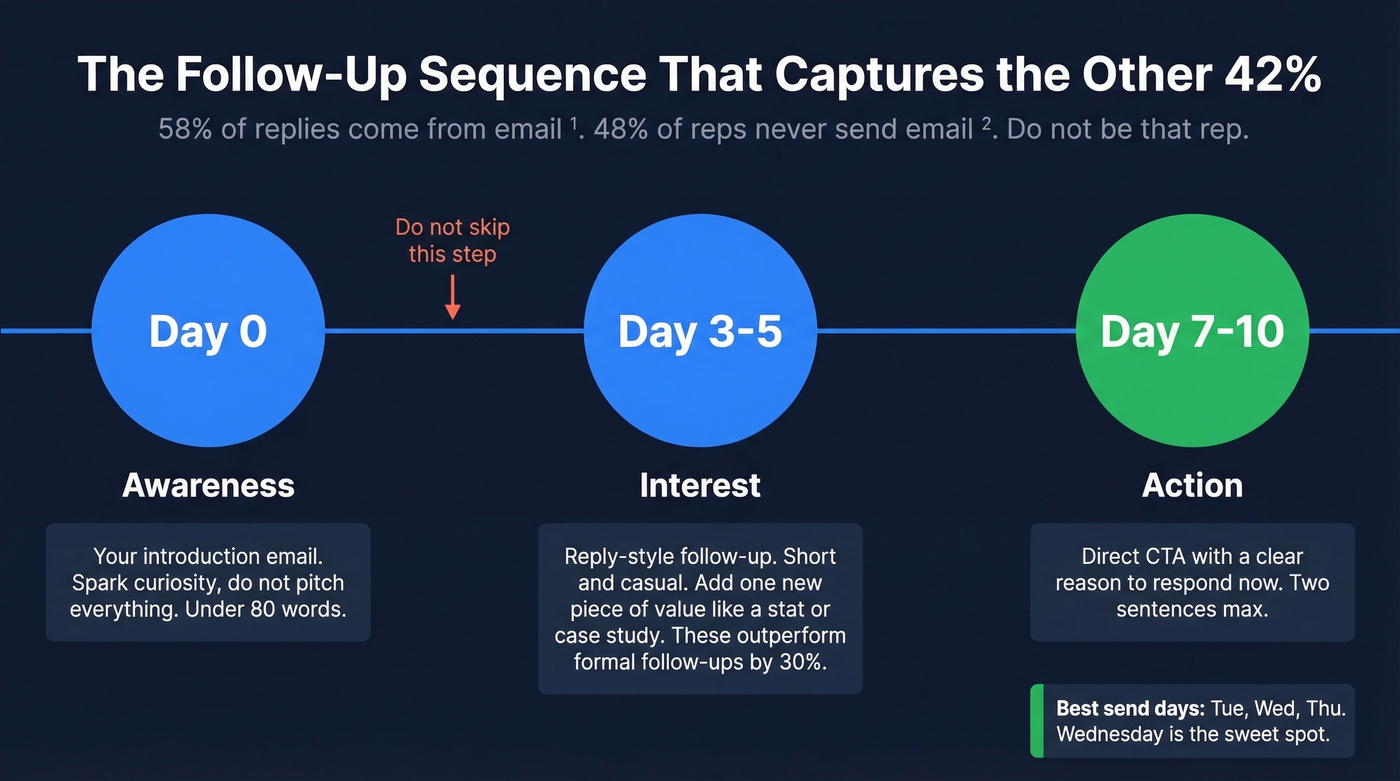
The data supports 4-7 total touchpoints. Under 4 quits too early, beyond 7 hits diminishing returns. A three-step framework that works:
- Awareness (Day 0). Your initial introduction email. Spark curiosity, don't pitch everything.
- Interest (Day 3-5). A "reply-style" follow-up - short, casual, adds one new piece of value like a relevant stat or case study link. These outperform formal follow-ups by roughly 30%.
- Action (Day 7-10). Direct CTA with a clear reason to respond now. Two sentences max.
Send Tuesday through Thursday if you can. Wednesday is typically the sweet spot. (More timing data: best time to send cold emails.)
Mistakes That Kill Your Reply Rate
Let's be honest - we've made most of these ourselves at some point.
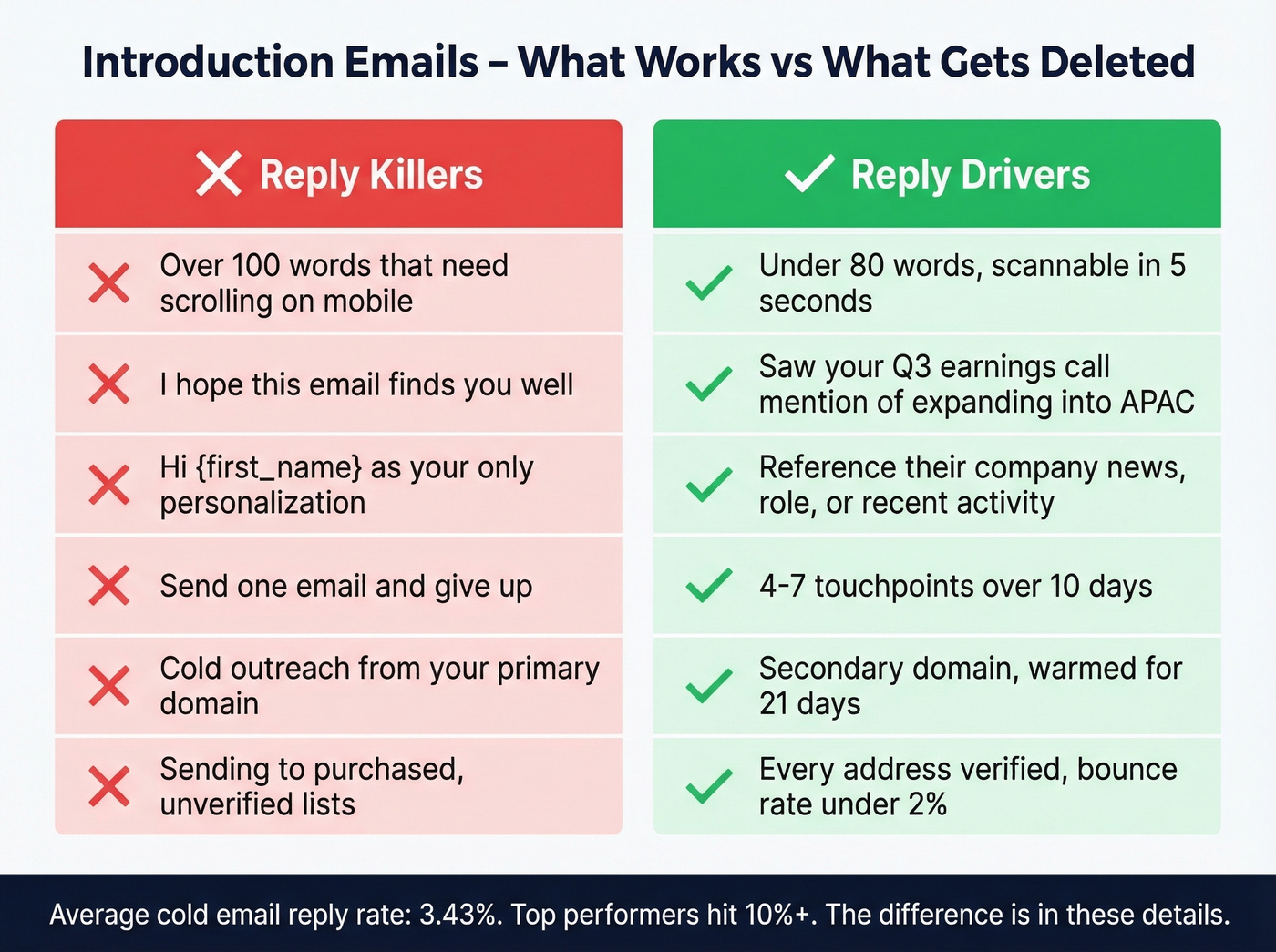
- Over 100 words. If your email needs scrolling on mobile, it's too long.
- Robotic openers. "I hope this email finds you well" tells the reader a robot wrote this. The consensus on r/coldemail is unanimous: it's a delete trigger.
- Name-only personalization. Using {first_name} isn't personalization. Referencing their company's Q3 earnings call is.
- No follow-up. You're leaving 42% of potential replies behind.
- Using your primary domain. Cold outreach on your main domain is a deliverability time bomb. Skip this shortcut - the damage takes months to undo.
- No unsubscribe link. CAN-SPAM requires it - even for B2B. Penalties run up to $53,088 per email.
- Sending to unverified lists. The fastest way to torch your sender reputation. One of our agency customers, Stack Optimize, built to $1M ARR while keeping client deliverability above 94% and bounce rates under 3% - entirely because they verified every address before sending.
Personalized first lines require real data. Prospeo gives you 50+ data points per contact - job changes, funding rounds, tech stack, headcount growth - so every introduction email references something specific and verifiable. At $0.01 per email, the data costs less than the time you'd spend guessing.
Turn every cold introduction into a warm one with real prospect intel.
Compliance in 30 Seconds
CAN-SPAM applies to all B2B commercial email, with penalties up to $53,088 per email. Include a valid physical postal address and a clear unsubscribe link in every message, and honor opt-outs within 10 business days. You're legally responsible even if a third party sends on your behalf.
For EU prospects, GDPR requires a legitimate interest basis for outreach, with fines reaching EUR 20M. If you're prospecting into EMEA, document your rationale before sending.
FAQ
How long should an introduction email to a potential client be?
Under 80 words. One practitioner cut from 141 to under 56 words and doubled their reply rate. Brevity isn't a style preference - it's a performance lever.
What's a good reply rate for prospecting emails?
The average cold email reply rate is 3.43%. Top performers hit 5.5%+, and elite senders exceed 10%. Focus on list quality and follow-ups to push higher.
Do you have an email to potential client sample I can copy?
The three templates above cover cold outreach, referral-based, and trigger-based scenarios. Copy the structure, then swap in details specific to your prospect's company, role, and recent activity. A generic template sent as-is will underperform every time.
How do I make sure my introduction email doesn't land in spam?
Set up SPF, DKIM, and DMARC on your sending domain. Use a secondary domain for cold outreach, warm it for 21 days, and verify every email address before sending. The free tier on most verification tools - including Prospeo - gives you enough credits to validate your first campaign list without spending a dollar.