iOS 15 Email Tracking: What Still Works in 2026
Your latest campaign shows a 62% open rate. Looks great on a dashboard. The problem? With Apple Mail commanding roughly 48% of email client market share, a massive chunk of those "opens" are Apple's servers downloading images before anyone read a single word. That's not a rounding error - it's a structural break in how email tracking works on Apple devices.
The privacy changes that started in September 2021 mean open rates stopped being a reliable metric entirely. We've watched teams spend months optimizing subject lines based on data that was almost half machine noise. Here's what still gives you real signal, and what to do about the rest.
How Email Tracking Pixels Work
Every HTML email can embed a tiny 1x1 transparent image - the tracking pixel. When a recipient opens the email and their client loads images, that pixel fires a request back to the sender's server, logging a timestamp, the device, and sometimes an IP address.
Gmail started caching images on its own servers back in 2013, and Yahoo followed in 2018. Both reduced the fidelity of IP and timing data. But Apple's Mail Privacy Protection in iOS 15 was the tipping point - it didn't just degrade the signal, it broke the entire mechanism.
How Mail Privacy Protection Actually Works
When Apple launched Mail Privacy Protection (MPP) in September 2021, it nuked the open-rate measurement model. Apple preloads remote content - including tracking pixels - via Apple-managed proxy servers, regardless of whether the recipient ever opens the email. That preload triggers the pixel. Your ESP records an "open." Nobody read anything.
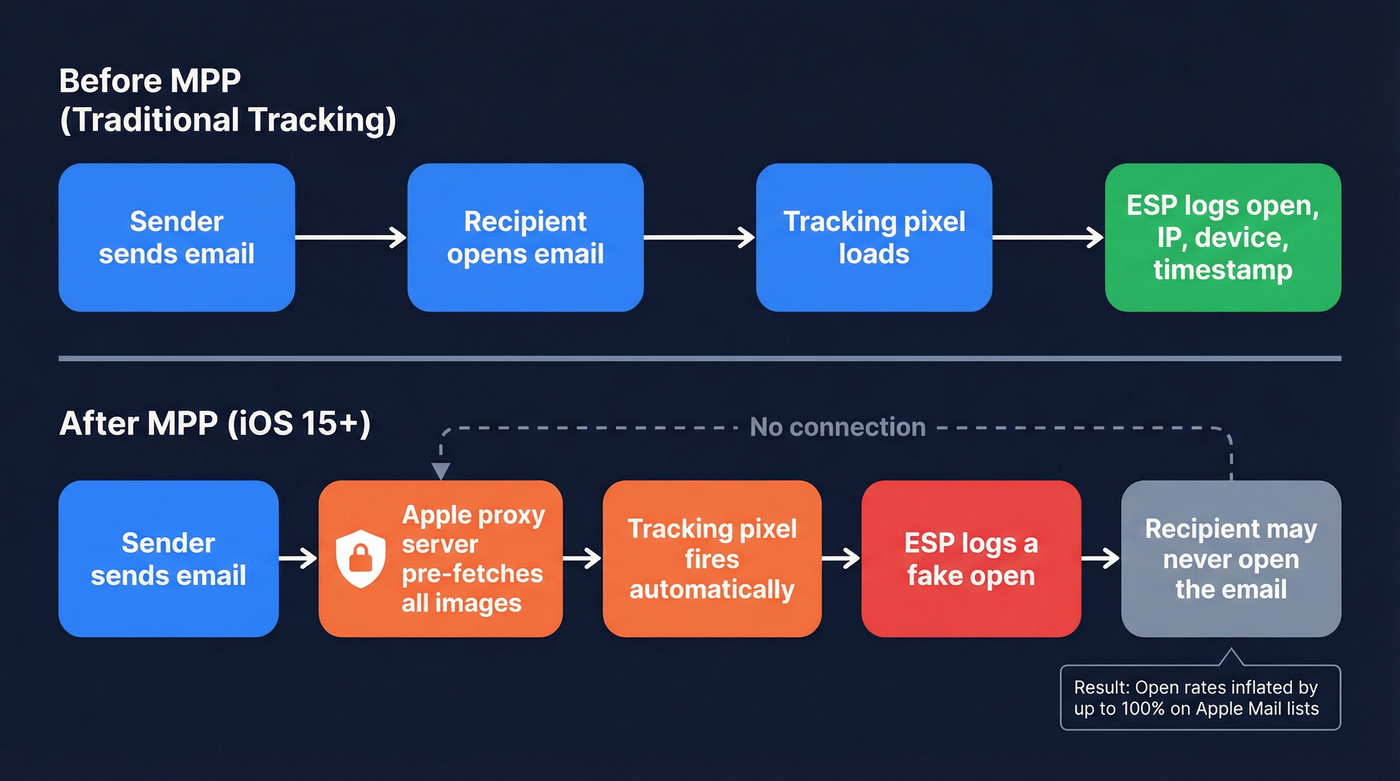
MPP hides real IP addresses, accurate open timestamps, geolocation, and device data from senders. For lists with heavy Apple Mail representation, open inflation can approach 100%. The practical impact: you can't use opens to identify engaged subscribers, trigger automations, or measure subject line performance with any confidence.
iOS 17: Link Tracking Protection
iOS 17 went after a different signal - click attribution. Link Tracking Protection (LTP) strips tracking parameters from URLs in Mail, Messages, and Safari Private Browsing. The parameters that get removed include ad-platform identifiers like gclid from Google Ads, fbclid from Meta, dclid and msclkid from Display and Microsoft Ads, and ESP identifiers like mc_eid, mkt_tok, and hsCtaTracking.
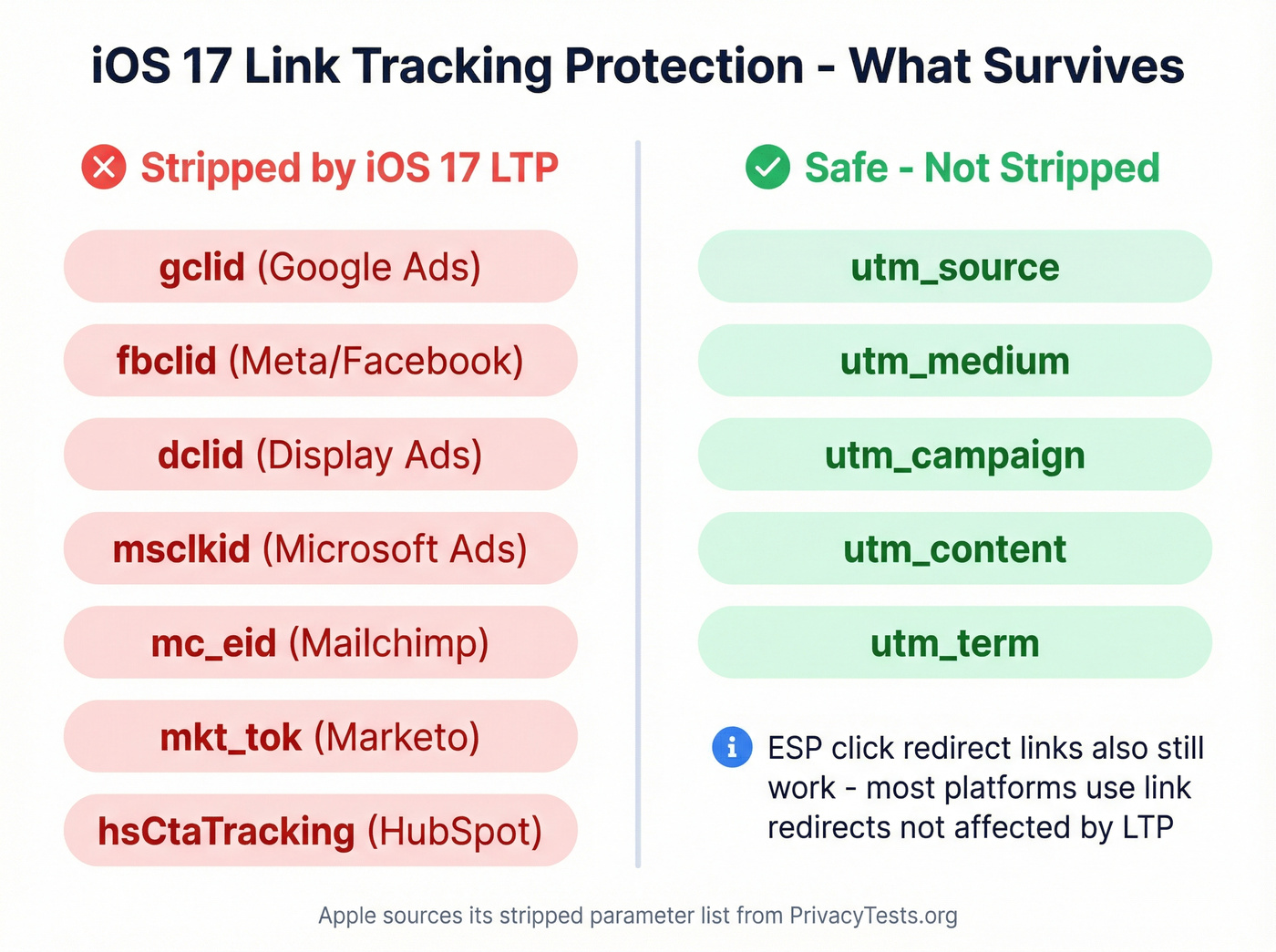
Here's the thing most people miss: UTM parameters aren't stripped. Apple targets user-identifiable tracking parameters, not campaign attribution tags. So utm_source, utm_medium, and utm_campaign survive intact. Apple sources its stripped parameter list from PrivacyTests.org, which maintains a known set of tracking query parameters.
Your ESP's click tracking also still works - most platforms use link redirects that aren't affected by LTP. With iOS 17 adoption reaching around 90% by early 2024 based on historical Apple adoption patterns, this is the reality for most Apple users now.

When open rates are noise, the only thing that matters is reaching real inboxes. Prospeo's 5-step email verification delivers 98% accuracy - so your clicks, replies, and conversions reflect actual engagement, not Apple proxy servers firing phantom opens.
Stop optimizing for ghost opens. Start measuring what converts.
iOS 18: The Inbox Overhaul
iOS 18 didn't introduce a new open-tracking break like MPP. It did something arguably worse - it changed how emails get seen in the first place.
Apple Mail now sorts messages into five automatic categories: Primary, Transactions, Updates, Promotions, and All Mail. If your marketing emails land in Promotions, they're competing for attention in a tab most people check sporadically. Digest View groups emails by sender, which can bury individual sends. A bulk unsubscribe feature makes it trivially easy for recipients to clean house.
The subtlest change? AI-driven email summaries can override your preheader copy entirely. Apple's system generates its own preview text based on the email body, so if your key message lives in an image rather than live text, the AI summary will miss it completely. Use live text for anything you want the summary to capture.
These aren't tracking changes per se, but iOS 18.2's new views make engagement signals harder to read - grouped emails, untrackable "See more" clicks, and reduced Primary inbox exposure all muddy the picture.
Reliable Email Metrics in 2026
Let's be honest about what you can actually trust. Here's our hierarchy, ranked by reliability:
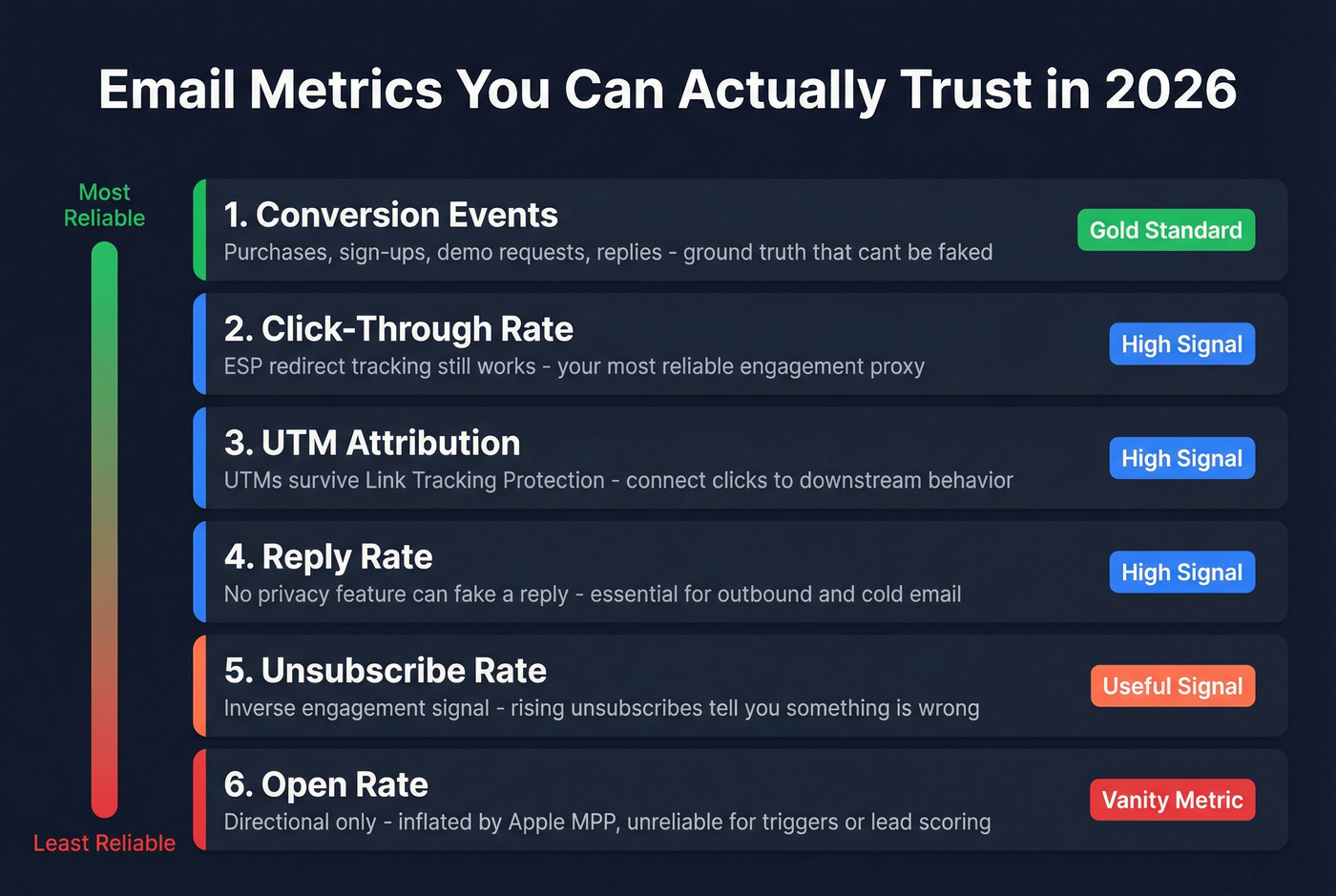
- Conversion events - purchases, sign-ups, demo requests, replies. Ground truth. If someone converted, they engaged.
- Click-through rate - ESP redirect tracking still works. This is your most reliable engagement proxy. (If you're still debating which to prioritize, see open rates.)
- UTM-based attribution - UTMs survive LTP. Use Google Analytics or your attribution platform to connect clicks to downstream behavior.
- Reply rate - especially for outbound and cold email, replies are the metric that matters. No privacy feature can fake a reply. (More on building for replies in cold email tactics.)
- Unsubscribe rate - an inverse engagement signal. Rising unsubscribes tell you something's wrong even when opens tell you nothing.
Open rates? Directional only. Useful for relative comparisons between campaigns on the same list, but unreliable for individual engagement tracking or automation triggers. If you need a deeper breakdown of what still works, compare with real-time email tracking and the updated view on email open tracking.
Across sales and email marketing communities on Reddit, the consensus has settled firmly: opens are vanity metrics post-MPP. The practitioners who adapted early are measuring clicks, replies, and conversions - and they're making better decisions because of it.
If your average deal size is under five figures and you're still using open rates to score leads, you're not just measuring wrong - you're actively misallocating your team's time. Kill the open-rate trigger. Today.
Adapting to Apple Mail's Privacy Impact
Replace open-based automation triggers. If you're still using "opened email" as a trigger for follow-up sequences or lead scoring, switch to click or conversion triggers. This should've happened in 2022, but we still see it everywhere. Reps who rely on open notifications to time their follow-ups are chasing phantom engagement - we watched one team's SDRs call 200 "hot" leads in a week that turned out to be entirely MPP noise. If you're rebuilding your system, start with an outbound email campaign that’s designed around clicks and replies.
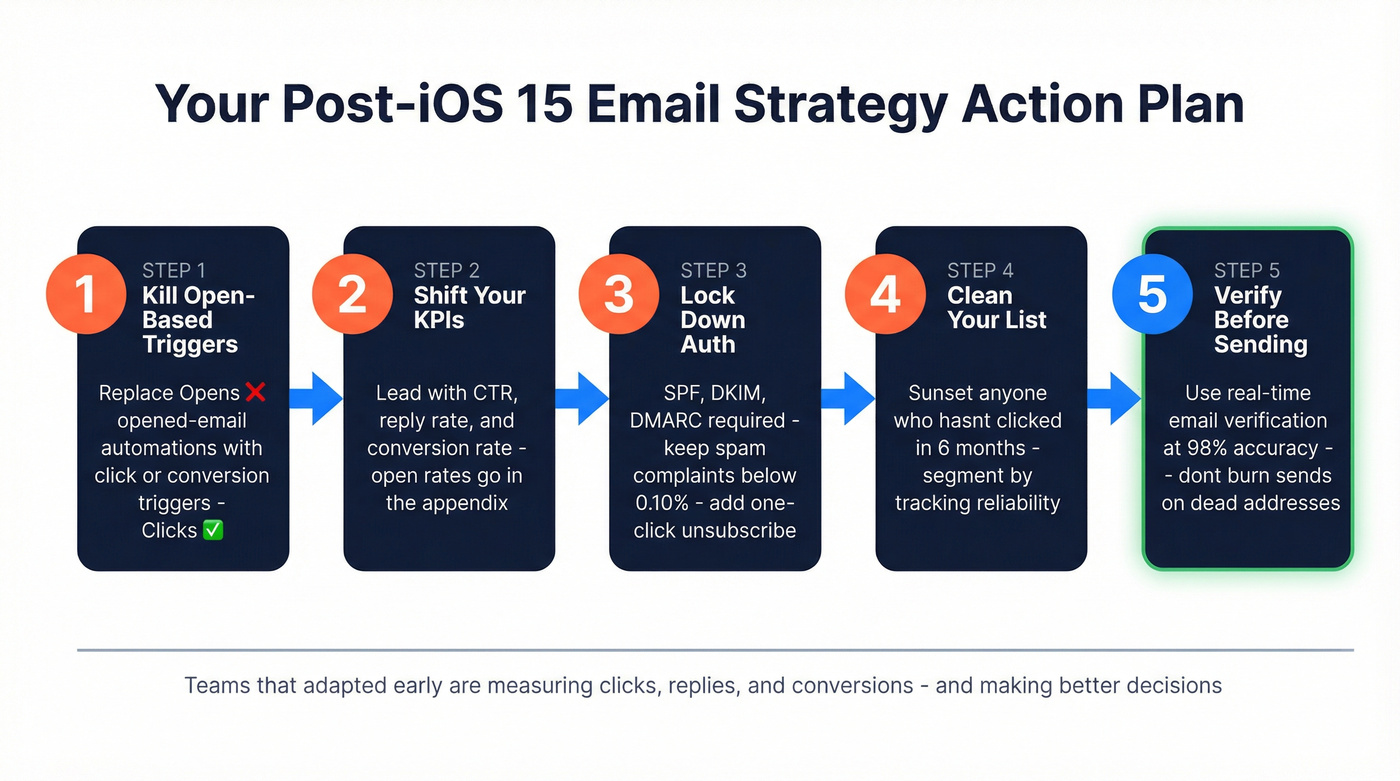
Shift your KPIs. Stop reporting open rates as a primary metric to leadership. Lead with click-through rate, reply rate, and conversion rate. Open rates can live in an appendix, not a headline. For a KPI framework that survives privacy changes, use email deliverability tracking as your baseline.
Lock down authentication and compliance. SPF, DKIM, and DMARC are required for anyone sending 5,000+ emails per day to Gmail or Yahoo. Keep spam complaints below 0.3% - ideally under 0.10%. Implement one-click unsubscribe via the List-Unsubscribe header, processed within two days. If you need the setup details, follow SPF, DKIM, DMARC.
Clean your list aggressively. You can't rely on opens to identify dead addresses anymore. Use click and conversion activity to segment engaged subscribers, and sunset anyone who hasn't clicked in six months. You can also identify Apple Mail users by sending iOS-only tracking links and flagging recipients with zero open events but confirmed clicks - useful for segmenting your list by tracking reliability. For a full workflow, see behavioral segmentation.
Verify contact data before sending. When tracking signals are degraded, data quality is the one thing you can still control. Prospeo's email verification runs at 98% accuracy on a 7-day refresh cycle, so you're not burning sends on addresses that were dead before you hit send. Bad emails mean wasted sends you can't even measure, plus direct damage to your sender reputation. If you're evaluating tools, compare options in email ID validators or start with an email checker tool.
Reply rate is the metric that survives every privacy update Apple ships. But replies require reaching real people at real addresses. Prospeo verifies 143M+ emails on a 7-day refresh cycle - bounces under 4% for teams that switched from legacy providers.
Clean data means real replies. At $0.01 per verified email, there's no excuse.
FAQ
Does Mail Privacy Protection affect Gmail or Outlook apps on iPhone?
No. MPP only applies to Apple's native Mail app. If someone uses the Gmail iOS app, their opens are tracked normally - though Gmail's own image caching still reduces IP and timing fidelity. The key variable is which email client the recipient uses, not which phone they own.
Are UTM parameters stripped by Link Tracking Protection?
No. iOS 17 LTP strips ad-platform parameters like gclid, fbclid, and msclkid, but leaves UTM parameters completely intact. Use UTMs for campaign attribution - they're your safest bet for connecting email clicks to downstream analytics.
How do I clean my email list without open data?
Use click and conversion activity to identify engaged subscribers - anyone who's clicked in the last 90-180 days is active. For pre-send verification, Prospeo checks emails in real time at 98% accuracy, catching invalid addresses before they hurt your sender reputation. Combine behavioral segmentation with verification for the cleanest list possible.
Should I stop tracking open rates entirely?
Skip them as a primary metric, but don't delete them from your reports. Open rates still have some value for relative A/B comparisons on the same list segment, where the MPP inflation is roughly consistent across both variants. They're just useless as an absolute measure of engagement or as an automation trigger.