

Last Chance Emails: How to Create Urgency Without Getting Sued
Last chance emails are one of the highest-converting message types in marketing - and one of the most legally dangerous. Old Navy learned this the hard way when they sent an email with the subject line "GAH! This is the last chance to get up to 50% OFF," then ran a similar discount the next day. A Washington state resident sued. The court ruled that subject line violated the state's Commercial Electronic Mail Act, and the statutory penalty is $500 per email sent. Plaintiffs are seeking treble damages under the Consumer Protection Act - $1,500 per email.
As of late 2025, eight class actions had been filed in six months. Nike, Macy's, Skechers, Discount Tire - all named defendants. The topic has surfaced on r/Emailmarketing, with the $1,500-per-email risk serving as a wake-up call for marketers who treated "last chance" as a throwaway subject line. That era is over. But deadline-driven urgency emails themselves? They still work. You just need to do them right.
What You Need (Quick Version)
Three things matter before you read another word:
1. The deadline must be real. If your "last chance" offer reappears after the stated deadline, you're exposed to CEMA liability in Washington - and the legal trend is spreading. Jump to the legal section.
2. Your sequence matters more than your copy. A 3-email countdown (48h, 24h, 2h) consistently outperforms a single blast. See the framework.
3. List hygiene is the #1 ROI lever. Urgency emails on stale data generate higher complaint rates and bounces at the worst possible moment - right when inbox providers are watching. Details here.
Why Deadline Emails Convert
A last chance email is the final message in a promotional sequence, sent before a deadline expires - a sale ending, a trial lapsing, a cart being abandoned, or inventory running out. It's the nudge that converts procrastinators into buyers.
The psychology is straightforward. Kahneman and Tversky's research on loss aversion shows people feel the pain of missing out roughly twice as intensely as the pleasure of gaining something equivalent. Scarcity triggers faster decision-making. And FOMO isn't just a buzzword - it's a documented cognitive bias that drives action when people believe an opportunity is closing.
Here's the thing: roughly 20% of adults are chronic procrastinators, according to research by Dr. Joseph Ferrari. That's one in five people on your list who genuinely need a final reminder to act on something they already want. These emails aren't manipulation when the deadline is real. They're a service.
The key distinction is between honest urgency and manufactured pressure. A sale that actually ends Sunday at midnight deserves a final reminder. A "final hours" subject line on a discount that reappears next Tuesday is a lie - and now, a lawsuit waiting to happen.
The Legal Risk Nobody Talks About
In 2025, the Washington Supreme Court handed down Brown v. Old Navy, LLC (4 Wash.3d 580, 567 P.3d 38), a 5-4 decision that changed the math on urgency emails overnight. The court ruled that CEMA covers any false or misleading information in a commercial email's subject line - not just deception about the email's commercial nature. The penalty: $500 per email sent to a Washington resident.
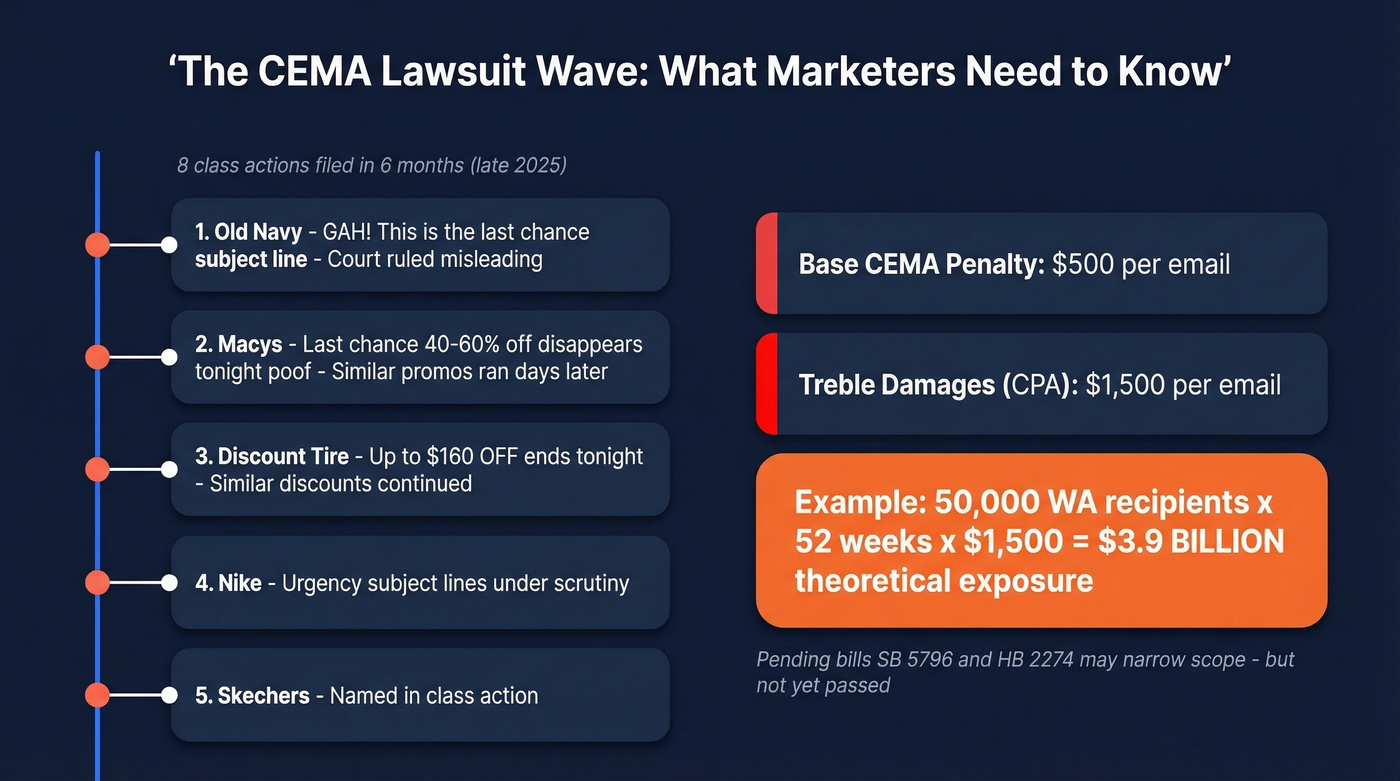
That $500 figure is bad enough. But plaintiffs are seeking treble damages under Washington's Consumer Protection Act. That's $1,500 per email. Send a weekly "last chance" email to 50,000 Washington residents for a year, and the theoretical exposure is staggering.
The litigation wave has been fast. Eight putative class actions in six months, targeting household names. Macy's got hit for subject lines like "Last chance! 40-60% off disappears tonight poof" - followed by comparable promotions days later. Discount Tire faced a suit over "Up to $160 OFF tires & wheels ends tonight!" when similar discounts continued afterward. Nike and Skechers are also in the crosshairs.
Defendants are fighting back with CAN-SPAM preemption arguments and constitutional challenges, but no court has ruled definitively in their favor yet. The Washington legislature has proposed SB 5796 and HB 2274 to narrow CEMA - requiring that a subject line be likely to mislead a reasonable recipient about a material fact. If passed, these bills would apply retroactively to existing claims. But "if passed" is doing a lot of heavy lifting, and you can't build a compliance strategy on pending legislation.
CEMA Compliance Checklist
Before you send any urgency email, run through these five items:
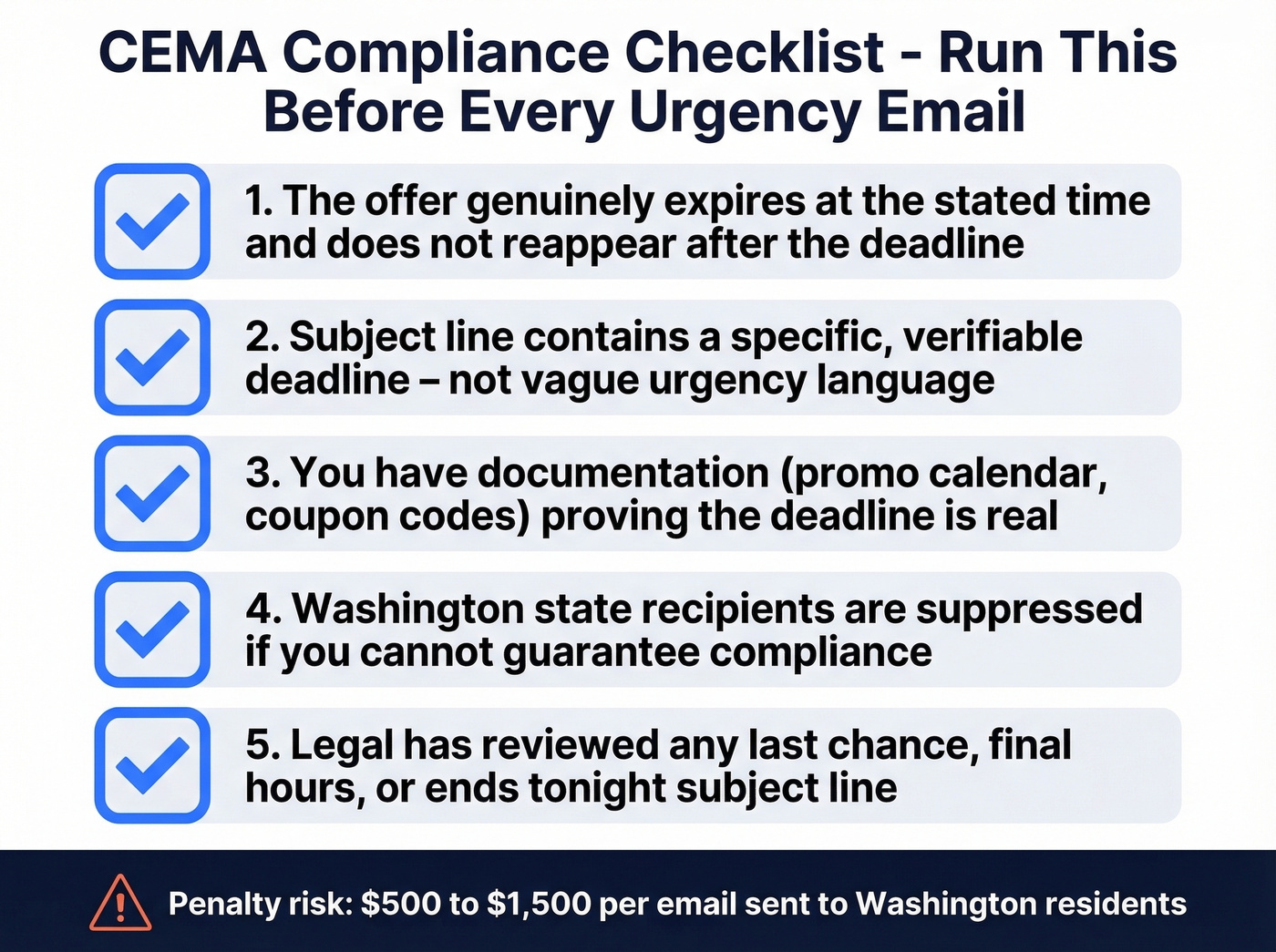
- The offer genuinely expires at the stated time and doesn't reappear after the deadline.
- The subject line contains a specific, verifiable deadline - not vague urgency language.
- You have documentation (promo calendar, coupon codes) proving the deadline is real.
- Your email suppresses Washington-state recipients if you can't guarantee compliance.
- Legal has reviewed any "last chance," "final hours," or "ends tonight" subject line.
Benchmarks - What Good Looks Like
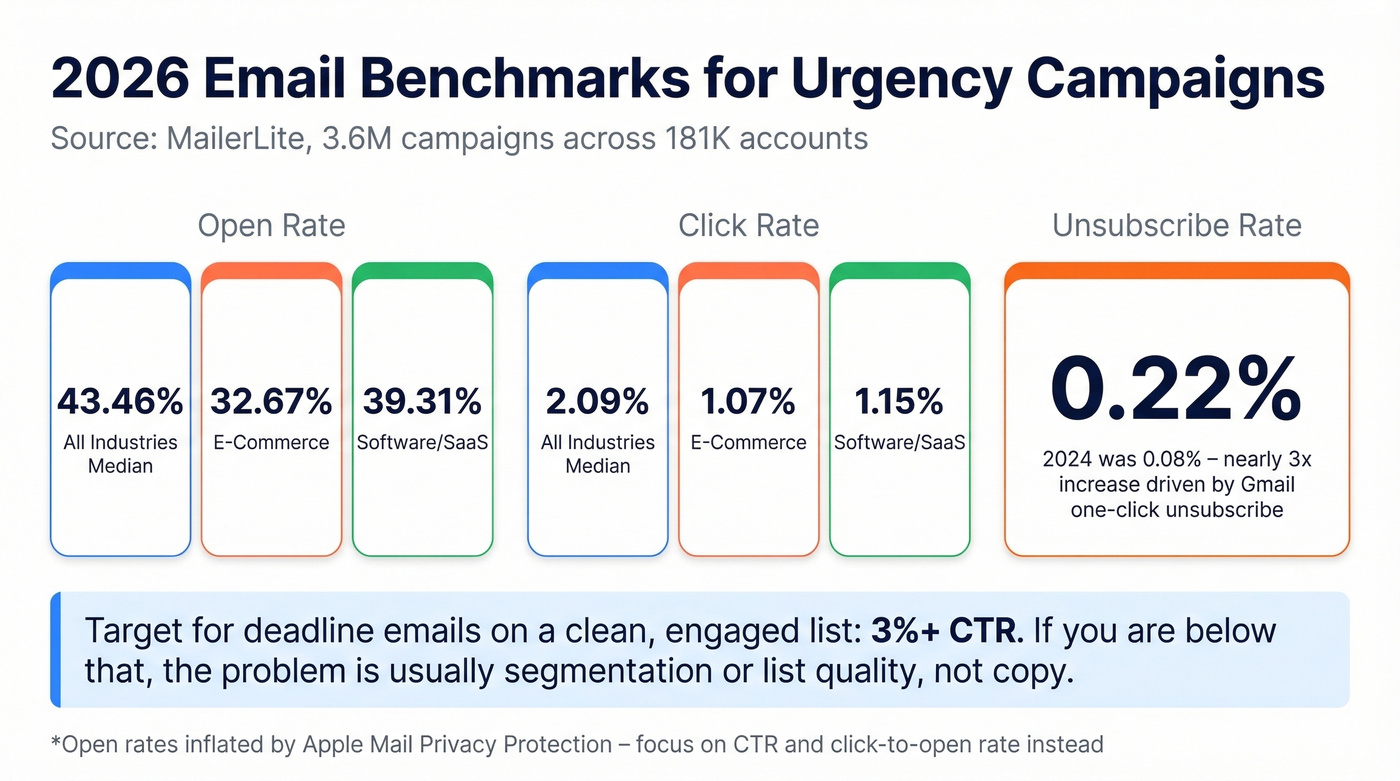
Before you optimize an urgency campaign, you need to know what baseline performance looks like. MailerLite's 2026 benchmark study - covering 3.6 million campaigns across 181,000 accounts - provides the clearest picture.
| Metric | Median (All Industries) | E-Commerce | Software/SaaS |
|---|---|---|---|
| Open rate | 43.46% | 32.67% | 39.31% |
| Click rate | 2.09% | 1.07% | 1.15% |
| Unsubscribe rate | 0.22% | Not reported | Not reported |
A few things stand out. That 0.22% unsubscribe rate is nearly 3x the 0.08% from 2024 - largely driven by Gmail's one-click unsubscribe button making it easier for recipients to opt out from the inbox UI. It's not necessarily a sign your emails are worse; it's a platform shift.
Open rates remain inflated by Apple Mail Privacy Protection, which pre-fetches emails and registers phantom opens. Salesforce's benchmark guidance recommends focusing on CTR and click-to-open rate instead. Promotional emails typically land in the 1-3% CTR range. In our experience, a well-executed deadline email on a clean, engaged list should clear 3%+ CTR. If your urgency emails aren't hitting that, the problem is usually segmentation or list quality, not copy.
Anatomy of a High-Converting Last Chance Email
Subject Lines That Convert
The subject line does two jobs: get the open and stay legal. Here's how to split the difference.
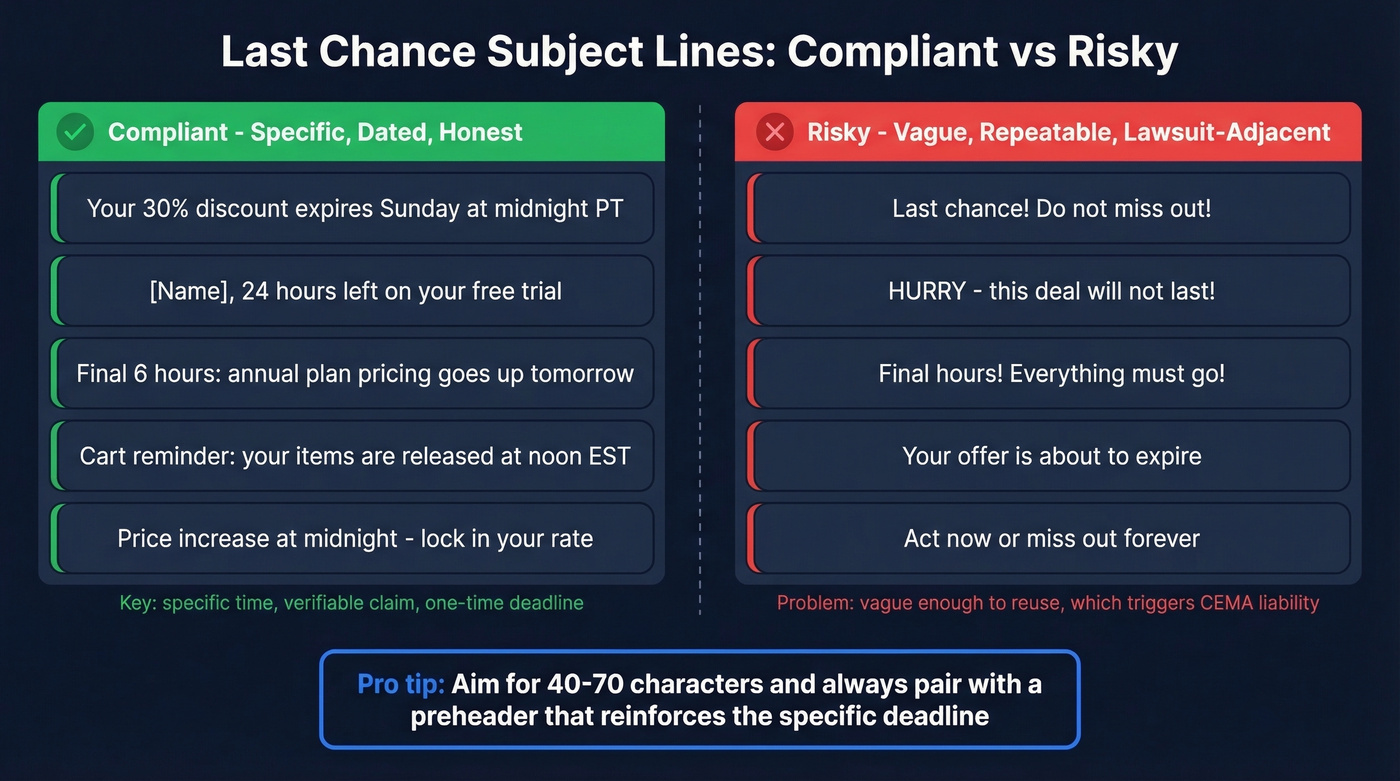
Compliant - specific, dated, honest:
- "Your 30% discount expires Sunday at midnight PT"
- "[Name], 24 hours left on your free trial"
- "Final 6 hours: annual plan pricing goes up tomorrow"
- "Cart reminder: your items are released at noon EST"
- "This Friday only: free shipping on orders $50+"
- "48 hours left: your reserved spot expires Monday"
- "Price increase at midnight - lock in your rate"
- "Your [product] hold expires in 3 hours"
Risky - vague, repeatable, lawsuit-adjacent:
- "Last chance! Don't miss out!"
- "HURRY - this deal won't last!"
- "Final hours! Everything must go!"
- "Your offer is about to expire"
- "Act now or miss out forever"
The difference is specificity. "Expires Sunday at midnight PT" is a verifiable claim. "Last chance! Don't miss out!" is vague enough to reuse - and that reuse is exactly what triggers CEMA liability. Aim for 40-70 characters for mobile preview, and always pair with a preheader that reinforces the specific deadline.
If you want more swipeable ideas, start with these email subject lines and adapt them to a verifiable deadline.
Countdown Timers - Do They Work?
Yes. And they're underused.
In Litmus's personalization survey, countdown timers sat at just 9% adoption, which means the novelty factor is still strong. A Litmus case study found that adding a countdown timer to a Cyber Monday email led to 43% of subscribers who opened the email re-opening it later. Omnisend reports timers can lift CTR by up to 25% and overall conversion rates by 20%.
The implementation choice matters. GIF timers display broadly across email clients and are simple to build, but they aren't truly real-time - they show the same countdown regardless of when the email is opened. Dynamic HTML timers update on each open, staying accurate, but Outlook and some older clients block them and show a fallback static image instead.
The biggest mistake is having no plan for late openers. If someone opens your email after the timer hits zero, they see "00:00:00" - which is confusing and kills conversion. Build an "after zero" fallback: swap the timer for a "sale ended" message with a link to current offers, or redirect the CTA to a waitlist.
CTA, Personalization & Mobile
Button copy should match the urgency. "Claim my 30% off" beats "Shop now." "Extend my trial" beats "Learn more." The CTA should name what they're about to lose. (More examples: email call to action.)
Segment beyond first name. Personalize by browsing behavior, plan tier, or engagement level. A trial user who's burned through 80% of their credits needs a completely different message than one who never logged in. Treating them the same wastes both sends. If you need a tighter approach, use intent based segmentation.
Design for mobile first. Single-column layout, 44px minimum tap targets, and preview text that complements the subject line rather than repeating it. If the CTA button is buried below the fold on a phone screen, the countdown timer is irrelevant. For testing ideas, see email preview text A/B testing.

The article is clear: urgency emails on stale data trigger complaint spikes and bounces right when inbox providers are watching. Prospeo refreshes 300M+ profiles every 7 days - not every 6 weeks - so your last chance campaigns hit real inboxes, not spam traps. 98% email accuracy, verified through a 5-step process with catch-all handling and honeypot filtering.
Stop gambling your sender reputation on data that's already dead.
E-Commerce Examples
Scarcity works best when paired with exclusivity - and Koio proves it. Their deadline emails combine limited inventory counts ("only 12 pairs left in your size") with a time-bound discount, using a clean single-column layout with large product photography against a white background. The dual trigger of time and quantity creates genuine urgency without needing to exaggerate either one. Browse Really Good Emails' last chance collection for more examples in this style.
Everlane takes the opposite approach: radical simplicity. Their final-call emails feature a single product category, a specific end date, and minimal design - no flashing GIFs, no all-caps panic, just bold typography on a muted palette with one CTA above the fold. The urgency comes from the deadline itself, not the formatting. It works because Everlane's audience trusts that when they say a sale ends, it actually ends.
Then there's the cautionary tale. Macy's subject lines like "Last chance! 40-60% off disappears tonight poof" followed by near-identical promotions days later are exactly what triggered CEMA litigation. The design was polished, the conversion copy was sharp - and none of it mattered because the deadline was fake. Don't be Macy's.
B2B & SaaS Examples
SaaS urgency emails look different from e-commerce, but the psychology is identical. The deadline is usually a trial expiring, a renewal approaching, or a reactivation window closing.
Trial expiration (Clay): When your Clay trial ends, they don't guilt-trip you. They move you to a free account with 100 bonus credits and a clear CTA to explore paid plans starting at $149/month. The "last chance" framing is implicit - you're about to lose features - but the tone is helpful, not desperate. If you're building these flows, a B2B cold email sequence framework can help you structure timing and messaging.
Reactivation (RB2B): RB2B takes the founder-style approach - a personal "we miss you" email from the CEO highlighting recent product improvements, paired with a 15% discount valid for 48 hours. The time constraint is real and specific, and the personal tone makes it feel like a genuine message rather than a marketing blast. We've seen this founder-email format outperform branded templates in B2B contexts, especially for reactivation, because it reads like a real person reaching out rather than a system-generated nudge.
Renewal deadline (Semrush): Semrush frames their final call as a personalized 1:1 session offer paired with 17% savings on annual plans. It's not "buy now or else" - it's "here's extra value if you commit before the deadline." If you want to quantify impact, track it like a funnel using funnel metrics.
For SaaS trial sequences specifically, the tactical checklist from Dan Siepen is straightforward: remind users which paid features they'll lose, include social proof from similar companies, offer a trial extension CTA as a secondary option, and add a plan comparison so they can self-select.
Copy-Paste Email Templates
Here's a 48-hour warning template you can adapt for any deadline. Swap the bracketed fields and send.
Subject: [Benefit] expires [Day] at [Time + Timezone]
Preheader: This is the real deadline - here's what you'll lose
Hi [First Name],
Your [offer/trial/discount] ends [Day] at [Time + Timezone]. After that, [specific consequence - price goes up / trial features lock / cart releases].
Here's what you're keeping if you act now:
- [Key benefit #1]
- [Key benefit #2]
- [Key benefit #3]
[CTA Button: Claim My [Offer] Before [Day] -->]
Questions? Reply to this email - I read every one.
[Sender name + title]
And a final-call version for the 2-hour mark:
Subject: 2 hours left: [Offer] gone at [Time]
Preheader: No extension this time
[First Name], this is the last email about [offer]. It expires at [Time + Timezone] today.
[CTA Button: Lock In [Offer] Now -->]
After [Time], [specific consequence]. No exceptions.
These are intentionally short. The final email in a sequence should be the shortest - everything has already been said. Your only job is to create one more moment of decision. For more variations, pull from these emails that get responses.
Building a Countdown Sequence
A single "last chance" blast underperforms a structured sequence. We've seen the 48h / 24h / 2h framework consistently beat single sends across both e-commerce and SaaS contexts, and I'd go as far as saying a single blast leaves 30-40% of your deadline revenue on the table.
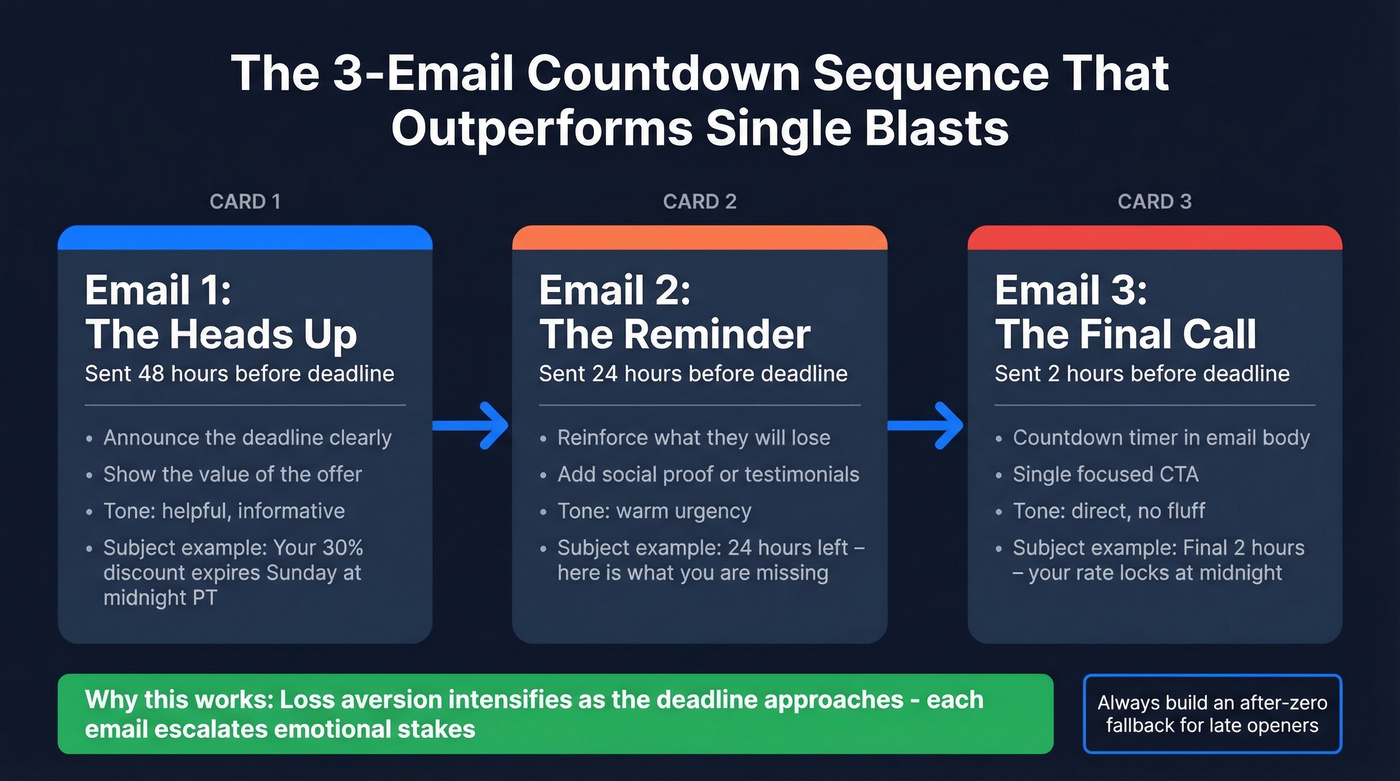
| Timing | Focus | Tone | |
|---|---|---|---|
| Heads up | 48 hours before | Value recap + deadline | Helpful |
| Reminder | 24 hours before | Social proof + specific time | Direct |
| Final call | 2 hours before | Countdown + single CTA | Urgent |
Each email escalates in urgency but shifts its angle. The first email reminds them why the offer matters. The second adds proof that others are acting ("1,200 teams upgraded this week"). The third strips everything away except the deadline and a single button.
Don't send all three to everyone. Active browsers who've visited your pricing page in the last 48 hours get the full sequence. Cold subscribers who haven't opened in 30 days get only the final email - or nothing at all. Blasting your entire list with three urgency emails is how you spike unsubscribes and train inbox providers to deprioritize your domain. If you're managing this at scale, treat it like sequence management.
Let's be honest about something: if your average deal size is under $5,000, a 2-email sequence (48h + 2h) is probably enough. The 24-hour middle email adds the most value for high-consideration purchases where buyers need social proof to justify the spend internally. For a $29/month SaaS plan or a $60 e-commerce cart, the middle email often just trains people to wait for the final one.
Clean Your List Before You Hit Send
Here's the scenario nobody talks about: you craft the perfect 3-email countdown sequence, nail the subject lines, set up dynamic timers - and then send it to a list with a 12% bounce rate. On a 50,000-contact send, that's 6,000 bounces hitting inbox providers at the exact moment you need maximum deliverability.
Urgency emails on stale data are uniquely destructive. Time-sensitive sends generate higher complaint rates because recipients who don't recognize you are more likely to hit "spam" when the subject line screams urgency. Bounces spike because you're sending to your full list, not just engaged segments. And inbox providers notice the pattern - a sudden volume increase combined with high bounces and complaints is the textbook signal for a compromised sender.
The fix takes five minutes. Run your list through an email verification tool before any high-stakes campaign. Prospeo's 5-step verification catches invalid addresses, spam traps, catch-all domains, and honeypots - the exact threats that destroy sender reputation on time-sensitive sends. (If you want the deeper playbook, use this email deliverability guide alongside your verification workflow.) At roughly $0.01 per verification with 98% accuracy, it's the cheapest insurance in your stack. We've watched clients tank their sender reputation by skipping verification on countdown campaigns. Stack Optimize built their agency to $1M ARR by doing the opposite - maintaining 94%+ deliverability and under 3% bounce rates with zero domain flags across all clients.
One bad bounce on a deadline email can tank the domain reputation you spent months building. Stack Optimize built a $1M agency on Prospeo data with 94%+ deliverability and under 3% bounce rates - across every client campaign. At $0.01 per verified email, list hygiene costs less than a single CEMA penalty.
Clean data is cheaper than a $500-per-email lawsuit.
Mistakes That Kill Last Chance Emails
Fake deadlines will get you sued. This isn't hypothetical anymore. Macy's, Nike, Skechers - they all thought "last chance" was just marketing language. The Washington Supreme Court disagreed, and the $500-per-email penalty means a single campaign to your Washington subscribers can generate six-figure liability. If the offer reappears after the deadline, don't call it "last chance." Period.
Beyond the legal risk, these tactical mistakes kill conversions:
- No mobile optimization. If your countdown timer, CTA button, or layout breaks on mobile, you've wasted the urgency you built.
- Ignoring segmentation. Sending the same urgency sequence to engaged buyers and cold subscribers is how you spike unsubscribes. Segment by engagement level, browsing behavior, and purchase history.
- Skipping list verification. Bounces and spam complaints on urgency sends are disproportionately damaging. Verify before any countdown campaign. (Related: email bounce rate.)
- Generic CTAs. "Shop now" tells the reader nothing. "Claim my 30% off before midnight" tells them exactly what they're getting and when they lose it.
- No post-deadline plan. Late openers see an expired timer and a dead CTA. Build a fallback - redirect to current offers or a waitlist.
- Overusing urgency. If every email is a "last chance," nothing is. Reserve genuine urgency for genuine deadlines, and your conversion rates on those sends stay high.
Skip the countdown sequence entirely if you can't commit to a real deadline. A strong promotional email without urgency framing will always outperform a "last chance" email that trains your audience to ignore deadlines because they know another one is coming next week.
FAQ
How many emails should I send per deadline?
Two to three. The 48h / 24h / 2h countdown framework gives procrastinators multiple nudges without overwhelming your list. For deals under $5,000, a 2-email sequence (48h + 2h) typically performs just as well.
Are last chance emails legal?
Yes - if the deadline is real. The Brown v. Old Navy ruling penalizes misleading subject lines, not urgency itself. If your offer genuinely expires and doesn't reappear afterward, you're compliant under CEMA.
What's a good click rate for urgency emails?
The all-industry median CTR is 2.09%. Well-executed deadline emails on engaged segments should clear 3%+. Focus on CTR over open rate - Apple's privacy features inflate opens artificially.
Do countdown timers improve conversions?
Yes. Case studies show up to 25% CTR lift and a 43% re-open rate on genuine deadline campaigns. Use dynamic timers for accuracy, include a GIF fallback for Outlook, and always plan a post-zero fallback message.
How do I protect deliverability on deadline campaigns?
Verify your list before sending. Bounces and complaints spike on time-sensitive sends, and inbox providers penalize sudden volume increases paired with poor engagement signals. A 5-step verification process that catches spam traps, catch-all domains, and honeypots is the minimum - our team runs this before every high-stakes campaign and it's saved us from deliverability disasters more than once.