

Lead Development Representative: Role, Salary & Career Path in 2026
You're scrolling job boards and you see three listings: lead development representative, sales development representative, business development representative. The descriptions look almost identical. The pay ranges overlap. And you're wondering if any of this actually matters - or if it's just the same job with different letterhead.
Short answer: it mostly is. But the details matter more than you'd think.
What Is a Lead Development Representative?
An LDR sits at the top of the sales funnel. The job is simple enough on paper: find potential buyers, qualify whether they're worth pursuing, and hand them off to an account executive who closes the deal. Salesforce frames the core responsibilities as prospecting, lead qualification, lead nurturing, and booking meetings - and that maps almost perfectly to what most companies mean when they post this role.
Where it gets messy is in the naming. Some organizations use LDR to signal an inbound-focused qualifier - someone who works marketing-generated MQLs rather than cold-calling strangers. Others use it interchangeably with SDR or BDR. The title tells you almost nothing. The job description tells you everything.
On Reddit, you'll find people debating whether an LDR title is a step back from other sales roles. It's not - as long as the responsibilities and comp match what you're looking for.
The Quick Version
- Title confusion is real. About 60% of companies use SDR and BDR interchangeably. LDR falls into the same bucket. Read the job description, not the title.
- Expect $60K base / $85K OTE at the median, with top performers clearing $127K.
- Plan to stay 12-18 months, and build your AE promotion case by hitting 90%+ of quota for two straight quarters.
- Your biggest lever is data quality. Verified contacts mean fewer wasted dials and more pipeline.
LDR vs SDR vs BDR - What's Actually Different?
Ask ten organizations to define these three titles and you'll get ten different answers.
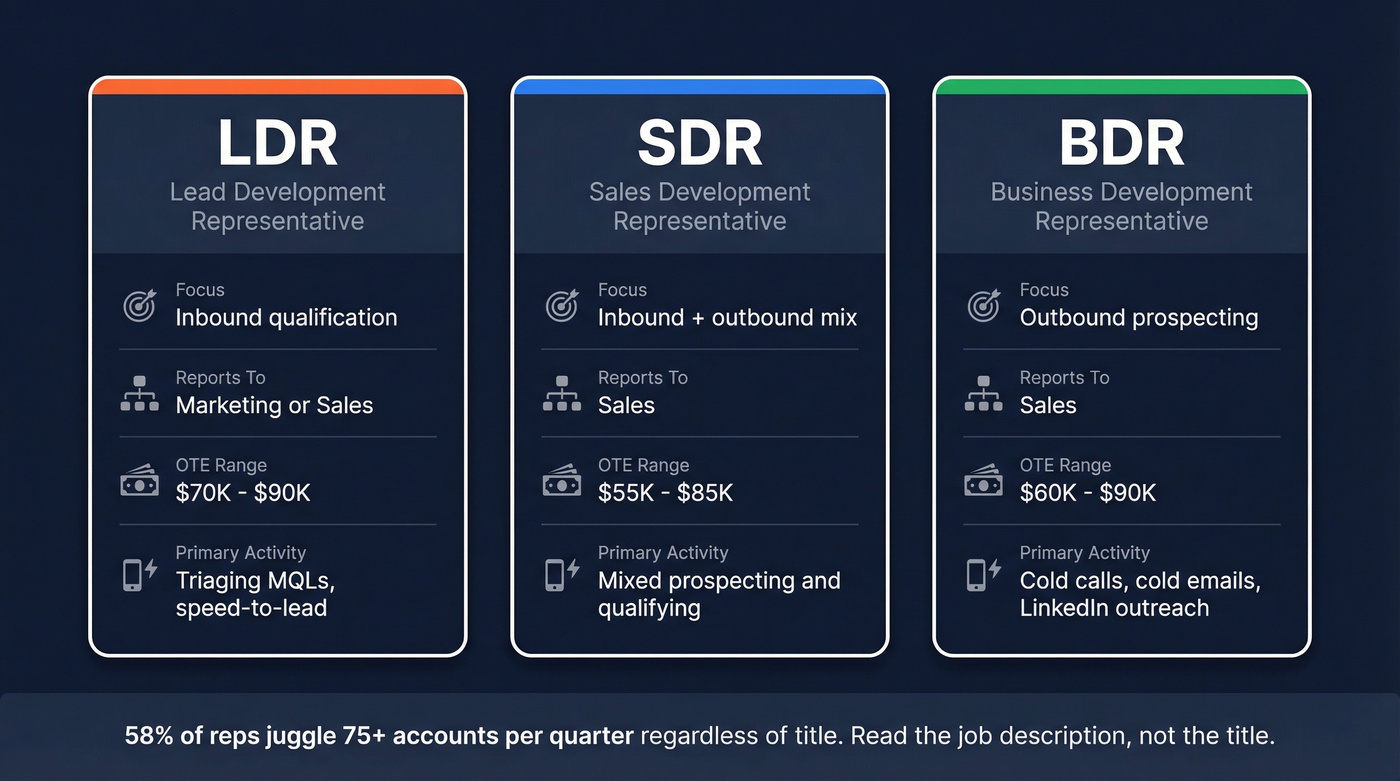
| Title | Typical Focus | Common Reporting Line | OTE Range |
|---|---|---|---|
| LDR | Inbound qualification | Marketing or Sales | $70K-$90K |
| SDR | Inbound + outbound mix | Sales | $55K-$85K |
| BDR | Outbound prospecting | Sales | $60K-$90K |
The textbook distinction: SDRs qualify inbound leads from marketing - content downloads, webinar signups, demo requests. BDRs create opportunities from scratch through cold outreach. LDRs typically lean inbound, but plenty of companies use the title for a hybrid role.
In practice, 58% of SDRs juggle more than 75 accounts per quarter regardless of their title. 80% of all sales development teams now report to Sales, up from 60% in 2022. The title confusion is the industry's mess, not yours.
Daily Tasks and Workflow
The daily rhythm is numbers-driven. Expect 40-50 calls and 40-100 emails per day to hit quota. It takes 18+ dials to connect with a single prospect, which means most of your day is spent reaching voicemail, not humans.
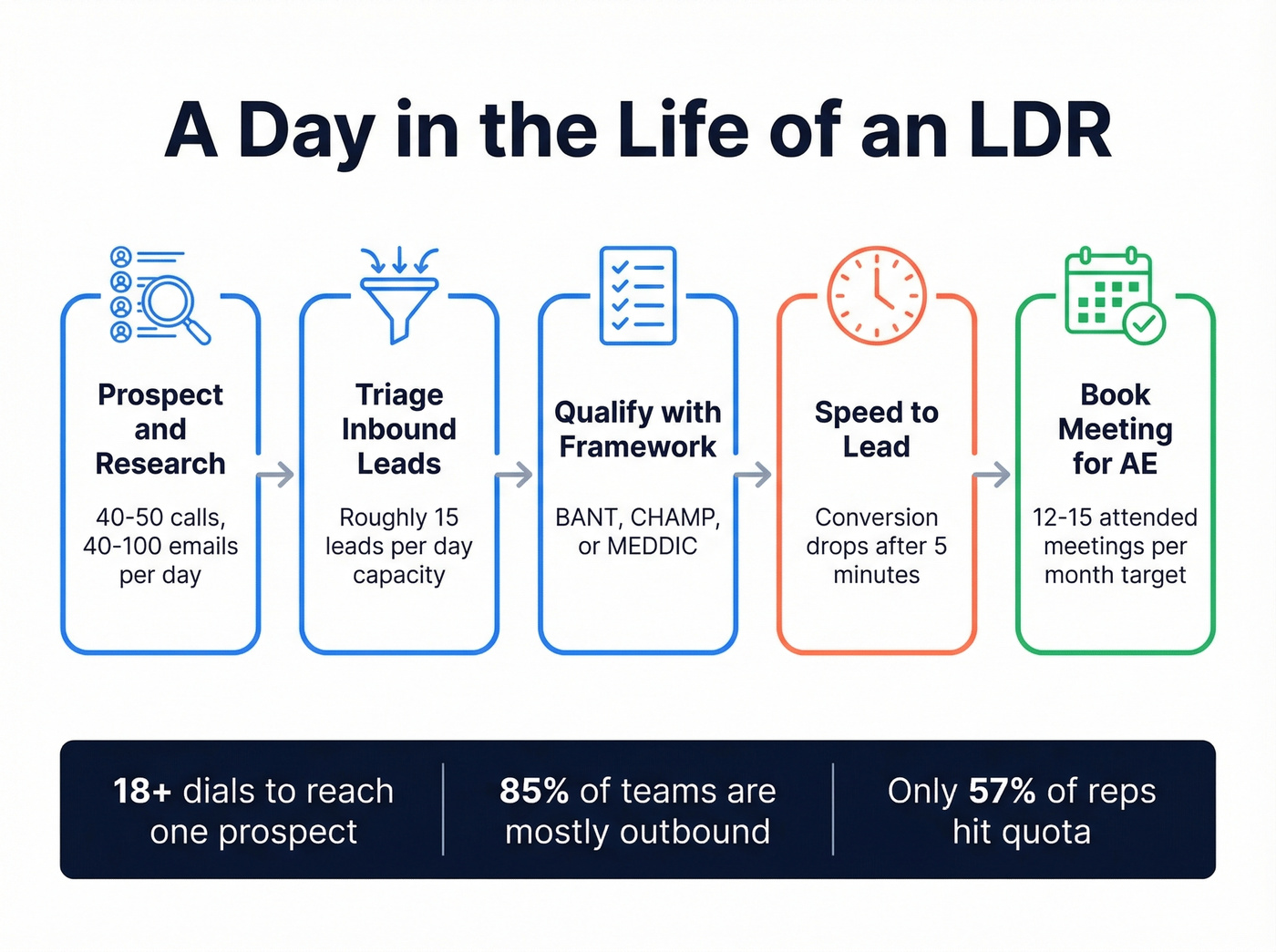
For inbound-focused LDRs, the capacity benchmark is roughly 15 leads per day - about 300 per month. Your job is to triage those leads, separate the SQLs from the tire-kickers, and book meetings for your AEs. Response time is critical on inbound: conversion rates drop sharply after the first five minutes, so speed-to-lead matters as much as your qualification skills.
Here's the thing most job descriptions won't tell you: 85% of sales development teams are mostly or entirely outbound. Even if your title says "lead development," odds are you'll be doing cold outreach alongside inbound qualification.
Lead Qualification Frameworks
Not every lead deserves a meeting. The framework you use depends on deal complexity.
| Framework | Best For | Key Criteria |
|---|---|---|
| BANT | SMB, high-volume inbound | Budget, Authority, Need, Timeline |
| CHAMP | Mid-market, buyer-centric | Challenges, Authority, Money, Prioritization |
| MEDDIC/MEDDPICC | Enterprise, complex deals | Metrics, Economic Buyer, Decision Process, Competition |
| GPCTBA/C&I | Strategic exec conversations | Goals, Plans, Challenges, Timeline, Budget, Authority, C&I |
BANT is fine for SMB triage, but it's too shallow for enterprise. Asking "do you have budget?" on a first call is a red flag in complex sales - budget is often created after a business case, not before. For deals above six figures, graduate to CHAMP or MEDDIC.
The practical ladder: start with BANT when you're new and handling high volume, move to CHAMP as you develop consultative skills, and learn MEDDPICC early if your company sells enterprise software with 6+ month cycles - it'll accelerate your path to AE faster than almost anything else you can do.

It takes 18+ dials to reach one prospect. Bad data makes that number worse. Prospeo gives LDRs 98% verified emails and 125M+ direct dials so you spend less time chasing voicemail and more time qualifying real buyers.
Stop wasting dials on dead data. Start connecting with decision-makers.
LDR Salary and Compensation in 2026
RepVue's 2026 data puts the SDR/BDR median at $60K base and $85K OTE, with top performers hitting $127,955. LDR comp aligns closely with these ranges.
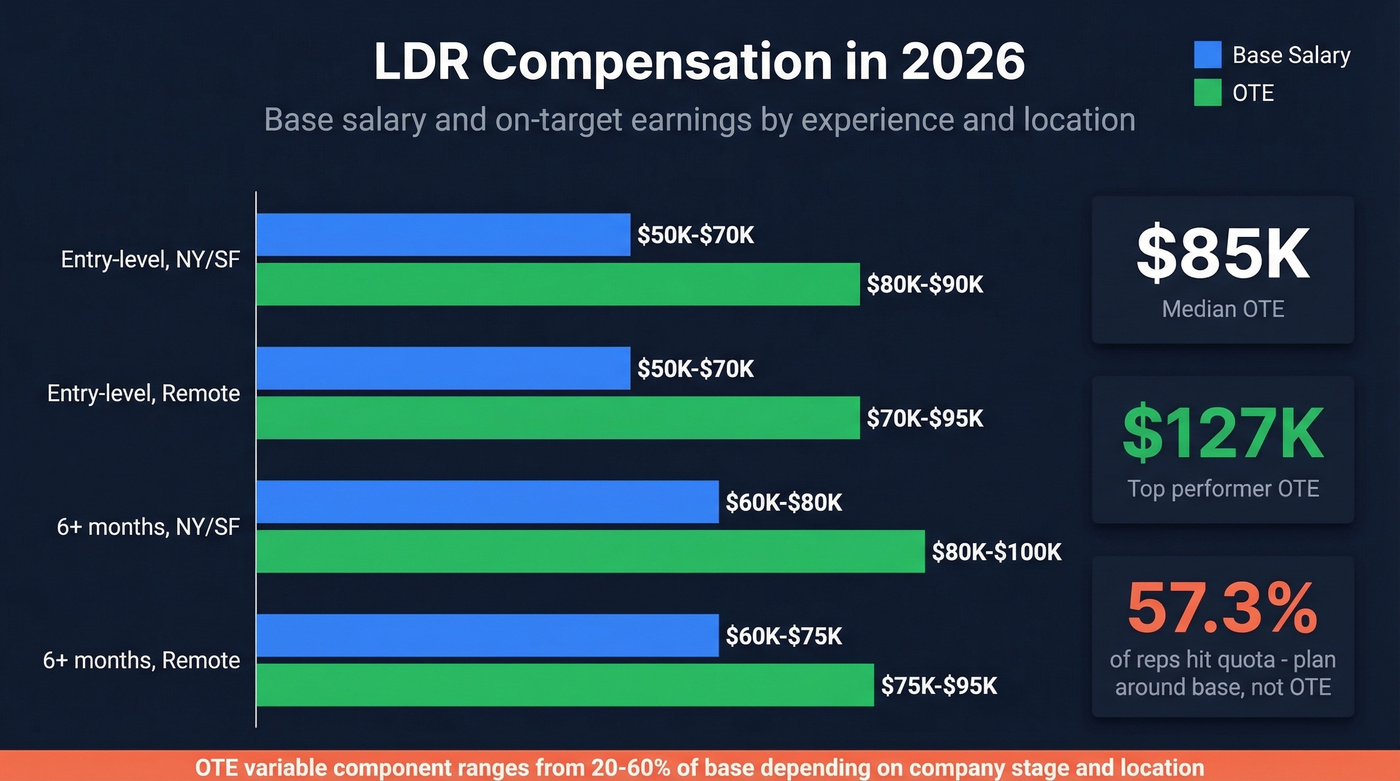
| Experience | Location | Base Salary | OTE |
|---|---|---|---|
| Entry-level | NY/SF | $50K-$70K | $80K-$90K |
| Entry-level | Remote | $50K-$70K | $70K-$95K |
| 6+ months | NY/SF | $60K-$80K | $80K-$100K |
| 6+ months | Remote | $60K-$75K | $75K-$95K |
OTE variability runs 20-60% of base salary depending on location and company stage. A startup might offer a higher variable split; an established company will weight toward base.
Only 57.3% of SDRs/BDRs hit quota. Plan your finances around base salary, not OTE. If you want to sanity-check comp packages, it helps to understand OTE math.
KPIs and Performance Benchmarks
The Bridge Group benchmark puts average pipeline per SDR at $3M/year in SaaS. Sales development teams source 30-45% of new revenue - which is why the role exists despite the burnout.
Let's break down the funnel math. An Operatix study of 150 SDRs found the benchmark is roughly 15 meetings/SALs per month, with about 20% dropout, yielding around 12 attended meetings. At a 50% conversion to next steps and a $100K average deal size, that's 6 qualified opportunities generating roughly $600K in pipeline per month from one rep. Those numbers explain why companies keep hiring for this role even with high turnover.
Inbound conversion rates vary wildly by intent level. Low-intent leads like content downloads convert at 5-10%. High-intent demo requests convert at 75-80%. Knowing which bucket your leads fall into changes how you prioritize your day. If you want more benchmarks, see sales conversion rate and average B2B lead conversion rate.
Career Path - Where LDRs Go Next
Most LDRs transition to account executive within 12-18 months. Fast-track programs at some companies cut that to 6-9 months. The promotion criteria are consistent: hit 90%+ of quota for two consecutive quarters, document your pipeline contribution, and have the conversation with your manager by month 12.
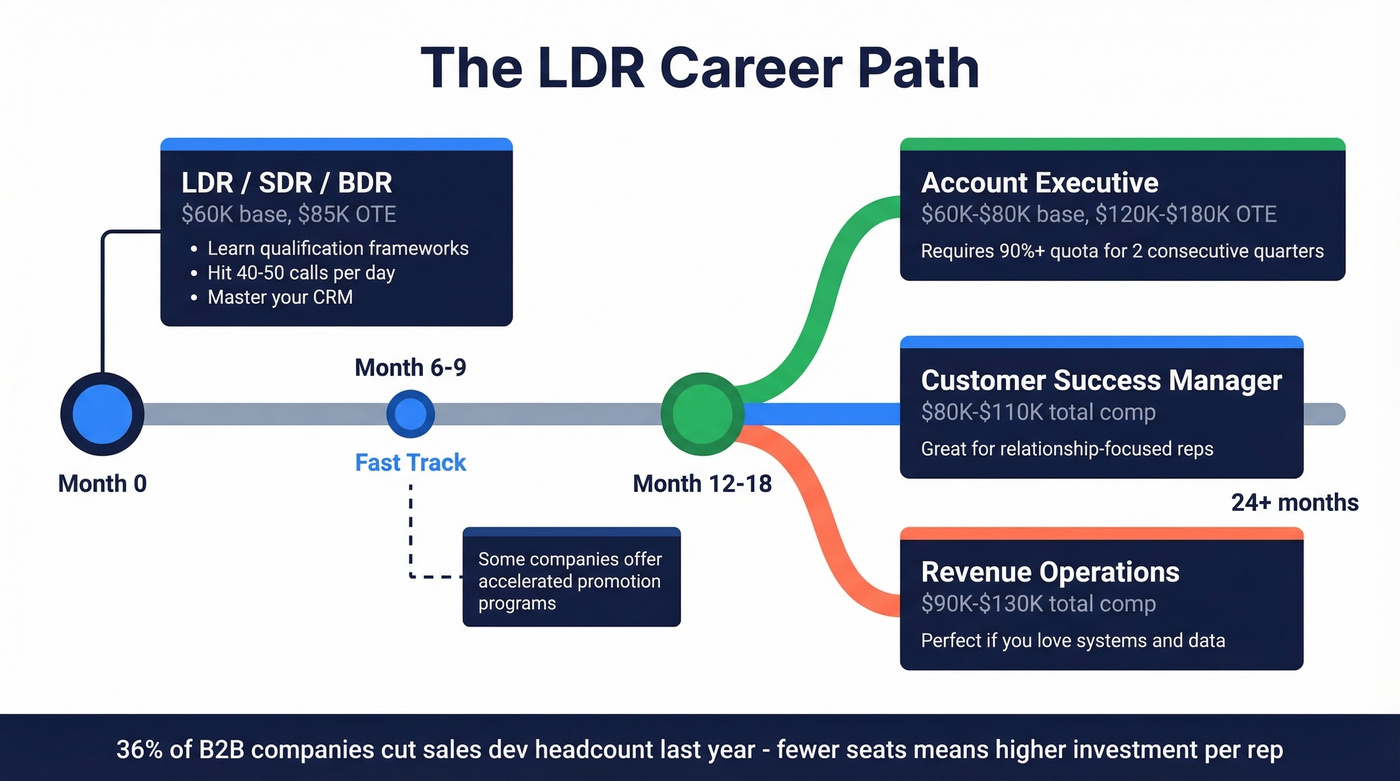
Mid-market AE comp jumps significantly - $60K-$80K base with $120K-$180K OTE. That's the carrot.
But AE isn't the only exit. Customer Success Manager is a natural pivot for people who prefer relationship management over net-new hunting, typically at $80K-$110K total comp. RevOps is another path at $90K-$130K for people who get obsessed with the systems and data behind sales rather than the selling itself. We've seen strong LDRs move into RevOps and thrive because they actually understood the frontline pain points that most ops people only read about in dashboards.
The lead development representative role is shrinking. 36% of B2B companies cut sales development headcount last year, shifting to smaller, AI-powered teams. If your average deal size sits below $10K, your company probably doesn't need a dedicated LDR at all - a good sales cadence tool and verified data can handle it. But for the reps who remain, fewer seats means more investment per head, better tools, and higher comp. The bar is rising. Clear it and you'll be fine.
The Burnout Reality
Sales development has a 34% turnover rate. Average tenure is 14-18 months. More than 1 in 10 companies exceed 55% turnover. Threads on r/sales regularly show BDR tenures of 3-10 months at the worst shops.
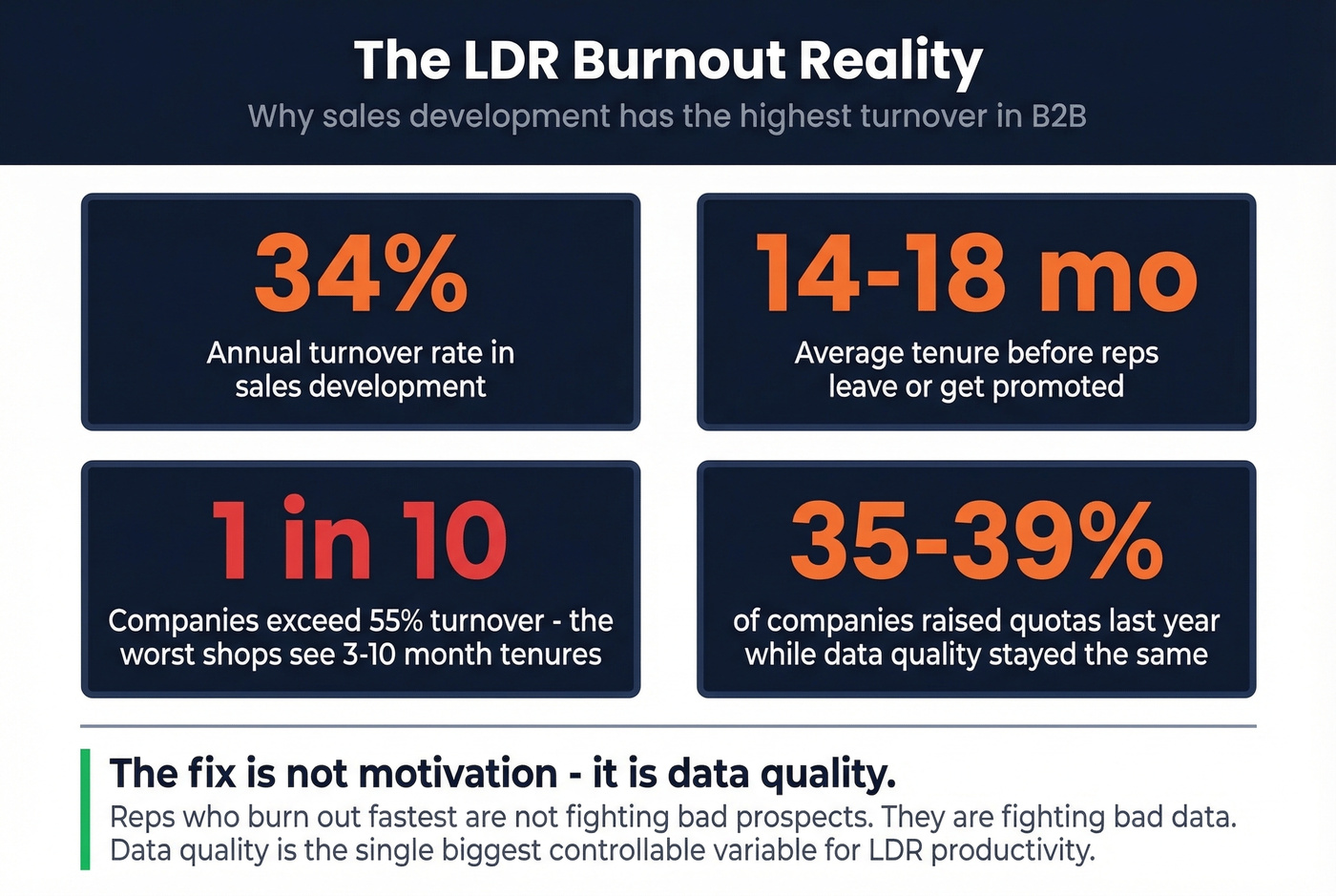
35-39% of companies raised quotas last year. Picture this: your manager bumps your target by 20%, but your lead list hasn't been updated in six weeks. Half your calls go to voicemail on dead numbers. That's not a motivation problem - it's a data problem. In our experience, the reps who burn out fastest aren't fighting bad prospects; they're fighting bad data. Data quality is the single biggest controllable variable for LDR productivity. You can't control your quota, your territory, or your manager's expectations. You can control whether the 50 numbers you dial today actually reach real people.
If you're trying to reduce wasted activity, start with sales prospecting techniques and a tighter 30-60-90 day plan.
Essential Tools for LDRs
Three categories matter. Everything else is optional.
CRM: Salesforce or HubSpot. Pick whichever your company uses and learn it cold. Skip this section if you already know your way around a CRM - the real leverage is in the next two. (If you need a refresher, here are examples of a CRM.)
Data platform: This is where most LDRs either thrive or waste hours. Fresh, verified contact data is the difference between a productive day and 50 calls to voicemail. Prospeo refreshes its database every 7 days - compared to the 6-week industry average - so your cadence hits live contacts instead of dead ends. With 300M+ professional profiles, 98% email accuracy, and 125M+ verified mobile numbers, it's built for reps who need to connect, not just dial. At roughly $0.01 per lead versus ZoomInfo's $15,000+/year or Apollo's $49-$119/user/month, the economics aren't close for teams that don't need an enterprise platform. If you're evaluating vendors, compare data enrichment services and sales prospecting databases.

Sequencing/Dialers: You need a multi-touch outreach tool - Outreach, Salesloft, or a lighter option like Instantly or Smartlead. The sequencer executes your cadence; the data platform determines whether anyone picks up. For a broader stack, see SDR tools and follow up email software.
Your path to AE depends on hitting 90%+ quota for two straight quarters. That math breaks down fast when 35% of your emails bounce. Prospeo's 7-day data refresh and 5-step verification keep bounce rates under 4% - so every rep activity counts toward pipeline.
Build your AE promotion case on data that actually connects.
FAQ
Is a lead development representative an entry-level role?
Yes - most companies expect 0-2 years of experience. It's designed as a 12-18 month launchpad into closing roles like account executive, not a long-term destination. Strong performers with consistent quota attainment move up fastest.
What's the difference between an LDR and an SDR?
In theory, LDRs lean toward inbound lead qualification while SDRs handle a broader inbound/outbound mix. In practice, roughly 60% of companies use these titles interchangeably. Read the job description - the responsibilities and comp structure matter far more than the three-letter acronym.
How do I get promoted from LDR to account executive?
Hit 90%+ of quota for two consecutive quarters, document your pipeline contribution in hard numbers, and have the promotion conversation with your manager by month 12. Build relationships with AEs now - they'll vouch for you when the time comes. Strong performers move up in 12-18 months; fast-track programs can cut that to 6-9 months.
What tools do LDRs need to hit quota?
A CRM, a verified data platform for accurate emails and direct dials, and a sequencing tool for multi-touch outreach. Bad contact data is the #1 productivity killer - fix your data before optimizing anything else.
How does the SDR lead qualification process differ from an LDR's?
The SDR qualification process typically covers both inbound and outbound contacts, while an LDR usually focuses on triaging marketing-generated leads. In either case, the frameworks are the same - BANT for high-volume SMB, CHAMP or MEDDIC for mid-market and enterprise - and the goal is identical: pass sales-qualified leads to an AE as quickly as possible.