

Lead Engagement: The System That Turns B2B Leads Into Revenue in 2026
79% of leads never convert. Not because the product's wrong - because the system between "lead captured" and "deal closed" is broken. Most teams treat lead engagement as disconnected tactics: an email here, a retargeting ad there, maybe a call if someone remembers. That's not a system. It's a hope strategy, and it's the fastest path to wasted pipeline.
What Is Lead Engagement?
Lead engagement is the full system of interactions - across every channel, at every stage - that moves a prospect from "vaguely aware" to "ready to buy." It's not a single email sequence or a nurture drip. It's the infrastructure that connects your content, outreach, scoring, and data quality into one coherent workflow.
Here's the reframe that matters: engagement isn't a tactic, it's infrastructure. When 79% of leads die before converting, the problem isn't that your reps aren't trying hard enough. The system between marketing and sales has gaps - bad data, slow follow-up, single-channel dependency, no scoring model. Fix the system, and conversion takes care of itself.
Why It Matters More in 2026
The B2B buying cycle has stretched to 10.1 months on average. Buyers don't contact a vendor until they're 61% through their journey. The winning vendor is on the buyer's "Day One shortlist" 95% of the time.
If you're not engaging prospects before they start formally evaluating, you're already off the list. 92% of B2B buyers start their evaluation with at least one vendor already in mind, and 41% have a preferred vendor before formal evaluation even begins. Engagement isn't about convincing people to buy - it's about being present and useful early enough that you're the name they already trust when budget conversations start.
Meanwhile, 70-80% of B2B buyers now prefer remote or digital self-service interactions over talking to a rep. That's why engaging leads can't be reduced to "send more emails." You need a system that starts with content for passive buyers, accelerates for active ones, and uses intent signals to know the difference.
Here's the thing: most teams don't have an engagement problem. They have a data and timing problem disguised as an engagement problem. Fix those two things and half your "engagement tactics" become unnecessary.
The PCIA Engagement Framework
Every effective system for engaging leads has four layers. We call it the PCIA Framework: Passive Content, Capture, Intent Signals, and Active Outreach.
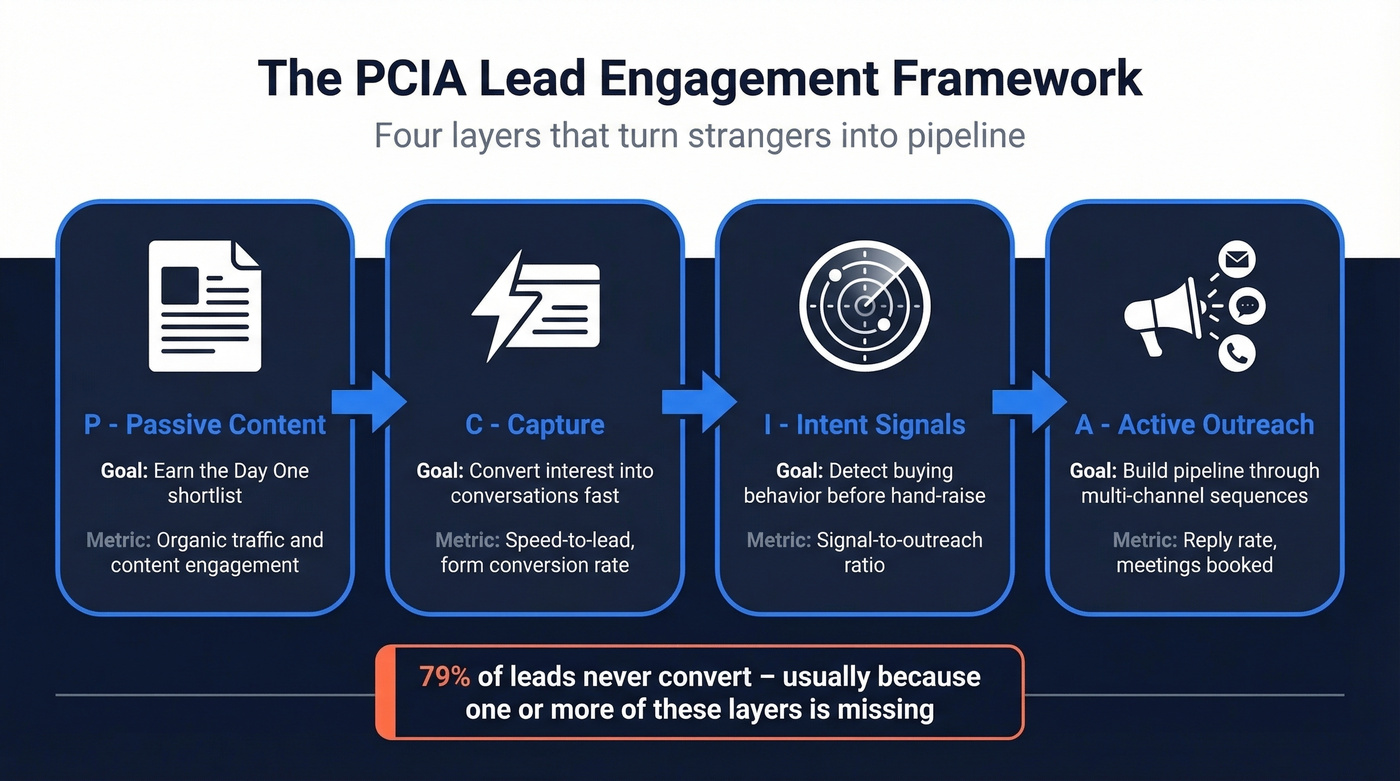
| Layer | Goal | Key Metric |
|---|---|---|
| Passive Content | Earn the Day One shortlist | Organic traffic, content engagement |
| Capture | Convert interest into conversations fast | Speed-to-lead, form conversion rate |
| Intent Signals | Detect buying behavior before hand-raise | Signal-to-outreach ratio |
| Active Outreach | Build pipeline through multi-channel sequences | Reply rate, meetings booked |
A community playbook on r/b2bmarketing breaks engagement into similar pillars, and the pattern holds across every high-performing team we've studied. Let's unpack each one.
Passive Content
Most of your addressable market isn't buying right now. They're reading, learning, and forming opinions about who knows their space. Active blogging generates 13x more leads than companies that don't publish consistently, and 88% of top-performing content marketers prioritize audience informational needs over sales messaging. Teach first, sell later.
Capture Active Buyers Fast
When someone fills out a form or requests a demo, the clock is ticking. Companies take 47 hours on average to respond to a new lead - nearly two full business days of silence while competitors close.
The practitioner rule: if you take more than 48 hours to reply to an inbound inquiry, you've lost. Use round-robin routing in your CRM, Slack alerts for new leads, or a dedicated SDR on inbound duty during business hours. Set an SLA of under 5 minutes for inbound leads and measure it weekly. We've seen teams cut their response time from hours to minutes just by adding a Slack notification on form submissions - no fancy tooling required.
Intent Signals
The most sophisticated engagement teams don't just react to form fills. They build systems that detect buying intent before a prospect ever reaches out, combining engagement metrics like email opens, content downloads, webinar attendance, and poll responses with website visitor identification, product analytics, and external intent data.
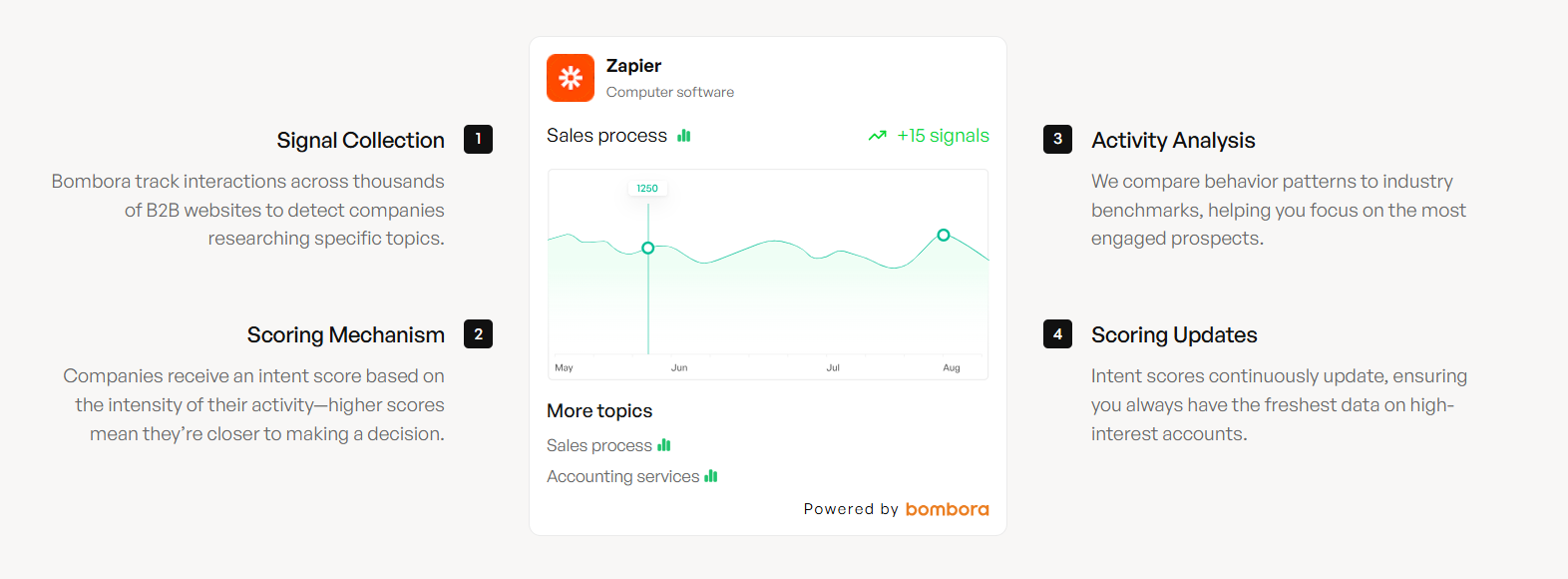
When a target account starts researching your category across the web, that signal should trigger a specific nurture track - not a generic drip. Bombora tracks 15,000+ intent topics, and layering that data with firmographic and behavioral signals gives your team a massive head start on outreach timing.
Active Multi-Channel Outreach
For prospects who've shown interest but haven't raised their hand, warm outreach across multiple channels is where pipeline gets built. The sequence that works: social engagement first, then phone calls for warm leads, plus retargeting ads for anyone who's visited your site.
Timing matters more than most teams realize. One practitioner framework from r/SaaS recommends outreach messages around 12:00-1:30 PM, calls between 10:00-11:30 AM, and a second window at 4:00-5:30 PM for social touches. monday CRM's case study showed that 6+ touchpoints produced 50% more sales-ready leads at 33% lower cost.
Your messaging should lead with quantified outcomes, not features. Instead of "our platform helps with retention," try "reduce churn by 18% in 90 days" or "improve activation 29% in 45 days." Specificity earns replies.
Scoring vs. Nurturing
These two concepts get conflated constantly, and the confusion kills execution.
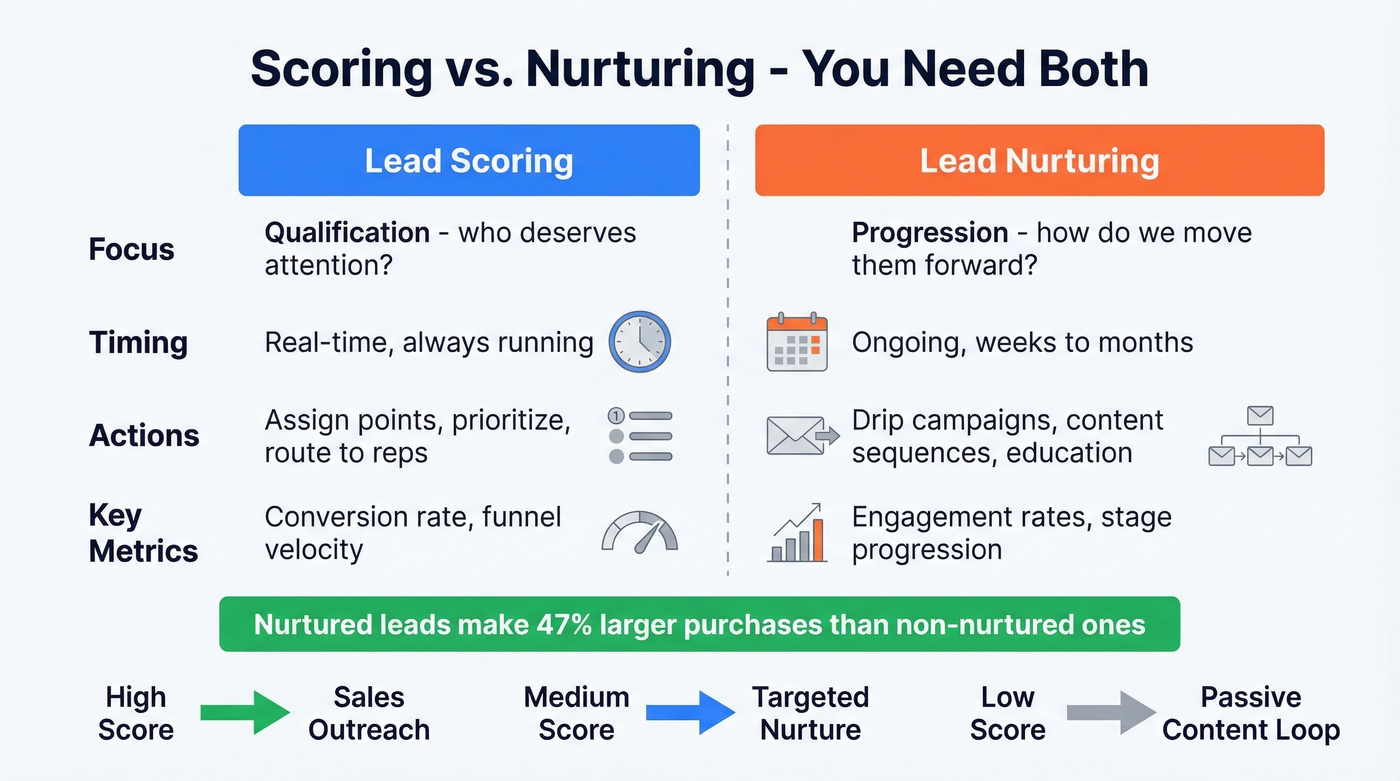
| Scoring | Nurturing | |
|---|---|---|
| Focus | Qualification | Progression |
| Timing | Real-time | Ongoing, weeks to months |
| Actions | Assign points, prioritize, route | Drip campaigns, content sequences |
| Metrics | Conversion rate, funnel speed | Engagement rates, stage progression |
Scoring tells you who to talk to. Nurturing tells you how to move them forward. You need both - high scores trigger sales outreach, medium scores trigger targeted nurture tracks, low scores stay in passive content loops.
Here's a starting model for behavioral + firmographic scoring:
| Signal | Points |
|---|---|
| Pricing page visit | +10 |
| Webinar attended | +15 |
| Demo request | +30 |
| C-suite title | +20 |
| Target industry | +15 |
| Email opened 3+ times | +5 |
| Content downloaded | +10 |
The dual-scoring concept - combining behavioral actions with firmographic fit - prevents your team from chasing engaged but unqualified leads. Nurtured leads make 47% larger purchases than non-nurtured ones. Track your lead velocity rate, the month-over-month growth in qualified leads entering the pipeline, to know whether your scoring and nurturing are actually accelerating revenue rather than just generating activity.

Intent signals only work when paired with verified contact data. Prospeo tracks 15,000 Bombora intent topics and matches them to 300M+ profiles with 98% email accuracy - so your engagement system reaches real buyers, not dead inboxes.
Stop engaging leads you can't actually reach.
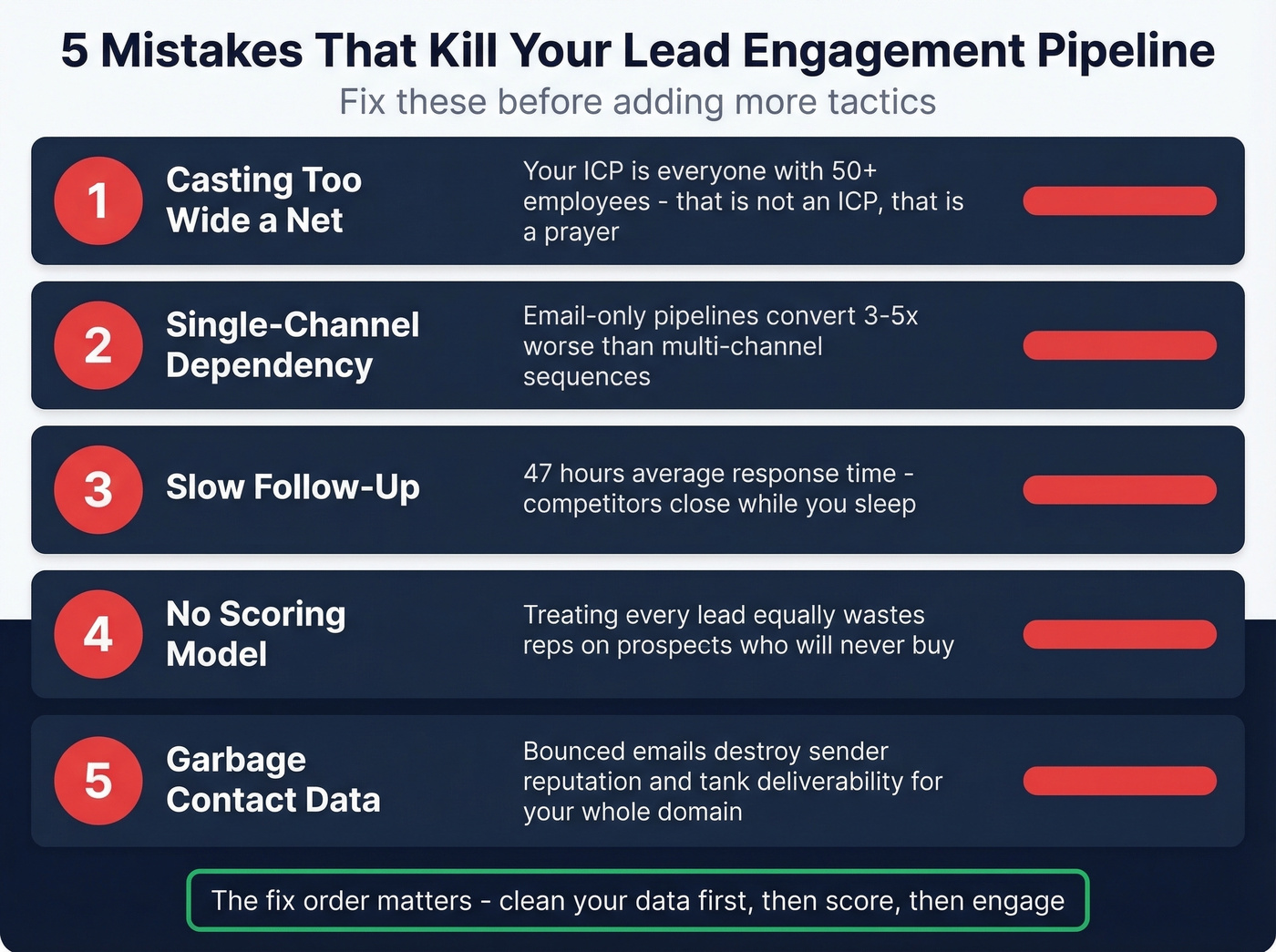
Five Mistakes That Kill Your Pipeline
Casting Too Wide a Net
The most common engagement failure isn't bad messaging - it's bad targeting. When your ICP is "any company with 50+ employees," you're spraying into the void. Narrow it: B2B SaaS with $500K+ ARR, funded startups scaling go-to-market, specific pain points like high churn or rising CAC. Without a tight ICP, even a quality lead gets buried under noise from prospects who were never going to buy.
If you need a starting point, use an ICP rubric that forces hard exclusions, not just inclusions.
Single-Channel Dependency
We've seen teams run entire pipeline strategies through email alone and wonder why conversion rates are flat. Multi-channel sequences convert 3-5x better than email-only. Layer in calls, social touches, and retargeting. Each channel reinforces the others.
Slow Follow-Up
47 hours. That's the average response time to a new lead - nearly two full business days while competitors close. This is the lead black hole in action: a prospect raises their hand, and the silence swallows them whole. Set an inbound SLA of under 5 minutes. Build real-time routing so leads hit the right rep's queue instantly.
If you want to operationalize this, keep a set of sales follow-up templates ready for every inbound scenario.
No Scoring Model
Without scoring, your sales team treats every lead equally - wasting time on unqualified prospects while hot leads go cold. In our experience, teams that implement scoring before they have clean data are just prioritizing garbage faster. Get the data right first, then score.
If you're building from scratch, start with a simple lead scoring model and iterate monthly.
Garbage Contact Data
None of the above matters if your emails bounce and your phone numbers are disconnected. Bounced emails destroy sender reputation, which tanks deliverability for your entire domain. Disconnected numbers waste SDR hours. Outdated firmographics lead to irrelevant messaging.
If you're seeing deliverability issues, fix the root cause with an email deliverability audit and verified lists.
AI's Role in 2026
The AI-powered sales and marketing tools market is projected to grow from $58B to $240.58B by 2030. Over 64% of organizations already use AI, and 78% of marketers have adopted marketing automation - which can drive a 451% increase in qualified leads.
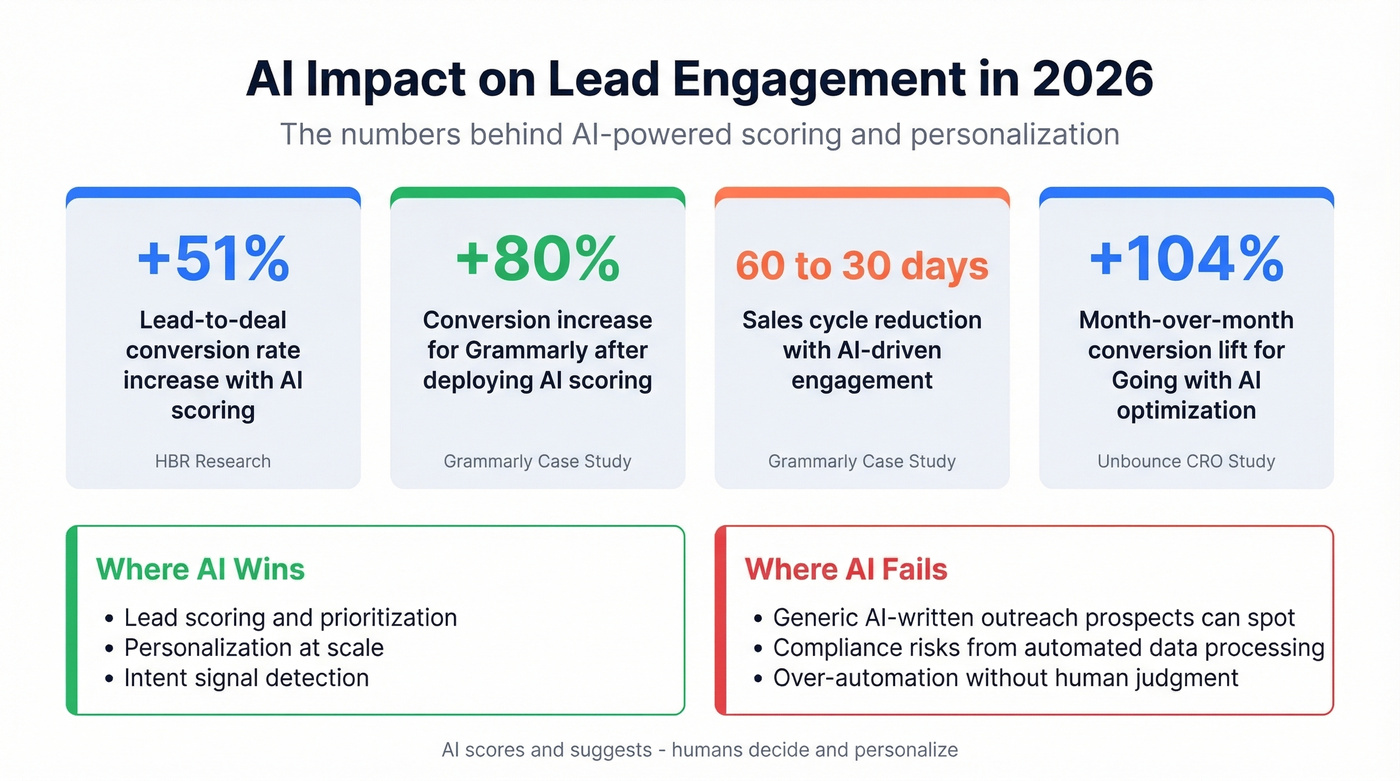
The biggest impact is in scoring and personalization. AI-based lead scoring drives a 51% increase in lead-to-deal conversion rates per HBR research. Grammarly deployed AI scoring and saw an 80% increase in conversions for upgraded plans, with their sales cycle dropping from 60-90 days to 30 days. Travel company "Going" achieved a +104% month-over-month conversion lift by applying AI-driven optimization to their engagement funnel.
But AI also creates new failure modes. Over-reliance on AI-generated messaging produces generic outreach that prospects can smell from a mile away. Compliance violations from automated data processing are a growing risk. The teams winning with AI in 2026 treat it as an augmentation layer - AI scores and suggests, humans decide and personalize. Governance isn't optional.
Tools for Lead Engagement
Start with three things: a verified data source, a CRM, and a sequencing tool. Everything else is optimization. We've tested dozens of engagement stacks, and the pattern is always the same - data quality is the bottleneck, not the sequencing tool.
| Tool | Category | Best For | Starting Price |
|---|---|---|---|
| Prospeo | Data + verification | Email accuracy + data freshness | Free (75 emails/mo), ~$0.01/email |
| HubSpot | CRM | SMB teams, free starter stack | Free CRM, Marketing from ~$20/mo |
| Salesforce | CRM | Enterprise, complex workflows | ~$25/user/mo |
| Apollo | Data + outreach | All-in-one prospecting | Free tier, from $49/user/mo |
| Instantly | Email sequencing | High-volume cold email | From ~$30/mo |
| Lemlist | Multi-channel sequencing | Personalized multi-channel | From ~$39/user/mo |
| Clay | Data enrichment | Workflow automation + enrichment | From $134/mo (2,000 credits) |
| ActiveCampaign | Marketing automation | Advanced nurture sequences | From $145/mo |
If you're comparing vendors, start with a shortlist of data enrichment services and validate accuracy before you buy.
Recommended stacks by team size:
- Under 10 reps: Prospeo + HubSpot Free + Instantly. Lean, fast, and cheap.
- 10-50 reps: Prospeo + Salesforce + Lemlist. Multi-channel with proper CRM infrastructure.
- Enterprise: Salesforce + full ABM stack with Clay enrichment and Bombora intent data.
Skip ActiveCampaign if you're running outbound-heavy motions - it's built for inbound nurture, and you'll fight the tool instead of using it.
Your scoring model is worthless if 35% of emails bounce. Prospeo's 7-day data refresh and 5-step verification keep bounce rates under 4% - so high-scoring leads actually get your outreach. At $0.01 per email, fixing your data costs less than one wasted rep hour.
Build your engagement system on data that connects, not data that bounces.
How to Measure Success
Stop tracking open rates. Bot opens and privacy features have made them unreliable. Track these instead:
Reply rate is the 2026 gold standard. Cold email reply rates typically range 1-5%; AI-personalized multi-channel sequences push to 10-15%+. MQL-to-SQL conversion measures whether marketing and sales agree on what "qualified" means. Lead-to-customer conversion is the #2 most important KPI for marketers per HubSpot's 2026 report.
Then there's lead velocity rate - month-over-month growth in qualified pipeline. A rising lead velocity rate is the strongest forward-looking indicator that your engagement system is working, because it measures momentum rather than lagging outcomes. Round it out with CAC and CLV for unit economics and CPL by channel to understand where your dollars work hardest: SEO leads cost roughly $31, email $53, webinars $72.
For benchmarks: B2B email conversion rates average about 2.4%, and the median conversion rate across industries is 6.6% per Unbounce's benchmark report. If you're below those numbers, the problem is usually upstream - data quality or targeting - not the copy.
To go deeper on upstream fixes, map your lead generation workflow and measure drop-offs stage by stage.
FAQ
What's the difference between lead engagement and lead nurturing?
Lead engagement is the full system of interactions across every channel and buying stage - scoring, data quality, speed-to-lead, multi-channel orchestration, and measurement included. Lead nurturing is one component: the ongoing drip of content and touchpoints that moves mid-funnel prospects forward over weeks or months.
How many touchpoints convert a B2B lead?
Most B2B conversions require 6-12 touches across multiple channels over 2-4 weeks for outbound, and longer for enterprise deals with $100K+ contract values. monday CRM's case study showed 6+ touchpoints produced 50% more sales-ready leads at 33% lower cost than shorter sequences.
What's a good reply rate for cold outreach?
Cold email reply rates typically range 1-5% depending on list quality and personalization depth. AI-personalized multi-channel sequences push reply rates to 10-15%+. The key variable is data accuracy - verified emails ensure sequences reach real inboxes instead of bouncing.
How does data quality affect prospect engagement?
Bounced emails damage sender reputation and tank deliverability for your entire domain - one bad list can poison months of outreach. Teams like Snyk cut bounce rates from 35-40% to under 5% by switching to verified data, which unlocked 180% more AE-sourced pipeline and 200+ new opportunities per month.
Lead engagement isn't a campaign you launch - it's infrastructure you build. Get the data right, score relentlessly, and show up across channels before your competitors do.