

Lead Generation Cold Email: The Practitioner's Playbook for 2026
A sender ran 217,000 cold emails over a year. Reply rates started at 2.1%, then collapsed to 0.7% as domains burned faster than new ones could warm up. The vibe in r/b2bmarketing threads on deliverability fatigue is clear: high-volume cold outreach is getting harder. But that doesn't mean cold email is dead - what's dying is lazy lead generation cold email. The campaigns booking 14 calls from 732 emails aren't winning on subject lines. They're running better data.
Most cold email advice obsesses over copywriting. The real edge is upstream - in data quality, infrastructure, and targeting. Fix those three, and mediocre copy still books meetings. Nail the copy on top of bad data, and you're just writing beautiful emails that bounce.
Here's the thing: if your average deal size is under $5K, you probably don't need a $15K/year data platform. A verification-first tool, a solid sender, and a free CRM will outperform an enterprise stack that's 80% shelfware.
What You Need (Quick Version)
- Data quality over copy quality. Verify every email before sending. Bounce rate must stay under 3%. One bad list can tank a domain's reputation for months.
- Infrastructure first. Secondary domains, a 4-week warmup ramp, SPF/DKIM/DMARC configured - all before a single outbound prospecting email goes out. Never send from your primary domain.
- The minimum viable stack. Prospeo for verified contact data, Instantly for sending with built-in warmup, HubSpot Free for CRM. Total cost: around $100/month on low-volume plans and free tiers. You don't need ten tools. You need three good ones.
2026 Cold Email Benchmarks
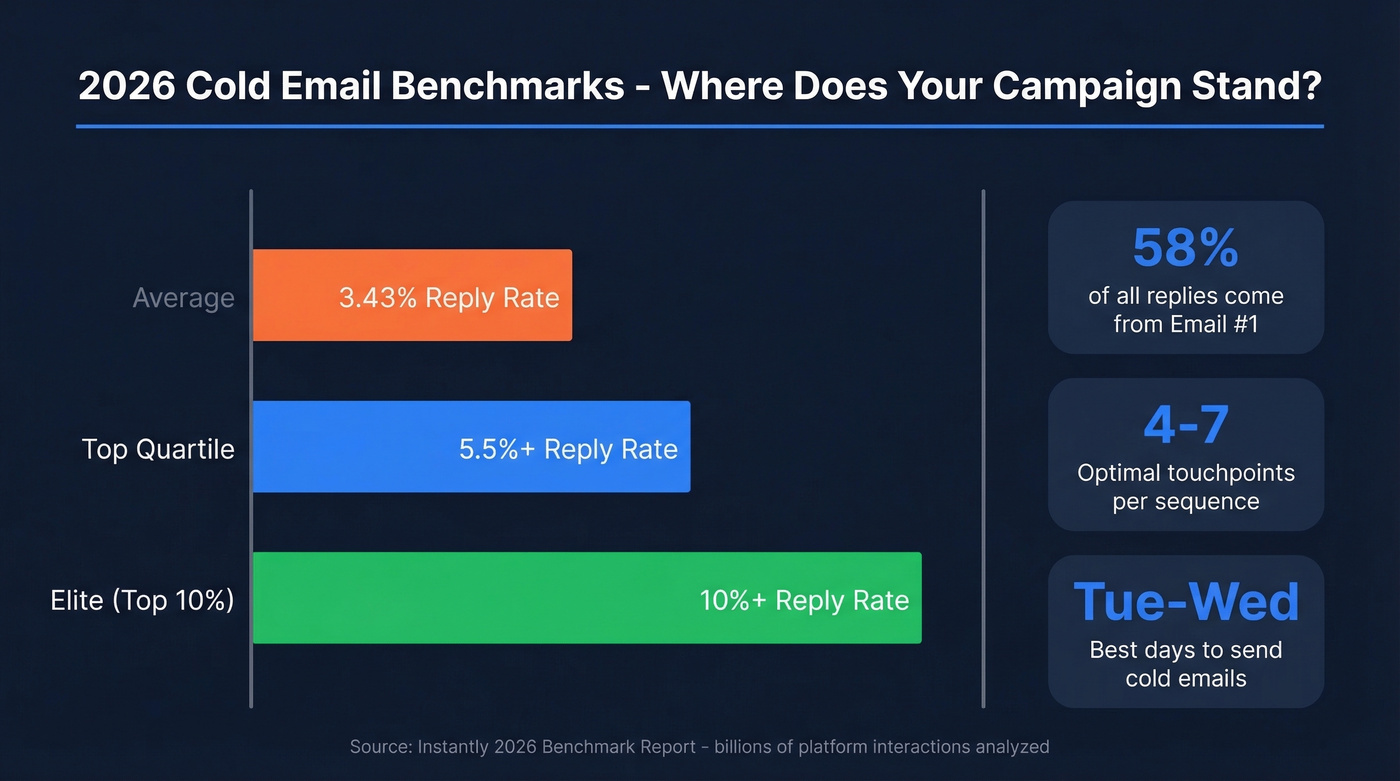
Numbers tell you whether your campaign needs a tweak or a rebuild. Instantly's 2026 benchmark report - based on billions of platform interactions - gives us the clearest picture of what "good" looks like right now.
| Metric | Average | Top Quartile | Elite (Top 10%) |
|---|---|---|---|
| Reply rate | 3.43% | 5.5%+ | 10%+ |
| Replies from email #1 | 58% | - | - |
| Optimal touchpoints | 4-7 | - | - |
| Best send days | Tue-Wed | - | - |
Two things jump out. First, 58% of all replies come from the first email in a sequence - your opener carries the campaign. Second, the gap between average and elite is almost entirely explained by data quality and targeting, not subject line tricks.
Below 2%? Don't touch your copy yet. Fix your list and infrastructure first.
The Outbound Email Playbook
Define Your ICP With Triggers
Static database pulls - "all VPs of Marketing at SaaS companies with 50-200 employees" - produce static results. The campaigns hitting 10%+ reply rates target triggers: a company just raised funding, posted a relevant job, launched a new product, or hired a new leader.
Trigger-based targeting works because it gives you a reason to reach out that isn't "I found you in a database." It's the difference between "Hey, I sell marketing software" and "I saw you're hiring three SDRs - here's how our clients ramp new reps 40% faster."
Segment your trigger-based lists into cohorts of 50 contacts or fewer. Smaller cohorts produce 2.76x higher reply rates because they force you to write tighter, more relevant messaging. If a cohort's reply rate drops below 8% in the first two weeks, kill the campaign and fix your targeting before sending another email.
Build a Verified Contact List
Every email address should be confirmed valid before it enters your sequence. We've seen teams buy "targeted" lists from data brokers and hit 11% bounce rates on the first send - a domain reputation death sentence. One practitioner rebuilt their list hygiene and saw bounce rate drop from 11% to under 2% after switching to manual verification as part of a broader infrastructure rebuild that took 62 days.
Prospeo runs a 5-step verification process with catch-all handling, spam-trap removal, and honeypot filtering on proprietary infrastructure. The result: 98% email accuracy across 143M+ verified addresses, with every record refreshed on a 7-day cycle versus the industry average of six weeks. That gap matters because people change jobs, and stale data means bounces. Stack Optimize built from $0 to $1M ARR using Prospeo data, maintaining 94%+ deliverability, bounce rates under 3%, and zero domain flags across all their clients.
Set Up Deliverability Infrastructure
This is the part most guides gloss over and most campaigns die on.
Domains and DNS:
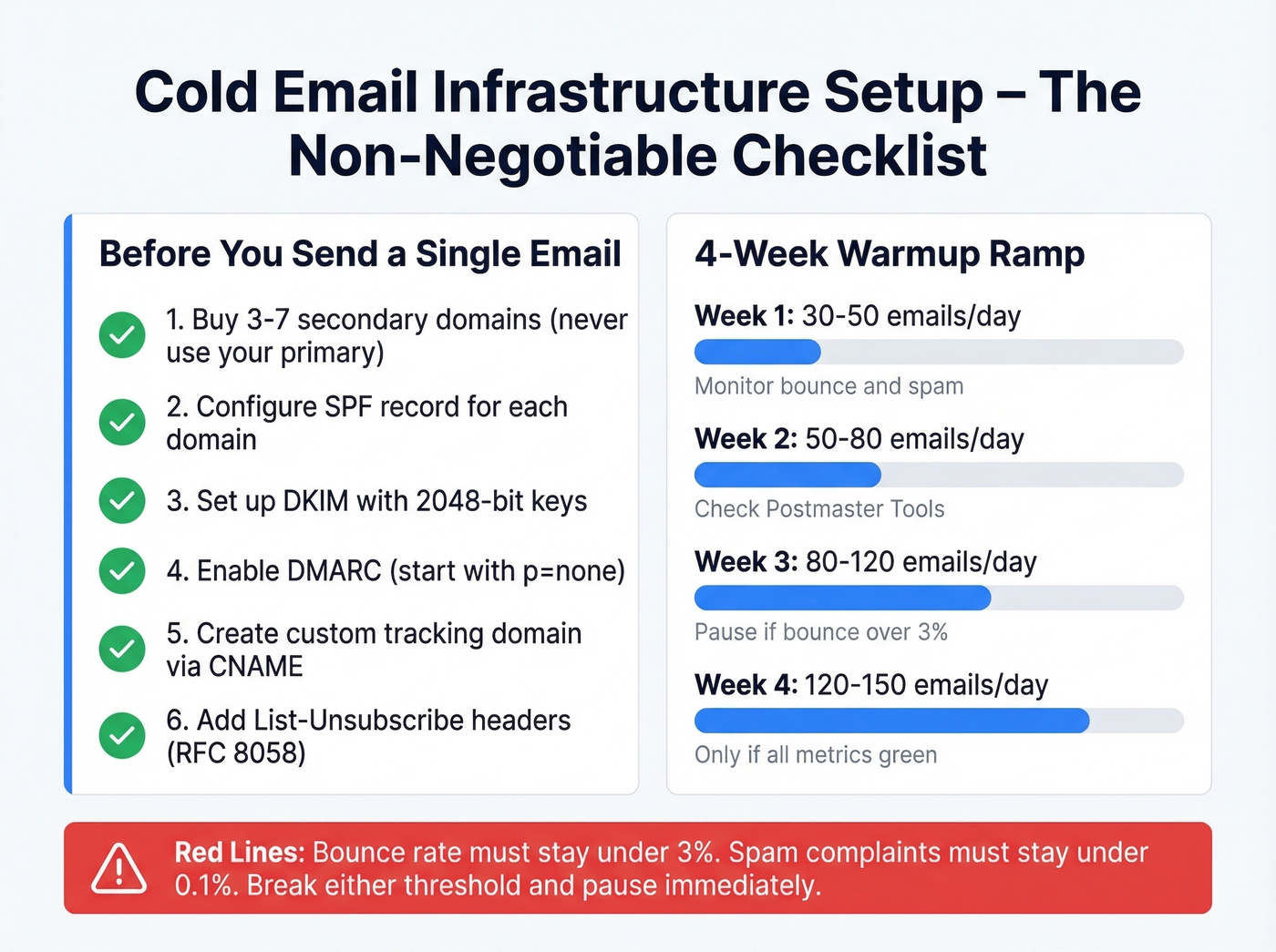
- Buy 3-7 secondary domains (variations of your brand). Never cold email from your primary domain.
- Configure SPF (one record per domain), DKIM (2048-bit keys), and DMARC (start with p=none and reporting enabled). If you need a deeper walkthrough, use this email deliverability guide as your checklist.
- Set up a custom tracking domain via CNAME to isolate your reputation from shared tracking infrastructure (more on tracking domain setup).
- Google, Yahoo, and Microsoft bulk-sender rules require SPF/DKIM/DMARC and RFC 8058 one-click unsubscribe headers. Add
List-UnsubscribeandList-Unsubscribe-Postheaders to every campaign - skip this and you'll land in spam regardless of content quality.
Warmup ramp (per mailbox):
| Week | Daily volume | Notes |
|---|---|---|
| 1 | 30-50 | Monitor bounce/spam. Keep warmup emails at 20-60% of total inbox activity. |
| 2 | 50-80 | Check Postmaster Tools |
| 3 | 80-120 | Pause if bounce >3% |
| 4 | 120-150 | Only if metrics green |
Guardrails: Bounce rate under 3%. Spam complaints under 0.1%. If either threshold breaks, pause immediately and diagnose. Monitor via Gmail Postmaster Tools and Microsoft SNDS. Run an inbox placement test before scaling volume - tools like GlockApps or Mail Tester show you exactly where your emails land across providers. If you're troubleshooting, start with email bounce rate codes and a quick email spam checker pass.
One practitioner on Reddit rebuilt their entire infrastructure - scaling from 3 to 7 domains, capping at 26 emails per day per domain - and watched their reply rate climb from 3% to 6% in 62 days. Split your sending across Google and Microsoft ESPs for additional resilience.
Write Emails That Get Replies
Copy matters - but less than you think, and differently than most B2B outreach guides suggest.
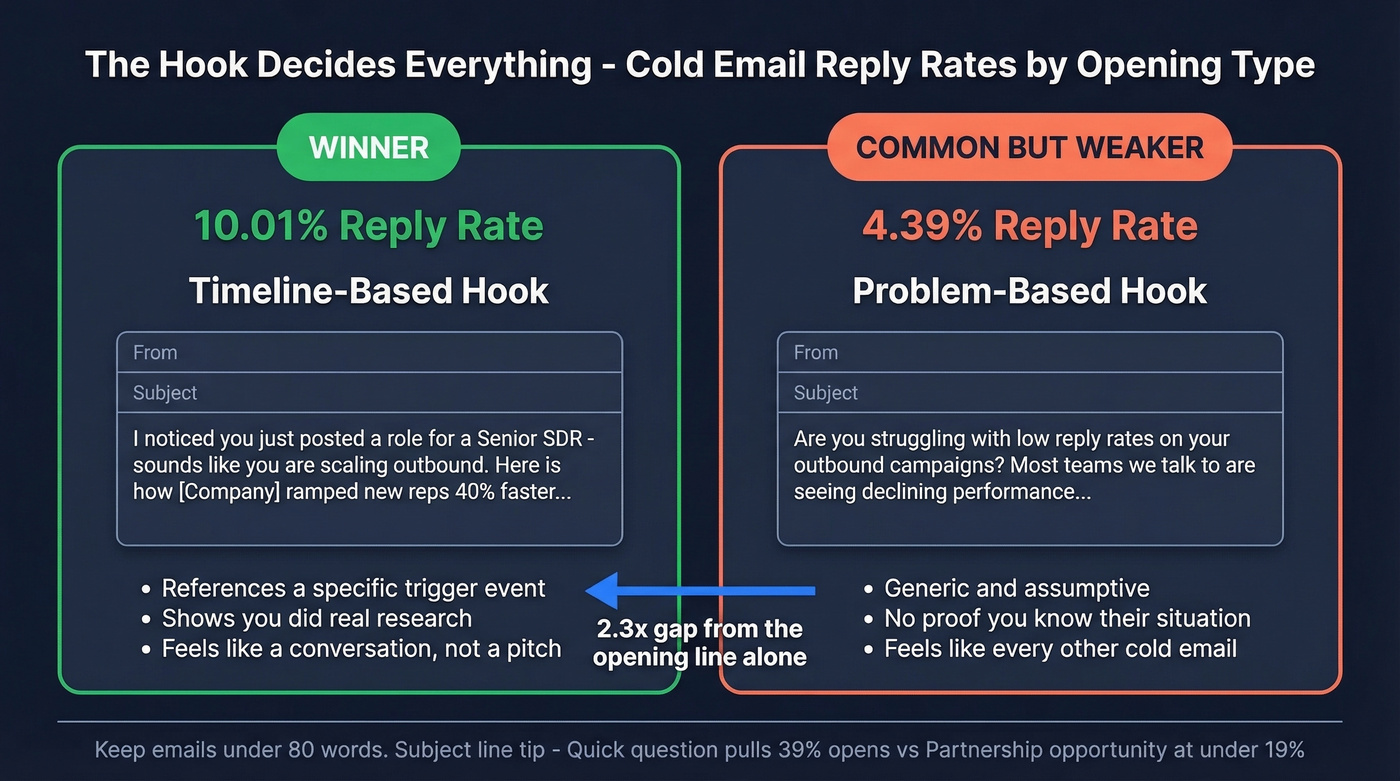
Hook type is everything. Timeline-based hooks ("I noticed you just posted a role for...") average a 10.01% reply rate. Problem hooks ("Are you struggling with...") average 4.39%. That's a 2.3x gap from the opening line alone.
Shorter wins. Keep emails under 80 words. One practitioner cut average length from 141 to 56 words and saw measurable improvement in replies. Subject lines follow the same pattern - "Quick question" pulls 39% opens versus "Partnership opportunity" at under 19%. If you want more options, pull from these cold email subject line examples and sanity-check against subject lines that get opened.
Let's break down an annotated template based on a campaign that booked 14 calls from 732 emails:
Subject: I have 3 prospects for [job title] you posted?
Hi [Name],
Saw [Company] is hiring a [role] - sounds like [specific inference from job description]. [One sentence of relevant proof/case study]. Would it help if I shared how [similar company] handled this? Happy to send over a quick breakdown.
Specific trigger reference, tailored inference, proof, low-friction CTA. Three minutes of personalization per email. That's the investment that separates 4% reply rates from 1%. For a deeper framework, see email copywriting.
Build Your Follow-Up Sequence
The 3-7-7 cadence captures 93% of replies by Day 10: follow up 3 days after the first email, then 7 days later, then 7 days after that. The sweet spot is 4-7 total touchpoints. Beyond 7, you're burning goodwill unless each touch adds genuinely new value.
Each follow-up should introduce something the previous email didn't. Don't just "bump" or "circle back." Add a new proof point, reference a recent trigger, or shift the value proposition. The best follow-ups feel like a new conversation, not a reminder of the old one. The strongest sales development teams also layer in a social touch - a profile view or thoughtful comment - between email #2 and #3. It doesn't replace email outreach, but it warms the next touchpoint. If you need ready-to-send options, use these cold email follow-up templates.

Bad data kills cold email campaigns before copy ever gets a chance. Prospeo's 5-step verification delivers 98% email accuracy across 143M+ addresses - with every record refreshed every 7 days, not the 6-week industry average. Stack Optimize built a $1M agency on Prospeo data with bounce rates under 3% and zero domain flags.
Stop writing beautiful emails that bounce. Start with verified data.
Real-World Case Study
A cold email practitioner shared full funnel numbers on r/coldemail worth studying. Over four weeks, they sent 732 hyper-personalized cold emails targeting companies with active hiring signals - a classic trigger-based approach.
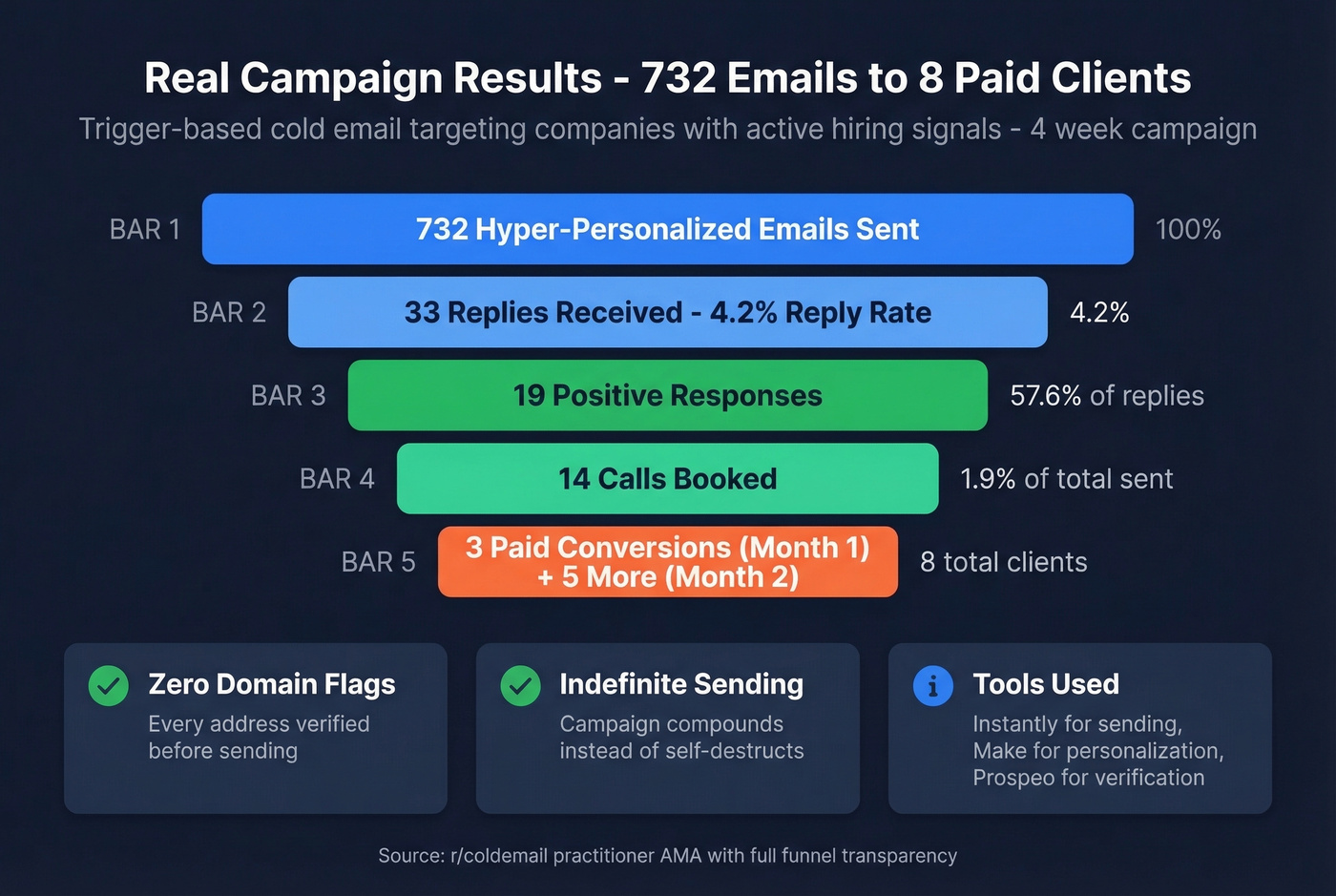
The results: 33 replies (4.2% reply rate), 19 positive responses, 14 call bookings, and 3 paid conversions. Five more conversions closed the following month. The template referenced specific job postings, included tailored proof points, and used low-friction CTAs. Sending was handled through Instantly with Make automating personalization at the first-line level. Every address was verified before sending, which meant zero domain reputation damage and a campaign that could keep running indefinitely.
That's the whole point. Lead generation cold email isn't about blasting 10,000 contacts and hoping. It's verified data, tight targeting, and a campaign that compounds instead of self-destructs. If you're building the broader system around this, map it to a repeatable lead generation workflow.
Cold Email Tool Stack for 2026
You need three categories covered: data, sending, and CRM. Everything else is optional until you're scaling past 1,000 emails per week.
| Category | Tool | Starting Price | Best For |
|---|---|---|---|
| Data + Verification | Prospeo | Free (75/mo); ~$0.01/email | 98% accuracy, 7-day refresh, no contracts |
| Data + Verification | Apollo | Free (100 credits/mo); $59/user/mo | Large free database for early-stage teams |
| Data + Verification | Hunter.io | Free (25 searches/mo); ~$49/mo | Domain-level email search |
| Enrichment | Clay | Free tier; ~$149/mo | Complex multi-source enrichment workflows |
| Sending | Instantly | ~$30-97/mo | Warmup + cold email at scale |
| Sending | Lemlist | $32/user/mo | All-in-one sending + deliverability with 450M+ leads |
| Sending | Saleshandy | $24/mo | Budget-friendly (6K emails/mo) |
| Sending | Woodpecker | $29/mo | SMB teams (500 prospects/mo) |
| Sending | Smartlead | ~$39/mo | High-volume, 10+ inbox scaling |
| CRM | HubSpot | Free | Pipeline tracking |
We've run bake-offs where Apollo data produced noticeably higher bounce rates than Prospeo on the same target list. At scale, that accuracy gap compounds into deliverability problems fast. Hunter.io is a reliable pick for domain-level lookups - you paste a company URL and get a list of associated emails - but it's a finder, not a full database with intent signals and enrichment. If you're comparing options, start with best email search tools and best email list providers.
Clay is the power tool for teams running complex enrichment workflows that pull from multiple data sources and waterfall through providers; at ~$149/month it isn't cheap, but it's the best orchestration layer available. If you're going deeper on this category, see data enrichment services. Lemlist is worth considering if you want sending and deliverability tooling in one platform, though the database depth doesn't match a dedicated data tool. Saleshandy and Woodpecker are solid budget options for teams that already have their data sourced. Skip Smartlead unless you're managing 10+ inboxes - it's overkill for smaller operations.
Legal Compliance
Cold emailing for B2B outreach is legal in most jurisdictions. But the penalties for getting it wrong are steep enough to deserve attention.
| Jurisdiction | Key Requirements | Penalty | Opt-Out Timeline |
|---|---|---|---|
| US (CAN-SPAM) | Physical address, opt-out, truthful subject | Up to $51,744 per message | 10 business days |
| EU (GDPR) | Legitimate interest (Art. 6(1)(f)), documented LIA | EUR 20M or 4% turnover | Prompt |
| Canada (CASL) | Implied/express consent, 3-year records | $10M/violation | 10 business days |
| Australia | Explicit consent required | $1.1M AUD/violation | Prompt |
Honor opt-outs within 2 business days regardless of jurisdiction. Keep unsubscribe records for at least 3 years if you're operating under CASL-style compliance standards. If you're sending into the EU, document your legitimate interest assessment before launching - not after someone complains.
Trigger-based targeting needs fresh data. Prospeo refreshes 300M+ profiles weekly and offers 30+ filters - buyer intent, job changes, funding, headcount growth - so your cohorts of 50 hit the right person at the right moment. All at $0.01 per email, no contracts.
Build trigger-based lists that actually connect you to real buyers.
FAQ
Is cold email still effective in 2026?
Elite campaigns hit 10%+ reply rates per Instantly's 2026 benchmarks. Spray-and-pray is dead, but personalized outreach outperforms most channels on cost-per-meeting. Teams using trigger-based targeting consistently report lower cost-per-opportunity than paid ads or content syndication.
How many emails should I send per day?
Cap at 25-40 per inbox and 26 per day per domain when scaling across multiple domains. Exceeding these limits accelerates domain burning - and once a domain's reputation tanks, recovery takes weeks.
Is cold email legal?
Yes, with requirements. CAN-SPAM needs an opt-out and physical address. GDPR requires documented legitimate interest. Penalties range from $51,744 to EUR 20M per violation. B2B cold outreach is permitted under all major frameworks as long as you follow the rules.
What's a good cold email reply rate?
The 2026 average is 3.43%. Top quartile hits 5.5%+. Below 2%? Fix your data and targeting before touching copy. The difference between average and elite almost always comes down to list quality and trigger-based targeting, not copywriting.