

Lead Generation for Accountants: What Actually Works in 2026
Accountants are the most trusted business advisors in the country - 86% of small business owners say so - yet most firms can't fill their pipeline. Lead generation for accountants isn't a trust problem. It's a visibility problem. You're great at the work, but nobody knows you exist until they need a tax return filed next week.
That's fixable. Here's what actually works, what it costs, and what to stop wasting time on.
The Quick Version
For leads this month: Run Google Ads targeting local service keywords (~$67-$68/lead) and optimize your Google Business Profile.
For sustainable growth: Pick a niche, build content around it, and run email nurture sequences that convert warm leads over 6-12 months.
For outbound prospecting: Build a verified prospect list, send a 5-touch cold email sequence, and follow CAN-SPAM/GDPR rules to the letter.
Why Accounting Firms Face Unique Challenges
Most B2B lead gen advice targets SaaS companies selling $50/month subscriptions. Accounting firms operate in a different reality. Sales cycles are long - a business owner doesn't switch accountants on a whim, and that decision takes weeks or months. It's seasonal too: accounting firm websites see a +45% traffic spike from January through April, then go quiet.
There's a critical distinction between demand generation and lead generation that most firms blur together. Demand generation builds awareness before buyers are in-market - webinars, guides, thought leadership. Lead generation captures contact info when someone's ready to talk. You need both, but most firms do neither systematically.
As Jason Staats, CPA, puts it: "Most accounting firms today do not need more clients; they need better clients." That reframes everything. You're not maximizing volume. You're attracting the right clients at the right price point.
Here's the thing: if your average client engagement is under $5,000/year, your lead gen problem is actually a pricing and positioning problem. Fix that first.
Know Your Leads - Suspect, Prospect, Qualified
Not every name in your pipeline is a real lead. Ian Bouchett's framework breaks it into three stages worth internalizing before you spend a dollar on marketing:
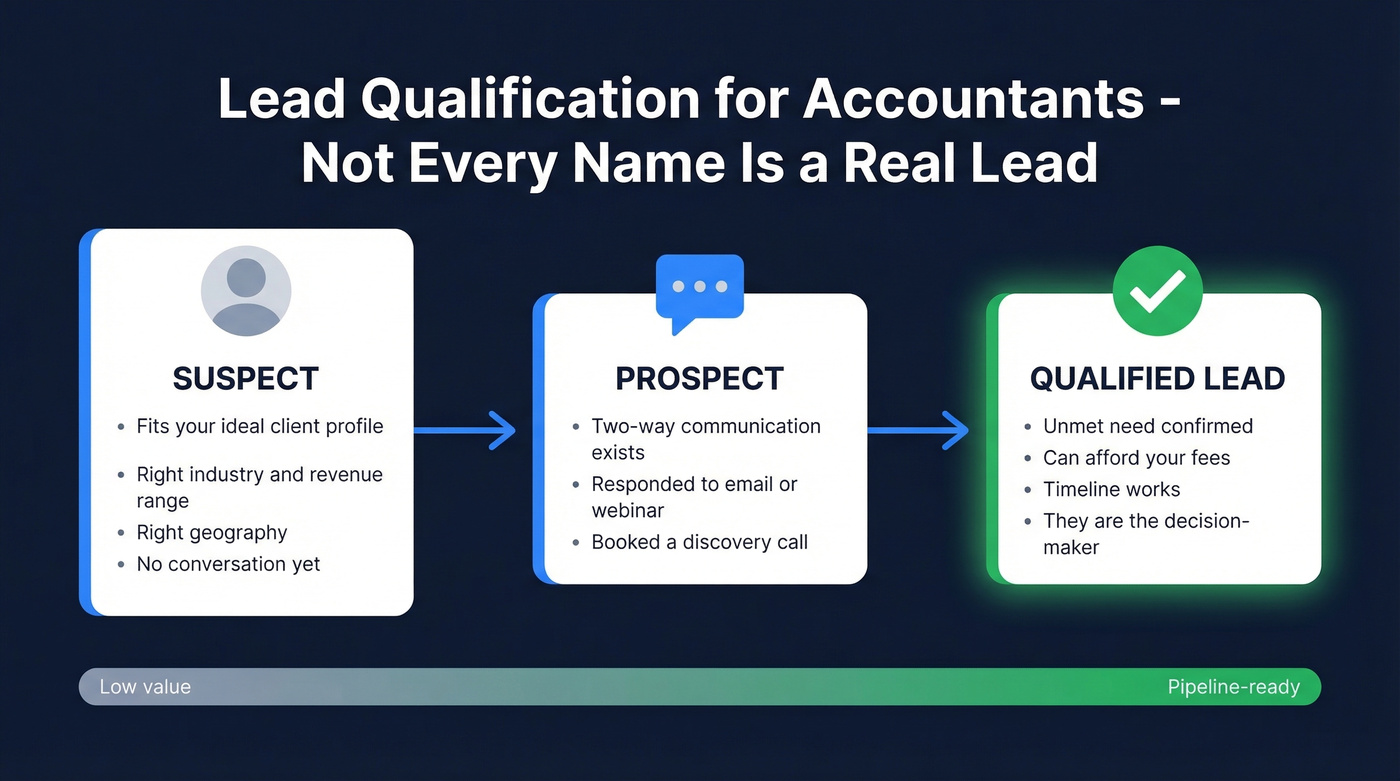
- Suspect: Fits your ideal client profile - right industry, revenue range, geography - but no conversation has happened.
- Prospect: Two-way communication exists. They've responded to an email, attended a webinar, or booked a discovery call.
- Qualified Lead: You've screened them. They have an unmet need, can afford your fees, and their timeline works. This is the only stage that matters for your sales pipeline.
For accountants, qualification should also cover niche fit, pain severity, fee tolerance, and whether they're the actual decision-maker.
Mistakes Accountants Keep Making
1. Giving up after one follow-up. 44% of salespeople quit after a single attempt, but 80% of sales require five or more touches. This is the biggest leak in most firms' pipelines.
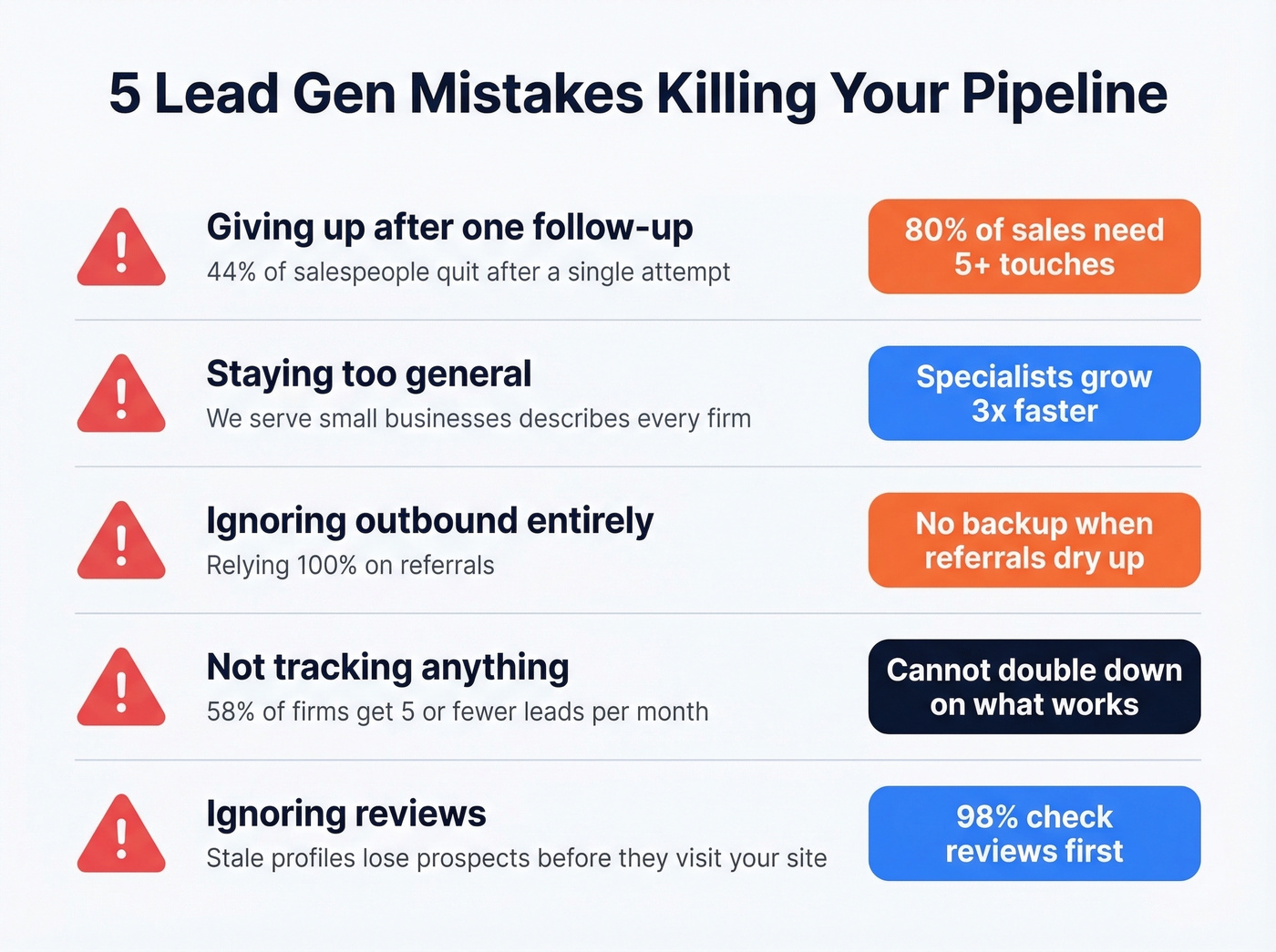
2. Staying too general. "We serve small businesses" describes every accounting firm in America. High-growth professional services firms are 3x more likely to specialize. Generalists compete on price. Specialists compete on expertise.
3. Ignoring outbound entirely. Most accountants rely exclusively on referrals. That works until it doesn't - and when referral flow dries up, there's no backup. Outbound email and paid search aren't replacements for referrals. They're insurance.
4. Not tracking anything. Over 58% of accounting firms get five or fewer leads per month, and most can't tell you where those leads came from. Without tracking your channels, you can't double down on what works.
5. Ignoring reviews. [98% of people check online reviews](https://www.powerreviews.com/power-of-reviews-2023/) before choosing a service provider. If your Google Business Profile has three reviews from 2022, you're losing prospects before they reach your website.
Strategies That Drive Accounting Leads
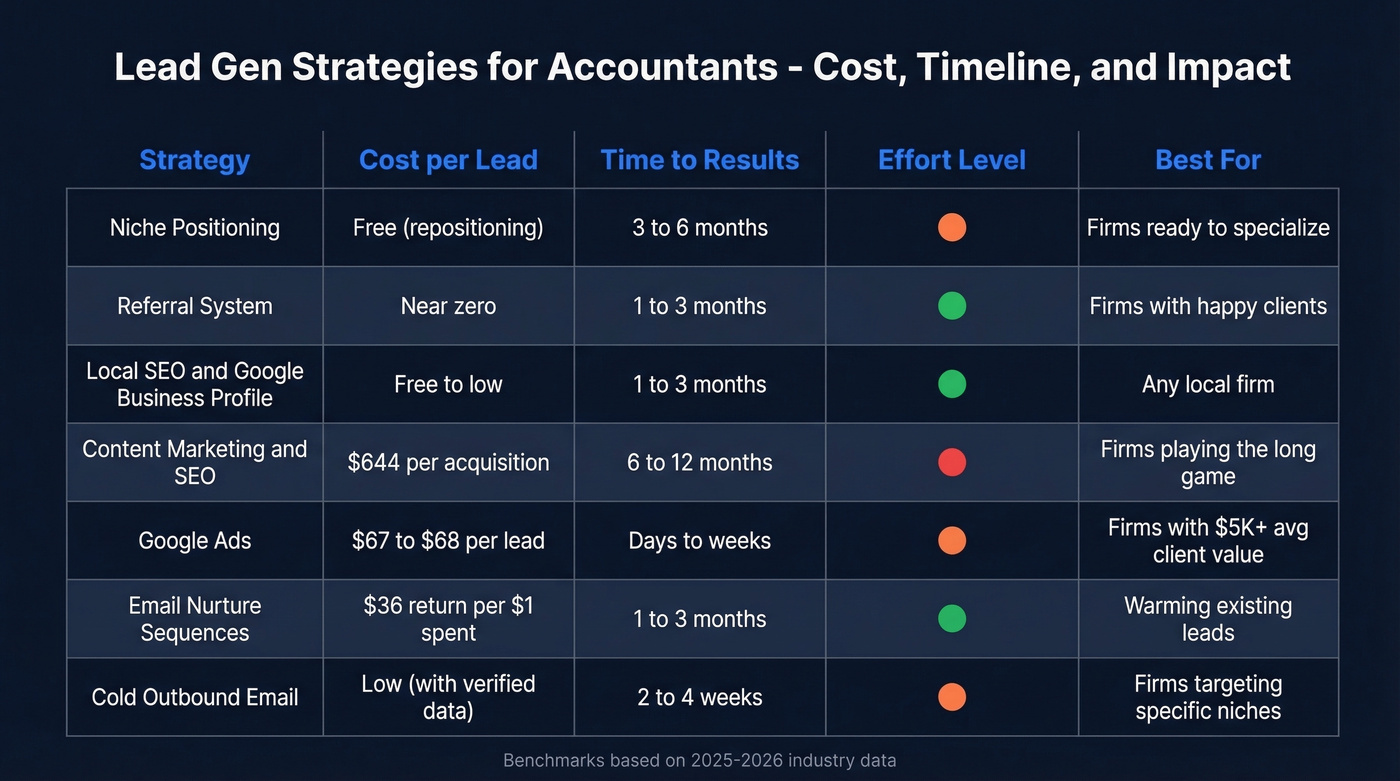
Niche Down First
Use this if: You're willing to turn away clients who don't fit and want to charge premium fees.
Skip this if: You're a solo practitioner in a small market where specialization would shrink your addressable market to near zero.
The data is clear: niched firms grow 3x faster than generalists. PCO Bookkeepers built a dominant position by focusing exclusively on pest management and lawn care companies. That sounds absurdly narrow - until you see their results below.
Systematize Referrals
Referrals are your highest-converting channel, but "hoping clients mention you" isn't a system. A real referral program includes asking after clear wins like tax savings milestones or clean audits, using a specific script ("We're taking on a few new clients in [niche]. Know anyone frustrated with their current setup?"), and building referral requests into quarterly client reviews.
Referrals should be one channel in your mix, not the entire strategy. The same principle applies to lead generation for lawyers and other professional services - relying on a single source leaves you exposed when it slows down.
Local SEO + Google Business Profile
97% of people looking for local services search online first. For accounting firms, organic search drives 54.1% of all website traffic globally - the single largest channel. In the U.S., paid search already accounts for 16.3% of traffic, which tells you competitors are bidding on your keywords right now.
Your Google Business Profile is the fastest lever. Set your primary category correctly, add service areas, post weekly updates, and actively request reviews. Firms with 20+ recent reviews consistently outrank those with a handful of stale ones. For context, accounting firm websites average a 3:14 visit duration and a 51.3% bounce rate - if yours is worse, fix the site before driving more traffic to it.
Content Marketing and SEO
This is the long game - 6 to 12 months before compounding returns kick in. But organic leads cost roughly $644 per acquisition versus $1,202 for paid channels, so the patience pays off.
The formats that work: tax planning checklists, industry-specific guides ("R&D Tax Credits for SaaS Companies"), webinars on regulatory changes, and blog posts targeting long-tail keywords. Every piece should have a lead magnet attached. Track branded search volume and inbound inquiries that reference your content - those are the leading indicators that demand gen is working.
Google Ads
The math works out well for most firms. The average CPC for finance and insurance keywords runs $3.44-$3.46, with a 5.10% conversion rate. That puts your cost per lead at roughly $67-$68.
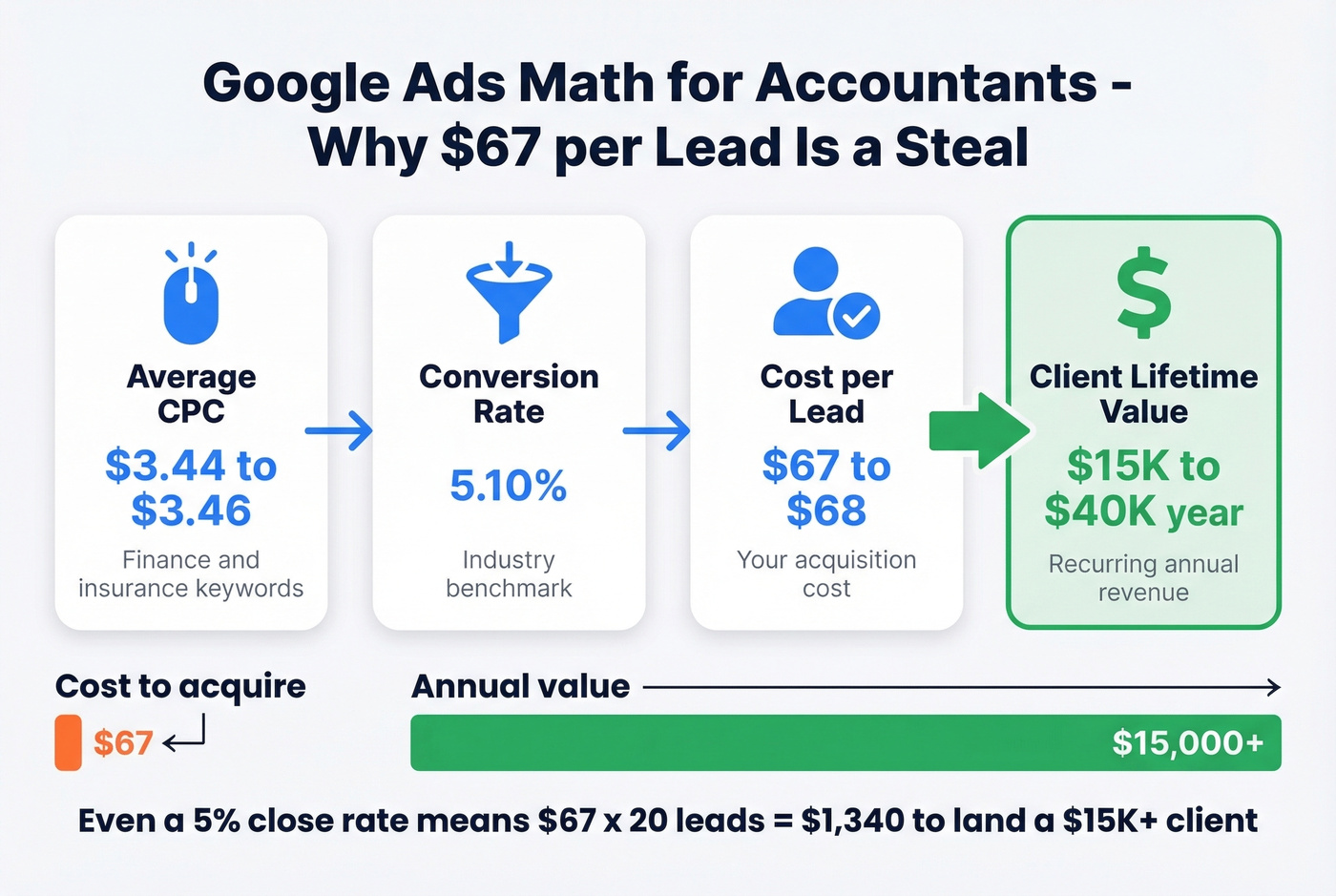
If your average client is worth $15,000-$40,000 in annual recurring revenue, $67-$68/lead is a steal. You'd need a catastrophically low close rate for the math not to work. But if you're advertising commodity bookkeeping at $200/month, the unit economics get tight fast.
Email Nurture Sequences
Email marketing returns $36 for every $1 spent and delivers 2x the ROI of cold calling, networking, or trade shows. A basic sequence runs: welcome email, then a value email with a tax tip or industry insight, then a case study, then a soft offer for a free consultation. Space these 3-5 days apart and let the sequence handle the follow-up work most accountants abandon after one attempt.
If you want to tighten performance, start with proven sales follow-up templates and iterate based on replies.
Cold Outbound Email
Cold email works for accounting firms, but only with clean data and proper compliance. Let's break down the legal side first.
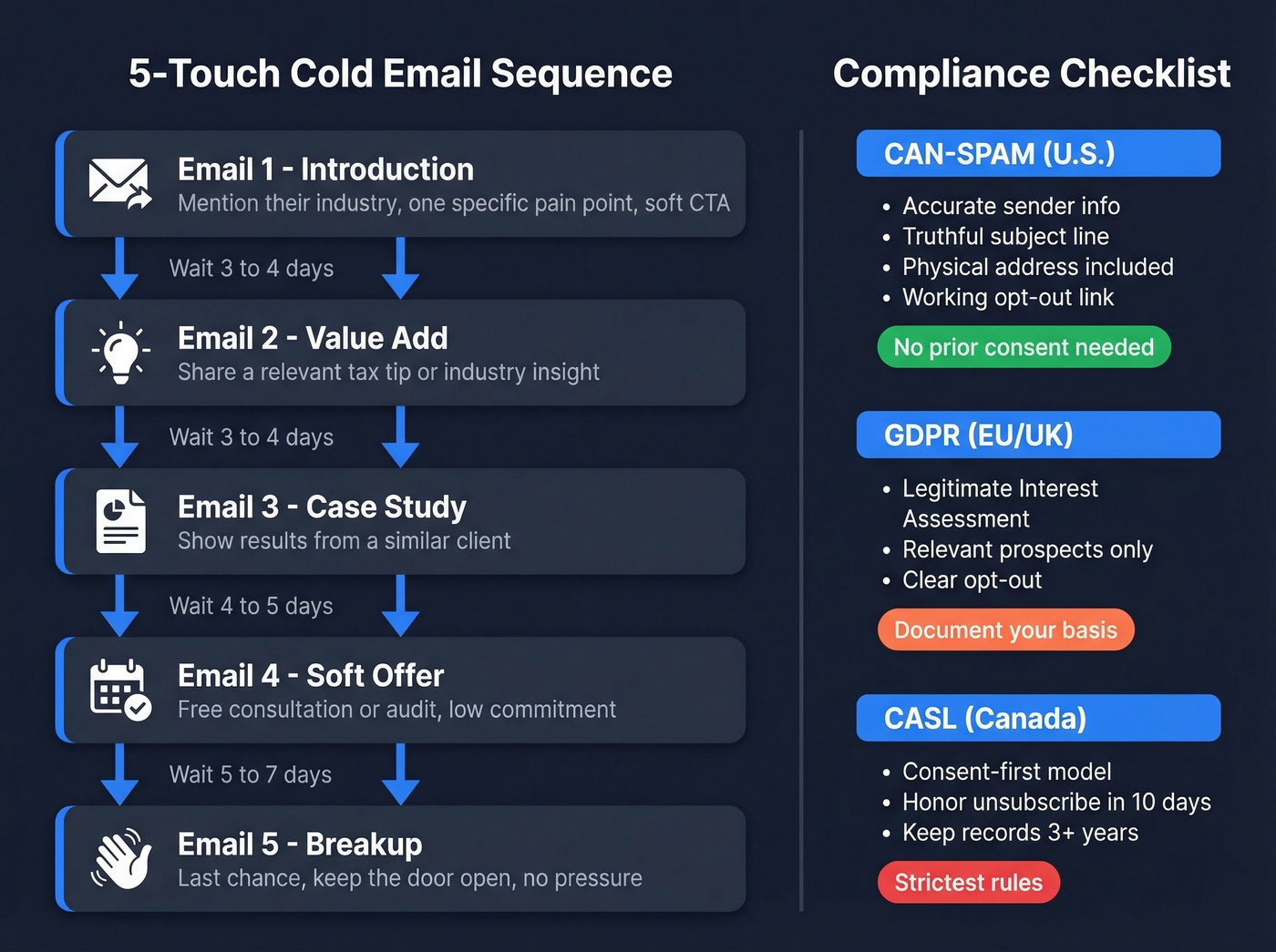
CAN-SPAM (U.S.): Cold email is legal without prior consent. Include accurate sender info, a truthful subject line, your physical address, and a working opt-out mechanism. Penalties can reach $53,088 per email.
GDPR (EU) / UK GDPR (UK): B2B cold email is permissible under Article 6(1)(f) legitimate interest, but you need a documented Legitimate Interest Assessment. Relevant prospects only, clear opt-out, no mass blasting.
CASL (Canada): Consent-first model. Honor unsubscribe requests within 10 business days and keep opt-out records for at least 3 years.
Data quality is the make-or-break factor. If 15% of your emails bounce, your domain reputation tanks and every subsequent campaign suffers. We've tested both approaches extensively - verified lists versus "good enough" lists - and the verified approach wins every time. One accountant on r/LeadGeneration reported closing roughly 1 client per 100 LinkedIn DMs, a ~1% conversion rate. We've seen firms beat that consistently with 5-touch email sequences built on verified contact data from tools like Prospeo, which runs a 5-step verification process including catch-all handling, spam-trap removal, and honeypot filtering to keep bounce rates under 4%.
If you're building this channel from scratch, follow a repeatable lead generation workflow and keep an eye on email bounce rate as a leading indicator.


You just read that 44% of firms quit after one follow-up. The fix isn't just persistence - it's starting with verified contact data. Prospeo gives you 300M+ profiles with 98% email accuracy so your 5-touch sequences actually land in real inboxes, not bounce folders that torch your domain.
Build a prospect list of business owners in your niche for $0.01 per email.
Strategic Partnerships
Co-marketing with complementary professionals is underrated. Lawyers, financial planners, payroll providers, and insurance brokers serve the same clients and don't compete with you. The simplest version is a mutual email introduction to each other's client bases - more ambitious versions include co-hosted webinars or joint guides. These partnerships compound over time and cost almost nothing.
Social Media (LinkedIn-First)
For B2B accounting services, LinkedIn is the only social platform worth serious time. Post tax tips tied to current legislation, industry insights, and client win stories. Don't expect direct conversions - LinkedIn builds the trust layer that makes your cold emails and discovery calls more effective. When a prospect gets your outbound email and sees months of thoughtful content on your profile, the conversion rate jumps.
To keep outreach consistent, borrow from modern sales prospecting techniques and track the lead generation metrics that actually correlate with revenue.
Over 58% of accounting firms get five or fewer leads per month because they can't systematize outbound. Prospeo's 30+ search filters let you target by industry, company size, revenue, and headcount growth - so you find the right clients at the right price point, not just more clients.
Stop competing on price. Start prospecting the niches you actually want to serve.
What It Actually Costs
| Channel | Monthly Cost | Time to Results | Expected CPL |
|---|---|---|---|
| Google Ads | $1,000-$5,000 | 2-4 weeks | ~$67-$68 |
| SEO / Content | $500-$3,000 | 6-12 months | $20-$40 (at scale) |
| Cold Outbound (DIY) | $200-$800 | 2-4 weeks | $30-$60 |
| Referral Program | $0-$500 | Ongoing | ~$0-$20 |
| Outsourced BD | $3,000-$8,000 | 1-3 months | $100-$300 |
| In-House Hire | $6,500-$10,000 | 3-6 months | $150-$400 |
The average customer acquisition cost in financial services runs $644 for organic and $1,202 for paid, with a blended average of $784. Against a client annual recurring revenue of $12,000-$40,000/year, even the expensive channels deliver strong ROI.
For firms testing outbound for the first time, DIY with good tools is the lower-risk path. An in-house BD hire costs $80,000-$120,000/year fully loaded and takes months to ramp. In our experience, the firms that start with a self-serve tool stack and graduate to dedicated headcount get better results than those who hire first and figure out the process later.
Case Study: PCO Bookkeepers
PCO Bookkeepers is a 20-year-old firm that bet on extreme specialization: they serve exclusively pest management and lawn care companies. Their database was honed to roughly 6,000 targets. Not 60,000. Six thousand.
Results after building a systematic lead gen engine around that niche:
- 6 months: 120 MQLs/month, 6-8 sales-ready leads/month, plus 2-4 inbound leads/month
- 12 months: 240 MQLs/month, 12-14 sales-ready leads/month, sales doubled, plus 3-4 inbound leads/month
- 18 months: 300 MQLs/month, 14-18 sales-ready leads/month, sales doubled again, plus 5-8 inbound leads/month
Their market share went from 5% to 10% of total addressable market. Each client represents $12,000-$40,000 in annual recurring revenue. A small, well-defined market with systematic outreach beats a massive, unfocused one every time.
Plan Around Tax Season
Accounting firm websites see that +45% traffic increase from January through April - exactly when your firm is busiest delivering work. The tension is real, and the solution is front-loading your marketing infrastructure.
Build your content library and schedule posts in October and November. Launch Google Ads campaigns in December so they're optimized by the time search volume spikes. Get your outbound prospect lists built and verified during the quiet months. May through August is your pipeline-building window - run outbound campaigns, build partnerships, attend industry events, and create content that compounds through the next tax season. The firms that treat off-season as marketing season are the ones that grow year over year.
How to Get Bookkeeping Clients Online
Many of the strategies above apply equally to bookkeeping practices, but the economics differ. Bookkeeping engagements tend to run lower in annual value, which means your cost per lead ceiling is tighter.
Focus on the lowest-cost channels first: Google Business Profile optimization, content targeting long-tail keywords like "bookkeeping for [industry]," and cold outbound with verified lists. Paid search can still work, but watch your CPL-to-client-value ratio closely. If your average bookkeeping client is worth $3,600/year, a $67 lead is fine. A $300 lead from an outsourced agency is not.
Tools Worth Paying For
CRM: HubSpot's free tier handles contact management and basic pipeline tracking. Paid plans start around $20/month per seat.
If you're comparing options, start with a shortlist of contact management tools and a few examples of a CRM to match features to your workflow.
SEO: Semrush starts around $139.95/month for keyword research, rank tracking, and competitive analysis.
Practice Management: Karbon typically starts around $59/user/month and keeps client work organized so you can free up time for business development.
Automation: Zapier ($19.99/month) connects your tools - form submissions to CRM, new clients to onboarding sequences.
Website: Squarespace or Wix ($16-$50/month) for a professional site without a developer.
B2B Data: Prospeo for building and verifying prospect lists. With 30+ search filters - including industry, headcount, revenue, and technographics - you can build tightly targeted lists for any accounting niche. The free tier includes 75 emails/month, and paid plans run about $0.01 per email.
FAQ
How long does it take to generate leads for a new accounting firm?
Paid channels and cold outbound produce leads within 2-4 weeks. Organic channels like SEO and content marketing take 6-12 months to compound. Run both in parallel - paid for immediate pipeline, organic for long-term cost reduction.
What's a good cost per lead for accountants?
$20-$70 depending on channel. Google Ads typically lands around $67-$68; organic drops to $20-$40 at scale. Benchmark against client lifetime value ($12,000-$40,000/year for most firms), not gut feel.
Is cold email legal for accounting firms?
Yes, in the U.S. under CAN-SPAM. Include accurate sender info, a truthful subject line, your physical address, and an opt-out mechanism honored within 30 days. GDPR and CASL have stricter requirements for EU and Canadian prospects.
Should accountants niche down or stay general?
Niche. Specialized firms grow 3x faster than generalists. PCO Bookkeepers doubled market share by targeting roughly 6,000 companies in a single industry - proof that a small, well-defined market beats a massive, unfocused one.
What's the best free tool for building outbound prospect lists?
Prospeo's free tier gives you 75 verified emails per month plus 100 Chrome extension credits - enough to test cold outbound without spending a dollar. For firms running real campaigns, 98% email accuracy prevents the bounce-rate damage that kills deliverability.
How do I get income tax clients specifically?
Focus content and ads on tax-season keywords starting in December. Publish guides on common tax pain points for your target audience, run Google Ads on terms like "[city] tax preparation for [industry]," and send outbound sequences to businesses whose fiscal year-end is approaching. Timing and specificity matter more than volume.