

Lead Generation for Financial Advisors: The Data-Backed Guide
You spent $3,000 last quarter on leads that never picked up the phone. The emails bounced, the numbers were disconnected, and the three people who did answer had already talked to four other advisors. That's not lead generation - it's an expensive way to feel busy.
Only 20% of U.S. advisors have a defined marketing strategy, per a 2024 Broadridge survey - the lowest since 2019. The advisors who do have one generate 168% more leads per month and are 83% confident they'll hit growth goals, compared to 62% for those winging it. The gap between "has a plan" and "doesn't" is enormous.
Here's the thing: most advisors don't have a lead generation problem. They have a system problem. The three highest-ROI channels - referral systems, local SEO, and verified email outreach - are accessible to any practice. But they require building something, not just buying something.
The Problem Advisors Won't Admit
Advisors are trained to manage portfolios and navigate tax law, not to generate demand. So when growth stalls, the default move is throwing money at a lead-gen vendor and hoping for the best. That's how you end up spending thousands on SmartAsset or Ramsey leads and getting contact rates under 10%.
Advisors with a defined strategy saw 70% increased inbound requests versus just 44% without one. The problem isn't unsolvable - it's that most advisors have never built a system. They've outsourced the thinking along with the budget.
What Leads Actually Cost in Financial Services
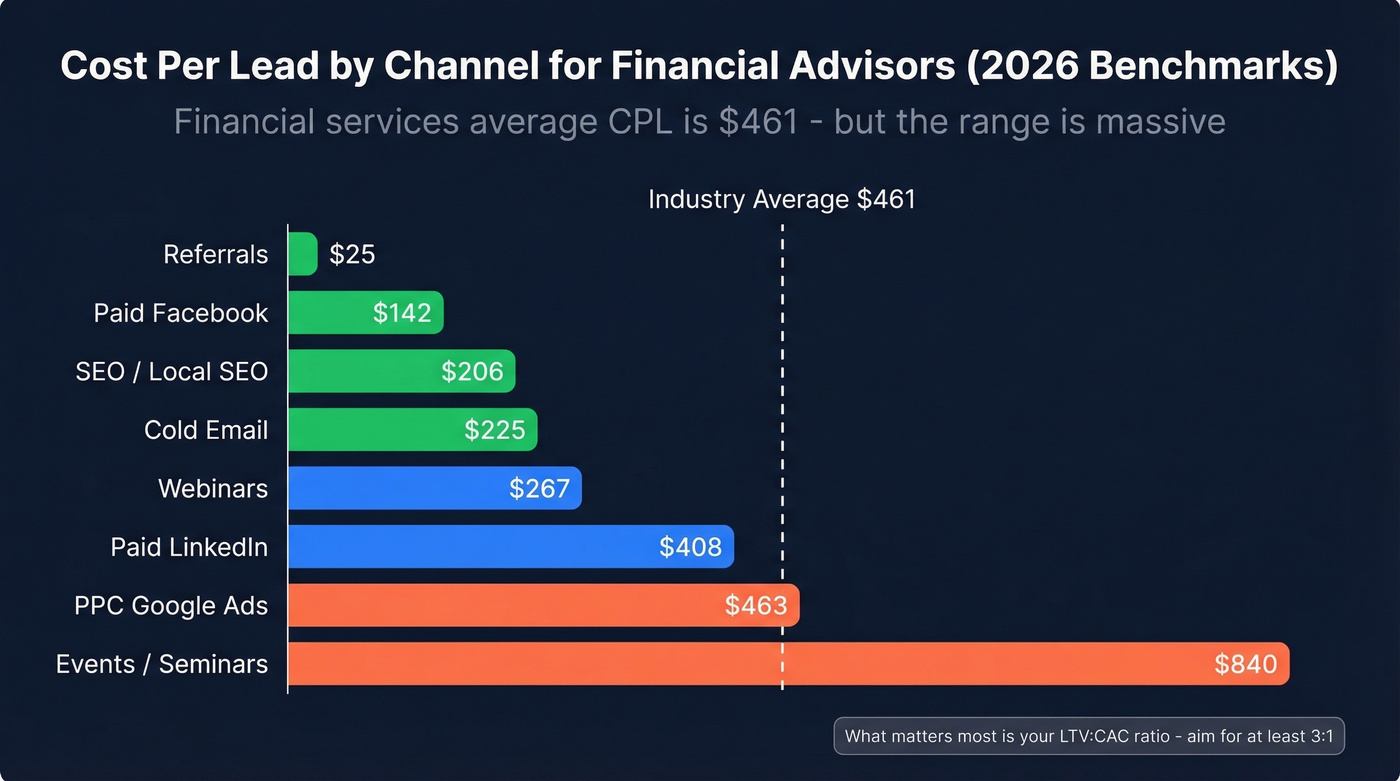
The financial services average cost per lead is $461, ranging $160-$761 depending on channel. That number means nothing without context, so let's break it down.
| Channel | Avg CPL | Time to Results | Best For |
|---|---|---|---|
| Referrals | ~$25 | Ongoing | Established practices with COI networks |
| SEO / Local SEO | $206 | 3-18 months | Patient advisors building long-term pipeline |
| Cold Email | $225 | 2-4 weeks | New advisors targeting a specific niche |
| Paid Facebook | $142 | 1-2 weeks | Advisors with strong content and landing pages |
| Webinars | $267 | 2-4 weeks | Advisors who can teach a niche topic well |
| Paid LinkedIn | $408 | 1-2 weeks | Advisors targeting executives and HNW professionals |
| PPC (Google Ads) | $463 | 1-2 weeks | Practices with $1K+/month ad budget |
| Events / Seminars | $840 | 4-8 weeks | Advisors in affluent local markets |
Beyond CPL, financial services CAC runs $644 for organic channels, $1,202 for paid, and $784 blended. The benchmark that actually matters is your LTV:CAC ratio - aim for at least 3:1. If your average client is worth $15,000 in lifetime revenue, you can spend up to $5,000 acquiring them. If they're worth $3,000, you can't afford $840 event leads that convert at 2%. The math should drive the channel, not the other way around.
If you want a deeper breakdown of benchmarks and formulas, see cost per lead and average cost per lead by industry.
The Truth About Paid Lead Platforms
SmartAsset, Ramsey, and Shared Leads
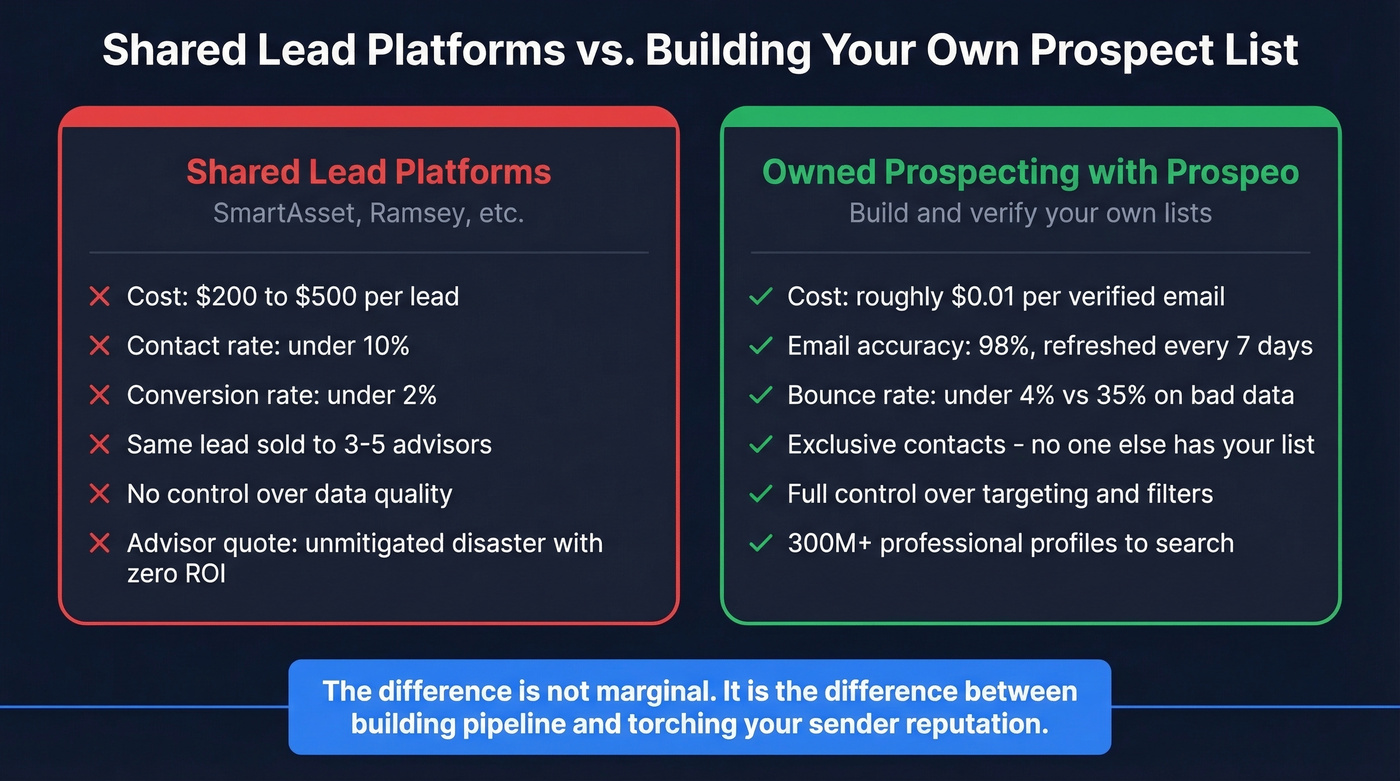
The consensus on r/CFP is brutal. One advisor called SmartAsset an "unmitigated disaster" costing "thousands of dollars with zero ROI." Another reported less than 10% contact rates and under 2% conversion. The core problem is structural: these platforms sell the same lead to multiple advisors simultaneously. By the time you call, three competitors already have.
If you're weighing vendors vs building your own pipeline, this framing helps: appointment setting vs lead generation.
The Delayed-Outreach Tactic
Here's the counterintuitive move. One advisor on Reddit stopped calling leads immediately and instead reached out to older leads with simple framing: "You probably got bombarded when you first filled out that form. I wanted to give you some space." Contact ratio went "through the roof" and they set multiple appointments. Sometimes the best speed-to-lead strategy is deliberate patience.

You just read how shared lead platforms deliver sub-10% contact rates and cost advisors thousands with zero ROI. The fix isn't a better vendor - it's owning your data. Prospeo gives financial advisors access to 300M+ profiles with 98% email accuracy, refreshed every 7 days, at roughly $0.01 per verified email. That's the difference between a 35% bounce rate and a sub-4% one.
Build your own prospect list instead of buying someone else's leftovers.
Strategies That Actually Work in 2026
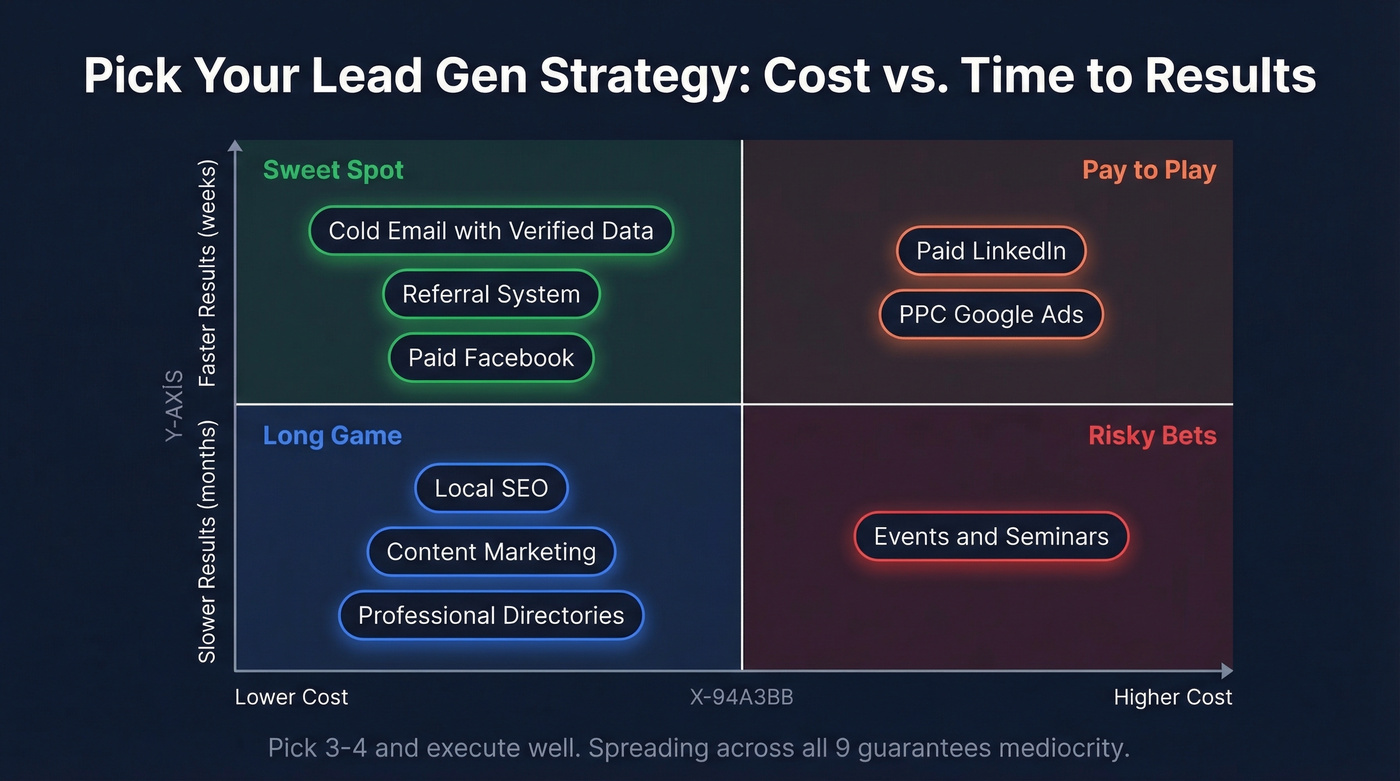
Pick three or four of these and execute them well. Spreading across all nine guarantees mediocrity.
Build a Referral System
A Kitces survey of nearly 1,000 advisory practices found client referrals scored highest for both lead quantity and quality. Yet most advisors still rely on "let me know if you know anyone" - which isn't a system, it's a prayer.
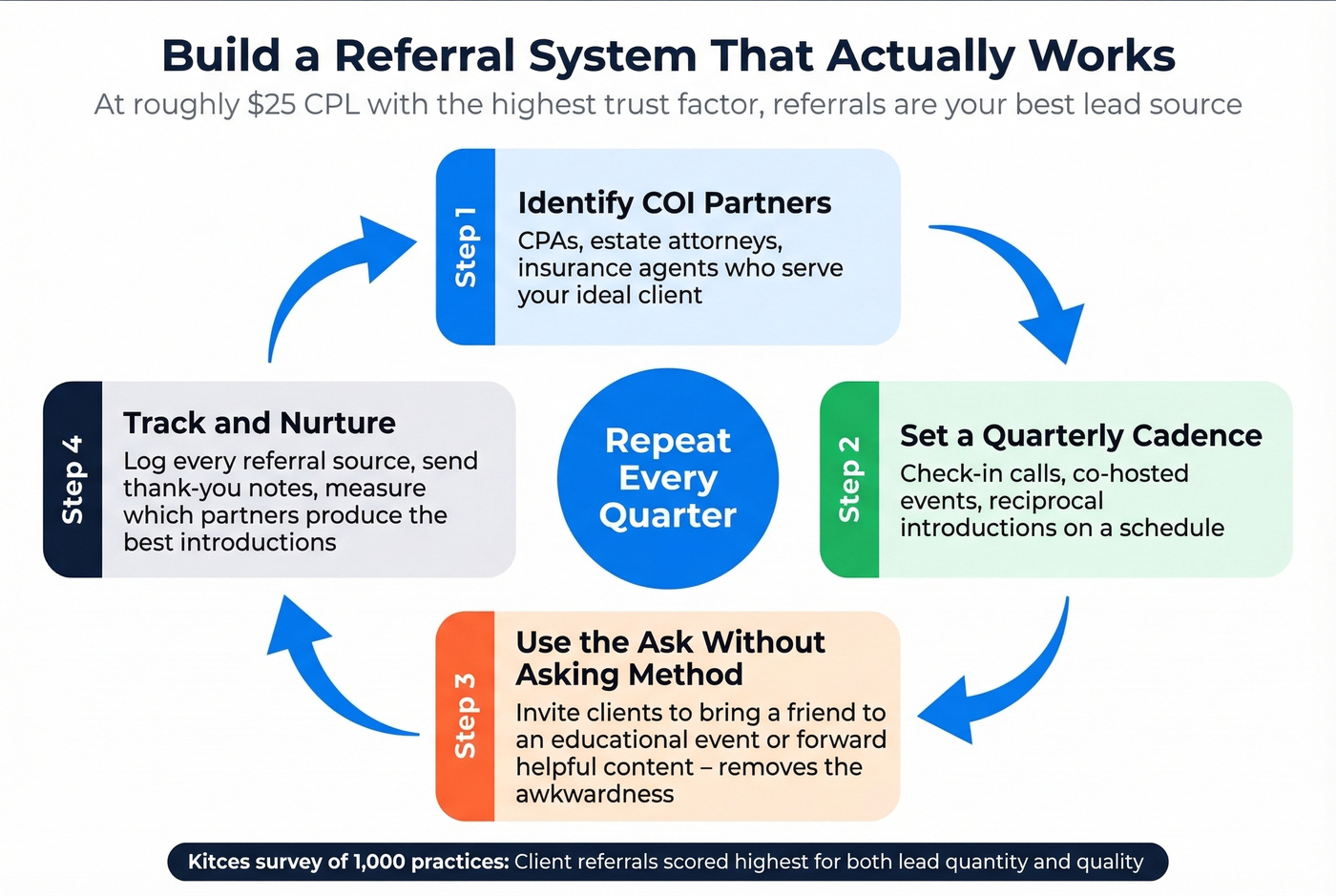
The move that works: build COI partnerships with CPAs, estate attorneys, and insurance agents. Create a quarterly cadence of check-ins, co-hosted events, and reciprocal introductions. One tactic we've seen work especially well is the "ask without asking" approach - instead of soliciting referrals directly, ask existing clients to invite a friend to an educational event or forward a piece of content. It removes the awkwardness and produces warmer introductions. At ~$25 CPL with the highest trust factor, referrals aren't just cheap. They're your best source of qualified prospects, period.
For a more structured approach, see referral network and when to ask for referrals.
Own Your Local SEO
When someone Googles "financial advisor [your city]," you need to show up. Optimize your Google Business Profile: verified NAP consistency, correct primary category, photos, and weekly Google Posts. Businesses posting weekly see 41% higher engagement than monthly posters.
Make sure your site is mobile-first, runs HTTPS, and targets local keywords naturally. Expect ranking improvements in 3-6 months, with results that snowball at 12-18 months. This isn't fast, but it builds equity that paid channels never will.
If you want a step-by-step playbook, use this local SEO lead generation guide.
Run a LinkedIn Playbook
68% of advisors have invested in LinkedIn, but only 4 in 10 create personalized content - while 42% of clients prefer tailored material. That gap is your opportunity.
Post market commentary, anonymized client stories, and educational content consistently. Sales Navigator ($80-$170/user/month) gives you 50+ filters to identify prospects by company size, role, and geography. For wealth management prospecting, LinkedIn is especially effective because high-net-worth professionals are already active on the platform.
To expand your toolkit, compare options in our lead generation Chrome extensions roundup.
Use Email Outreach with Verified Data
The SmartAsset section above established the core problem: bad data kills campaigns. The alternative is building your own verified prospect list instead of buying shared leads at $200-$500 a pop.
Prospeo finds verified emails and direct dials across 300M+ professional profiles, with 98% email accuracy refreshed every 7 days. Verified emails cost about a penny each. Use the Chrome extension to prospect on company websites and professional profiles, then export verified contacts into your outreach tool. In our experience, the difference between a 35% bounce rate and a sub-4% bounce rate isn't marginal - it's the difference between a campaign that builds pipeline and one that torches your sender reputation.
If you're building this channel from scratch, start with email lead generation and keep deliverability clean with a bounce checker.

Create Content That Answers Real Questions
Advisors who personalize content convert social media leads at 45% vs 34% and generate 3.3 website leads per month vs 1.9. The barriers are real - 49% say they're "not sure how," 46% cite lack of time, and 34% worry about compliance.
Start with the questions clients actually ask: Roth conversions, Social Security timing, tax-loss harvesting. Write clear, jargon-light answers. If you're wondering how to attract clients for life insurance or annuity products, educational content that addresses specific protection needs consistently outperforms product-focused pitches.
For more formats that convert, use these lead magnet examples.
Host Targeted Webinars
Skip this if you can't niche down. "Retirement Planning 101" attracts tire-kickers. "Tax Strategies for Tech Executives with RSUs" attracts people with real money and real problems. We've seen advisors fill a room of 30 qualified prospects with a single well-targeted topic. Webinars run ~$267 CPL and scale far better than in-person events at $840.
High Net Worth Prospecting Through Niche Specialization
If your website says "we help individuals and families achieve their financial goals," you sound like every other advisor in America.
Niche specialization - physicians, tech employees, business owners, divorcees - is a lead magnet because it signals expertise. Your content, referral networks, and outreach all resonate at a completely different level than generalist messaging. Affluent prospects want an advisor who understands their exact situation, not a generalist who dabbles.
If you need help tightening targeting, use this lead targeting framework.
Use Trigger-Based Prospecting
This is the angle most advisors miss entirely. Instead of cold-calling into indifference, target prospects based on life and career triggers: liquidity events, IPOs, funding rounds, job changes to higher-paying roles, or company acquisitions. Someone who just exercised $2M in stock options has an immediate, urgent need for financial advice.
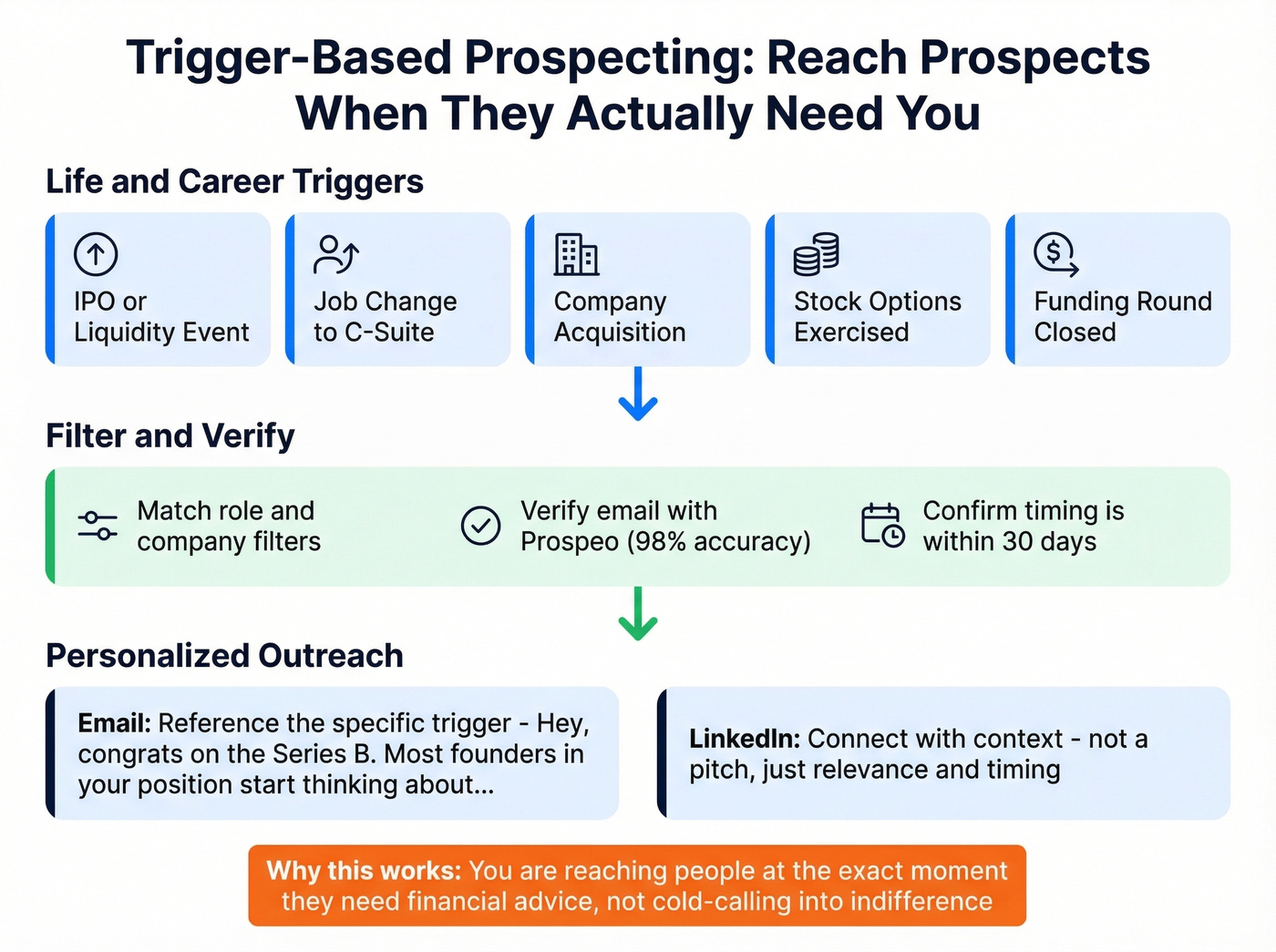
Combining intent signals with role and company filters - using tools that track job changes, headcount growth, and buyer intent across thousands of topics - lets you reach people at the exact moment they're most receptive. That timing advantage is worth more than any discount on bulk leads.
To go deeper on this approach, see intent signals in B2B marketing.
Join Professional Directories
NAPFA, FPA, and Zoe Financial serve as steady lead sources for fee-only and fiduciary advisors. The cost is modest - NAPFA's ongoing requirement is 60 hours of continuing education you're likely doing anyway. These directories attract prospects who've already self-selected for the type of advisor they want. Low effort, reliable trickle.
Compliance: What the SEC Is Flagging
The SEC's December 2025 Risk Alert focused on Marketing Rule (Rule 206(4)-1) failures. The most common deficiencies:
- Failing to disclose whether a promoter is a current or former client
- Missing disclosure of compensation and material terms
- Not recognizing that lead-generation firms, referral programs, and refer-a-friend programs trigger endorsement rules
- Missing written agreements with paid promoters
- Improper reliance on the $1,000 de minimis exemption
If you're using any paid lead-gen service, referral incentive, or client testimonial, you need disclosures. Full stop. FINRA Rule 2210 applies to communications across channels - social, email, ads - and they must be fair, balanced, and archived. Automated outreach platforms don't exempt you from these requirements. If anything, they increase the surface area for compliance risk.
Your Lead-Gen Tech Stack
You don't need 15 tools. You need four categories covered.
CRM: Wealthbox ($49-$89/user/month) or Redtail ($99/month for up to 15 users) for advisor-specific workflows. HubSpot works too, especially for inbound marketing - free tier up to $1,200+/month for enterprise.
Marketing automation: FMG Suite or Snappy Kraken ($200-$500/month each) handle compliant content creation and distribution built specifically for advisors.
Data and verification: Prospeo handles the data layer - verified emails and mobile numbers across 300M+ professional profiles, with a free tier (75 emails + 100 Chrome extension credits/month) that's enough to test the workflow. Integrates with Salesforce, HubSpot, Lemlist, and Instantly.
If you're comparing providers, start with lead databases and sales leads databases.
Advertising: For Google Ads, budget at least $1,000-$3,000/month. Below that, you're donating to Google.
Mistakes That Keep Advisors Stuck
No niche. Trying to serve everyone means your messaging resonates with no one. Pick a specialty and build everything around it.
Talking about yourself. Your website shouldn't read like a resume. Lead with client problems, not your credentials.
No CTA on your website. If there's no clear next step - book a call, download a guide, attend a webinar - visitors leave and don't come back.
Outdated digital presence. A slow website, an empty profile, or a 48-hour response time kills trust before you ever speak. Set up auto-responders and use scheduling tools like Calendly to eliminate friction.
Ignoring data quality. Sending outreach to unverified emails and disconnected phone numbers burns your domain reputation and your budget simultaneously. We've watched teams blow through entire quarterly budgets on lists with 30%+ bounce rates - that's not a lead problem, it's a data problem.
FAQ
What's the average cost per lead for financial advisors?
The financial services average CPL is $461, ranging $160-$761 by channel. Referrals are cheapest at ~$25; seminars and events are most expensive at ~$840. Your LTV:CAC ratio - not raw CPL - should determine which channels you invest in.
Do SmartAsset leads actually work?
Reddit sentiment is overwhelmingly negative - contact rates under 10%, conversion under 2%, frequent complaints about fake data. Most advisors report better results building their own pipeline through outbound prospecting and referral systems instead of buying shared leads.
How long does SEO take for financial advisors?
Expect initial ranking gains in 3-6 months, with compounding results over 12-18 months of consistent effort. Local SEO (Google Business Profile optimization, local keywords) tends to produce results faster than broader organic strategies.
Can financial advisors use testimonials in marketing?
Yes, but the SEC's December 2025 Risk Alert requires clear disclosure of client status, compensation, and conflicts of interest. Written agreements with paid promoters are mandatory, and the $1,000 de minimis exemption is narrower than most advisors assume.
What's the best way to build a prospect list without buying leads?
Use a B2B data platform to find verified emails and direct dials for target prospects, then run personalized outreach sequences at a fraction of shared-lead costs. At roughly $0.01 per verified email with 98% accuracy, you control the niche, geography, and timing - and you're not competing with three other advisors for the same contact.
Financial advisors using LinkedIn and cold email need one thing above all else: data that connects them to real people. Prospeo's Chrome extension lets you pull verified emails and direct dials from LinkedIn profiles, company websites, and CRMs in one click - no shared leads, no $461 CPL, no competing with four other advisors for the same prospect.
Stop splitting leads. Start owning your pipeline at a penny per contact.