Intent Signals in B2B Marketing: The Operational Playbook for 2026
You pulled a list of 200 accounts showing "high intent" for your category. You enriched them, sent outreach, and got a 40% bounce rate. The intent was real - the contact data was stale. That's the dirty secret of intent signals in B2B marketing: most teams buy signals and never operationalize them because they lack scoring frameworks, routing rules, and fresh contact data to act on what they learn.
Gartner projected 80% of B2B sales interactions would happen in digital channels by 2025, and the shift has only accelerated. Buyers complete 60-90% of their decision-making before contacting a vendor, reviewing an average of 11 pieces of content along the way. Each one is a demand capture signal you're either acting on or missing. Intent-based campaigns see 93% higher conversion rates than traditional approaches, yet only 25% of companies use intent data at all. The gap isn't awareness. It's execution.
Here's the thing: if your average deal size sits below $15K, you almost certainly don't need a $50K+ intent platform. A scoring framework, a self-serve data tool, and disciplined follow-up will outperform an enterprise black box that your sales team ignores.
What Are Intent Signals?
Intent signals are behavioral data points indicating a company is actively researching a problem your product solves - the digital breadcrumbs buyers leave during that invisible 60-90% of their journey before anyone fills out a demo form.
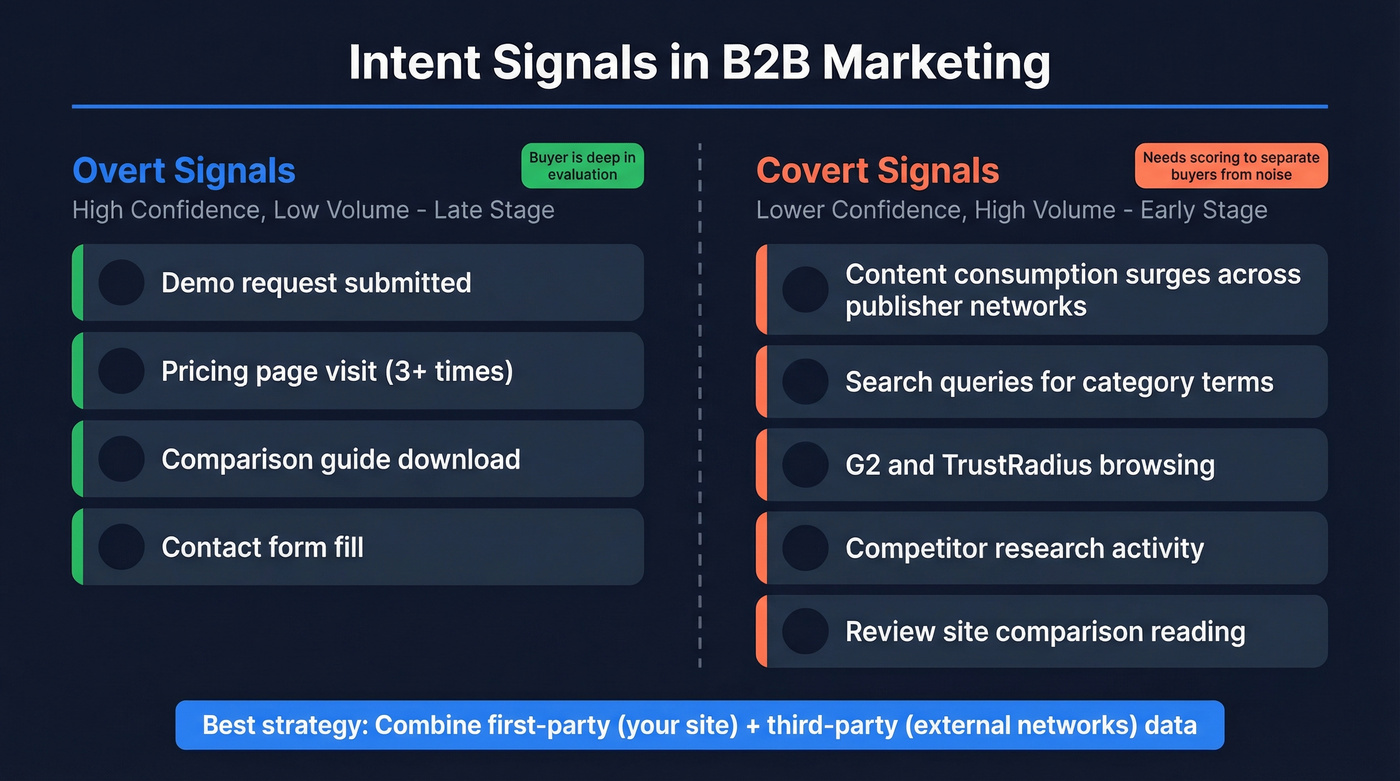
The useful distinction is between overt and covert signals. Overt signals are explicit: a prospect requests a demo, visits your pricing page, or downloads a comparison guide. High-confidence, low-volume. By the time someone takes an overt action, they're deep in evaluation.
Covert signals are what separate good teams from great ones. Content consumption across publisher networks, search queries for category terms, review-site browsing on G2 or TrustRadius, competitor research - these happen earlier in the buying cycle at much higher volume. The challenge is noise. Someone reading a blog post about your category might be a buyer, a student, or a journalist. That's why scoring matters.
Data sources split into two camps. First-party data comes from your own properties - website visits, email engagement, product usage. Third-party data comes from external networks like publisher cooperatives, review platforms, and search behavior aggregators. First-party is more accurate; third-party gives you visibility into accounts you'd never see otherwise. The best strategies combine both.
Seven Types Worth Tracking
Not all signals carry equal weight. Here are the seven categories worth tracking, ordered by actionability.
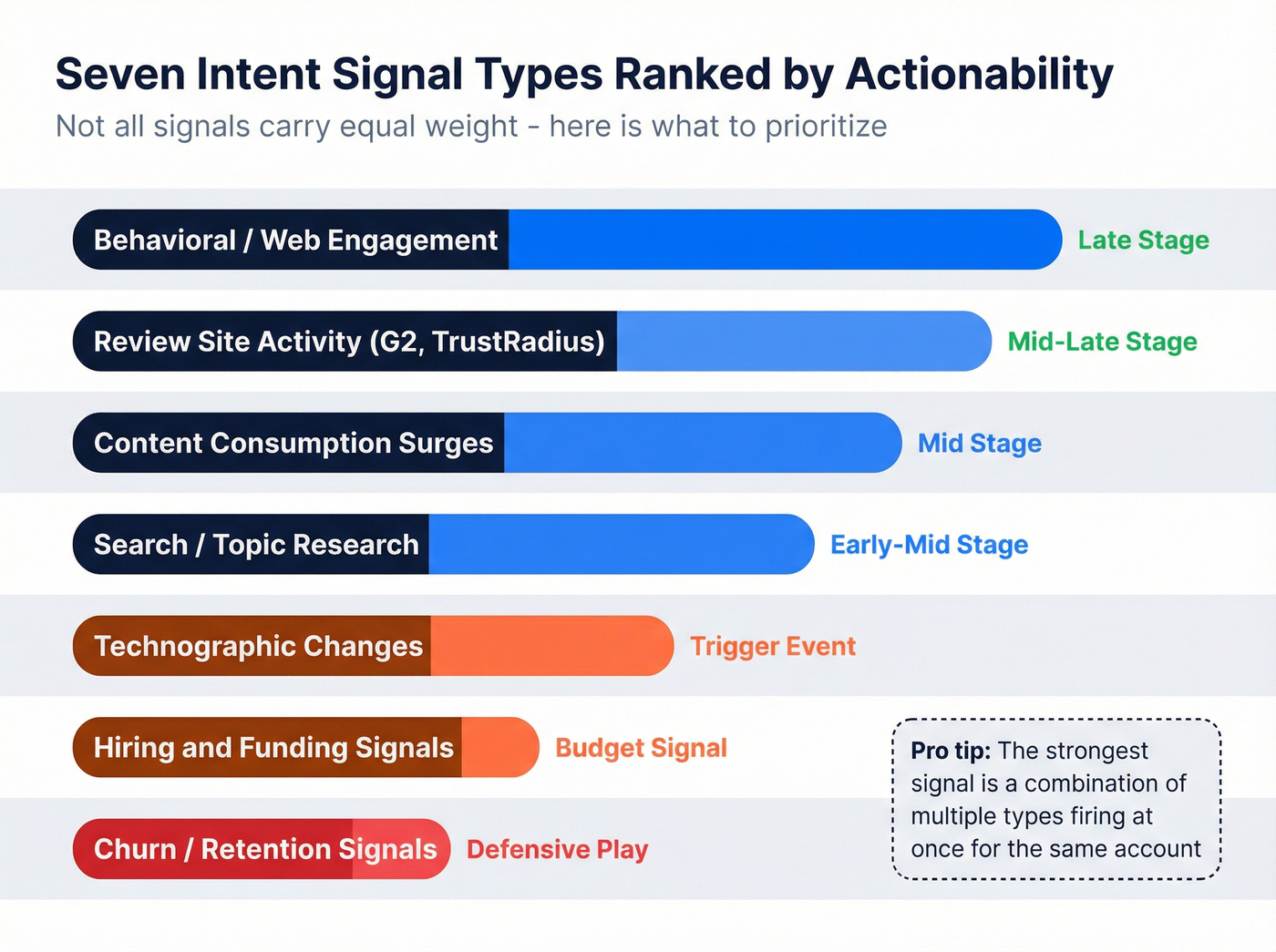
Behavioral/web engagement. Repeated visits to high-intent pages - pricing, case studies, integration docs. A prospect who visits your pricing page three times in a week is telling you something a blog reader isn't.
Content consumption. Accounts consuming category-relevant content across publisher networks at volumes significantly above their baseline. The signal isn't one article - it's a surge.
Search/topic research. Accounts searching for terms like "best CRM for mid-market" or "intent data providers." These searches happen before anyone visits your site. (If you want a starting set, use a buyer intent keywords list by tier.)
Review-site activity. Prospects browsing your G2 or TrustRadius profile, reading comparisons, or viewing competitor reviews. When someone's comparing you on G2, they're buying. G2 Buyer Intent signals have measurable impact on B2B buying journeys.
Technographic changes. A company drops a competitor's product or adopts a complementary tool. If a target account just ripped out a competitor, your timing couldn't be better. (This pairs well with firmographic and technographic data in your ICP model.)
Hiring and funding signals. A company posts a job for "Revenue Operations Manager" or closes a Series B. Not traditional buyer intent indicators, but they signal budget, growth, and organizational readiness. (See a practical workflow for hiring signals.)
Churn/retention signals. Existing customers researching competitors, revisiting pain-point content, or showing declining engagement. Most teams use intent for acquisition. The best teams use it for retention too.
How to Score Buyer Intent Signals
A raw list of "high-intent accounts" is almost useless. The account reading about your category might be a competitor doing market research, an analyst writing a report, or an intern doing homework. We've seen this play out dozens of times: the most common failure mode with intent data isn't the signals themselves - it's that sales teams don't trust the scoring, so they ignore it entirely. The tool isn't the bottleneck; internal adoption is.
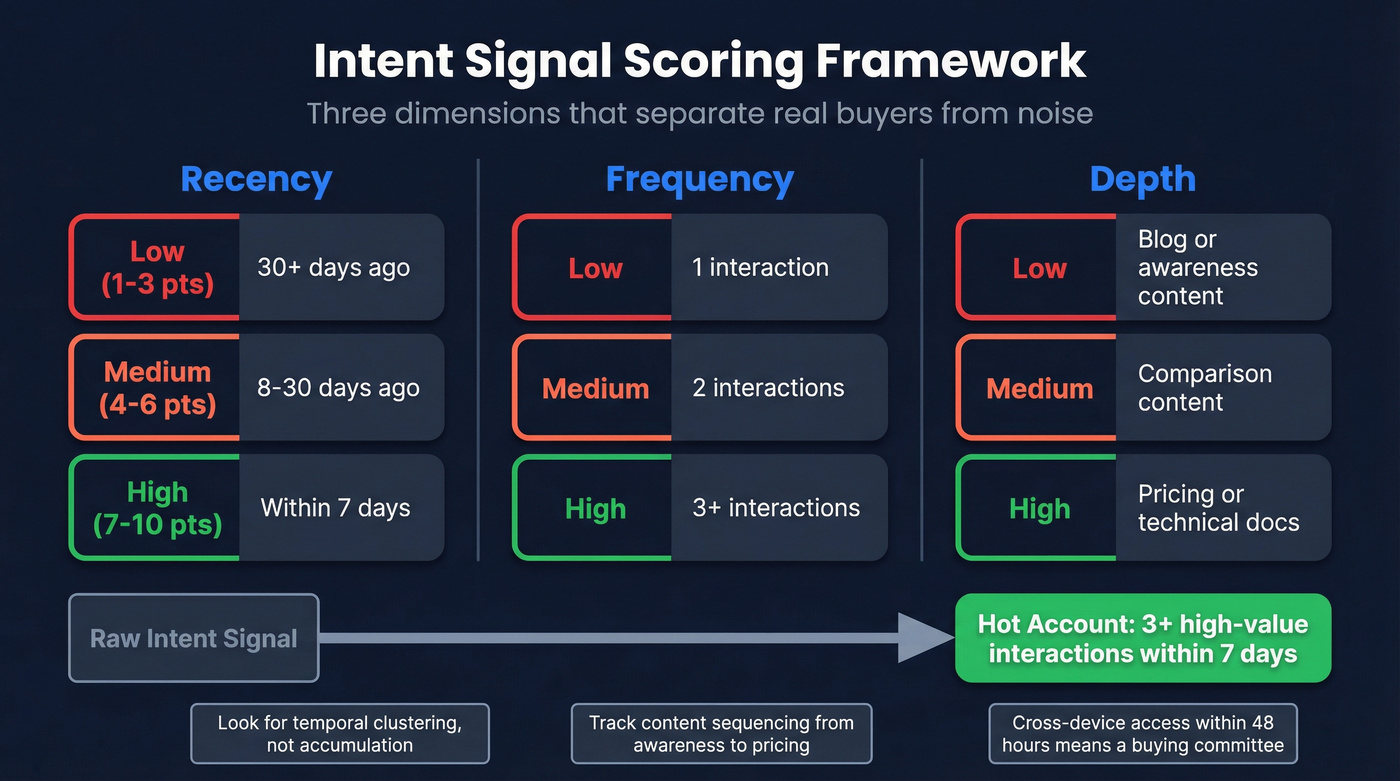
You need a scoring framework that separates real buyers from noise. The one that works uses three dimensions: recency, frequency, and engagement depth.
| Dimension | Low (1-3) | Medium (4-6) | High (7-10) |
|---|---|---|---|
| Recency | 30+ days ago | 8-30 days | Within 7 days |
| Frequency | 1 interaction | 2 interactions | 3+ interactions |
| Depth | Blog/awareness | Comparison content | Pricing/technical |
In our experience, the most useful threshold is flagging accounts with 3+ high-value interactions within 7 days. That's your "hot" tier. (If you need a governance model, adapt an ABM lead scoring approach.)
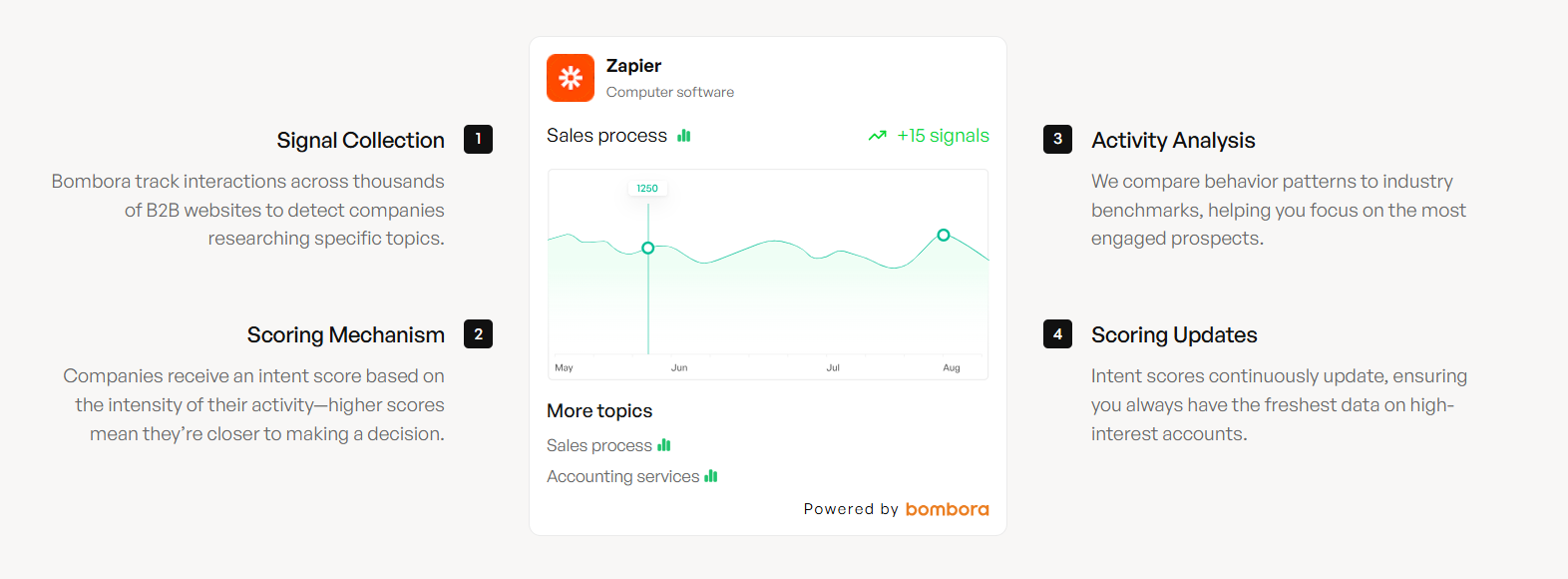
Temporal clustering matters more than raw volume. Five pricing page visits in one week indicates active evaluation. Five visits spread across six months is casual interest. Look for concentration, not accumulation.
Content sequencing is another powerful heuristic. Buyers typically move from awareness content to comparisons to technical docs to pricing to case studies. An account that jumps straight to API docs and pricing pages is in late-stage evaluation.
Cross-device behavior within 48 hours is a buying committee signal. When the same content gets accessed from multiple devices or IPs in a short window, multiple stakeholders are reviewing - a real evaluation is underway. (This is also a good time to apply multithreading basics.)
The strongest signals are multi-category combinations. An account researching your category on publisher networks, visiting competitor profiles on G2, and posting a job for an implementation role? That's not noise. That's a deal in motion. Teams that skip the scoring step waste 60%+ of their intent budget chasing false positives.

Intent signals are worthless without fresh contact data to act on them. Prospeo layers 15,000 Bombora intent topics directly onto 300M+ verified profiles - refreshed every 7 days, not 6 weeks. No more 40% bounce rates on "high-intent" lists.
Stop buying signals you can't operationalize. Get intent and contacts in one platform.
Intent Data Providers and Costs
Budget 15-25% above the license cost for implementation and configuration - that's the hidden line item vendors won't mention upfront. The intent data market is projected to exceed $4B by 2027, and the vendor landscape reflects that growth.
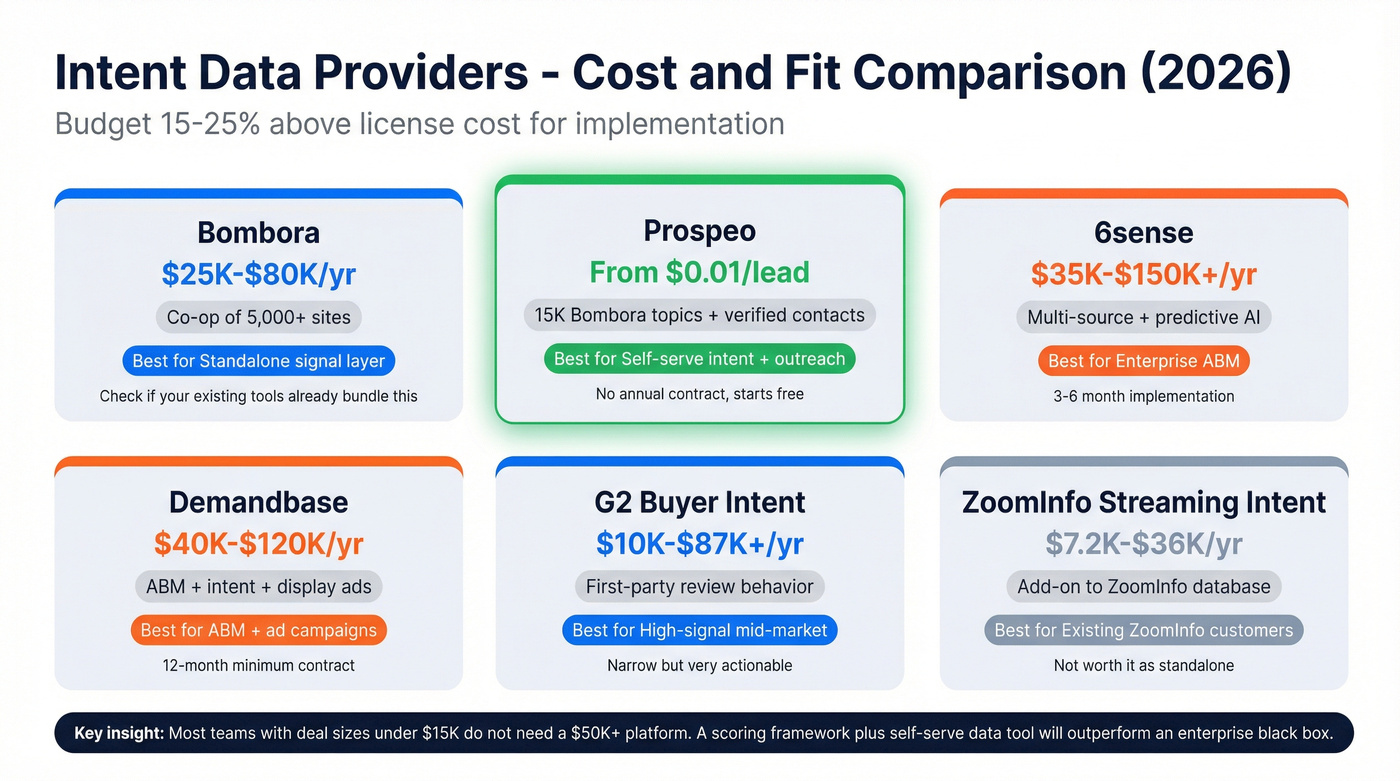
| Provider | Annual Cost | Methodology | Best For |
|---|---|---|---|
| Bombora | $25K-$80K | Co-op of 5,000+ sites | Standalone signal layer |
| Prospeo | ~$0.01/lead | 15K Bombora topics + verified data | Self-serve intent + outreach |
| 6sense | $35K-$150K+ | Multi-source + predictive | Enterprise ABM |
| Demandbase | $40K-$120K | ABM + intent + display | ABM + ad campaigns |
| G2 Buyer Intent | $10K-$87K+ | First-party review behavior | High-signal mid-market |
| ZoomInfo | $7.2K-$36K | Streaming intent add-on | ZoomInfo add-on |
Bombora is the data source most other platforms build on. Its cooperative network tracks topic research across 18,000+ B2B topics and detects when an account's research volume surges above baseline. The limitation: it's company-level, not person-level. Before purchasing standalone, check whether your existing 6sense, Demandbase, or ZoomInfo contract already bundles Bombora data - many do.
6sense is the platform everyone demos and half the teams regret buying. It aggregates multiple intent sources, layers in website visitor identification, and applies predictive models to assign buying stages. The frustration we hear constantly on r/sales and r/salesoperations: 6sense tells you an account is in "Decision" stage but won't explain why. You're supposed to trust the black box. Implementation takes 3-6 months, and the $35K-$150K+ price tag means this is enterprise-only territory.
Skip Demandbase if you just want intent data. It combines ABM orchestration with integrated intent and display advertising - powerful if you're running account-based display campaigns alongside outbound, but you're overpaying for ad tech you won't use. Expect $40K-$120K/year with a 12-month minimum.
G2 Buyer Intent is the most actionable signal source for mid-market teams. The coverage is narrower - only behavior on G2 itself - but when someone's comparing you to competitors and reading your reviews, they're in active evaluation. $10K-$87K+ depending on category and volume.
ZoomInfo Streaming Intent runs $7.2K-$36K/year as an add-on. If you're already paying for ZoomInfo's contact database, it's the cheapest way to layer in intent. If you're not on ZoomInfo, this isn't a reason to start.
HockeyStack focuses on multi-touch attribution and intent tied to revenue outcomes - worth evaluating if your primary goal is understanding which signals correlate with closed deals. Expect $20K-$60K/year.
Prospeo: Intent + Verified Contacts
After absorbing those price points, here's the self-serve alternative. Prospeo tracks 15,000 intent topics powered by Bombora and pairs them with 300M+ professional profiles, 143M+ verified emails, and 125M+ verified mobile numbers - all on a 7-day refresh cycle.
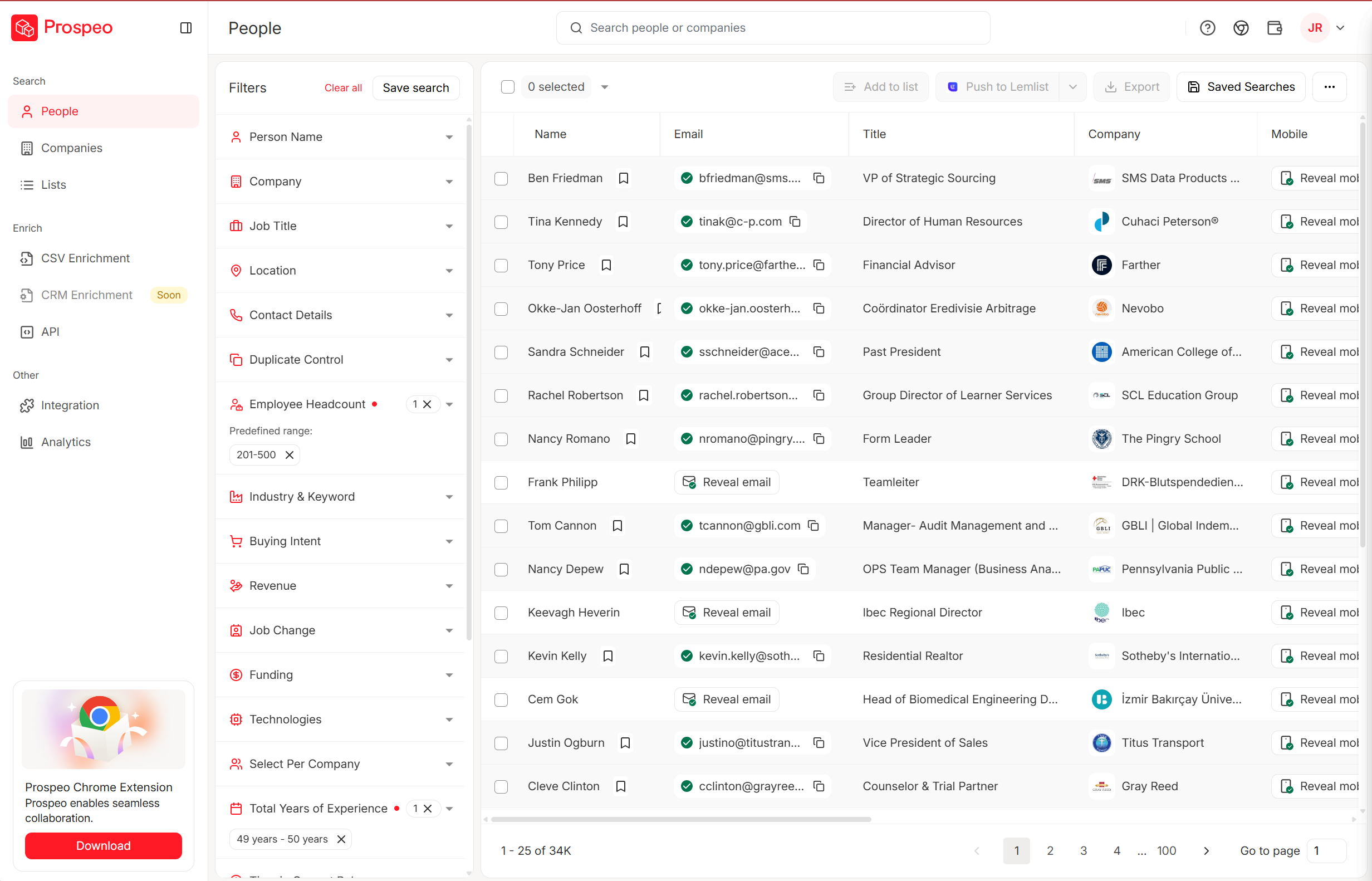
The difference is operational. Enterprise intent platforms tell you which accounts are in-market. Prospeo tells you which accounts are in-market and gives you verified contact data to reach the right people immediately. No separate enrichment step, no stale data, no 40% bounce rates. (If you're troubleshooting bounces, start with hard bounce and work backward.)
One customer, Meritt, tripled their pipeline from $100K to $300K/week after switching, with bounce rates dropping from 35% to under 4%. Pricing starts free with 75 emails and 100 Chrome extension credits per month, with credits at roughly $0.01 per lead. No annual contracts, no "talk to sales" gates.
Turning Insights Into Action
Acquisition
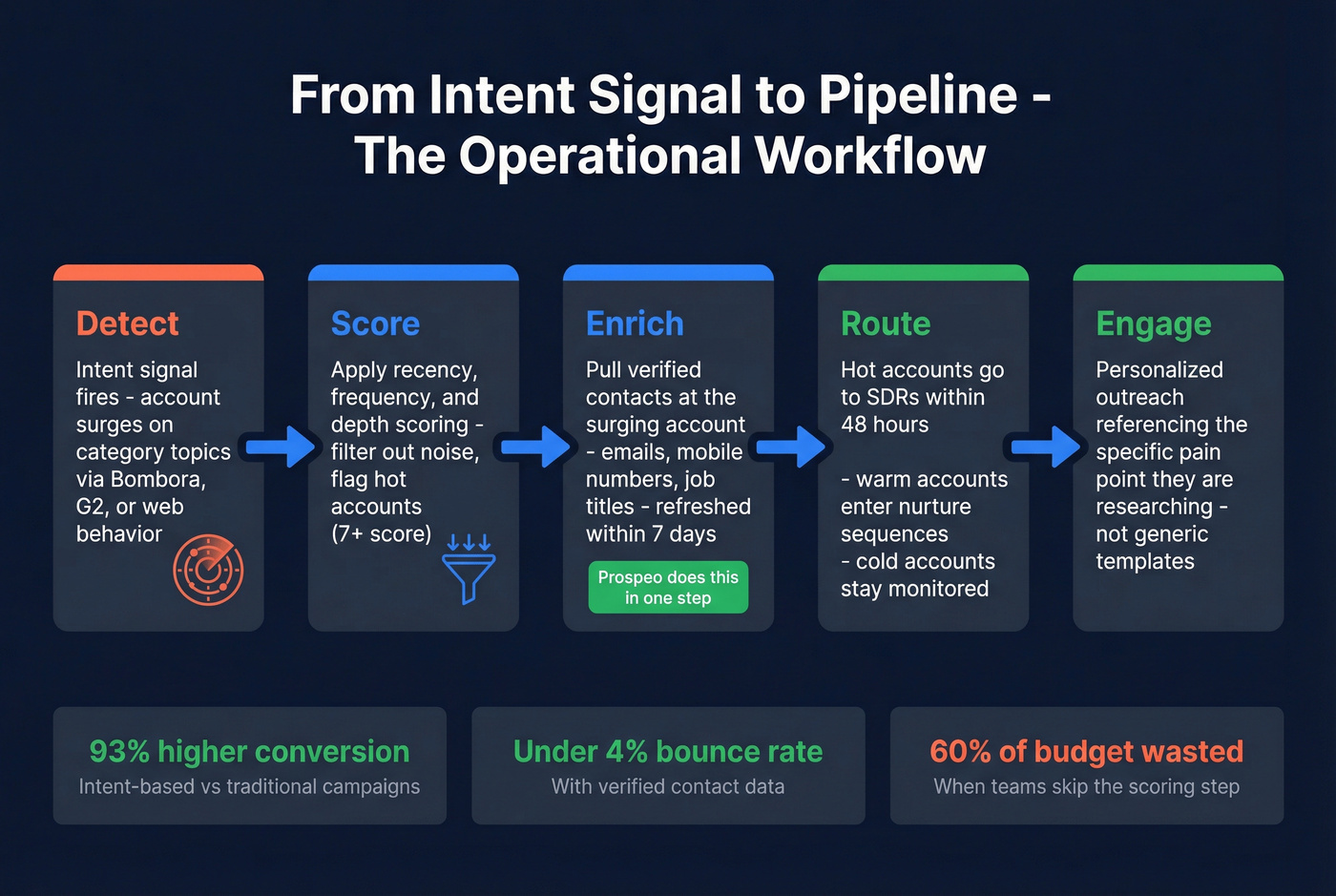
Use intent signals to prioritize ABM target lists - instead of spraying outreach across 5,000 accounts, focus on the 200 showing active research signals. Time your outreach to coincide with intent spikes rather than arbitrary cadences. If an account surges on "CRM migration" topics on Monday, your SDR should be calling by Wednesday, not waiting for the next quarterly cadence review. (For a routing + SLA model, borrow from AI lead qualification playbooks.)
Buyers use an average of 10 interaction channels during their journey. Reach them during an intent spike with a relevant message and you're competing against vendors still waiting for the inbound form fill. The teams combining topic research, review-site activity, and technographic changes consistently outperform those relying on a single data source. (This is the core of signal-based outbound.)
Retention
Your existing customers generate intent signals too - and the ones pointing away from you matter most.
The strongest churn signal combination: a customer researching competitor categories, consuming migration/switching content, and browsing integration documentation for a rival product. When you see all three within a two-week window, escalate to CS immediately. Don't wait for the renewal conversation to turn adversarial.
You don't need a $50K platform to monitor this. Basic first-party analytics combined with a G2 Buyer Intent feed will surface the accounts that need attention before it's too late.
The Data Quality Problem
Here's the contrarian take most intent data vendors won't give you: 30% of B2B data goes stale every year. Over 90% of a typical database becomes outdated within three years. Cookie deprecation and expanding privacy regulations are accelerating this decay. (If you want the benchmarks and fixes, see B2B contact data decay.)
Intent data without fresh contact data is a waste of money. You can have the most sophisticated scoring framework in the world, but if the emails bounce and the phone numbers ring disconnected lines, the signal was worthless. This is the gap most enterprise platforms ignore - they'll tell you an account is "in-market" and leave you to figure out who to call. (Operationally, this is a data quality problem, not a marketing one.)
Look, GDPR and CCPA aren't going away, and first-party data emphasis is only increasing. The teams that win in 2026 combine consent-based first-party signals with verified third-party data from providers that take data freshness seriously - weekly refresh cycles, not monthly or quarterly. (If you're building a compliance checklist, start with GDPR for Sales and Marketing.)

You just built a scoring framework. Now you need data that keeps up. Prospeo delivers 98% email accuracy and 125M+ verified mobiles at ~$0.01/lead - 90% cheaper than enterprise intent platforms that gate contact data behind a separate contract.
Score the account, reach the buyer, close the deal - all from one self-serve platform.
FAQ
What's the difference between first-party and third-party intent data?
First-party data comes from your own properties (website visits, email engagement, product usage); third-party data comes from external publisher cooperatives and review platforms. First-party is higher-confidence, while third-party reveals accounts researching your category before they ever visit your site. Combining both gives the most complete picture of account-level buying behavior.
How much does B2B intent data cost?
Enterprise platforms range from $10K to $150K+/year - Bombora runs $25K-$80K, 6sense $35K-$150K+, Demandbase $40K-$120K. Budget an additional 15-25% for implementation. Self-serve tools bundle intent with verified contacts starting free at ~$0.01/lead, making them viable for teams with deal sizes under $20K.
How do intent signals differ from lead scoring?
Lead scoring grades individual contacts based on demographic fit and engagement with your brand. Intent signals detect account-level research behavior across the open web - often before a prospect ever touches your properties. The best teams use both: intent signals to identify in-market accounts, lead scoring to prioritize contacts within those accounts.