

How to Build a Lead Generation System That Actually Works
It's Monday morning. You open your pipeline dashboard and it looks like a ghost town - a handful of stale opportunities, a few "maybe next quarter" deals, and nothing new from last week's campaign.
Here's the uncomfortable math: 79% of marketing leads never convert into sales. Not because teams lack tactics or tools, but because nothing connects them into a coherent lead generation system. Meanwhile, 92% of buyers already have a vendor in mind before they start evaluating options. If your system isn't doing the work before that moment, you've already lost.
The lead gen software market is projected to hit $16.2 billion by 2034, up from $7.4 billion in 2025. Every competitor is investing in this. The teams that win aren't the ones with the biggest budgets - they're the ones with actual architecture connecting their pieces. Let's build that architecture.
What You Need (Quick Version)
A complete system has six components: ICP definition, channel strategy, lead capture, qualification, nurture, and measurement. Most companies fail because they buy tools before building the framework.
Minimum viable stack:
- CRM: HubSpot CRM (free plan available)
- Prospecting & enrichment: Prospeo (free tier - 75 emails/month)
- Outreach: Instantly or Smartlead (~$30-100/month)
- Total: typically under $200/month
What Is a Lead Generation System?
A lead generation system is a repeatable framework that turns strangers into qualified pipeline through coordinated processes, not random acts of outreach.
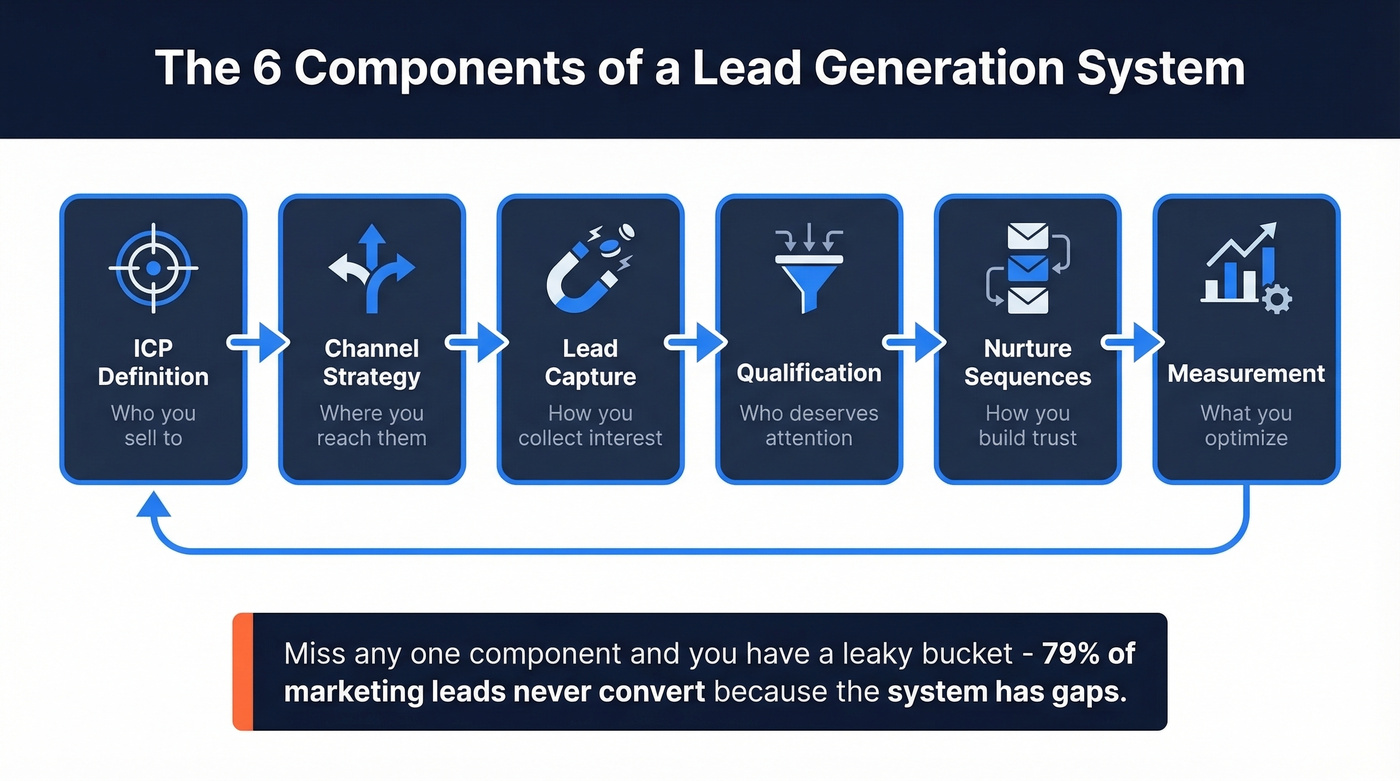
Tactics are individual plays - a cold email campaign, a webinar, a paid ad. Tools are the software that executes those plays. A system is the architecture that connects them so every lead gets captured, scored, nurtured, and routed without manual intervention or dropped handoffs. That distinction matters more than most teams realize, because the gap between "we have tools" and "we have a system" is where pipeline goes to die.
Here's why this matters more than ever: first contact with sellers now happens at 61% of the buying journey. Your prospects are more than halfway through their decision before they ever talk to you. The system has to do the heavy lifting before that conversation happens.
Only 3-5% of your market is ready to buy at any given time. Demand generation creates awareness among the other 95%. Lead generation captures the intent that already exists. Your system needs to handle both - warming up future buyers while converting today's hand-raisers.
The six components: ICP definition, channel strategy, capture mechanisms, lead qualification, nurture sequences, and measurement. Miss any one and you've got a leaky bucket.
How to Build Your System in 7 Steps
Step 1: Define Your ICP
Skip the "we sell to everyone" trap. Your ICP isn't a persona doc that collects dust - it's a living filter that determines who gets your time and budget.
Start with sub-segmentation. Belkins calls this competency mapping: break your addressable market into segments, then rank each by ease of selling, strategic fit, and growth potential. The segment that scores highest across all three is where you start. We've found that teams who nail this step cut their cost per qualified lead by 30-40% within the first quarter, simply because they stop wasting outreach on the wrong accounts.
Before you move on, confirm:
- You've identified the point of contact (takes your call), champion (sells internally for you), decision maker (signs the check), influencer (shapes opinion), and blocker (can kill the deal)
- You know each segment's top 3 priorities and constraints
- You can articulate why your solution matters to this segment in one sentence
Relevancy beats personalization. Knowing a prospect's priorities matters more than knowing their first name.
Step 2: Choose Your Channels
B2B buyers now engage across 10 channels before purchasing, up from 5 in 2016. Modern purchases require 70+ touchpoints across 6 channels. You don't need to be everywhere, but you need to be in more than one place.
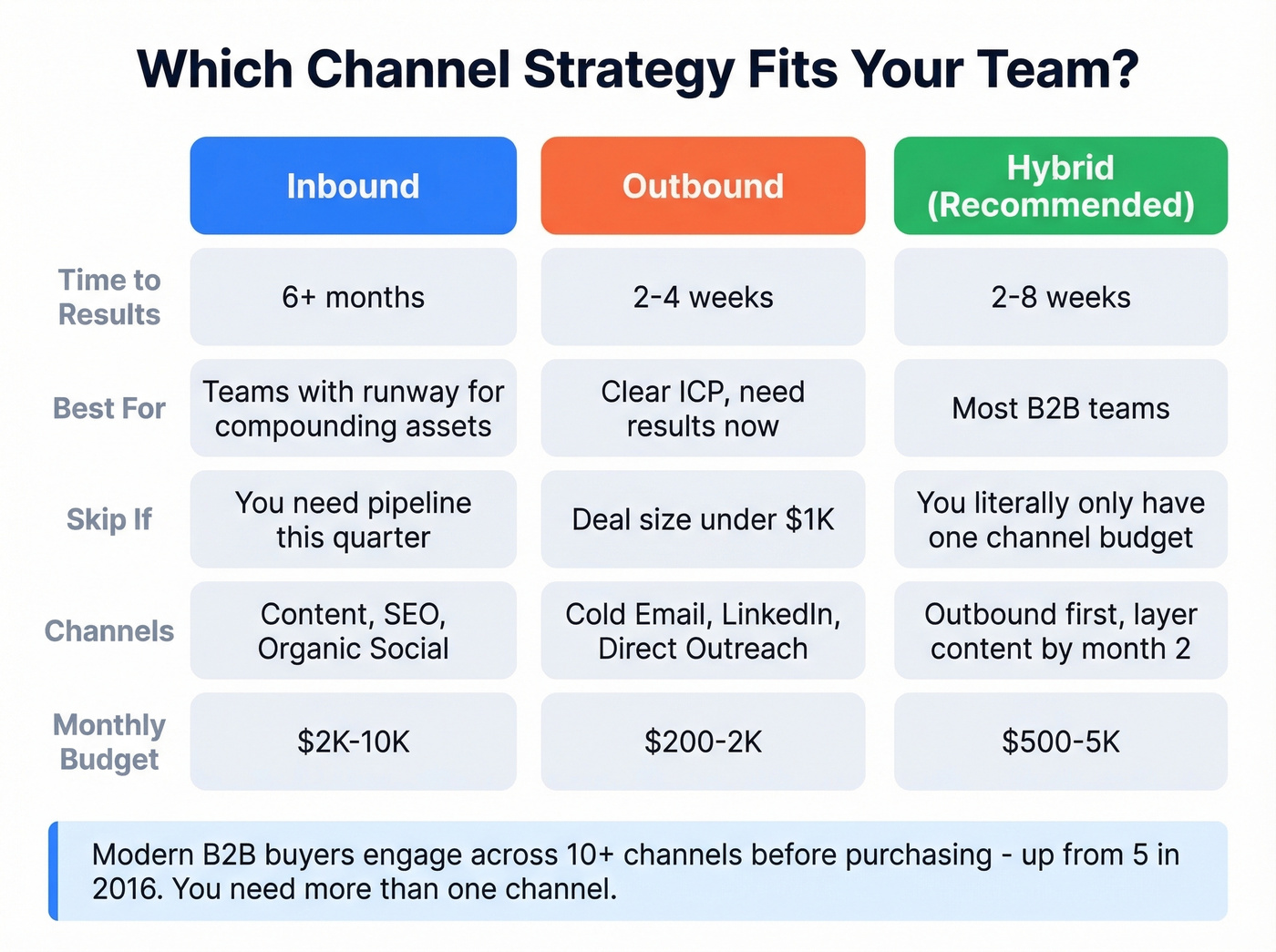
Inbound (content, SEO, organic social) Use if you have 6+ months of runway and can invest in compounding assets. Skip if you need pipeline this quarter.
Outbound (cold email, direct outreach) Use if you need results now and have a clear ICP. Skip if your average deal size is under $1K - the unit economics won't work. If you're building repeatable outbound, start with proven sales prospecting techniques before you scale volume.
Hybrid (recommended for most B2B teams) Use if you want quick wins while building long-term leverage. For startups with limited runway, pure inbound is a luxury you can't afford. Start outbound, layer in content by month two, and let the flywheel build.
The right channel mix is one of the most critical decisions you'll make. Get it wrong and you'll burn budget for months wondering why nothing's converting.
Step 3: Create Lead Magnets
Nobody's trading their contact info for something vague. 56% of buyers say there's already too much content - so yours needs to be genuinely useful or it's noise.
The best lead magnets solve a specific, immediate problem. A calculator that estimates ROI. A benchmark report with numbers your prospect can't find elsewhere. A template they can use today. Generic "ultimate guides" don't cut it anymore. Here's the thing: if you wouldn't personally download your own lead magnet, neither will your prospects.
Step 4: Build Capture Mechanisms
Your capture layer is where interest becomes data. Forms, chat widgets, popups - these are the basics. The advanced play is progressive profiling: ask for an email on the first visit, job title on the second, company size on the third. You build a complete record without a 12-field form that scares everyone away.
One tactic that consistently outperforms: push-to-calendar on your thank-you page, paired with an SMS confirmation within 60 seconds. Show rates jump when you reduce the friction between "interested" and "booked."
Step 5: Implement Lead Scoring
Most teams skip lead scoring because it sounds complicated. It isn't. Start with two variables - engagement frequency and firmographic fit. Score 1-100. Above 70 gets a call. If you want a deeper framework, use a dedicated lead scoring model instead of reinventing it.
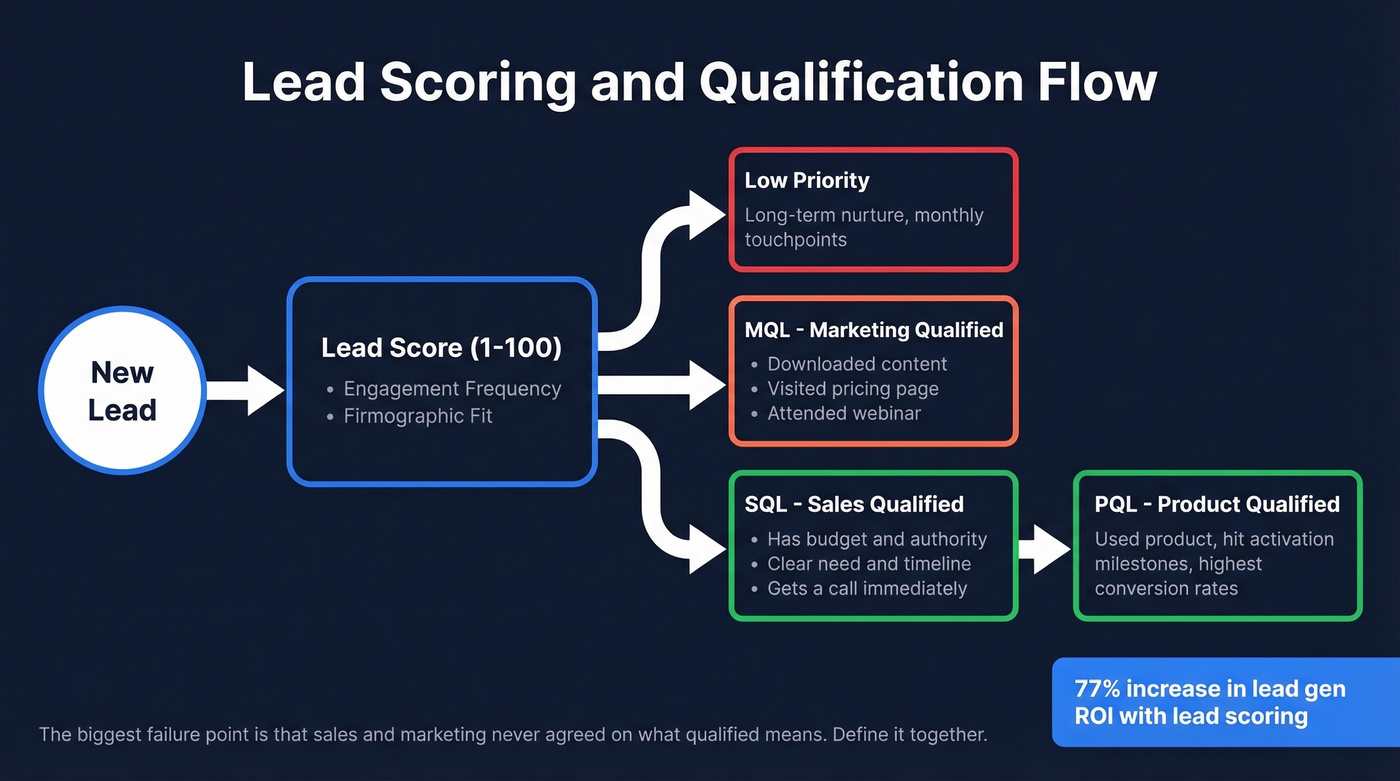
Three lead types to define before you build anything:
- MQL (Marketing Qualified Lead) - engagement-based. Downloaded content, visited pricing page, attended a webinar.
- SQL (Sales Qualified Lead) - has budget, authority, need, and timeline.
- PQL (Product Qualified Lead) - used your product and hit activation milestones. PQLs convert at the highest rates because they've already proven product-solution fit.
Companies using lead scoring see a 77% increase in lead gen ROI. The biggest failure point isn't the scoring model - it's that sales and marketing never agreed on what "qualified" means. Define it together, write it down, revisit quarterly.
Step 6: Set Up Nurture Sequences
The average B2B buying cycle runs 10.1 months. That's a long time for a lead to go cold. Marketing automation drives a 451% increase in qualified leads - nurture sequences are where that lift comes from.
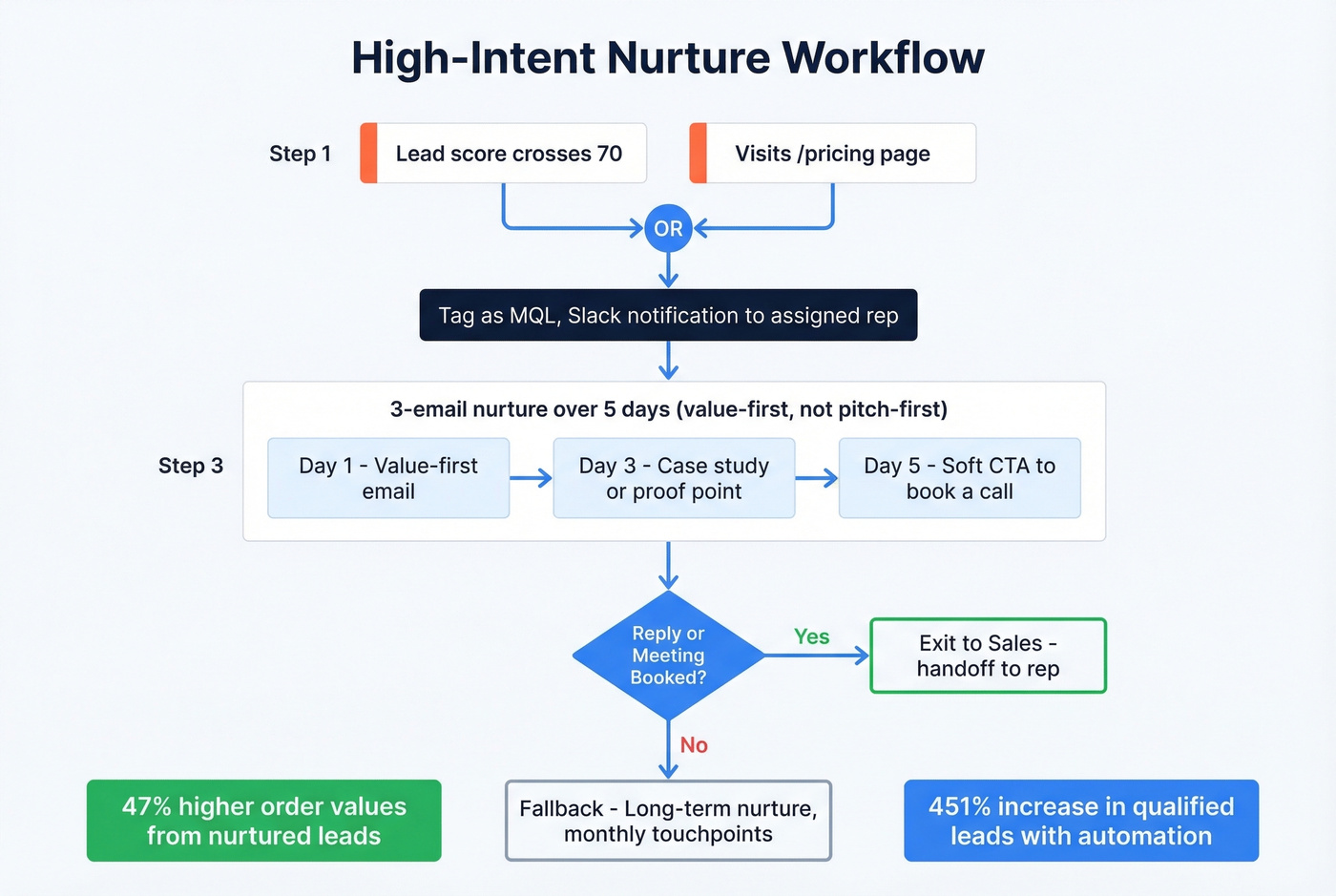
Here's a high-intent nurture workflow:
- Entry trigger: Lead score crosses 70 OR visits /pricing page
- Action: Tag as MQL, Slack notification to assigned rep
- Sequence: 3-email nurture over 5 days (value-first, not pitch-first)
- Exit condition: Reply received or meeting booked, exit to sales
- Fallback: No engagement, move to long-term nurture with monthly touchpoints
Nurtured leads produce 47% higher order values than non-nurtured leads. The math justifies the effort.
Step 7: Automate Handoff and Follow-Up
Speed kills deals - in both directions. Companies that respond to leads within 5 minutes are 100x more likely to connect than those waiting 30 minutes. Your system needs to make fast follow-up automatic, not aspirational.
The workflow: new lead captured, enrich with verified contact data, score based on firmographic and behavioral criteria, route to the right rep by territory or segment, trigger outreach sequence. Every manual step in that chain is a place where leads die. If you're standardizing this, keep a set of sales follow-up templates so reps don't freestyle under pressure.
We've seen teams cut average response time from 4 hours to under 10 minutes just by automating the enrichment-to-routing handoff. The leads didn't change. The speed did. Once that automation is in place, you scale volume without adding headcount - and that's where the real compounding starts.
Recommended Tech Stack
A 3-tool stack with orchestration beats a 10-tool stack with no orchestration. We've watched teams spend $50K/year on software and still lose leads because nothing was connected. Start lean, connect everything, add tools only when you've outgrown what you have.
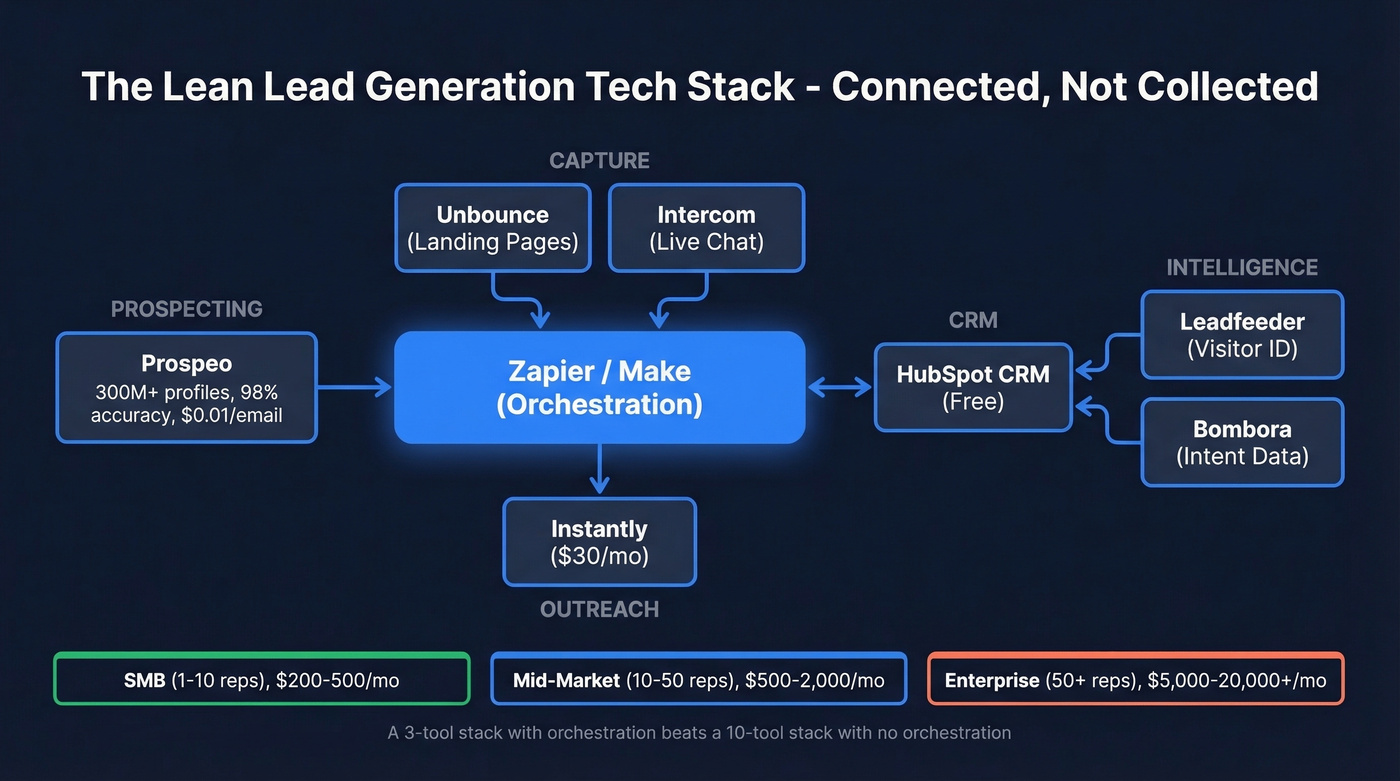
| Category | Recommended Tool | Starting Price |
|---|---|---|
| CRM | HubSpot | Free |
| Prospecting & Enrichment | Prospeo | Free (75 emails/mo) |
| Email Outreach | Instantly | ~$30/mo |
| Automation | Zapier | Free (100 tasks/mo) |
| Landing Pages | Unbounce | $99/mo |
| Live Chat | Intercom | $29/seat/mo |
| Visitor ID | Leadfeeder | ~$99/mo |
| Intent Data | Bombora (via Prospeo) | Available via paid plans |
For prospecting and enrichment, Prospeo covers 300M+ professional profiles with 98% email accuracy and a 7-day data refresh cycle - the industry average is 6 weeks. At roughly $0.01 per email, it's 90% cheaper than enterprise providers like ZoomInfo. Native integrations with HubSpot, Salesforce, Smartlead, Instantly, Lemlist, Clay, Zapier, and Make mean the tool slots into any stack without custom engineering. If you're comparing vendors, start with a shortlist of data enrichment services and work backward from accuracy + refresh rate.
On Reddit's r/automation, practitioners report enrichment costs with tools like Clay "blowing up" at scale - one user built their own API layer to avoid it. That's the kind of problem you sidestep with predictable, credit-based pricing. Total cost by company size:
| Company Size | Monthly Cost | Core Stack |
|---|---|---|
| SMB (1-10 reps) | $200-500 | HubSpot Free + Prospeo + Instantly |
| Mid-Market (10-50 reps) | $500-2,000 | HubSpot Professional + Prospeo + Outreach |
| Enterprise (50+) | $5,000-20,000+ | Salesforce + Salesloft + 6sense |
Look, if your average contract value is under $10K, you probably don't need a $30K/year data platform. A lean stack with accurate data and fast follow-up will outperform an enterprise suite that nobody fully adopts. We've seen it over and over - the teams booking the most meetings aren't the ones with the most tools.

Step 2 says choose your channels. Step 0 is making sure your data doesn't sabotage them. Prospeo gives you 300M+ profiles with 98% email accuracy, 30+ filters to match your ICP, and a 7-day refresh cycle so you're never outreaching to dead contacts. Most teams cut bounce rates from 35%+ to under 4%.
Stop building your lead generation system on bad data.
You just read about ICP definition, lead scoring, and capture mechanisms - but none of it matters if your enrichment layer returns stale emails and disconnected numbers. Prospeo's CRM enrichment returns 50+ data points per contact at a 92% match rate, with native integrations into HubSpot, Salesforce, Instantly, and Smartlead. That's the infrastructure layer your system is missing.
Plug the data gap in your lead generation system for free.
Benchmarks: What "Good" Looks Like
Numbers without context are meaningless. Here's what conversion rates actually look like across industries:
| Industry | Avg Conversion Rate |
|---|---|
| Legal Services | 7.4% |
| HVAC Services | 3.1% |
| Staffing & Recruiting | 2.9% |
| Higher Education | 2.8% |
| Manufacturing | 2.2% |
| Financial Services | 1.9% |
| IT & Managed Services | 1.5% |
| B2B SaaS | 1.1% |
If you're in SaaS and converting at 1.1%, you're average. Not broken - average. The lever isn't always conversion rate. Sometimes it's volume, sometimes it's lead quality, sometimes it's speed-to-lead.
B2B cost per lead runs $73-156 depending on industry. Lead-to-opportunity conversion averages 13-27%, with top performers hitting 35%+. That 5-minute speed-to-lead threshold isn't a nice-to-have - it's the single highest-leverage metric in your pipeline. To pressure-test your funnel, track the right lead generation metrics and review them monthly.
Measuring ROI
Cost per lead: Total Campaign Investment / Number of Qualified Leads. Include everything - ad spend, content creation, software, team time. Tech services average $127 CPL; professional services run around $94.
Sales velocity: (Opportunities x Avg Deal Size x Win Rate) / Sales Cycle Length. This tells you how fast your pipeline produces revenue, not just leads. If you want a tighter operating view, add pipeline health checks to your reporting cadence.
For overall ROI, 5:1 is strong, 2:1 is barely profitable after overhead, and 10:1 is outstanding. One critical choice: multi-touch attribution delivers 89% accuracy versus 65% for first-touch models. If you're still crediting the last touchpoint before conversion, you're misallocating budget.
Mistakes That Kill Your Pipeline
1. Relying on purchased lead lists. Those contacts don't know you, didn't ask for your email, and rarely convert. You're paying for data that damages your domain reputation. If you're unsure where the line is, read Is It Illegal to Buy Email Lists?
2. No lead qualification criteria. When every lead gets the same treatment, reps waste time on prospects who were never going to buy. Define MQL/SQL thresholds before you generate a single lead.
3. Slow follow-up. Warm leads go cold fast. If your average response time exceeds 30 minutes, you're losing deals to competitors who respond in 5. 47% of enterprise GTM teams struggle to deliver strong customer experience for leads - speed is usually the first thing that breaks.
4. Weak lead magnets. Generic ebooks and "subscribe to our newsletter" don't earn attention. If your lead magnet doesn't solve a specific problem, it's clutter.
5. Poor data hygiene. Bad contact data is a primary reason leads stall or die. If your bounce rate exceeds 5%, your data quality is the first thing to audit. If you're diagnosing deliverability, start with email bounce rate benchmarks and root causes. Snyk cut bounce rates from 35-40% to under 5% after switching to weekly-refreshed, multi-step verified data - and saw AE-sourced pipeline jump 180%.
6. Siloed sales and marketing. When marketing generates leads that sales ignores, nobody wins. Shared definitions, shared dashboards, shared accountability. This is the fastest way to undermine everything you've built.
7. Not measuring. A system without feedback loops isn't a system - it's a set of habits. Track CPL, conversion rates, and velocity monthly. Cut what doesn't work. Double down on what does.
Scaling Without Adding Headcount
Once the foundation is in place, the question shifts from "does it work?" to "does it scale?"
Advanced setups share a few traits: they decouple volume from headcount, they use enrichment and scoring to maintain quality as volume grows, and they have feedback loops that improve targeting over time. The key is automation at every handoff point. When enrichment, scoring, routing, and initial outreach all run without manual intervention, adding a new segment or doubling your outbound volume doesn't require doubling your team. If you need a blueprint, map your process as a lead generation workflow and automate the handoffs first.
That's the difference between a lead generation system and a collection of processes. The system compounds. The processes plateau.
FAQ
What is a lead generation system?
A repeatable framework combining ICP definition, channel strategy, lead capture, scoring, nurturing, and measurement to produce consistent, qualified deal flow. Most teams have the individual pieces but lack the architecture connecting them - that's why 79% of marketing leads never convert.
How much does it cost to build one?
SMBs typically start at $200-500/month using HubSpot Free, Prospeo's free tier, and Instantly. Mid-market teams spend $500-2,000/month. Enterprise stacks with Salesforce and 6sense run $5,000-20,000+/month.
What's the difference between lead generation and demand generation?
Lead gen captures existing buying intent from the 3-5% of your market ready to purchase now. Demand gen creates awareness among the other 95-97% who aren't yet in-market. Effective B2B teams run both simultaneously.
How long until I see results?
Outbound campaigns produce pipeline within days. Inbound channels like SEO and content take 3-6 months to compound. A hybrid approach - outbound for quick wins, inbound layered in month two - shows measurable results in 1-3 months.
What's the single most important component?
Data quality. If your contact data is inaccurate or outdated, nothing downstream works - not scoring, not nurture, not follow-up. Teams using verified, weekly-refreshed data consistently outperform those relying on stale databases.