

12 B2B Lead Generation Tactics With Real Numbers Behind Them
Your SDR manager just showed you the numbers: 2% reply rate, 15% bounce rate, pipeline down 30% from last quarter. You're not alone - 61% of marketers say generating traffic and leads is their top challenge. The problem isn't that you need more lead generation tactics for B2B. You need 3-5 executed well, not 37 executed poorly.
Most numbers in this article come from 2025-2026 platform data, plus a 2017-2025 benchmark dataset for funnel conversion rates. Let's get into it.
The Short Version
If you can only do three things: build a verified prospect list with intent signals, run a signal-based cold email sequence of 4-7 touchpoints, and publish one ungated content piece per week.
That's the cheat sheet. Here's the reasoning.
The 95:5 Rule
Here's the thing most lead gen articles skip entirely: 95% of your ICP isn't buying right now. The [95:5 rule](https://business.linkedin.com/advertise/resources/b2b-institute/b2b-research/trends/95-5-rule) means your outbound captures the 5% who are in-market today, while demand gen builds trust with the other 95% who'll buy in 6, 12, or 18 months.
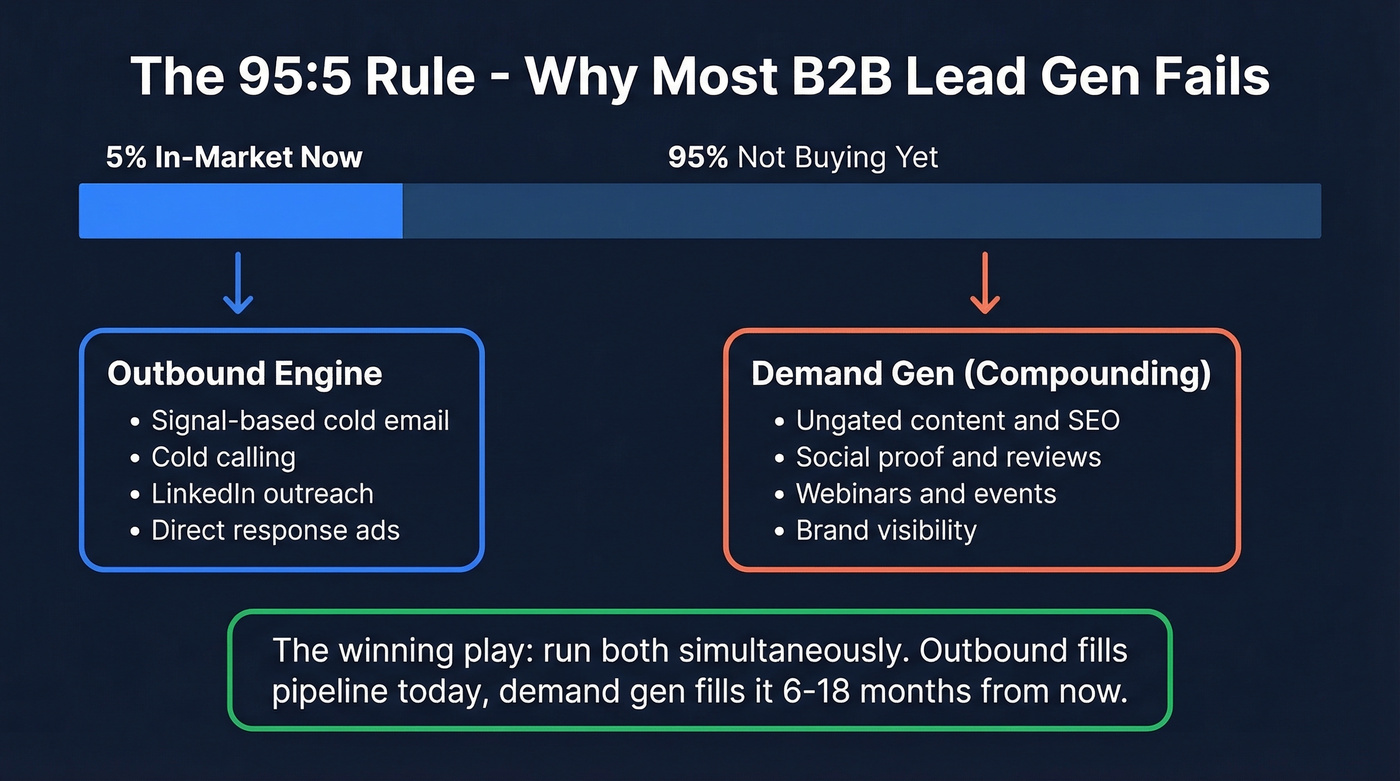
This split should dictate your entire strategy. Outbound is your short-term pipeline engine. Content, social proof, and brand visibility are your compounding assets. Teams that go all-in on outbound without demand gen end up on a feast-or-famine rollercoaster - we've watched it happen to clients more times than we can count.
And here's the part nobody wants to hear: most pipeline failures happen after capture. Misaligned handoffs, fragmented attribution, SDRs reaching out days after competitors already have. Fix the system before adding more channels.
One more contrarian take: stop gating your best content. Gate demos and tools, not PDFs. Ungated content reaches the 95%. Gated content just inflates your MQL count with people who'll never reply to your SDR's follow-up.
Picking the Right Tactics
Not every tactic works for every company. Belkins lays out three calibration lenses that are genuinely useful for prioritization.
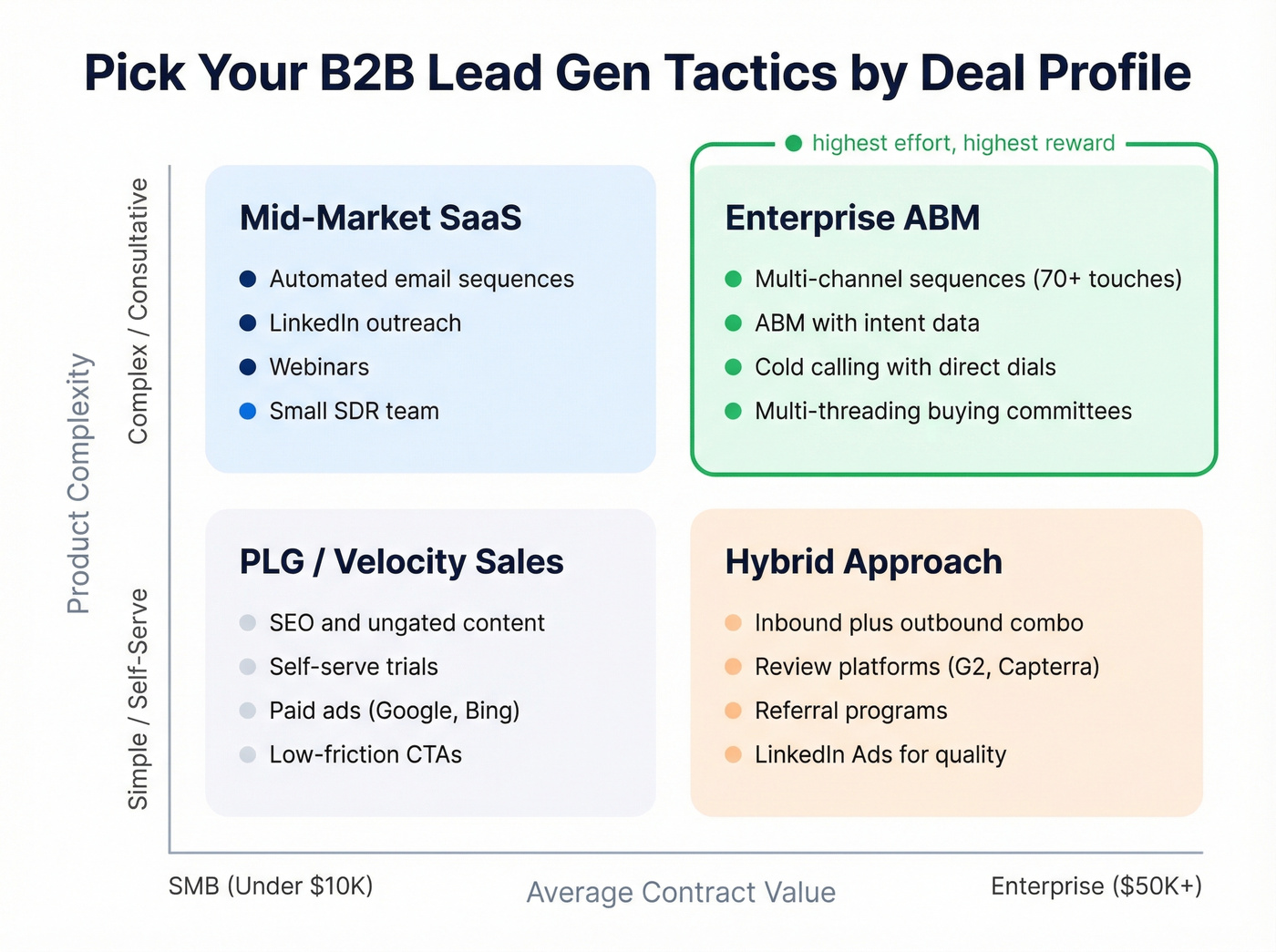
ACV and sales cycle. Enterprise deals with six-figure ACVs need ABM, multi-threading, and phone calls. SMB velocity deals need automated email sequences and frictionless signup flows. Mixing these up wastes months.
Market position. Established players with brand recognition can lean on inbound - people are already searching for you. Disruptors and startups need outbound to create awareness that doesn't exist yet.
Product complexity. Complex products like enterprise software need webinars, demos, and consultative selling. Simple products need self-serve trials and low-friction CTAs.
For enterprise, expect 70+ touchpoints across six channels before a deal closes. For SMB, you might close in 4-7 email touches. Let your deal profile pick your tactics, not the other way around.
If your average deal size is under $10K, you probably don't need ZoomInfo-level data or a 12-step ABM program. A clean list, a sharp sequence, and fast follow-up will outperform a bloated tech stack every time.

You just read it: 15% bounce rates kill pipeline. Prospeo's 5-step verification delivers 98% email accuracy on a 7-day refresh cycle - not the 6-week industry average. 30+ filters including buyer intent, technographics, and job changes let you build signal-based lists that actually convert.
Stop feeding bad data into good sequences. Start with 75 free verified emails.
12 Methods That Move Pipeline
Inbound Tactics
Ungated content + SEO is the long game that compounds. Ungated content reaches the 95% who aren't buying today but will remember you when they are. Blog posts, research reports, and how-to guides that rank organically generate leads at near-zero marginal cost after the initial investment. The tradeoff: expect 3-6 months before SEO content meaningfully contributes to pipeline.
Webinars and live events work best for complex products with higher ACVs. They let you demonstrate expertise, answer objections in real time, and build trust that a landing page can't. Treat them as pipeline events, not brand exercises - have sales follow up within hours, not days.
Social proof and review platforms are lead gen channels, not just reputation management. 92% of buyers rely on social proof before purchasing. G2, Capterra, and TrustRadius profiles generate high-intent inbound leads because buyers are actively comparing solutions. If you're not investing in reviews, you're leaving pipeline on the table.
Outbound Tactics
Signal-based cold email is the flagship outbound tactic for 2026. The workflow: define your ICP, build a list using filters like job title, company size, industry, and tech stack, verify emails, enrich with signals using Clay, Make.com, or Apify + LLMs for funding rounds, job changes, and hiring patterns, personalize the first line with a "why now" angle, then send with a low-friction CTA like "Is this a priority right now?"
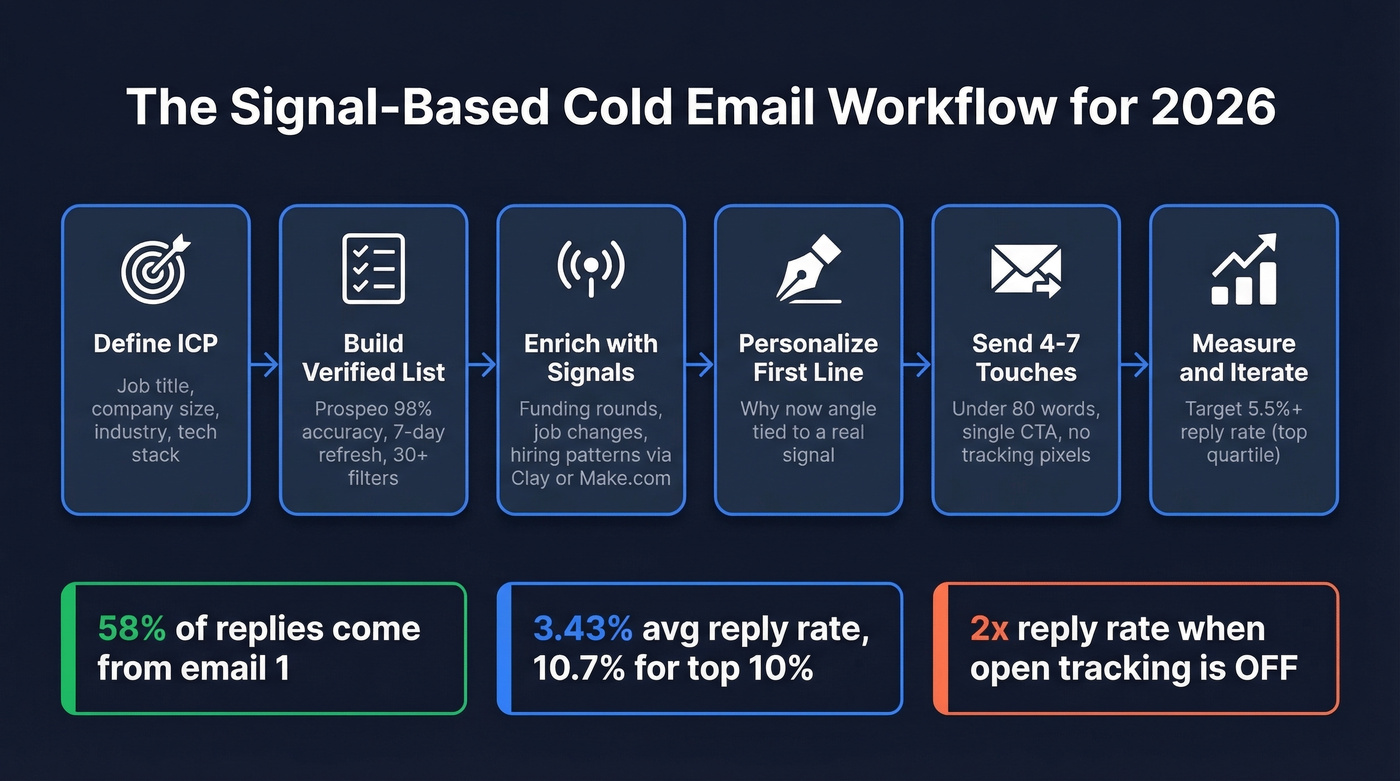
The Instantly 2026 benchmark report gives us real numbers: 3.43% average reply rate, 5.5% for top quartile performers, and 10.7% for the top 10%. Fifty-eight percent of replies come from the first email. The sweet spot is 4-7 touchpoints, emails under 80 words, and a single CTA.
One insight most teams miss: turn off open and click tracking. Tracking pixels hurt deliverability. In Snov.io's analysis of 44 million emails, campaigns with open tracking disabled saw reply rates of 2.36% vs 1.08%. That's more than double.
Data quality as a standalone tactic deserves its own line item because bad data doesn't just waste sends - it actively damages your infrastructure. Nearly 20% of cold emails get flagged as spam. A popular r/sales thread puts it bluntly: Apollo is "a jack of all trades, master of none" for data quality, since its data is populated by other users and the platform "is not verifying anything by themselves."
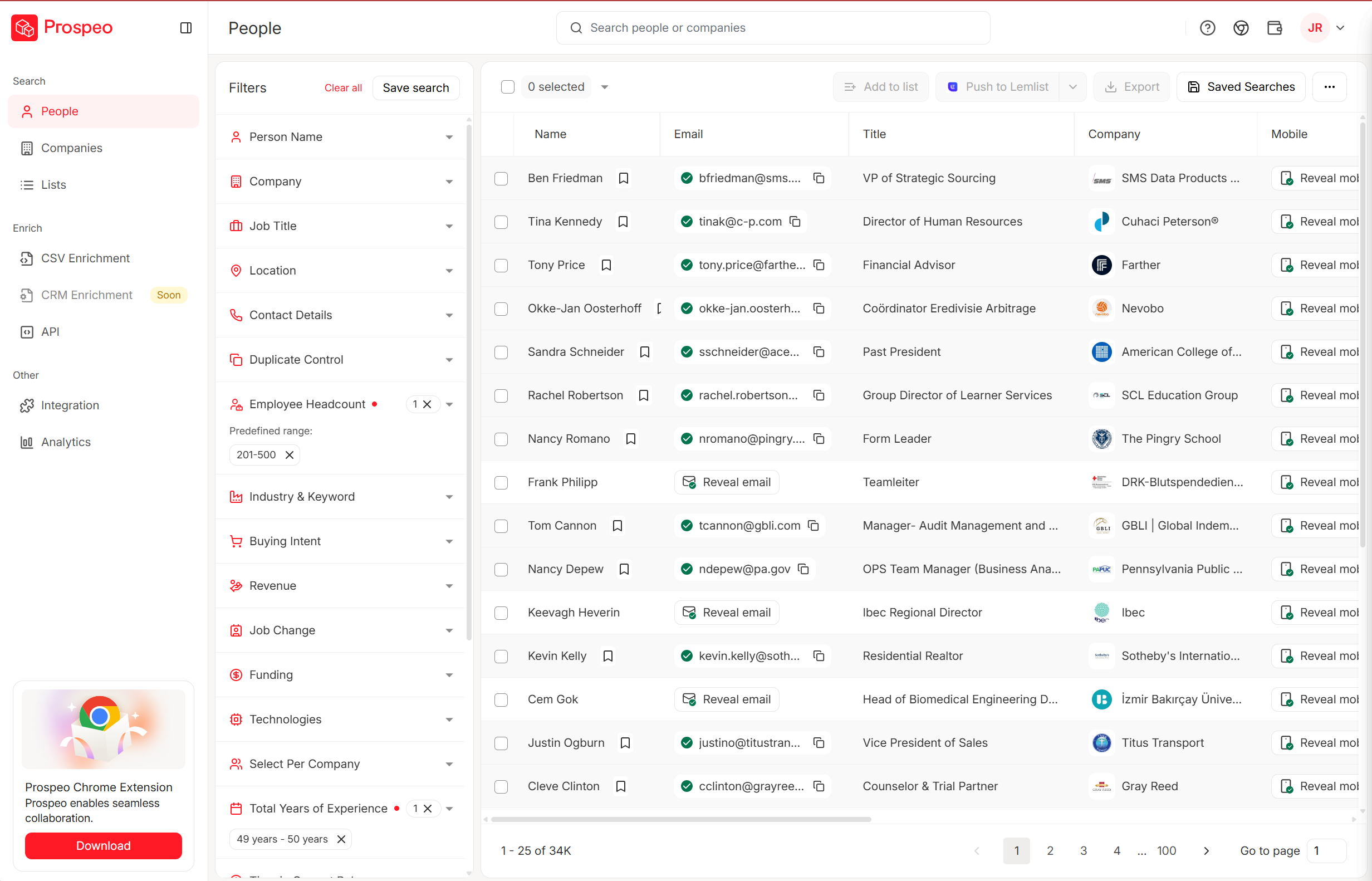
Prospeo runs a 5-step verification process with catch-all handling, spam-trap removal, and honeypot filtering at 98% accuracy on a 7-day refresh cycle. Its proprietary email-finding infrastructure doesn't rely on third-party providers - a meaningful differentiator when deliverability is on the line. Snyk dropped their bounce rate from 35-40% to under 5%, saw AE-sourced pipeline jump 180%, and generated 200+ new opportunities per month after switching. Meritt tripled pipeline from $100K to $300K per week.
LinkedIn outreach is 277% more effective for lead generation than Facebook and X combined. 89% of B2B marketers already use it, and peak engagement runs Tuesday through Thursday. What separates top performers: advanced personalization referencing a prospect's recent post or company announcement can double response rates compared to generic connection requests. Tools like HeyReach, commonly recommended on r/sales for LinkedIn automation, help systematize this. Consistency beats intensity - 3-5 meaningful interactions per day compounds faster than sporadic bursts.
Cold calling + multi-channel sequences remain essential for mid-market and enterprise. Email alone won't cut it when you're selling to a buying committee. The combination of email, calls, and social touches creates the visibility that gets replies. One warning from r/sales: VoIP-based dialers, including Apollo's dialer that uses Twilio VoIP numbers, get flagged as spam increasingly often. Direct dials that actually connect are worth the investment - Prospeo's 125M+ verified mobile numbers deliver a 30% pickup rate, compared to 12.5% from ZoomInfo and 11% from Apollo.
If you’re building a repeatable outbound motion, start with a documented lead generation workflow and a clear sales prospecting techniques playbook.
Paid Acquisition
Bing Ads is the most underrated B2B paid channel in 2026. A Digital Bloom analysis pegged Bing's ROI at 253% - highest among major PPC platforms. Lower competition means lower CPCs and a surprisingly strong B2B audience on Edge-default corporate machines.
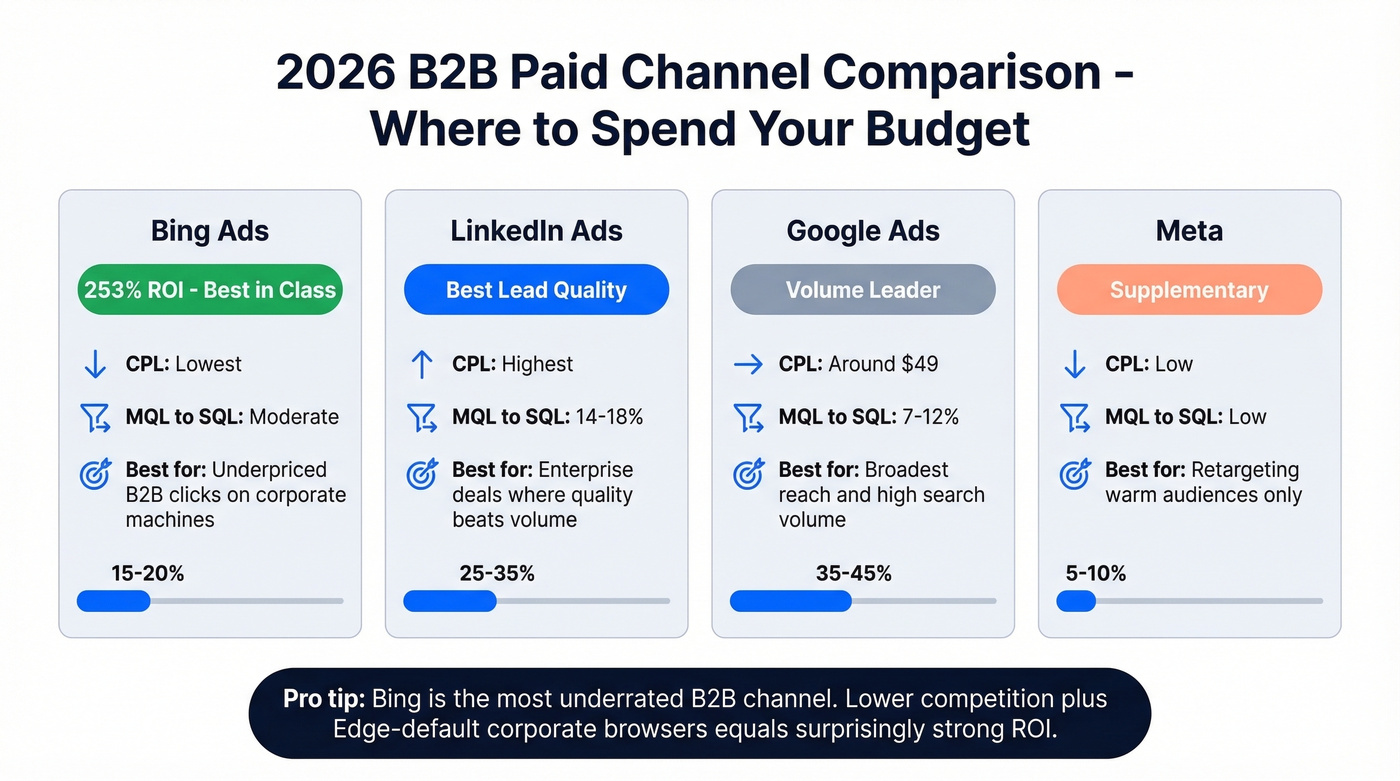
LinkedIn Ads deliver strong lead quality at 14-18% MQL-to-SQL, nearly double Google's 7-12%. The CPL is higher, but when you're selling five- and six-figure deals, cost per qualified opportunity matters more than cost per lead.
Google Ads still win on volume: ~$49 average CPL, 3.75% conversion rate, and the broadest reach.
Starting budget split: Google 35-45%, LinkedIn 25-35%, Bing 15-20%, Meta 5-10%.
| Platform | Avg CPL | MQL-to-SQL Rate | ROI | Best For |
|---|---|---|---|---|
| Bing Ads | Lowest | Moderate | 253% | Underpriced clicks |
| Highest | 14-18% | Strong | Lead quality | |
| ~$49 | 7-12% | Moderate | Volume | |
| Meta | Low | Low | Variable | Retargeting |
Partnerships and ABM
Account-based marketing is the right play for enterprise deals targeting a defined list of accounts. Layer intent data with firmographic filters to identify which accounts are actively researching your category, then multi-thread across the buying committee. ABM requires tight sales-marketing alignment, but when it works, deal sizes and win rates both climb. Skip this if your ACV is under $25K or you don't have dedicated SDRs for named accounts - you'll burn resources without the infrastructure to follow through.
Referral programs often deliver low CPL and high trust. Make the ask specific ("Who else on your team evaluates tools like this?"), offer a meaningful incentive (account credits beat gift cards), and time the ask after the first measurable win - not during onboarding.
Speed-to-lead routing is the tactic hiding in plain sight.
Connecting within 60 seconds of a form fill increases conversion by 391%. Most teams take hours or days. Real-time lead routing through tools like Chili Piper or LeanData isn't optional anymore - it's the difference between a conversation and a cold call.
Funnel Benchmarks Worth Knowing
If your pipeline is leaking, you need to know where. First Page Sage's benchmark data gives us B2B SaaS conversion rates at each stage:
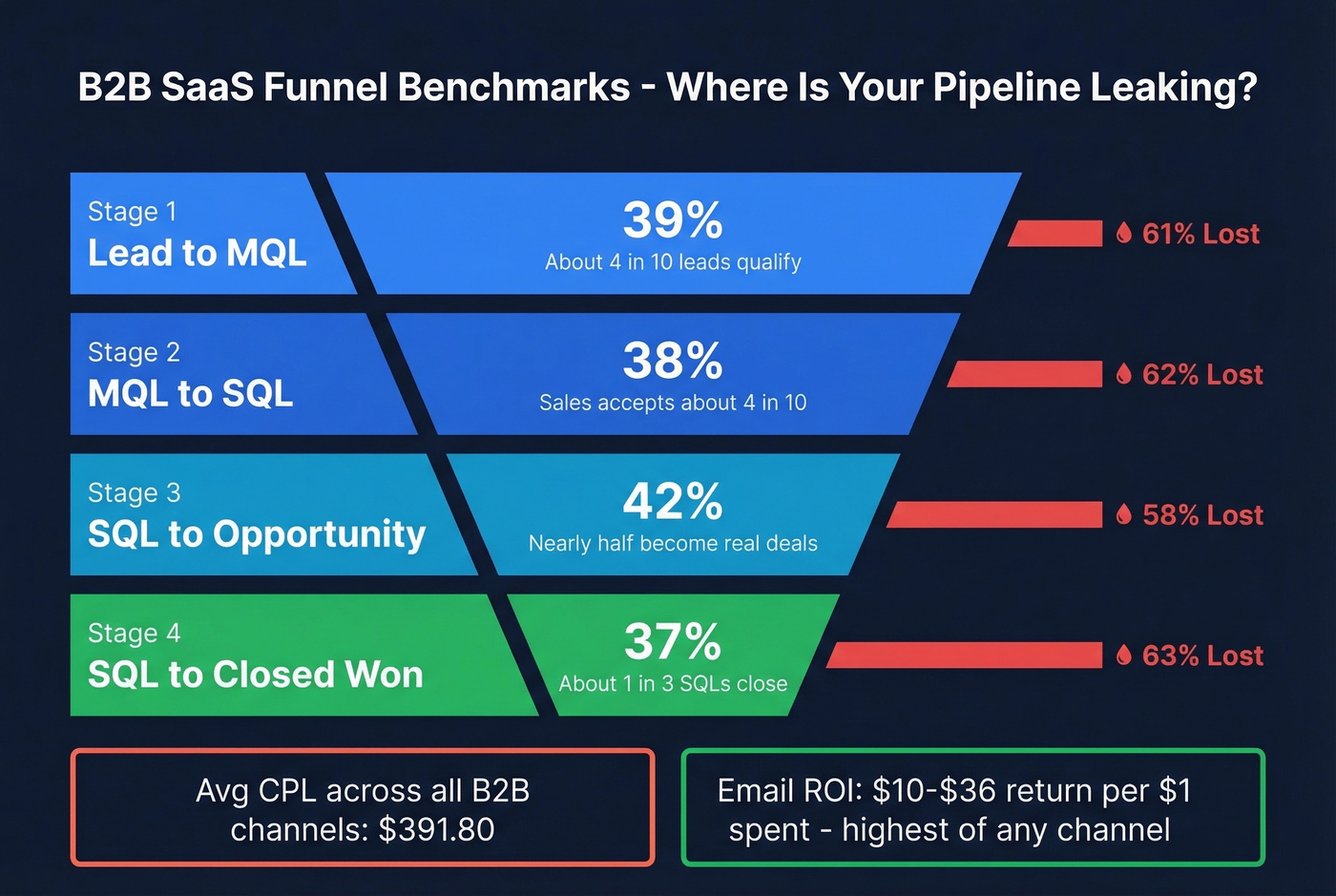
| Funnel Stage | Benchmark Rate | What It Means |
|---|---|---|
| Lead to MQL | 39% | ~4 in 10 leads qualify |
| MQL to SQL | 38% | Sales accepts ~4 in 10 |
| SQL to Opp | 42% | Nearly half become deals |
| SQL to Closed | 37% | ~1 in 3 SQLs close |
Average CPL across all B2B channels sits at $391.80. Email remains the highest-ROI channel at $10-$36 return per $1 spent. If your numbers are below these benchmarks, the problem is in the stage, not the channel. Diagnose the drop-off point before switching tactics.
If you want a deeper breakdown of stage-by-stage math, use a B2B sales funnel template and track funnel metrics consistently.
5 Mistakes That Kill Pipeline
Skipping email verification. Look, this is the easiest problem to fix and the most expensive to ignore. 20% of cold emails get flagged as spam. Every bounced email chips away at your domain reputation, making future emails less likely to land.
Counting warm-up inside daily limits. If your daily send limit is 30, that's 30 total - including warm-up emails. Sending 30 outreach emails plus 10 warm-up emails means you're at 40, and your ESP notices. We've seen this tank deliverability for weeks.
Leaving open/click tracking on. Already covered above, but it bears repeating: tracking pixels hurt deliverability. Kill them.
Slow follow-up. The 391% conversion lift from sub-60-second response times isn't a nice-to-have. It's the single highest-leverage fix for most teams' pipelines.
Ignoring the 95%. All outbound, no demand gen means your pipeline dries up the moment you stop sending. Build the compounding engine alongside the outbound machine.
The Outbound Stack for 2026
The right combination of lead generation tactics for B2B depends on your deal size, market position, and team capacity - but clean data and fast follow-up are non-negotiable regardless.
If you’re tightening deliverability, start with an email deliverability guide and keep an eye on email bounce rate benchmarks.
Snyk dropped bounce rates from 35% to under 5% and added 200+ opportunities per month. Meritt tripled pipeline from $100K to $300K per week. The difference wasn't more tactics - it was cleaner data from Prospeo's proprietary email infrastructure at $0.01 per lead.
Execute 3-5 tactics well with data that won't torch your domain reputation.
FAQ
What's the difference between MQL, SQL, and SAL?
An MQL has engaged with marketing content but isn't sales-ready. An SQL has taken a direct action like requesting a demo. A SAL is the handoff point - an MQL that sales has reviewed and accepted into their pipeline, preventing leads from falling between teams.
How much does B2B lead generation cost?
Average CPL across all B2B channels is $391.80. Email delivers the highest ROI at $10-$36 per $1 spent. LinkedIn Ads cost more per lead but convert at 14-18% MQL-to-SQL, making them cheaper per qualified opportunity for high-ACV products.
What are the most effective B2B lead generation tactics in 2026?
Signal-based cold email with verified data, ungated SEO content, and LinkedIn social selling deliver the strongest results across deal sizes. For paid channels, Bing Ads offer 253% ROI, while LinkedIn Ads deliver the best lead quality. The right mix depends on your ACV and sales cycle length.
Which B2B lead gen activities produce the fastest results?
Outbound produces pipeline within 2-4 weeks with clean data and a tested sequence. SEO content takes 3-6 months to compound. Paid acquisition delivers leads immediately but needs 4-6 weeks of optimization to hit target CPL.