

Lead Management Software Features That Matter in 2026
79% of marketing leads never convert. Not because the leads are bad - because the system between "captured" and "closed" is broken. Leads rot in spreadsheets, get assigned to the wrong rep, or sit untouched for days while a competitor follows up in minutes. The fix isn't buying a bigger CRM. It's getting ruthless about which lead management software features you actually deploy and ignoring the rest.
What You Need (Quick Version)
You don't need 20 features. You need five that work. Whether you're a 5-person startup or a 200-rep org, prioritize in this order:
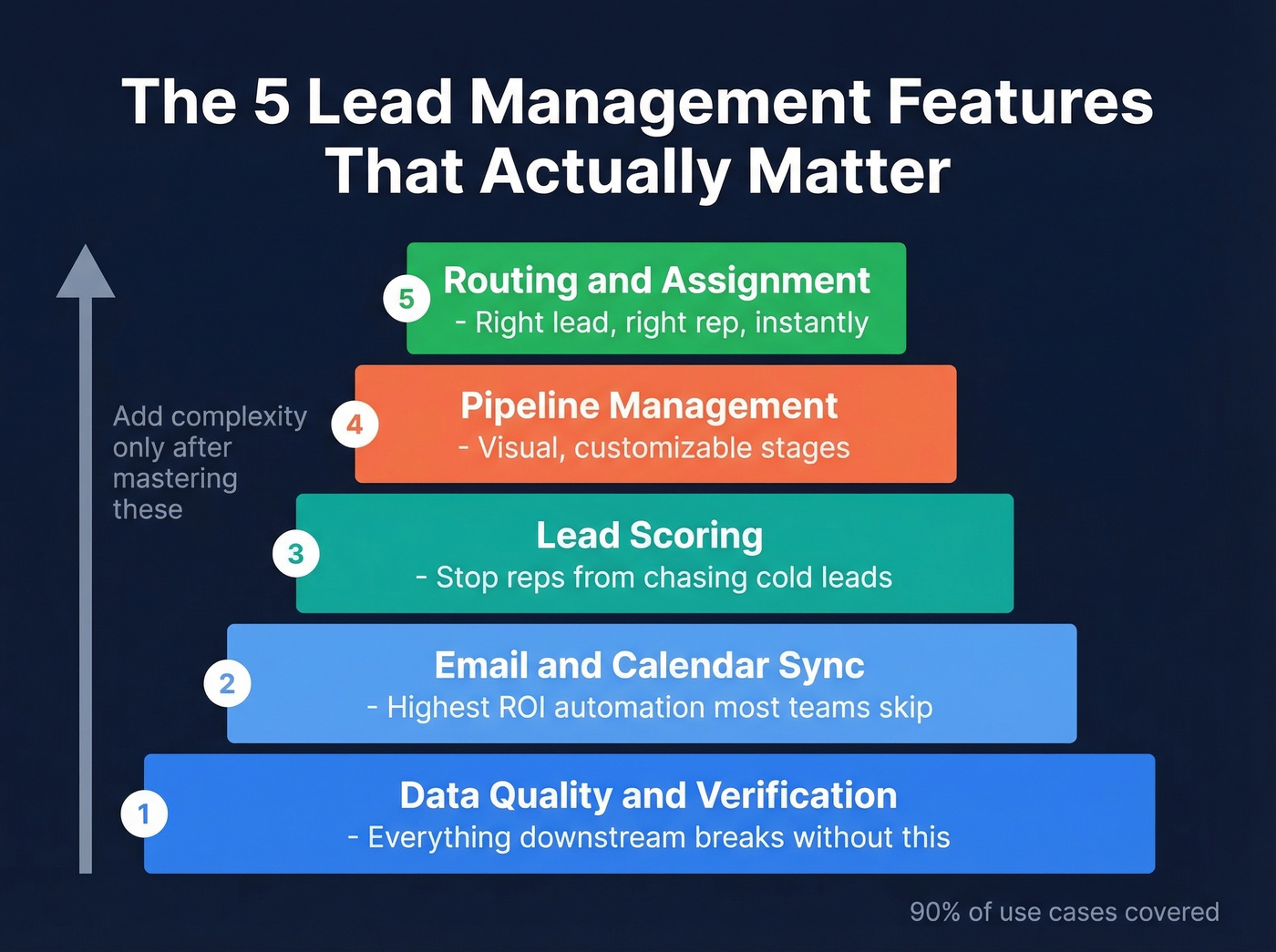
- Data quality & verification - everything downstream breaks if your contact data is wrong
- Email & calendar sync - the single highest-ROI automation most teams skip
- Lead scoring - so reps stop chasing cold leads
- Pipeline management - visual, customizable stages
- Routing & assignment - the right lead hits the right rep, instantly
In our experience, teams that nail these five outperform teams with twice the tech stack. Add complexity only when you outgrow the basics.
Lead Management vs. CRM vs. Marketing Automation
These three categories overlap, but they aren't the same thing. Lead management software focuses on converting prospects into customers - scoring, routing, nurturing. It's sales-activity-first and typically lighter to set up. A CRM manages the full customer lifecycle after conversion, including support and account management. Marketing automation sits upstream, generating and qualifying demand before handing leads off.
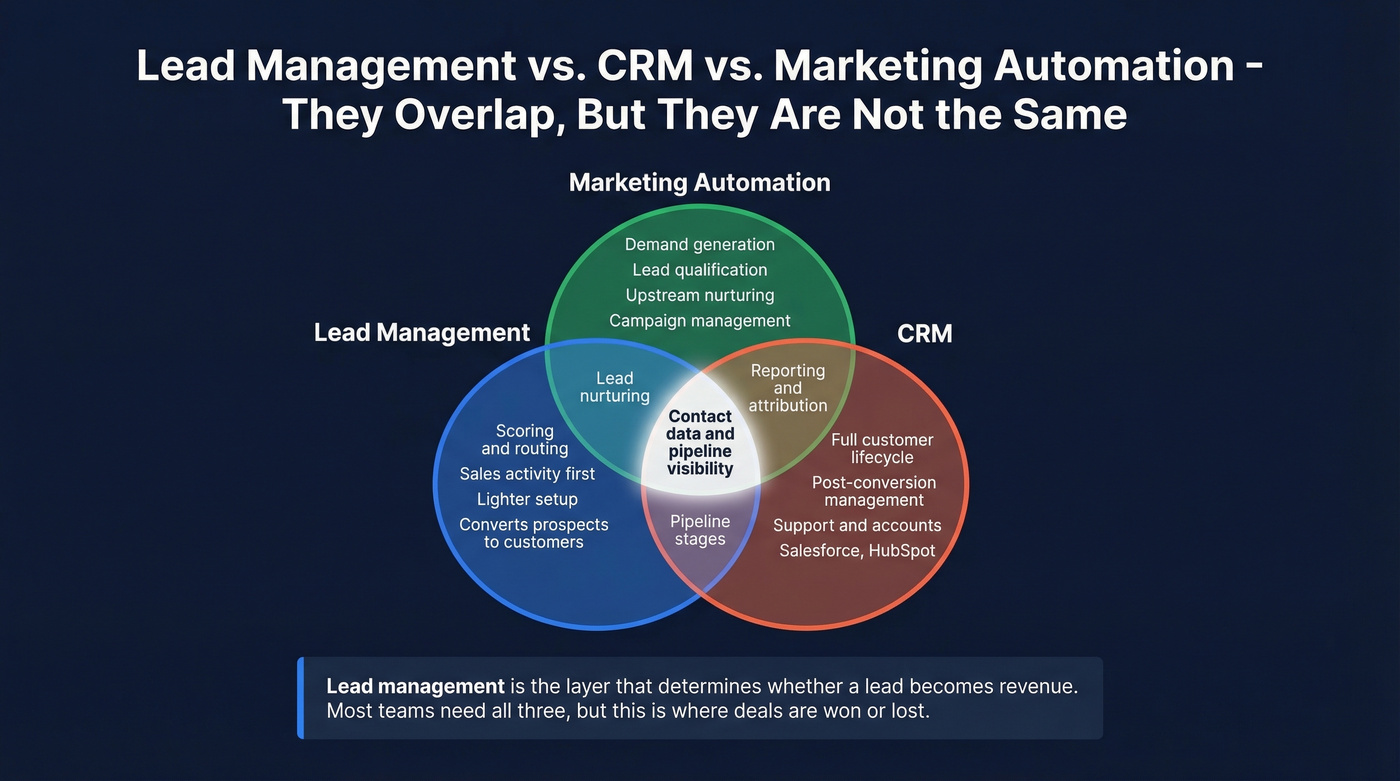
Most teams need all three layers, but lead management is the one that actually determines whether a lead becomes revenue.
10 Features That Move the Needle
1. Multi-Source Lead Capture
Your leads come from forms, ads, email replies, chatbots, and event registrations. Good lead source management software tracks where every contact originated so you can attribute revenue back to the channel that produced it. If your software can't ingest from all of these sources automatically, you're creating manual work from day one. Zapier Forms and Chatbots handle the ingestion layer well, routing captures into your management system without custom dev work.
2. Email & Calendar Sync
A CRM admin on Reddit described spending 8-10 hours per week manually entering contacts and logging interactions. They turned on email sync - a feature buried in settings - and it pulled roughly four years of emails and meetings, creating thousands of enriched contact records in about an hour.
This is the highest-ROI feature in any lead management stack, and most teams miss it during onboarding. Check your settings today.
3. Lead Scoring
Combine ICP fit (firmographics, title, company size) with behavioral signals like page visits and content downloads. Add decay scoring so inactive leads drop over time. Here's a sample model we've used:
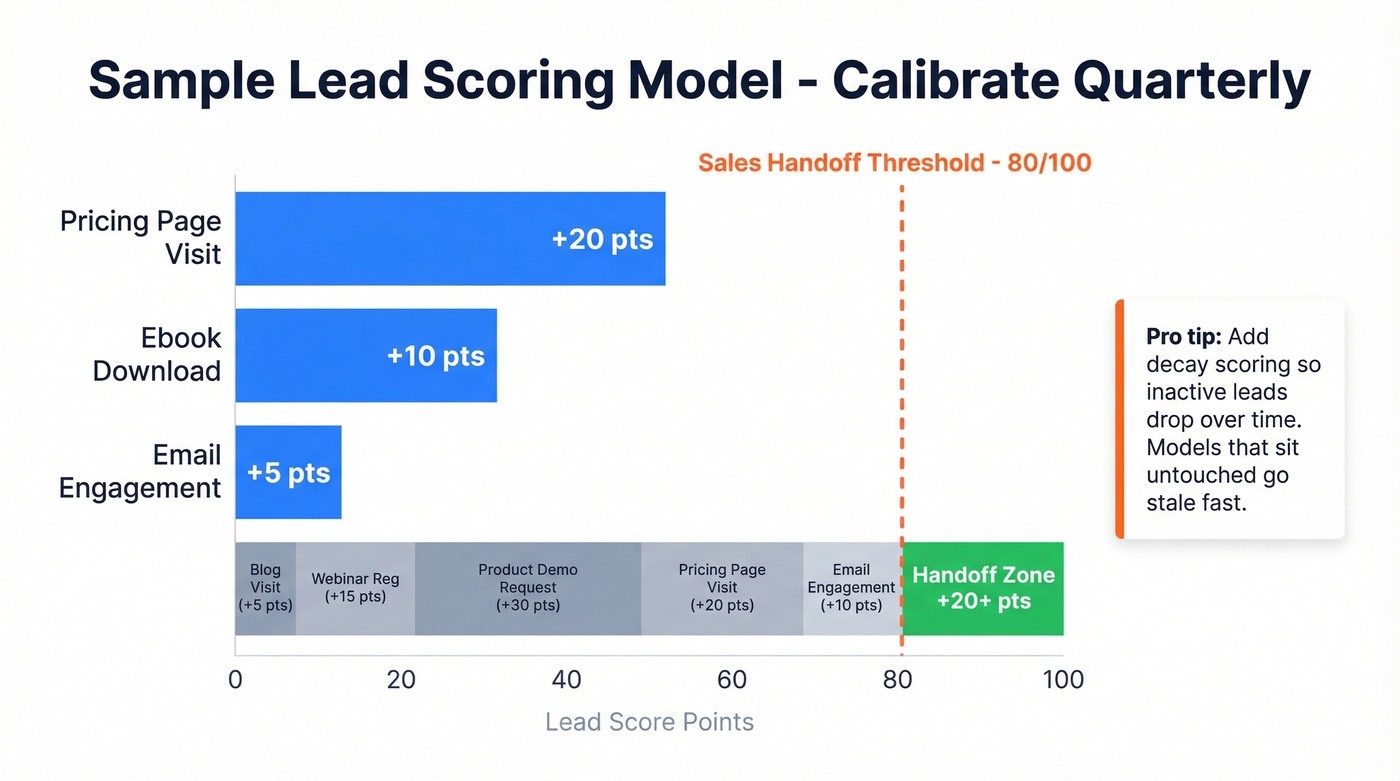
- Pricing page visit = +20 points
- Ebook download = +10
- Email engagement = +5
- Handoff threshold = 80/100
Recalibrate quarterly based on closed-won patterns. Scoring models that sit untouched go stale fast.
4. Pipeline Management
Visual, customizable stages are non-negotiable. You need to see where every lead sits and how long it's been there. Pipedrive ($49/user/month billed annually, $69 billed monthly on its Professional plan) remains the simplicity benchmark - drag-and-drop stages, clean UI, minimal setup. If your pipeline view requires a training session to understand, it's too complicated.
5. Lead Routing & Assignment
Round-robin works for small teams. Rules-based routing by territory, deal size, or product line works for everyone else.
One practitioner running a roofing company with 15-18 reps shared on r/sales that they needed a dashboard showing lead volume per rep plus closing rates, with an assignment workflow integrated via Zapier Lead Router. That's a common pattern - the CRM alone rarely handles distribution well enough.
6. Follow-Up Automation
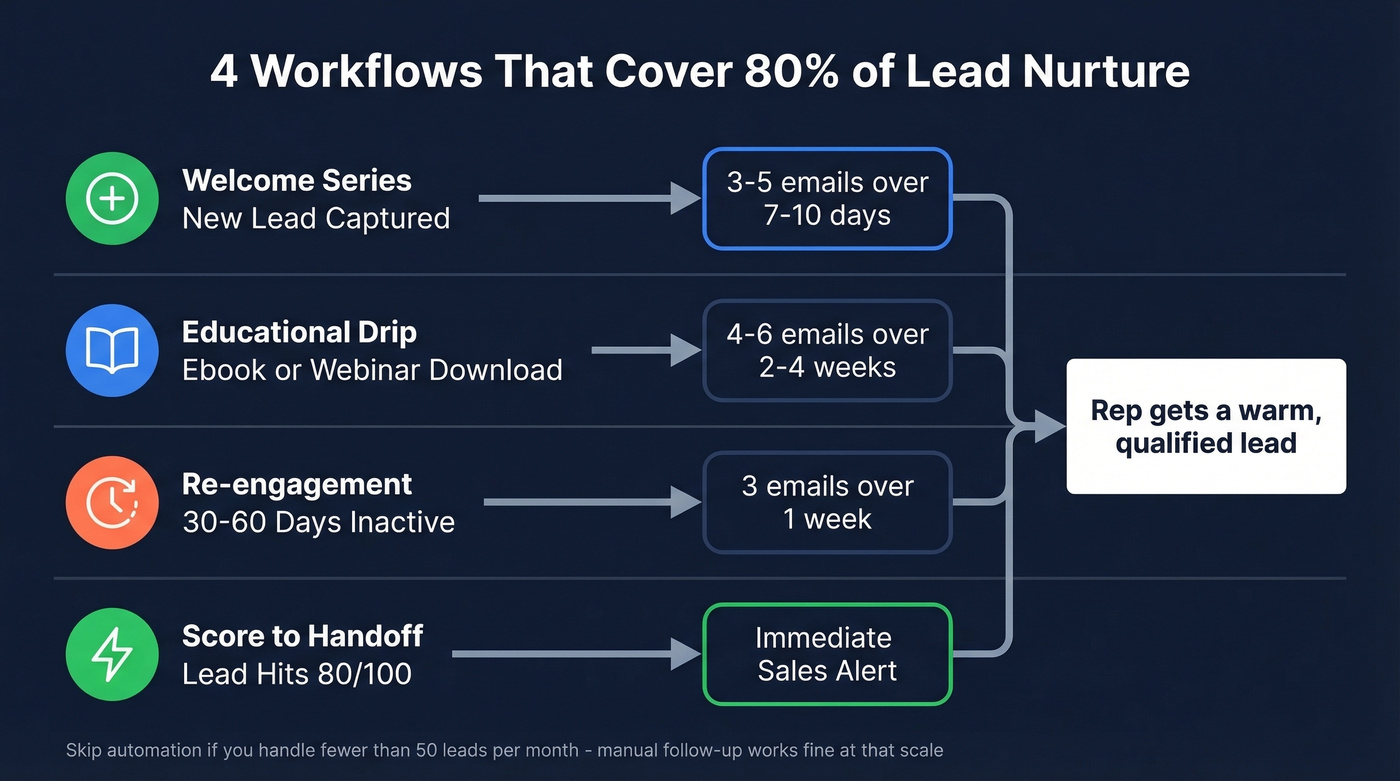
Automation isn't about blasting emails. It's about triggering the right sequence at the right moment so nothing slips through the cracks:
| Workflow | Trigger | Cadence | Emails |
|---|---|---|---|
| Welcome series | New lead captured | 7-10 days | 3-5 |
| Educational drip | Ebook/webinar download | 2-4 weeks | 4-6 |
| Re-engagement | 30-60 days inactive | 1 week | 3 |
| Score-to-handoff | Lead hits 80/100 | Immediate | Sales alert |
Build these four and you've covered 80% of nurture use cases. Skip this section if your team handles fewer than 50 leads per month - manual follow-up is fine at that scale, and over-automating small pipelines creates more confusion than it solves.
7. Contact Enrichment
A lead with just a name and email isn't actionable. Enrichment fills in title, company, phone, tech stack, and more - automatically. Prospeo returns 50+ data points per contact with an 83% enrichment match rate, via API or CSV upload. That's the difference between a name in a spreadsheet and a lead your rep can actually work. If you're comparing vendors, start with a shortlist of data enrichment services.
8. Data Quality & Verification
Bad data doesn't just waste time - it breaks scoring, routing, and nurturing simultaneously. If 15% of your emails bounce, your sender reputation tanks, your scoring model trains on noise, and your routing sends dead leads to reps who lose trust in the system entirely. This is also a compliance risk under frameworks like GDPR and CAN-SPAM. (If you're seeing this in production, use these email bounce rate benchmarks to diagnose the root cause.)
Here's the thing: we've watched teams spend months building sophisticated scoring models only to realize the underlying data was garbage. A 7-day data refresh cycle (versus the 4-6 week industry average) is the kind of difference that compounds across every other feature on this list. Clean data is the foundation everything else depends on.
9. Reporting & Analytics
85% of B2B marketers struggle to connect marketing performance to business outcomes - and 41% can't align marketing-generated leads with sales expectations. Reporting closes that gap.
At minimum, you need two things: source attribution showing which channels produce leads that close, and pipeline velocity tracking how long leads spend in each stage. SEO-driven leads close at 14.6% versus 1.7% for outbound. If your reporting can't show you that breakdown, you're flying blind. To tighten this up, align your dashboards to the right lead generation metrics and monitor pipeline health weekly.
10. Integrations
Lead management isn't a single app - it's a stack. Your management layer needs to talk to CRM platforms like Salesforce ($25-175/user/mo) and HubSpot Sales Hub Professional ($90/seat/mo), your sequencer tools like Outreach and Lemlist, your enrichment layer, and your automation platform. Zapier ($19.99/mo) remains the glue for most teams. Native CRM connectors matter more than feature count - a tool with 200 integrations but no Salesforce sync is useless to half the market. If you're standardizing your stack, use a simple checklist for how to connect outreach tool to CRM.

Feature #8 on this list - data quality - is the one that makes every other feature work. Prospeo's 5-step verification delivers 98% email accuracy with a 7-day refresh cycle, so your scoring models train on real signals and your routing sends live leads to reps. At $0.01 per email, clean data costs less than one bounced sequence.
Stop building lead management workflows on top of garbage data.
The 2026 Layer: AI & Automation
Let's be honest - predictive scoring and AI sequences aren't differentiators anymore. They're table stakes. If your lead management stack doesn't incorporate intent signals by now, you're already behind.
Apollo ($49/user/mo) offers AI sequences that adapt based on prospect behavior. Clay ($134/mo) pulls enrichment from 50+ sources for hyper-personalized outreach. And tools like Prospeo layer intent data across 15,000 topics via Bombora, so you can prioritize leads actively researching your category - not leads who downloaded an ebook six months ago. Automation at this level means your system is doing the qualifying and prioritizing before a rep ever touches a record. If you want a practical framework for this, start with intent based segmentation and a tighter lead generation workflow.
Three Mistakes That Kill Adoption
Relying on spreadsheets for tracking. Every team thinks they'll "move to a real tool later." Later never comes until the pipeline is already a mess. I've seen a 40-person sales org still running their entire pipeline in Google Sheets because migrating felt too painful - by the time they switched, they'd lost months of attribution data.
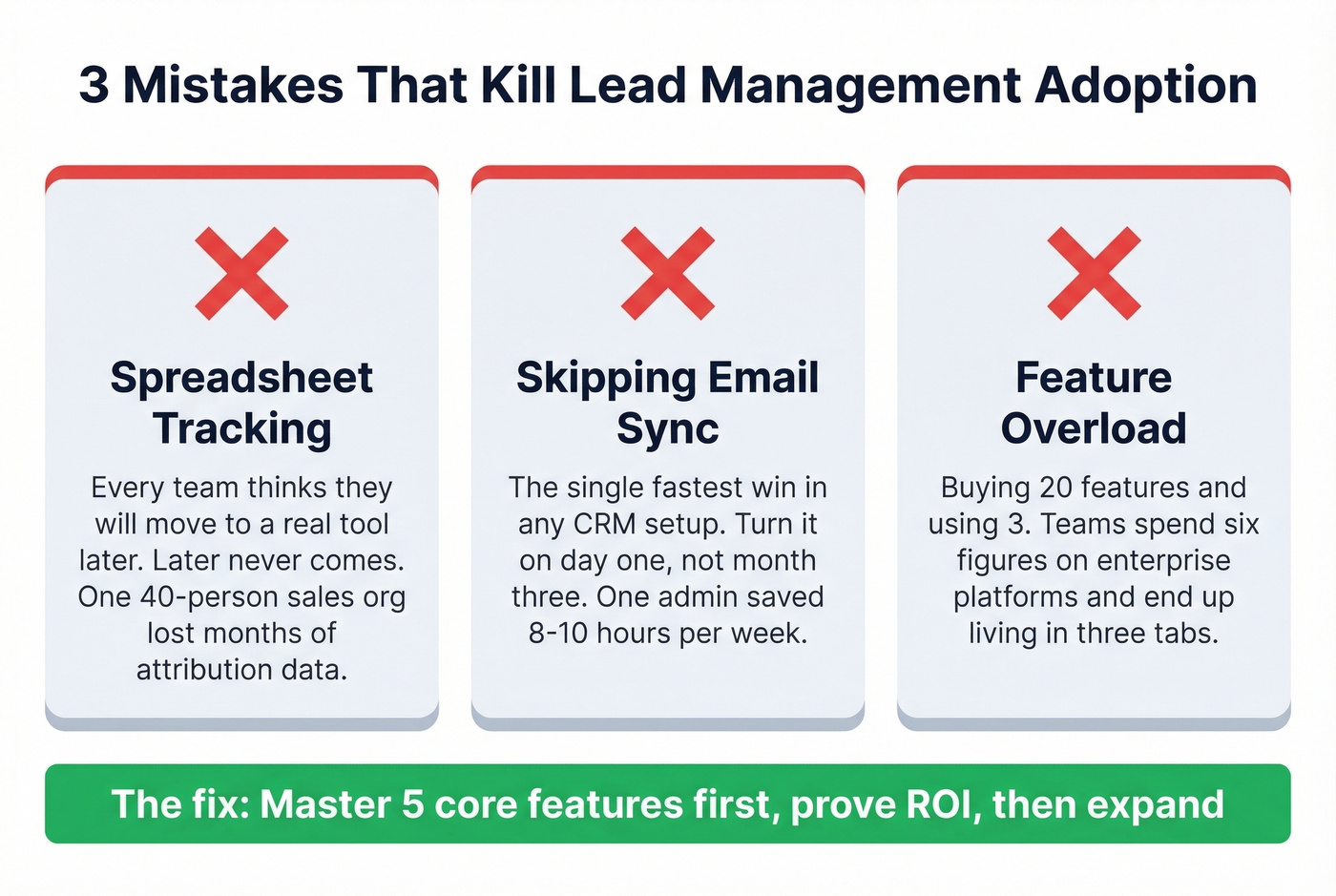
Ignoring email sync during onboarding. It's the single fastest win. Turn it on day one, not month three.
Feature overload. Buying a platform with 20 features and using three. We've seen teams spend six figures on enterprise platforms and end up living in three tabs. Start with the five core capabilities above, prove ROI, then expand. If you're rolling this out to new reps, bake it into a 30-60-90 day plan for sales reps.
Start With Clean Data
Every feature on this list - scoring, routing, nurturing, reporting - depends on accurate contact data. The lead management software features that matter most in 2026 all share one prerequisite: they need verified information to function. If your emails bounce and your phone numbers are dead, none of it works. For a deeper playbook, see our guide to lead enrichment.
Enrichment turns a name and email into 50+ actionable data points - title, company size, tech stack, phone, and more. Prospeo's 83% enrichment match rate means your reps get leads they can actually work, not rows in a spreadsheet. Plug it into Salesforce, HubSpot, or your sequencer via native integrations.
Every lead management feature on this list breaks without clean, enriched contacts.
Lead Management Software FAQ
What's the difference between lead management software and a CRM?
Lead management software focuses on converting prospects through scoring, routing, and nurturing - the pre-sale pipeline. A CRM manages the full customer lifecycle after conversion, including support and account management. Most teams need both, with lead management as the qualifying layer that ensures only sales-ready leads reach your CRM.
How many features do I actually need?
Five core features cover 90% of use cases: data verification, email sync, lead scoring, pipeline management, and routing. Teams that master these five before adding complexity consistently outperform teams running bloated tech stacks with low adoption.
How does automation improve response times?
Automated workflows remove the manual steps between capture and first touch. When a lead fills out a form, the system scores it, routes it to the right rep, and triggers a follow-up sequence - all within seconds. Without automation, that same lead sits untouched for hours while a competitor responds first.
What's a good free tool for keeping lead data accurate?
Prospeo offers a free tier with 75 email credits and 100 Chrome extension credits per month, including real-time verification at 98% accuracy. For small teams, that's enough to validate your highest-priority leads without paying for an enterprise contract. Hunter's free plan (25 searches/mo) is another option but caps enrichment data significantly.
Is lead scoring worth it for small teams?
Yes - even a basic model helps. Assign points for ICP fit and engagement actions, set a handoff threshold at 80/100, and recalibrate quarterly based on closed-won data. It prevents reps from chasing cold leads and gives marketing and sales a shared definition of "qualified."