

Lead Volume: What It Really Means, How to Measure It, and Why Your CRM Number Is Lying
You've got 15,000 leads in Salesforce. Marketing's celebrating. But your SDRs can't book a meeting to save their lives, and the pipeline review looks like a ghost town.
The disconnect isn't effort - it's that your lead volume number is fiction. Email lists decay roughly 28% per year, which means a quarter of your "leads" are already dead contacts walking. That decay doesn't just waste sequences - it torches your domain reputation, burns out SDRs, and quietly poisons every metric downstream.
The Short Version
Lead volume is the total number of new leads generated in a given period. Your effective count is far lower, because data decay, bad-fit contacts, and unverified emails silently gut your real number. Stop counting CRM records and start tracking leads by source with conversion overlays. The fastest way to find your real number is to run your list through Prospeo's bulk verification and see what comes back verified.
What Is Lead Volume?
It's the total count of new leads your team generates within a defined period - a week, a month, a quarter. It's the top-of-funnel number that marketing reports on and sales complains about.
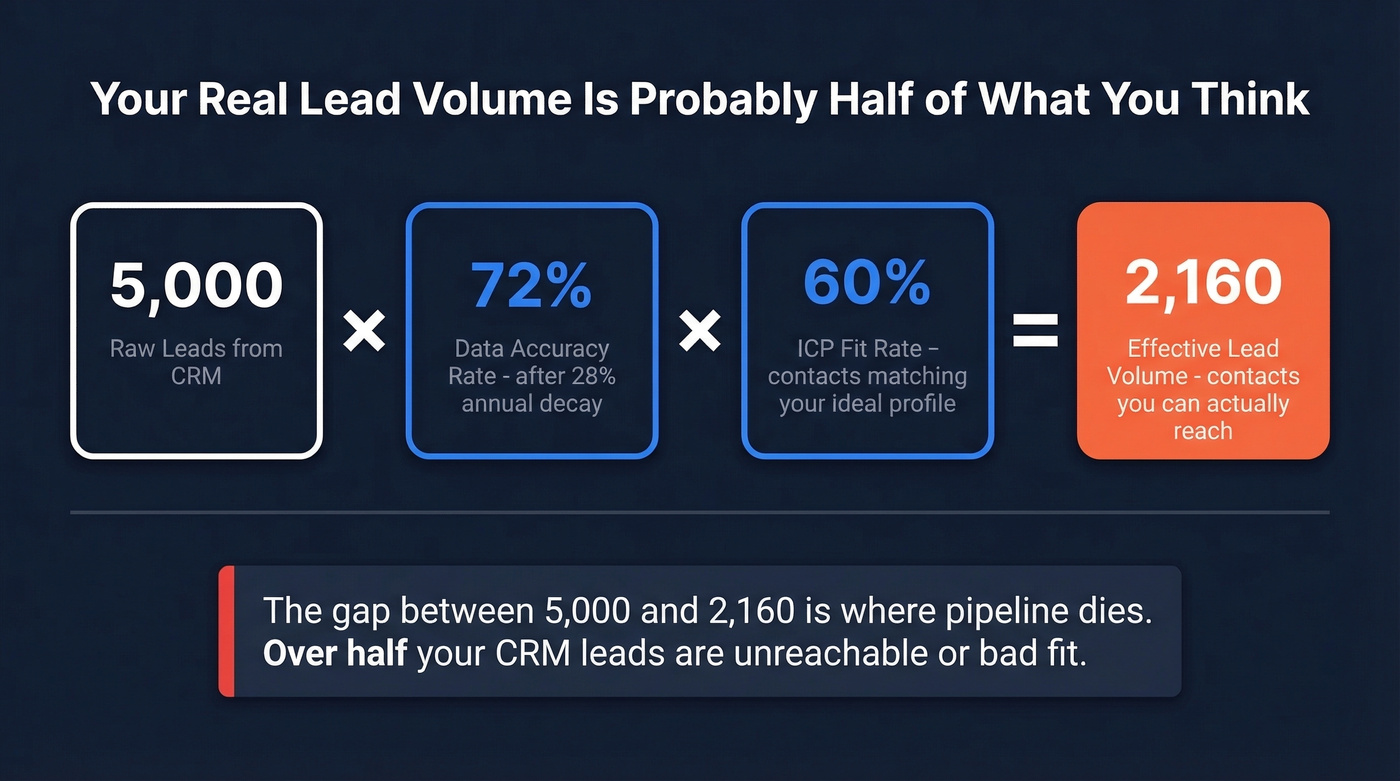
But raw counts are a vanity metric unless you adjust them. Here's the formula that actually matters:
Raw Leads x Data Accuracy Rate x ICP Fit Rate = Effective Lead Volume
Say you generated 5,000 leads last month. If your list hasn't been cleaned recently, decay alone wipes out a big chunk of reachability - and then you still have the "bad fit" problem stacked on top. If roughly 60% of those contacts match your ICP and only the reachable ones can actually be worked, your effective number can easily be less than half of what the CRM says. That gap between raw and effective is where pipeline dies.
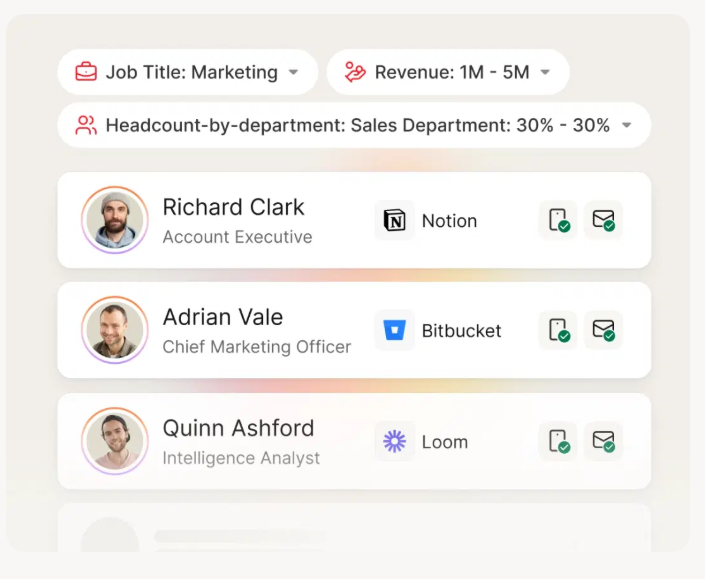
Most teams never calculate this. They report the big number, wonder why conversion rates are terrible, and blame the reps.
Benchmarks That Actually Matter
Lead generation is projected to be a $295B industry by 2027. The average CPL across all B2B channels sits around $392, but the range is enormous:
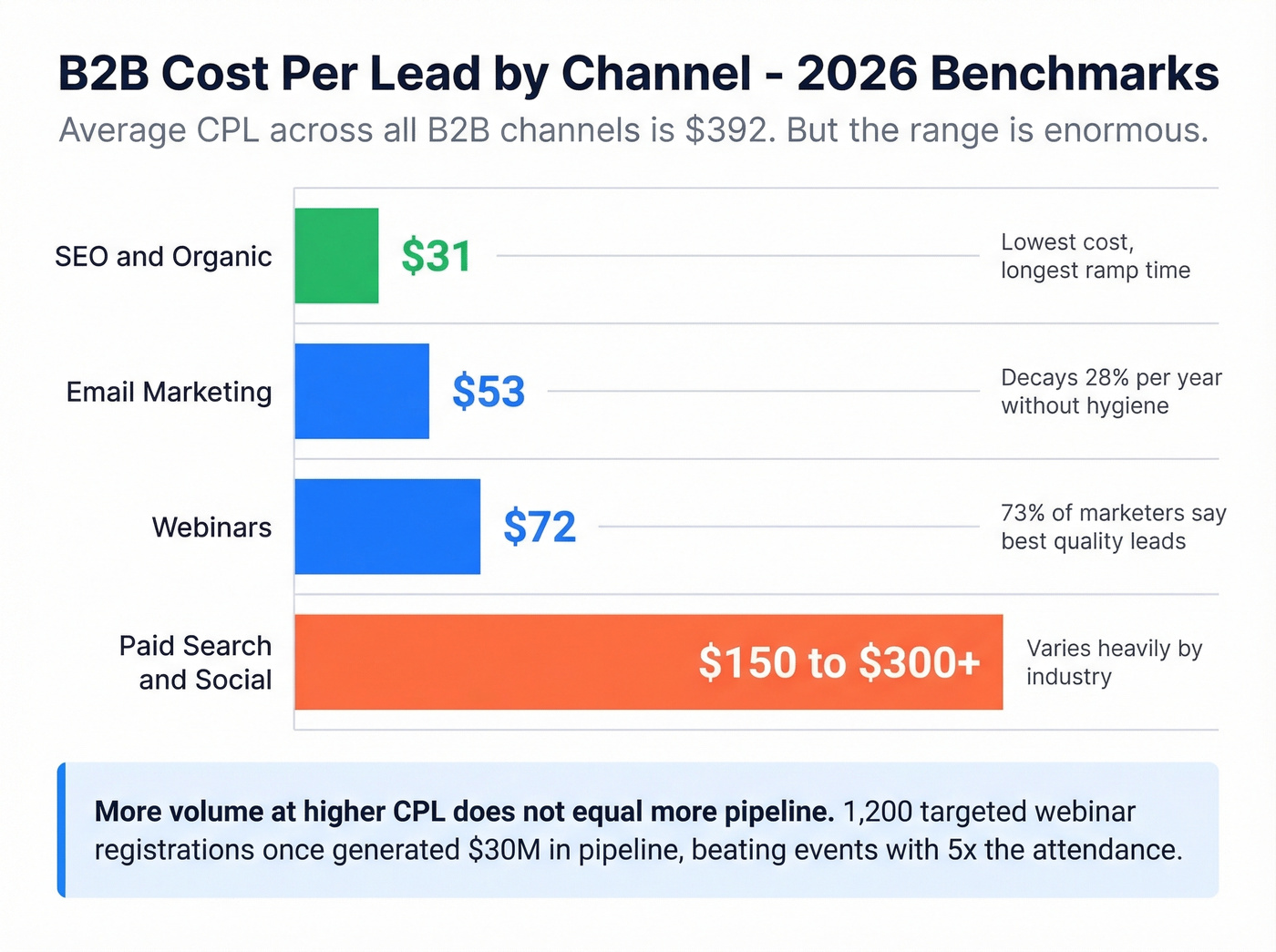
| Channel | Avg CPL | Notes |
|---|---|---|
| SEO / Organic | $31 | Lowest CPL, longest ramp |
| Email Marketing | $53 | Decays 28%/yr without hygiene |
| Webinars | $72 | 73% of marketers say best quality |
| Paid Search/Social | $150-$300+ | Varies heavily by industry |
For cold email, Snov.io's analysis of millions of sends puts the average reply rate at 5.1%, open rate at 27.7%, and bounce rate at 7.5%. A "good" deliverability target is 95%+. If you're bouncing above ~5%, start with data hygiene before you rewrite your entire sequence. Sequences with exactly two emails hit a 6.9% response rate - more emails didn't improve outcomes.
Here's the thing about volume: more isn't always better. One Reddit poster shared a case where 1,200 webinar registrations generated $30M in pipeline, outperforming prior events with 5x the attendance. The count was modest. The targeting and follow-up were surgical.
If your average deal size is under $15k, you probably don't need 10,000 leads per month. You need 500 verified, ICP-fit contacts and a tight sequence. We've watched teams 10x their top-of-funnel numbers and flatline on revenue because nobody bothered to check whether those leads were reachable.
Why More Leads Won't Fix Your Pipeline
The B2B buying cycle has changed. 92% of buyers already have at least one vendor in mind before they start evaluating, and the winning vendor is on the Day One shortlist 95% of the time. The average buying cycle runs 10.1 months. The average prospect needs 12-15 touchpoints before engaging. Dumping more contacts into the top of the funnel doesn't change any of those dynamics.
Then there's the nurturing problem. 79% of marketing leads never convert to sales - not because the leads were bad, but because follow-up was nonexistent or generic. Meanwhile, 61% of marketers say generating quality leads is their top challenge. Email-only campaigns produce 29% fewer leads year over year, which means your strategy needs a multichannel nurture layer, not just a bigger list.
The consensus on r/coldemail reinforces this: practitioners report that "verified" emails from big databases still bounce, outdated roles pollute outreach, and the cleanup time from volume-first approaches eats into actual selling hours. The fix is straightforward - use a tool that verifies in real time with a weekly refresh cycle, so "verified" actually means verified, not "verified six months ago and who knows now."

You just learned that Raw Leads x Data Accuracy x ICP Fit = Effective Lead Volume. Prospeo fixes the biggest variable: data accuracy. With 98% verified emails, a 7-day refresh cycle, and 30+ filters to lock in ICP fit, your effective volume stops being a fraction of your raw count.
Stop reporting vanity metrics - start building pipeline from verified contacts.
Lead Volume vs. Lead Quality
This isn't an either/or debate. It's a maturity question.
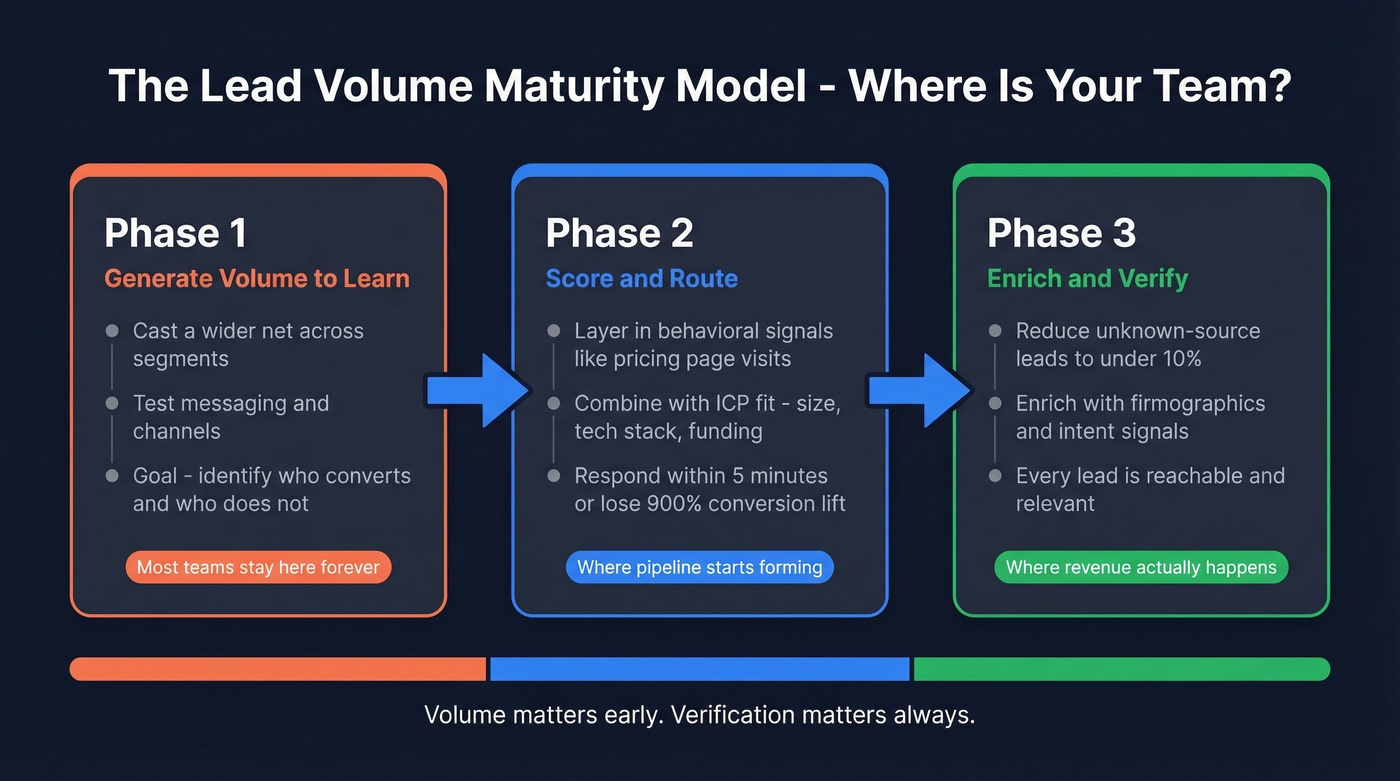
Phase 1: Generate enough volume to learn. Early-stage teams need data. Cast a wider net, test messaging across segments, and figure out what resonates. You can't optimize what you haven't measured. The goal here is to grow your number of new leads fast enough to identify patterns in who converts and who doesn't.
Phase 2: Score and route. Once you have sufficient pipeline coverage, layer in lead scoring that combines behavioral signals - pricing page visits, demo requests, return frequency - with ICP fit like company size, tech stack, and funding stage. The critical SLA: respond within 5 minutes. Waiting longer kills 900% of your conversion lift.
Phase 3: Enrich and verify. Reduce your unknown-source leads to under 10-15% of total count. Enrich every contact with firmographics, technographics, and intent signals. The goal is to make every lead reachable and relevant, not just a row in a spreadsheet.
In our experience, most teams stay in Phase 1 forever - burning budget and best-fit accounts without ever graduating to the phases that actually produce revenue.
How to Track Leads by Source
Raw numbers are useless without source attribution. Let's break this down.
Start with required data fields in your MAP and CRM: lead created date, lifecycle stage, UTM parameters, firmographic data, and conversion timestamps. Without these, you're flying blind. Use first-touch attribution for your volume mix - it tells you which channels fill the funnel.
Set an integrity target: if more than 10-15% of your leads have "unknown" as their source, fix your UTM capture before any analysis is meaningful.
The core metrics to track by source are volume share, MQL conversion within 30 days, lead-to-opportunity rate, speed-to-lead, and CPL. High volume and high quality? Scale it. High volume but low quality? Fix it. Low volume but high quality? Selectively expand - that's often where partners and ABM live.
Common Mistakes Teams Make
Spray-and-pray outbound. Blasting your entire TAM with generic messaging burns best-fit accounts before you've figured out what works. Those accounts don't come back. (If you need a better system, start with these sales prospecting techniques.)
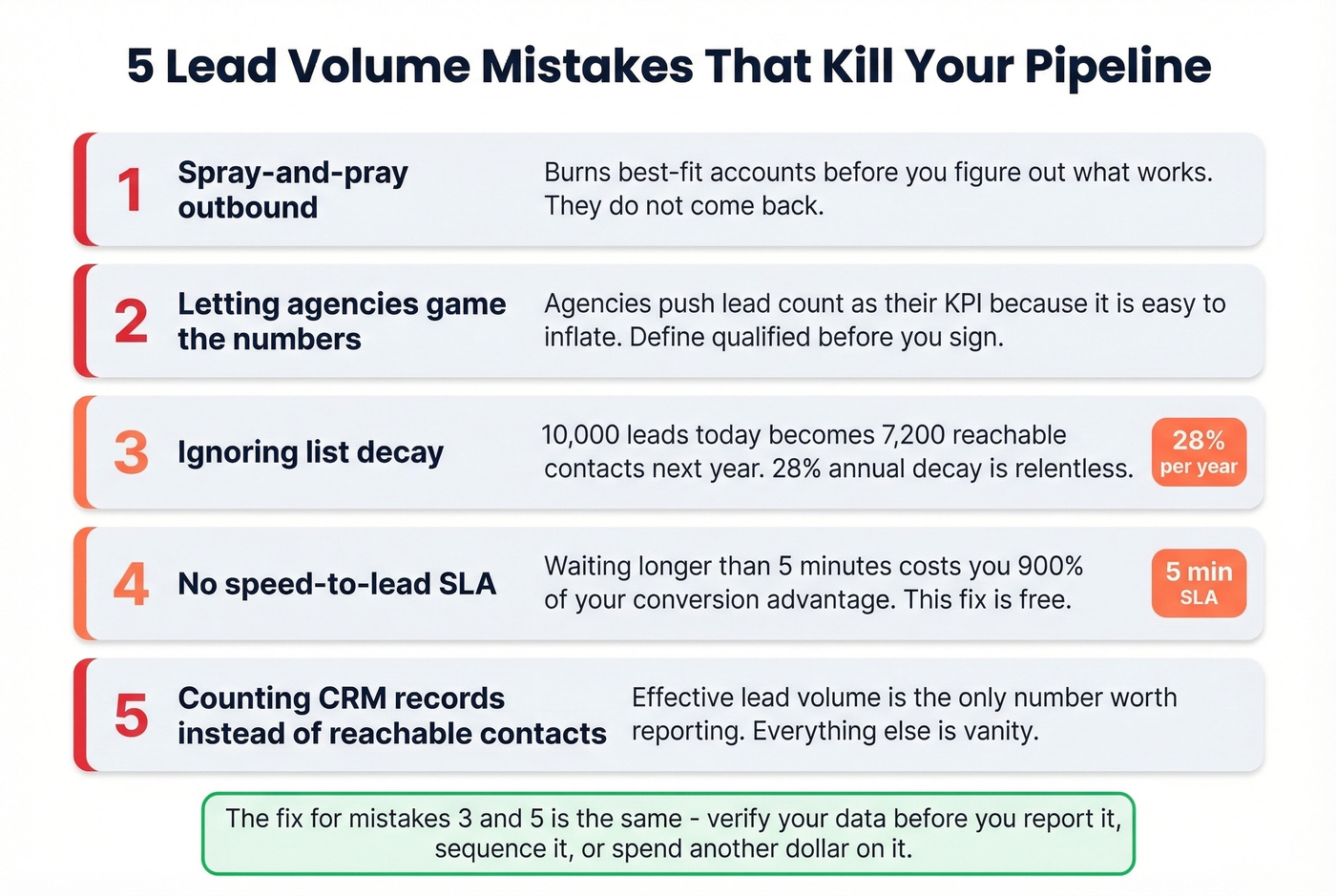
Letting agencies game the numbers. The #1 concern on r/B2BSaaS: agencies push lead count as their KPI because it's easy to inflate. Define "qualified" before you sign.
Ignoring list decay. Your 10,000-lead list is ~7,200 reachable contacts next year. Without regular hygiene, you're emailing ghosts. (If bounces are creeping up, use an email bounce rate checklist to diagnose the cause.)
No speed-to-lead SLA. If your team takes more than 5 minutes to respond to an inbound lead, you've already lost most of the conversion advantage. This one's free to fix and it's the highest-ROI change most teams can make. (You can also standardize responses with sales follow-up templates.)
Counting CRM records instead of reachable contacts. We've watched agencies report 10,000 leads while pipeline stays flat. Effective lead volume is the only number worth reporting. (For a broader KPI set, track lead generation metrics alongside volume.)
Tools for Managing Your Pipeline
The right stack depends on your maturity phase, but every team needs a data quality layer underneath everything else.
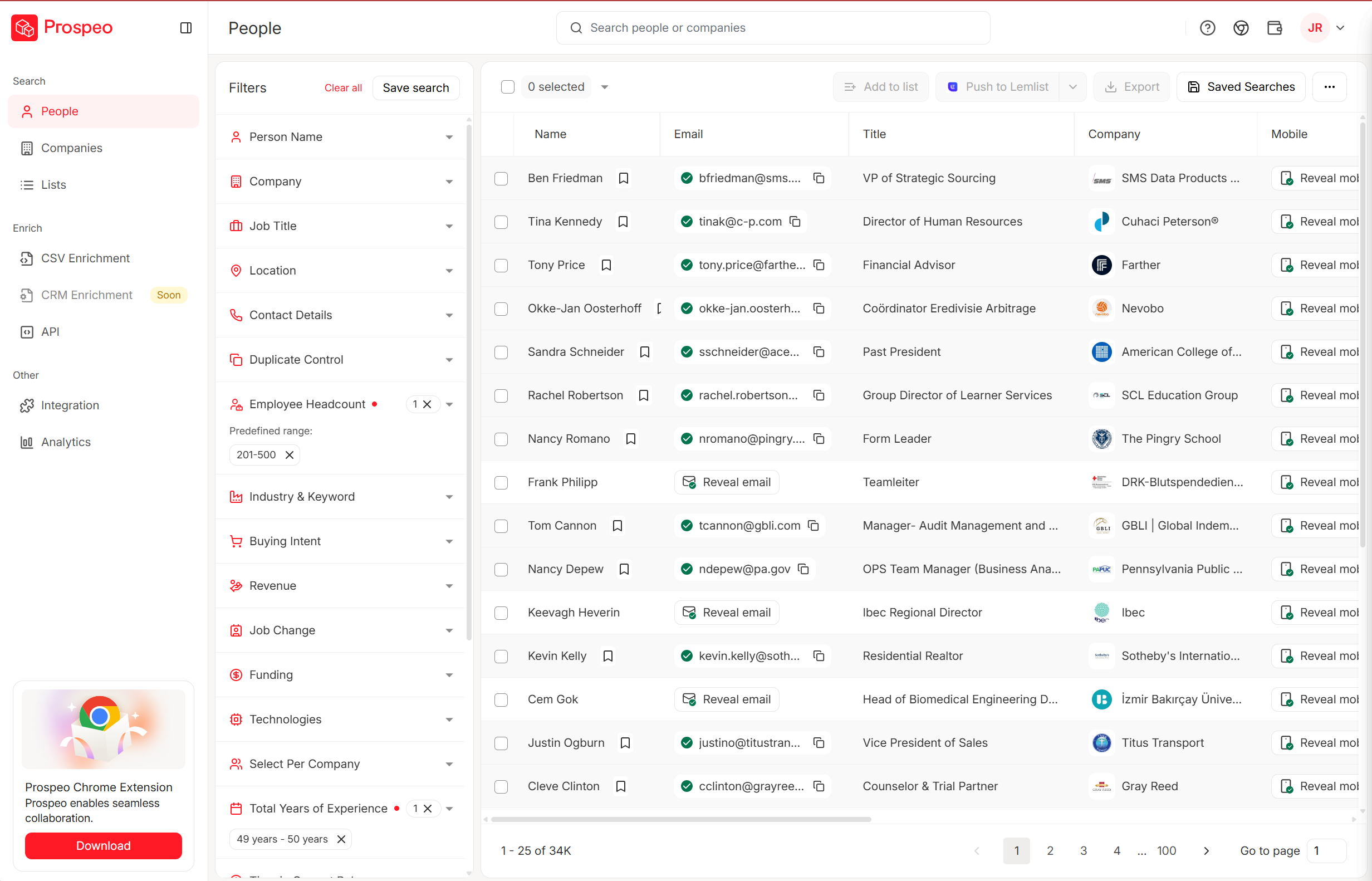
Prospeo is that data quality layer. With 300M+ profiles, 98% email accuracy, and a 7-day refresh cycle, it closes the gap between raw and effective lead counts. Upload a CSV, run bulk verification, and find out how many of your "leads" are actually alive - at roughly $0.01 per email. The free tier gives you 75 emails per month to test. Teams like Snyk saw bounce rates drop from 35-40% to under 5% and AE-sourced pipeline jump 180% after switching. (If you're comparing vendors, start with data enrichment services.)
HubSpot handles CRM and marketing automation. The free CRM is genuinely useful for early-stage teams, and paid Marketing Hub tiers unlock automation and reporting. (If you're evaluating options, see these examples of a CRM.)
Apollo is the tool to grab if you need prospecting and sequencing in one place. 275M+ contacts, built-in email sequences, and a free tier generous enough to validate the workflow before committing. Paid plans start at $49/user/mo. Skip it if you already have a sequencer - you'd be paying for overlap. (For more options, review outbound lead generation tools.)
Clay connects everything with workflow automation and multi-source enrichment. Free with 100 credits/month; Starter at $149/mo for teams that need more throughput. (If you're building lists in Clay, use this Clay list building workflow.)
FAQ
What's a good lead volume per month?
SMB inbound teams typically target 200-500 MQLs per month; enterprise ABM teams work 50-100 high-intent accounts. Focus on effective lead volume - reachable, ICP-fit contacts - not raw CRM count. Your ideal number depends on deal size and conversion rates.
How do you increase leads without increasing spend?
Verify your existing database first - 28% decays annually, so you're sitting on recoverable contacts. Bulk verification at $0.01/email recovers reachable leads you've already paid for. Then add channels, since email-only campaigns produce 29% fewer leads year over year.
Is lead volume or lead quality more important?
Neither in isolation. Early-stage teams need enough volume to learn what converts; mature teams need quality to close efficiently. The real win is ensuring every lead in your count is actually reachable - so you're not optimizing a number that's 30% fiction.
How often should I clean my lead database?
At minimum quarterly, but monthly is better for high-volume outbound teams. With 28% annual decay, a list cleaned in January loses ~7% reachability by April. Tools with weekly refresh cycles keep data current automatically, reducing manual cleanup to near zero.
The article above shows that email lists decay 28% per year and most "verified" databases haven't been refreshed in weeks. Prospeo refreshes every 7 days - not 6 weeks like the industry average - so your lead volume number reflects contacts you can actually reach at $0.01 per email.
Turn your CRM ghost town into a pipeline that books meetings.