Leads to Meetings Conversion Rate: Every Benchmark You Need in 2026
Ask five RevOps leaders for their leads to meetings conversion rate and you'll get nine different answers. Not because anyone's lying - because everyone's counting something different.
One team measures inbound form fills to booked demos. Another counts cold email sequences to held meetings. A third blends inbound and outbound into one "average" that sounds precise and means nothing. And yes, it's frustrating, because you can't fix what you can't define.
Let's break this down the way we'd do it internally: pick the right denominator, separate booked from held, then work the levers that actually move the number.
Quick Benchmarks for 2026
Here's the table most people want first. Screenshot it, send it to your VP, then come back and read the denominator section so you don't benchmark the wrong thing.

| Metric | Benchmark |
|---|---|
| Inbound qualified -> booked | 62% median, 78%+ top 10% |
| Outbound sequence -> meeting | 1-4% |
| Cold call dial -> meeting | ~2.3% |
| Cold email reply -> meeting | 15-30% |
| Inbound no-show rate | ~6.5% (about 93.5% show rate) |
| Booked -> attended (outbound) | ~67% |
If you're below these, the fix often isn't "more touches." It's upstream: list quality, routing, and the booked-vs-held gap.
What This Metric Actually Measures
"Leads to meetings" isn't one metric. It's a family of metrics that changes shape depending on where you start counting.

The basic formula is still:
(meetings booked ÷ leads) × 100
The problem is the word "leads." Are those raw inbound form fills? Qualified inbound leads? Contacts enrolled in an outbound sequence? Dials? Connected calls? Each denominator produces a different conversion rate, so comparing your number to a benchmark without matching definitions is how teams talk themselves into the wrong "fix."
One helpful way to sanity-check your funnel is to look at stage conversion ranges. FirstPageSage publishes a widely cited B2B SaaS breakdown showing Lead->MQL at 39%, MQL->SQL at 38%, and SQL->Opportunity at 42%. Those are useful anchors, but the real lesson is the variance: MQL->SQL swings hard across companies and definitions, so you always need to ask what got counted as an MQL and what qualified as an SQL.
If you want one rule that prevents 80% of bad benchmarking: write the denominator in plain English on the dashboard. Not "Leads." "Inbound qualified leads (routed) -> meetings booked." Or "Outbound deliverable contacts -> meetings held."
Inbound Benchmarks
Inbound is where the numbers look "healthy" and where tiny bits of friction do outsized damage.
RevenueHero analyzed over one million B2B SaaS form submissions and reported these qualified-to-booked rates:
| Segment | Conversion Rate |
|---|---|
| Median | 62% |
| Top 10% | 78%+ |
| Best performers | 88% |
They also shared industry splits that show real variance:
| Industry | Qualified -> Booked |
|---|---|
| Construction Tech | 69.1% |
| Ecommerce | 68.8% |
| Travel Tech | 68.3% |
| Sales Tech | 62.8% |
Funding stage is a sneaky indicator of operational maturity. Seed-stage teams convert at 63.6% and Series D/PE teams hit 66.8%, while Series A (53.6%) and Series B (55.3%) dip. In our experience, that's the "we scaled demand gen faster than we scaled routing and qualification" phase: more leads, more noise, more handoffs, and suddenly the calendar isn't as full as it should be.
The biggest inbound driver is still speed-to-lead. Harvard Business Review's classic research found leads contacted within five minutes are far more likely to convert than leads contacted later, and the drop-off after 30 minutes is brutal. If you want the original study, start here: https://hbr.org/2011/03/the-short-life-of-online-sales-leads
Scheduling automation exists for a reason. Tools like Calendly (https://calendly.com) and Chili Piper (https://www.chilipiper.com) remove the "we'll reach out shortly" dead zone and turn interest into a time on the calendar while intent is still high.

Speed-to-lead matters, but only if your lead data is real. Teams using Prospeo cut bounce rates from 35% to under 4% and tripled their pipeline - because 98% verified emails mean your sequences actually reach people. At $0.01 per email with a 7-day refresh cycle, you stop losing meetings to dead contacts.
Stop losing 20-40% of your outbound to bad data before a single meeting gets booked.
Outbound Benchmarks
Outbound numbers look ugly in isolation. That's normal.
| Channel | Metric | Benchmark |
|---|---|---|
| Cold email sequence | Sequence -> meeting booked | 1-4% |
| Cold calling | Dial -> meeting | ~2.3% |
| Cold email | Reply -> meeting | 15-30% |
| Cold calling | Connected -> appointment | 15-20% |
That last row is the one most teams ignore, and it's the one that tells the truth: once you reach a real human, a meaningful chunk of conversations turn into meetings. The bottleneck is reach, not persuasion.
Cold email variance is huge. Generic blasts can struggle to get replies at all. Research-led outbound can pull strong reply rates, and then 15-30% of those replies convert into booked meetings. That's why "sequence -> meeting" looks tiny while "reply -> meeting" looks healthy: the top of the funnel is where most outbound dies.
Here's a scenario we've seen more than once. An SDR manager says, "Outbound isn't working, we're at 1%." We look closer and find 20-30% of the list never received an email because of bounces, plus another chunk got filtered because the domain reputation was already bruised. Once you reframe the metric as deliverable contacts -> meetings held, the channel doesn't magically become easy, but it becomes measurable and fixable.
One more point people forget: outbound isn't only about booking a meeting with "the" decision-maker. B2B deals involve committees, and your job is to create enough relevant conversations that the right internal thread forms. A 2% sequence-to-meeting rate can be perfectly rational if the ACV supports it and the team is targeting accounts that can actually buy.
Booked vs. Held: The No-Show Gap
Your dashboard says "47 meetings booked." Cool. How many happened?

An analysis of 6,428 meetings across 15 industries found an overall inbound no-show rate of 6.5%. The spread by industry is wide:
| Industry | No-Show Rate |
|---|---|
| Healthcare | 0% |
| Developer Tools | 1.2% |
| IT & Security | 1.8% |
| Data & Analytics | 2.8% |
| Marketing Software | 4.6% |
| Real Estate | 15.1% |
| Education/E-learning | 18.1% |
Outbound is a different beast. EngageTech's benchmarking shows only about 67% of outbound-booked meetings are attended. That's a 33% drop-off, and it wrecks forecasting if you're only tracking booked.
We've tested this with teams that swear their SDRs are "crushing it." Then we pull held meetings by rep and the story flips: one rep has a 75% held rate, another sits at 45%, and the manager's coaching plan suddenly writes itself. Track both numbers. Pay attention to held.
Why Your Rate's Lower Than It Should Be
Most teams start with scripts and cadences because it's tangible. Real talk: that's usually the wrong place to start.
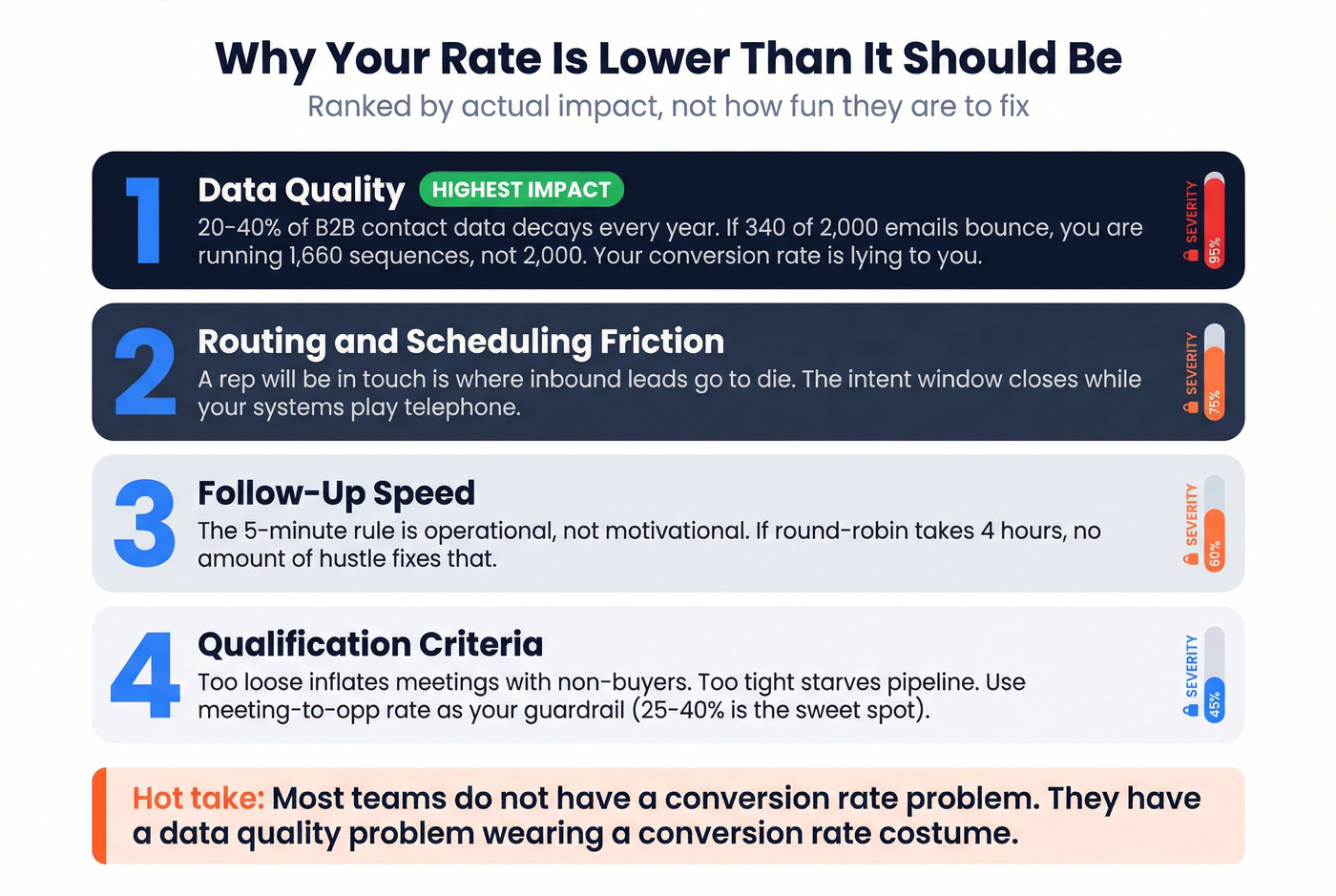
1) Data quality (the unsexy fix that changes everything)
Between 20-40% of B2B contact data decays each year. People change jobs, inboxes get shut down, domains change policies, and yesterday's "verified" list turns into today's bounce report.

If 340 out of 2,000 outbound emails bounce, you're not running 2,000 sequences. You're running 1,660. That means your reported conversion rate is lying to you in the most annoying way possible: it makes the channel look worse than it is, and it hides what you should actually fix.
This is where tools like Prospeo fit naturally in the workflow: verify emails before you send, keep records fresh on a 7-day cycle, and stop burning domains on dead addresses. Prospeo's email accuracy is 98%, and the free tier is enough to run a real test on a slice of your list instead of arguing about "quality" in a meeting.
2) Routing and scheduling friction
"Thanks for your interest - a rep will be in touch" is where inbound leads go to die.
If your lead routing takes hours, you're not losing because your reps are bad at discovery. You're losing because the prospect's intent window closed while your systems played telephone. Self-serve scheduling and clean routing rules remove that delay, and they also reduce the back-and-forth that creates no-shows.
3) Follow-up speed
The five-minute rule isn't motivational poster material. It's operational.
If your round-robin assignment takes four hours, your best SDR isn't going to "hustle" their way out of that. Fix the process: instant routing, instant notification, and a first-touch SLA you actually enforce.
4) Qualification criteria
Too loose and you inflate meeting counts with people who were never going to buy, which makes AEs hate SDR meetings. Too tight and you starve pipeline.
Use downstream metrics as guardrails. If your meeting-to-opportunity rate is under ~25%, you're booking too many low-quality meetings. If it's consistently over ~40%, you're probably filtering out deals you could win, or your AEs are only logging opps for slam dunks.
Hot take: most teams don't have a conversion rate problem. They've got a data quality problem wearing a conversion rate costume.
You just read that only 67% of outbound meetings are held - and that 20-40% of contact data decays annually. Prospeo's 5-step verification and 7-day refresh cycle keep your lists clean so emails land, phones connect, and booked meetings actually happen. Snyk's 50 AEs drove 200+ new opportunities per month once they switched.
Close the booked-to-held gap with data that's verified this week, not last quarter.
How to Calculate Your Rate (Without Lying to Yourself)
Say your team ran 2,000 outbound sequences last month. 340 emails bounced. Of the 1,660 that reached real inboxes, 52 meetings were booked and 38 were held.
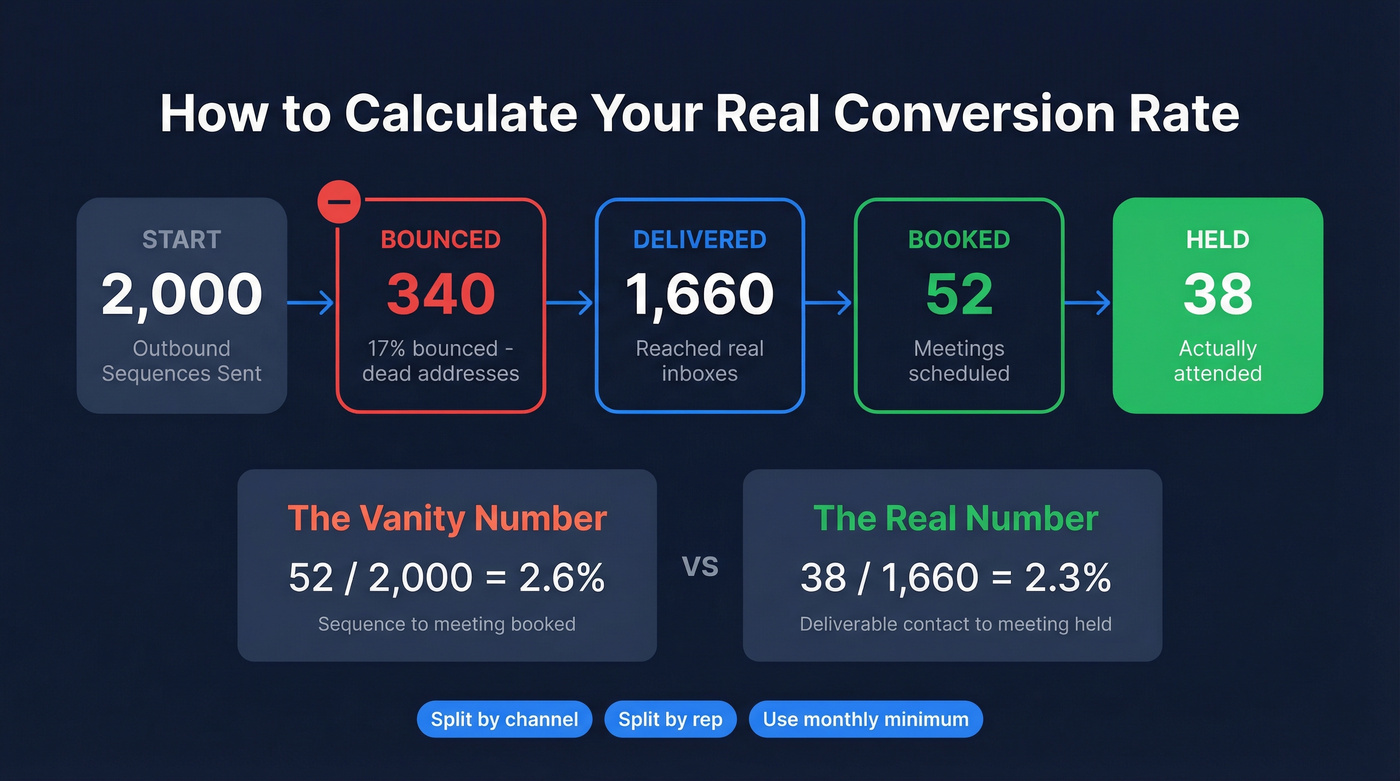
- Sequence -> meeting booked: 2.6% (52 ÷ 2,000)
- Deliverable contact -> meeting held: 2.3% (38 ÷ 1,660)
Both numbers are useful. The second one is the one that tells you whether targeting, messaging, and rep execution are working on the audience that actually received your outreach.
A few segmentation rules we use because they prevent bad decisions:
- Split by channel: inbound vs outbound vs referral. Blending them creates a fake average.
- Split by rep: a 3x gap between best and worst SDR isn't rare, and it's coachable.
- Use the right time window: monthly is the minimum, quarterly shows trend, weekly is noise unless volume is massive.
For quality control, track meeting -> opportunity and opportunity -> close alongside meeting conversion. HubSpot (https://www.hubspot.com) and Salesforce (https://www.salesforce.com) can surface this quickly with stage conversion reporting filtered by lead source and date range.
FAQ
What's a good leads to meetings conversion rate for outbound?
From sequences started, 1-4% is a normal range. From positive replies, 15-30% convert to booked meetings. Outbound looks low at the top of the funnel, but the economics can still work if you're targeting the right accounts and the ACV supports the effort.
How does speed-to-lead affect meeting conversion?
It affects it a lot. Leads contacted within minutes convert far better than leads contacted later, and the drop after 30 minutes is steep. Tight routing plus self-serve scheduling is the cleanest way to remove the delay.
How much does bad data affect meeting-set rates?
A lot more than most teams want to admit. If 15-40% of your outreach never reaches a real inbox, your "conversion rate" is partly a measurement error. Fixing bounces directly increases the number of real conversations that can turn into booked meetings. Prospeo's 98% email accuracy and 7-day refresh cycle remove most of that waste.
What's the difference between booked and held meeting rates?
Booked is a calendar event. Held is a real conversation.
Inbound meetings often show around a 93.5% attendance rate (about 6.5% no-shows). Outbound-booked meetings can land closer to ~67% attendance, which means a third of "pipeline meetings" disappear before discovery even starts. Track both, or your forecast will always feel cursed.
Every benchmark in this article changes the moment you change the denominator. Define yours clearly, track booked and held separately, and fix your data before you touch anything else. That's the playbook for improving your leads to meetings conversion rate in 2026.