

Lusha Email Finder: What 1,618 Reviews and Real Data Tell Us
You installed the Chrome extension, ran five lookups, and thought "this is great." Then you burned through 70 free credits in three days, upgraded to Pro at around $30/user/month on annual billing, and realized a chunk of those emails bounced on your first outreach sequence. Now you're doing the math on what each usable contact actually costs - and the number isn't pretty.
30-Second Verdict
Lusha scores a solid 4.3/5 on G2 from 1,618 reviews, and the praise is deserved for one thing: it's dead simple to set up. But simplicity doesn't fix stale data. User-reported email accuracy runs 60-70%, and the phone number situation is worse - roughly 50/50 validity at 10 credits per reveal. That 10:1 credit ratio for phones is punitive, and it burns budgets fast.
Lusha works best for light prospecting and quick one-off lookups. Once you're doing consistent high-volume list building, the economics start to hurt.
Lusha Pros:
- Chrome extension is fast, clean, and genuinely easy to use
- Free tier lets you test before committing
- Strong CRM integrations with Salesforce and HubSpot
Lusha Cons:
- Email accuracy of 60-70% means a third of reveals are wasted credits
- Phone numbers cost 10 credits each with ~50% validity
- Database-based enrichment means data can be outdated
What Lusha Actually Does
Lusha is a database-based contact lookup tool. When you reveal a contact, you're pulling from stored data rather than discovering and verifying every address on the spot.

The primary workflow is the Chrome extension. You browse professional profiles or company websites, click the Lusha icon, and it surfaces whatever email and phone data it has on file. It's fast and clean when the contact exists in the database. Lusha claims 280,000+ revenue teams use the platform - scale that makes the accuracy complaints all the more notable.
Beyond the extension, Lusha offers CRM integrations with Salesforce and HubSpot (with caveats - more on that below), bulk enrichment, and a prospect search workflow with company and role filters. The core limitation is baked into the architecture: if a contact isn't in Lusha's database, you get nothing. There's no fallback pattern-matching discovery in the extension workflow. You're renting access to a directory, and coverage varies by persona, region, and seniority.
How Accurate Is the Data?
This is the question that matters. The answer isn't clean.
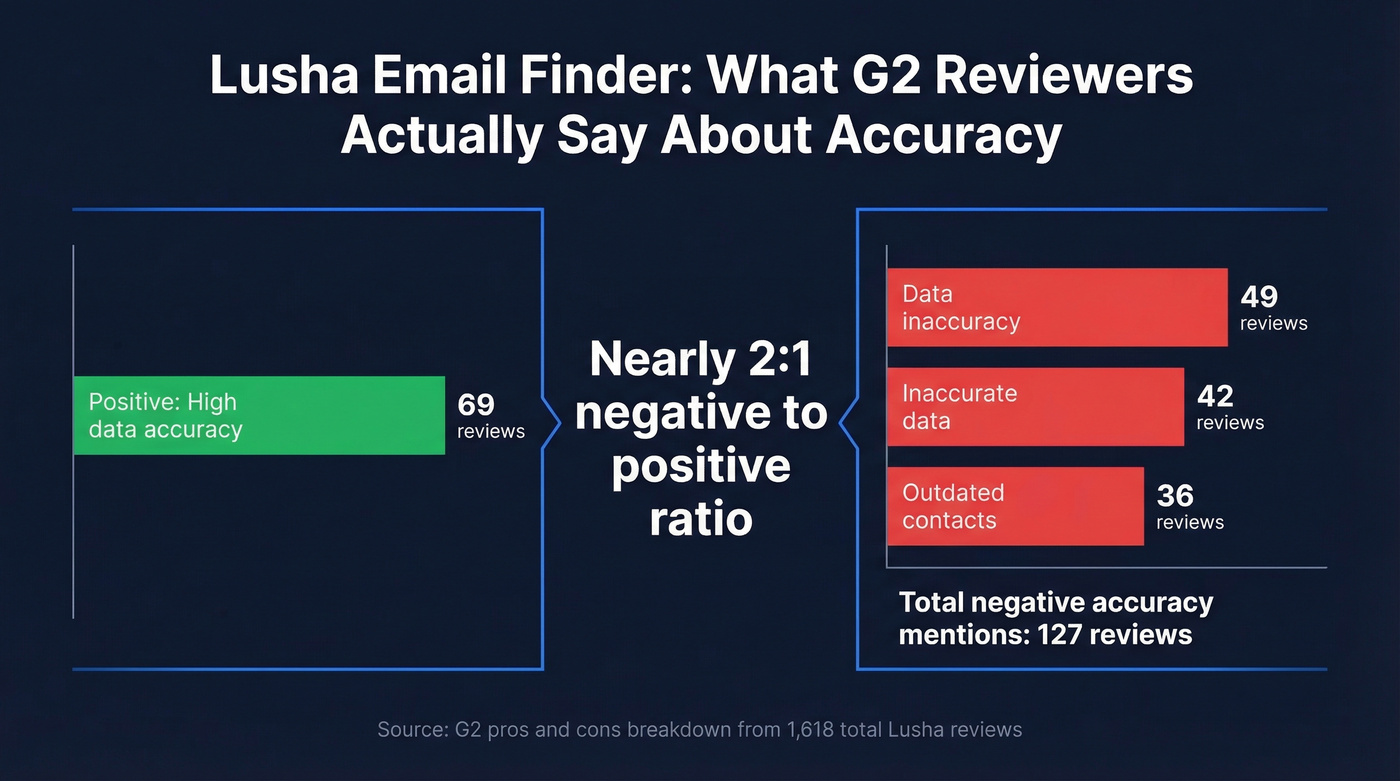
G2's own pros and cons breakdown tells a conflicting story: 69 reviewers praise "high data accuracy" while 49 cite "data inaccuracy," 42 flag "inaccurate data," and 36 mention "outdated contacts." That's 127 negative accuracy mentions against 69 positive ones - nearly 2:1.
Reddit benchmarks paint a similar picture. Users who've run a few thousand enrichments put Apollo and Lusha at roughly 60-70% valid emails, with phone numbers hitting about 50/50 at best. Some users push accuracy to ~90% by cascading multiple providers, but that defeats Lusha's simplicity advantage entirely.


Every bounced email from Lusha costs you a credit and chips away at your domain reputation. Prospeo's 5-step verification and 7-day data refresh deliver 98% email accuracy - turning wasted reveals into real conversations.
Stop paying $0.18 per usable email when $0.01 gets you a verified one.
Lusha Pricing Breakdown
Lusha's pricing page shows the credit mechanics clearly, but paid plan dollar amounts are often easier to find in third-party 2026 breakdowns than on-page. Here's the typical structure:
| Free | Pro | Premium | Scale | |
|---|---|---|---|---|
| Price/mo | $0 | ~$30/user (annual) / ~$40 (monthly) | ~$52-70/user | Custom |
| Credits/mo | 70 | 250 | 800 | Custom |
| Email cost | 1 credit | 1 credit | 1 credit | 1 credit |
| Phone cost | 10 credits | 10 credits | 10 credits | 10 credits |
| Rollover | N/A | 2x cap (monthly) | 2x cap (monthly) | Custom |
Monthly plans roll over unused credits up to 2x your plan limit while you're subscribed. Annual plans issue credits up front, and unused credits reset at the end of the cycle. The Scale plan is custom-priced; one published breakdown pegs it at around $37,482/year for 25 seats.
The Real Cost Per Usable Contact
Let's break this down with actual math, because the sticker price is misleading.
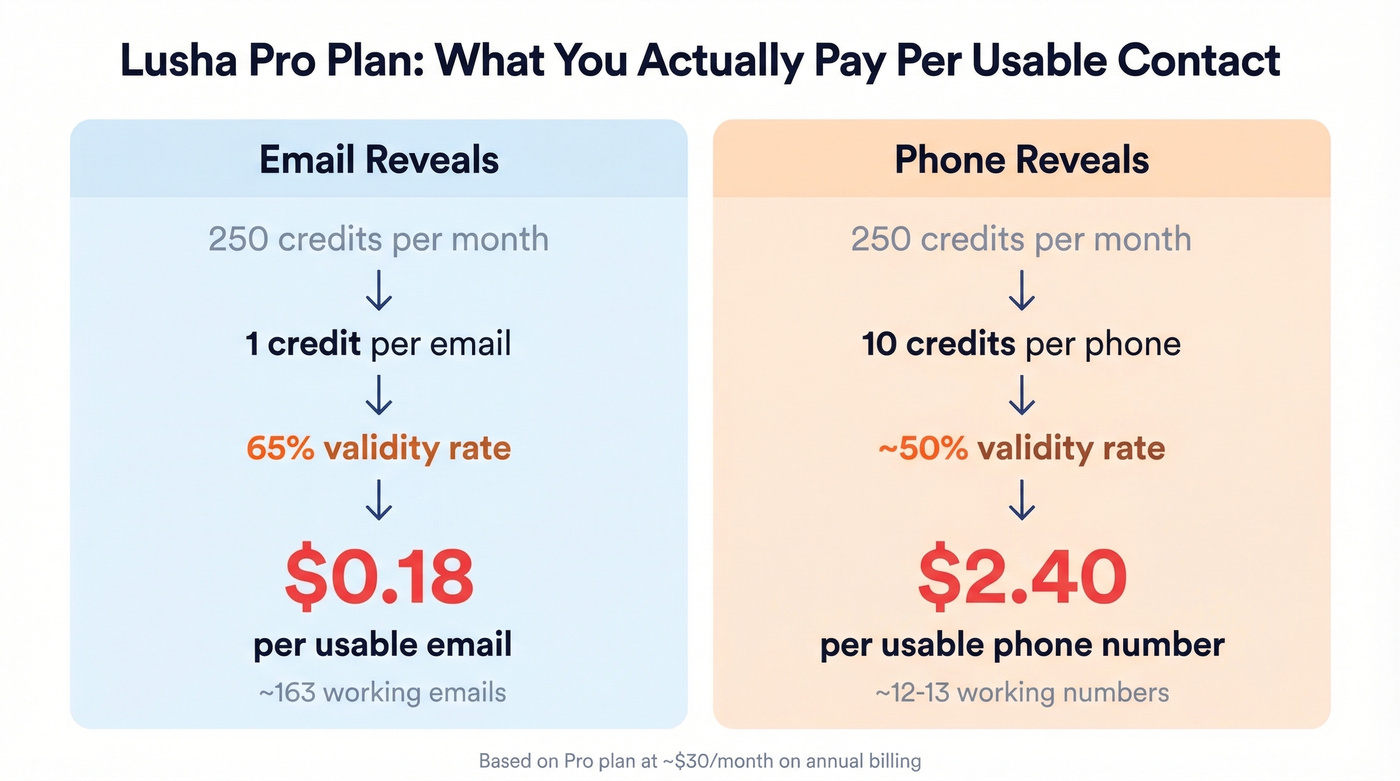
On the Pro plan at ~$30/month (annual billing), you get 250 credits. That's about $0.12 per credit. At 65% validity, you're getting roughly 163 usable emails - about $0.18 per working email address.
Phone numbers are where it gets painful. At 10 credits per reveal, your 250 credits buy exactly 25 phone lookups. At ~50% validity, that's about 12-13 working numbers. You're paying roughly $2.40 per usable phone number - and that's your entire monthly credit budget gone on just phones.
If your average deal size is under $5K, those per-contact economics eat your margin fast, especially once you factor in bounces and deliverability risk (see Email Bounce Rate and How to Improve Sender Reputation in 2026).
Lusha vs. Prospeo: Side-by-Side
| Lusha Free | Lusha Pro | Lusha Premium | Prospeo Free | Prospeo Paid | |
|---|---|---|---|---|---|
| Price/mo | $0 | ~$30 (annual) | ~$52-70 | $0 | ~$0.01/email |
| Credits/mo | 70 | 250 | 800 | 75 emails + 100 ext. | Scales with plan |
| Email accuracy | 60-70% | 60-70% | 60-70% | 98% | 98% |
| Data refresh | Undisclosed | Undisclosed | Undisclosed | 7 days | 7 days |
| Contracts | None | Annual or monthly | Annual or monthly | None | None |
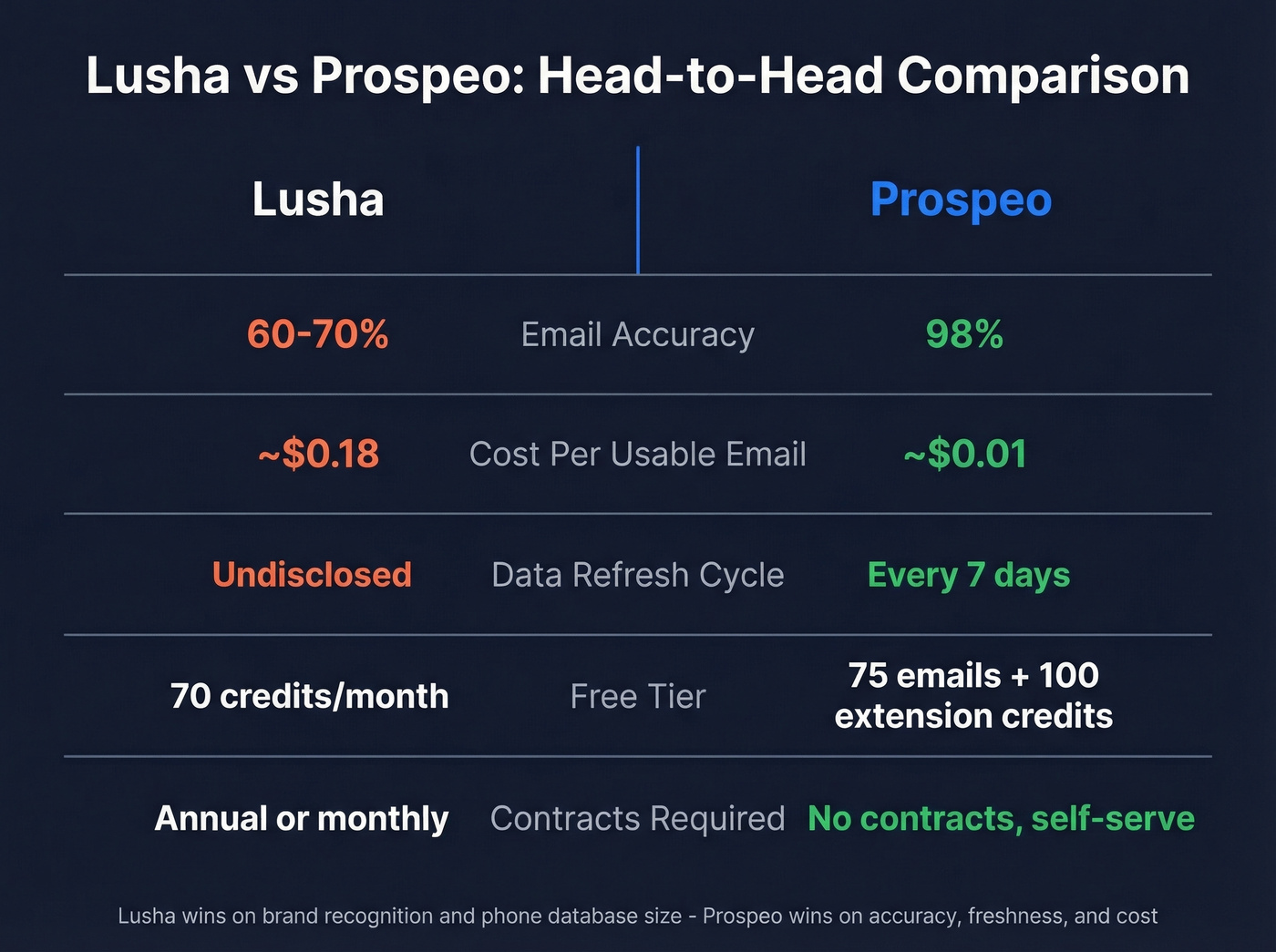
Prospeo wins on accuracy, data freshness, and self-serve flexibility. Lusha wins on brand recognition and the size of its phone database - though the ~50% validity benchmark undercuts that advantage.
Chrome Extension - Strengths and Limits
Use this if you're doing light, one-off prospecting - maybe 10-20 lookups a day while browsing professional profiles. The extension is genuinely fast, surfaces data in one click, and the UX is clean (more sales prospecting techniques help here than another tool).
Skip this if you're trying to build lists at scale. We've seen this pattern across database-lookup tools: initial results look great, then coverage thins out as you move past the most common contacts. One Reddit user described it perfectly - Lusha worked great at first, then increasingly couldn't find emails or phone numbers for new contacts.
Here's the thing about the HubSpot integration: it deserves a specific warning. Multiple users describe it as buggy and say CRM sync can override deal ownership, meaning your carefully assigned pipeline gets scrambled by an enrichment push. That's a data integrity risk that can mess up reporting and commission tracking. We've heard this complaint enough times that it's worth flagging before you connect anything (especially if you're standardizing your stack around contact management software or examples of a CRM).
GDPR and Privacy Risks
Lusha holds ISO 27701, ISO 27001, ISO 27018, and SOC 2 Type 2 certifications, plus ePrivacyTrust and TrustArc seals. It offers a pre-signed DPA with EU/UK Standard Contractual Clauses and a self-serve privacy center for opt-outs. On paper, that's a strong compliance posture.
But there's a notable wrinkle. In April 2025, Italy's data protection authority (Garante) opened an investigation into Lusha over alleged privacy violations involving Italian residents' data. The trigger was complaints from individuals receiving unsolicited calls, suggesting data was sourced without proper consent.
For context, CNIL (France's regulator) investigated Lusha's extension back in 2022 and concluded GDPR didn't apply due to a jurisdiction nuance. The regulatory picture is mixed - certifications say one thing, active investigations say another. If you're prospecting into EU markets, factor this into your vendor evaluation (and consider the risk side of Is It Illegal to Buy Email Lists?).
Better Alternatives to Lusha
Prospeo - Best for Email Accuracy
Prospeo attacks Lusha's biggest problem - stale data - with a fundamentally different approach. Instead of a static lookup, it runs a 5-step verification process with catch-all handling, spam-trap removal, and honeypot filtering across 300M+ professional profiles. The result is 98% email accuracy on a 7-day data refresh cycle (see also: Spam Trap Removal).
At ~$0.01 per email, the cost is roughly 1/18th what Lusha charges per usable contact when you factor in bounces. The free tier gives you 75 emails plus 100 Chrome extension credits per month - no contracts, no sales calls, self-serve onboarding. Native integrations with Salesforce, HubSpot, Lemlist, Instantly, and Clay mean it drops into your existing stack without custom work (if you're doing list ops in Clay, see Clay list building). Real-world results back this up: Snyk cut bounce rates from 35-40% to under 5% after switching, and Stack Optimize maintains 94%+ deliverability across all client campaigns.
Apollo.io - The Reddit Favorite
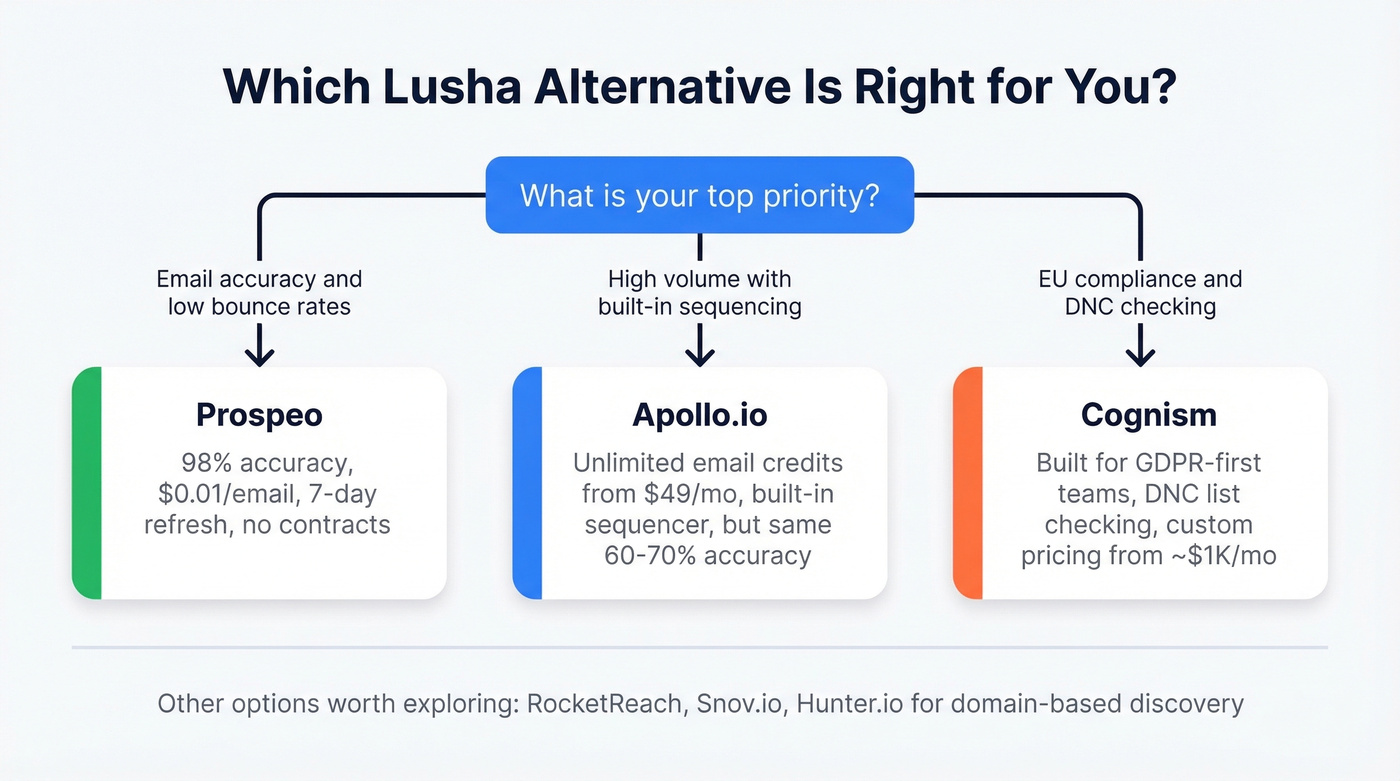
Apollo is the tool Reddit reaches for first when replacing Lusha. Paid plans start at ~$49/user/month with unlimited email credits, eliminating the credit anxiety that plagues Lusha users. The built-in sequencer means one fewer tool in your stack (if you're tightening outreach ops, pair this with sequence management).
The catch: email accuracy often lands in the same 60-70% range, so you're trading credit anxiety for the same bounce-rate problem. The consensus on r/sales is that Apollo's great for volume but you still need a verification layer on top (see Bouncer alternatives).
Cognism - For EU-First Teams
If you're selling into Europe and compliance isn't optional, Cognism is built for that world. DNC list checking is central to its positioning, and it's commonly cited as a stronger choice for Europe-focused outbound than lighter tools. Custom pricing typically runs ~$1,000-3,000/month for small teams. In our testing, Cognism's accuracy didn't match Prospeo's, but for compliance-first teams it's a strong pick.
Other tools worth checking: RocketReach and Snov.io both offer email finding with different coverage strengths. Hunter.io remains solid for domain-based email discovery. None match Prospeo on verified accuracy, but each has niche advantages depending on your workflow (for a broader shortlist, see data enrichment services).
Lusha's 10-credit phone reveals at ~50% validity mean you're paying $2.40 per working number. Prospeo gives you access to 125M+ verified mobiles with a 30% pickup rate - and you only pay when a number is found.
Get mobile numbers that actually connect to real decision-makers.
FAQ
Is Lusha's email data accurate?
User reports and G2 review themes suggest ~60-70% valid emails. On G2's pros/cons breakdown, 127 accuracy-related complaints outnumber 69 mentions praising high accuracy - nearly a 2:1 ratio. Always run emails through a verification tool before sending.
How many free credits does Lusha give?
Lusha's free plan includes 70 credits per month. Emails cost 1 credit and phone numbers cost 10, so that's either 70 email lookups or just 7 phone reveals. Most active prospectors exhaust them within a few days.
Does Lusha work outside North America?
Third-party comparisons describe Lusha as having 21M European contacts, but user sentiment suggests coverage and accuracy weaken outside North America. Direct phone numbers for international contacts are particularly unreliable.
Is Lusha GDPR compliant?
Lusha holds ISO 27701 and SOC 2 Type 2 certifications and offers a pre-signed DPA with EU/UK SCCs. However, Italy's Garante opened an investigation in April 2025 over alleged privacy violations - a risk signal worth weighing before committing to EU-focused prospecting.