

How to Manage Remote Sales Reps Without Micromanaging Them
It's 4:30 PM on a Tuesday. You open Salesforce and half your team's pipeline has no notes, no next steps, no evidence anyone talked to a prospect today. If that sounds familiar, you're not alone - it's the exact frustration that fills r/sales threads, where managers describe reps who "act like they understand" but hardly log anything in CRM. Only 43.5% of sales reps hit quota right now, and 80% of B2B sales interactions happen virtually. Remote management doesn't make those numbers worse by default. Bad remote management absolutely does.
Here's the thing: managing remote sales reps isn't a communication problem. It's a clarity problem. Only 54% of managers say they fully trust their remote teams, and that trust gap gets filled with Slack pings instead of systems. Teams that add more check-ins usually make performance worse. The fix is documented expectations, visible metrics, and a cadence that replaces surveillance with accountability.
What You Need Before Anything Else
Hybrid sales teams are 28% more likely to outperform fully remote or fully in-person ones. Structure matters more than location. You need three things:
- A scorecard with real numbers - not vibes, but weekly targets your reps can self-assess against (use these sales operations KPIs as a baseline).
- An async-first meeting cadence - daily updates that take 5 minutes, weekly syncs under 45, and 1:1s that actually coach (borrow from proven remote sales meeting tips).
- A data layer that keeps contacts fresh - because remote reps can't lean over and ask a colleague for a better phone number (see what “good” looks like in automated lead enrichment).
Stop over-communicating. Start over-documenting.
The Remote Sales Scorecard
The operating principle: be inflexible with the what, flexible with the how. Every rep knows the targets. How they hit them is their call. If it isn't in CRM, it didn't happen (this is also why sales KPI tracking needs to be dead simple).
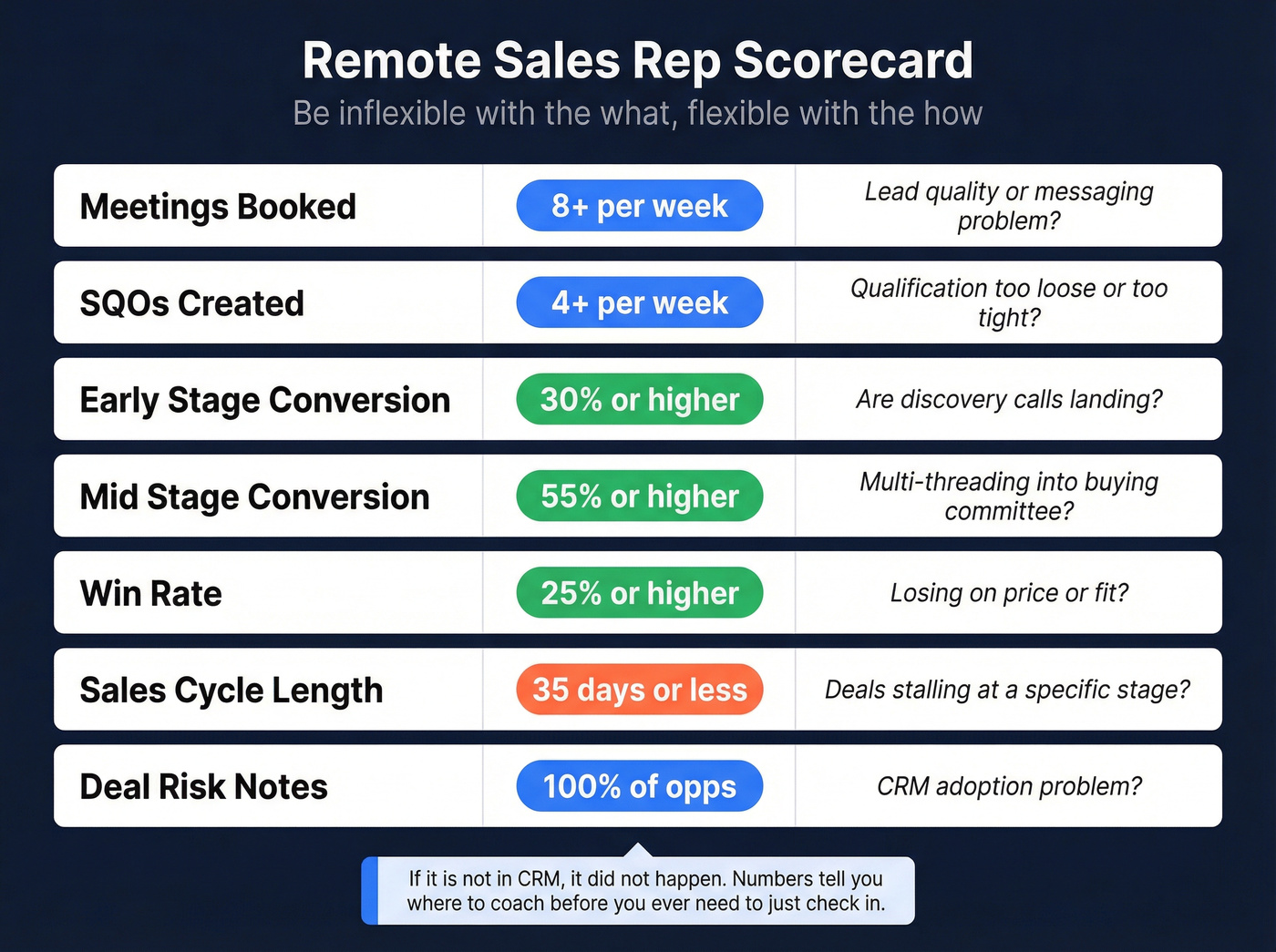
Each metric below has a diagnostic trigger - a question that tells you what's actually broken when a number dips, so you coach the right thing instead of just asking reps to "do more."
| Metric | Weekly Target | Key Question If Off-Track |
|---|---|---|
| Meetings booked | 8+ | Lead quality or messaging? |
| SQOs created | 4+ | Qualification too loose/tight? |
| Stage conversion (early) | ≥30% | Discovery calls landing? |
| Stage conversion (mid) | ≥55% | Multi-threading enough? |
| Win rate | ≥25% | Losing on price or fit? |
| Sales cycle | ≤35 days | Deals stalling at a stage? |
| Deal risk notes | 100% of opps | CRM adoption problem? |
This isn't a leaderboard. It's a coaching tool. When average call duration drops below 2 minutes, that's a messaging problem - not an effort problem. When mid-funnel conversion craters, your reps aren't multi-threading into the buying committee. The numbers tell you where to coach before you ever need to "just check in." (If you want more benchmarks, pull from these sales rep performance metrics.)
Your Async-First Meeting Cadence
Remote teams don't need more meetings. They need the right ones, with async filling the gaps. We've seen this cadence work across dozens of distributed sales orgs (especially teams running modern remote selling strategies):
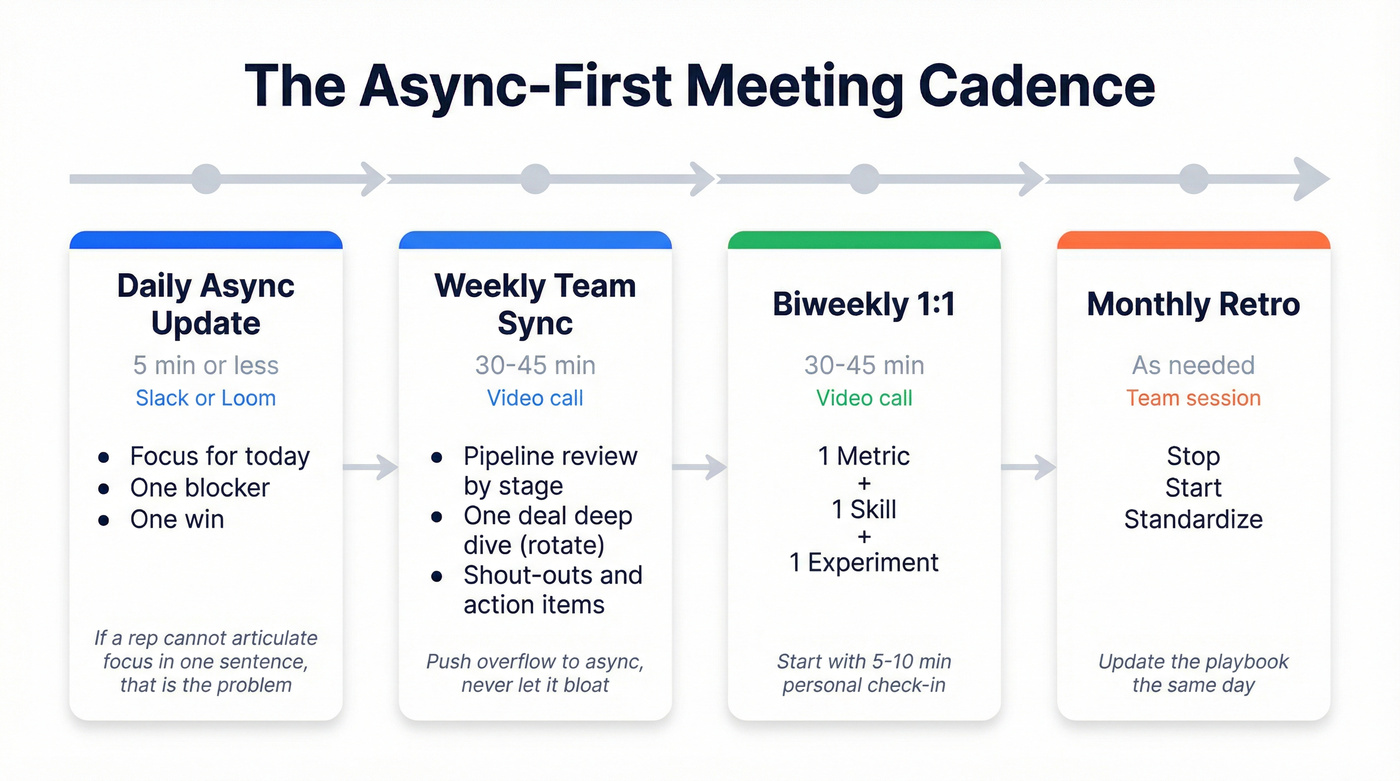
Daily async update (≤5 min, Slack or Loom). Each rep posts Focus, Blocker, One Win. If a rep can't articulate their focus in one sentence, that's the problem you need to solve.
Weekly team sync (30-45 min, video). Pipeline by stage, one deal deep dive (rotate who presents), shout-outs, action items. If your weekly regularly runs over 45 minutes, push the overflow to async - don't let it bloat.
Biweekly 1:1 (30-45 min). Structure it as 1 metric + 1 skill + 1 experiment. Review one lagging number, coach on one specific skill, and agree on one small experiment the rep will try before the next 1:1. Start with 5-10 minutes of personal check-in. Jumping straight into metrics signals you only care about the number, and your reps will notice.
The monthly retro follows a simple framework: Stop / Start / Standardize. Update the playbook the same day - not next week, when everyone's forgotten the details (this is where a lightweight sales enablement playbook pays off fast).

When mid-funnel conversion drops, your remote reps might not have a skills problem - they have a data problem. Prospeo refreshes 300M+ contacts every 7 days with 98% email accuracy, so your team spends coaching time on real pipeline instead of troubleshooting dead leads.
Stop diagnosing effort when the real problem is stale data.
Five Mistakes That Sink Remote Teams
1. Creating an "always-on" culture. When you Slack reps at 9 PM, you're setting an expectation, not being responsive. Schedule messages for business hours. Your reps will mirror whatever you model.
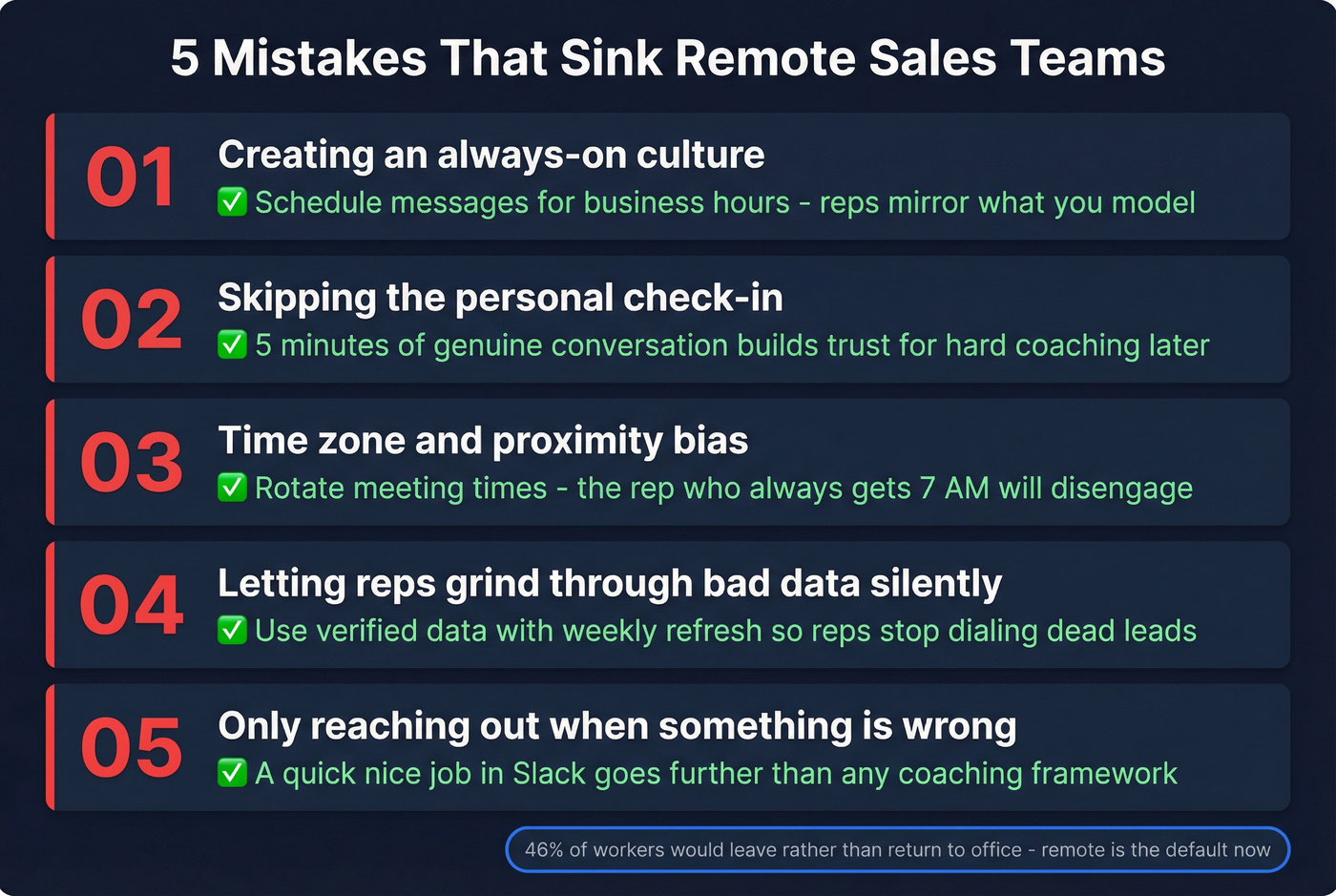
2. Skipping the personal check-in. Five minutes of genuine conversation builds the trust that makes hard coaching conversations possible later. Watch for extroverts especially - they burn out faster without live energy, and remote work strips that away quietly (a solid remote sales coaching rhythm helps prevent this).
3. Time zone and proximity bias. Rotating meeting times isn't optional. It's a fairness issue. The rep who always gets the 7 AM call will eventually disengage, and you won't hear about it until they've already mentally checked out.
4. Letting reps grind through bad data silently. In an office, a rep with a dead phone number asks the person next to them. Remote, they just keep dialing dead leads for hours. Tools like Prospeo verify emails at 98% accuracy on a 7-day refresh cycle, so reps don't burn call blocks on contacts that were never going to pick up (if you're auditing your stack, compare options in best B2B database platforms).
5. Only reaching out when something's wrong. In our experience, the reps who disengage fastest are the ones whose only manager contact is negative. A quick "nice job on that deal" in Slack goes further than any coaching framework.
The Remote Sales Tech Stack
Let's be honest: most remote sales teams are over-tooled and under-integrated. You need three things - a CRM your reps will actually use, an async layer, and a data platform that keeps contacts fresh. Everything else is optimization (here’s a broader view of sales enablement tools if you’re rationalizing spend).
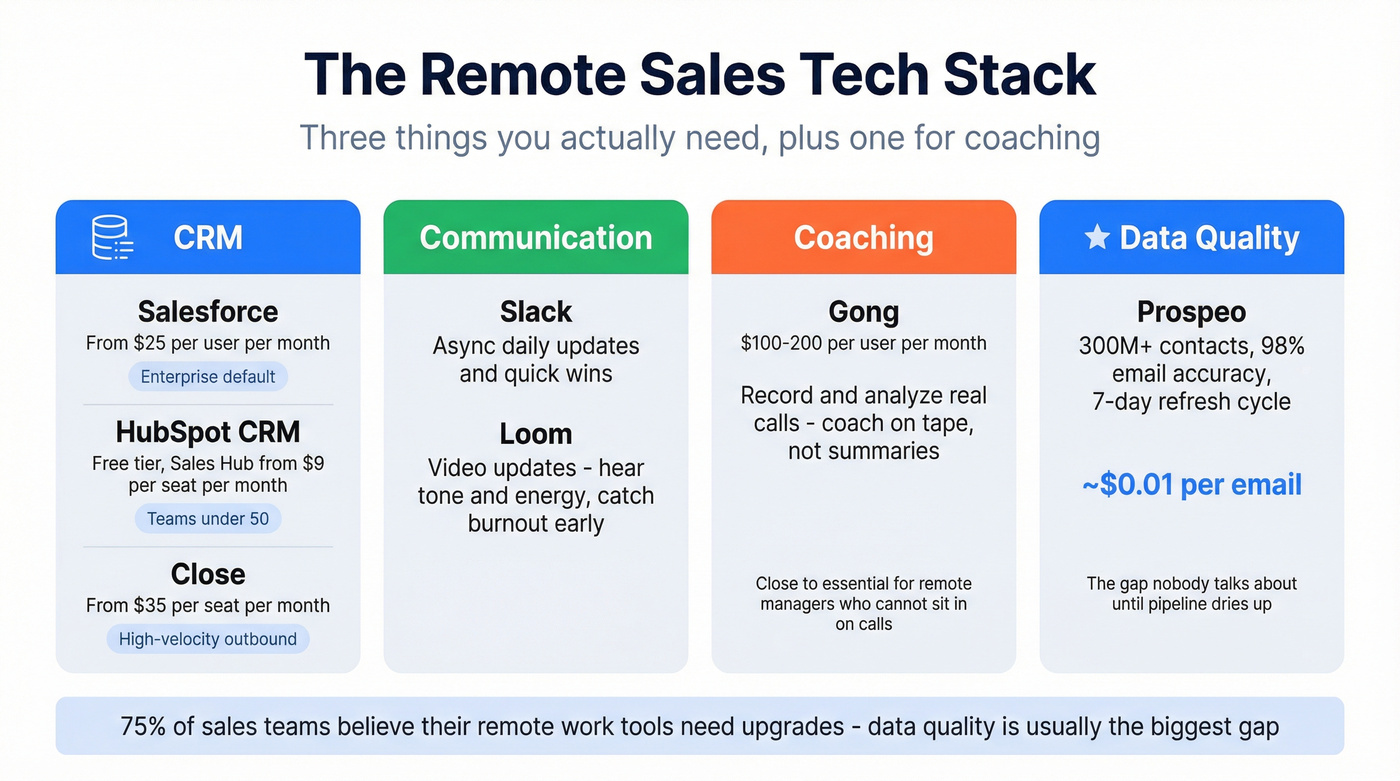
CRM. Salesforce starts around $25/user/month and remains the enterprise default. HubSpot's free CRM works well for teams under 50, with Sales Hub paid plans from ~$9/seat/month. Close starts around $35/seat/month and is built for high-velocity outbound with native calling - solid for SMB sales floors gone remote.
Communication. Slack for async. Loom for video updates - way more effective than typed status reports because you can hear tone and energy. If a rep sounds defeated in their daily Loom, that's a coaching signal no text update will ever give you.
Coaching. Gong typically runs $100-200/user/month depending on package and volume. It records and analyzes calls so you can coach on real conversations instead of secondhand summaries. For remote managers, this is close to essential - you can't sit in on calls from your kitchen table, but you can review the tape.
Data quality. This is where remote teams leak the most time, and it's the gap nobody talks about until pipeline dries up. A rep grinds through stale contacts without anyone noticing. When GreyScout doubled their sales team from 2 to 5 remote reps, they cut ramp time from 8-10 weeks to 4 weeks using Prospeo because new hires weren't spending their first month learning which data to trust. The 7-day refresh cycle meant reps always had current emails and direct dials - no manual list cleaning required. 75% of sales teams believe their remote work tools need upgrades, and data quality is usually the biggest gap.

Adjust Comp Plans for Remote
This is the section every other remote sales guide skips. Your comp plan was designed for an office where reps overhear each other's calls and compete on a visible whiteboard. Remote breaks all of that (if you need a starting point, map incentives to sales goals and leading indicators).
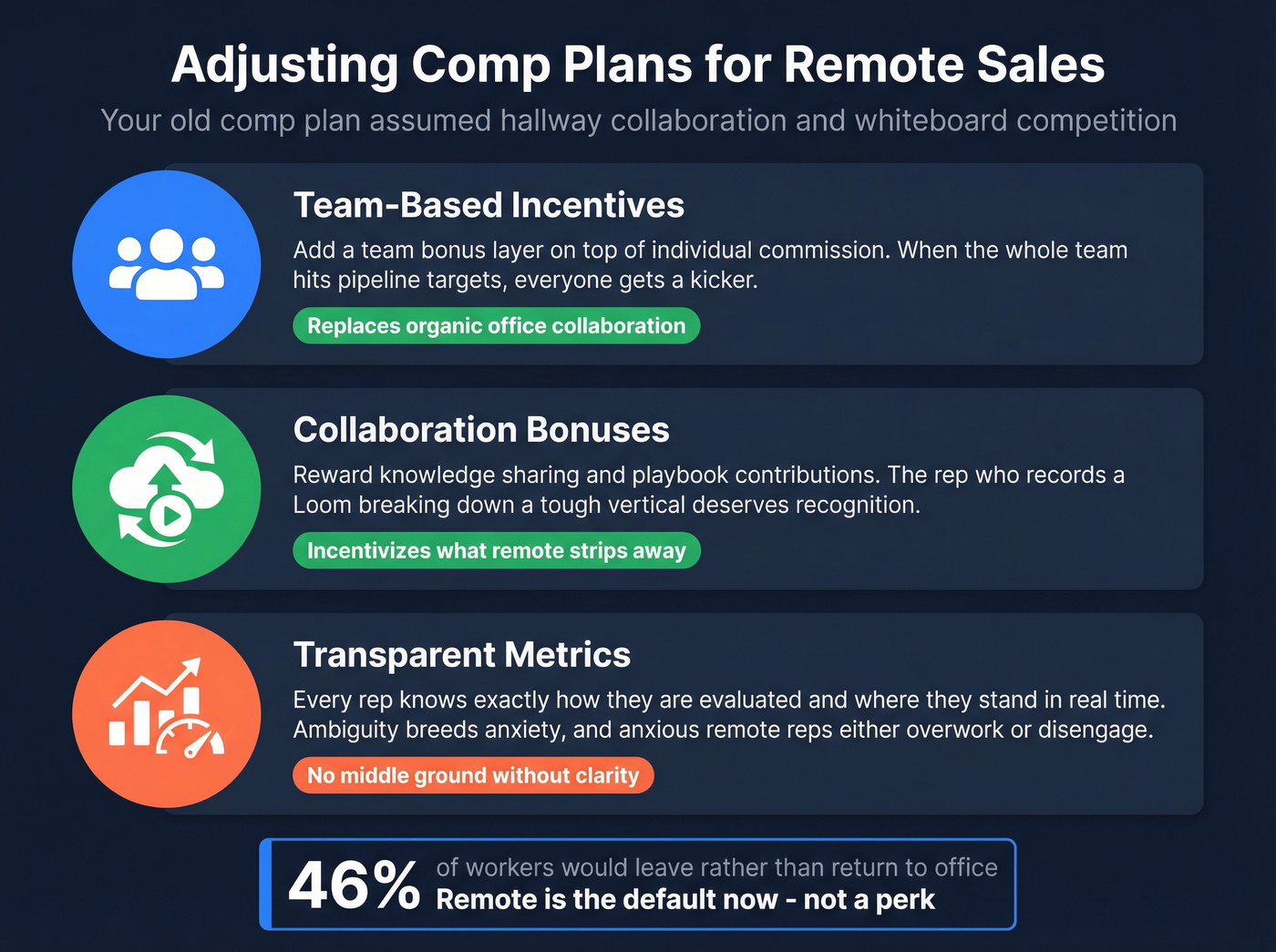
Team-based incentives. Add a team bonus layer on top of individual commission. When the whole team hits pipeline targets, everyone gets a kicker. This replaces the organic collaboration that offices provide for free (more frameworks in how to incentivize sales reps).
Collaboration bonuses. Reward knowledge sharing and playbook contributions. The rep who records a Loom breaking down how they cracked a tough vertical deserves recognition - not just the rep who closed the biggest deal.
Transparent metrics. Every rep should know exactly how they're evaluated and where they stand in real time. Ambiguity breeds anxiety, and anxious remote reps either overwork or disengage - there's rarely a middle ground.
Here's a number worth sitting with: 46% of workers would consider leaving rather than return to an office. Remote isn't a perk anymore. It's the default. If your comp plan still assumes hallway collaboration and whiteboard competition, you're compensating for a workplace that no longer exists.
GreyScout cut rep ramp time from 8-10 weeks to 4 by giving remote hires data they could trust from day one. With 98% verified emails, 125M+ direct dials, and a 7-day refresh cycle, new reps prospect instead of cleaning spreadsheets - at roughly $0.01 per email.
Ramp remote reps in weeks, not months.
FAQ
How often should I check in with remote sales reps?
Daily async updates (5 minutes), weekly team syncs (30-45 minutes), and biweekly 1:1s. Skip the ad-hoc "just checking in" messages - they signal distrust. Build systems that make performance visible without requiring constant synchronous contact.
What KPIs matter most for remote sales teams?
Meetings booked, stage-to-stage conversion rate, win rate, and sales cycle length. Activity metrics like calls and emails are leading indicators, but don't confuse motion with progress. If average call duration is under 2 minutes, that's a messaging problem, not an effort problem.
How do I handle reps who won't log CRM activity?
Separate willingness from clarity. Most reps skip CRM updates because fields are ambiguous or the process feels like busywork. Define exactly what "logged" means - next step, date, and one sentence of context per opportunity - then tie it to the scorecard. If logging doesn't improve after expectations are crystal clear, that's a performance conversation, not a process one.
How do I keep remote reps from working stale contact lists?
Use a data platform with a weekly refresh cycle and built-in email verification. Bad data compounds silently in remote teams because reps can't flag dead numbers to a colleague across the room. They grind through invalid contacts until pipeline dries up, and by then you've lost weeks of selling time you can't get back.