

The Marketing Funnel Template That Actually Works in 2026
You downloaded a marketing funnel template last quarter. It was a pretty cone with five colored sections and zero instructions. You stared at it, added your logo, and closed the tab. That's not a strategy - it's a shape.
Eight out of ten funnel templates floating around the internet are exactly this: blank diagrams you can't do anything with. What you actually need is a framework with stages, tactics, benchmarks, and metrics already baked in. Every template below is filled in with real numbers - not a blank cone you'll close in five minutes.
Here are three ready-to-use funnel frameworks for SaaS, ecommerce, and high-ticket B2B, plus the conversion benchmarks to tell you whether yours is working or leaking.
What Is a Marketing Funnel?
A marketing funnel maps the journey from "never heard of you" to "tells their friends about you." The classic AIDA model) - Awareness, Interest, Desire, Action - still holds up conceptually, but modern teams have expanded it to include retention and advocacy. Acquiring a customer and then ignoring them is a fast way to burn money.
The terminology you'll see everywhere: TOFU is top of funnel, MOFU is middle of funnel, and BOFU is bottom of funnel. These map roughly to awareness, consideration, and conversion. The modern lifecycle adds two more stages after the sale. Forbes Advisor's funnel overview reinforces the idea of mapping the journey from awareness through purchase and beyond, and it's the structure we'll use throughout.
The 5 Stages Every Funnel Needs
Five stages is the common modern standard. Here's what belongs in each one, what to measure, and what content actually moves people forward.
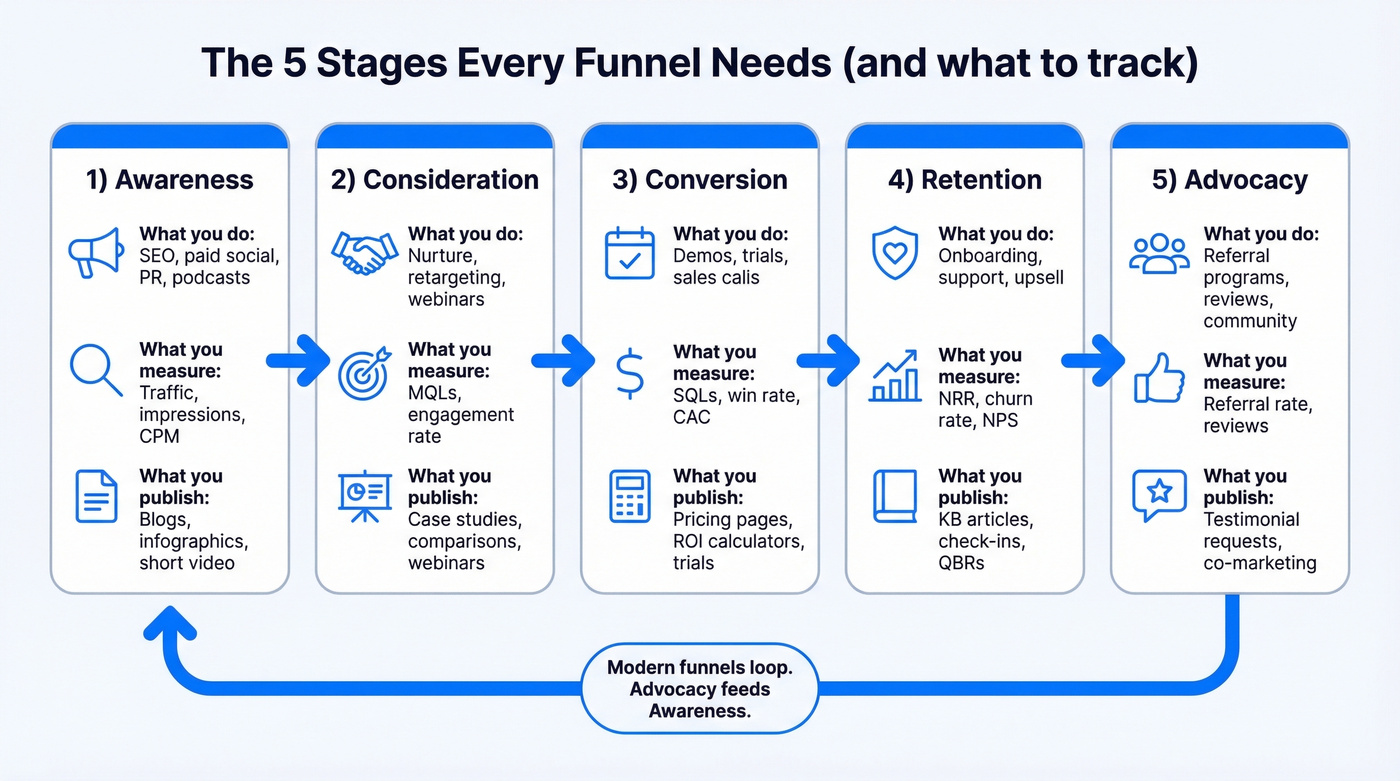
| Stage | Tactics | KPIs | Content Types |
|---|---|---|---|
| Awareness | SEO, paid social, PR, podcasts | Traffic, impressions, CPM | Blogs, infographics, short video |
| Consideration | Nurture, retargeting, webinars | MQLs, engagement rate | Case studies, comparisons, webinars |
| Conversion | Demos, trials, sales calls | SQLs, win rate, CAC | Pricing pages, ROI calculators, trials |
| Retention | Onboarding, support, upsell | NRR, churn rate, NPS | KB articles, check-ins, QBRs |
| Advocacy | Referral programs, reviews, community | Referral rate, reviews | Testimonial requests, co-marketing |
Here's the stat that justifies this structure: 69% of B2B buyers engage salespeople only after they've already made their decision. Your TOFU and MOFU content is doing the real selling. If you're only investing in BOFU - demos, pricing pages, sales decks - you're showing up after the game is already decided.
Don't skip the post-sale stages either. Acquiring a new customer costs five times more than retaining an existing one. Retention and advocacy aren't nice-to-haves. They're where the compounding happens.
Why Linear Funnels Fail
The five-stage model is useful for organizing tactics and metrics. It's dangerous if you treat it as a literal sequence where every buyer moves neatly from stage one to stage five.
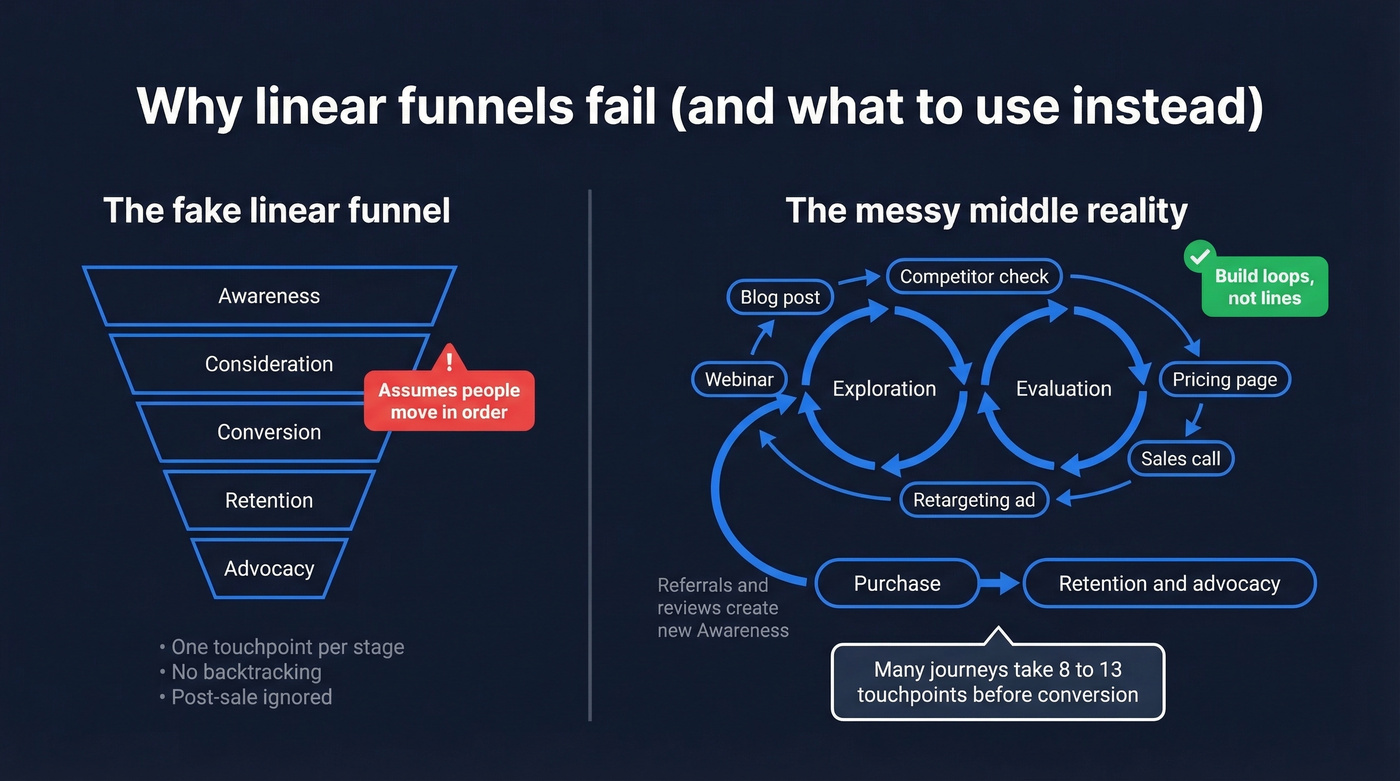
Google's "Messy Middle" research showed that real purchase behavior looks nothing like a funnel. Buyers loop between exploration and evaluation - reading a blog post, checking a competitor, watching a webinar, disappearing for two weeks, then coming back through a retargeting ad. 60% of consumers take six or more actions before buying from a new brand, and many buying journeys involve 8-13 touchpoints before conversion.
Adapt your template for reality: Add a feedback loop between Consideration and Awareness - buyers revisit earlier stages constantly. Map multiple touchpoints per stage instead of assuming one piece of content per step. Add an advocacy layer that feeds back into awareness, turning your funnel into a flywheel. Miro's funnel template has a solid visual framework for this.
The funnel isn't dead. The assumption that buyers move through it in order - that's what's dead.

Your MQL-to-SQL leak isn't a funnel problem - it's a data problem. Prospeo's 300M+ profiles with 98% email accuracy and 125M+ verified mobiles mean your reps reach real buyers, not dead ends. At $0.01 per email, fixing the middle of your funnel costs less than one bad lead.
Stop feeding your funnel bad data. Start with contacts that convert.
Funnel Conversion Benchmarks
A template without benchmarks is just a to-do list. You need to know what "good" looks like at each stage so you can spot where your funnel is leaking.
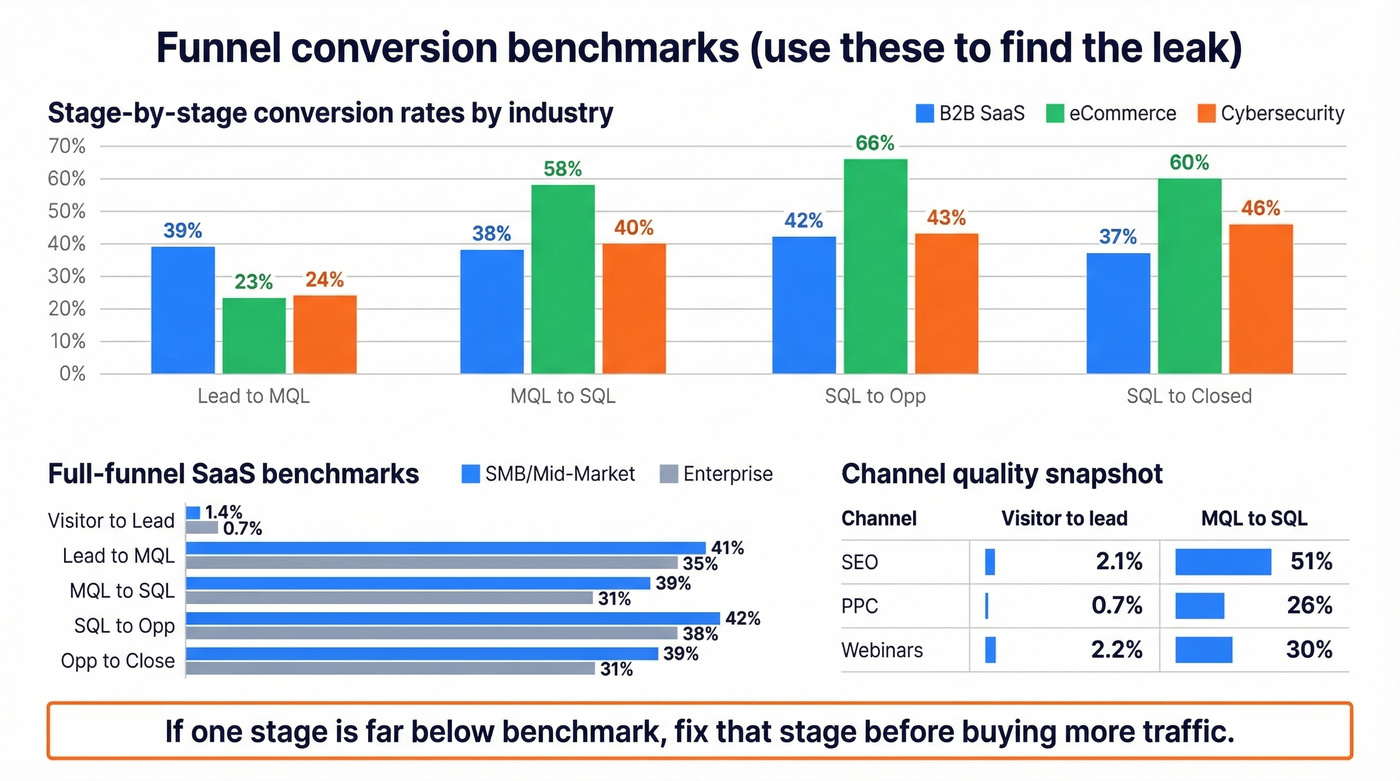
Stage-by-Stage Conversion Rates
Data from FirstPageSage's benchmarks report spanning 2017-2025 across a client mix that's roughly 65% B2B:
| Industry | Lead-MQL | MQL-SQL | SQL-Opp | SQL-Closed |
|---|---|---|---|---|
| B2B SaaS | 39% | 38% | 42% | 37% |
| eCommerce | 23% | 58% | 66% | 60% |
| Cybersecurity | 24% | 40% | 43% | 46% |
Full-Funnel SaaS Benchmarks
Digital Bloom's 2025 compilation of 40+ studies:
| Metric | SMB/Mid-Market | Enterprise |
|---|---|---|
| Visitor-Lead | 1.4% | 0.7% |
| Lead-MQL | 41% | ~35% |
| MQL-SQL | 39% | 31% |
| SQL-Opp | 42% | ~38% |
| Opp-Close | 39% | 31% |
Channel performance matters here. SEO drives a 2.1% visitor-to-lead rate with a 51% MQL-to-SQL conversion. PPC converts visitors at 0.7% with a 26% MQL-to-SQL rate. Webinars land at 2.2% visitor-to-lead but only 30% MQL-to-SQL.
In our experience, the biggest funnel leak is between MQL and SQL - and it's almost always a lead scoring problem, not a volume problem. If your numbers are dramatically below these ranges, you don't have a funnel problem. You have a stage-specific problem. Find the leak, fix that stage.
Let's be honest: most teams obsess over TOFU traffic when their real bottleneck is a 15% MQL-to-SQL rate buried in a CRM nobody audits. Fix the middle before you spend another dollar on top-of-funnel.
Three Ready-to-Use Funnel Templates
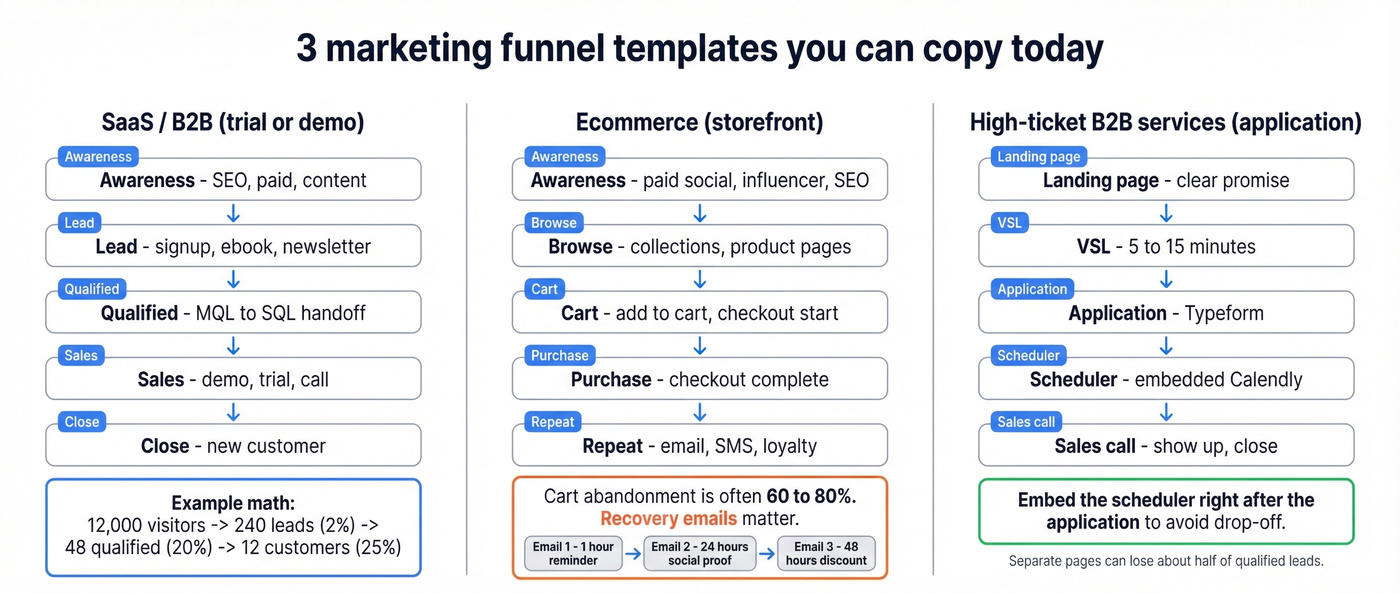
Funnel templates come in many flavors - squeeze pages, bridge funnels, survey funnels, VSL funnels - but the three frameworks below cover the business models most teams actually run. Pick the one closest to your business and adapt it.
SaaS / B2B Funnel
Use this if you're selling software with a free trial or demo-based sales motion. Skip this if you're selling physical products or one-time services.
Here's the math for a mid-market SaaS funnel using the benchmarks above:
- Awareness: 12,000 monthly visitors from SEO, paid, and content
- Consideration: 240 leads at 2% visitor-to-lead conversion
- Conversion: 48 qualified leads at 20% lead-to-qualified rate
- Close: 12 customers at 25% qualified-to-close rate
- Overall: 0.1% visitor-to-customer conversion
Track two numbers at every stage: volume and dollar value. A spreadsheet with dual metrics per stage - contacts in the left column, weighted revenue in the right - gives you the clearest view of where value is created and where it leaks. We've seen teams run this in Google Sheets for months before they ever need a BI tool.
If you want a version built specifically for pipeline stages and handoffs, use our B2B sales funnel template as a starting point.
Ecommerce Funnel
This one lives and dies on two numbers: your add-to-cart rate and your cart abandonment recovery rate. Everything else is optimization.
The flow runs from Awareness through paid social, influencer, and SEO into Browse on product pages and collections, then Cart where visitors add items and begin checkout, then Purchase, then Repeat. Ecommerce conversion rates typically land between 1.84% and 3.71%. Cart abandonment runs 60-80%, which makes your abandoned cart sequence the highest-ROI automation you can build.
Plug Klaviyo or your email platform into the cart-abandonment trigger and run a 3-email sequence: reminder at 1 hour, social proof at 24 hours, discount at 48 hours. A common request on r/shopify is "plug and play" templates for exactly this flow - hero product, upsell sequence, email recovery.
Skip this template if you're running a marketplace with thousands of SKUs. You need a different model entirely.
Your KPIs: cost per acquisition, average order value, repeat purchase rate, and email revenue as a percentage of total revenue.
If you're tightening the email side of this funnel, start with email copywriting and a clean email bounce rate baseline.
High-Ticket B2B Services Funnel
Skip this if your average deal is under $2,000 - the unit economics won't support this model.
The structure: Headline, then a 5-15 minute VSL (video sales letter), then a Typeform application, then an embedded Calendly scheduler, then a sales call, then close.
Here's the thing: if you separate the application and the scheduler into two separate pages, you'll lose roughly 50% of qualified leads in that handoff. Embed the scheduler directly after the application submission. Near-100% app-to-scheduled conversion versus 50% is the difference between a profitable funnel and a broken one.
The pre-call nurture is aggressive by design. In the 48 hours between booking and the call, send 12 emails - roughly 6 per day, every 2 hours - plus retargeting ads to the booked-call audience. This sounds excessive. It works because no-show rates kill high-ticket funnels, and every percentage point of show-rate improvement drops straight to the bottom line. A practitioner on r/ContentMarketing reported consistent results with this exact cadence across multiple client funnels.
KPIs that matter: cost per booked call, show rate, close rate, and cash collected - not just revenue, but cash in the door. Track these weekly. If your close rate is the bottleneck, use a tighter discovery questions set and a consistent product demo checklist.
How to Fill Your Funnel With Qualified Contacts
You've got the template. You've mapped content to stages. You know your benchmarks. Now comes the part most funnel guides skip entirely: where do the actual contacts come from?
Your TOFU is only as good as the data feeding it. If you're running outbound to fill the top of your funnel - cold email, targeted ads, ABM campaigns - stale or unverified contact data will break your funnel math before it starts. Bounced emails tank your domain reputation. Bad phone numbers waste your SDRs' time. Inaccurate firmographics mean your "ideal customer" list is full of people who'll never buy.
For B2B outbound, tools like Prospeo let you build prospect lists using 30+ filters - buyer intent, technographics, job changes, headcount growth - instead of guessing. With 300M+ professional profiles refreshed every 7 days and 98% email accuracy, the free tier gives you 75 verified emails per month to test whether your TOFU math holds before you scale spend.
If you're building lists from scratch, pair this with an ideal customer profile and a repeatable lead generation workflow.

A beautiful funnel template with stale contacts is just a diagram. Prospeo refreshes every record on a 7-day cycle - 6x faster than the industry average. Layer in buyer intent across 15,000 topics and 30+ filters to fill each stage with prospects who are actually in-market.
Build the funnel. We'll fill it with verified, in-market buyers.
Five Funnel Mistakes That Kill Conversions
1. Building around your org chart, not the buyer journey. Marketing owns awareness, sales owns conversion, CS owns retention - and nobody owns the gaps between them. Map the funnel to how buyers actually move, not how your departments are structured.
2. Treating the funnel as linear. Buyers loop. They revisit stages. They disappear and come back. Build re-engagement triggers at every stage, not just at the bottom.
3. Stopping at conversion. No retention stage, no advocacy stage, no expansion revenue. Returning customers spend 67% more than new ones. If your funnel ends at "closed-won," you're leaving the most profitable stages on the table.
4. Siloed data with no cross-channel attribution. Your analytics platform says one thing, your CRM says another, your ad platforms each take credit for the same conversion. Until you consolidate funnel data into a single view - even a simple dashboard in Looker Studio - you're optimizing blind.
5. Bad prospect data at the top. Garbage in, garbage out. If 15% of your TOFU emails bounce, that cascades into wasted nurture spend, inflated MQL counts, and a conversion rate that looks worse than it is. Verify contacts before they hit your CRM with data enrichment services and a proper email deliverability guide.
FAQ
What's the difference between a marketing funnel and a sales funnel?
A marketing funnel covers the full journey from first awareness through advocacy and referrals, while a sales funnel focuses narrowly on the stages from qualified lead to closed deal. In practice, most modern teams use one unified funnel where marketing owns TOFU/MOFU and sales owns BOFU, with shared accountability at the MQL-to-SQL handoff.
How many stages should a funnel template have?
Five stages - Awareness, Consideration, Conversion, Retention, Advocacy - is the most common modern standard. Some teams simplify to three (TOFU/MOFU/BOFU) for easier tracking. Avoid going beyond six; more granularity creates tracking complexity without improving clarity. Pick a model, commit, and optimize within it.
What tools do I need to build a funnel?
At minimum: a CRM like HubSpot's free tier, an email platform, and stage-by-stage conversion tracking. For visual mapping, Miro or Google Sheets work well and cost nothing. For B2B outbound, add a data provider like Prospeo to fill the top of your funnel with verified contacts - the free plan gives you 75 emails/month to validate your funnel math before scaling.