

Marketing Lists: The Complete Guide to Buying, Building, and Actually Using Them
Buying marketing lists feels like a shortcut until you hit the first send: 14% hard bounces, spam complaints, and a domain that gets soft-blocked before lunch. With 400B+ emails sent daily, inbox providers have zero patience for sloppy data.
Here's what these lists really cost, when to skip list brokers entirely, and the modern alternatives that actually protect your pipeline.
What Are Marketing Lists?
A marketing list is a set of contact records you can target through a channel - email, direct mail, calls/SMS, or ads. In the old world, that meant buying a CSV from a broker. Today, it also includes self-serve B2B data platforms where you build lists dynamically with filters, enrichment, and verification baked in.
The email marketing services market hit $8.17B in 2023 and is projected to reach $27B by 2031. That growth is exactly why list quality is getting more scrutinized, not less.
The taxonomy matters because "marketing list" can mean three different things:
- Consumer lists (households/individuals): usually for direct mail, sometimes email (risky).
- Business lists (companies + contacts): for B2B outbound, ABM, recruiting, partnerships. A well-maintained contact list here is the backbone of any outbound engine.
- Specialty/trigger lists: new movers, new homeowners, job changes, funding events. These convert well because you're reaching people during a decision window - they actually need what you're selling.
The channel dictates the rules. A list that's fine for postcards can be a deliverability disaster for email.
What You Need (Quick Version)
Pick the path that matches what you're actually trying to do:
B2B email prospecting (cold outreach) - Skip traditional list brokers. Use a self-serve B2B database like Prospeo or Apollo. You'll get fresher data, better filtering, and verification that protects deliverability. (If you need a broader shortlist, see email list providers.)
Consumer direct mail (postcards, letters, flyers) - Use a reputable consumer data provider like Data Axle or Experian. Budget $50-$200 CPM depending on selects like geography, income bands, and homeowner status. Direct mail has a structural advantage: households receive about 2 pieces of mail per day versus 157 emails, and open rates run 80-90%.
Consumer email blasts (newsletter/promos) - Build your own opt-in list. Buying consumer email lists is a deliverability landmine, and most serious ESPs will punish you for importing purchased contacts.
Types of Marketing Lists
Different list types behave differently because they're collected and used differently. A "good" B2B list is about role accuracy and recency. A "good" direct mail list is about address deliverability and household targeting. Don't conflate them.
| Type | Typical Use | Pricing Model | Typical CPM/Cost |
|---|---|---|---|
| Consumer email | Promotions/newsletters | CPM / per send | $100-$400 CPM |
| B2B email | Outbound/ABM | CPM / platform | $600-$1,000+ CPM |
| Direct mail | Postcards/letters | CPM / per record | $50-$200 CPM |
| Telemarketing | Calls/SMS | Per record | $0.10-$0.50 |
| Specialty/trigger | Life events | CPM premium | $150-$500 CPM |
| B2B data platforms | Dynamic lists | Subscription/credits | ~$0.01/email+ |
The "B2B data platform" category is the big shift. Instead of buying a static file that starts decaying immediately, you're querying a living dataset, then verifying and enriching at export time (more on data enrichment services if you’re stitching sources together).
What Marketing Lists Actually Cost
Most people underestimate list cost because they compare "$300 for 10,000 emails" offers - usually garbage - to what real providers charge for segmented, usable data. ActiveCampaign's breakdown confirms: consumer email lists run $100-$400 per 1,000, while business email lists run $600-$1,000+ per 1,000.
| List / Platform | Pricing Model | Typical Cost |
|---|---|---|
| Consumer email list | CPM | $100-$400/1k |
| B2B email list | CPM | $600-$1,000+/1k |
| Direct mail list | CPM | $50-$200/1k |
| Apollo.io | Subscription | ~$49+/user/mo |
| Lusha | Subscription | $37+/user/mo |
| Lead411 | Subscription | $99+/user/mo |
| ZoomInfo | Annual contract | $15k-$40k+/yr |
Here's the thing that catches teams off guard: purchased lists are often single-use licensed. You pay once, you send once, and you don't "own" the data in a way that supports ongoing enrichment. That's why platforms beat brokers for anything email-driven.
Buy vs. Build - The Real Math
Buying lists looks cheaper until you price in decay, bounces, and reputation damage. Business email data goes bad at roughly 22% per year - about 2% per month - and that's before you account for role changes, layoffs, and domain migrations. (If you want the operational playbook, start with email bounce rate benchmarks and fixes.)
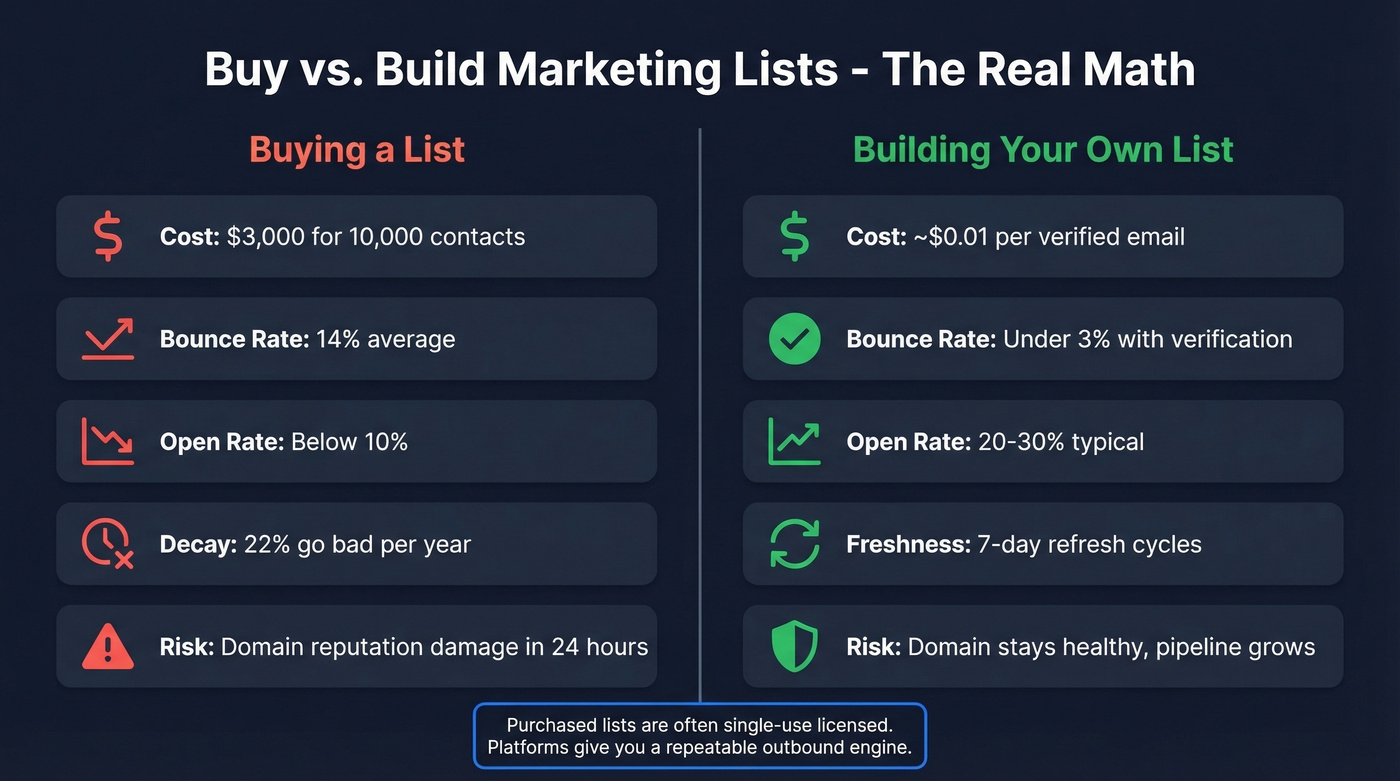
Performance follows the same pattern. Purchased lists often land below 10% open rates, while opt-in lists regularly hit 20-30%. Even if open rates are a noisy metric now, the direction is clear: consent and recency win.
We've watched this scenario play out too many times: a team buys 10,000 contacts for $3,000, loads them into a sequencer, and their bounce rate hits 14%. Within 24 hours, domain reputation tanks, inbox placement drops, and now they're "saving money" while burning the asset that prints pipeline. It's genuinely painful to watch. (If you’re already in the hole, use a step-by-step email deliverability guide to recover.)
When buying makes sense: Direct mail and one-off postal campaigns. The channel doesn't punish you like email does. For email, build opt-in or use a B2B database that verifies at export time.


The article says it: purchased lists decay at 22%/year and bounce rates tank your domain. Prospeo's 300M+ profiles refresh every 7 days - not 6 weeks - with 98% email accuracy and 5-step verification that catches spam traps, honeypots, and catch-all domains before they touch your sender reputation.
Build marketing lists that don't destroy your domain - starting at $0.01 per verified email.
How to Build a Targeted Marketing List
"Verified" is one of the most abused words in this space. SafetyMails' benchmark across ~1B emails found 80.94% valid, 11.7% invalid, and 7.9% risky - almost 19.6% problematic in total. That's nearly 1 in 5 addresses that can hurt you. (If you’re building a repeatable workflow, this is basically lead enrichment + verification at the right step.)
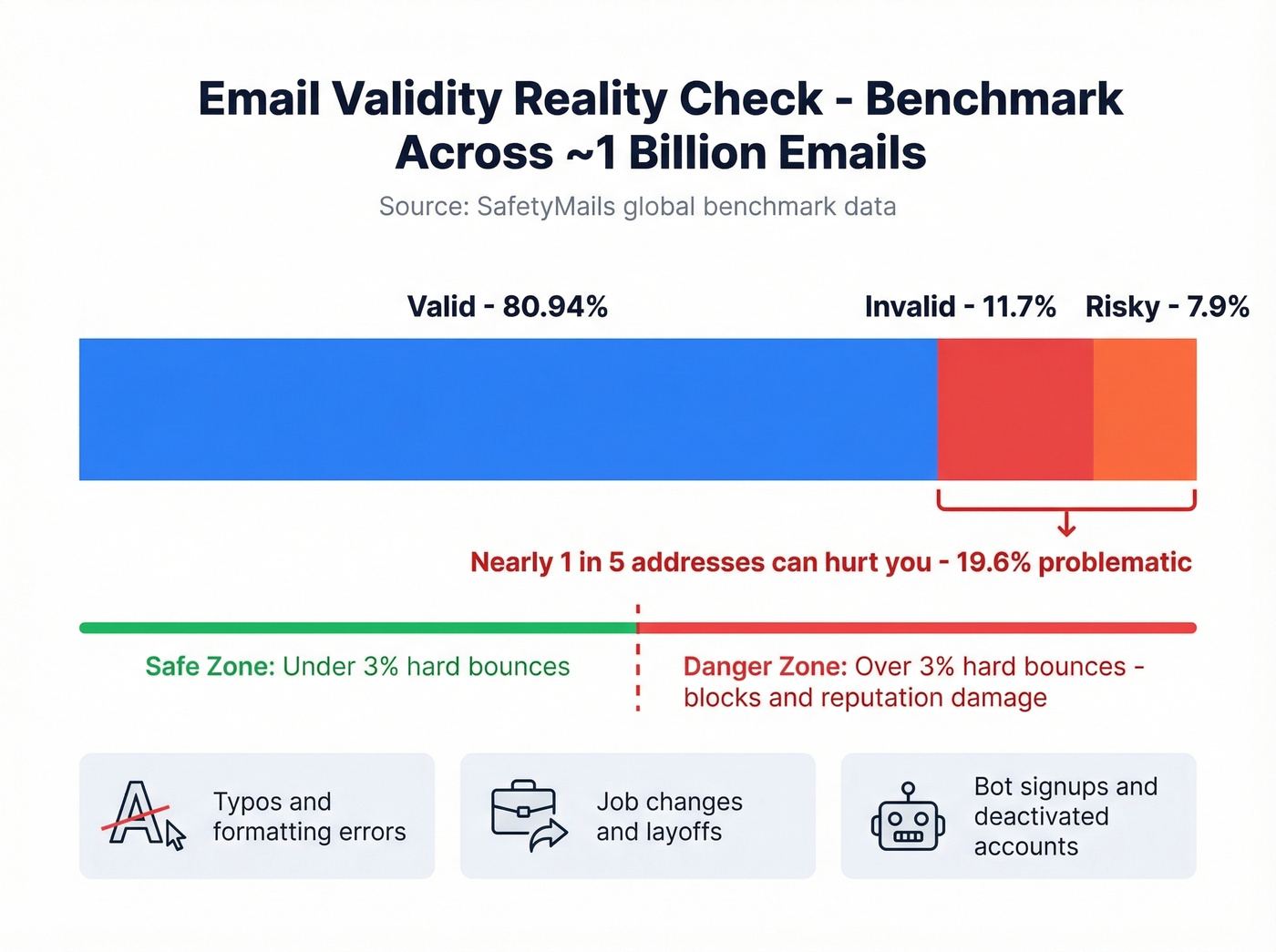
The operational threshold is clear: once you're over 3% hard bounces, you're in the danger zone for blocks and reputation damage.
Technical deliverability - meaning the mailbox can receive email - doesn't mean the person still works there, the role is current, you have consent, or the address isn't a trap. Across typical lists, 5-30% invalid isn't unusual. Causes are boring but deadly: typos, job changes, deactivated accounts, and bot signups. If you're building lists for outbound, verification at the point of export is the only workflow that makes sense in 2026, and it's the reason platforms with real-time verification have replaced static file purchases for most serious outbound teams. (Related: spam trap removal if you suspect you’ve hit traps.)
Compliance - What You're Risking
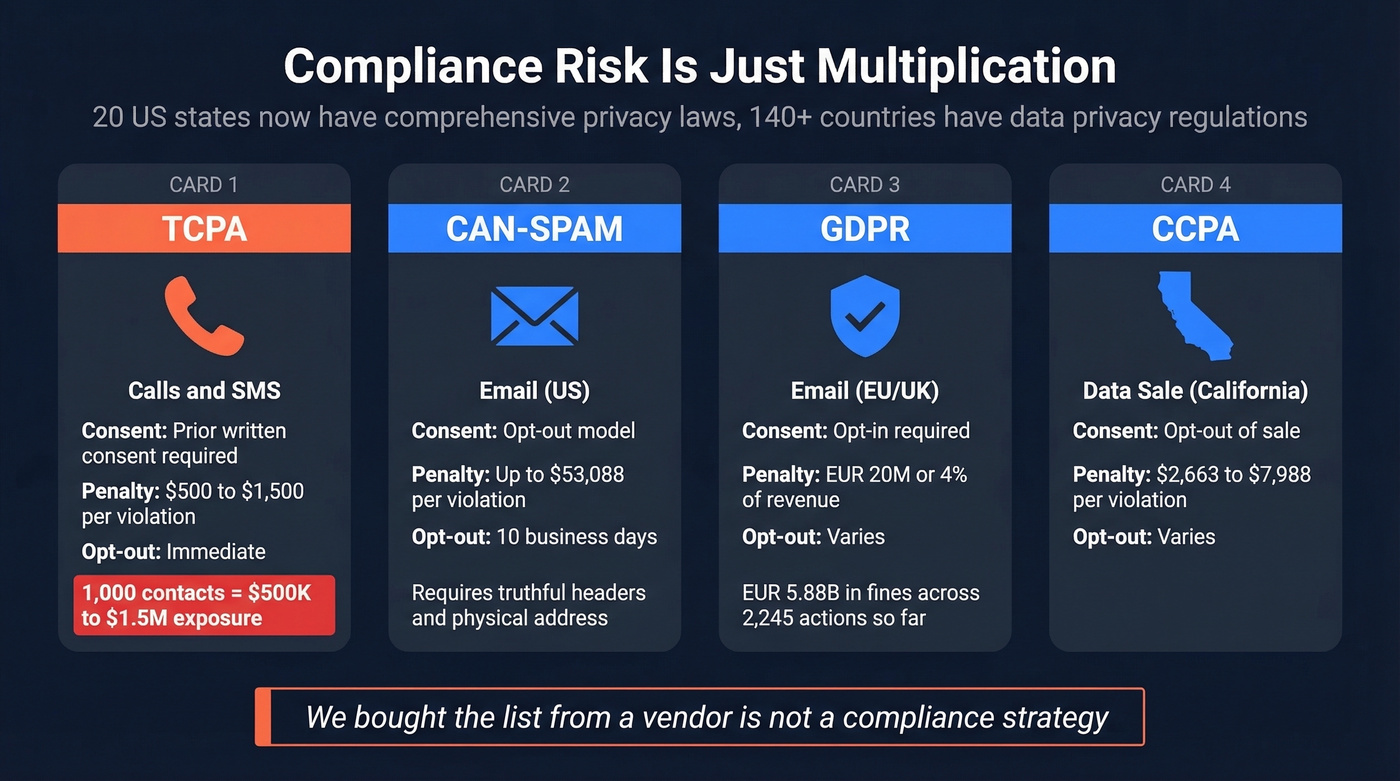
Most teams treat compliance like a checkbox. It's not. It's a risk model tied to channel, jurisdiction, and consent. Twenty U.S. states now have comprehensive privacy laws, and 140+ countries have data privacy regulations. "We're a small business" isn't a shield.
| Regulation | Consent Model | Penalty Range | Opt-Out Window |
|---|---|---|---|
| TCPA | Prior written | $500-$1,500/violation | Immediate |
| CAN-SPAM | Opt-out | Up to $53,088/violation | 10 biz days |
| GDPR | Opt-in | EUR20M or 4% rev | Varies |
| CCPA | Opt-out sale | $2,663-$7,988/violation | Varies |
A clean way to internalize TCPA risk: 1,000 non-consented contacts = $500K-$1.5M exposure. That's not theoretical. It's just multiplication.
Email (US): CAN-SPAM is opt-out, but you still need truthful headers, a physical address, and unsubscribe processing within 10 business days. Email (EU/UK): GDPR pushes opt-in consent with limited legitimate interest scenarios. GDPR fines have hit ~EUR5.88B across 2,245 actions. Calls/SMS: TCPA is where teams get wrecked. Consent and DNC scrubbing aren't optional.
Look, I'm not a lawyer. But we've seen teams treat "we bought the list from a vendor" as a compliance strategy, and that's how you end up in a very expensive conversation.
How to Vet a List Provider
If you're buying a list - especially for direct mail - vet the provider like you're buying production infrastructure. Because you are.
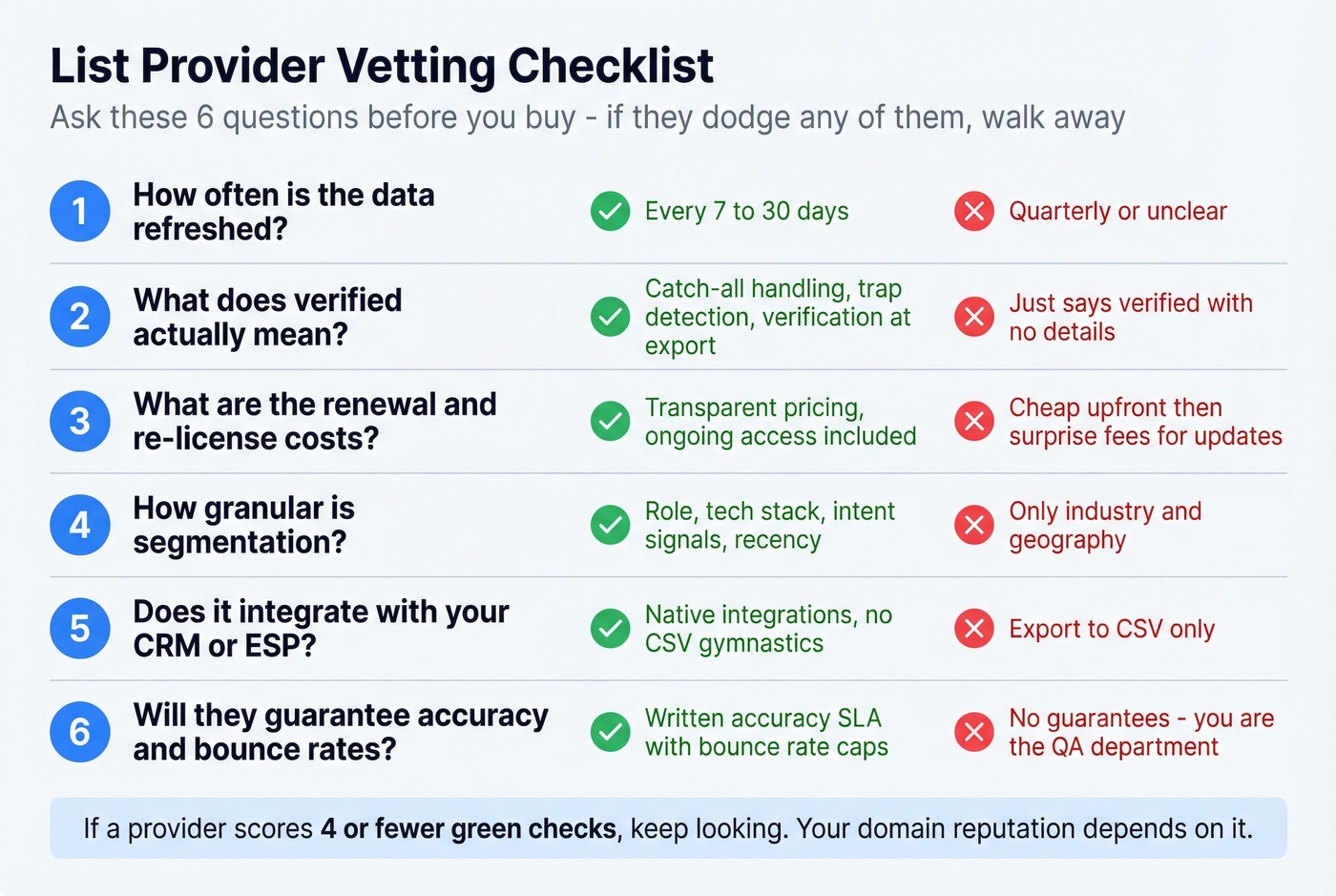
Data refresh frequency? Anything older than 30 days is stale. "Wholesale" sourcing usually means the file is 2-8 months old before you touch it.
What does "verified" mean specifically? Ask about catch-all handling, trap detection, and whether verification happens at delivery time or only at collection. If they can't answer this clearly, walk away.
Renewal and access costs? Many brokers sell cheap once, then charge for re-licenses or updates.
Segmentation granularity? Industry + geo is table stakes. Role, tech stack, intent, and recency are where pricing jumps - and where ROI lives. (If you’re formalizing this, use firmographic filters as your baseline.)
CRM/ESP integration? If you're stuck with CSV gymnastics, you'll create duplicates and lose attribution. (See a practical connect outreach tool to CRM setup.)
Accuracy guarantees? If they won't stand behind bounce rates, you're the QA department.
Mistakes That Kill List ROI
Your marketing director asks for 5,000 electrical contractors in the Midwest by Friday. You buy a list, upload it, and hit send.
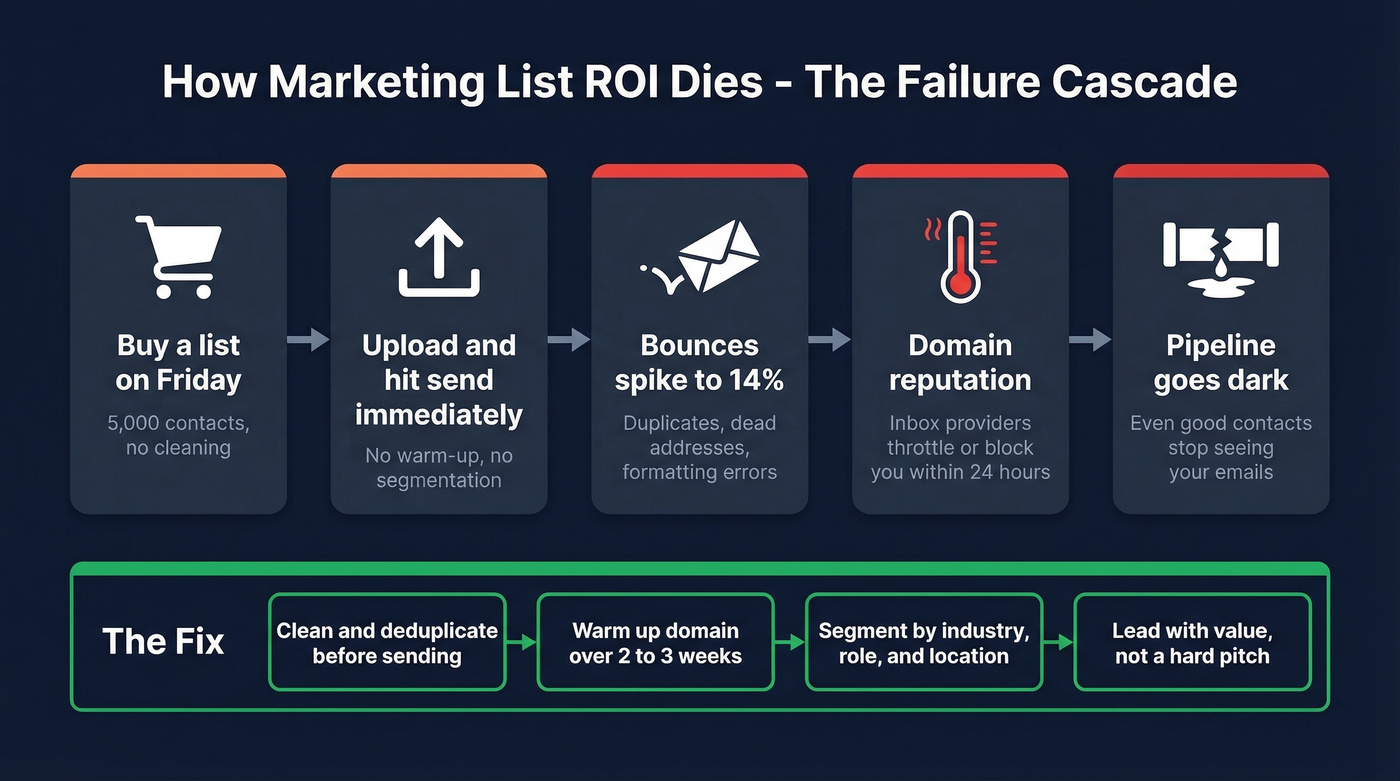
That's the moment most list ROI dies.
Sending without cleaning first is the biggest killer - duplicates, formatting issues, and dead addresses spike bounces immediately. Skipping warm-up is the second: sudden volume from a cold domain is how you get throttled. Start with small batches, then ramp over 2-3 weeks. (If you need guardrails, use an email velocity plan.)
Beyond that, the usual suspects: no welcome or confirm-interest step, generic spammy content, zero segmentation by industry/location/role, and hard selling before building any trust. Campaign audience building deserves the same rigor as campaign creative - if you segment poorly, even great copy underperforms. Give value first. A useful resource, a benchmark, a short audit offer. Pitching immediately is how you train people to ignore you.
Modern Alternatives: B2B Data Platforms
Static lists are a one-time snapshot. B2B data platforms are an ongoing system: search, verify, enrich, push into your workflow. That's the difference between "we bought a file" and "we have a repeatable outbound engine." (If you’re comparing vendors, start with sales prospecting databases.)
Let's be honest: if your average deal size sits below five figures, you probably don't need ZoomInfo-level data. A lighter, more accurate tool paired with good sequences will outperform an enterprise suite you're only using at 20% capacity.
Prospeo
Prospeo is the best pick when you care about accuracy and freshness more than feature bloat. It covers 300M+ professional profiles and 143M+ verified emails, running at 98% email accuracy with a 7-day refresh cycle - the industry average is about 6 weeks. That refresh cadence is the quiet killer feature, because stale data is what turns "targeting" into spray-and-pray.
Filtering goes deep: 30+ filters including buyer intent across 15,000 Bombora topics, technographics, job changes, headcount growth, and funding signals. The email-finding infrastructure is proprietary, so you're not just reselling the same third-party verification everyone else uses. A Chrome extension with 40K+ users lets you prospect from websites and web sources, and native integrations with Salesforce, HubSpot, Smartlead, Instantly, and Lemlist mean you're never stuck with CSV exports.
The proof is in the numbers: Snyk's 50 AEs dropped bounce rates from 35-40% to under 5% and grew AE-sourced pipeline 180%. Pricing is self-serve, no contracts, about ~$0.01/email, plus a free tier with 75 emails/month.

Apollo.io
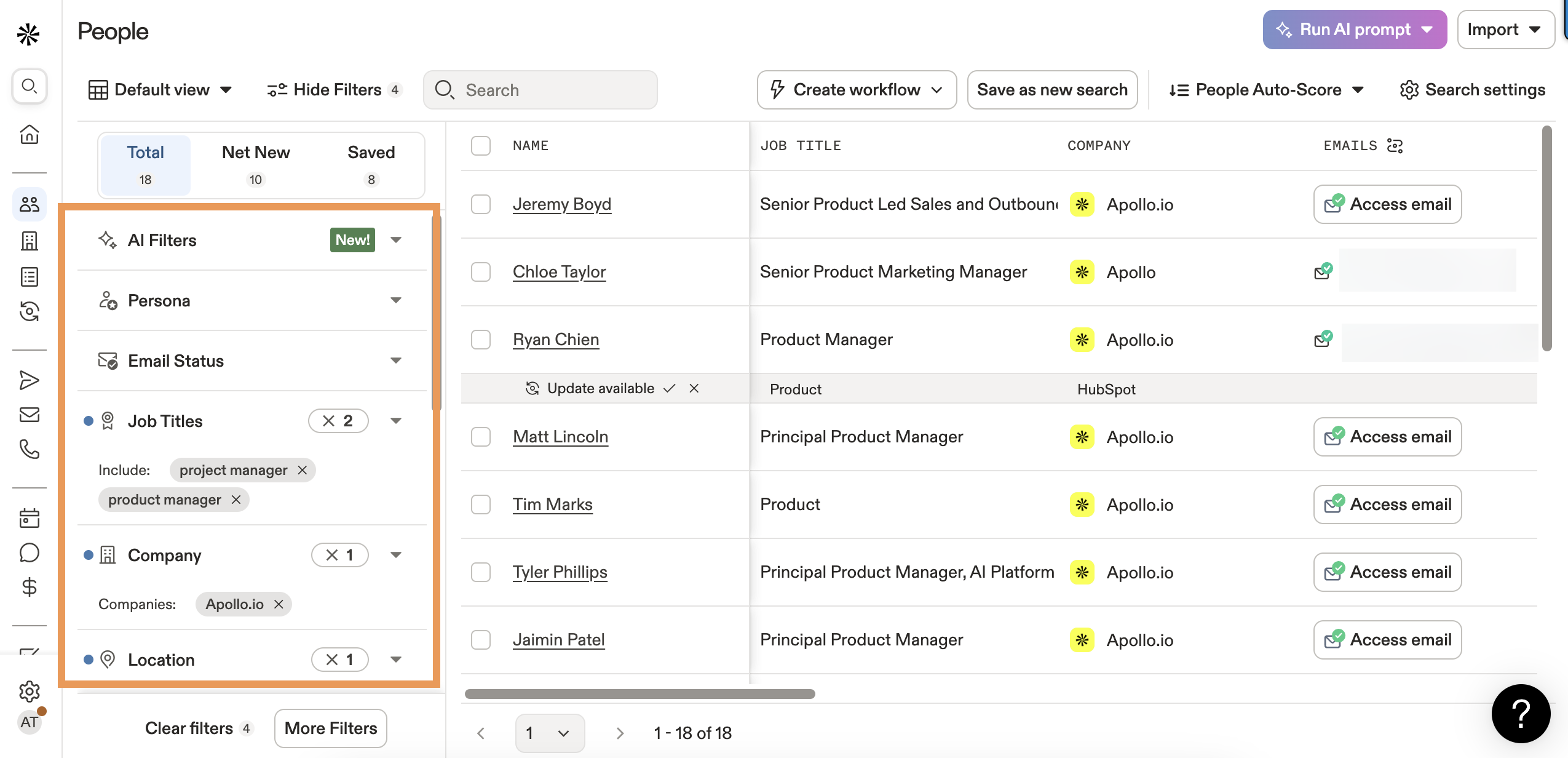
Apollo is the obvious starting point for most SMB teams because it combines a big database with built-in sequences. Fast to deploy, reps like it, and pricing starts around ~$49/user/month with a free tier. The tradeoff is data quality: Apollo's email accuracy runs about 79%, which shows up as higher bounce rates unless you verify aggressively before sending. For teams that outgrow it, the migration path is usually toward a tool with better verification.
ZoomInfo
ZoomInfo is still the enterprise standard when you need breadth, intent integrations, and a platform that can support a big GTM org. It's also the tool most smaller teams regret buying because they pay for modules they never turn on. Pricing is typically $15K-$40K+/year, and email accuracy sits around 87% - fine, but not "set it and forget it" for domain reputation. Skip this if your team is under 10 reps or your ACV doesn't justify the contract.
Data Axle / Salesgenie
Data Axle is the practical choice for consumer direct mail and SMB targeting where postal deliverability and household selects matter more than inbox placement. Pricing runs $50-$200 CPM depending on filters. They earned a spot in Forrester's Wave Q1 2026 for data quality, and Salesgenie - their SMB product - backs accuracy with a third-party audit claiming 96.1% accuracy for company name, address, and phone number.
Other Notable Platforms
Cognism is the go-to for EMEA-focused teams needing phone-verified mobiles and GDPR-compliant data. Expect ~$1K-$3K/mo for small teams.
Lusha keeps things simple: quick lookups, clean UI, $37/user/month with a free plan. Best for individual reps who need fast contact data without a full platform.
Lead411 starts at $99/user/month with a 7-day trial and shines at trigger-based outreach - job changes, funding rounds, hiring surges.
Kaspr targets European teams at EUR45/user/month with a free plan. Tactical contact capture, not a full database.
Hunter.io starts at GBP28/user/month. A scalpel for domain-based email finding, not a warehouse.
Bookyourdata offers pay-as-you-go credits (often $0.20-$0.50/contact) that never expire. Solid budget option for one-off list pulls.
Melissa is data quality infrastructure - address/email hygiene and enrichment, typically $100-$500/mo depending on volume.
NAICS Association sells industry-code-driven lists at $0.10-$0.30/record. Pure segmentation by classification.
Platform Comparison
| Platform | Starting Price | Email Accuracy | Data Refresh | Best For |
|---|---|---|---|---|
| Prospeo | Free / ~$0.01 | 98% | 7 days | Verified B2B email |
| Apollo.io | ~$49/user/mo | 79% | ~Monthly | Prospecting + sequences |
| ZoomInfo | $15k-$40k/yr | 87% | 4-6 wks | Enterprise GTM |
| Cognism | ~$1k-$3k/mo | ~85-90% | ~Monthly | EMEA + phone |
| Data Axle | $50-$200 CPM | N/A (postal) | Varies | Consumer direct mail |
You just read that nearly 1 in 5 emails across typical lists are problematic. Prospeo verifies at export time with proprietary infrastructure - no third-party email providers - so your marketing lists ship clean. Layer 30+ filters including buyer intent, technographics, and funding to build lists that actually convert.
Replace your list broker with a living database of 143M+ verified emails.
FAQ
Is it legal to buy marketing lists?
Yes in most cases, but legality depends on channel and jurisdiction. US email is opt-out under CAN-SPAM with unsubscribe requirements, GDPR pushes opt-in for EU contacts, and telemarketing/SMS under TCPA requires prior written consent. Always scrub against DNC registries before calling.
How much do marketing lists cost?
Consumer email lists usually cost $100-$400 per 1,000 contacts, B2B email lists run $600-$1,000+ per 1,000, and direct mail lists are often $50-$200 per 1,000. B2B database platforms can get you to about ~$0.01/email with free tiers available.
How often should I clean my contact list?
At minimum every 30 days, because email data decays about 2% per month - roughly 22% annually. Once you exceed 3% hard bounces, you risk reputation damage and inbox placement issues. High-churn segments like SMB roles need even more frequent hygiene.
What's the difference between a static list and a B2B database?
A traditional list is a one-time file you buy and use once - it starts decaying immediately. A B2B database is a self-serve platform where you filter, verify, and enrich contacts continuously with ongoing refresh. For outbound email, databases are replacing static lists entirely.
Can I upload a purchased list to Mailchimp or HubSpot?
Most mainstream ESPs restrict purchased lists because they drive complaints and bounces. You'll need a dedicated outbound tool like Smartlead, Instantly, or Lemlist for cold outreach, plus verification before sending to protect deliverability.