

Meeting-to-Opportunity Conversion Rate: 2026 Benchmarks and How to Fix Yours
A RevOps lead we know spent three weeks arguing with their VP of Sales about whether a 30% meeting-to-opportunity conversion rate was "good" or "terrible." Turns out they weren't even using the same definition of "opportunity." One counted any deal created in Salesforce. The other only counted deals with a confirmed budget and timeline. Both right, both wrong. Let's untangle it.
What Is Meeting-to-Opportunity Conversion Rate?
This metric measures the percentage of sales meetings that produce a qualified opportunity in your pipeline:
(Opportunities Created / Meetings Held) x 100 = Conversion Rate
If your team held 40 meetings last month and created 12 opportunities, that's a 30% rate. Simple math. The hard part is agreeing on what counts as an "opportunity," which is where most teams go sideways. Without that agreement, tracking this metric is an exercise in frustration.
The Quick Version
- Outbound: 10-30%. Inbound/ABM: 30-60%+. The range is massive because "opportunity" means different things at every company.
- If your rate seems off, the problem is almost always definitional - no shared opportunity criteria - or upstream, with bad data putting the wrong people in meetings.
- The single highest-leverage fix: write down what qualifies a meeting as an opportunity and get sales + marketing to agree on it before you touch anything else.
Why Your Number Means Nothing Yet
Here's the thing. There's a Reddit thread where an SDR manager posts that their team converts 58% of inbound leads to opportunities and asks if that's bad. Half the comments say it's great. The other half say it should be 80-90% for inbound. The argument goes on for dozens of replies, and nobody's wrong - they're just using different definitions.
First Page Sage defines an opportunity as "an SQL who has a proposal or contract in hand and is actively considering a purchase." That's strict. Most SaaS teams count an opportunity the moment a rep creates a deal in Salesforce after a decent conversation. Those two definitions will produce wildly different numbers from the same meetings.
Before you benchmark anything, nail down your opportunity creation criteria. A meeting becomes an opportunity when it hits all five of these:
- Confirmed need or use case
- Identified decision-maker or mapped buying committee
- A path to budget or approval
- A realistic timeline
- An agreed next step
That's a practical version of BANT or MEDDIC, adapted for how modern teams actually sell. Without this written down and enforced, your conversion rate is just noise. In our experience, the definitional fix alone moves the needle more than any tool change or process overhaul.
If you want a ready-to-use rubric, start with an Ideal Customer Profile and align qualification to it.

Your meeting-to-opportunity rate is only as good as the data that books those meetings. When reps sit down with someone who changed roles months ago - or who was never a decision-maker - that meeting was dead on arrival. Prospeo refreshes 300M+ profiles every 7 days with 98% email accuracy, so your team walks into meetings with verified decision-makers who actually match your ICP.
Stop wasting meetings on the wrong people. Fix it upstream.
2026 Benchmarks by Motion Type
| Motion | Conversion Range | Context |
|---|---|---|
| Outbound cold | 10-30% | 10-15% typical; 25-40% for tightly qualified pipelines |
| Inbound demo request | 30-50% | High-intent inbound converts well above cold outbound |
| ABM / high-intent | 40-63% | Top-performing ABM teams push past 60% |
| Partner / referral | 40-60% | Warmer intros, higher intent |
The outbound range is wide because it depends heavily on targeting quality. EngageTech's benchmarks show SAL-to-opportunity at 46% in their outbound funnel, but their SAL definition already filters out bad meetings. If you're measuring raw meetings booked to opportunities, 10-30% is realistic for cold outbound.
If you're trying to map this into a broader funnel, use a consistent funnel metrics framework so stages don’t drift quarter to quarter.
The Full Outbound Funnel
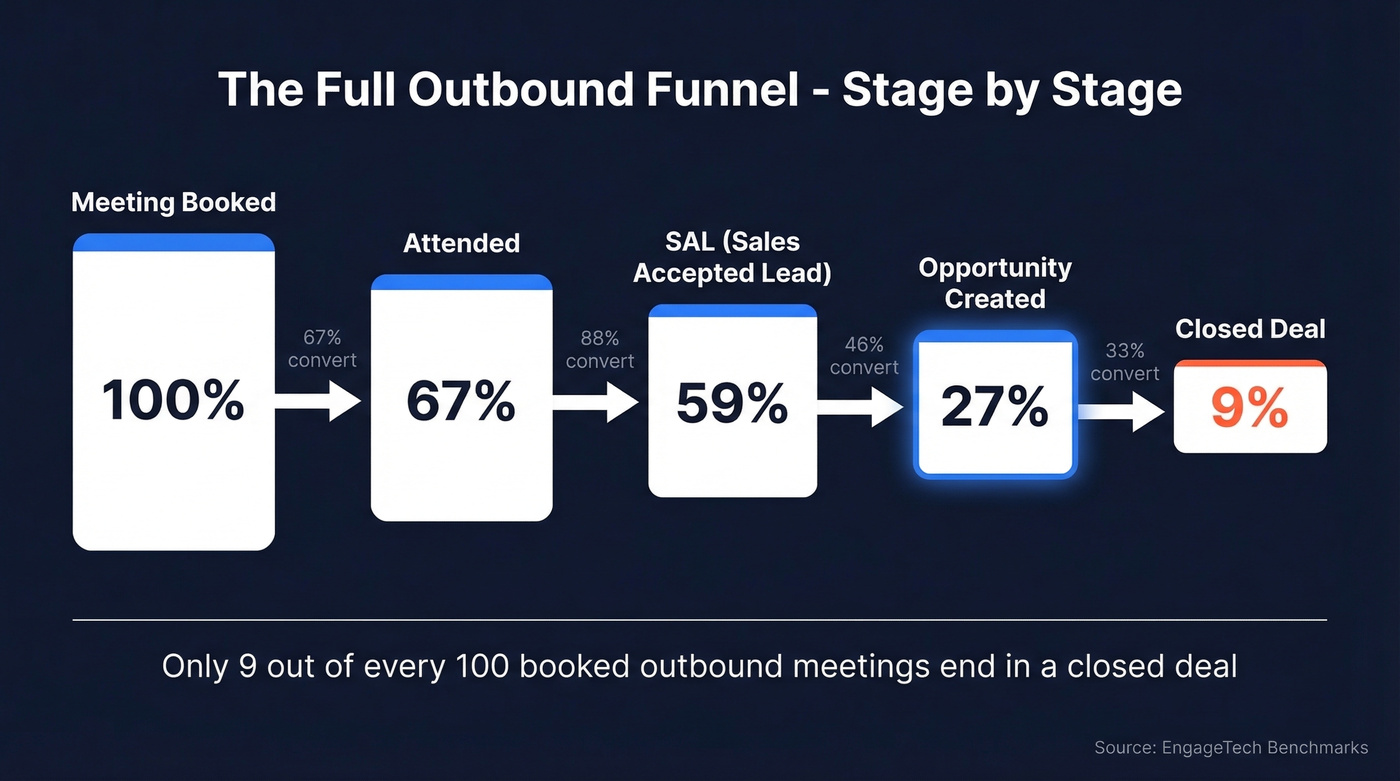
EngageTech published the most granular outbound funnel breakdown we've found. Here's the stage-by-stage chain:
| Stage | Conversion | Cumulative from Booked |
|---|---|---|
| Meeting booked -> Attended | 67% | 67% |
| Attended -> SAL | 88% | 59% |
| SAL -> Opportunity | 46% | 27% |
| Opportunity -> Closed Deal | 33% | 9% |
Roughly 9% of booked outbound meetings end in a closed deal. That number should reframe how you think about meeting volume: you need a lot of at-bats, and every percentage point of improvement at the meeting-to-opportunity stage compounds downstream.
The ABM number deserves context too. That 63% figure came from a mid-market B2B SaaS team that rebuilt their entire ABM motion with tight account selection, personalized microsites, and full sales-marketing alignment. It's aspirational, not average.
Benchmarks by Industry and Company Size
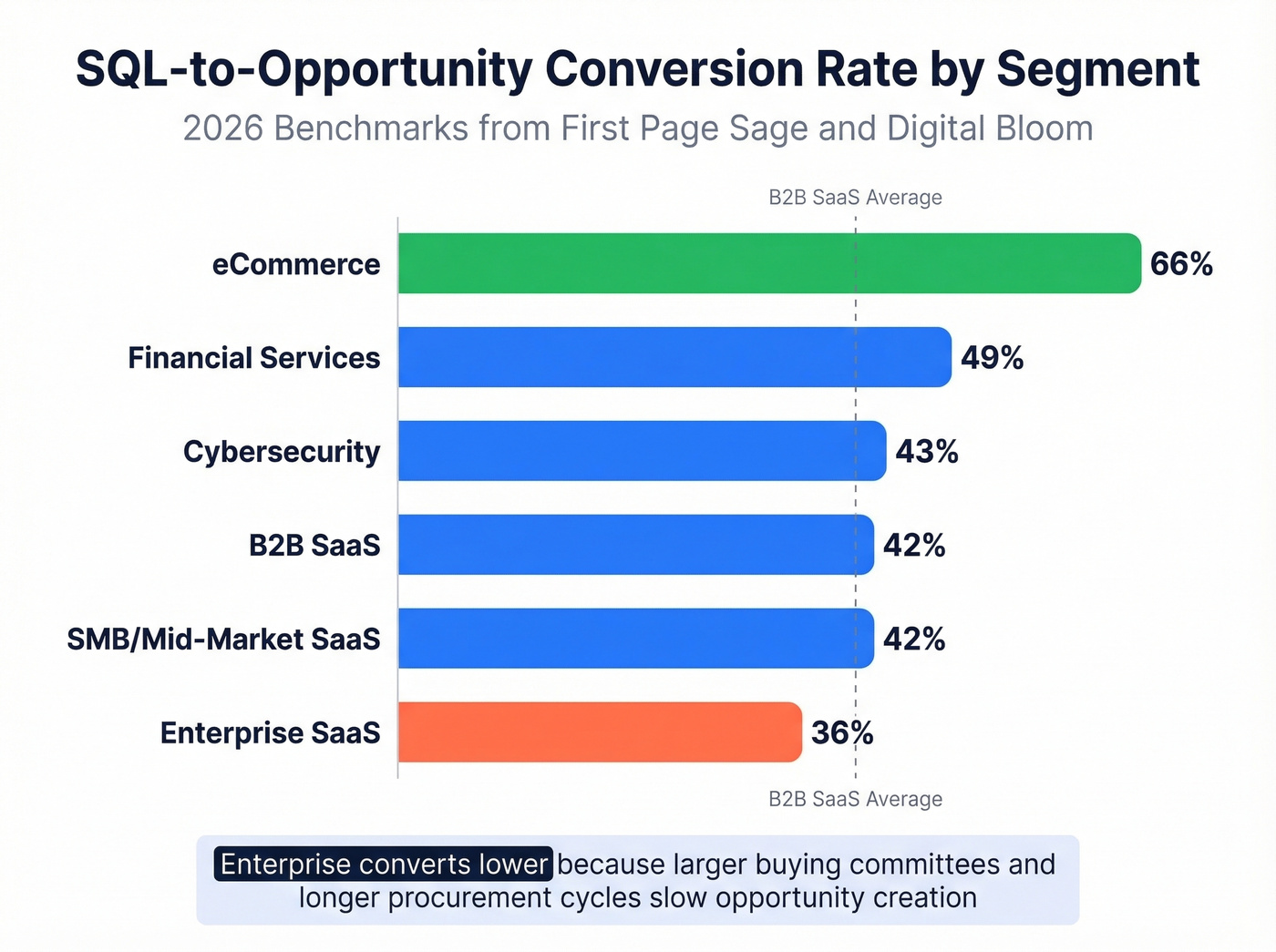
First Page Sage and Digital Bloom both publish SQL-to-opportunity benchmarks across segments. Here's how they break down:
| Segment | SQL-to-Opportunity Rate |
|---|---|
| B2B SaaS | 42% |
| Cybersecurity | 43% |
| Financial Services | 49% |
| eCommerce | 66% |
| SMB/Mid-Market SaaS | 42% |
| Enterprise SaaS | 36% |
Enterprise deals convert lower because buying committees are larger and procurement cycles drag on. A meeting with one champion doesn't become an opportunity until you've mapped the committee - and that takes more conversations.
If you’re selling into larger orgs, it helps to benchmark against enterprise B2B sales norms rather than SMB motions.
Hot take: If your enterprise opportunity create rate is above 50%, you're probably creating opportunities too early. That inflated number will haunt you when your win rate craters and your pipeline "evaporates" at forecast time. A lower create rate with tighter qualification is worth more than a high one built on wishful thinking.
Why Your Rate Is Low
Here's a diagnostic checklist. Work through it top to bottom - the fixes at the top have the highest leverage.
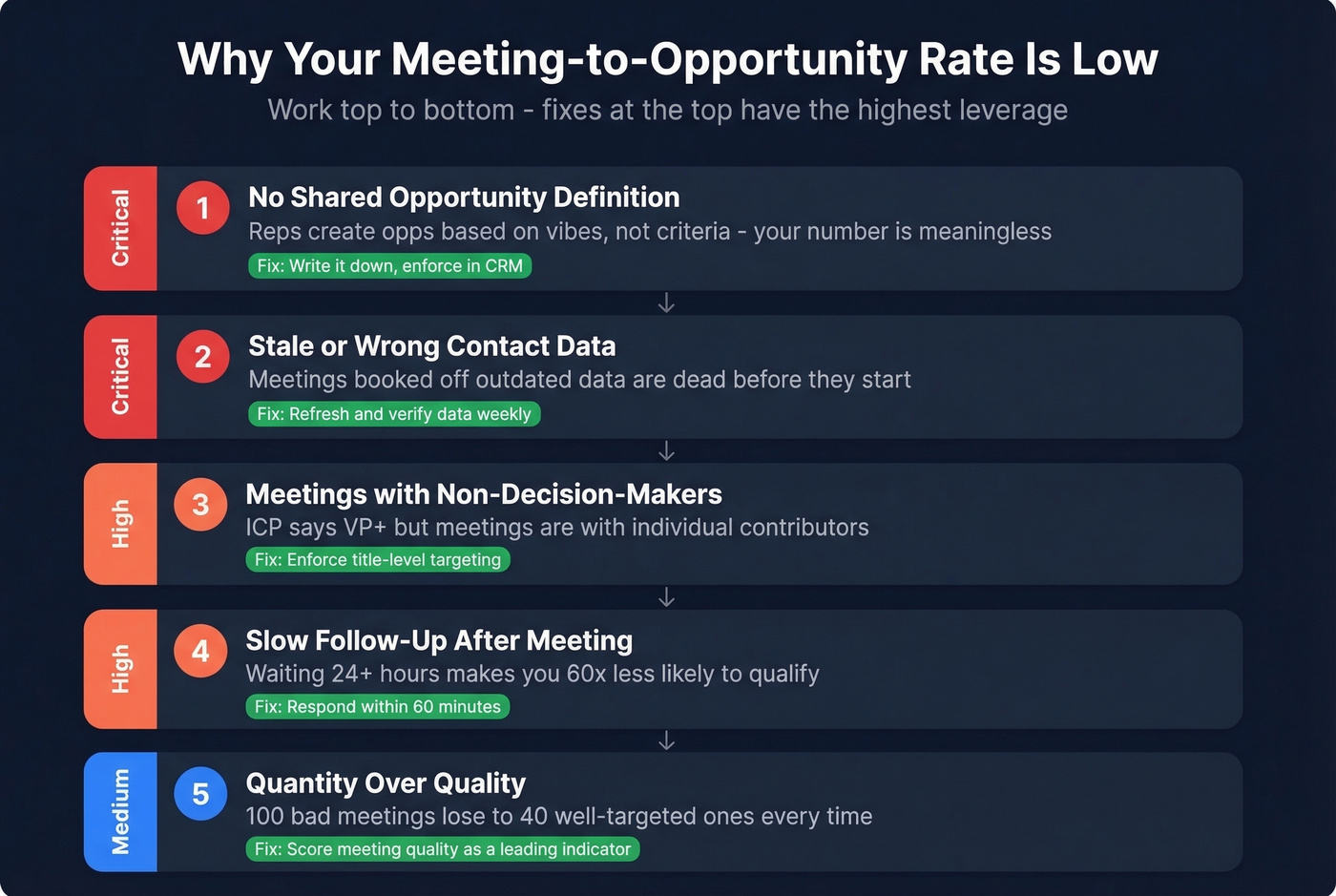
1. No shared opportunity definition. If reps create opportunities based on vibes rather than criteria, your number is meaningless. Salesforce and HubSpot both let you enforce stage-specific requirements, but most teams never configure them. We've seen teams double their reported conversion rate overnight just by tightening their opportunity criteria - and then watched it drop back to reality when they enforced those criteria consistently. Both moves were progress.
2. Stale or wrong contact data. Meetings booked off outdated data are dead before they start. When an SDR reaches someone who changed roles six months ago, that meeting was never going to convert. This is a data quality problem, and it's fixable - tools like Prospeo refresh contact data every 7 days and verify emails at 98% accuracy, so your reps meet the right person at the right company while that company is actually in-market. (If you’re evaluating vendors, start with these data enrichment services.)
3. Meetings with non-decision-makers. Related to data quality, but distinct. If your ICP says VP+ and your meetings are with individual contributors, no amount of sales skill fixes the conversion math. This is a targeting problem, not a selling problem.

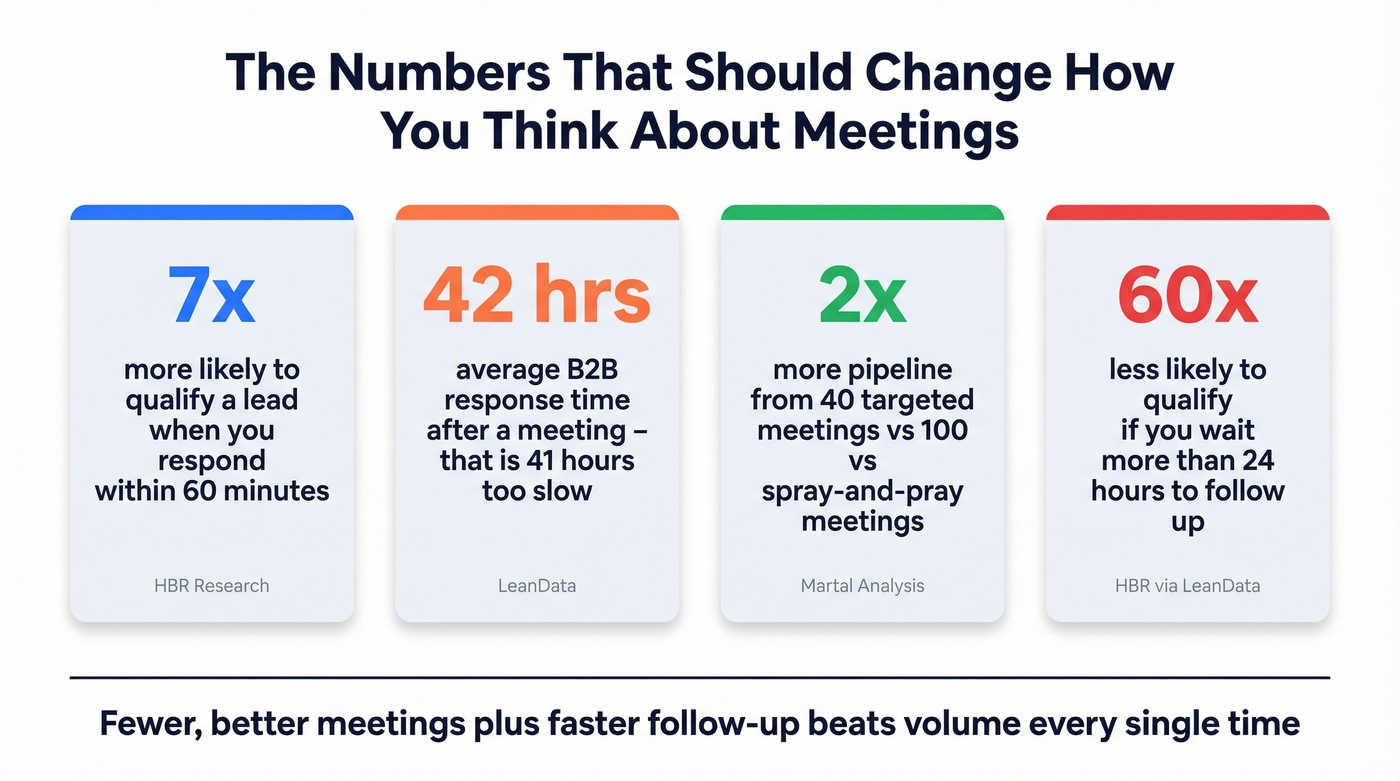
4. Slow follow-up after the meeting. LeanData cites HBR research showing that waiting 24+ hours makes you 60x less likely to qualify a lead than responding in the first hour. The average B2B response time? 42 hours. That gap alone explains a lot of lost opportunities. If you need a system for this, use proven sales follow-up templates and standardize them across the team.
5. Quantity over quality. Martal's analysis illustrates this perfectly: 100 meetings producing 15 opportunities vs. 40 well-targeted meetings producing 30. Fewer, better meetings almost always win on pipeline generated.
How to Improve Your Conversion Rate
Five fixes ranked by impact.
1. Standardize opportunity creation criteria. Get sales and marketing in a room. Define exactly what qualifies a meeting as an opportunity - need, authority, budget path, timeline, agreed next step. Write it down. Put it in your CRM as required fields. This alone can shift your reported rate by 10-20 points in either direction, and more importantly, it makes the metric trustworthy. (If you want a deeper framework, borrow from MEDDIC sales qualification.)
2. Fix contact data upstream. Run your list through an enrichment tool before your next campaign. Prospeo's enrichment returns verified contact data on 83% of leads at roughly $0.01 per email - cheaper than a single wasted meeting with someone who left the company three months ago. When your reps sit down for a call, they should already know the person's current title, company, and whether that company is showing buying intent. This is also where lead enrichment and consistent firmographic filters make a measurable difference.
3. Qualify harder before the meeting. Don't just book meetings - confirm ICP fit, authority level, and at least a surface-level need before the calendar invite goes out. In our experience, adding a single qualifying question to the booking flow ("What's driving your interest in solving this now?") filters out 20-30% of time-wasters before they hit a rep's calendar. Pre-meeting qualification emails or brief discovery calls cut no-shows and boost conversion significantly. If you need prompts, use a structured set of discovery questions.
4. Reduce follow-up time to under one hour. Responding within 60 minutes makes you 7x more likely to qualify a lead. Zendesk cut their response time from 45 minutes to 8 minutes with routing automation and saw immediate pipeline impact. If your reps are waiting a day to follow up after a meeting, you're leaving opportunities on the table.
5. Score meeting quality as a leading indicator. Track not just "meeting held" but a meeting quality score based on ICP match, seniority, and engagement signals. This gives you a predictive metric that catches problems weeks before your opportunity numbers drop. Most CRMs support custom scoring fields - the hard part isn't the technology, it's getting reps to fill them in honestly. If you want a formal model, implement lead scoring and mirror it for meetings.
Quick Conversion Rate Calculator
Want to see where you stand?
- Pull total meetings held last quarter from your CRM
- Pull total opportunities created from those same meetings - not from inbound or other sources
- Divide opportunities by meetings, multiply by 100
- Compare against the benchmarks above for your motion type
If your outbound rate is below 10%, you've got a targeting or data quality problem. Between 10-20%, you're in the normal range but have room to tighten qualification. Above 25% on cold outbound, you're doing something right - or your opportunity criteria are too loose. Check your win rate to confirm which one it is.
The benchmarks are clear: tightly targeted outbound converts at 25-30%, while sloppy targeting drags you below 10%. The difference is data quality. Prospeo gives you 30+ filters - buyer intent, job changes, headcount growth, technographics - so every meeting your team books has a real path to becoming a qualified opportunity.
Every percentage point at the meeting stage compounds downstream. Start compounding.
FAQ
What's a good meeting-to-opportunity conversion rate?
Outbound cold meetings convert at 10-30%, inbound demo requests at 30-50%, and ABM motions at 40-60%+. The number only means something if your team has agreed on what qualifies as an "opportunity" - without shared criteria, benchmarking is pointless.
How is this different from lead-to-opportunity conversion?
Lead-to-opportunity measures the full funnel from first touch to pipeline. Meeting-to-opportunity isolates what happens after a live conversation - whether your meetings are with the right people and whether your qualification process works. It's a tighter, more diagnostic metric.
What's a healthy opportunity create rate for enterprise sales?
Enterprise teams typically see 25-36% because larger buying committees and longer procurement cycles slow qualification. If your number is significantly higher, audit whether reps are advancing deals that haven't truly been qualified - a bloated pipeline today becomes a forecasting problem next quarter.
How do I make sure meetings are with the right people?
Verify contact data before outreach. Check emails and job titles on a regular refresh cycle so you aren't booking meetings with people who've changed roles. Pair that with pre-meeting qualification - confirm ICP fit and authority level before the calendar invite goes out.