

Modern Sales Prospecting: What Actually Works in 2026
84% of reps missed quota last year. 69% say they don't have enough leads to make it. The average rep spends just 37.67% of their time actually selling - the rest vanishes into admin, internal meetings, and manual research that goes nowhere. Modern sales prospecting isn't broken because reps aren't working hard enough. It's broken because the 2022 playbook doesn't survive contact with 2026 inboxes.
The Short Version
Effective prospecting in 2026 comes down to three things: verified data, signal-based targeting, and deliverability-first email. If you only fix one thing, fix your data. Everything else follows.
What's Actually Changed
Three shifts define B2B outreach right now, and each one has made the tactics teams relied on look fundamentally different from even a few years ago.
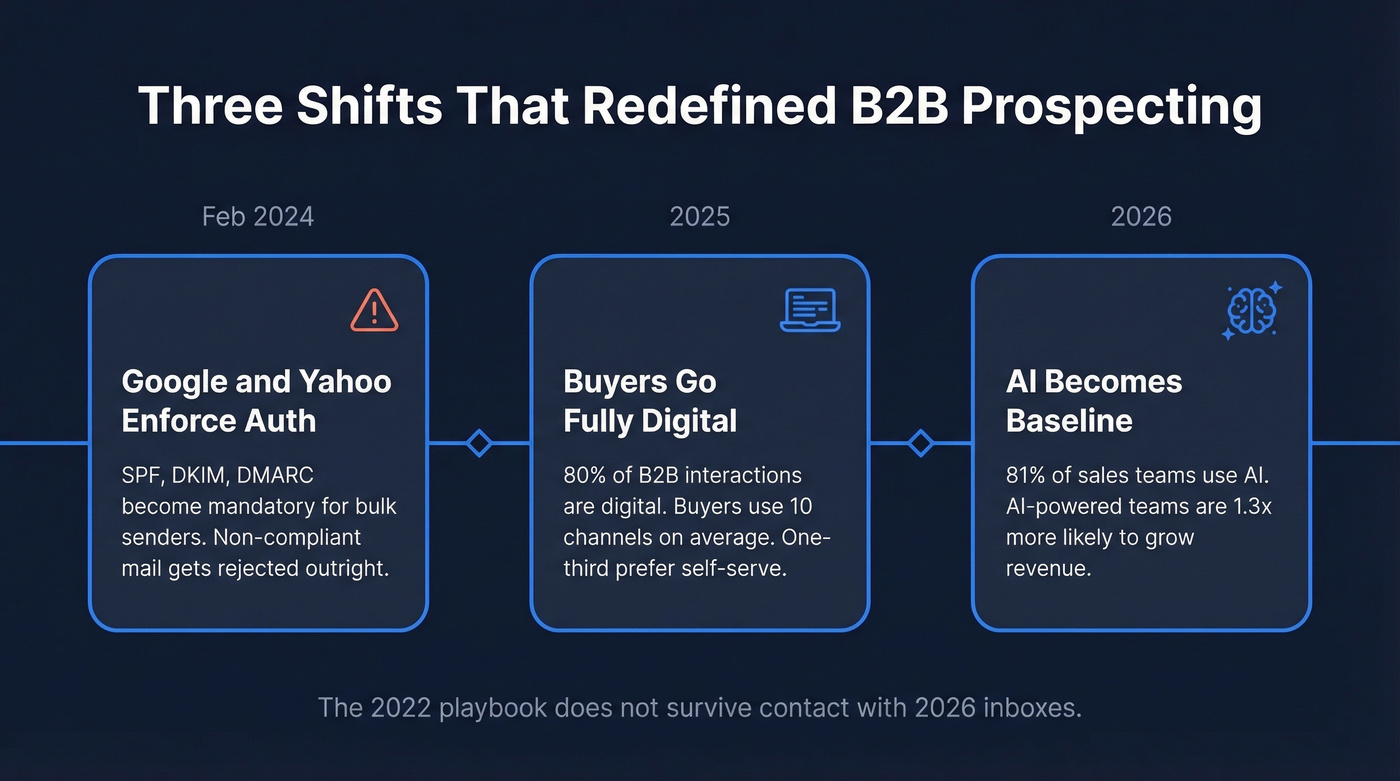
AI went mainstream. 81% of sales teams have implemented or are experimenting with AI in their sales process, and teams using AI are 1.3x more likely to see revenue growth. This isn't experimental anymore - it's baseline infrastructure.
Deliverability got enforced. Google and Yahoo started enforcing bulk sender requirements in February 2024. Microsoft followed in May 2025. Non-compliant mail increasingly gets rejected outright, not just spam-foldered. SPF, DKIM, and DMARC aren't optional.
Buyers went fully digital. Gartner projected 80% of B2B sales interactions would be digital by 2025, and that's exactly where we are. Buyers now use an average of 10 interaction channels, and McKinsey's "rule of thirds" holds: at any stage, roughly a third of buyers prefer in-person, a third remote, and a third digital self-serve. If you're only emailing, you're missing two-thirds of the room.
One enterprise rep on r/sales summed it up as "a lot harder to connect" than even two years ago. The data backs that up.
Prospecting Strategies That Work Now
Start With Verified Data
SDRs burn 20-40% of their time on manual data research. Every bounced email chips away at your domain reputation, and once that's damaged, even your good emails stop landing.
We've seen this play out repeatedly. Meritt saw bounce rates drop from 35% to under 4% and pipeline triple after switching to a verified data source. The fix isn't complicated - start with a database that refreshes weekly instead of every 4-6 weeks, verify before you send, and stop treating bad data as an acceptable cost of doing business.

Target by Fit, Timing, and Reachability
Building an ICP list isn't the bottleneck anymore. The bottleneck is knowing who to call right now.
Layer three inputs: fit (does this account match your ICP?), timing (are they showing buying signals?), and reachability (can you actually get through?). Treat intent data as a filter, not a list - pair it with first-party engagement, hiring patterns, and trigger events. An account that matches your ICP, just raised a Series B, and has a verified direct dial for the VP of Sales is worth ten accounts that only match on firmographics.
Use Signals, Not Static Lists
Signal-personalized outreach achieves 15-25% reply rates versus the 3-5% cold email average. Stack real-time events - leadership changes, funding rounds, hiring surges, tech adoption - into your messaging. Accounts with 3+ active signals convert at 2.4x the rate of single-signal accounts.
Static lists pulled once a quarter can't compete. If you were still running batch-and-blast in 2023, the gap between that approach and signal-driven targeting has only widened since.
Fix Deliverability Before Scaling
Look: only 16% of domains have implemented DMARC. If yours isn't one of them, your outbound is at risk before a single email gets written.
The non-negotiables: SPF, DKIM, and DMARC configured; bounce rate under 2%; spam complaint rate under 0.3%; one-click unsubscribe headers. Implementation takes 6-8 weeks, so start now. Not next quarter. Now.
If you need a step-by-step, use an email deliverability checklist and track your email bounce rate weekly.
Personalize by Depth, Not by Name
Dropping someone's first name into a subject line isn't personalization - it's a mail merge. The reply-rate ladder tells the real story: 1-3% with no personalization, 5-9% with basic tokens, 9-15% with advanced research, and 15-25% with signal-based messaging. Belkins found that campaigns of 50 or fewer recipients average 5.8% response, while campaigns over 500 drop to 2.1%.
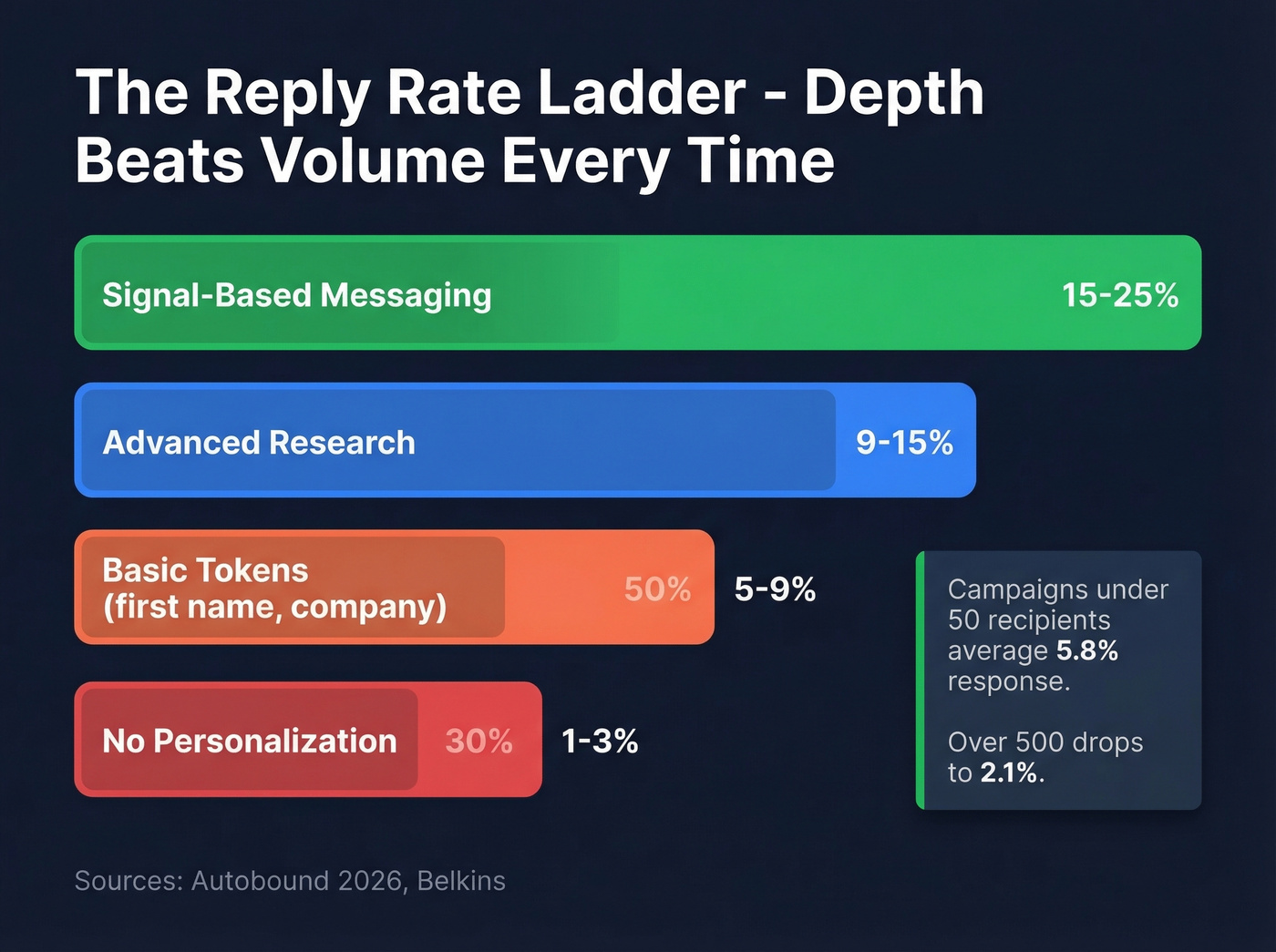
Depth beats volume every time.
If you're stuck on what to write, start from proven sales follow-up templates and refine from there.
Multi-Thread the Account
The average mid-market buying committee includes 7 people, and 89% of B2B buyers report a deal stalling in the past year. Single-threading to one champion is a recipe for ghosted deals. Map the committee early - economic buyer, technical evaluator, end user - and run parallel sequences.
Generational preferences matter here too: younger buyers skew toward chat and social, while senior decision-makers still respond to direct calls and email. When your champion goes dark, you've got other doors open.
Let AI Prioritize, Not Replace
60% of B2B software teams already use AI across their sales process, and those teams are 1.3x more likely to grow revenue. The real value isn't AI writing your emails. It's AI surfacing which accounts to work right now, summarizing signals, and cutting manual research time by 50%+. AI SDR agents like Reply.io, Artisan, and AiSDR are worth watching at $350-$2,000/mo, but they're supplements, not replacements.
If you're evaluating tools, compare your options against a ranked list of SDR tools and a practical guide to generative AI sales tools.
Let's be honest about stack bloat: if your average deal size is under $10k, you probably don't need a $15,000/year data platform or a $2,000/mo AI SDR. A verified data source, a sequencer, and disciplined signal-based targeting will outperform an over-engineered stack nine times out of ten.

You just read that SDRs burn 20-40% of their time on manual research and bad data. Prospeo's 300M+ profiles refresh every 7 days - not every 6 weeks - with 98% email accuracy and 125M+ verified mobile numbers. Meritt tripled their pipeline and dropped bounce rates to under 4%. At $0.01 per email, fixing your data costs less than one bounced campaign.
Stop prospecting with stale data. Start with numbers that actually connect.
A 14-Day Multichannel Cadence
43% of buyers who accept meetings say it's fine for sellers to contact them five or more times. Start midweek mornings - Tuesday through Thursday - for initial outreach.
| Day | Channel | Action |
|---|---|---|
| 1 | Signal-based cold email | |
| 2 | Social | Connect request + shared note |
| 3 | Phone | Direct dial, reference email |
| 5 | Follow-up with resource | |
| 7 | Social | Engage with their content |
| 8 | Phone | Second call attempt |
| 9 | Case study or proof point | |
| 11 | Social | Social DM with value-add |
| 13 | Phone | Final call attempt |
| 14 | Breakup email |
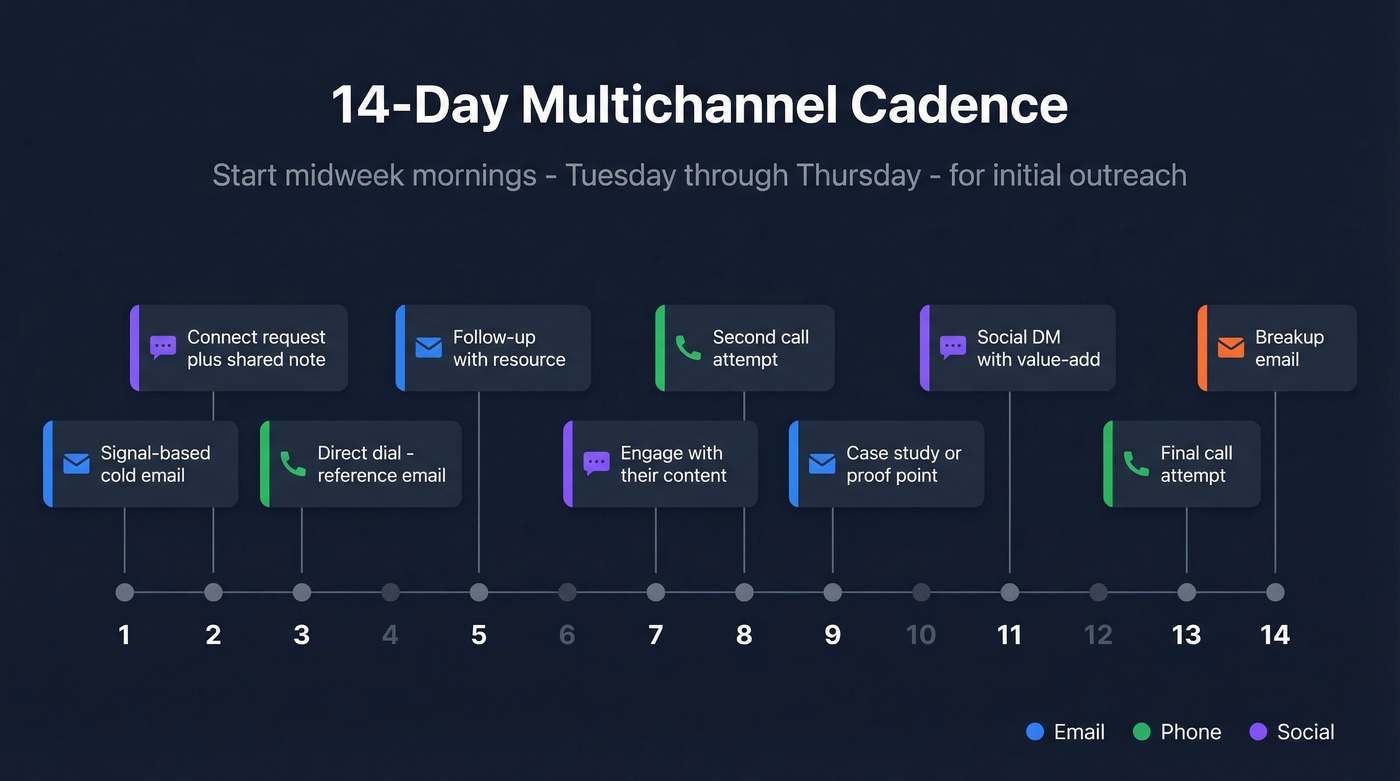
Social touches get a boost when you mention shared commonalities - 46% higher InMail acceptance rates when sellers reference shared connections or backgrounds.
Your Prospecting Tool Stack
| Tool | Best For | Starting Price |
|---|---|---|
| Apollo | All-in-one on a budget | Free tier; $49/user/mo |
| ZoomInfo | Enterprise data + intent | ~$15,000/year |
| Clay | Signal-based enrichment | $185/mo |
| Lusha | Quick contact lookups | $36/mo |
| Hunter | Email finding + verification | $34/mo |
| Reply.io AI SDR | Autonomous outbound | $350/mo |
Skip ZoomInfo if you're a team under 20 reps - the contract minimums and onboarding overhead rarely justify the cost at that scale. For teams building from scratch, start with verified data, a sequencer like Outreach or Salesloft, and a CRM. That's the minimum viable stack.
If you're building the stack from scratch, it helps to understand what a CRM actually is (and isn't) - see examples of a CRM.
In our experience, teams that fix data quality first see measurable results within the first month. Snyk's 50-person AE team cut bounce rates from 35-40% to under 5% and saw AE-sourced pipeline jump 180% after switching to weekly-refreshed data. Add intent data and a signal tool like Clay once you're consistently booking 15+ meetings per month.

Modern sales prospecting demands signal-based targeting, verified direct dials, and multichannel cadences - all powered by data you can trust. Prospeo gives you 30+ filters including buyer intent across 15,000 topics, technographics, job changes, and funding signals. Layer fit, timing, and reachability in one platform instead of stitching together a bloated stack.
One platform for signals, verified contacts, and intent - no $15K contracts required.
Common Mistakes to Avoid
Blasting untargeted lists. Emails to large unsegmented lists get 67% fewer replies than smaller targeted groups. Volume isn't pipeline.
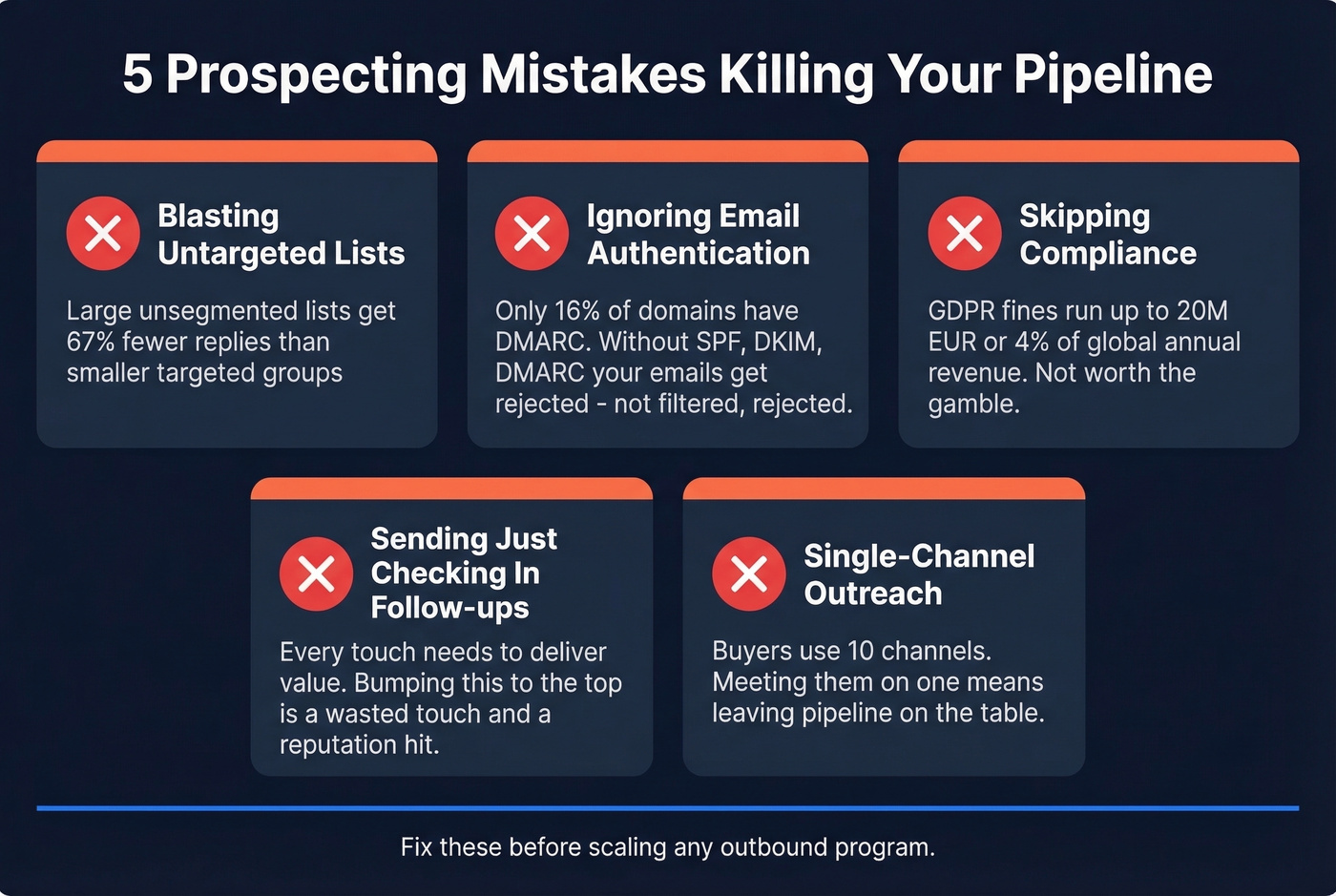
Ignoring authentication. Without SPF, DKIM, and DMARC, your emails get rejected - not filtered, rejected. This is the single fastest way to kill an outbound program. If you want the technical nuance, start with DMARC alignment and a clean SPF record example.
Skipping compliance. GDPR fines run up to EUR 20M or 4% of global annual revenue. If you're prospecting into the EU without a lawful basis, you're gambling with real money. (If you're unsure where the line is, read Is It Illegal to Buy Email Lists?.)
Sending "just checking in" follow-ups. Every touch needs to deliver value. A follow-up that says "bumping this to the top of your inbox" is a wasted touch and a reputation hit. Use alternatives from How to Say Just Checking In Professionally.
Single-channel outreach doesn't cut it either. Buyers use 10 channels. Meeting them on one is leaving pipeline on the table.
FAQ
What is modern sales prospecting?
It's proactive, rep-driven outreach that combines verified data, real-time buying signals, and multichannel sequences to reach high-fit accounts. It replaces the old spray-and-pray model with targeted, signal-based engagement across email, phone, and social - typically requiring 8-12 touches over two to three weeks.
How many touches to book a meeting?
Research consistently shows 8-12 touches across multiple channels over two to three weeks. 43% of buyers who accept meetings say five or more contacts is fine - the key is varying channels and adding value each time, not repeating the same "just following up" message.
What tools do you need to prospect effectively?
At minimum: a verified data source for accurate emails and mobiles, a sequencing tool like Outreach or Salesloft, and a CRM. Add intent data and a signal tool like Clay once you're booking 15+ meetings per month.
What's the difference between prospecting and lead generation?
Prospecting is outbound and rep-driven - you choose the accounts and initiate contact. Lead generation is inbound and marketing-driven - content, ads, and events pull buyers toward you. The best teams blend both, using marketing to capture intent signals while reps prospect the highest-fit accounts directly.
How has prospecting changed since 2025?
The biggest shift is enforcement. Email authentication rules that were recommendations became hard requirements, AI tools moved from pilot programs to core workflows, and buyers now expect every touchpoint to be relevant. Teams that adapted early had a head start - those still catching up need to prioritize deliverability and signal-based targeting immediately.