

MQL to SQL Conversion Rate: 2026 Benchmarks, Channel Data & How to Fix It
A manufacturing company spending $25k/month on paid media watched their MQL to SQL conversion rate sit below 10% for three straight months. Google drove the most volume, but most of those leads were unqualified. That's not a media problem - it's a measurement and qualification problem, and it's more common than most teams admit.
The cross-industry average sits at 13%. That number is almost useless without context.
What Is MQL to SQL Conversion Rate?
This metric measures the percentage of marketing qualified leads that sales accepts and advances as sales qualified leads:
(SQLs / MQLs) x 100 = MQL to SQL Conversion Rate
If marketing generates 500 MQLs in a quarter and 65 become SQLs, your rate is 13%. Simple math, but timing matters. If your average conversion time from MQL to SQL is three months, you need to compare SQLs created in month three against MQLs from month one - not both in the same month. Same-month calculations distort the rate for any B2B sales cycle over 30 days, and we've seen teams misdiagnose "low conversion" when the real issue was just a measurement lag.
The Short Version
- The cross-industry average is 13%, but rates range from 11% in fintech to 26% in HVAC/insurance by industry, and from 26% for PPC to 51% for SEO by channel.
- If your SQL conversion rate is below 10%, the problem is almost always one of three things: vague MQL definitions, slow follow-up, or bad contact data.
- The single highest-impact fix? Respond to MQLs within 5 minutes. You're 100x more likely to convert versus waiting 30 minutes.
2026 Benchmarks by Industry
The 13% average masks enormous variation. An HVAC company and a fintech startup operate in completely different universes - their conversion rates should look nothing alike.
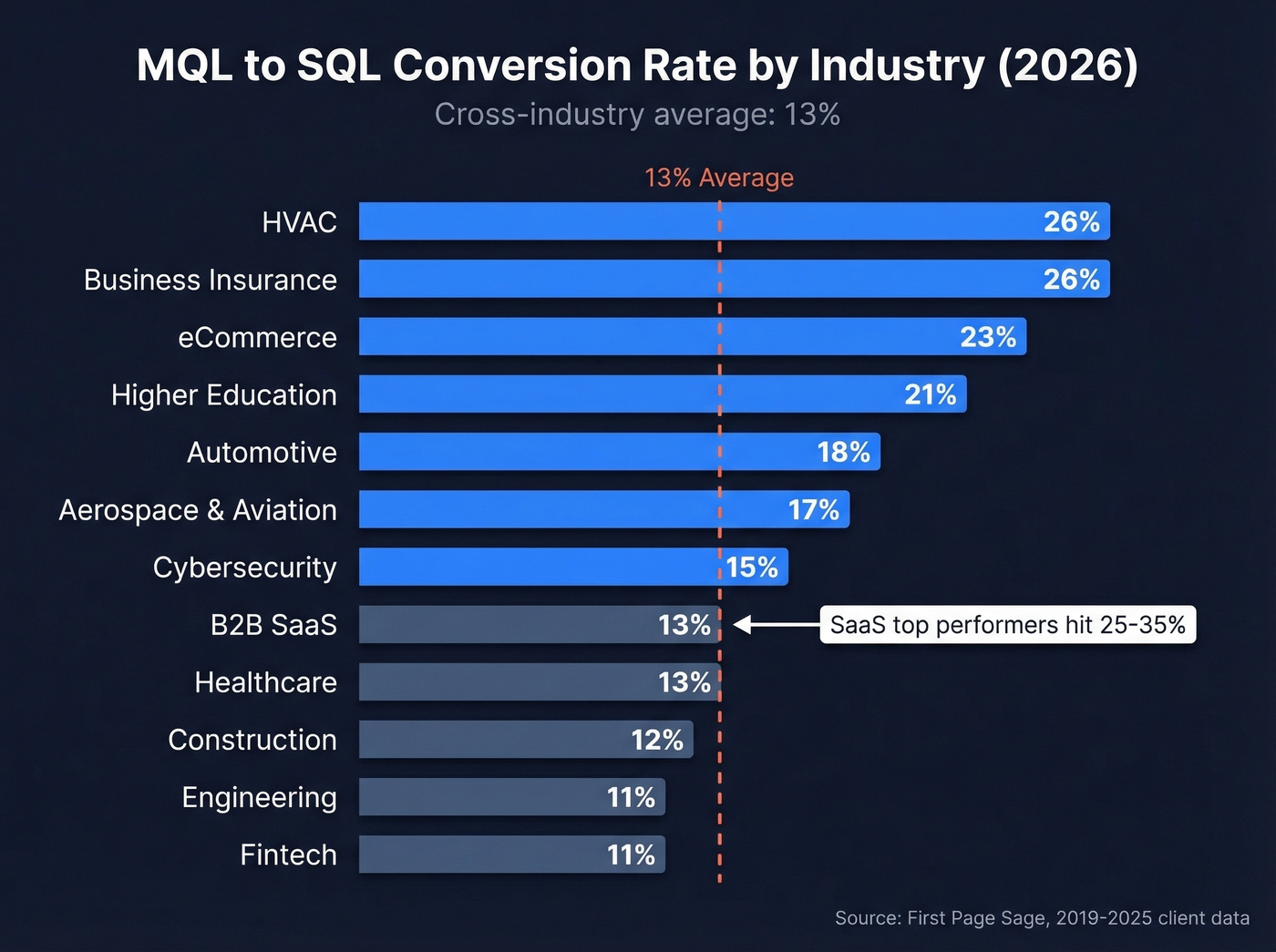
Here's the industry breakdown from First Page Sage, based on client data gathered between 2019 and 2025:
| Industry | MQL to SQL Rate |
|---|---|
| HVAC | 26% |
| Business Insurance | 26% |
| eCommerce | 23% |
| Higher Education | 21% |
| Automotive | 18% |
| Aerospace & Aviation | 17% |
| Cybersecurity | 15% |
| B2B SaaS | 13% |
| Healthcare | 13% |
| Construction | 12% |
| Engineering | 11% |
| Fintech | 11% |
Industries with shorter sales cycles and clearer buyer intent convert at double the rate of complex, multi-stakeholder B2B sales. If you're in B2B SaaS and comparing yourself to a blended 13% that includes HVAC, you're benchmarking against the wrong universe.
B2B SaaS teams specifically tend to average 18-22%, with top performers hitting 25-35%. The gap between 13% and 18-22% reflects different methodologies and sample compositions. If you're sitting at 13% in SaaS, you're average across all industries but underperforming for your category. That distinction matters when you're setting targets.
Benchmarks by Channel
If your blended rate is low, the problem might be your channel mix, not your sales team.
| Channel | MQL to SQL Rate |
|---|---|
| SEO | ~51% |
| Email Marketing | ~46% |
| Webinars | ~30% |
| PPC | ~26% |
| Events | ~24% |
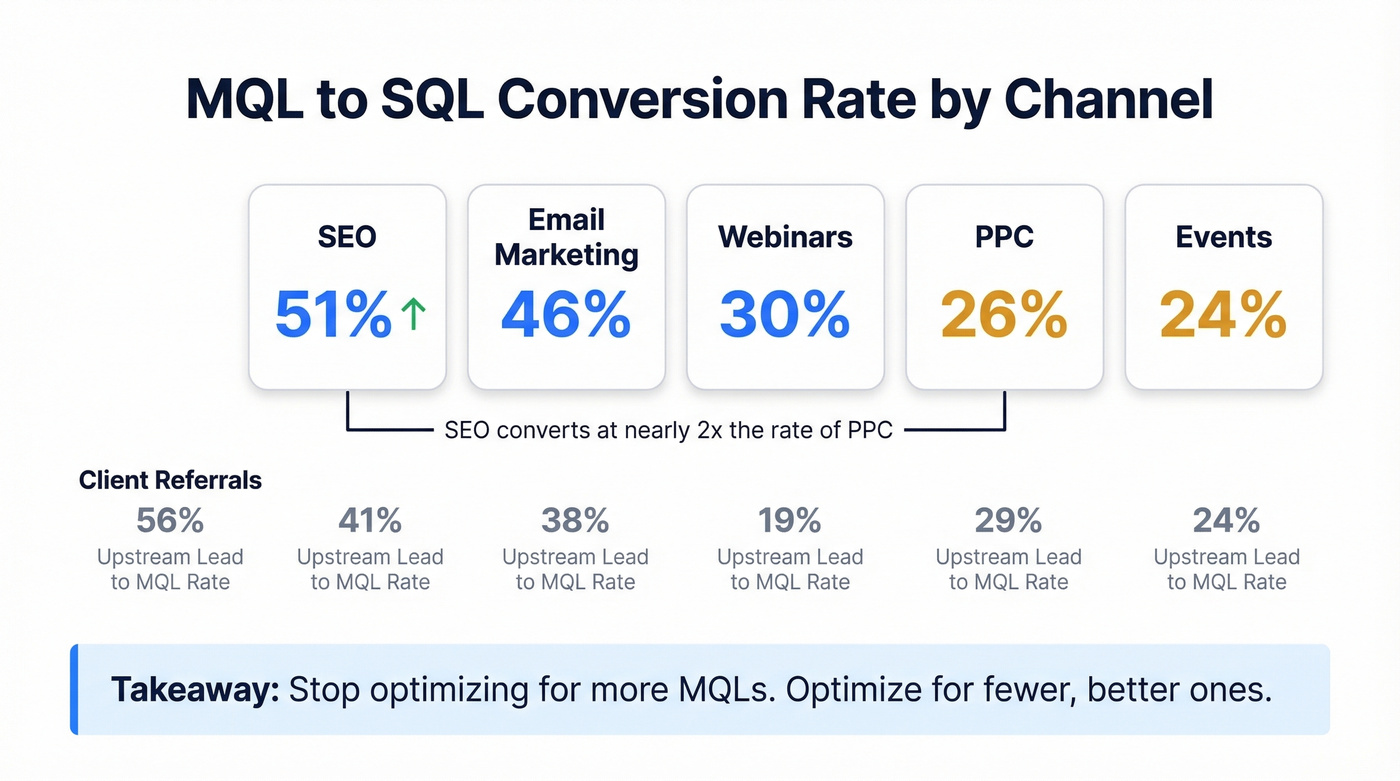
SEO leads convert at nearly double the rate of PPC leads. This makes sense: today's B2B buyers complete roughly 67% of their research before engaging sales and consume 13+ pieces of content in the process. Content-driven channels meet them deep in evaluation mode with high intent. The pattern holds downstream too - organic content produces leads that advance through the full funnel at significantly higher rates than paid channels.
The story starts even earlier. Upstream lead-to-MQL rates by channel explain why downstream conversion varies so much:
| Channel | Lead to MQL Rate |
|---|---|
| Client Referrals | 56% |
| SEO | 41% |
| 38% | |
| PPC | 29% |
| Webinars | 19% |
SEO and referrals produce higher-quality leads from the start. When you pour budget into PPC to inflate MQL volume, you're diluting pipeline quality. Stop optimizing for more MQLs. Optimize for fewer, better ones.
If you want a broader baseline, compare this against the average B2B lead conversion rate across the funnel.

You just read that bad contact data is one of the top three reasons MQL to SQL rates tank. SDRs mark leads "unresponsive" when the real problem is bounced emails and disconnected numbers. Prospeo's 98% email accuracy and 125M+ verified mobiles mean your reps reach real buyers - not dead inboxes.
Stop losing qualified leads to stale data. Fix it in minutes.
Full-Funnel Conversion Context
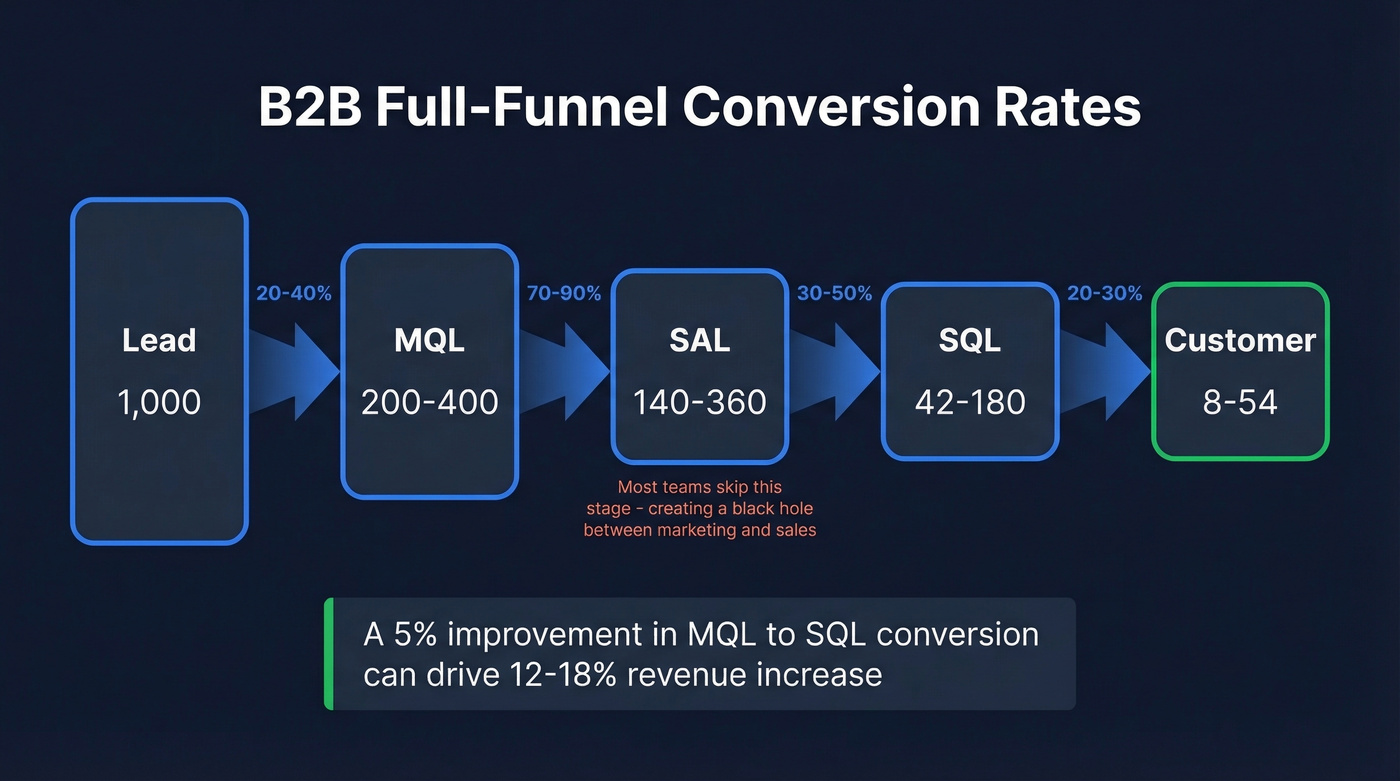
MQL to SQL is one stage in a longer chain. Here are the typical stage-to-stage rates for B2B:
| Stage | Typical Rate |
|---|---|
| Lead to MQL | 20-40% |
| MQL to SAL | 70-90% |
| SAL to SQL | 30-50% |
| SQL to Customer | 20-30% |
Most teams skip the SAL (Sales Accepted Lead) stage entirely, creating a black hole between marketing and sales. A SAL is an MQL that sales has reviewed and accepted as worth engaging - it signals a formal handoff and a commitment to follow up within a defined timeframe. Without it, MQLs pile up in a queue nobody owns.
The revenue math is compelling. For a typical B2B pipeline, a 5% improvement in MQL to SQL conversion can drive a 12-18% revenue increase, and strong lead management generates 50% more sales-ready leads at 33% lower cost. That's not a rounding error - it's the difference between hitting and missing your annual number.
To pressure-test your funnel, map this stage against your broader funnel metrics and pipeline health.
Why Your Rate Is Low
79% of marketing leads never convert to sales. Three root causes kill conversion rates more than anything else.
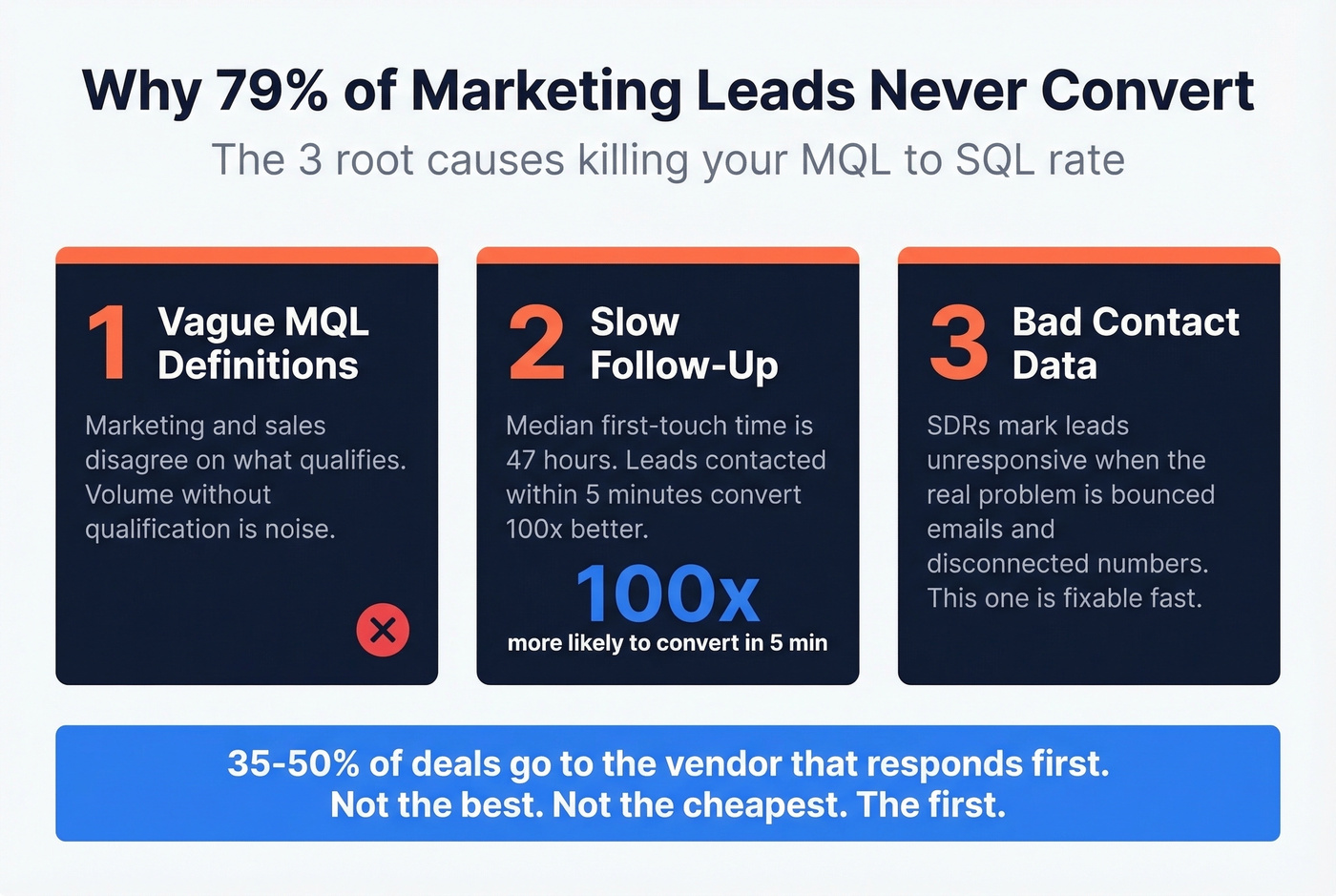
Vague MQL definitions. If marketing and sales can't agree on what qualifies as an MQL, every handoff becomes a negotiation. The manufacturing team spending $25k/month on paid media? Google was driving volume, but most of those leads didn't match their ICP. Volume without qualification is noise. Use an Ideal Customer Profile to lock the definition.
Slow follow-up. MQLs that sit untouched for 24 hours are essentially dead. The speed gap between top-performing and average teams is staggering, and most teams dramatically overestimate how fast they respond. We've audited CRMs where the median first-touch time was 47 hours - nearly two full business days - while the team believed it was "same day." If you need a system, start with sales follow-up templates and a clear importance of follow-up in sales SLA.
Bad contact data. Even a perfectly scored, perfectly timed lead is worthless if the contact info is stale. SDRs mark leads "unresponsive" when the real problem is bounced emails and disconnected numbers. This one's fixable fast - especially if you’re tracking email bounce rate.
How to Improve Your Conversion Rate
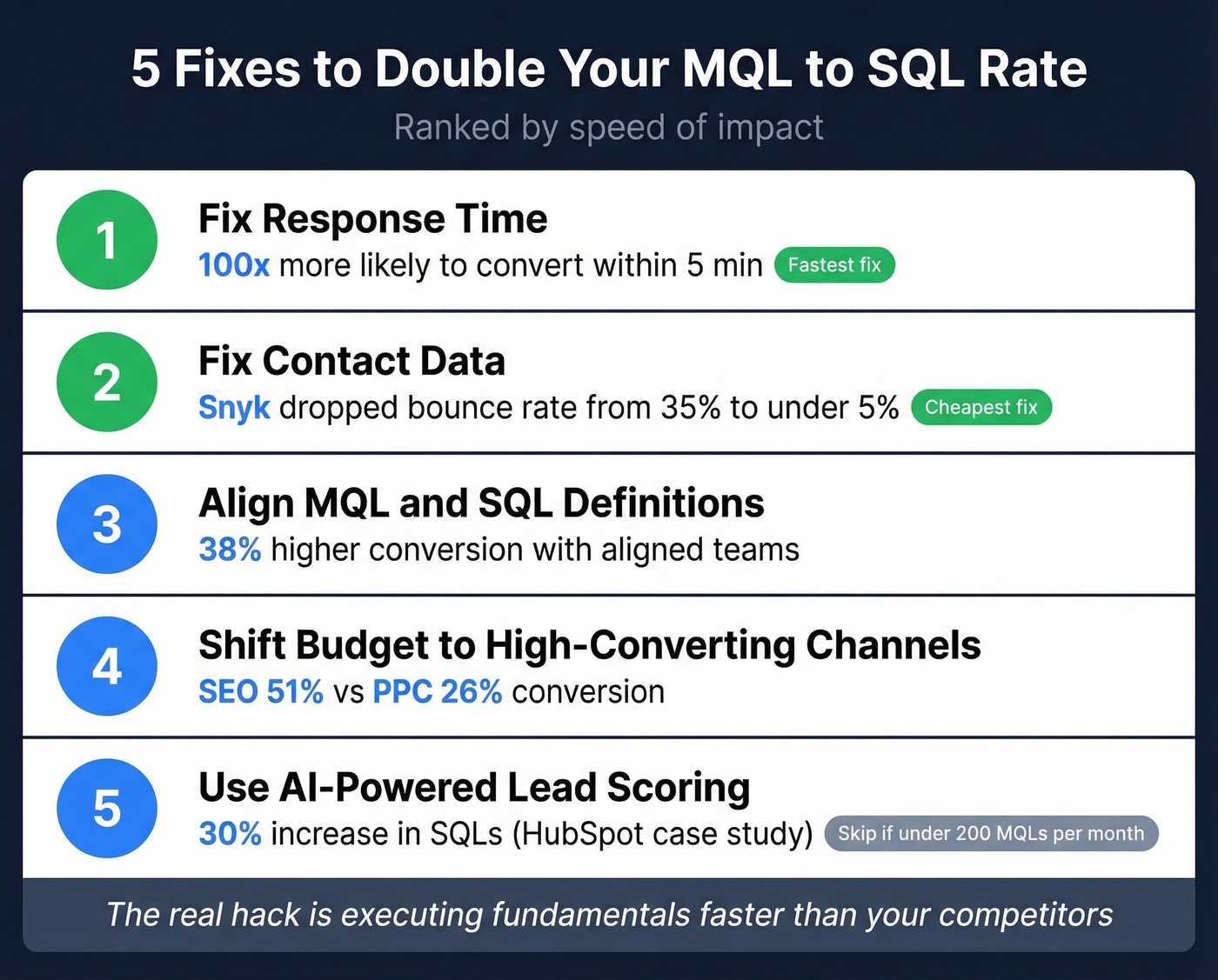
The consensus on r/sales and r/RevOps is that teams spend too much time looking for "unconventional hacks" when the basics aren't covered. Let's be honest: the real hack is executing fundamentals faster than your competitors.
Fix Your Response Time
This is the single fastest lever you can pull. Contacting a lead within 5 minutes makes you 100x more likely to convert them. Wait an hour and you're still 7x more likely to have a meaningful conversation. Wait 24 hours and the probability drops by 60x.
35-50% of deals go to the vendor that responds first. Not the best vendor. Not the cheapest. The first. If your team doesn't have an SLA for MQL response time, fix that before touching scoring models or channel strategy.
Align MQL and SQL Definitions
Marketing and sales need to agree on what counts. Build a specific scoring model: +20 points for a director-level title, +15 for webinar attendance, +10 for a pricing page visit. Set a threshold score for MQL status and get sales to sign off on it. Companies with aligned sales and marketing teams report conversion rates up to 38% higher - the definition alignment alone drives measurable lift.
SQL readiness should require three or more high-intent interactions plus confirmed ICP fit. Think pricing page visits, demo requests, competitor comparison page views. Review these definitions quarterly. What qualified as a strong signal six months ago may not hold as your market shifts.
If you’re formalizing this, use a dedicated lead scoring model and consistent lead status stages.
Shift Budget Toward High-Converting Channels
SEO-sourced MQLs convert at 51% - nearly double PPC's 26%. If your blended rate is dragging, audit your channel mix before blaming the sales team.
Here's the thing: most B2B teams with deal sizes under $25k are dramatically overspending on paid acquisition. Cut MQL volume intentionally. Fewer, higher-intent leads that convert at 40%+ will generate more pipeline than a flood of PPC leads converting at 15%. We've seen teams double their SQL count by cutting their MQL count in half - just by reallocating spend toward organic and email.
Use AI-Powered Lead Scoring
Manual lead scoring misses behavioral patterns that matter. Repeat pricing page visits, multiple content downloads in a short window, competitor comparison page views - these compound signals are hard to weight manually but trivial for machine learning models. HubSpot's implementation of AI lead scoring produced a 30% increase in sales-qualified leads by surfacing leads that human-built scoring rules missed entirely.
Skip this if your MQL volume is under 200/month. At that scale, a well-tuned manual scoring model with 5-7 criteria will outperform an AI model that doesn't have enough data to learn from.
Fix Your Contact Data
None of the above matters if your SDRs can't reach the leads. Bad contact data is the silent killer of MQL to SQL conversion, and it's the problem teams diagnose last because it doesn't show up in a scoring model or a channel report. Every bounced email and disconnected number is a wasted MQL that gets marked "unresponsive" when the real problem was stale data.
Prospeo addresses this with 98% email accuracy and a 7-day data refresh cycle, compared to the 6-week industry average. Snyk's team dropped their bounce rate from 35-40% to under 5% after switching, which directly translated to 200+ new opportunities per month.
Before you invest in better scoring or faster routing, verify your contact data. It's the cheapest, fastest fix with the most immediate impact on conversion. If you’re evaluating vendors, start with data enrichment services.
Responding to MQLs within 5 minutes makes you 100x more likely to convert - but only if your contact data actually works. Prospeo refreshes 300M+ profiles every 7 days, so the emails and direct dials your team hits are current, not months old. At $0.01 per email, bad data is no longer an excuse.
Your MQLs deserve data that converts. Start with 75 free verified emails.
Is the MQL Dead?
The consensus on Reddit and in RevOps circles is shifting - teams are moving toward pipeline velocity, SQL conversion, and revenue impact as primary metrics. MQLs create friction when handoffs happen too early, and plenty of teams are asking whether they should ditch the metric entirely.
MQLs aren't dead. They're misused. An MQL that never gets a demo scheduled is just a form fill. The metric is valuable when it's connected to pipeline and revenue, not treated as a vanity KPI that marketing celebrates in a slide deck.
If your MQL definition is tight, your follow-up is fast, and your contact data is clean, the MQL to SQL conversion rate becomes one of the most useful diagnostic metrics in your funnel. If any of those three are broken, the number is meaningless.
FAQ
What is a good MQL to SQL conversion rate?
The cross-industry average is 13%, but B2B SaaS averages 18-22% and top performers hit 25-35%. By channel, SEO-sourced MQLs convert at 51% while PPC converts at 26%. Benchmark against your specific industry and primary acquisition channels, not a blended average.
How do you calculate this metric?
Divide the number of SQLs by the number of MQLs, then multiply by 100. Use time-lagged cohorts - MQLs created in January measured against SQLs from that same cohort by March - rather than same-month snapshots, which distort the rate for any sales cycle longer than 30 days.
What's the fastest way to improve MQL to SQL conversion?
Respond within 5 minutes - you're 100x more likely to convert versus waiting 30 minutes. Next, verify your contact data so SDRs aren't wasting time on bounced emails. Then audit your channel mix: shifting budget from PPC toward SEO can nearly double your downstream conversion without changing anything else.