

NLP for Sales: What Actually Works, What's Hype, and How to Apply It
A RevOps lead we know spent a couple thousand dollars on an NLP certification, then couldn't get a prospect on the phone because half the numbers in his CRM were disconnected. The techniques were solid. The data wasn't. That tension - between communication skill and practical execution - is the real story of NLP for sales in 2026.
Industry research attributes a 67% close-rate lift to sales mirroring, citing work from Stanford and Northwestern. Whether that exact number holds in every context, mirroring itself is one of the most consistently useful "NLP-adjacent" skills you can train.
Here's the bigger point: natural language processing sales tools and Neuro-Linguistic Programming techniques both deal in language patterns, but the latter is a mix of genuinely useful communication methods and a lot of overreach. Let's separate the two.
If your reps can't reach prospects because of bad phone numbers, no amount of NLP training will save your quarter. Fix the data first, then sharpen the words.
The Short Version
If you only learn three NLP techniques, make them verbal mirroring, reframing objections, and presupposition patterns in your email copy. The one book to read: Words That Change Minds by Shelle Rose Charvet. And none of it matters if you're calling the wrong person - verify your contact data before you practice your tonality.
What Is Neuro-Linguistic Programming?
NLP was developed by Richard Bandler and John Grinder in the 1970s. Neuro refers to how we perceive the world through our senses. Linguistic covers the language and nonverbal cues we use to communicate those perceptions. Programming describes the behavioral patterns we run, often unconsciously, when making decisions.
In practice, NLP is about adapting your communication style to match how a buyer processes information and makes choices. It's pattern recognition applied to conversation, not mind control.
Does NLP Actually Work in Sales?
A 2024 psychiatry commentary in PMC described NLP as making "promises with questionable evidence." The Sturt et al. (2012) systematic review examined 10 studies and concluded there's insufficient evidence to recommend NLP for any health condition outside research purposes.
But a practitioner meta-analysis - mixing peer-reviewed and non-peer-reviewed studies - showed a standardized mean difference of 0.54 (CI 0.20-0.88), a moderate positive effect. The catch: significant heterogeneity across conditions, populations, and techniques.
In sales, the most practical way to think about it is this: individual techniques like mirroring and reframing have stronger standalone support than "NLP" as a bundled system. That 67% close-rate claim is best treated as an industry stat about mirroring specifically, not proof that the entire framework is scientifically validated. Use the techniques that hold up. Skip the mysticism.
You'll notice anchoring isn't on the list below. It works in workshops. On a cold call, it's theater.
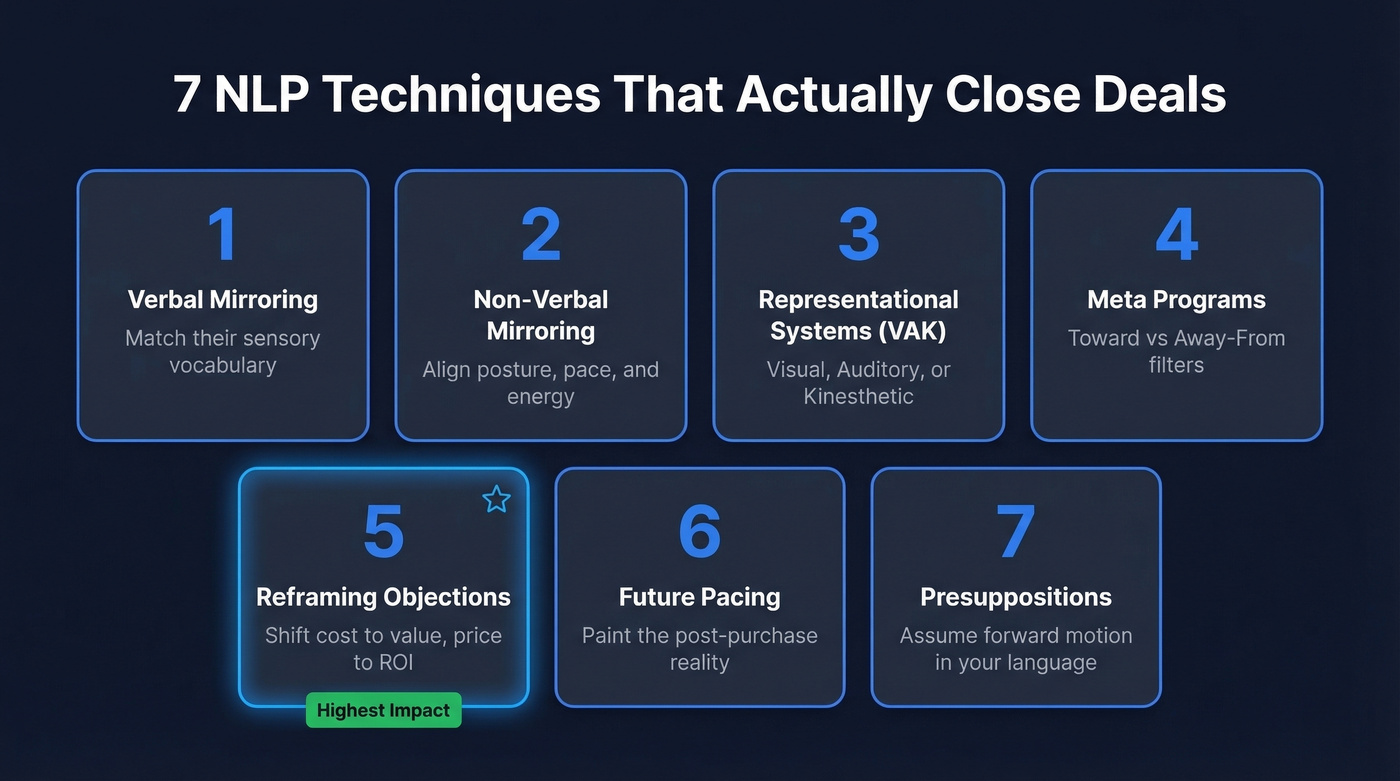
7 Techniques That Actually Close Deals
Verbal Mirroring
Match the prospect's sensory vocabulary. If they say "I see what you mean," respond with visual language. If they say "that doesn't sound right," switch to auditory phrasing. The close-rate lift people associate with mirroring comes from deliberate language alignment and pacing, not from parroting back sentences word for word.
Non-Verbal Mirroring
On video calls and in-person meetings, subtly match posture, gesture pace, and energy level. If a prospect leans back and speaks slowly, don't sit bolt upright firing rapid questions. Match their rhythm. If you're doing it right, they won't notice. If they notice, you're doing it wrong.
Representational Systems (VAK)
People process information through dominant sensory channels - visual, auditory, or kinesthetic. Listen for trigger words, then respond in kind.
| Prospect Says | Their System | You Respond With |
|---|---|---|
| "I see the potential" | Visual | "Let me show you the picture" |
| "That sounds promising" | Auditory | "Let me walk you through how this resonates" |
| "I feel good about this" | Kinesthetic | "Let's get a handle on the details" |
Most people blend systems. But leading with their dominant channel builds rapport faster than defaulting to your own.
Meta Programs
Meta programs are the unconscious filters buyers use to make decisions. Shelle Rose Charvet's LAB Profile identifies 14 of these filters with diagnostic questions to uncover them. The two most useful in sales: toward vs. away-from and internal vs. external.
Ask "What made you start looking at solutions like this?" and listen. The answer tells you which filter to sell through. A "toward" buyer talks about growth and opportunity. An "away-from" buyer talks about problems they're trying to escape. Sell to the filter they reveal, not the one you'd respond to yourself.
Reframing Objections
When a prospect says "it's too expensive," the amateur argues price. The NLP-informed rep reframes. "Too expensive compared to what? The cost of the problem you described earlier?" Reframing shifts the conversation from cost to value, from price to ROI. It's the single most useful technique on this list because objections are where most deals die. (If you want more scripts, see objections and overcoming the price objection.)
Future Pacing
Guide the prospect's imagination into a future where they've already bought. "Picture your team six months from now - pipeline's full, reps aren't wasting time on bad numbers, your bounce rate's under 3%. What does that change for your quarter?" Future pacing works because vivid, specific outcomes create emotional ownership before the contract is signed.
Presuppositions & Embedded Commands
Presuppositions assume the sale without asking for it. "When you see the ROI report next quarter..." presupposes they'll be a customer by then. "As you review the proposal..." embeds the command to review it. Use them in email subject lines, CTAs, and closing questions - not as manipulation, but as confident language that assumes forward motion.
Cold Call Scripts With NLP Annotations
Two annotated script frameworks. Roughly 60% of cold calls hit "I'm not interested" - these scripts are designed to get past that wall. (For more frameworks, compare these with proven outbound call scripts and sales script templates.)
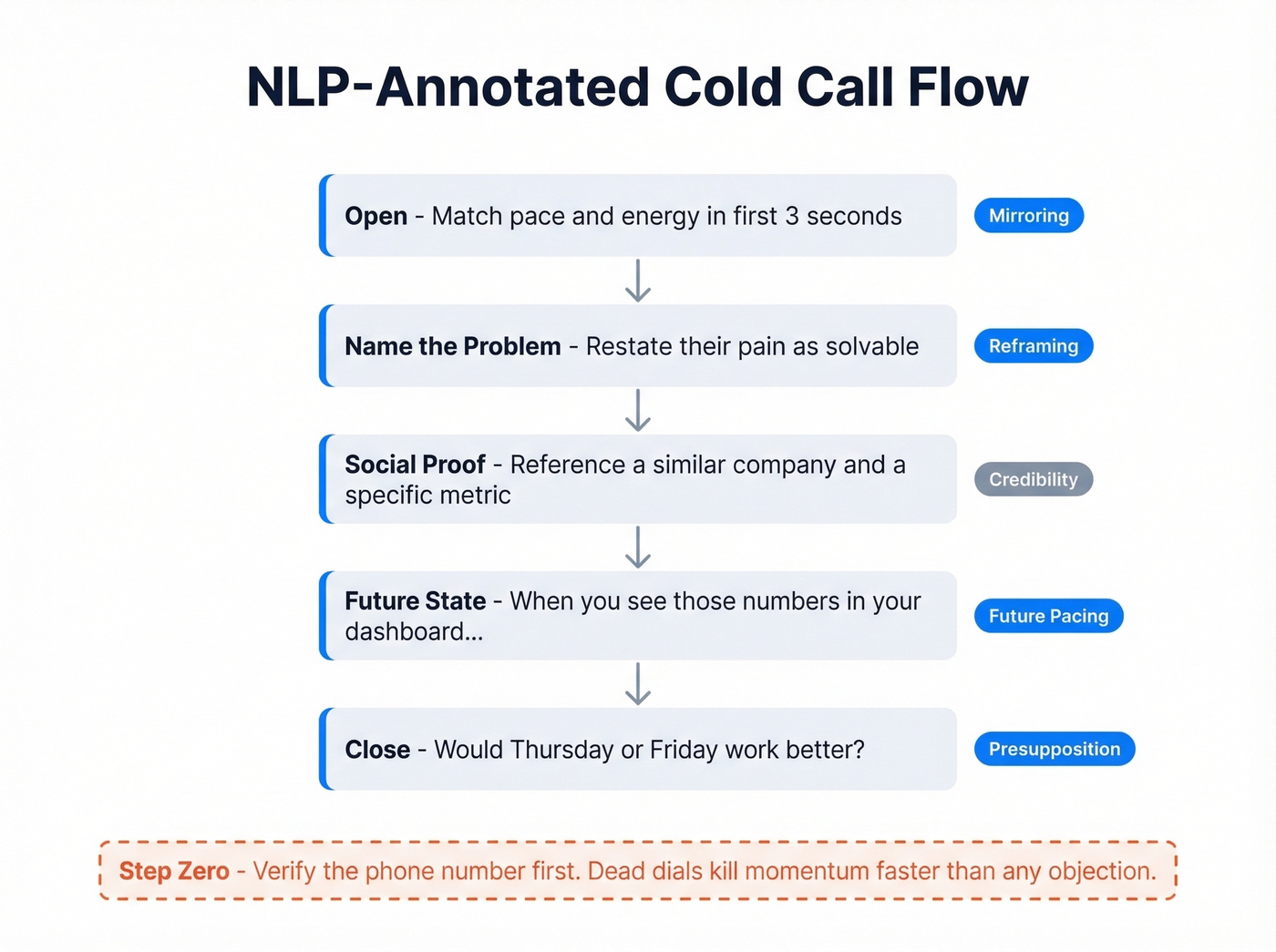
Script 1: Problem-Solution-Benefit
"Hi [Name], this is [You] from [Company]. I'm reaching out because teams like yours at [Company] are telling us [specific problem]. We've helped [similar company] cut that by [metric]. When you see those numbers in your own dashboard - would it make sense to spend 15 minutes on this Thursday?"
Techniques at work:
- Mirroring - Match the prospect's pace and energy from the first three seconds.
- Reframing - Restate the problem as solvable, not permanent.
- Future pacing - "When you see those numbers" places them in a post-purchase reality.
- Presupposition - "Thursday" assumes the meeting happens; the only question is when.
Script 2: Pattern Interrupt
"Hi [Name] - I know you weren't expecting this call, so I'll be quick. I noticed [trigger event at their company]. That usually means you're looking to scale [outcome]. When you're ready to explore this - can I send over a one-pager?"
Techniques at work:
- Pattern interrupt - Acknowledging the cold call disarms resistance.
- Meta program (toward) - "Looking to scale" sells to toward-motivated buyers.
- Presupposition - "When you're ready" assumes readiness is inevitable.
Layer BANT qualification (Budget, Authority, Need, Timeline) underneath either script to qualify while you build rapport. But step zero before any of this: verify the number. Dead dials kill momentum faster than any objection. (Benchmarks help too: see B2B cold calling success rates.)
Handling Objections With NLP
| Objection | Technique | Response |
|---|---|---|
| "I'm not interested" | Reframing | "Totally fair. If I could show you how to [benefit] in 90 seconds, would that change anything?" |
| "It's too expensive" | Reframing + Presupposition | "Compared to the cost of [their problem]? When you see the ROI breakdown, the math usually flips." |
| "Send me an email" | Mirroring + Future Pacing | "Absolutely - when you read it, you'll see exactly how [outcome]. Quick question so I send the right thing: biggest priority this quarter?" |
| "We already have a solution" | Meta Program (away-from) | "Most teams aren't looking to replace - they're fixing gaps. What's the one thing your current tool doesn't do well?" |
Don't memorize these word for word. Recognize which technique fits the moment and deploy it naturally.

That RevOps lead from the intro? His NLP skills were sharp - his data wasn't. Prospeo's 125M+ verified mobile numbers hit a 30% pickup rate, so your mirroring and reframing actually reach a live human. 98% email accuracy means your presupposition-loaded subject lines land in inboxes, not bounce logs.
Master the words after you fix the numbers.
NLP in Sales Emails
Look, language patterns applied to email copy are arguably more valuable than phone techniques in 2026. Persuasion patterns compound across hundreds of sends, and small improvements in open and reply rates add up fast.
If you're building this into a system, pair it with deliverability fundamentals like inbox placement and a clean list (start with an email verifier).
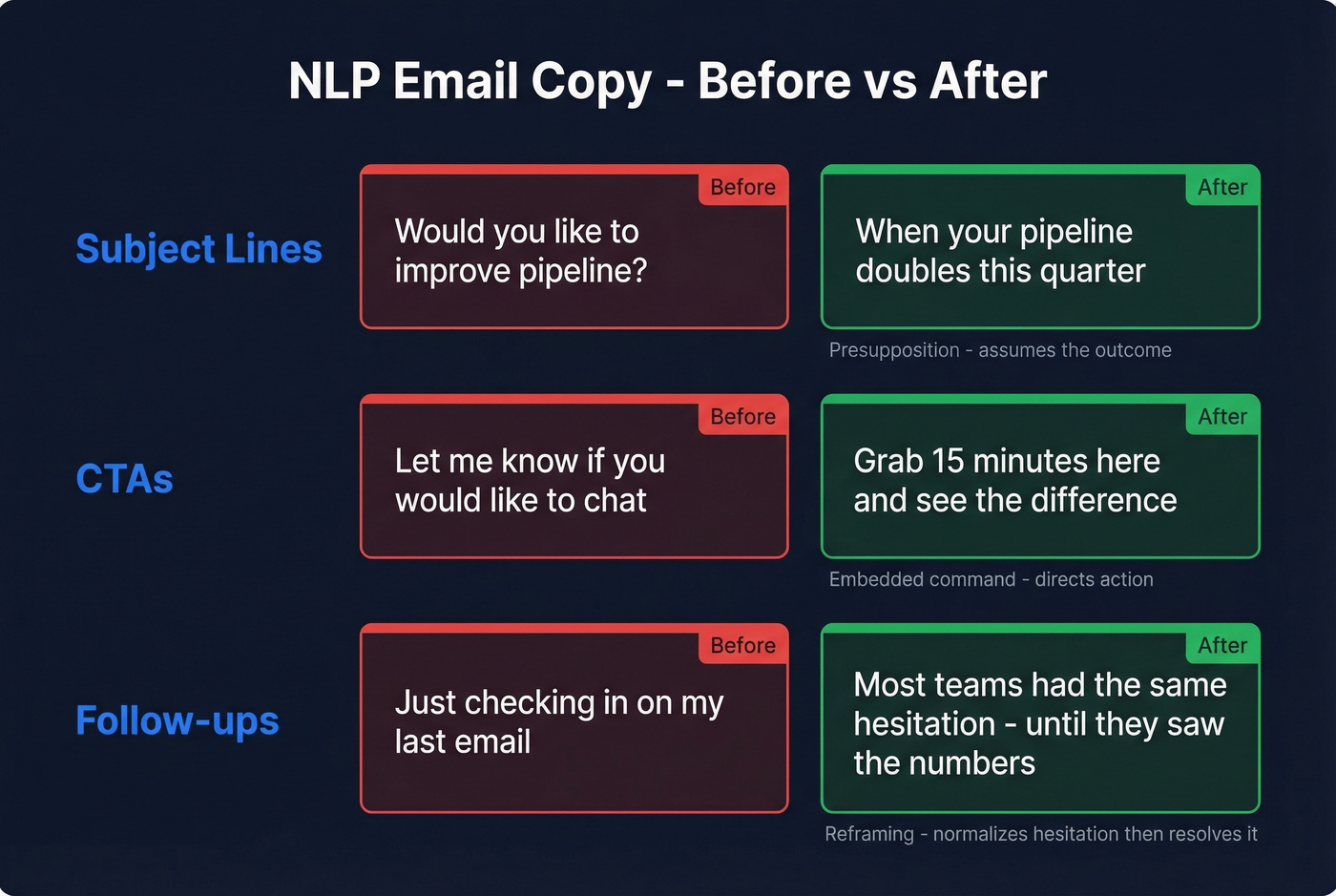
Presuppositions in subject lines:
- Before: "Would you like to improve pipeline?"
- After: "When your pipeline doubles this quarter"
Embedded commands in CTAs:
- Before: "Let me know if you'd like to chat"
- After: "Grab 15 minutes here and see the difference"
Reframing in follow-ups:
- Before: "Just checking in on my last email"
- After: "Most teams had the same hesitation - until they saw the numbers. Here's what changed."
Pairing NLP-informed copy with A/B testing tools - testing which language patterns drive opens and replies at scale - turns intuition into a repeatable system. The consensus on r/sales is that follow-up copy matters more than the initial outreach, which makes reframing the single highest-leverage email skill you can develop.
Where Human Skill Meets Automation
The most interesting development in 2026 isn't persuasion techniques or AI tools in isolation - it's the overlap. Encoding your best-performing reframes, presuppositions, and mirroring cues into sequencing tools means every email in a campaign carries the same persuasive structure your top rep uses on a live call. (If you're evaluating platforms, start with outbound email automation and CRM automation software.)
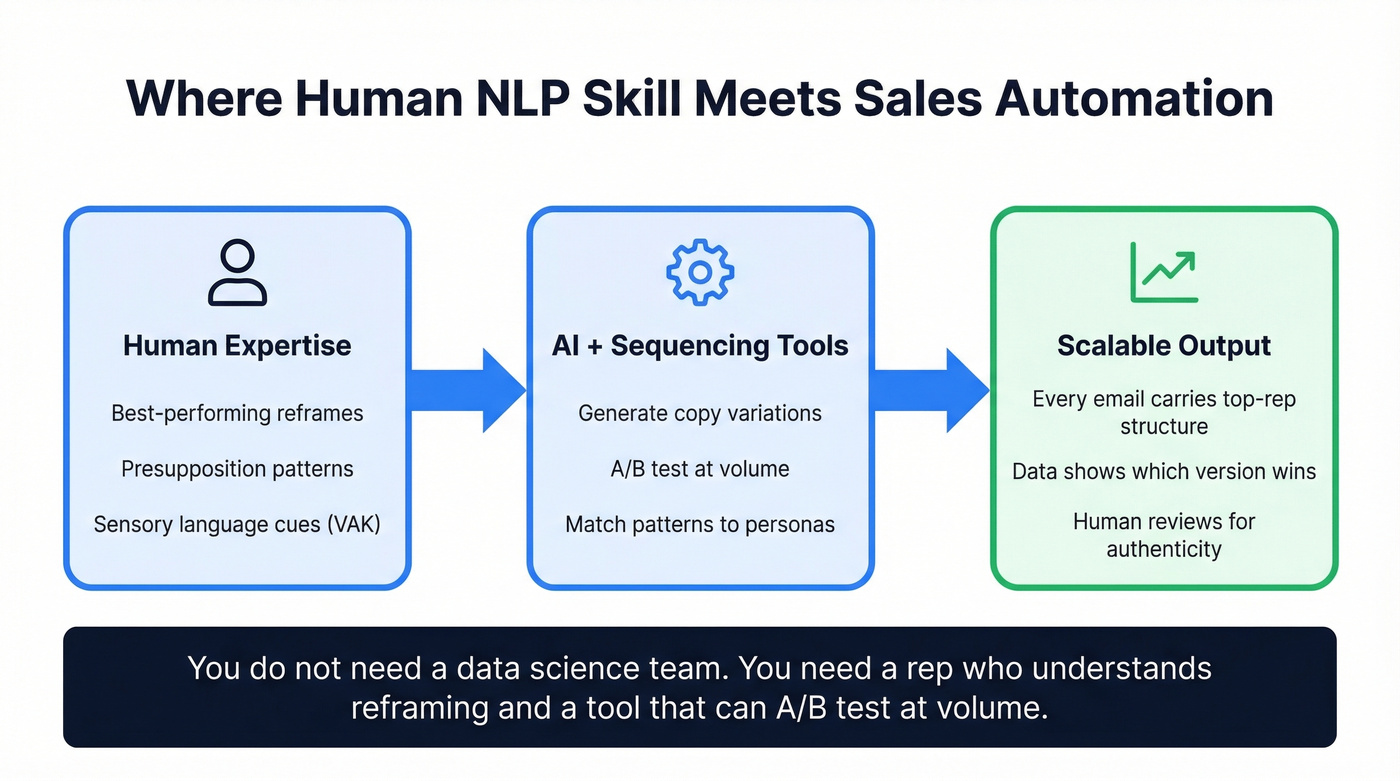
We've seen teams start by using generative AI to draft variations of their highest-converting email copy, then apply NLP principles to edit each variation for the right sensory language and meta-program appeal. Machine learning can surface which version resonates with which persona, but a human still needs to judge whether the language feels authentic.
You don't need a data science team. You need a rep who understands reframing and a sequencing tool that can A/B test at volume.
Mistakes That Kill Credibility
Parroting instead of mirroring. Repeating someone's exact words back makes you sound like a therapist from a bad movie. Mirror the pattern, not the phrase.
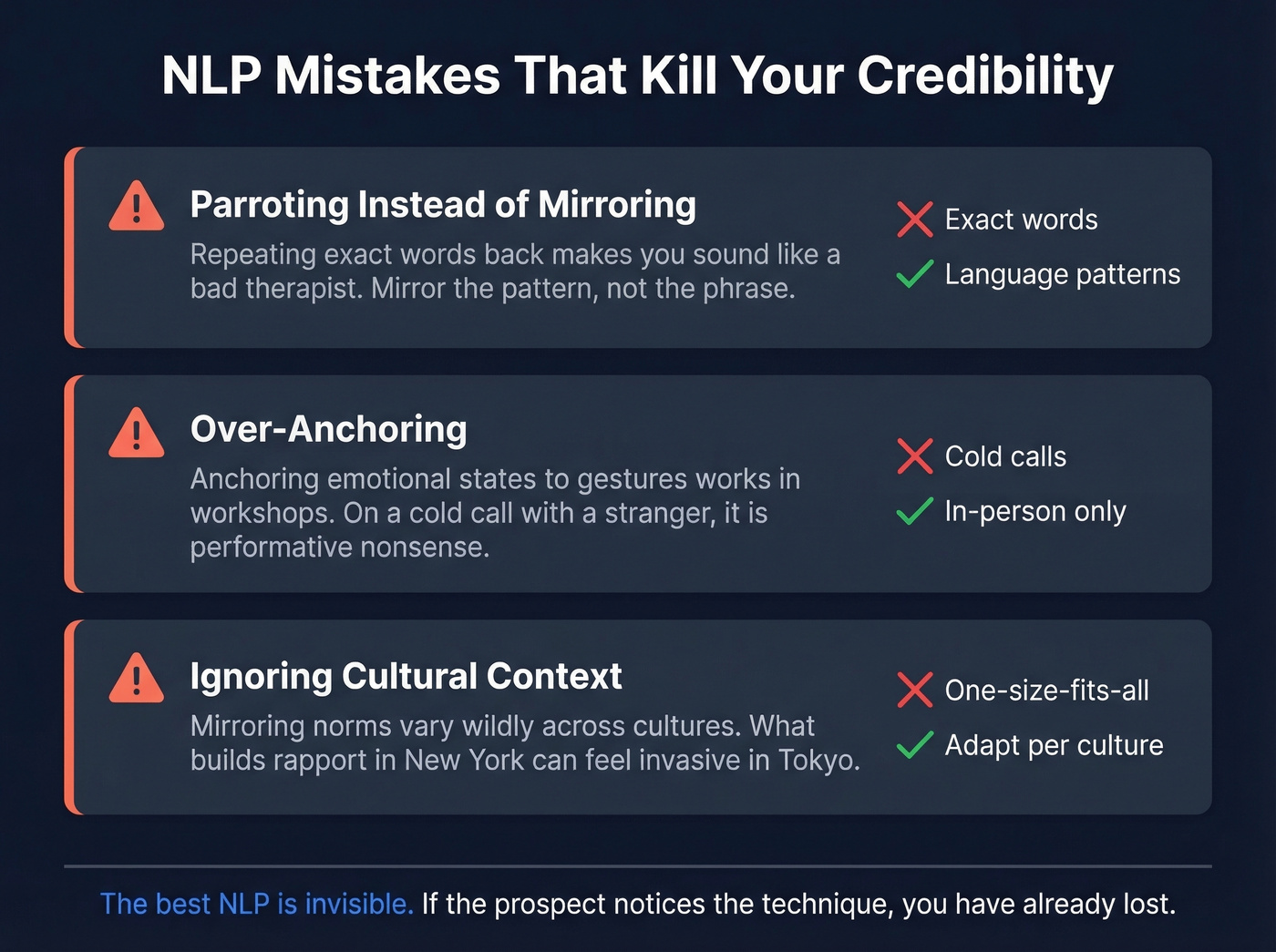
Over-anchoring. Anchoring a positive emotional state to a physical gesture works in a workshop. On a cold call with a stranger, it's performative nonsense.
Ignoring cultural context. Mirroring norms vary wildly across cultures. What reads as rapport-building in the US can feel invasive in Japan or Northern Europe. If you're selling internationally, this matters more than any technique on this list.
Using NLP as a crutch for bad data. The most elegant reframe doesn't help if you're pitching the wrong person at the wrong company. Fix your targeting first (your ideal customer profile is the real starting point).
Skipping rapport entirely. These techniques sit on top of genuine human connection. If you haven't earned the right to be heard, no presupposition pattern will save you.
Persuasion vs. Manipulation
NLP has a credibility problem, and it's not entirely undeserved. The association with pickup artists and high-profile scandals - however unfair to legitimate practitioners - has created real skepticism. The ethical concerns are documented and worth taking seriously. (If you're building training internally, set guardrails with a clear ethics in sales policy.)
The line is straightforward: if the technique is designed to bypass someone's decision-making process entirely, you've crossed it. NLP is ethical when it improves communication clarity - when it helps you understand how a buyer thinks and adapt your message accordingly. Use it to communicate better. Don't use it to trick people into buying something they don't need.
Fix Your Data Before Your Pitch
NLP techniques optimize how you communicate. They assume you're communicating with the right person at a working number with a valid email. You can't mirror someone who never picks up.
In our experience, the teams that get the most from sales communication training are the ones that already solved their data problem. Prospeo covers 300M+ professional profiles with 143M+ verified emails at 98% accuracy and 125M+ verified mobile numbers hitting a 30% pickup rate. Data refreshes every seven days - not the six-week industry average. That means when you apply your mirroring, reframing, and presupposition techniques, you're applying them to live prospects, not stale records. (If you're comparing providers, start with the best B2B database and verified contact database roundups.)

Future pacing only works when your reps can actually get prospects on the phone. Prospeo refreshes every record every 7 days - not the 6-week industry average - so your cold call scripts hit live numbers, not voicemail graveyards. At $0.01 per email, fixing your data costs less than one NLP certification module.
Stop practicing tonality on disconnected lines.
Best Books for Sales Persuasion
- Words That Change Minds (Shelle Rose Charvet) - The definitive guide to meta programs and buyer profiling. If you read one book, make it this one.
- Influencing With Integrity (Genie Z. Laborde) - Best for meetings and negotiation. Simplifies the Meta Model) into five memorable "Pointers."
- The Unfair Advantage (Duane Lakin) - Pure sales application of NLP principles, no fluff.
Combining NLP and Data
Communication techniques don't exist in a vacuum anymore. As machine learning reshapes sales processes - from lead scoring to conversation intelligence to automated follow-ups - the reps who thrive will be the ones who can read a room the way only a human can while letting data and automation handle scale. NLP for sales gives you the human edge; verified data and sequencing tools give you the reach. The winners combine both.
FAQ
Is NLP pseudoscience?
Sturt et al.'s systematic review found insufficient evidence across 10 studies, but a practitioner meta-analysis showed a moderate positive effect (SMD 0.54). Individual techniques like mirroring have stronger standalone support than the bundled system. It's not mind control - it's a grab bag where the best parts overlap with legitimate social psychology research.
Can NLP work in B2B sales?
B2B is where these techniques work best. Meta programs and reframing shine in complex sales cycles with multiple stakeholders who each have different decision filters. Discovery calls, multi-threaded deals, and executive presentations all benefit from adapting language to how each buyer processes information.
How long does it take to learn?
The core skills - mirroring, reframing, presuppositions - can be practiced on your next call. Fluency takes four to eight weeks of conscious application on real conversations. The learning curve isn't the techniques themselves; it's making them automatic so you stop thinking about frameworks and start reading the room.
What's the biggest mistake teams make with NLP training?
Investing in communication skills before fixing contact data quality. Teams with 30%+ bounce rates or disconnected phone numbers won't see ROI from any training program. Pair clean, verified data with persuasion techniques and connect rates typically triple - that's what we've seen firsthand.
That RevOps lead from the intro? He eventually paired the NLP skills with clean data. His connect rate tripled. The techniques were always solid - he just needed someone to actually pick up the phone.