

How to Write a Sales Script That Doesn't Sound Like a Robot
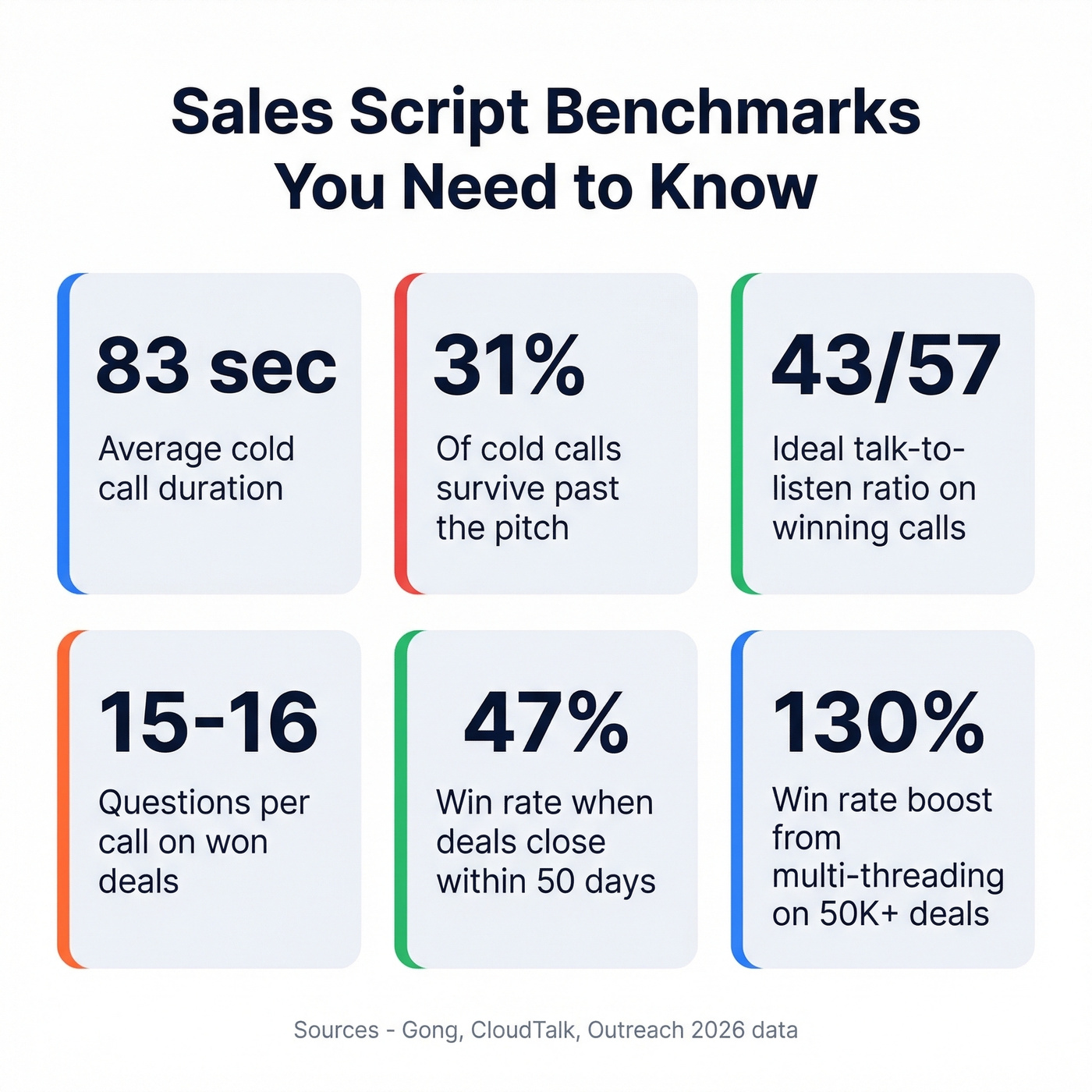
Monday morning. Your SDR team opens the dialer, stares at 200 contacts, and starts reading from a Google Doc titled "Cold Call Script v7 FINAL FINAL." Half the phone numbers are disconnected. The other half hang up within 30 seconds because they can hear the script being read word-for-word. The average cold call lasts 83 seconds - and only 31% of cold calls make it past the pitch.
That's not a script problem. That's a framework problem.
A sales script is a decision tree with guardrails, not a teleprompter. Script your opener, discovery questions, and objection responses - then let the conversation breathe. An analysis of 326K calls shows winning reps ask fewer, better questions and listen more than they talk. But before you script anything, verify your contact data. The best framework in the world can't save a dead phone number.
What Is a Sales Script?
Most guides hand you a Mad Lib. "Hi [PROSPECT NAME], I'm [YOUR NAME] from [COMPANY]. We help [INDUSTRY] companies [VAGUE BENEFIT]." You fill in the blanks, read it aloud, and wonder why prospects keep hanging up.
A script isn't a teleprompter. It's a decision tree. You script the moments that matter - your opening hook, your discovery questions, your objection responses - and leave everything in between conversational. As one r/Entrepreneur practitioner put it: "Do not read this word-for-word. Reading makes you sound like a robot and breaks all trust."
Here's the thing: two reps can use the same script and get wildly different results. The difference isn't the words. It's whether they treat the script as a crutch or a compass. Stop memorizing scripts. Memorize questions instead.
Scripts also pull double duty as onboarding tools. New reps ramp faster when they have a framework to practice against, and in regulated industries like financial services or insurance, a well-structured script keeps you compliant without killing the conversation.
The Data Behind Scripts That Close
Most guides skip the research. Let's not.
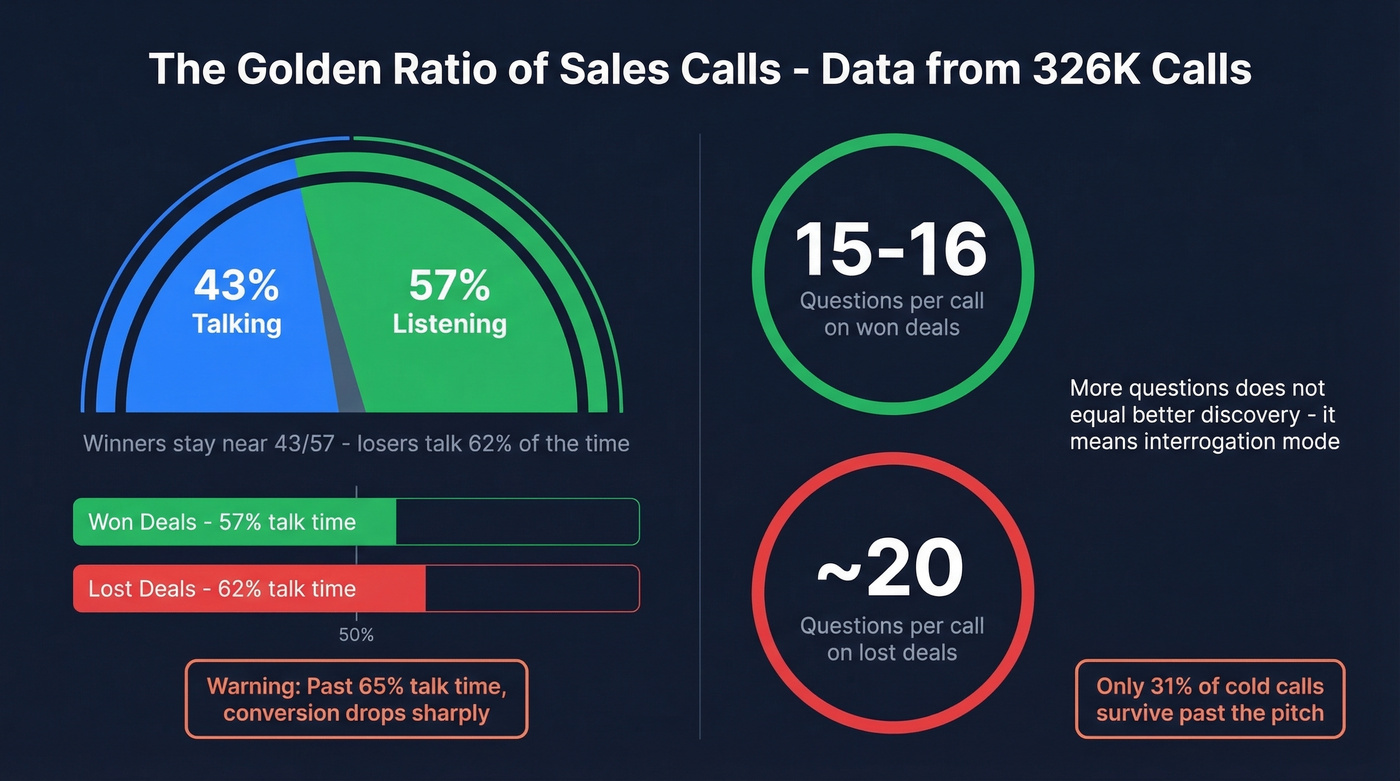
An analysis of 326,000 sales calls - each over 10 minutes - found a clear pattern. The "golden ratio" is roughly 43% talk / 57% listen. Across all calls in the dataset, the average was 60% talk / 40% listen.
In practice, reps on won deals averaged 57% talk time versus 62% on lost deals. That gap looks small until you realize what happens at the extremes: once you cross the 65% talk-time threshold, conversion rates drop sharply. Only 31% of cold calls survive past the pitch, and long seller monologues are a primary reason - higher back-and-forth interactivity consistently correlates with success.
Question count matters too, but not how you'd expect. Won deals averaged 15-16 questions per call. Lost deals averaged around 20. More questions doesn't mean better discovery - it means interrogation mode. Prospects feel grilled, not heard. The best reps ask fewer, sharper questions and let the answers breathe.
Consistency separates top performers from everyone else. In our experience, this is the most underrated metric in script design. Low performers swing wildly - 54% talk time on won deals, 64% on lost ones. High performers stay steady regardless of outcome. Their scripting creates a rhythm they can maintain call after call, win or lose, Tuesday or Friday.
Speed matters on the pipeline side too. Outreach's 2026 data shows that opportunities closed within 50 days hit a 47% win rate. After 50 days, that drops to roughly 20%. Lead qualification is the #1 seller challenge heading into 2026, and 34% of revenue teams report average sales cycles of 1-2 quarters. Your script needs to qualify fast and move deals forward - not stall them with generic discovery that goes nowhere.
How to Write a Sales Script
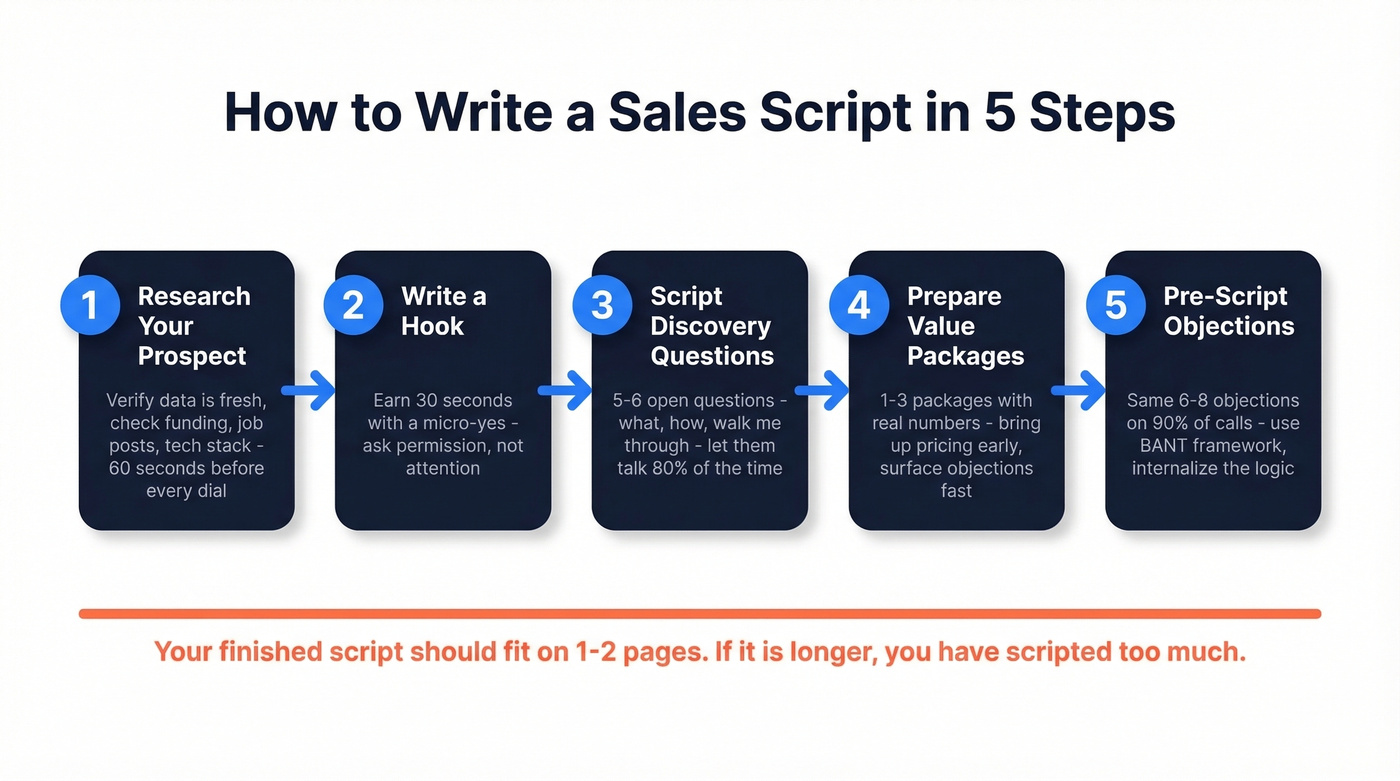
Five steps. Each one builds on the last. Skip any and the whole thing falls apart.
Research Your Prospect
Before you write a single word, you need to know who you're calling and whether the number actually works. We've watched teams burn entire sprint cycles dialing disconnected numbers because their data was six months stale.
This is where your data platform earns its keep. With Prospeo, you're working from 300M+ profiles refreshed every 7 days - not a stale CSV from last quarter. Use the 30+ filters to narrow by title, company size, or buyer intent before you open a script doc. Your reps should spend time selling, not chasing dead numbers.

Research the prospect's company for 60 seconds before dialing. Check recent funding, job postings, tech changes - anything that gives you a reason to call beyond "I saw your name on a list."
If you need a repeatable way to do this, borrow a few sales prospecting techniques that force pre-call context.
Write a Hook That Earns 30 Seconds
Your opener has one job: buy you 30 more seconds. Keep it to 2-3 sentences max.
The micro-yes technique works well here - give the prospect a small choice early that keeps them engaged. Instead of "Do you have a minute?" try "I know I'm calling out of the blue - would it be crazy if I took 30 seconds to explain why, and you can tell me if it's worth continuing?" You're asking for permission, not attention.
If you want more options, keep a swipe file of talk track examples for different personas.
Script Discovery Questions, Not Pitches
This is where most scripts fail. They jump straight from the hook to the pitch and skip the part where you actually learn something.
The best framework comes from an r/Entrepreneur practitioner who closed 200+ deals with it: "Act like a doctor. Diagnose and then confidently present the cure." In the first half of the call, your prospect should be doing roughly 80% of the talking. You're asking questions, listening, and mapping their pain to your solution.
Script 5-6 discovery questions. Don't script the transitions between them - that's where the conversation lives. Good discovery questions start with "what," "how," and "walk me through" rather than yes/no gates. And build in one question about who else is involved in the decision. Multi-threading - engaging multiple stakeholders - boosts win rates by 130% on deals over $50K, and 77% of deals involve multiple contacts. "Who else would need to weigh in on this?" should be in every discovery framework.
For a deeper library, use a structured set of discovery questions you can rotate by segment.
Prepare Your Value Packages
One of the biggest mistakes reps make is dodging pricing. Prepare 1-3 clear value packages with actual numbers so you can present them confidently when the moment arrives. Bringing up pricing early surfaces objections faster and keeps momentum alive. Prospects respect directness.
If you’re standardizing this across the team, sales battle cards make it easier to keep packages consistent.
Pre-Script Objection Responses
You'll hear the same 6-8 objections on 90% of calls. Script responses for each one using the BANT framework (Budget, Authority, Need, Timing). We cover specific word-for-word responses in the objection handling section below. Write them down, practice them out loud, and internalize the logic - not the exact phrasing.
If you’re getting shut down early, it’s worth tightening your approach to cold call rejection patterns before rewriting the whole script.
Your finished script should fit on 1-2 pages. If it's longer, you've scripted too much.
Sales Script Templates by Scenario
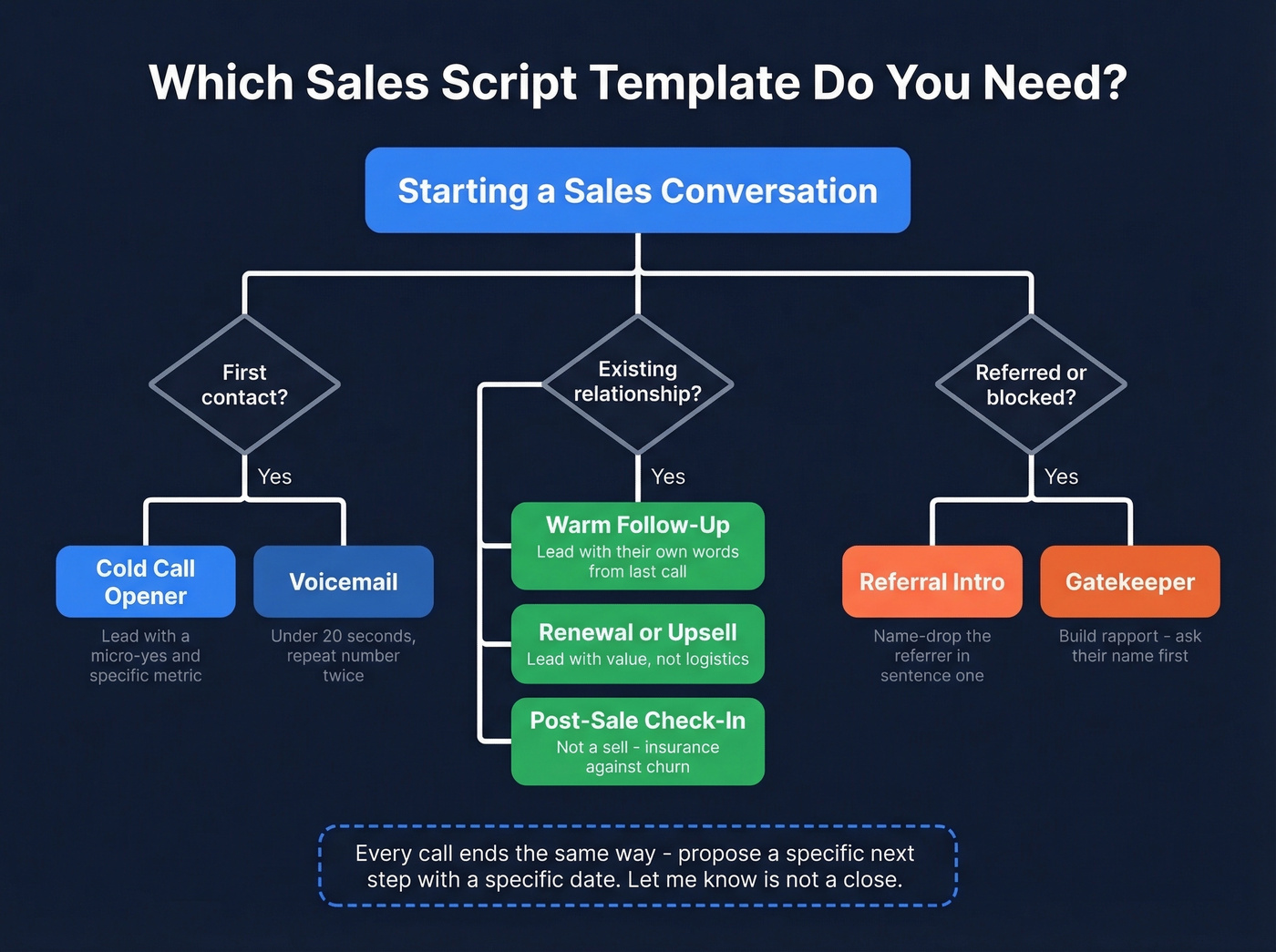
Cold Call Opener
"Hey [Name], this is [Your Name] with [Company]. I know I'm calling out of the blue - quick question: are you still handling [specific responsibility] at [Company]? [Wait for yes.] Great. We just helped [similar company] cut their [specific metric] by [number]. I'd love to see if that's relevant for you - mind if I ask a couple questions?"
If your deal size is under $10K, your cold call opener matters more than your demo. You won't get a second chance to pitch - the opener is the pitch.
Warm Follow-Up
Most reps bury the callback context three sentences deep. Don't. Lead with the prospect's own words:
"[Name], we spoke [timeframe] ago about [topic]. You mentioned [specific pain point they raised]. I've put together a quick breakdown of how we'd tackle that - do you have 10 minutes this week to walk through it?"
If you need more variations, keep a set of sales follow-up templates ready for different outcomes.
Voicemail
Keep voicemails under 20 seconds. Repeat your number twice. Give them one reason to call back, not three.
"Hey [Name], it's [Your Name] from [Company]. Quick reason for my call - we're helping [industry] teams [specific outcome]. I'd love to see if that's relevant for you. My number is [number]. Again, that's [number]. Talk soon."
Getting Past the Gatekeeper
| Approach | Script |
|---|---|
| Friendly redirect | "Hi, I'm hoping you can help me. I'm trying to reach [Name] about [topic]. Could you point me in the right direction?" |
| Name-first rapport | "Before I ask - what's your name? [Response.] Thanks, [Name]. I'm looking for the right person to talk to about [function]." |
Build rapport. Gatekeepers remember who treated them like a person versus who bulldozed through.
Referral Introduction
"[Name], [Referrer] suggested I reach out. They mentioned you're dealing with [challenge] and thought we might be able to help. I helped [Referrer's company] with something similar - would it make sense to chat for 15 minutes?"
Renewal, Upsell, and Post-Sale Check-In
These three scenarios share a common thread: you already have a relationship. Use it.
For renewals, lead with value, not logistics: "Before we talk renewal, I wanted to flag something - based on your usage, you'd get more value from [upgraded tier]. Teams like yours typically see [outcome]. Want me to run the numbers?"
For post-sale check-ins, keep it short: "Hey [Name], just checking in 30 days after launch. How's [feature] working for the team? Anything we should adjust?" This call isn't a sell - it's insurance against churn.
If you’re trying to reduce churn after the sale, a simple churn analysis process helps you spot patterns fast.
Closing / Next Step
"Based on everything we've discussed, it sounds like [summary of their pain] is costing you [quantified impact]. Here's what I'd recommend - [specific action]. Does [day/time] work to loop in [decision maker]?"
"Let me know" isn't a close. Always propose a specific next step with a specific date.
Discovery Call
Skip this template if your team already has a strong discovery framework. Otherwise, start here:
"Before I walk you through anything, I want to make sure I understand your situation. Can you walk me through how your team currently handles [process]? What's working? What's not? If you could fix one thing about it tomorrow, what would it be?"
Let them talk. Take notes. Don't pitch until you've earned the right.

The best sales script can't save a dead phone number. Prospeo refreshes 300M+ profiles every 7 days - so your SDRs spend those 83 seconds talking to real prospects, not voicemail boxes. 125M+ verified mobiles with a 30% pickup rate.
Stop burning dials. Start burning through your call list.
Scripts Adapted by Industry
Different industries require different tones. A SaaS opener that leads with quantified ROI would sound absurd in insurance, where trust and risk framing matter more.
| Industry | Tone | Example Opener |
|---|---|---|
| SaaS | Pain + ROI | "We cut [company]'s onboarding time 37%..." |
| Insurance | Trust + risk | "If you filed a claim tomorrow, covered?" |
| Recruiting | Casual + passive | "Probably not looking - got two minutes?" |
| Financial Services | Credibility + low-pressure | "Not selling - sharing a strategy." |
| Commercial Real Estate | Local + timing | "Lease might be up - better terms per sq ft?" |
| B2B Appointment Setting | Direct + micro-CTA | "Who handles that? 15 minutes crazy?" |
The biggest differentiation across industries isn't the words - it's the trust threshold. SaaS buyers expect data upfront. Insurance prospects need to feel safe before they'll engage. Recruiting scripts must acknowledge the prospect probably isn't looking. In financial services, leading with "I'm not selling anything today" lowers the guard faster than any pitch. Match the trust threshold of your industry, and the specific words matter less than you think.
Objection Handling Scripts
The 3-Step Framework
Every objection gets the same structure: Listen, Clarify, Respond with value. Don't interrupt. Don't immediately counter. Acknowledge what they said, ask a clarifying question, then respond with something specific. 60% of cold calls hit the "I'm not interested" objection - having a scripted response doesn't mean sounding scripted. It means not freezing.
Budget Objections
"It's too expensive." "Totally fair. Most of our customers felt the same way before they saw the ROI breakdown. What are you spending right now on [current solution]? Usually the cost of doing nothing is higher than people expect."
"We don't have budget for this." "I hear you. If budget weren't a factor, is this something you'd want to solve? [If yes:] Let's map out the business case - sometimes that's what unlocks the budget conversation internally."
Authority Objections
"I'm not the decision maker." "No problem. Who would be the right person to loop in? Would it help if I sent a one-pager you could forward?"
"Send me an email." "Happy to. So I send you something relevant - what's the biggest challenge your team is facing with [area] right now?"
Need Objections
"We're happy with our current solution." "Glad to hear it's working. If there were one thing you'd improve about it, what would it be? [Listen.] That's actually where we add the most value."
"I'm not interested." "Totally understand. Quick question before I let you go - is it the timing, or does [problem area] just not feel like a priority right now?"
Timing Objections
"I'm too busy right now." "Completely get it. When would be a better time this week? I'll keep it to 10 minutes."
"Call me next quarter." "Absolutely. Before I do - what's changing next quarter that makes the timing better? I want to come back with something relevant."
"I'm in a contract." "When does it renew? Most teams start evaluating 60-90 days before renewal so they're not scrambling at the deadline. I'll set a reminder and reach back out with a comparison then."
Mistakes That Kill Deals
Look, reading word-for-word is the fastest way to kill trust. Your prospect can hear it - the cadence is wrong, the pauses are unnatural, and they've mentally hung up before you finish your second sentence. We've listened to hundreds of call recordings, and the difference between a scripted-sounding rep and a natural one is obvious within five seconds.
Equally damaging is the hook that runs too long. If your opener takes more than 15 seconds or stretches past 3 sentences, you've already lost the window. Get to the point.
The subtler killer is skipping discovery and jumping straight to the pitch. Reps who pitch before diagnosing sound like they don't care about the prospect's actual problem. And monologuing past the 65% talk-time threshold tanks your close rate. If you catch yourself talking for more than 90 seconds without a question, stop and ask one.
Then there's data quality. Calling stale numbers wastes hours every week - burning dials on disconnected lines and outdated titles. I've seen teams lose an entire Monday to bad data before anyone thinks to question the source. If your contact data is more than 6 weeks old, fix that before you touch your script.
A lightweight data enrichment workflow can prevent this from happening again.
Tools That Make Scripts Work in 2026
A great script is useless without the infrastructure to execute it - and without a process for ongoing refinement based on real call data.
Conversation intelligence is where script improvement actually happens. Instead of managers reviewing 3% of calls manually, these platforms can help teams review up to 95% of calls and identify what top performers actually say. Teams using conversation intelligence see roughly a 15% lift in win rates. Expect to pay around $1,200-$2,400/user/year for most plans.
AI coaching tools like Hyperbound let reps practice scripts against AI-generated prospects before going live. Sellers who frequently use AI generate 77% more revenue than those who don't, and AI tools save reps up to 2 hours per day on research and prep. Hyperbound runs around $50-150/user/mo depending on team size.
Engagement platforms like Outreach and Salesloft ($100-200/user/mo) handle sequencing, task management, and analytics. They're where your script lives in production - not a Google Doc. 45% of teams now run a hybrid AI-SDR model, and these platforms are the backbone. If you’re evaluating options, start with a ranked list of SDR tools.
CRM is non-negotiable. HubSpot offers a free CRM, with Sales Hub seats typically ~$100-$150/user/mo on higher tiers. Salesforce starts around $25/user/mo and commonly runs ~$75-$330/user/mo depending on edition. Track which script versions convert and iterate monthly. (If you’re comparing platforms, here are real examples of a CRM with pricing.)
Lead intelligence is the foundation underneath everything else. For contact data and pre-call research, Prospeo covers 300M+ profiles with 98% email accuracy and 125M+ verified mobiles - all refreshed on a 7-day cycle. Before your rep opens a script, they should have a verified number and 60 seconds of company context. That alone changes the entire tone of the call.
You scripted the perfect opener, nailed discovery, and prepped every objection. Now make sure you're calling the right person. Prospeo's 30+ filters let you target by buyer intent, job title, and company size - at $0.01 per email.
Research your prospect in seconds, not sprint cycles.
FAQ
How long should a sales script be?
One to two pages max. Script your opener, 5-6 discovery questions, and responses to the 6-8 most common objections. Leave the middle of the call conversational - over-scripting kills trust.
Should I memorize my script word-for-word?
No. Memorize your opener and core discovery questions, then improvise the pitch based on what you learn. Internalize the structure and logic, not the exact lines - prospects can hear the difference within five seconds.
What's the best time to cold call?
Tuesday through Thursday, 10-11 AM and 4-5 PM in the prospect's local time zone. Monday mornings and Friday afternoons consistently show the lowest connect rates across most industries.
Do cold call scripts work for email outreach?
The framework transfers - hook, question, value prop, CTA - but emails should be 3-5 sentences max. Verify addresses with a tool like Prospeo's email finder before sending. High bounce rates destroy domain reputation and tank deliverability for your entire team.
What tools help improve sales scripts in 2026?
Conversation intelligence platforms for reviewing real calls at scale, AI coaching tools like Hyperbound for practice reps, and verified contact data so you're not wasting scripts on disconnected numbers. Layer in a CRM to track which versions convert and iterate monthly.