

Outbound Leads, Defined: What They Are and Why Most Fail
You're a founder with 12 months of runway. You can't wait for SEO to compound. You need meetings this month - that's what outbound is for, and getting the definition right matters far less than understanding why most teams botch the execution.
What Are Outbound Leads?
An outbound lead is a prospect your team contacts first. They haven't visited your site, downloaded your ebook, or raised their hand in any way. They're cold. You found them, you reached out, and now you're trying to earn a conversation.
Inbound flips that - a lead comes to you through content, SEO, or ads with some existing awareness. Outbound leads typically have zero prior awareness, which is exactly why the playbook is different.
The Quick Version
- Outbound leads close at roughly 1.7% vs 14.6% for SEO-driven inbound. Lower per-lead close rate, but you control volume and timing.
- Data quality matters more than copy. If 30%+ of your emails bounce, your subject line doesn't matter.
- Target tight, verify everything, measure meetings held - not opens.
- Multi-channel wins. Email alone isn't enough in 2026.
Outbound vs Inbound Leads
You don't have to choose one. But the economics are genuinely different.
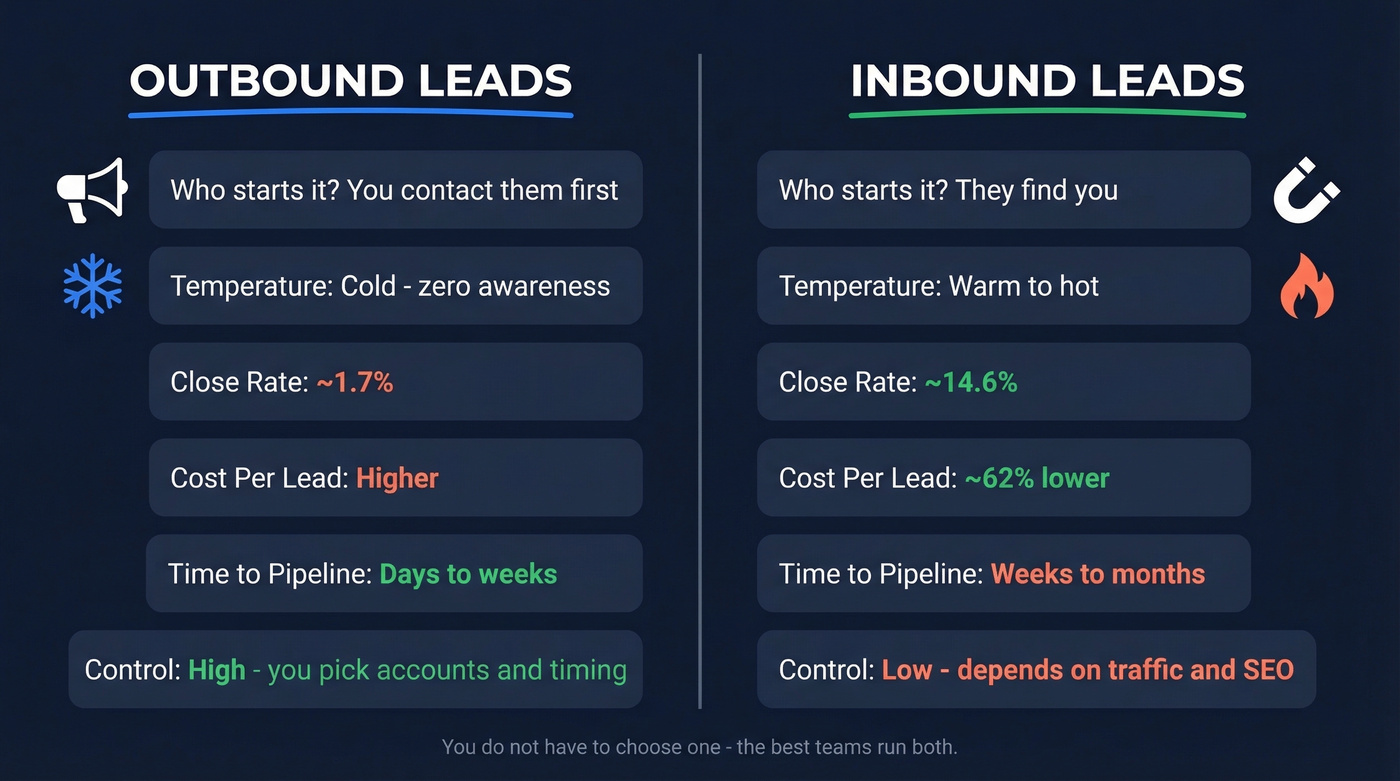
| Outbound | Inbound | |
|---|---|---|
| Who initiates | You contact them | They find you |
| Lead temperature | Cold | Warm to hot |
| Close rate | ~1.7% | ~14.6% (SEO leads) |
| Cost per lead | Higher | ~62% lower |
| Time to pipeline | Days to weeks | Weeks to months |
| Control | High - you pick accounts | Low - depends on traffic |
HubSpot data suggests inbound generates 54% more leads at lower cost. But the average B2B SaaS website converts just 1.1% of visitors into a conversion action, so "more leads" doesn't always mean "enough leads." Outbound lets you pick exactly who you talk to and when. For teams that need pipeline this quarter, it's the lever that moves fast enough.
If you're building a repeatable outbound motion, it helps to track the right lead generation metrics from day one.

You just read that outbound closes at 1.7% - which means every lost email is a lost shot at pipeline. Prospeo gives you 300M+ profiles with 98% verified email accuracy on a 7-day refresh cycle, so your sequences actually land.
Control your outbound volume without torching your domain.
Why Outbound Still Works in 2026
The "cold outreach is dead" crowd has been saying the same thing since 2018. They're still wrong.
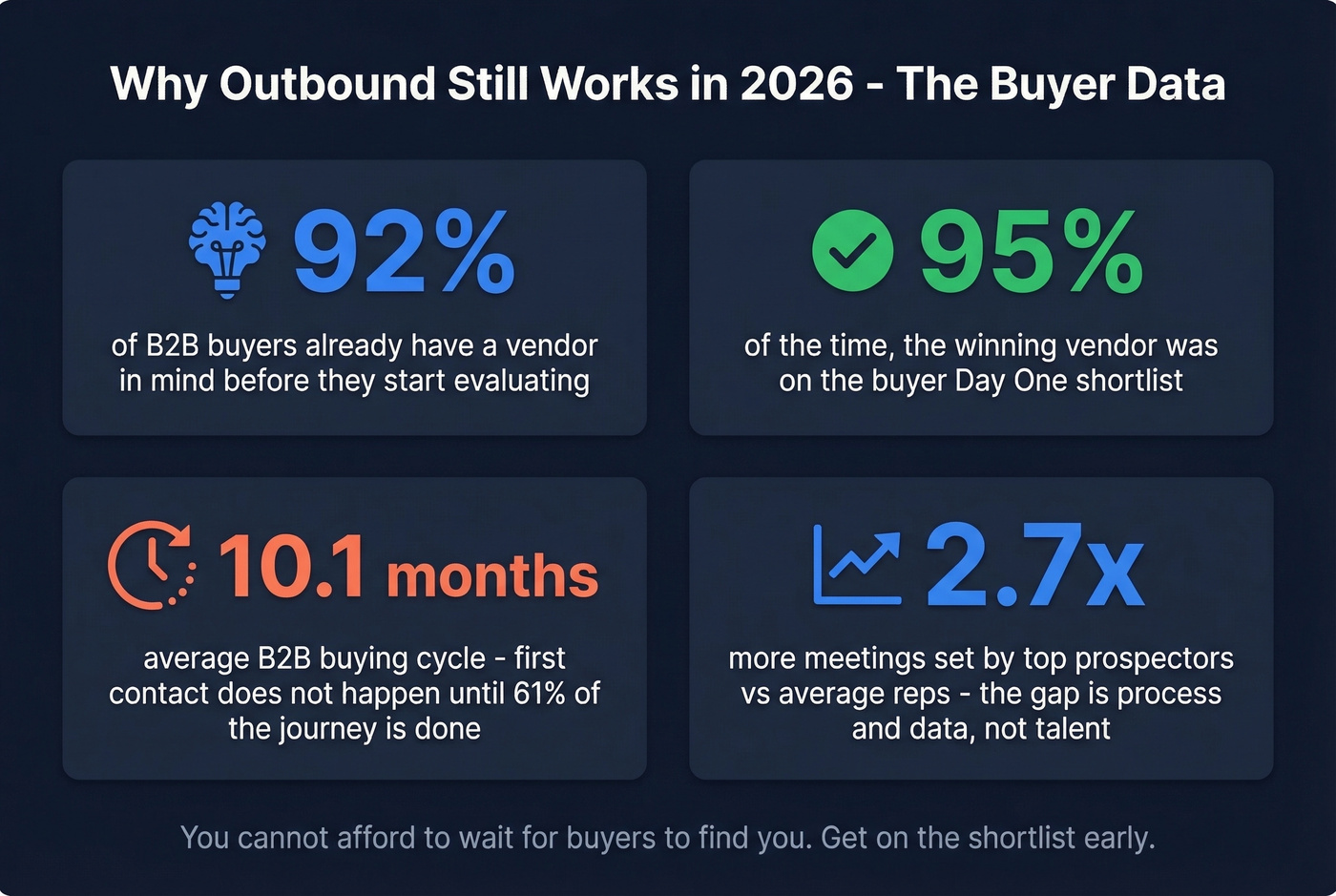
But outbound has gotten harder, and the reason is how buyers actually buy. 92% of B2B buyers already have a vendor in mind before they start evaluating, and the winning vendor lands on the buyer's Day One shortlist 95% of the time. With an average buying cycle of 10.1 months where first contact doesn't happen until 61% of the journey is complete, you can't afford to sit back and hope they find you. RAIN Group's research shows top prospectors set 2.7x more meetings than their peers. The gap isn't talent - it's process and data.
If you want a tighter playbook for booking meetings, borrow from proven sales prospecting techniques instead of reinventing the wheel.
How Outbound Leads Are Generated
So what does an outbound lead look like in practice? It's the result of a repeatable process, not a lucky cold call. Five steps:
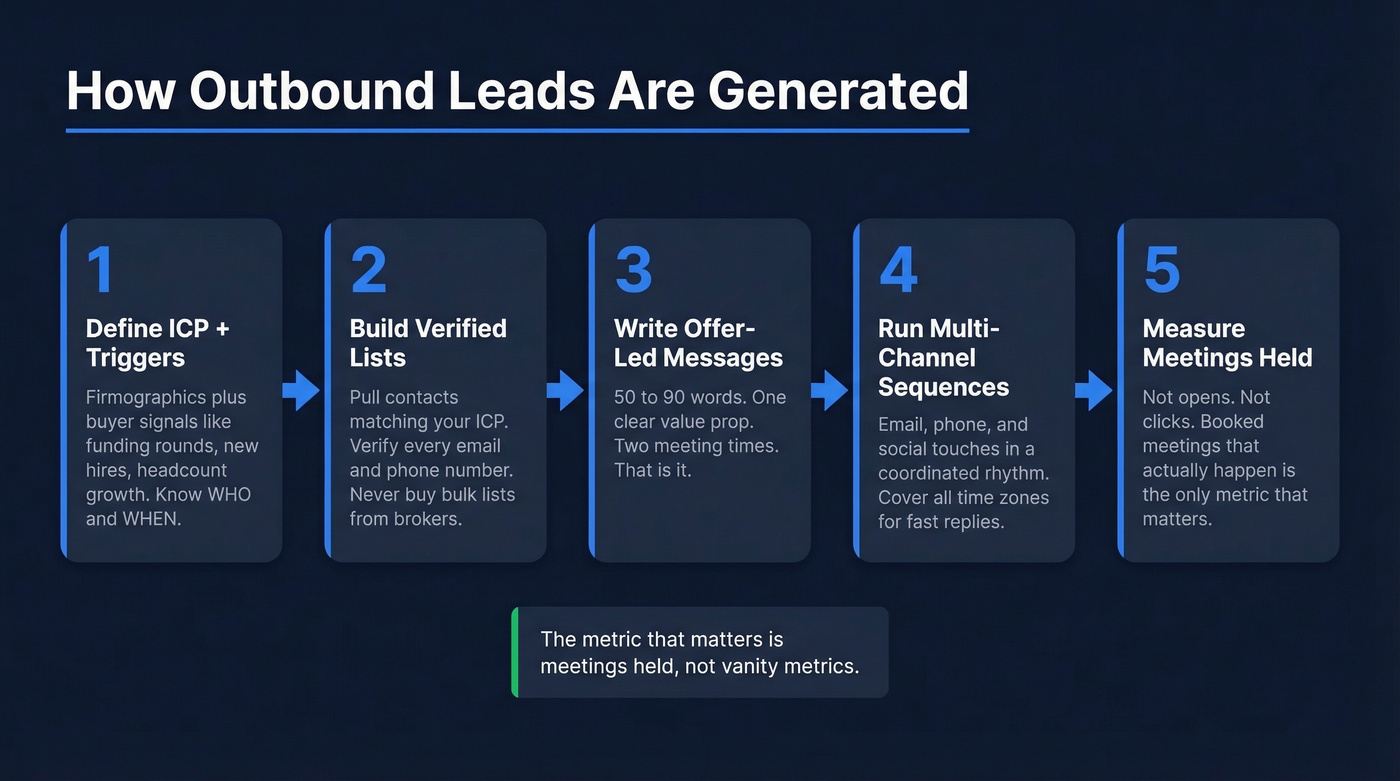
1. Define ICP + triggers. Not just firmographics - buyer triggers like funding rounds, new hires, or headcount growth tell you when to reach out, not just who. Layering intent data on top of firmographic filters is what separates spray-and-pray from precision outbound.
2. Build verified lists. Pull contacts matching your ICP, then verify every email and phone number. Buying bulk "leads" from a list broker is how you tank your domain. If you need a workflow, start with a practical lead generation workflow.
3. Write offer-led messages. 50-90 words. One clear value prop. Two suggested meeting times. That's it. If you're stuck, use these sales follow-up templates as a baseline and adapt them to cold outreach.
4. Run multi-channel sequences. Email, phone, and social touches in a coordinated rhythm. Have reply coverage across time zones so hot responses don't go cold overnight. This is much easier with solid sequence management.
5. Measure meetings held. The metric that matters is booked meetings that actually happen - not opens, not clicks, not "engagement."
Why Most Outbound Fails
Here's the thing: most outbound doesn't fail because the channel is broken. It fails because of execution gaps that compound on each other. We've seen this pattern across dozens of teams, and the consensus on r/sales and r/coldemail backs it up - the channel works, but teams sabotage themselves.
The failure modes stack up fast: targeting wrong accounts, no segmentation between company stages, ignoring persona differences, generic messaging with no trigger context, single-channel reliance, volume over fit, stale ICP definitions, and pitching before the buyer even recognizes the problem.
But the upstream killer that makes all of these worse? Bad data.
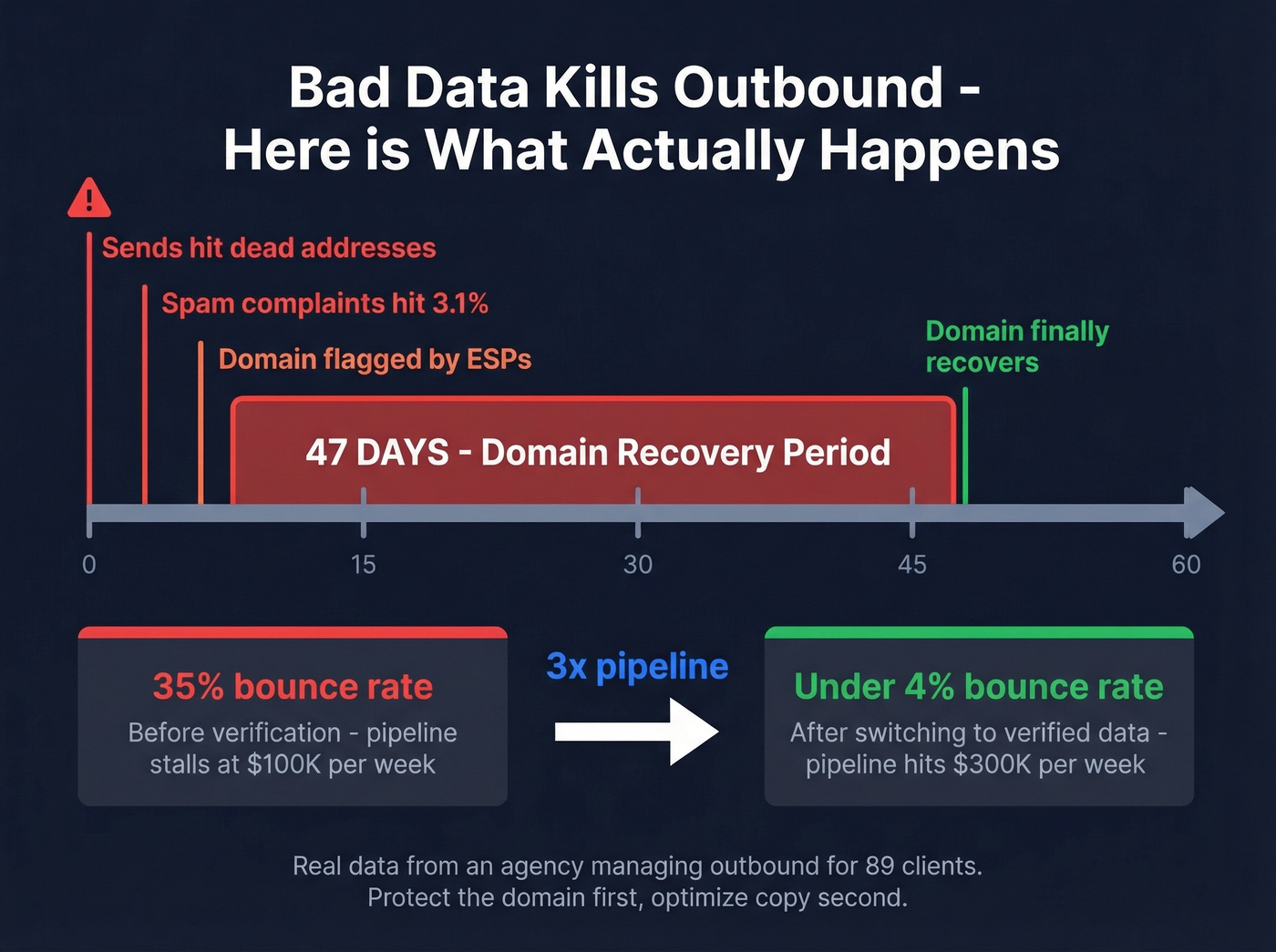
One agency managing outbound for 89 clients reported on Reddit that bad warmup - often caused by sending to dead addresses - is the #1 deliverability killer. A client hit 3.1% spam complaints and it took 47 days to recover the domain. Almost two months of dead pipeline from a single data quality failure.
Let's be honest: most outbound fails because of bad data, not bad messaging. If your average deal size is under five figures, you probably can't survive a 47-day domain recovery. Protect the domain first, optimize copy second.
Here's the warmup schedule that actually works. Age new domains at least 14 days before sending anything. Start with 5-10 emails per day in week one, scale to 15-20 in week two. Set DMARC to p=quarantine, not p=none. Keep spam complaints under 2% - always. And verify every address before it enters a sequence. Prospeo runs a 5-step verification process on a 7-day refresh cycle, which is why Meritt saw their bounce rate drop from 35% to under 4% after switching - and their pipeline tripled from $100K to $300K per week.
If you're troubleshooting bounces and list hygiene, start with these email bounce rate benchmarks and fixes, then work through a full email deliverability guide.
Meritt tripled pipeline from $100K to $300K/week after switching to Prospeo - bounce rate dropped from 35% to under 4%. Layer 30+ filters including buyer intent, funding, and headcount growth to hit the right accounts at the right time.
Stop guessing who to contact. Start with data that connects.
Compliance in 30 Seconds
EU regulators have issued EUR 6.2B+ in GDPR fines since 2018. Skip this section at your own risk.
For B2B outbound, legitimate interest is typically your lawful basis - but you need to document a three-part test: purpose, necessity, and balancing against the prospect's rights. Include a clear opt-out in every message, respond to data subject access requests within one month, and under CAN-SPAM, honor opt-outs within 10 business days. Build it into your workflow from day one, not after your first complaint.
FAQ
What's the difference between outbound and inbound leads?
Inbound leads find you through content, SEO, or ads. Outbound leads are prospects you contact first with no prior relationship. Inbound closes higher per lead - 14.6% vs 1.7% - but outbound gives you direct control over volume, timing, and account selection.
What are outbound leads in day-to-day sales?
They're the contacts your SDR team sources, verifies, and sequences before any relationship exists. Unlike inbound where marketing qualifies the lead, outbound requires reps to do the qualifying themselves through research, trigger-based targeting, and personalized multi-channel outreach.
What's a good conversion rate for outbound?
Outbound leads close at roughly 1.7% on average. Experienced SDRs target a 5% connect rate on 200+ daily dials, producing about one booked meeting per day. Clean data and multi-channel sequences push these numbers meaningfully higher - we've seen teams double their connect rates just by fixing verification.
How do you prevent outbound emails from bouncing?
Use a provider that verifies emails on a weekly refresh cycle, not quarterly. Warm up new domains for at least two weeks before sending volume, and keep spam complaints under 2%. The difference between a 35% bounce rate and a sub-4% bounce rate is often just switching to fresher data.