

Outbound Marketing vs Inbound: The Practitioner's Guide to What Actually Works
Your CEO is asking why the $15K/month content budget hasn't closed a single deal in two quarters. Meanwhile, your SDR team just ran a 10,000-email sequence and got 91% zero-response rates. Both sides of the building are frustrated, and both are pointing fingers at the other's strategy.
The outbound marketing vs inbound debate is a distraction from the real question - how much of each do you need, and when?
The Quick Version
Inbound captures existing demand. It's cheaper per lead, compounds over time, and converts at higher rates - but it takes months (sometimes years) to build momentum. Outbound creates new demand. It's faster, gives you precise control over who you're targeting, and lets you break into markets where nobody's searching for you yet.
Companies running both strategies see 2x faster revenue growth than those betting on just one. The real question isn't "which one?" It's how to allocate between them based on your business stage, deal size, and sales cycle length.
Demand Capture vs Demand Creation
Every competitor article frames this as "push vs pull." That's technically accurate and practically useless. A SaaS practitioner on r/SaaSSales put it better: inbound captures existing demand, outbound creates new demand. That distinction changes how you think about the entire strategy.
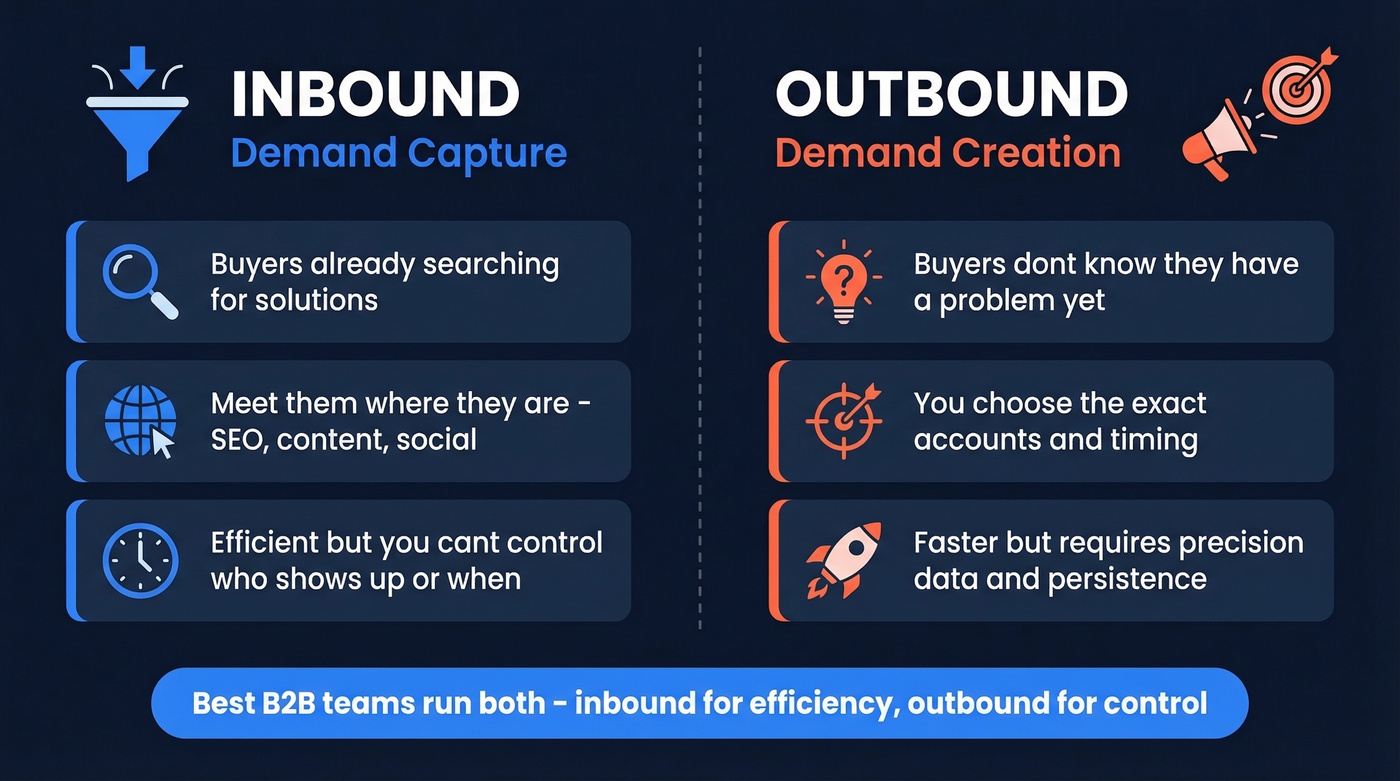
If your buyers are already Googling their problem, inbound is the efficient play - you're meeting them where they already are. But if you're launching into a new market, selling a category-creating product, or targeting enterprise accounts that don't search for solutions the way SMBs do, you need outbound to manufacture the conversation. Nobody at a Fortune 500 company is typing "best procurement optimization platform" into Google. You have to go find them.
The best B2B companies don't pick a side. They run inbound for efficiency and outbound for control, then adjust the ratio as the business evolves.
Inbound Marketing - Real Costs and Timelines
Channels and ROI Benchmarks
According to 2026 B2B benchmarks, SEO delivers 748% ROI with break-even at around 9 months. Email marketing hits 261% ROI, breaking even at 7 months. Webinars come in at 213%. PPC? Just 36%.
Organic search leads convert at 14.6%, which dwarfs the 1-2% you'll see from cold outreach. LinkedIn converts visitors to leads at 2.74% - roughly 4x higher than Twitter or Facebook - making it the strongest social channel for B2B inbound. Overall, inbound methods cost about 62% less per lead and generate 54% more leads than outbound.
Those numbers are compelling. Until you look at the timeline.
The Timeline Nobody Talks About
Here's a useful planning framework: Q + R + S = T. Quiet period (the time before a buyer starts researching) + Research time (when they're consuming content and evaluating options) + Sales cycle = Total time to conversion.
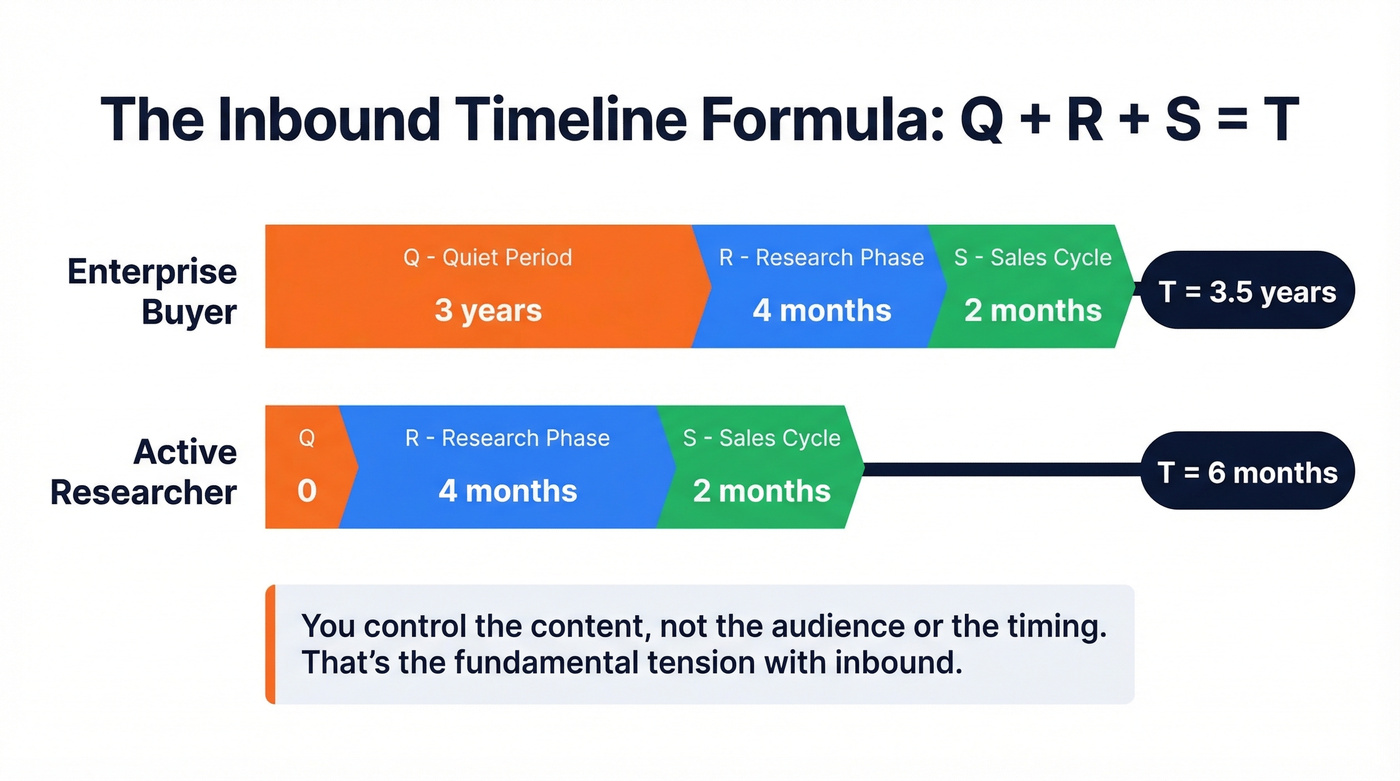
For an enterprise deal, Q might be 3 years - the prospect isn't even aware they have a problem yet. R adds another 4 months of research. S tacks on 2 months of sales process. That's 3.5 years from content publication to closed deal. For buyers already in research mode, you're looking at roughly 6 months. But you don't get to choose which buyers show up, and that's the fundamental tension with inbound: you control the content, not the audience or the timing.
This is why 80% of business decision-makers [prefer articles over ads](https://contentmarketinginstitute.com/b2b-research/b2b-content-marketing-trends-research) - they're doing research on their own timeline, not yours.
Where Inbound Falls Short
Inbound is volatile. SEO algorithm changes can crater your traffic overnight. Ad costs rise. Seasonality hits harder than most marketers admit.
Let's be honest: the consensus on Reddit is that inbound is "less reliable for enterprise" because enterprise buyers don't follow the neat content-to-demo funnel that PLG companies enjoy. Nurtured leads do buy 47% more than non-nurtured ones, but "nurtured" implies patience - months of drip campaigns, retargeting, and content production before you see a return. If your board wants pipeline next quarter, inbound alone won't get you there.
Outbound - What Actually Works in 2026
The Cold Truth About Cold Outreach
The baseline is rough. 91% of cold outreach emails get zero response. Typical reply rates run 1-5%. Contact-to-customer conversion sits at 0.2-2%. Cold calling converts at about 2.3% - roughly 1 in 50 calls.
It's getting harder, too. An estimated 912 million people now use ad blockers worldwide, with 63.2% citing "too many ads" as the reason. The interruptive playbook that worked in 2018 is running into a wall of buyer resistance.
So is outbound dead? Not even close. But single-channel, spray-and-pray outbound is.
Signal-Led Outbound - The 2026 Playbook
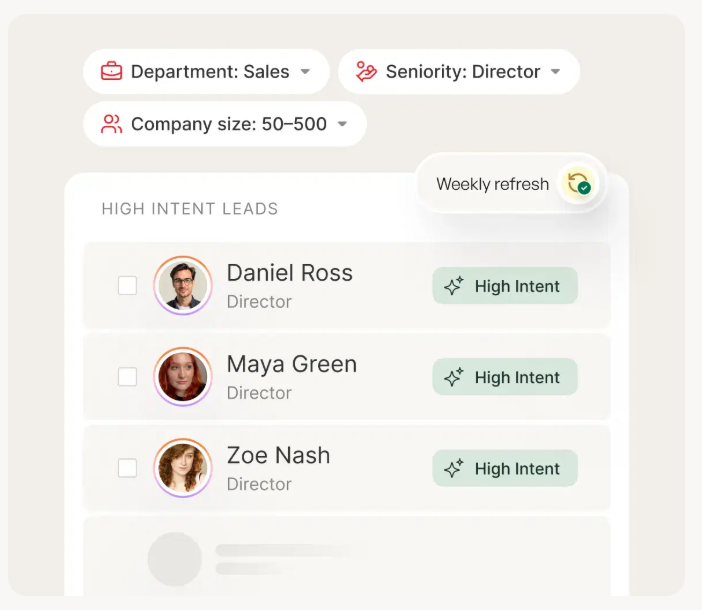
The teams getting results have shifted from volume-based outbound to signal-led selling. Instead of blasting 10,000 cold emails, they watch for intent signals - job changes, funding rounds, technology adoption, content consumption patterns - and time outreach to moments when buyers are actually receptive. This is outbound powered by enriched B2B data, real-time tracking, and genuine personalization. A different animal from the batch-and-blast campaigns of five years ago.
Multichannel sequences combining email, phone, and social increase response rates by 287% compared to single-channel outreach. That's not a marginal improvement - it's a 3x difference in results.
Top-quartile SDRs book 12-15 meetings per month; median sits at 8-10. The difference between those tiers isn't effort - it's targeting precision and timing. As one practitioner noted: "We started optimizing for calendar slots instead of customers." That's the trap. Outbound should be an intelligence system, not just a meeting factory.
One CRM tactic worth stealing: replace "Closed Lost" with "Closed Lost - Nurture" and maintain a separate pipeline view. Timing kills more deals than product-market fit. Keep those contacts warm.
Where Outbound Falls Short
Here's the thing: the #1 failure point isn't messaging, targeting, or channel selection. It's data. We've seen teams spend weeks building sequences, crafting personalization, and setting up multichannel cadences - only to watch bounce rates spike on the first send. Bounce rates above ~4% damage deliverability and domain reputation, and once that's gone, even your good emails land in spam.
Most outbound campaigns fail before the first email sends because the contact data is wrong. Prospeo's 5-step verification and 7-day data refresh cycle exist specifically to solve this: your outbound actually lands instead of bouncing.
The other killer? Persistence. 48% of reps stop after one touch, but 80% of sales require five or more follow-ups. A sales practitioner on r/sales nailed it: the last thing a buyer at a 1,000+ employee company does is respond to a cold email. That doesn't mean outbound doesn't work for enterprise - it means you need more touches, better timing, and verified data to earn the conversation.

Signal-led outbound only works if the data behind it is accurate. Prospeo tracks 15,000 intent topics via Bombora, refreshes all 300M+ profiles every 7 days, and delivers 98% email accuracy - so your multichannel sequences actually reach real buyers instead of bouncing.
Stop blasting 10,000 emails into the void. Target the ones that matter.
Head-to-Head Comparison
| Dimension | Inbound | Outbound |
|---|---|---|
| Cost per lead | Winner - ~60% lower | Higher, but larger deals offset it |
| Conversion rate | Winner - 14.6% (organic) | 1-2% (cold outreach) |
| Best channel ROI | Winner - SEO: 748% | Direct mail: up to 29-35%; multichannel lift: 287% |
| Time to results | 6 months - 3+ years | Winner - days to weeks |
| Scalability | Winner - compounds over time | Linear (more reps = more cost) |
| Pipeline control | Low (market-dependent) | Winner - choose exact ICP |
| Best for | SMB/PLG, long-term | Enterprise, new markets |
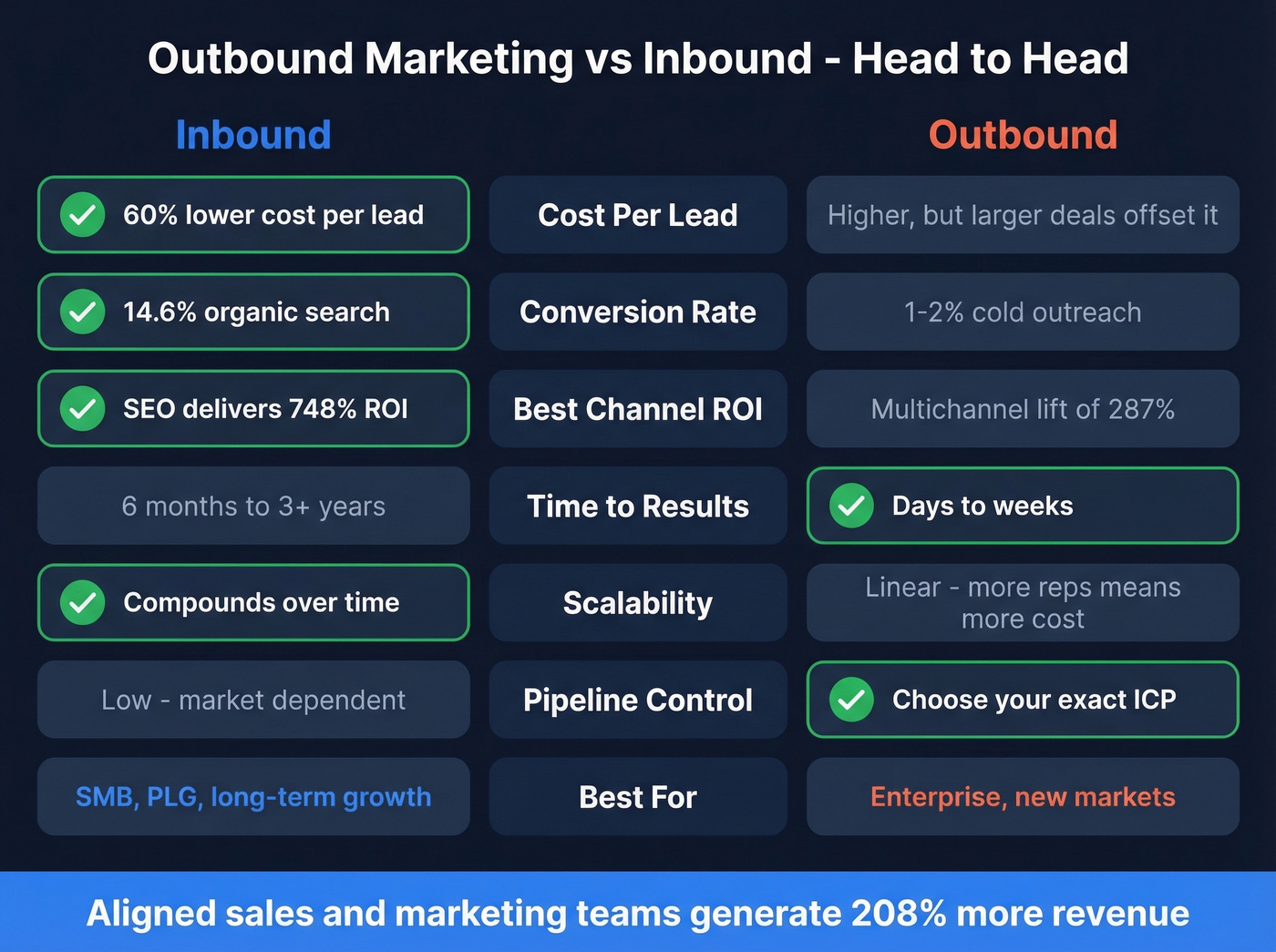
The numbers make inbound look like the obvious winner on efficiency. But efficiency isn't the only variable. If you're entering a new market segment or selling six-figure deals to accounts that don't search for your category, inbound's conversion advantage is irrelevant - there's no demand to capture yet. One approach optimizes for cost, the other for control.
Aligned sales and marketing teams generate 208% more revenue and 67% higher close rates. The strategy debate is secondary to the alignment question.
The Decision Framework
By Business Stage
Startup / pre-PMF: Lead with outbound. You need fast feedback loops to validate messaging, ICP, and pricing. Start building your content engine in parallel - blog posts, case studies, SEO foundations - but don't expect inbound to carry pipeline for at least 6-9 months.
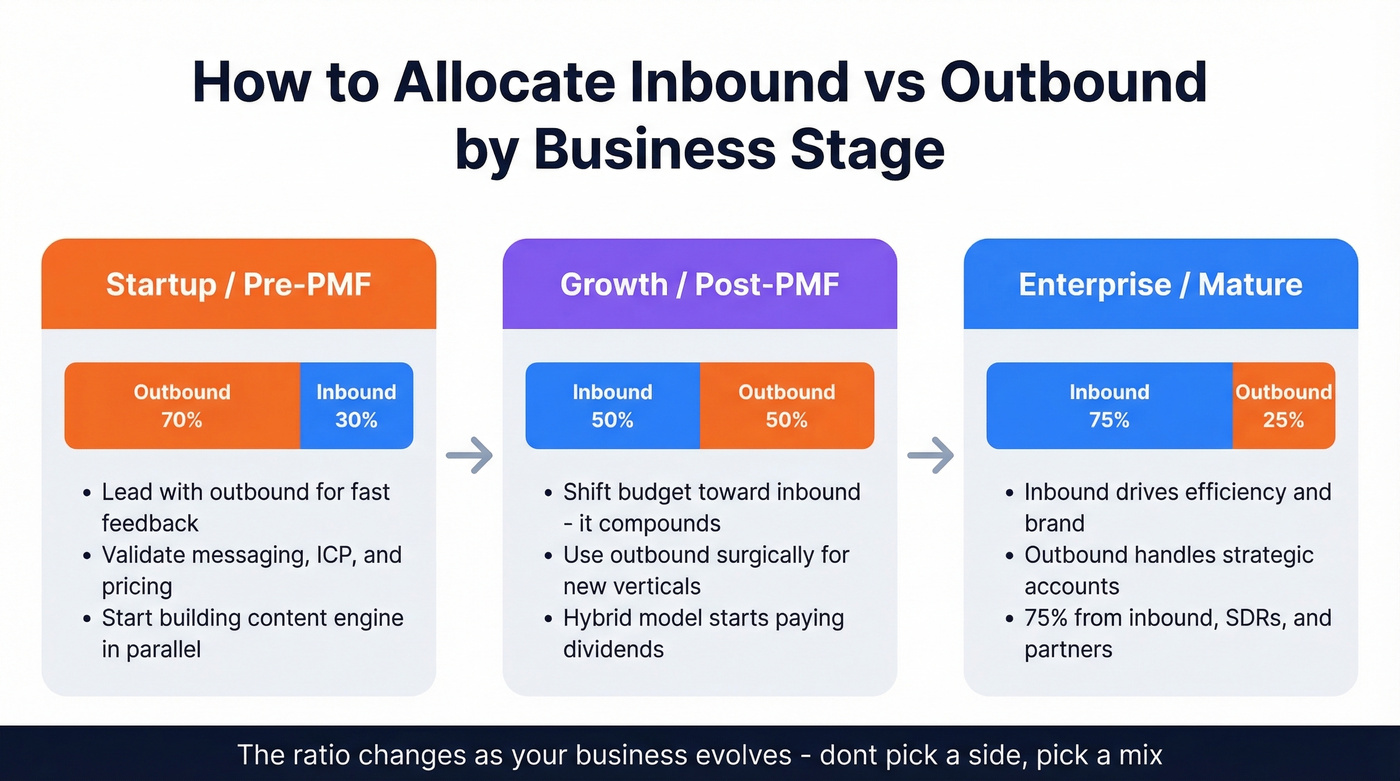
Growth / post-PMF: Shift budget toward inbound. It compounds. Use outbound surgically for enterprise expansion, new verticals, and segments where you don't yet have organic visibility. This is where the hybrid model starts paying dividends and the inbound and outbound marketing differences become less about choosing a side and more about finding the right mix.
Enterprise / mature: Run both at scale. Inbound drives efficiency and brand. Outbound handles strategic accounts and new market entry. One practitioner on Reddit suggested mature companies should generate roughly 75% of leads through inbound, SDRs, and partners - with outbound filling the strategic gaps.
By Deal Size and Sales Cycle
For sub-$10K deals with cycles under 30 days, lean heavily into inbound. PLG, content, SEO - let buyers self-serve. The economics don't support an SDR touching every lead.
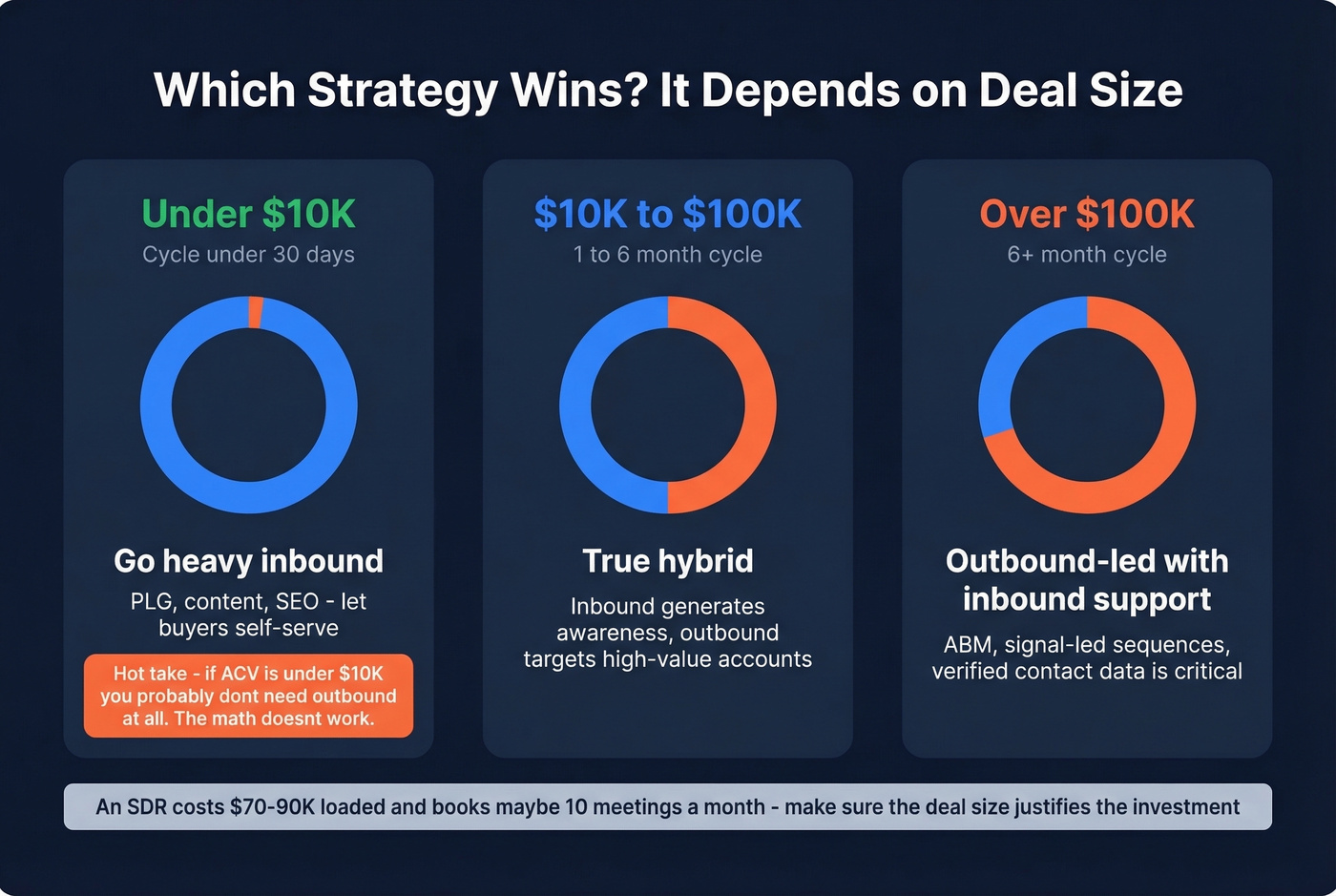
Hot take: if your average contract value is under $10K, you probably don't need outbound at all. The math doesn't work. An SDR costs $70-90K loaded, books maybe 10 meetings a month, and you need a 20%+ close rate just to break even on their comp. Put that budget into content and paid distribution instead.
For deals in the $10K-$100K range with 1-6 month cycles, run a true hybrid. Inbound generates volume; outbound accelerates the deals that matter most. Your SDRs should be enriching inbound leads and running targeted sequences to high-value accounts simultaneously.
For six-figure deals with 6+ month cycles, outbound carries the weight. These buyers aren't Googling solutions - you need to create the conversation, build multi-threaded relationships, and stay persistent across quarters.
A Concrete Example
Consider a B2B SaaS company selling a $45K ACV compliance platform to mid-market financial services firms. Their inbound blog posts on "SOX compliance automation" rank well and generate 30 MQLs per month - mostly from companies with 50-200 employees already searching for solutions. That's demand capture working.
But their ideal customers are 500-2,000 employee firms where the CFO doesn't know automated compliance is an option. No search volume exists for a problem they haven't identified yet. The outbound team targets these accounts using funding signals and CFO job changes, running 5-touch multichannel sequences. They book 8 meetings per month at 3x the ACV of inbound leads. Neither channel alone would build enough pipeline. Together, they cover both the buyers who are looking and the buyers who should be.
The Hybrid Playbook
Implementation Timeline
Months 1-3 (Foundation): Stand up outbound sequences and start publishing content weekly. Outbound carries 80%+ of pipeline. Focus on validating messaging and ICP through direct conversations.
Months 4-6 (Optimization): Optimize outbound sequences based on reply data. Early content starts ranking. Retarget blog visitors with outbound sequences. Shift to a 60/40 outbound-to-inbound budget split.
Months 7-12 (Compounding): Inbound compounds. Organic traffic grows, content converts, and cost per lead drops. Shift to 40/60 outbound-to-inbound. Use outbound exclusively for strategic accounts and new segments.
Integration Tactics That Work
The highest-performing teams don't run inbound and outbound as separate motions - they feed each other. Promote your highest-performing content with paid distribution to expand reach. Retarget inbound website visitors with outbound sequences, since they've already shown interest.
Enrich every inbound lead with contact data so SDRs can follow up with direct dials, not just the generic email the prospect submitted. Combine email outreach with social engagement for multichannel coverage. 96% of marketers say personalized experiences increased sales - and that applies equally to inbound content and outbound sequences. Personalization isn't a channel strategy; it's a data strategy.
Here's what that buyer journey looks like in practice: a VP of Sales reads your blog post on outbound benchmarks, downloads a template, and your CRM enriches their profile with verified contact data and company firmographics. An SDR calls their direct line within 5 minutes, referencing the specific content they consumed. That call converts to a demo at 3x the rate of a generic cold call. That's inbound and outbound working as one motion rather than two competing budgets.
Operational Rules
Speed-to-lead is the most underrated metric in B2B. Responding to an inbound lead within 5 minutes makes you 9x more likely to convert that lead. Most teams respond in hours. Some respond in days. That's pipeline you're handing to competitors.
Integrated campaigns lift response rates by 118%, but only if you actually follow through. Build SLAs into your process: inbound leads get a call within 5 minutes, outbound sequences run a minimum of 5 touches across at least 2 channels, and no lead gets marked "unresponsive" until it's been touched at least 7 times over 3 weeks.
Mistakes That Kill Both Strategies
Running outbound on stale data. Bounce rates above ~4% damage deliverability and domain reputation. If your data provider refreshes on a 6-week cycle (the industry average), you're sending to dead addresses. This is the fastest way to tank deliverability for your entire domain. We've watched agencies burn through three sending domains in a single quarter because they skipped this step. (If you want a deeper dive, see bounce rates and email deliverability.)
No follow-up SLA for inbound leads. A 5-minute response window converts 9x better. If your inbound leads sit in a queue for hours, you've already lost to the competitor who called first. Use proven sales follow-up templates and set a clear importance of follow-up standard.
Single-channel outbound. Email-only sequences get roughly a quarter of the responses that multichannel sequences achieve. Add phone and social touches to every sequence. Skip this if you're selling a $500/year product - the unit economics don't justify the extra effort. (More ideas: sales prospecting techniques and outbound lead generation tools.)
Expecting inbound results in 30 days. Remember Q + R + S = T. Your content might take 9 months just to break even on SEO investment, and enterprise buyers won't enter the research phase for years. Budget accordingly. If you're building the engine, start with B2B content marketing fundamentals.
No sales and marketing alignment. Aligned teams generate 208% more revenue. Misaligned teams argue about lead quality while pipeline stalls. Fix the handoff process before you fix the strategy. (Helpful ops reads: lead enrichment and data enrichment services.)
Bounce rates above 4% destroy your domain reputation and kill both inbound and outbound. Prospeo's 5-step verification with catch-all handling and spam-trap removal keeps bounce rates under 4% - just like Snyk's team of 50 AEs who dropped from 35% to under 5%.
Protect your domain. Get verified emails at $0.01 each.
FAQ
What's the difference between inbound and outbound marketing?
Inbound attracts buyers already searching for a solution through content, SEO, and social media. Outbound proactively reaches buyers who don't yet know they have a problem - through cold email, calling, and targeted ads. Inbound captures existing demand while outbound creates new demand. Most B2B companies need both, weighted by deal size and business stage.
Is inbound marketing cheaper than outbound?
Yes - inbound costs about 62% less per lead and compounds over time, with SEO delivering 748% ROI versus 36% for PPC. That said, inbound requires months of upfront investment before results materialize, so the initial spend feels higher even though long-term unit economics favor it.
How long does inbound take to work?
For buyers already researching, expect 3-6 months to first conversions. For enterprise deals with long quiet periods, 1-3+ years is realistic. Use the Q+R+S=T framework: quiet period + research time + sales cycle = total conversion time. SEO typically breaks even around 9 months.
Is cold email dead in 2026?
Single-channel cold email is dying - 91% get zero response. But multichannel sequences combining email, phone, and social increase response rates by 287%. The variable isn't the channel; it's data quality, personalization, and signal-based timing.
What tools help run inbound and outbound together?
You need a CRM (HubSpot or Salesforce), a content platform, and a B2B data provider for enrichment and prospecting. Prospeo covers the data layer with 143M+ verified emails at 98% accuracy, 125M+ mobiles, and intent data across 15,000 topics - so outbound sequences start with accurate contacts and inbound leads get enriched instantly.