

How Outbound Sales and Marketing Actually Work Together in 2026
Most teams treat outbound sales and marketing as separate functions that occasionally share a Slack channel. That's the root of the problem. 65% of sales and marketing professionals report a lack of alignment - and pipeline suffers because of it. The teams winning right now run outbound as a single coordinated motion, not two silos passing leads over a wall and hoping for the best.
Both functions need to operate as one revenue motion with shared ICP definitions, shared KPIs, and shared data. Signal-based targeting plus multi-channel sequencing is the only approach worth investing in right now.
What "Alignment" Actually Means
The AMA defines outbound marketing as "push marketing" - disseminating a message broadly regardless of whether the recipient asked for it. Outbound sales is the 1:1 version: calls, emails, social touches aimed at specific prospects. The intersection, where marketing warms accounts and sales closes them, is where pipeline actually gets built. We've seen teams treat these as two completely separate P&Ls, and it never ends well.
Why Alignment Is the Whole Game
Firms with strong cross-functional alignment see 2.4x higher revenue growth according to Forrester, and high-performing aligned organizations can see revenue increase up to 208%. Aligned teams are 67% better at closing deals with 38% higher win rates.
The failure side is ugly. 53% of companies still experience broken handoffs between sales and marketing. 69% of B2B buyers get inconsistent information between a vendor's website and its sellers - a trust killer that tanks conversion at every stage of the funnel.
Here's the thing: only 30% of sales pros say their teams are strongly aligned. The bar is low. Get this right and you're already ahead of most competitors.
How Aligned Outbound Works
The framework isn't complicated. It's just rarely executed well.
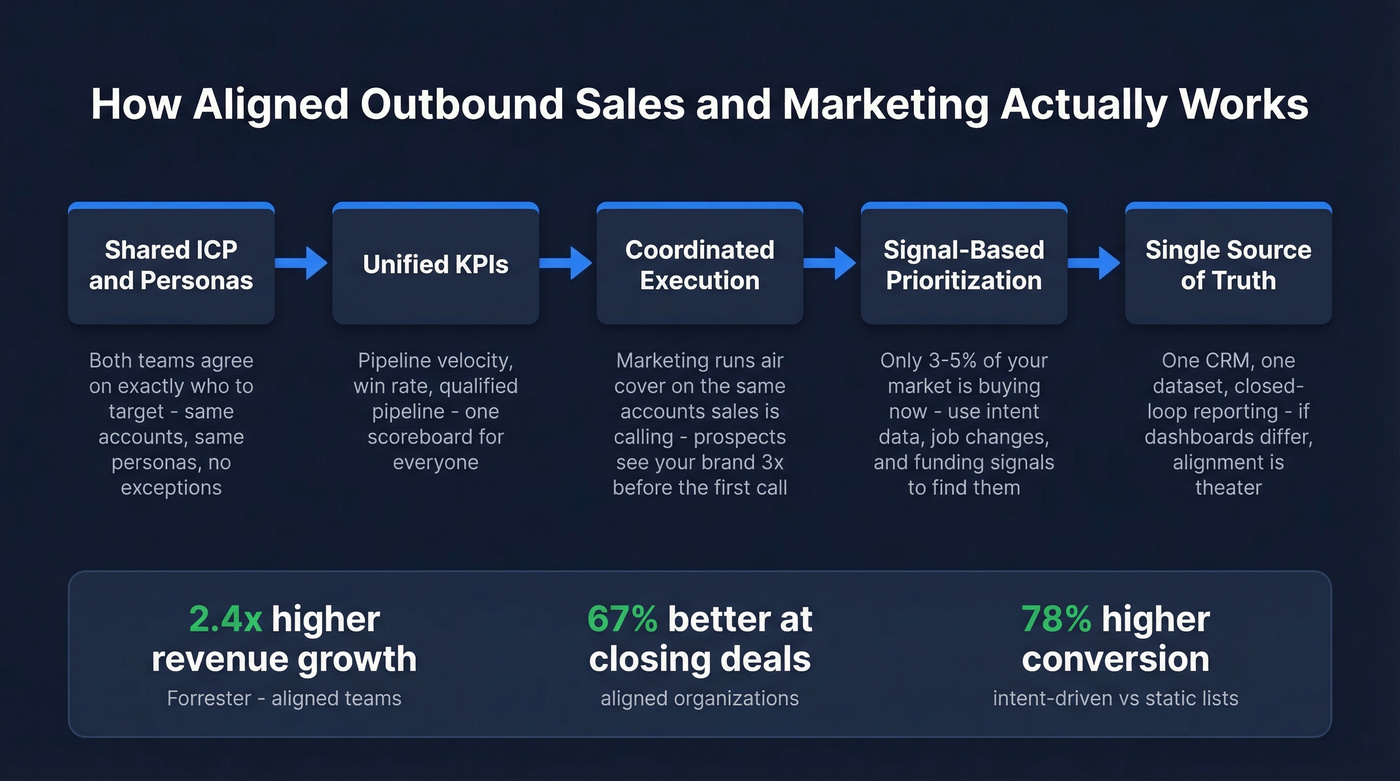
Shared ICP and personas. Both teams agree on who you're targeting, down to the persona level. No more marketing chasing "awareness" accounts that sales would never call. Use an Ideal Customer Profile that both teams can score the same way.
Unified KPIs. Pipeline velocity, win rate on marketing-sourced leads, and qualified pipeline generated - not MQLs for marketing and quota for sales. Same scoreboard. If you want a clean way to operationalize this, start with funnel metrics that map to revenue.
Coordinated execution. Marketing runs air cover on the same accounts sales is prospecting. When an SDR calls, the prospect has already seen your brand three times that week. This is where marketing outbound efforts - paid ads, retargeting, direct mail - compound the impact of every sales touch.
Signal-based prioritization. Only 3-5% of your market is buying right now. Another ~7% is open to a conversation. Use intent data, job changes, funding signals, and tech-stack shifts to find that ~10% and focus there. Intent-driven strategies deliver 78% higher conversion rates versus static lists, and 81% of sales teams already use AI to surface these signals faster. If you need a practical scoring model, see identifying buying signals.
Single source of truth. One CRM, one set of contact data, closed-loop reporting. If marketing and sales are looking at different dashboards, alignment is theater. This is also where data enrichment keeps records consistent across tools.

Signal-based outbound only works when the data behind it is accurate. Prospeo gives you 300M+ profiles with 98% email accuracy, intent data across 15,000 topics, and a 7-day refresh cycle - so your sales and marketing teams target the same buyers with data they can trust.
Stop burning sender reputation on stale data. Start with 75 free verified emails.
Channels, Cadence, and Benchmarks
| Channel | Typical Conversion | Best For |
|---|---|---|
| Cold email (solo) | 1-3% reply rate | Scale, low cost |
| Cold calling (solo) | 5-8% conversion | High-value accounts |
| Social selling (solo) | 2-4% reply rate | Warm-up, relationship |
| Multi-channel (coordinated) | 4-7% conversion | Maximum pipeline |
Multi-channel sequences consistently beat email-only outreach. When email alone runs 1-3% and coordinated multi-channel runs 4-7%, you're looking at a 2x+ lift in real-world outcomes. That's not marginal.
Personalization matters more than volume. Tailored outreach pulls 17% reply rates versus 7% for generic messaging. The consensus on r/SaaS is clear: "spray and pray" list blasting is dead. Signal stacking - layering funding events, hiring patterns, and tech changes - is what's working now. For more tactics reps can actually execute, use these sales prospecting techniques.
If your average deal size sits below $15K, you don't need a $30K/year data platform or a 14-tool stack. You need clean data, a sequencer, and disciplined follow-up. Most teams over-tool and under-execute.
A Concrete 3-Week Cadence
Week 1: Identify buying signals. Social connect with a personalized note. Follow up with a relevant case study.
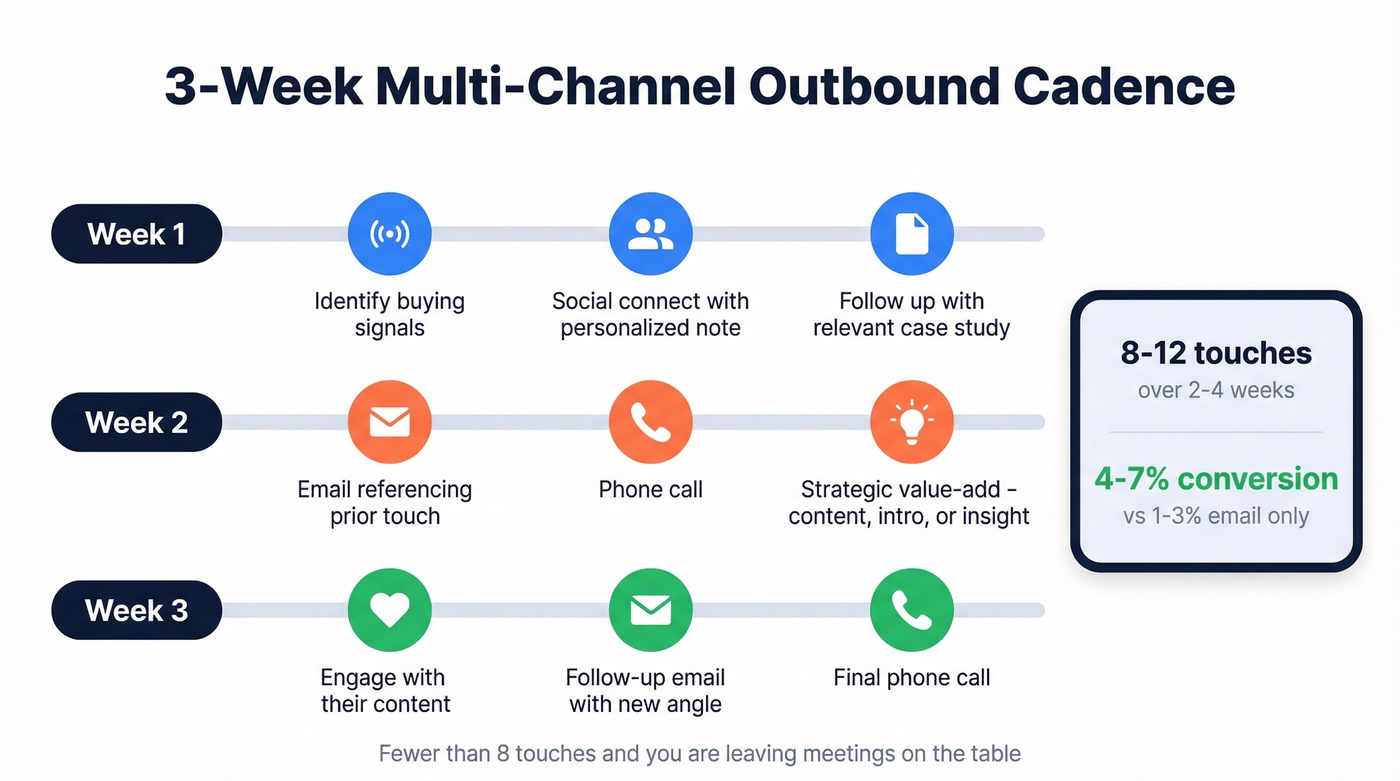
Week 2: Email referencing the prior touch. Phone call. Strategic value-add - content, intro, or insight they can actually use. If you need copy you can ship fast, pull from these sales follow-up templates.
Week 3: Engage with the prospect's content. Follow-up email with a new angle. Final phone call.
Plan for 8-12 touches over 2-4 weeks. Fewer than that and you're leaving meetings on the table.
The Outbound Sales and Marketing Tool Stack
Invest in the data layer first. Your sequencer and CRM don't matter if you're feeding them bad emails and wrong phone numbers. We learned this the hard way watching teams burn through sender reputation because they skipped verification.
| Category | Tool | Starting Price |
|---|---|---|
| Data/Prospecting | Apollo | Free tier |
| Sequencing | Outreach | ~$100-150/user/mo |
| Sequencing | Instantly | ~$30-97/mo |
| CRM | HubSpot | Free |
| CRM | Salesforce | ~$25-165+/user/mo |
| Intent Data | Bombora | ~$25-40K/year |

For the data layer, Prospeo gives you 300M+ professional profiles at 98% email accuracy with a 7-day data refresh cycle - versus the six-week industry average most providers run on. The free tier includes 75 verified emails per month to test, and paid plans start around $39/mo with no annual contract. Apollo's free tier works for getting started, but email accuracy sits around 79%, which becomes a real problem at scale when bounce rates start wrecking your domain. ZoomInfo runs $15-40K/year and only makes sense for larger orgs running full-stack GTM. If you're evaluating options, compare sales prospecting databases and prioritize verification.
Mistakes That Kill Outbound B2B Teams
Let's be honest - most outbound fails because of execution, not strategy.
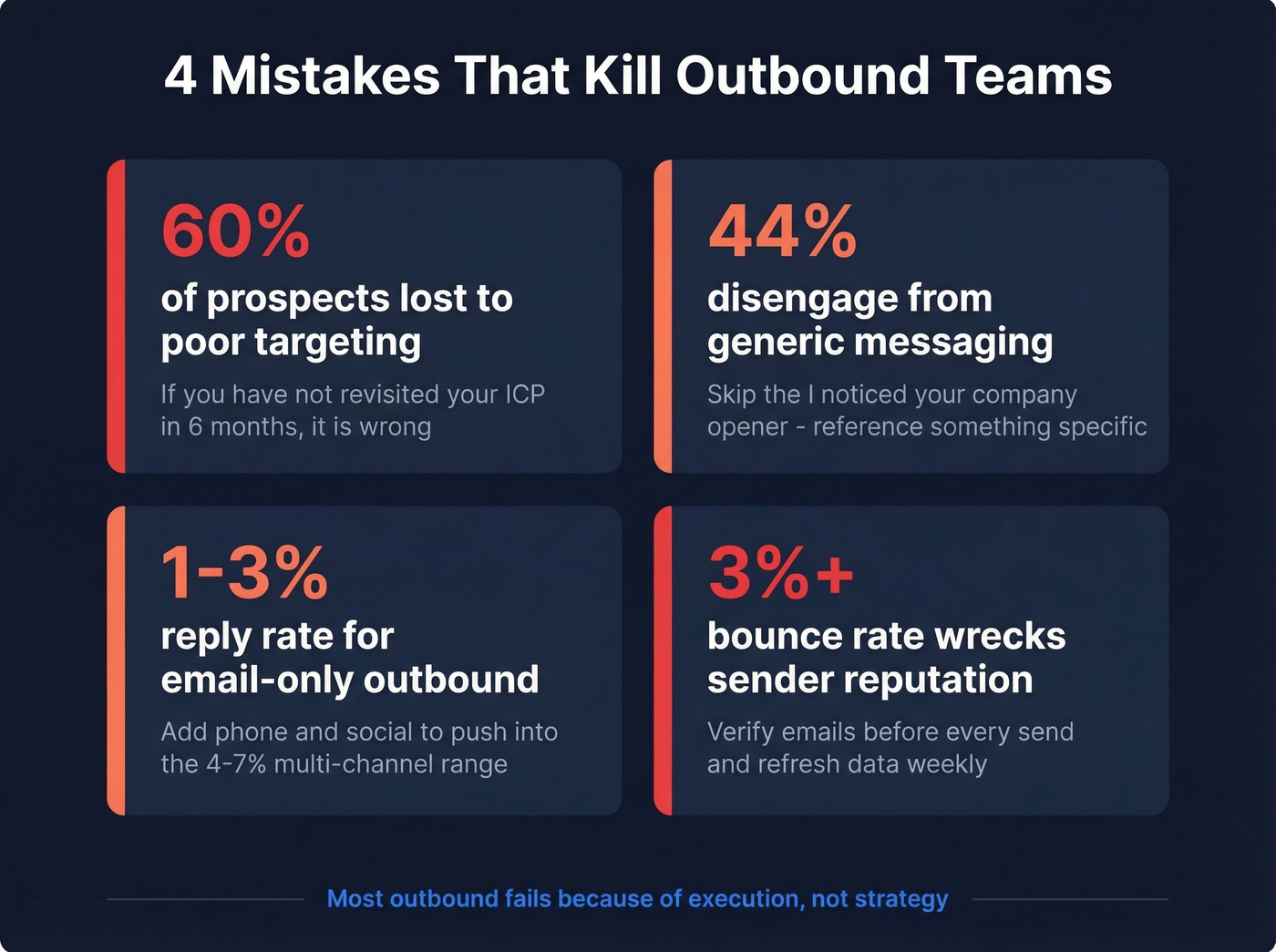
Poor targeting is the biggest offender. 60% of prospects are lost because teams target the wrong accounts entirely. If you haven't revisited your ICP in six months, it's wrong. Markets shift, buying committees change, and last quarter's ideal customer profile might be sending you into dead ends.
Irrelevant messaging is a close second. 44% of prospects disengage when messaging feels generic. Skip the "I noticed your company..." opener that everyone uses and reference something specific - a recent hire, a funding round, a tech migration. Tighten this up with better email subject lines and cleaner positioning.
Single-channel reliance caps your upside. Email-only outbound often lands in the 1-3% range. Add phone and social to push into the 4-7% multi-channel range.
Pitching too early kills deals before they start. Lead with insight, not a demo request. And if your data is stale, none of this matters anyway - bounce rates above 3% wreck sender reputation fast, so verify emails before every send and keep your data refreshed weekly. If deliverability is slipping, start with email bounce rate and then fix sender reputation.
You just read that 60% of prospects are lost to poor targeting and bad data wrecks domain reputation at scale. Prospeo's 5-step verification, catch-all handling, and spam-trap removal keep bounce rates under 4% - at $0.01 per email with no annual contract.
Your multi-channel cadence deserves data that actually connects. Test it free today.
Compliance in 30 Seconds
GDPR: Legitimate interest or consent for B2B outreach in the EU. Fines up to EUR 20M or 4% of global revenue.
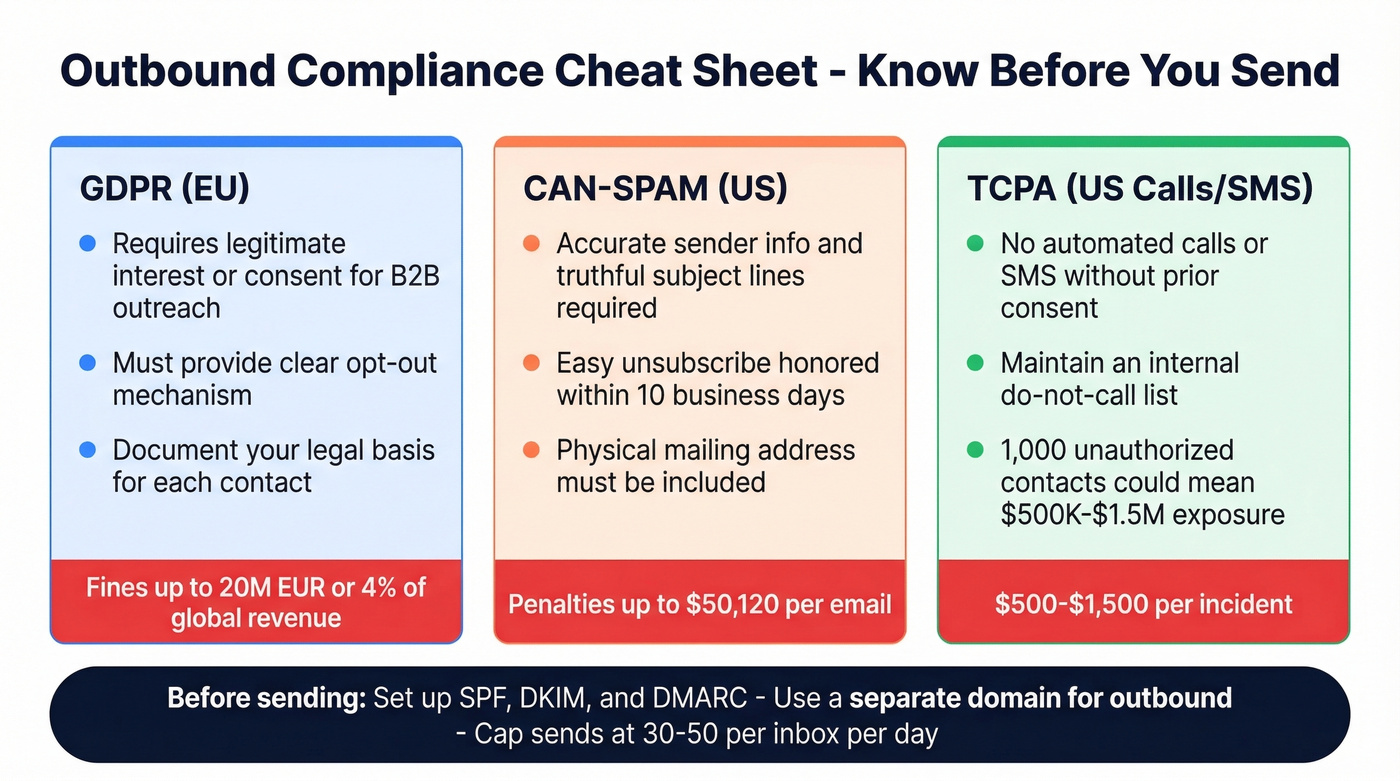
CAN-SPAM: Accurate sender info, truthful subject lines, easy unsubscribe honored within 10 business days. Penalties up to $50,120 per email.
TCPA: $500-$1,500 per incident for unauthorized automated calls or SMS. Contact 1,000 people without consent and you're looking at $500K-$1.5M exposure.
Infrastructure: Set up SPF, DKIM, and DMARC before sending a single cold email. Use a separate domain for outbound. Cap sends at 30-50 per inbox per day.
FAQ
What's the difference between outbound sales and outbound marketing?
Outbound sales is direct 1:1 prospecting - calls, emails, and social touches aimed at specific people. Outbound marketing is broader push messaging like ads, direct mail, and events. The best teams coordinate both so marketing warms target accounts before sales reaches out, creating a 67% improvement in close rates.
How many touches does it take to book a meeting?
Expect 8-12 touches over 2-4 weeks across multiple channels. Multi-channel sequences convert at 4-7%, versus 1-3% for email-only. The average prospect requires 8+ call attempts before you reach them live.
What tools do I need to start outbound?
Three things: a B2B data platform with verified contacts, a sequencer like Instantly or Outreach, and a CRM like HubSpot or Salesforce. Add intent data and calling tools once you're doing 50+ dials per day.
Does outbound marketing B2B still work with tighter privacy regulations?
Yes, but only when you respect compliance frameworks like GDPR, CAN-SPAM, and TCPA. The key is combining legitimate interest with signal-based targeting so you're reaching prospects who are actually in-market - not blasting cold lists indiscriminately.