

Outbound SDR Guide: Scripts, Benchmarks & Playbook (2026)
A RevOps lead we know ran a 3-tool bake-off last quarter. The "best" database created 4,000 duplicate contacts in Salesforce in five days. The cheapest one had better phone connect rates. The lesson: outbound SDR success isn't about the fanciest tools - it's about accurate data, a proven multichannel cadence, and scripts you've actually practiced.
What Is an Outbound SDR?
An outbound SDR (Sales Development Representative) is the person who opens doors. Their job isn't to close deals - it's to find the right prospects, reach out cold, qualify interest, and hand warm meetings to account executives.
The core responsibilities break down into four buckets: prospecting (building targeted lists), outreach (cold calls, cold emails, social touches), qualification (confirming budget, authority, need, and timeline), and AE handoff (booking the meeting and briefing the closer). An inbound SDR responds to incoming leads generated by marketing - demo requests, content downloads, webinar signups. Outbound SDRs go hunt them, initiating contact with prospects who haven't raised their hand.
The goal is simple: book qualified meetings. Everything else - the scripts, the cadences, the tech stack - exists to make that happen more efficiently.
The Outbound SDR Funnel
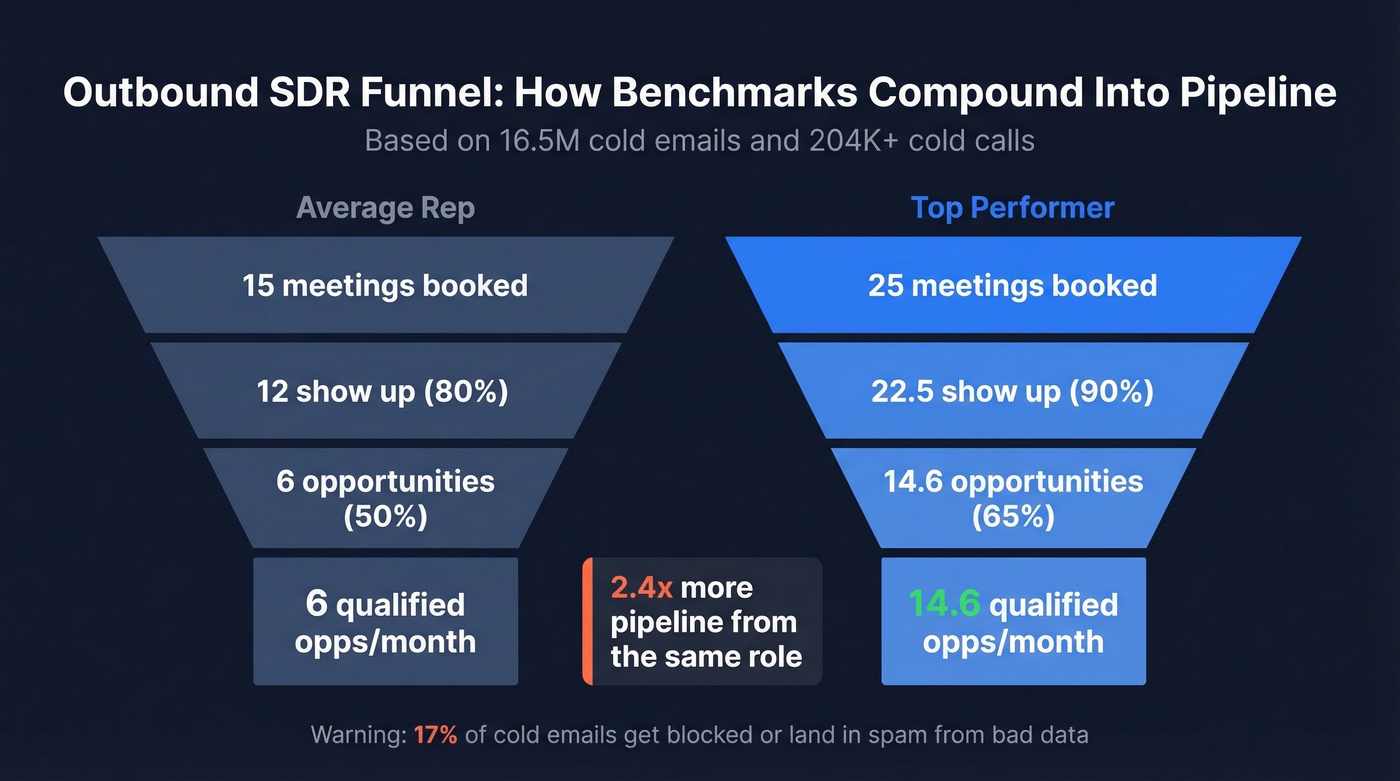
These benchmarks come from an analysis of 16.5M cold emails and 204K+ cold calls:
| Metric | Average | Good | Top Performer |
|---|---|---|---|
| Connect rate (dials) | 16.6% | 18-20% | 22%+ |
| Dial to meeting | 2.3% | 4-5% | 6.7%+ |
| Cold email reply rate | 5.8% | 7-8% | 10%+ |
| Meetings booked/month | 15 | 18-20 | 25+ |
| Meeting show rate | ~80% | 85% | 90%+ |
| Meeting to opportunity | ~50% | 55-60% | 65%+ |
These numbers compound fast. A rep booking 15 meetings a month at an 80% show rate and 50% meeting-to-opportunity conversion creates 6 qualified opportunities. A top performer booking 25 meetings with a 90% show rate and 65% conversion creates 14.6. That's nearly 2.5x the pipeline from the same role.
The standard recommendation is a 3:1 pipeline-to-quota ratio. If your team's quota is $500K, you need $1.5M in qualified pipeline. Work the funnel backwards from there to figure out how many dials and emails your reps actually need to make.
One stat that should worry every sales leader: 17% of cold emails get blocked or land in spam. If your data provider is feeding you bad emails, you're not just wasting time - you're actively damaging your domain reputation.
Team Structure in 2026
The Bridge Group's study of 351 B2B companies gives us the clearest picture of how sales development teams are organized right now. The SDR-to-AE ratio sits at 1:2.4 - a number that's been remarkably consistent since 2018. Most teams (60%) have their SDR group reporting to Sales, not Marketing.
If you want a deeper breakdown of org design and ratios, see our guide to sales team structure.
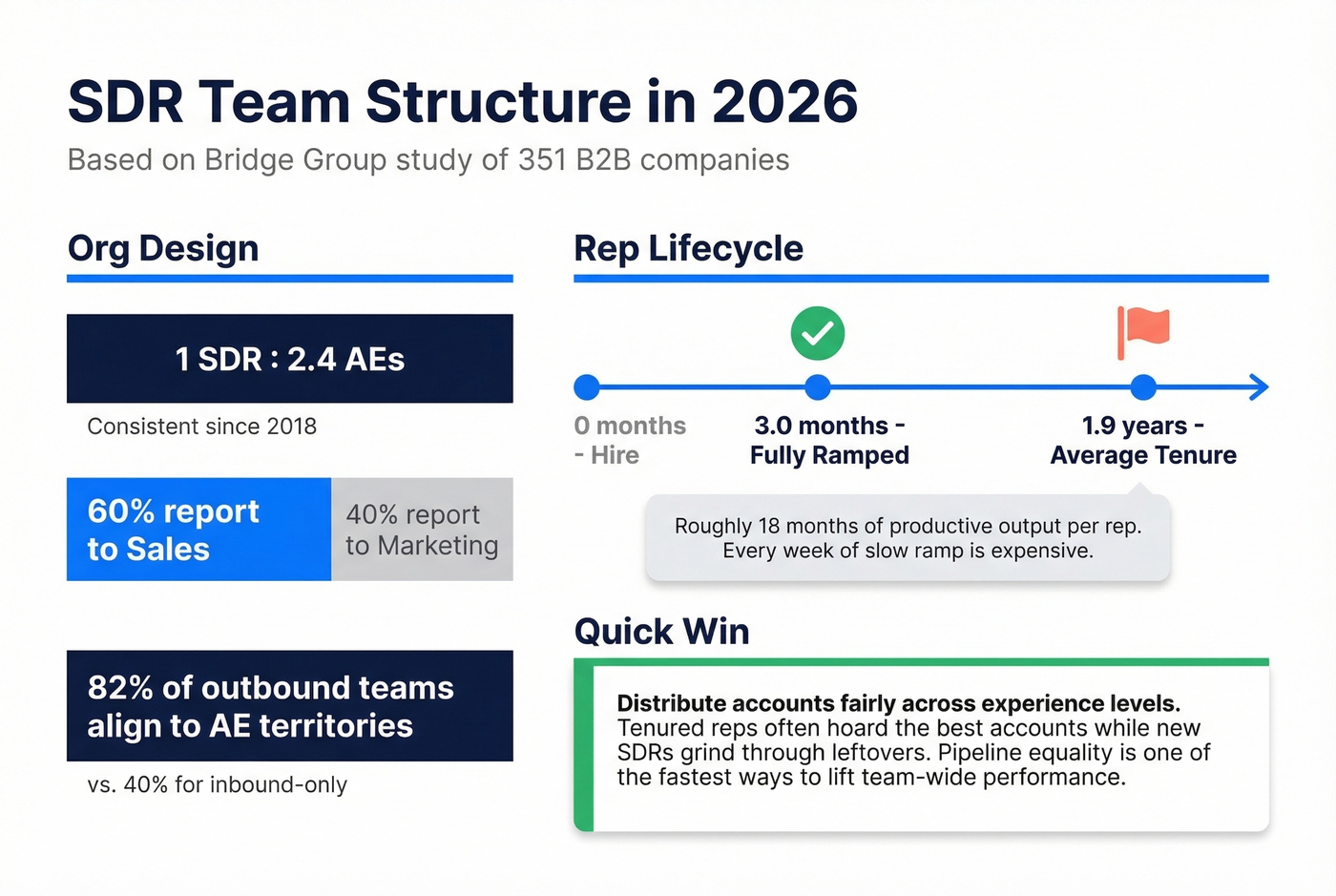
Territory alignment matters more than most leaders realize. 82% of outbound teams align to AE territories, compared to just 40% of inbound-only teams. This alignment keeps handoffs clean and prevents the "who owns this account?" fights that kill pipeline velocity.
One underrated management lever: pipeline equality. Tenured reps often get the best accounts while new SDRs grind through leftovers. Distributing accounts fairly across experience levels is one of the fastest ways to lift team-wide performance. Average ramp time has dropped to 3.0 months - the lowest since 2010 - and average tenure is 1.9 years. That means you've got roughly 18 months of productive output from a ramped rep before they promote out or leave. Every week of slow ramp is expensive.
If you're rebuilding onboarding, use a structured SDR onboarding plan to shorten time-to-productivity.
The Outbound SDR Tech Stack
Tech adoption among sales development teams tells you what's table stakes: 77% use a sales engagement platform, 81% use a professional network tool, 74% use a contact data provider, 66% use call recording, and 41% use parallel dialers.
Here's the stack we'd recommend:
| Category | Tool | Price Range | Key Strength |
|---|---|---|---|
| Data Provider | Prospeo | ~$0.01/lead; free tier | 98% email accuracy, 7-day refresh, 125M+ mobiles |
| Data Provider | ZoomInfo | $15-40K/yr | Largest DB, enterprise |
| Data Provider | Apollo | Free; $49-99/mo paid | Free tier, built-in sequences |
| Sales Engagement | Outreach | ~$100-200/seat/mo | Market leader, analytics |
| Sales Engagement | Salesloft | ~$100-200/seat/mo | Strong coaching features |
| CRM | HubSpot | Free; Sales Hub from $20/mo | Popular SMB-to-mid-market CRM |
| CRM | Salesforce | From ~$25/user/mo | Enterprise standard |
| Conversation Intel | Gong | ~$100-200/user/mo | Call recording + AI coaching |
The data provider category deserves the most attention because it's the foundation of everything else. Scripts don't matter if you're calling disconnected numbers. Cadences don't matter if your emails bounce.
If you're evaluating vendors, start with a shortlist of B2B data enrichment tools and a dedicated email verifier app to protect deliverability.
Here's the thing: if your average deal size is under $15K, you almost certainly don't need a $30K/year data provider. Spend the savings on better sales engagement tooling and a data source with higher accuracy at a fraction of the cost.
Prospeo's 7-day data refresh cycle is the real differentiator here - the industry average is six weeks, which means most providers are serving you stale contacts by default. At roughly $0.01 per lead versus the ~$1/lead many teams end up paying with enterprise data providers, the unit economics aren't close. Meritt switched and saw their bounce rate drop from 35% to under 4%, with pipeline tripling from $100K to $300K per week.


17% of cold emails hit spam - and bad data makes it worse. Prospeo's 5-step verification and 7-day refresh cycle keep your SDRs sending to real inboxes, not honeypots. At ~$0.01/email, your team books more meetings without burning your domain.
Give your reps data that actually connects them to buyers.
Cold Calling Scripts That Work
The 4-Part Call Structure
Every effective cold call follows the same skeleton. The framework from OutboundSalesPro breaks it into four parts:
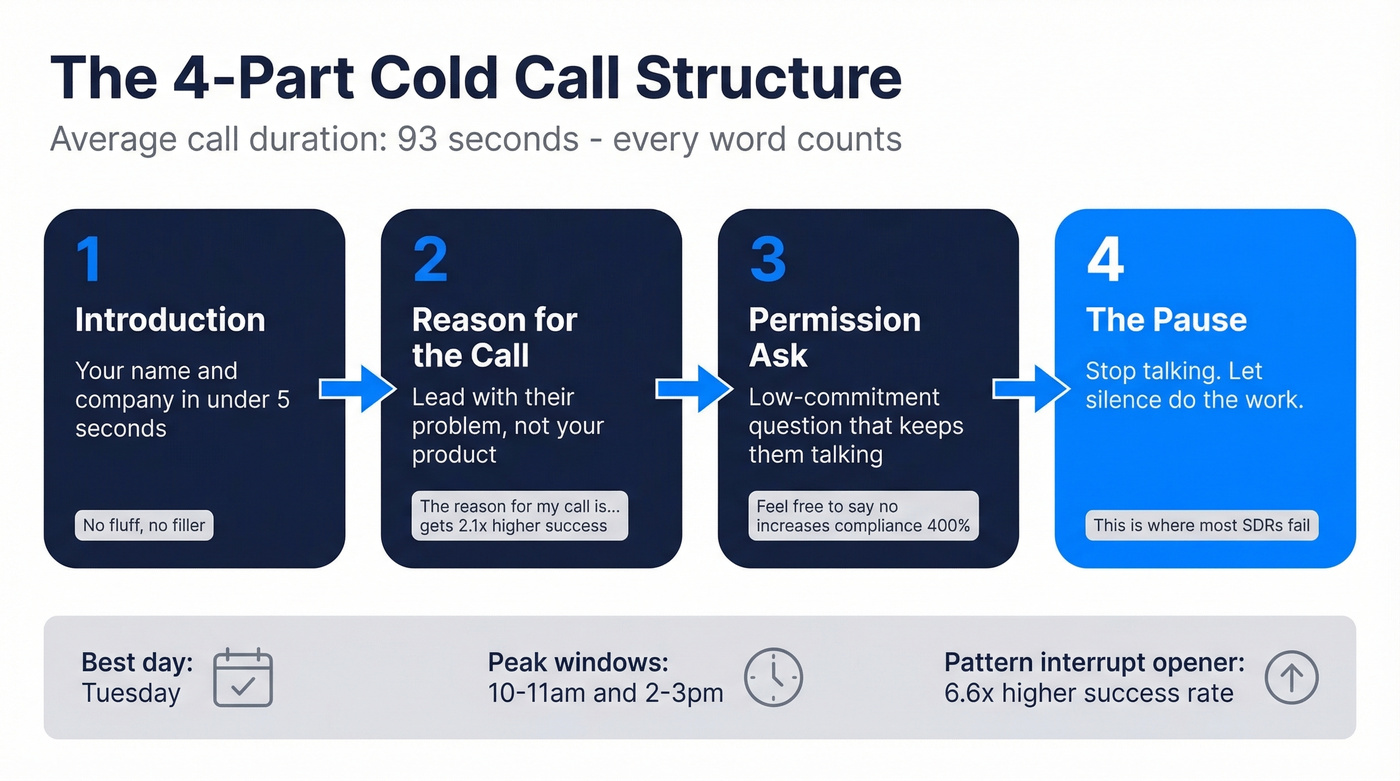
- Introduction - fast, no fluff, your name and company in under five seconds
- Reason for the call - problem-based, not product-based
- Permission ask - low-commitment question that keeps them on the line
- Pause - silence after the ask, let them respond
The pause is where most SDRs fail. They fill the silence with more talking. Don't.
If you want a manager-led way to improve talk tracks, consider formal cold calling coaching instead of ad-hoc feedback.
Openers That Convert
The permission-based opener: "Hey [Name], this is [You] from [Company]. Feel free to say no, but I noticed [trigger] and wanted to ask a quick question - does that sound fair?" Adding "you're free to accept or refuse" language increased compliance 400% in a behavioral study. It works because it gives the prospect control.
The pattern interrupt: "Hey [Name], how have you been?" This simple question delivers a 6.6x higher success rate because it breaks the telemarketer script the prospect expects. They pause, recalibrate, and actually listen.
The reason statement: "The reason for my call is..." This phrase produces a 2.1x higher success rate because it signals you have a specific purpose - you're not just dialing down a list.
The 30MPC framework adds a layer: lead with context about the prospect before introducing yourself. "I saw your team just closed a Series B - congrats" before "I'm [Name] from [Company]" reframes you from stranger to someone who did their homework.
Handling Objections
The "Mr. Miyagi method" from 30MPC is the cleanest objection framework we've seen: agree with the objection, redirect the momentum, then get them talking. You're handling their emotional reaction before addressing the logical one.
When a prospect says "I'm not interested," don't argue. Try: "Totally fair - most people aren't when they first hear from us. Quick question before I let you go: how are you currently handling [specific problem]?" You've acknowledged their position, asked for almost nothing, and opened a door.
For more ready-to-use language, keep a library of objection handlers your team can practice weekly.
Voicemail That Gets Callbacks
Most cold calls go to voicemail, so treat it as a channel, not a dead end. Keep it under 20 seconds: your name, one sentence about why you're calling tied to a specific trigger, and your phone number twice. Skip the "call me back at your convenience" filler - end with the trigger so it's the last thing they hear.
Tuesdays are the best day for cold calls, with 10-11am and 2-3pm as the peak windows. Average call duration is 93 seconds - you don't have long, so every word counts.
Top SDRs book 25+ meetings a month - but only when their dials reach real people. Prospeo's 125M+ verified mobiles deliver a 30% pickup rate vs. the 12.5% industry average. That's 2.4x more live conversations from the same activity volume.
Stop dialing dead numbers. Start hitting direct lines.
Cold Email Playbook
Cold email is a precision game, not a volume game.
If you're building sequences from scratch, start with proven cold email sequence examples and align them to your personalized outreach process.
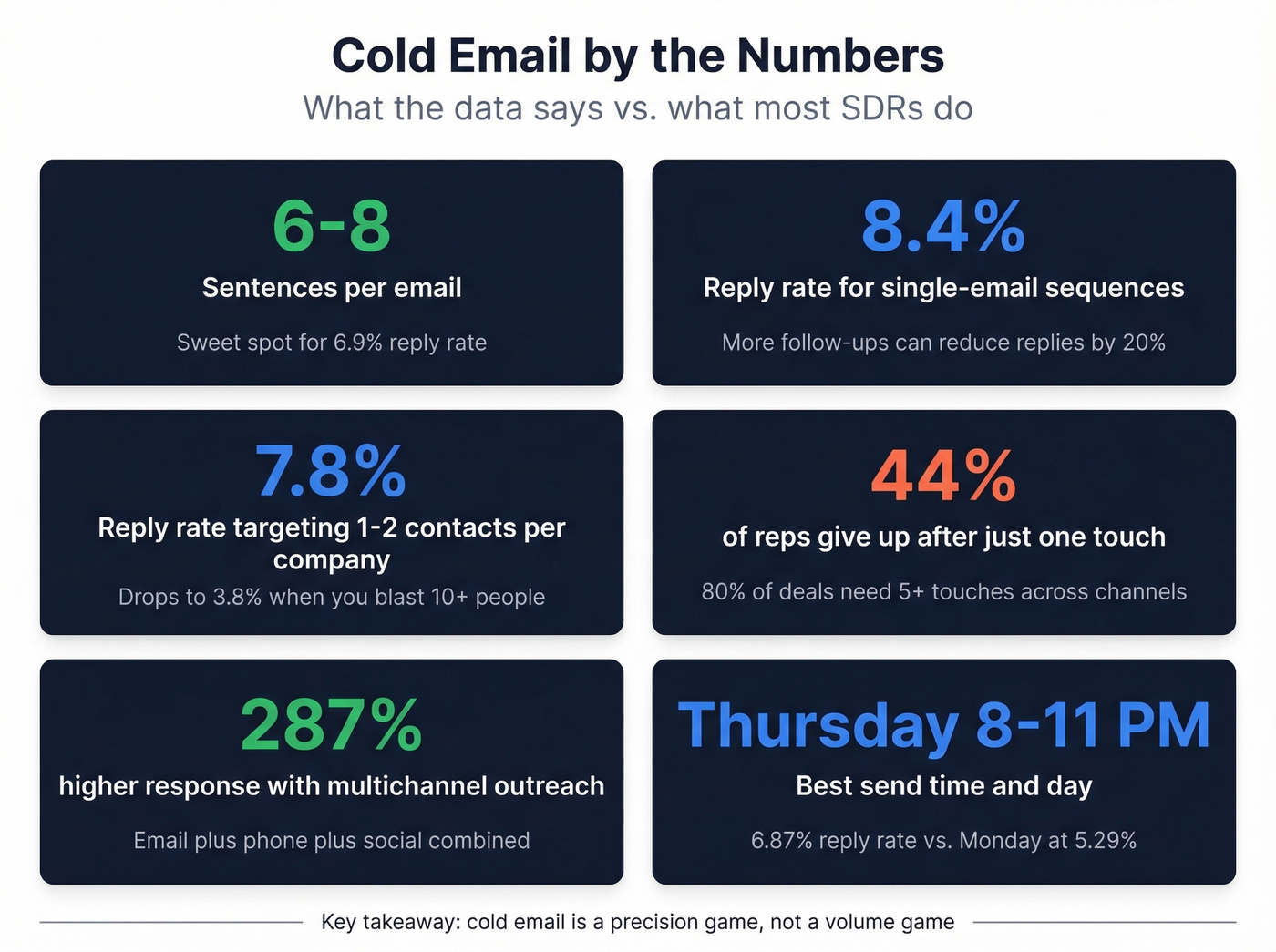
Emails of 6-8 sentences perform best at a 6.9% reply rate - shorter feels incomplete, longer doesn't get read. Thursday sends pull a 6.87% reply rate versus Monday's 5.29%, and the 8-11 PM window hits 6.52% because people read email at night when they're not in meetings.
Here's the counterintuitive finding that should change how you build sequences: single-email sequences actually produce the highest reply rate at 8.4%. Adding a third email can reduce replies by up to 20%. More follow-ups aren't always better - each additional touch needs to earn its place with a genuinely new angle, not just a "bumping this to the top of your inbox."
Targeting density matters too. Contact 1-2 people per company and you'll see a 7.8% reply rate. Blast 10+ contacts at the same company and it drops to 3.8%. Prospects talk to each other. Spray-and-pray gets you flagged.
That said, 80% of deals require 5+ touches across channels, but 44% of reps give up after one. Using email, phone, and social together increases response rates 287% versus single-channel. The key is multichannel persistence, not email-only repetition.
Sample Cold Email
Here's a template that follows the data - problem-focused, 7 sentences, with a low-friction ask:
Subject: [Trigger] - quick question
Hi [First Name],
Saw that [Company] just [specific trigger - e.g., opened 3 new SDR roles / closed a Series B / expanded into EMEA]. Congrats - that kind of growth usually means the outbound engine needs to scale fast.
The challenge we keep hearing from teams in your position: reps burn 40% of their day on bad data instead of live conversations. [Your Company] helps teams like [Similar Company] cut bounce rates below 4% and triple pipeline within a quarter.
Would it make sense to spend 15 minutes seeing if we could do the same for your team?
Either way, no pressure - happy to share the playbook we used with [Similar Company] if that's more useful.
Best, [Your Name]
Before you launch any cold email campaign, verify your list. 17% of cold emails get blocked or land in spam - and most of that comes from bad data, not bad copy.
To reduce bounces and protect inboxing, follow a simple how to verify an email workflow before every send.
Multichannel Cadence Templates
Standard 5-Touch Cadence
This is the workhorse cadence for cold outbound when you don't have a specific buying signal:
- Day 1: Personalized email (problem-focused, 6-8 sentences)
- Day 3: Cold call (use permission-based opener)
- Day 7: Follow-up email (new angle, reference the call attempt)
- Day 10: Second call attempt (different time of day)
- Day 14: Breakup email (clear, no guilt trip, leave the door open)
Keep it tight. Don't stretch a 5-touch cadence across 30 days - momentum dies after two weeks of silence.
If you want a day-by-day version you can copy into your SEP, use this follow up plan.
Intent-Triggered Burst Cadence
When a prospect shows a buying signal - funding round, new VP hire, competitor tech removal - compress the timeline:
- Day 1 (within 24 hours of signal): Email referencing the trigger
- Day 2: Cold call
- Day 4: Follow-up email with a different value angle
- Day 6: Social touch (comment, connection request)
- Day 7: Final call or email
Intent platforms deliver a 2-3x lift in response rates when the first touch lands within 24 hours of a signal. For enterprise deals with longer sales cycles, extend this to a 21-28 day cadence with 8-10 touches - the compressed timeline works for mid-market, but enterprise buyers need more air between contacts.
If you're shopping for signal sources, compare the best intent data providers before you commit.
Improving Sales Development Performance
The biggest performance levers aren't about working harder. They're about working with better inputs.
Name-dropping converts. Mentioning a mutual connection or relevant company name in your opener increases conversions by 73%. That's the difference between a 14% and 25% conversion rate in one study. Showing your name on caller ID lifts conversion rates 54% - anonymous calls get screened, named calls get answered.
Fix your data before fixing your scripts. One team we tracked shifted from a volume-first approach to precision-over-volume and saw average meetings jump from 3.2 to 6.8 per month. Top performers went from 6.3 to 9.5. The primary change wasn't better talk tracks - it was better data. Bounce rates dropped from 4.8% to 1.2%.
If you’re operationalizing this, track the right sales productivity metrics so you can prove what changed.
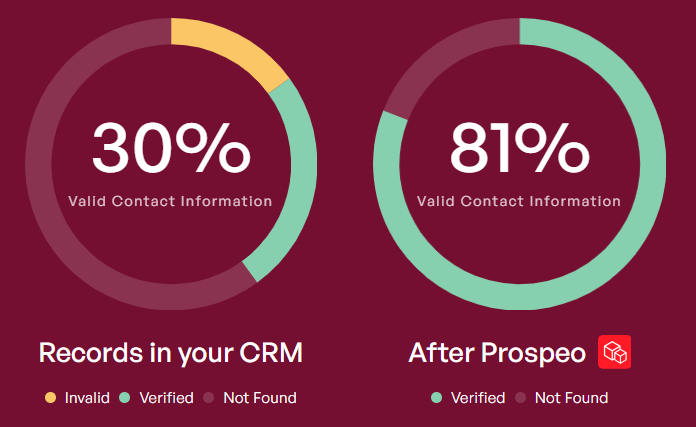
GreyScout's experience illustrates this perfectly. After upgrading their data layer, their bounce rate dropped from 38% to under 4%, pipeline grew 140%, and rep ramp time was cut from 8-10 weeks to 4 weeks. Reps spend only 28% of their time actually selling - cleaning bad data eats the rest. Fix the data and you give reps their time back.
Signal-Based Prospecting
Only 3-5% of your market is actively buying right now. Another ~7% is open to a conversation. If you're working 600-700 accounts a month with no signal filtering, you're annoying roughly 570 of them.
Signal-based prospecting flips the model. Instead of blasting a list, you watch for buying signals and reach out when the timing is right:
- Funding rounds - new money means new initiatives
- New VP/C-suite hire - new leaders bring new vendors
- Job openings (especially SDR/AE roles) - they're scaling the team
- Competitor tech removal - they're evaluating alternatives
- Usage spikes or drops - something changed
The real power comes from stacking signals. A company that just raised a Series B, hired a new VP of Sales, and posted three SDR roles isn't just a prospect - it's a prospect with urgency. The signal-stacking approach has gained real traction on r/SaaS and r/sales, and the math backs it up: teams that layer two or more intent signals before outreach consistently report 2-3x higher reply rates than those working static lists.
AI and the Future of Sales Development
AI isn't replacing outbound SDRs in 2026. Only 7% of organizations have AI fully scaled across their enterprise, and just 13% cite headcount reduction as a primary AI objective. Meanwhile, 42% of B2B sales decision-makers are implementing generative AI use cases - so adoption is real, but it's augmentation, not replacement.
If you’re pressure-testing tools and workflows, this deep dive on AI in sales will help you separate hype from ROI.
The hybrid model is what's actually emerging. AI SDR tools like Artisan's Ava and Qualified's Piper handle the repetitive work: data gathering, initial outreach personalization, engagement tracking, and scheduling. Humans handle what AI can't: navigating objections in real time, running nuanced needs assessments, and managing multi-stakeholder deals where politics matter more than product features.
Let's be honest - the SDRs who'll thrive are the ones who use AI to eliminate busywork and spend more of their day in actual conversations. The ones who resist it will fall behind.
Salary and Career Path
2026 Compensation
SDR compensation varies by geography and experience, but here are the ranges from Betts Recruiting's data:
| Level | Region | Base Salary | OTE |
|---|---|---|---|
| Entry-level | NY/SF | $50-70K | $80-90K |
| Entry-level | Central/Eastern | $55-70K | $70-85K |
| 6+ months | NY/SF | $60-80K | $80-100K |
| 6+ months | Central/Eastern | $60-75K | $80-95K |
OTE variability runs 20-60% of base depending on location and company stage, with total comp commonly landing in the $70-100K range.
Career Progression
The standard progression is SDR to Senior SDR to Account Executive to sales leadership. With an average tenure of 1.9 years, most reps promote out within two years. The 3.0-month ramp period is your window to prove yourself - teams that can't ramp new hires fast enough lose them to frustration before they ever hit quota.
For a more detailed timeline and role options, see our SDR career path guide.
The outbound SDR role isn't glamorous. But it's one of the fastest on-ramps into tech sales, and the earning potential at the AE level - where OTEs regularly hit $150K+ - makes the grind worthwhile. Skip this path if you hate rejection or need immediate gratification; it's a delayed-reward game that pays off for people who can stay disciplined through the first 6-12 months.
FAQ
How many calls should an outbound SDR make per day?
Most teams target 50-80 dials per day, yielding 8-13 live conversations at a ~16.6% connect rate. The key isn't maximizing dials - it's maximizing quality conversations. Parallel dialers push higher volumes but connect rates often drop as targeting loosens.
What does the outbound SDR process look like step by step?
Build a targeted account list using signal data, enrich contacts with verified emails and direct dials, execute a multichannel cadence (calls, emails, social touches), qualify interested prospects against ICP criteria, and hand warm meetings to an AE with full context. The cycle usually runs 10-14 days per prospect.
What's a good meeting booking rate?
The average rep books 15 meetings per month. Good performers hit 18-20, and top performers consistently book 25+. Below 15, the problem is usually data quality or call structure, not effort.
How long does it take to ramp?
The current average is 3.0 months - the lowest on record. Teams with strong onboarding, clean data, and territory alignment ramp faster. Teams that hand new reps a phone and a list take twice as long.