

How to Write an Outreach Message That Actually Gets Replies
A founder on r/SaaS shared his numbers last year: 2,000+ cold emails sent, six replies, zero customers. He concluded cold outreach was dead and pivoted to content marketing. He wasn't wrong about his results - but he was wrong about the diagnosis. His outreach message wasn't the problem. His infrastructure was.
The average cold email reply rate sits at 3.43%. Elite campaigns blow past that - one content outreach operation hit an 81% open rate and 13% reply rate. The gap between 3.43% and 13% isn't copywriting talent. It's systems: data quality, deliverability, sequencing, and yes, the message itself. But the message is maybe 20% of the outcome.
Here's the short version: your copy matters less than you think. Data quality and deliverability are the other 80%. Elite first-touch emails run under 80 words, include one CTA, and lead with the prospect's problem. And before you send anything, verify your list, warm your domains, and plan for 4-7 touches per prospect.
Data and Deliverability Come First
You've probably read ten articles about outreach copy. None of them mentioned that if your bounce rate is above ~3%, you're already hurting deliverability - and above 5%, you're in the danger zone. You're blaming the subject line, but the problem is your list.
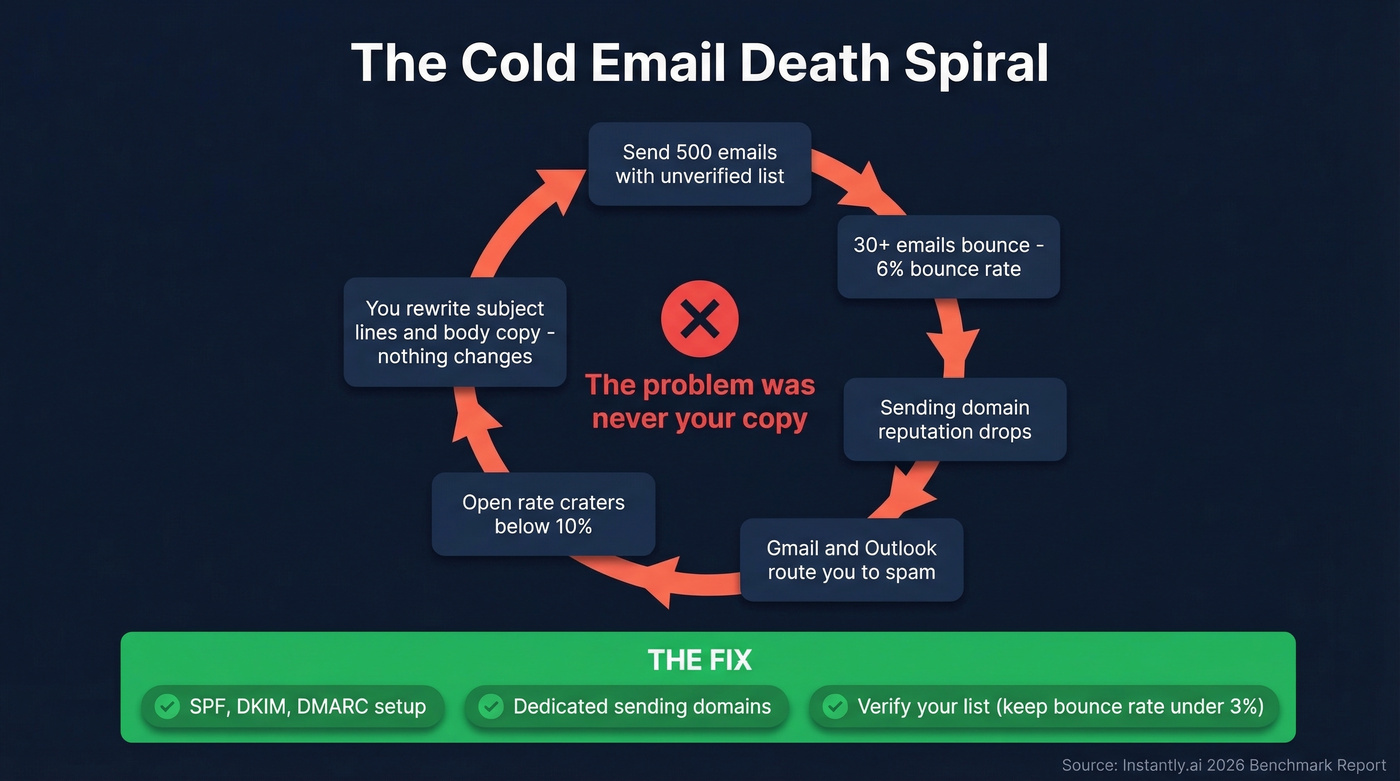
The death spiral works like this. You send 500 messages. 30 bounce. Your bounce rate hits 6%, and your sending domain's reputation drops. Gmail and Outlook start routing you to spam. Your open rate craters. You rewrite the subject line. Nothing changes. You rewrite the body. Nothing changes. Because the emails never arrived.
Before you write a single word of outreach copy, lock down three things:
- SPF, DKIM, and DMARC records on every sending domain. Non-negotiable. These authentication protocols prove you're not spoofing.
- Domain separation. Never send cold outreach from your primary business domain. Use dedicated secondaries.
- Inbox warmup. New domains need 14-21 days of warmup before you send at scale. Skip this and you're dead on arrival.
The most overlooked piece is list verification. We've seen teams go from a 35% bounce rate to under 4% just by switching to a provider with pre-verified data and a weekly refresh cycle - that's the difference between landing in inboxes and landing in spam. Prospeo runs 98% email accuracy with a 7-day data refresh, and you pay only for verified addresses, so you're not burning credits on bad data.

Subject Lines That Get Opened
Belkins analyzed 5.5 million emails across all of 2024, and the data is clear: personalized subject lines hit a 46% open rate versus 35% without personalization. That's a 31% lift just from including something relevant to the recipient. Reply rates jumped even harder - 7% versus 3%.
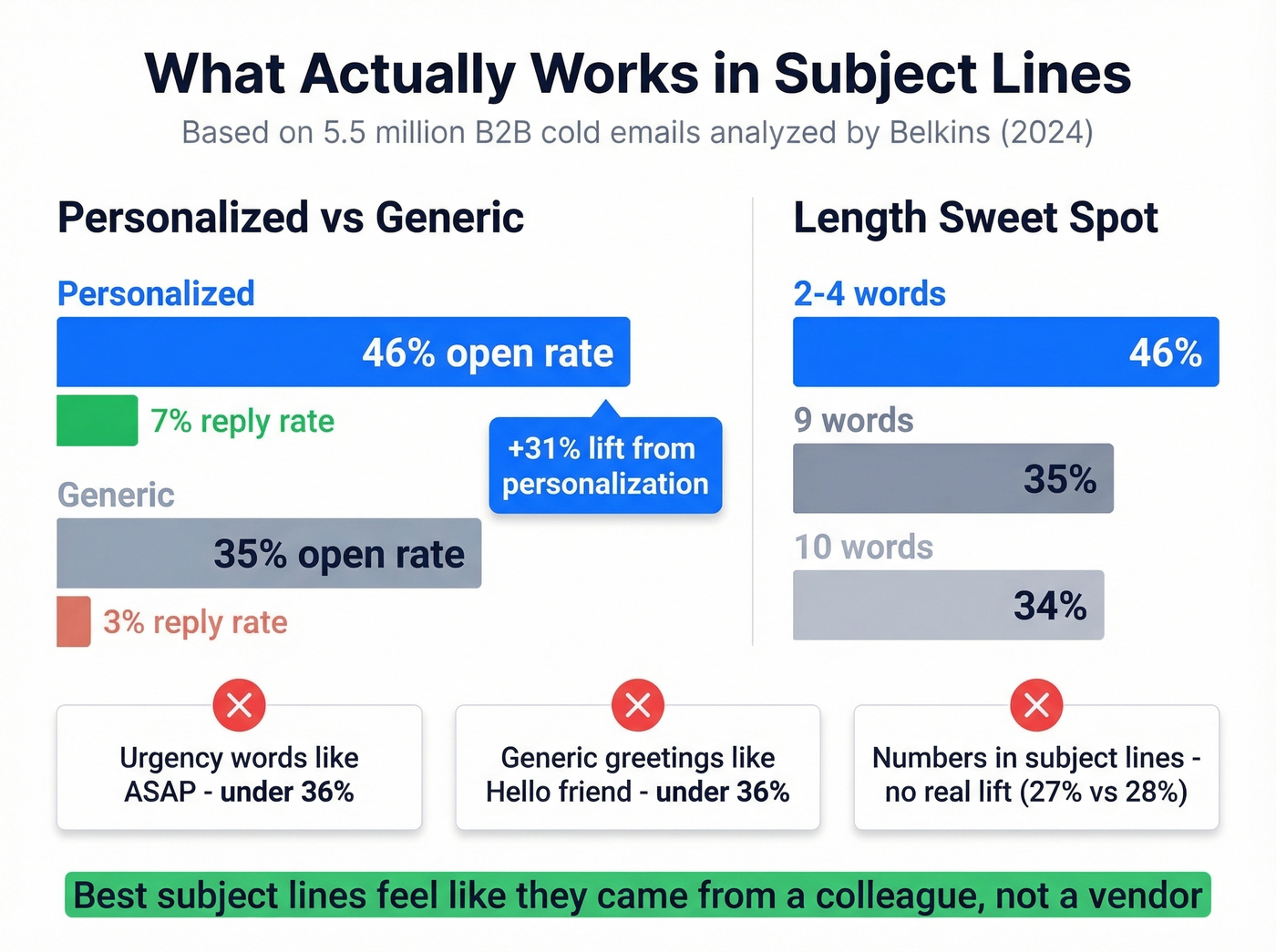
Keep it short. Two to four words is the sweet spot.
| Length | Open Rate |
|---|---|
| 2-4 words | 46% |
| 9 words | ~35% |
| 10 words | ~34% |
Question-style subject lines matched the 46% open rate of personalized ones. "Scaling the SDR team?" beats "Introducing Our Platform" every time. Urgency terms like "ASAP" and generic greetings like "Hello, friend" correlated with under 36% open rates - the more it sounds like marketing, the worse it performs. And numbers in subject lines? They hit 27% open rates versus 28% without. Not the silver bullet most guides claim.
The best subject lines feel like they came from a colleague, not a vendor. Short, specific, and relevant to something happening at the prospect's company right now. If you want more patterns to steal, keep a swipe file of subject lines and test them against your segments.
Templates That Work
Every template below follows the same principles: under 80 words, single CTA, problem-first positioning. These map to the patterns that elite campaigns use to hit 10%+ reply rates.
Cold First Touch
Hi {{first_name}},
Noticed {{company}} just {{trigger event - hiring, funding, expansion}}. When that happens, most teams hit {{specific problem}}.
We helped {{similar company}} solve that in {{timeframe}} by {{one-line mechanism}}.
Worth a 15-min call this week?
Opens with their world, not yours. The trigger event proves you did homework. One CTA, one ask. Under 60 words. This structure consistently outperforms "intro-about-us-pitch-CTA" formats because the prospect sees their own situation reflected back before you ever mention yourself.
The "Reply-Style" Follow-Up
Step-2 emails that feel like replies outperform formal follow-ups by ~30%. That stat alone should change how you write every follow-up:
Hey {{first_name}} - just bumping this up. Did the timing not work, or is {{problem}} not a priority right now?
Under 25 words. Feels like a real reply, not a scheduled drip. No signature block, no formatting, no links.
The Breakup Email
Breakup emails pull replies from prospects who ignored the first four touches. The resource link gives value even if they never respond:
{{first_name}}, I'll assume the timing isn't right. If {{problem}} becomes a priority, here's a {{resource link}} that might help either way.
No hard feelings - happy to reconnect whenever.
Removes pressure entirely. You're giving, not asking.
LinkedIn DM
LinkedIn DMs should stay under ~300 characters to feel native. Reference something they actually posted - "compare notes" frames it as peer-to-peer, not vendor-to-prospect:
Hi {{first_name}} - saw your post about {{topic}}. We're working on something similar at {{your company}} for {{their industry}}.
Would love to compare notes. Open to a quick chat?
Warm Intro Request
Hi {{first_name}}, {{mutual connection}} suggested I reach out. They mentioned you're working on {{initiative}}.
We just helped {{similar company}} with {{outcome}}. Happy to share what worked if it's useful.
The mutual connection does the heavy lifting. In our experience, warm intros outperform cold touches by 3-5x. If you have a warm path, always take it - even if it's slower.
These principles apply beyond sales outreach. Link-building campaigns, partnership asks, investor outreach - they all follow the same mechanics: short, specific, one ask. The highest-performing outreach messages across industries share the same DNA: a relevant hook, a clear value exchange, and a single call to action.

The article says it plainly: data quality is 80% of your outreach results. Prospeo's 98% email accuracy and 7-day data refresh cycle mean your messages actually land in inboxes - not spam folders. Teams using Prospeo cut bounce rates from 35% to under 4% and tripled their pipeline.
Stop rewriting subject lines. Start fixing your list.
Building a Follow-Up Sequence
58% of replies come from the first message. That means 42% come from follow-ups, and most reps give up after one or two. The average prospect needs 5 touches. Executives require around 9; individual contributors respond after roughly 4. If you're prospecting into the C-suite, plan a longer sequence and don't panic when the first five go unanswered.
Timing matters too. Tuesday and Wednesday consistently produce the highest reply rates, with Wednesday edging ahead. Monday inboxes are flooded; Friday attention is gone. (If you want a data-backed schedule, start with best time to send cold emails.)
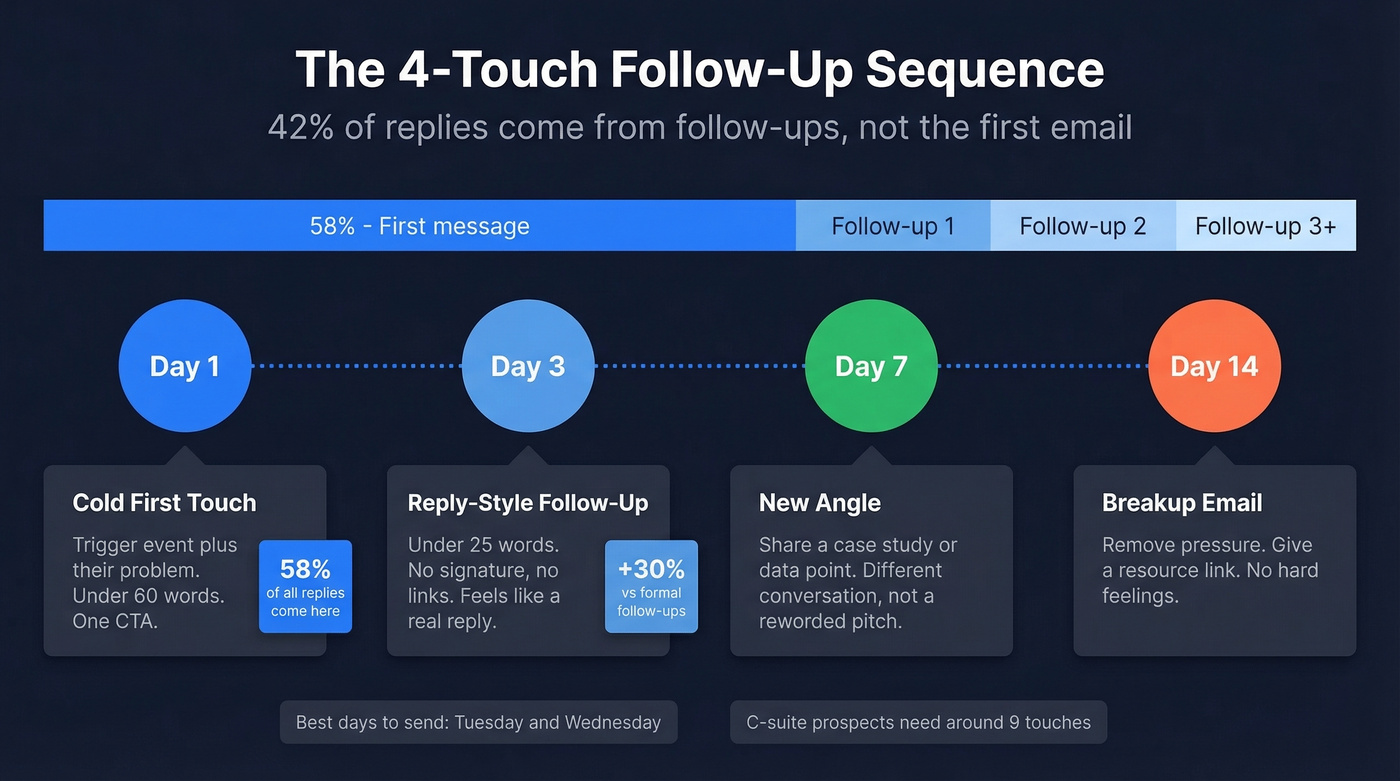
A practical four-step sequence: Day 1, the cold first touch. Day 3, the reply-style follow-up. Day 7, a new angle - share a relevant case study or data point. Day 14, the breakup email. Each touch should feel like a different conversation, not the same pitch reworded four times. If you need more variations, pull from these sales follow-up templates.
Creative Ideas That Stand Out
81% of decision-makers say they'll respond to cold outreach when it's tailored to their company and context. But "personalized" doesn't mean "generated by ChatGPT with their name inserted." Buyers can spot AI-written outreach now. The tells are everywhere.
Some of the most effective creative cold outreach ideas go beyond text entirely. Teams that embed a 30-second Loom video walking through a prospect's website or product see reply rates 2-3x higher than text-only emails. Others reference a prospect's recent podcast appearance or conference talk - anything that proves genuine attention rather than batch personalization. (If you want a playbook, see Loom video outreach.)
Outreach.io's framework for personalization prompts is useful: Context, Detail, Structure, Guardrails. Give the AI context about the prospect's situation, specify the variables you want included, define the structure, then set guardrails for what to avoid. Those guardrails matter most. The AI tells to eliminate:
- Em dashes everywhere
- "It's not just X, it's Y" constructions
- Exaggerated praise ("Your incredible leadership in...")
- Rule-of-three sentence patterns
- Bland filler and forced analogies
If your personalization reads like a LinkedIn influencer post, it's hurting you. The best personalization is specific and brief - one sentence that proves you looked at their company, then straight into the value prop. For more examples, compare approaches in personalized outreach.
Email vs. LinkedIn vs. Multi-Channel
LinkedIn outreach delivers roughly double the response rate of cold email, but that number is misleading without context.
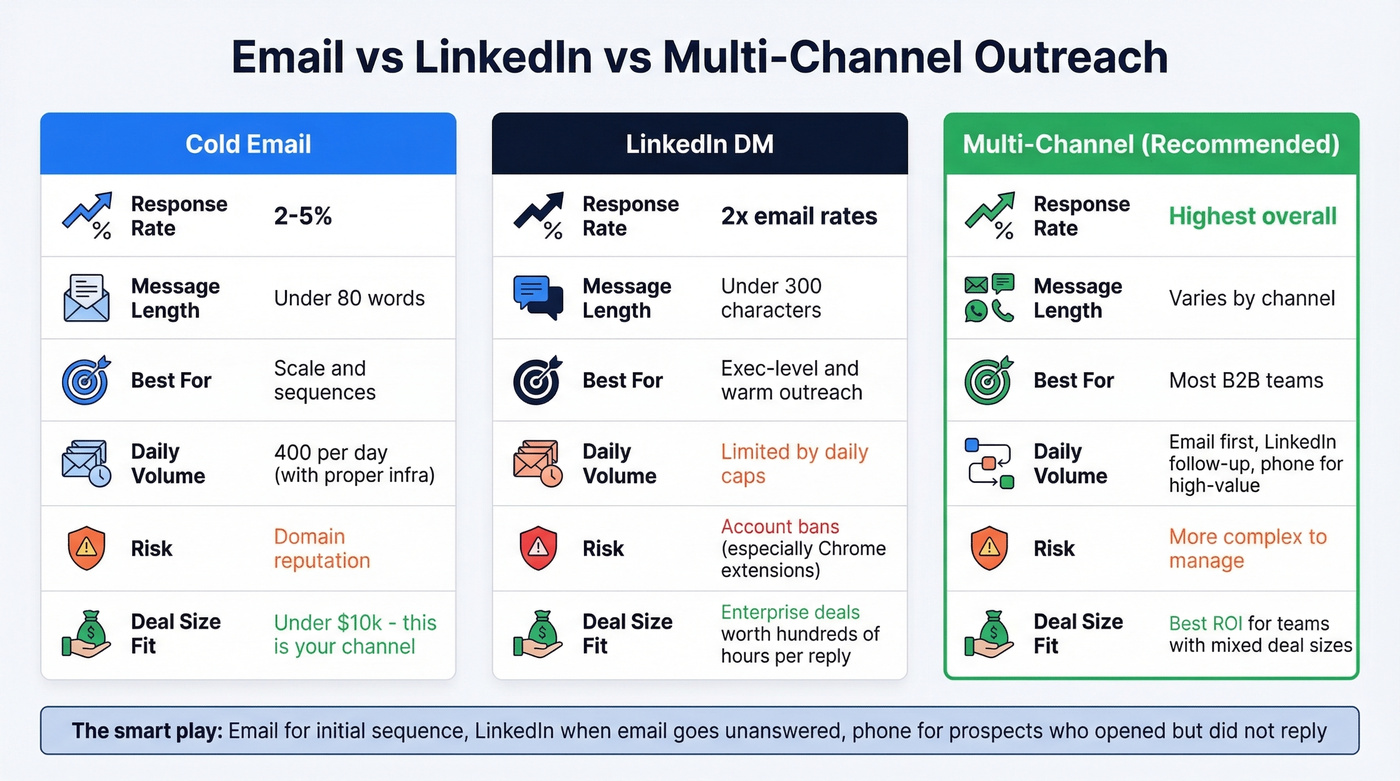
| Factor | Cold Email | LinkedIn DM | Winner |
|---|---|---|---|
| Response rate | 2-5% | ~2x email | |
| Character norm | Under 80 words | Under ~300 chars | Email (more room) |
| Best for | Scale, sequences | Exec-level, warm | Depends on target |
| Risk | Domain reputation | Account bans | Email (more controllable) |
| Mobile | 81% open mobile | Native app | Tie |
Email wins on scale and automation. 400 emails a day across multiple domains is a common scaling target with proper infrastructure. LinkedIn caps your daily connection requests and messages, and Chrome-extension-only automation tools carry the highest ban risk.
Let's be honest: if your deals close under $10k, you probably don't need LinkedIn outreach at all. Email at scale with clean data will outperform hand-crafted LinkedIn messages every time at that price point. Save LinkedIn for enterprise deals where a single reply is worth hundreds of hours.
For most teams, the smart play is multi-channel. Email for the initial sequence, LinkedIn for the follow-up touch when email goes unanswered, phone for high-value prospects who've opened but not replied. Don't pick one channel - layer them.
Infrastructure Math
To send 400 emails per day - a reasonable scale for a small outbound team - you need:
- 10-12 secondary domains (never your primary)
- 2-3 inboxes per domain (spreading volume)
- 10-15 emails per inbox per day (staying under spam thresholds)
- 14-21 days of warmup before sending from any new inbox
At 400 emails per day, that's roughly 12,000 per month. A 3% reply rate produces about 360 replies monthly. That's your top-of-funnel. From there, conversion to meetings depends on your targeting and message quality.
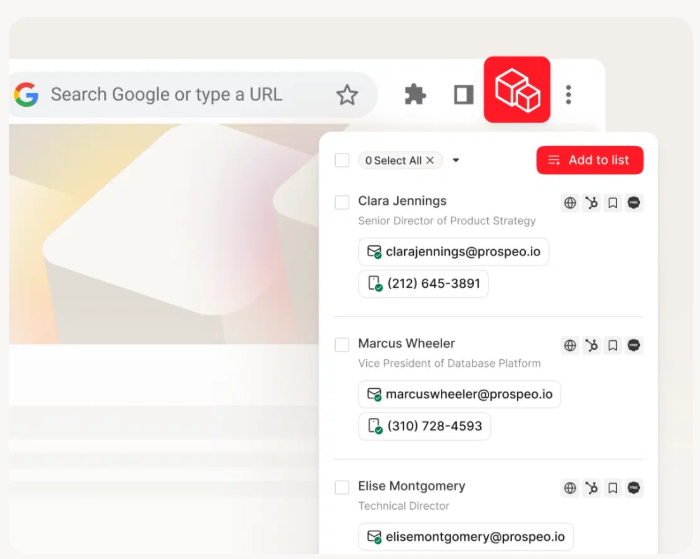
Building those prospect lists is where Prospeo's Chrome extension comes in - 40,000+ users pull verified emails and mobile numbers from company websites, professional profiles, and CRMs in one click. You're building lists with pre-verified data, which means you skip the "clean the list" step entirely. If you're comparing providers, start with data enrichment services and email list providers.
Mistakes That Kill Your Results
We've audited dozens of outbound setups, and the same problems come up over and over. A pre-send checklist:
- Using your primary domain for cold email. Set up secondaries. This isn't optional.
- Skipping warmup. 14 days minimum, 21 preferred. Keep warmup running even after you start sending.
- Multiple CTAs. One ask per email. Period. (More rules and examples: email call to action.)
- No unsubscribe link. It's required for compliance in many jurisdictions and helps deliverability.
- Heavy HTML or too many links. Plain text outperforms designed emails for cold outreach. Keep links to one or two max.
- Not cleaning your list. A bounce rate above ~3% starts damaging your sender reputation.
- Missing SPF/DKIM/DMARC. These authentication records are table stakes.
- Sending from one account at scale. Distribute volume across multiple inboxes and domains.
The consensus on r/coldemail is that deliverability infrastructure - not subject lines, not templates - is where most outreach campaigns actually fail. Fix the plumbing before you rewrite the copy.
You just built a 4-7 touch sequence. Now you need verified contacts to send it to. Prospeo gives you 300M+ profiles with 30+ filters - buyer intent, job changes, technographics - so every outreach message hits the right person at the right moment. At $0.01 per email, scaling your sequence costs almost nothing.
Build the list your outreach sequence deserves.
FAQ
What's a good reply rate for cold outreach?
The average cold email reply rate is 3.43%. Top-quartile campaigns hit 5.5%+, and elite performers exceed 10%. If you're below 2%, check your deliverability setup before rewriting templates - the emails may not be arriving at all.
How many follow-ups should I send?
Four to seven touches is the sweet spot for most sequences. 58% of replies come from the first message, but 42% come from follow-ups - so stopping after one email leaves nearly half your potential replies on the table. For executives, plan up to 9 touches.
How do I keep emails from landing in spam?
Verify your list and keep bounce rates under ~3%. Set up SPF, DKIM, and DMARC on every sending domain. Use secondary domains - never your primary - and warm up new inboxes for 14-21 days. Send to verified addresses from day one, and your domain reputation stays clean.
Should I skip LinkedIn outreach for smaller deals?
For deals under $10k, email at scale with clean data almost always outperforms hand-crafted LinkedIn messages. LinkedIn's real value is in enterprise prospecting where a single reply justifies the time investment. For everything else, a well-built email sequence with verified contacts will get you further, faster.