Overcoming Sales Challenges That Actually Matter in 2026
Only 5% of B2B buyers say salespeople exceed their expectations. Five percent. Overcoming sales challenges in 2026 isn't about building a better process - it's about the ground shifting underneath your process while only 27% of reps consistently hit quota.
The game changed. Most sales orgs haven't caught up.
Three Root Causes Behind Every Sales Obstacle
Most sales challenges trace back to three things:
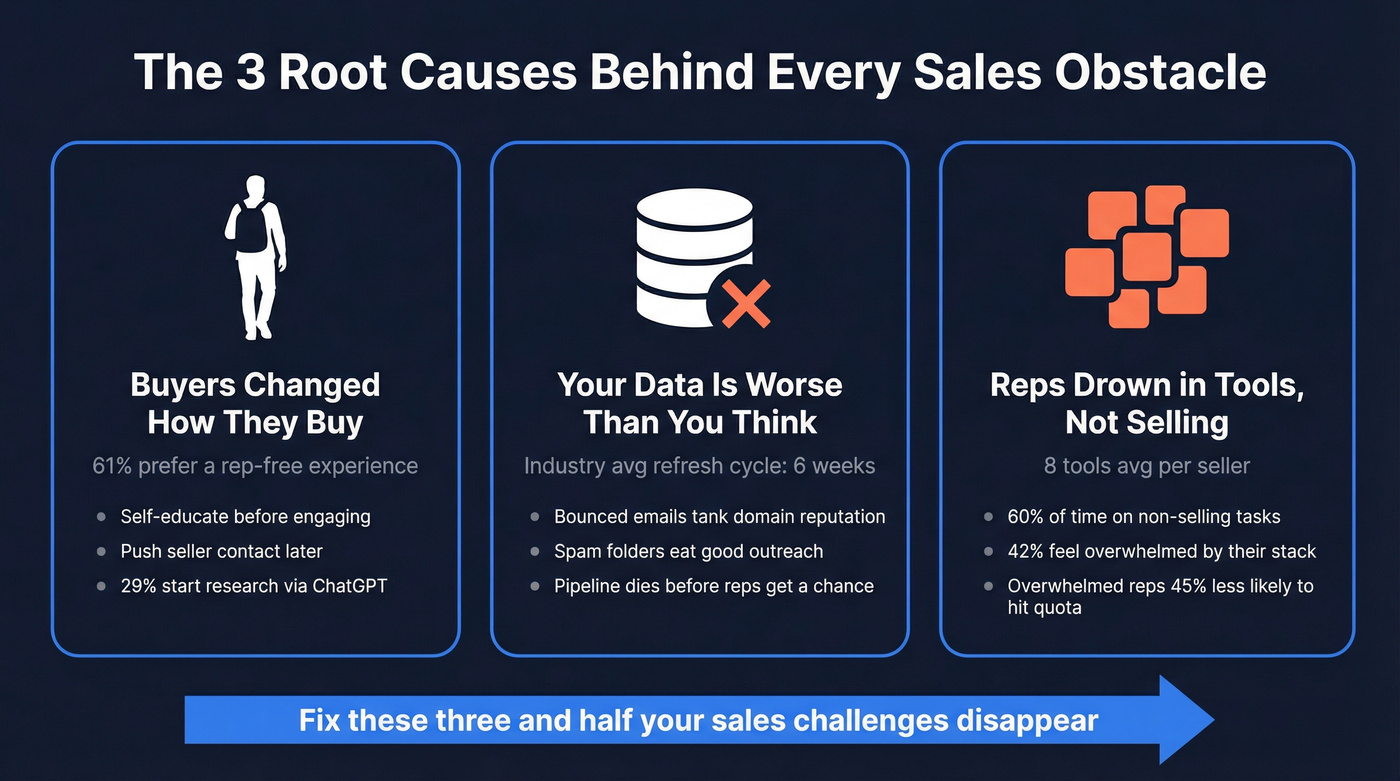
- Buyers changed how they buy. They self-educate, engage sellers late, and ghost irrelevant outreach.
- Your data is worse than you think. Bad emails and stale numbers silently kill your pipeline before reps even get a chance (see B2B contact data decay).
- Reps are drowning in tools instead of selling. The average seller uses eight tools to close deals, and reps spend 60% of their time on non-selling tasks.
Fix those and half the "challenges" on every generic listicle disappear.
Buyers Don't Want to Talk to You
61% of B2B buyers prefer a rep-free buying experience. G2's survey of 1,169 decision-makers shows those who do engage sellers are pushing that engagement later - up 17 percentage points year over year. And here's the stat nobody's talking about: 29% of buyers now start research via ChatGPT more often than Google.
The "5-8 stakeholders" talking point every sales trainer loves? Committees are actually shrinking to 3-4 members. Fewer people, but better informed. 73% of B2B buyers actively avoid sellers who send irrelevant outreach. The bar for relevance isn't "personalize the first line." It's "know my business problem before I tell you." (If you need a tighter framework, use account-based prospecting.)
Bad Data Is the Silent Pipeline Killer
Picture this: your SDR sends 200 cold emails Monday. A big chunk bounce. Domain reputation tanks. By Wednesday, even good emails land in spam. By Friday, deliverability is cooked.
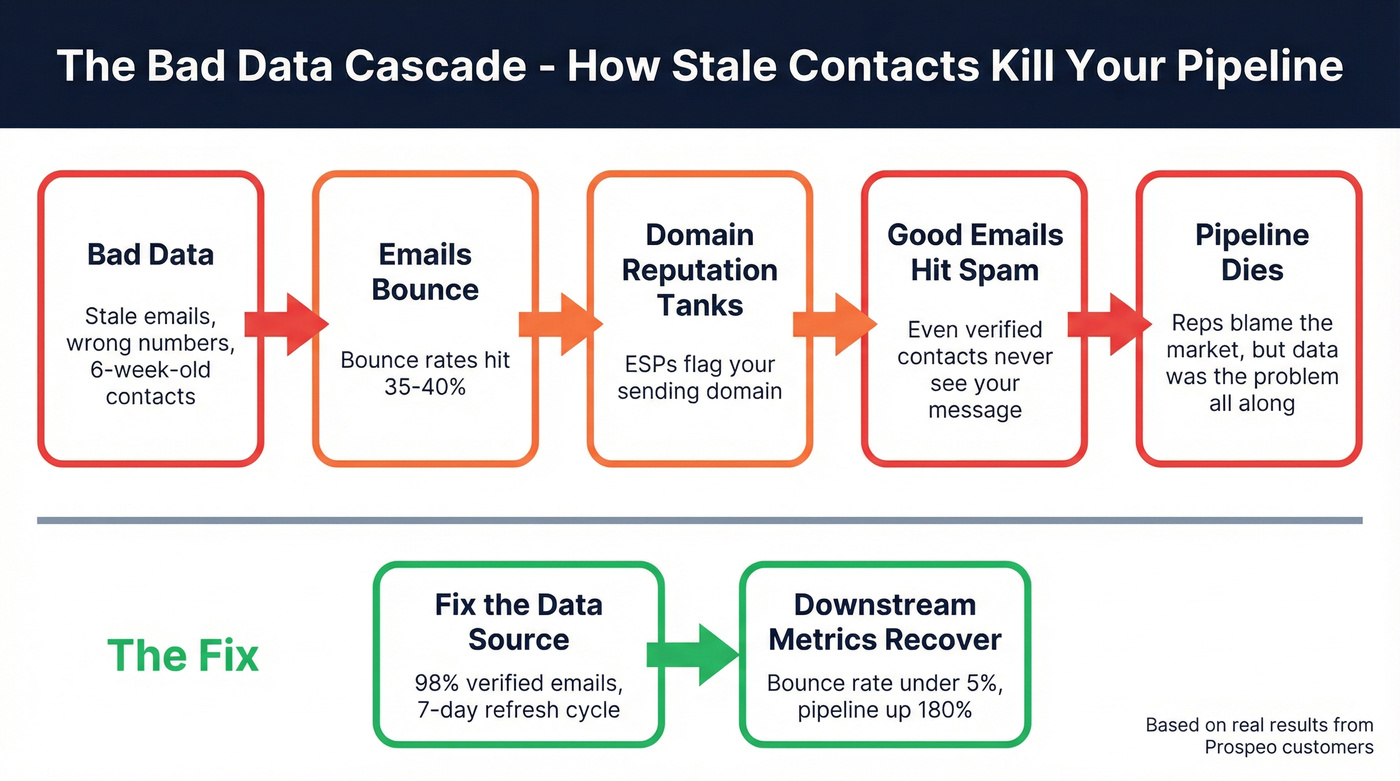
Ask any SDR what their biggest headache is and you'll hear the same thing: "pipeline quality is trash." They're right - but the root cause is upstream. Bad data leads to bounces, bounces damage your domain, damaged domains collapse deliverability, and collapsed deliverability kills pipeline. Most teams treat this as a deliverability problem when it's a data problem (use an email deliverability checklist and fix hard bounce drivers). Fix the data layer and downstream metrics recover on their own.
We've watched teams cut bounce rates from 35-40% to under 5% by fixing the data source. Snyk's 50 AEs were dealing with exactly this - after switching to Prospeo's 98% verified emails with a 7-day refresh cycle, their bounce rate dropped under 5% and AE-sourced pipeline jumped 180%. When the industry average refresh cycle is six weeks, most providers are handing you contacts that went stale a month ago.

Your reps are juggling 8 tools fed by stale data. Prospeo consolidates verified emails, direct dials, and intent signals into one platform - with native integrations for Salesforce, HubSpot, Smartlead, and more. 98% email accuracy. 125M+ verified mobiles. One data layer to rule your stack.
Stop duct-taping your sales stack. Start with clean data.
Multi-channel outbound only works when every channel has verified contact data behind it. Prospeo gives your reps 98% accurate emails and 125M+ verified mobile numbers in the same platform - refreshed every 7 days, not every 6 weeks. Teams using Prospeo book 35% more meetings than Apollo users.
Layer email, phone, and social with contacts you can actually reach.
Prospecting Demands More Than One Channel
It takes 4.81 touches on average just to get a response. Meanwhile, 57% of sales pros say cycles are getting longer, and 54% of outbound teams say identifying quality leads is their biggest hurdle (see quality lead generation).
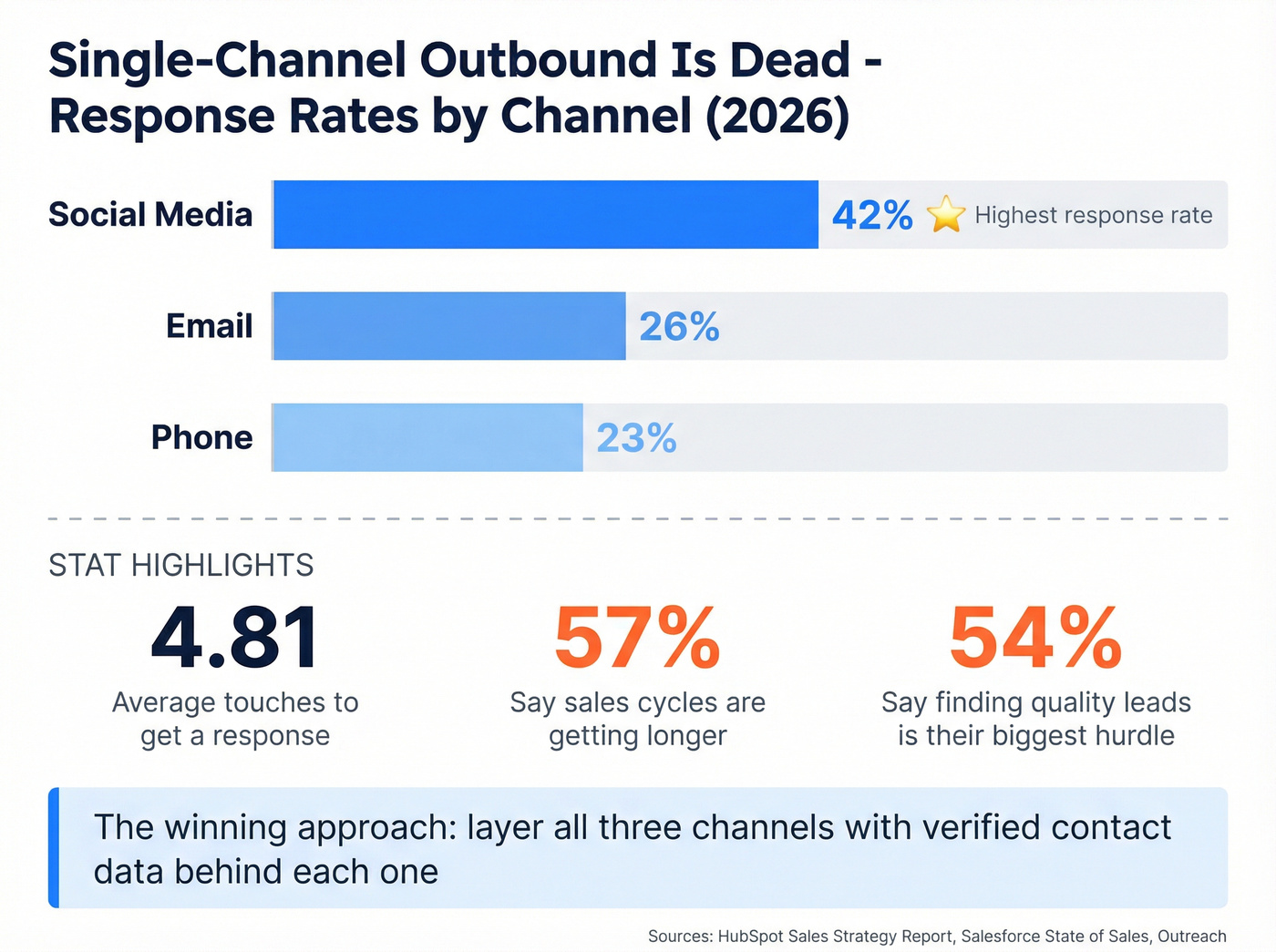
Here's my hot take: single-channel outbound is dead. Teams still running email-only sequences are leaving pipeline on the table. 42% of sales pros say social media now delivers the highest cold outreach response rate - ahead of email at 26% and phone at 23%. The best results come from layering verified email sequences with social touches and direct dials, treating each channel as reinforcement rather than a standalone bet (build it like AI multi-channel prospecting).
Analysis paralysis kicks in when reps stare at five channels and don't know which to prioritize. The fix isn't another strategy deck - it's a sequenced playbook that removes the decision entirely. That means having verified emails and direct dials in the same platform so reps aren't toggling between three tabs to build a single sequence. We've found that consolidating contact data into one source of truth, rather than stitching together multiple providers, is what actually makes multi-channel execution practical for teams running at scale.
Tool Overload Is Killing Productivity
Sellers use an average of eight tools to close deals. 42% feel overwhelmed, and overwhelmed sellers are 45% less likely to hit quota.
Let's be honest: the tools aren't the problem. The data feeding them is. Eight tools running on stale, unverified data just means eight tools producing garbage faster. The consensus on r/sales echoes this constantly - reps don't need another platform, they need the platforms they already have to work with clean inputs (start with CRM hygiene). Consolidating your stack around a single verified data layer that integrates natively with your CRM, sequencer, and enrichment workflows eliminates the duct-tape problem most RevOps teams live with daily.
Skip this approach if your team is under five reps and only uses two tools. You probably don't have a stack problem - you have a targeting problem.

Discovery Still Wins Deals
Gong's research shows top closers speak only 43% of the time versus 65% for average performers. The best reps ask more and talk less - starting with how, what, and why instead of closed questions that kill conversations (use these open-ended questions).
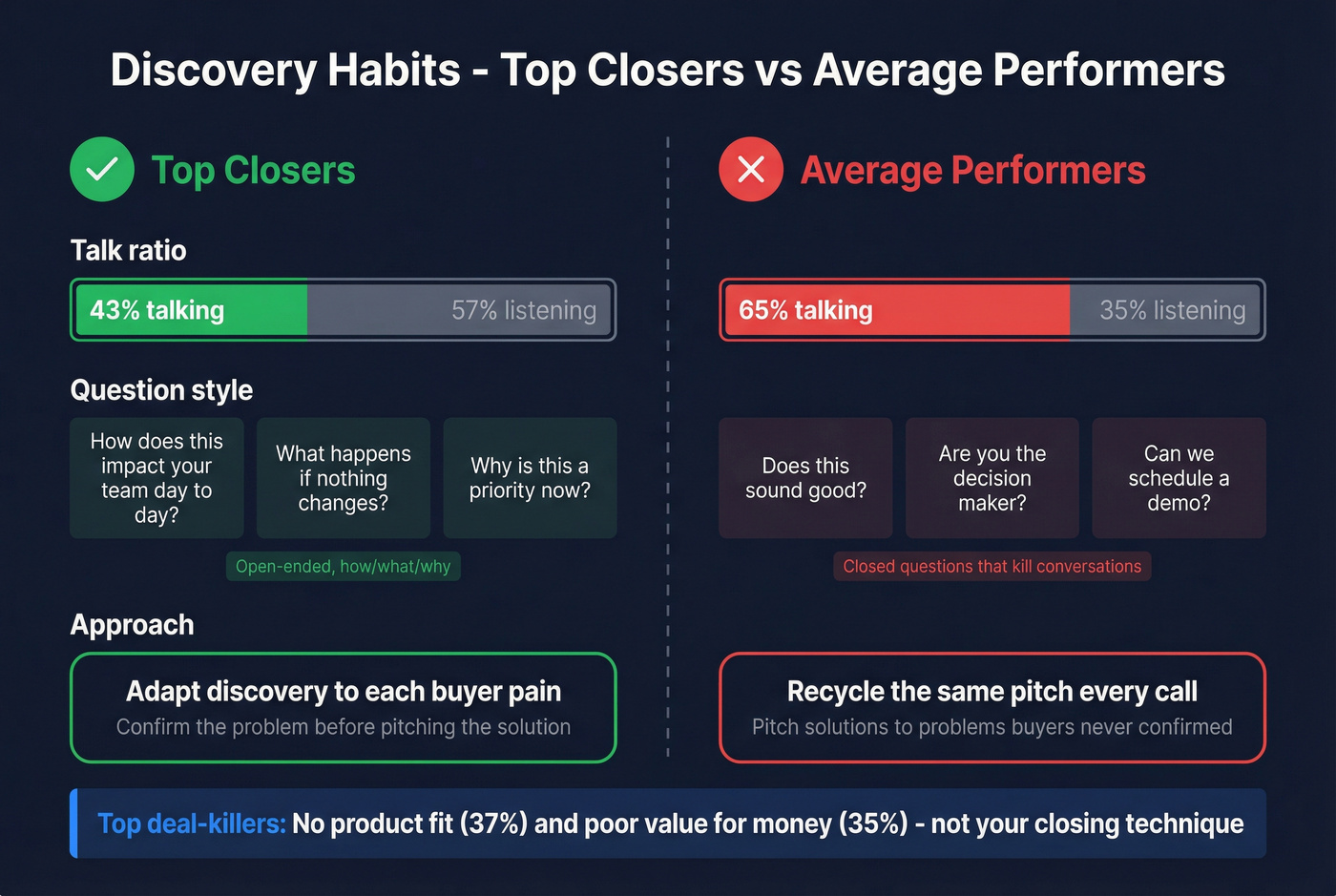
The top deal-killers haven't changed: no product fit at 37% and poor value for money at 35%. If you're losing deals, it's almost certainly one of those two - not your closing technique. Complacency is what keeps reps recycling the same pitch instead of adapting discovery to each buyer's specific pain, and it's the fastest way to land on the wrong side of those stats. We ran an internal experiment where our team restructured discovery calls around three open-ended questions before any product discussion. Close rates went up. Not because the questions were magic, but because reps stopped pitching solutions to problems buyers hadn't confirmed they had.
What Actually Works Now
Everyone loves the AI narrative. Only 8% of reps report not using AI, and 85% say it frees them for higher-value work. But AI isn't a strategy. It's an accelerant. Point it at bad data and broken processes and you just accelerate the mess (see AI CRM data entry automation).
You don't have a sales challenge problem. You have a buyer adaptation problem. The teams winning right now consolidated their tools, fixed their data at the source, and stopped pretending buyers need them for information. Your job in 2026 is confidence-building, not information delivery - helping buyers feel certain about a decision they've already half-made before they ever talk to you. The reps who internalize that will be in the 27% who hit quota. The rest will keep blaming "the market."