

Persona Marketing: How to Build Personas That Actually Get Used
Most persona projects end the same way. Someone spends three weeks building slide decks with stock photos, fictional names, and hobbies like "enjoys hiking and craft beer." The deck gets presented, earns a few nods, then lives on a shared drive untouched for 18 months.
The consensus on r/b2bmarketing is blunt: these are "fairytale personas," and they collect dust because persona marketing was never the problem - execution was. Persona-based marketing works when personas model decisions, not demographics, and when every attribute maps to something actionable. Here's how to build personas that survive first contact with your sales team.
The Quick Version
- Use a decision-centric model, not demographics-first. Your persona should describe how someone buys, not what they look like.
- Start with one to three personas validated by real customer interviews. Never more than five without proving ROI on the first batch.
- Every persona needs activation handles - observable signals like intent data, firmographics, tech stack, and job changes that let you target matching prospects in your CRM or data platform.
- The real test: can your persona generate a prospect list? Open a database, apply your persona's attributes as filters, and pull a list of real people. If you can't, go back and rebuild.
What Is a Marketing Persona?
A marketing persona is a research-based profile of your ideal buyer that captures how they evaluate, decide, and purchase - not just who they are demographically. The practice of creating these profiles, then using them to align messaging, targeting, content, and sales motions around how those buyers actually make decisions, is what defines persona marketing. Alan Cooper pioneered the concept in software design, first informally in 1983, then formally in his 1999 book The Inmates Are Running the Asylum.
A persona isn't a "target audience." Target audiences describe broad groups. Personas model specific decision-making patterns - what triggers a purchase, what objections arise, what success looks like, and who else is involved. In B2B, that means reflecting buying committees, firmographics, and buying journeys rather than individual demographics. Done right, a buyer persona becomes the operating system for your go-to-market strategy. Done wrong, it's poster art.
Why Persona-Driven Strategy Works
The ROI case is strong and getting stronger. Fast-growing companies generate 40% more revenue from personalization than slower-growing competitors, per McKinsey. HubSpot found that personalized CTAs outperform generic ones by 202%. And Twilio's Segment research shows 80% of businesses report consumers spend 38% more when experiences are personalized.

One widely cited case study: Skytap saw a 124% increase in sales leads and a 55% jump in organic search traffic after implementing persona-driven content. The personalization software market has grown to an estimated $11.6B in 2026, up from $7.6B in 2021. Companies are betting real money on this approach.
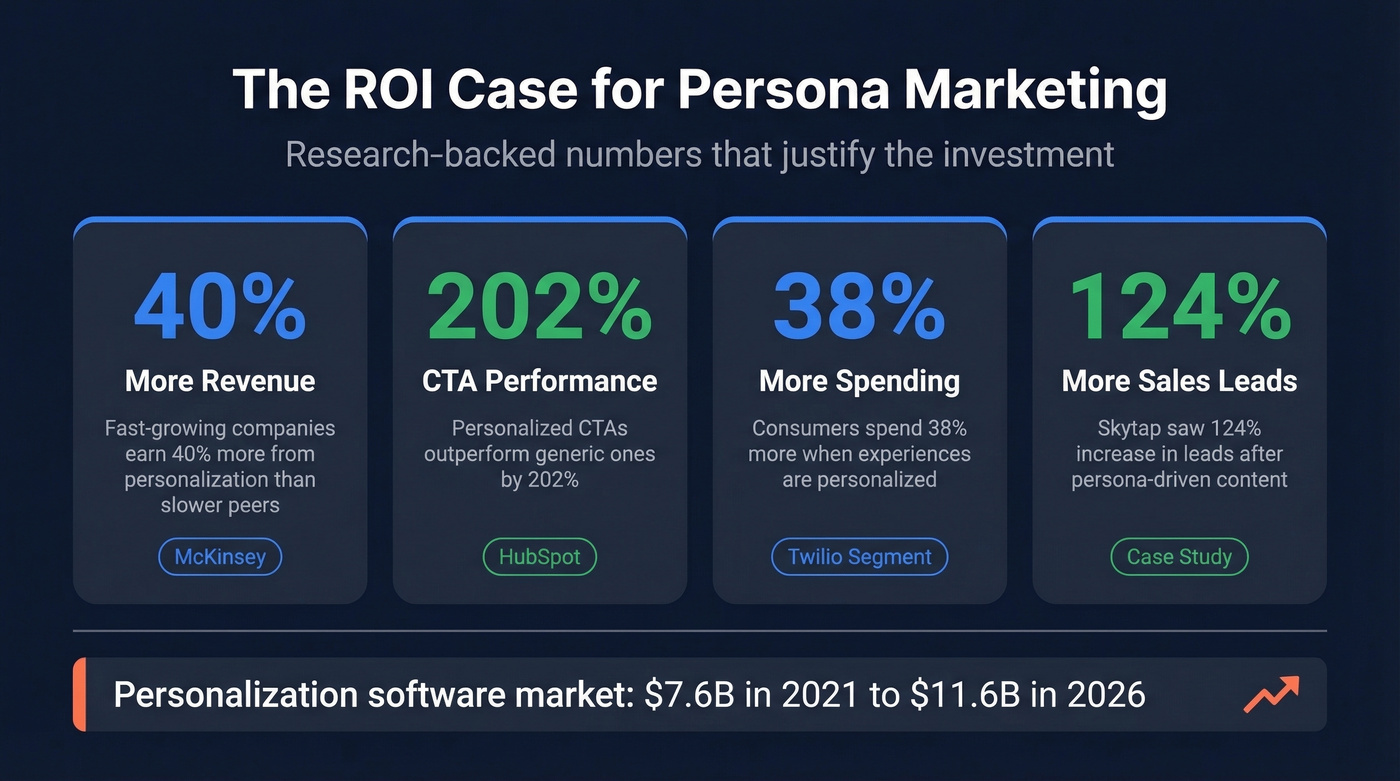
These gains come from research-backed personas tied to activation workflows, not the fairytale variety. Most organizations identify three to five primary personas; beyond that, focus gets diluted and implementation gets harder.
Types of Marketing Personas
Not all personas serve the same purpose. Buyer personas model the person who signs the check - buyer persona marketing focuses specifically on understanding the decision-maker's journey. User personas model the person who uses the product daily, and in B2B, these are often different people. Customer personas are broader profiles for content and campaign targeting. Negative personas define who you don't want to attract, which is just as valuable for keeping your pipeline clean. A negative persona for a mid-market SaaS company might be solo consultants with no budget authority who consume content but never convert.
| Field | B2B Persona | B2C Persona |
|---|---|---|
| Core profile | Company size, industry, role | Demographics, lifestyle |
| Decision model | Buying committee, approval chain | Personal motivation, emotion |
| Key criteria | ROI, integration, compliance | Price, convenience, brand |
| Channels | Events, professional networks | Social, email, retail |
| Disqualifiers | Tech stack, headcount, budget | Geography, income, life stage |
Decision-Centric Persona Framework
The biggest mistake in persona development - and we've seen this repeatedly across dozens of audits - is describing the buyer instead of the buyer's decision. Adele Revella's "5 Rings of Buying Insight" framework fixes this:
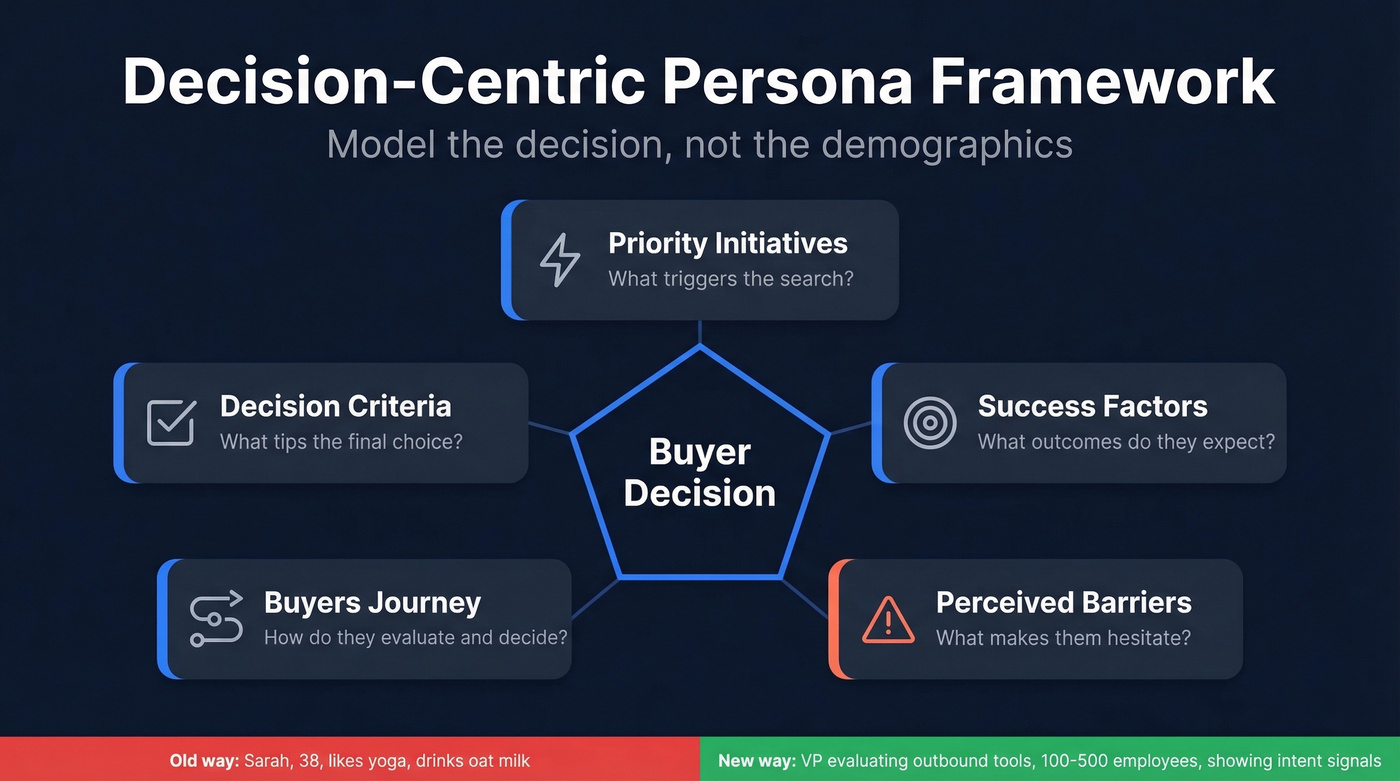
- Priority initiatives - what triggers the search
- Success factors - what outcomes the buyer expects
- Perceived barriers - what makes them hesitate
- Buyer's journey - how they evaluate and decide
- Decision criteria - what tips the final choice
| Element | Demographic Persona | Decision-Centric Persona |
|---|---|---|
| Lead field | "Sarah, 38, likes yoga" | "VP evaluating outbound tools" |
| Core content | Age, income, hobbies | Initiatives, barriers, criteria |
| Actionability | Hard to target or measure | Maps to CRM filters + intent |
| Shelf life | Stale within months | Refreshable with new data |
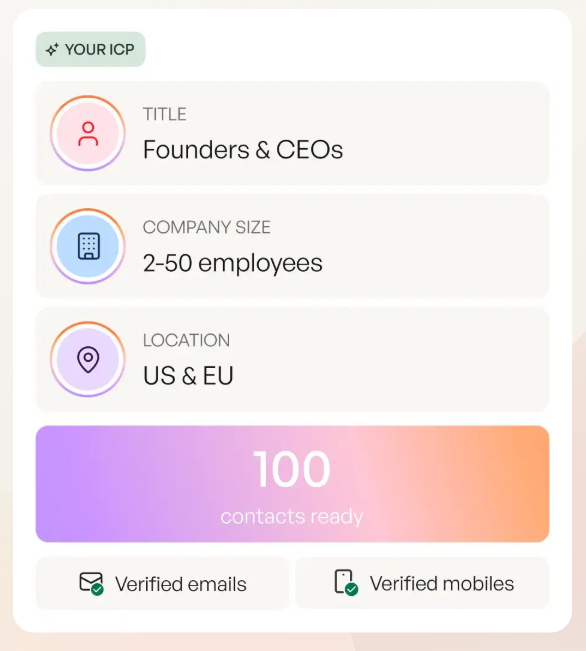
The decision-centric model also requires activation handles - observable signals that let you find these people in the real world. "Cares about pipeline efficiency" isn't a filter in any database. "VP of Sales at 100-500 person SaaS companies showing intent for outbound tools" is.
How to Build a Buyer Persona Strategy
Audit existing data. Pull closed-won and closed-lost data from your CRM. Review call recordings and Gong transcripts. Check analytics for engagement patterns by segment.
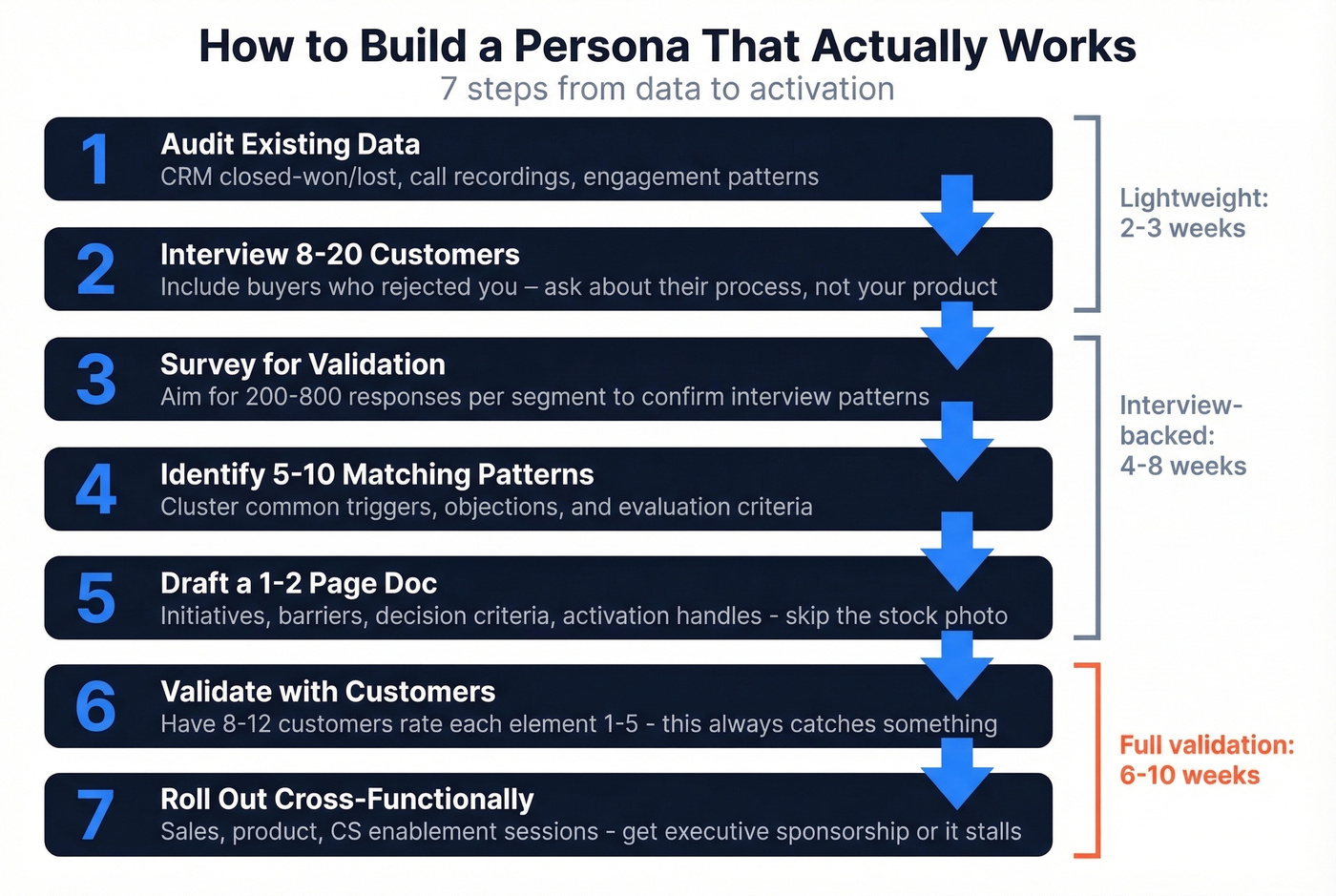
Interview 8-20 customers per persona. Talk to real buyers, including people who evaluated and rejected you. Ask about their buying process, not your product. What triggered the search? Who else was involved? What almost killed the deal?
Survey for validation. Interviews give depth; surveys give scale. For B2B, aim for 200-800 responses per segment. The survey validates whether interview patterns hold broadly.
Identify 5-10 matching patterns. Look for clusters across interviews and survey data - common triggers, shared objections, similar evaluation criteria. These become the persona's skeleton.
Draft a 1-2 page doc. Include priority initiatives, success factors, perceived barriers, decision criteria, and activation handles. Skip the stock photo.
Validate with customers. Take your draft back to 8-12 customers and have them rate each element 1-5. This step catches assumptions that slipped through - and it always catches something.
Roll out cross-functionally. A persona that lives only in marketing fails. Run enablement sessions with sales, product, and CS (this is classic marketing enablement). Executive sponsorship matters; without it, adoption stalls within a quarter.
Timeline: Lightweight persona: 2-3 weeks. Interview-backed: 4-8 weeks. Full survey validation: 6-10 weeks.

The article says it clearly: if your persona can't generate a prospect list, go back and rebuild. Prospeo's 30+ search filters - buyer intent, technographics, job changes, headcount growth, funding - map directly to decision-centric persona attributes. Pull verified contacts from 300M+ profiles at 98% email accuracy.
Stop building personas that collect dust. Build lists that book meetings.
Using AI Without Making Personas Worse
AI accelerates persona development, but it also produces convincing garbage if you're not careful.
Use AI for synthesizing interview transcripts into pattern clusters, generating first-draft frameworks using structured prompts, and analyzing large survey datasets for segmentation patterns. The best workflow we've found: upload real interview transcripts and sales call summaries into your LLM, let it find patterns, then validate with actual customers before finalizing.
Skip AI for generating personas from scratch without customer input. This produces exactly the fairytale personas everyone complains about. Ardath Albee's warning holds: AI persona outputs aren't validated until you check them with real buyers. Never trust demographic details the model invents.
Let's be honest about the "dynamic AI persona" trend - it's mostly hype right now. Tools that promise auto-updating personas sound great in demos, but without a decision-centric framework underneath, you're just auto-updating garbage. Get the foundation right first. Dynamic updates become meaningful only when the underlying model reflects real buying behavior, not demographic assumptions.
Turning Personas Into Prospect Lists
Here's where most persona projects die. You've built a decision-centric persona, and now you need to find these people. Open your CRM and try to build a list of "VP of Marketing at mid-market SaaS companies showing buying intent for outbound tools." Most CRMs can't do it. The persona sits on a shared drive, and reps go back to manual prospecting.
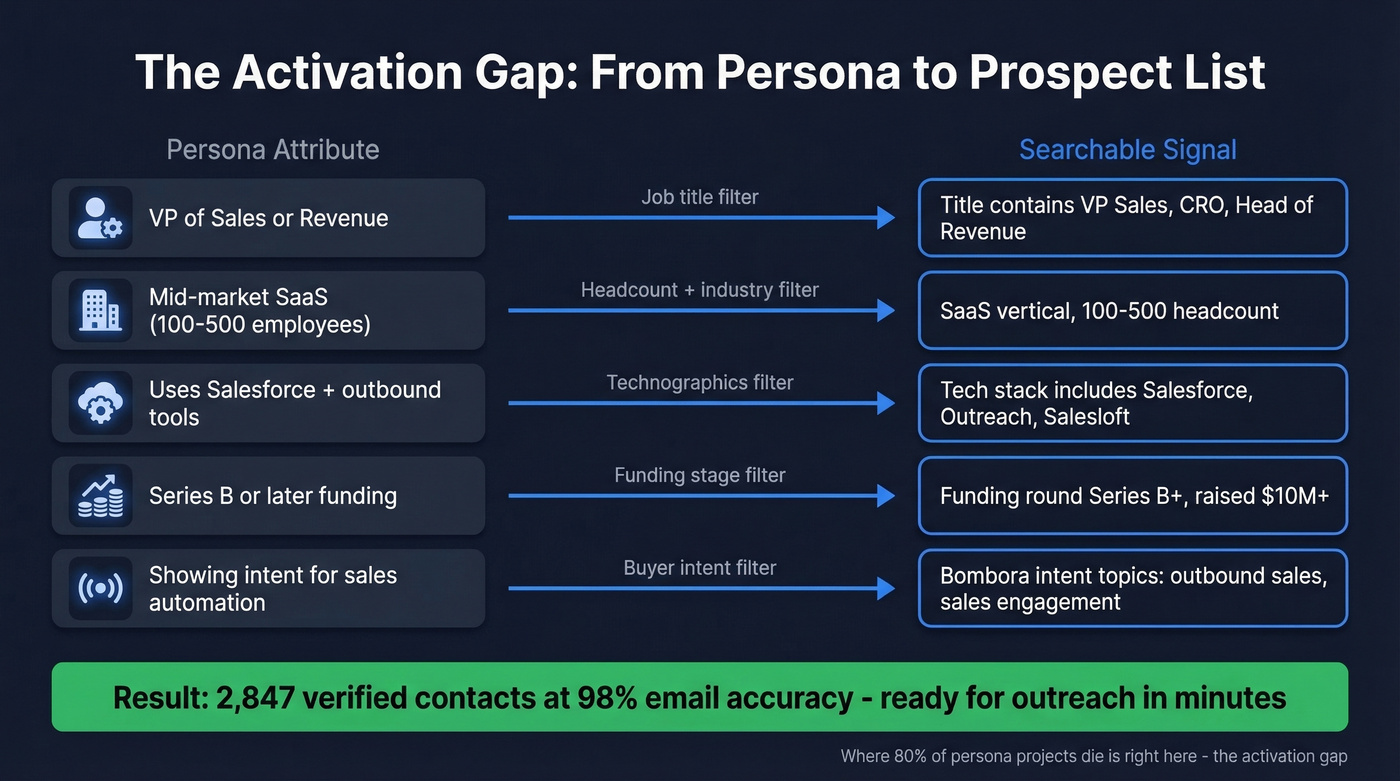
The fix is mapping every persona attribute to a searchable, filterable signal. Industry, headcount, tech stack, funding stage, job title, intent signals - all filterable in a B2B data platform (see firmographic filters and firmographic and technographic data). Consumer targeting is shifting too: Cordial's research shows purchase-history-based recommendations dropped from 62% to 38% influence year-over-year, while social-activity-based targeting rose from 13% to 21%. Static demographic targeting is losing ground everywhere.

In our experience, the activation gap is where 80% of persona projects die. Prospeo's 30+ search filters - including buyer intent powered by Bombora, technographics, and headcount growth - map directly to persona attributes. Translate each attribute into a filter, get a verified prospect list in minutes at 98% email accuracy. When Snyk deployed this across 50 AEs, bounce rates dropped from 35-40% to under 5% and AE-sourced pipeline jumped 180%.
Operationalizing Personas Across Your Org
Building the persona is half the work. Getting your organization to actually use it is the other half.
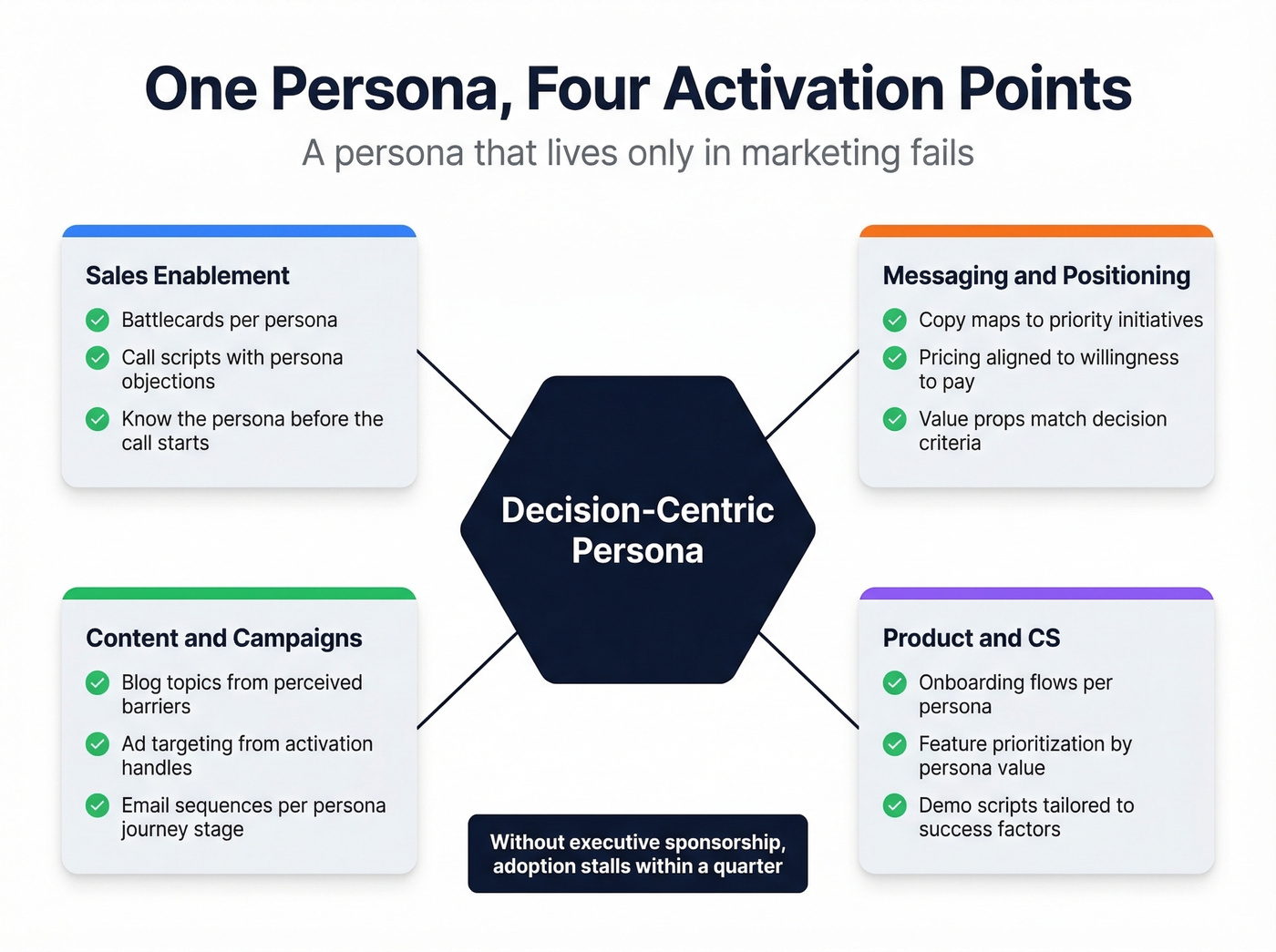
Sales enablement: Translate personas into battlecards, call scripts, and objection-handling guides. Reps should know which persona they're talking to before the call starts. Positioning and messaging: Every piece of copy maps to a specific persona's priority initiatives and decision criteria (tighten this with B2B brand positioning). Pricing strategy, too - different personas have different willingness to pay. Launch assets: Landing pages, onboarding flows, and demo scripts should be persona-specific. One-size-fits-all demos lose deals.
Two adoption KPIs worth tracking: the percentage of campaigns that specify a target persona, and the percentage of sales calls where reps identify the persona before dialing. If those numbers are low, your personas aren't operationalized - they're decorations.
Executive sponsorship is non-negotiable. Refresh quarterly with light reviews, full refresh every 12-18 months. And start with one persona. Prove it drives results. Then expand. Teams that launch five personas simultaneously end up with five unused documents.
Mistakes That Kill Persona ROI
Fairytale personas built on assumptions. If nobody on the team has talked to a customer in the last 90 days, your persona is fiction. Full stop.
Demographics-first thinking in B2B. "Marketing Mary, 34, likes podcasts" tells you nothing about how a buying committee evaluates software. A buyer persona should reflect decision-making behavior, not lifestyle trivia.
Too many personas. More than five without proven ROI on the first one means you're spreading resources across profiles nobody uses. Three is the sweet spot for most teams.
No activation path. We've audited dozens of persona docs with zero activation handles. If a persona can't generate a prospect list, it's a creative writing exercise.
No refresh cadence. A persona from 2024 is already stale. Build in quarterly reviews or accept that your targeting will drift.
Persona theater. Pretty posters on the office wall that change nothing about how the team sells or builds product. If the persona doesn't alter at least one decision per quarter, it's theater.
Are Personas Dead?
The "personas are dead" take resurfaces every year. The criticisms aren't wrong - they're just incomplete. Yes, personas can oversimplify complex buying behavior. Yes, they become outdated without refreshes. Yes, many are built on assumptions rather than research.
But the alternative - untargeted marketing with no buyer model at all - performs worse by every metric. The decision-centric framework addresses every major criticism: it replaces assumptions with interviews, demographics with decision criteria, and static documents with activation handles that connect to live data.
Personas aren't dead. Lazy personas are.
B2B Persona Example
Persona: "Pipeline-Strapped VP of Sales"
- Role: VP of Sales, 150-300 person B2B SaaS company
- Priority initiative: Scaling outbound pipeline without adding headcount - board pushing for capital efficiency
- Success factors: 30%+ increase in qualified pipeline within two quarters
- Perceived barriers: High bounce rates from current data provider; reps waste 4-6 hours/week on manual prospecting
- Decision criteria: Email accuracy above 95%, mobile coverage, self-serve onboarding, cost under $500/mo per rep
- Activation handles: SaaS industry, 150-300 employees, Series B-C, intent for "outbound sales tools," recently hired SDR/BDR roles
With these attributes defined, plug them into a B2B data platform - apply the industry, headcount, funding, and intent filters - and generate a verified list of matching prospects in minutes. That's the difference between a persona that sits in a slide deck and one that fills a pipeline (more on list-building mechanics in sales prospecting techniques and how to generate an email list).
Activation handles only work if your data platform can match them. Prospeo tracks 15,000 intent topics via Bombora, layers in tech stack signals, and refreshes every 7 days - so your persona targeting hits buyers while they're actually in-market, not six weeks too late.
Your personas defined the buyer. Now find 300M+ of them with real contact data.
FAQ
What is persona marketing?
Persona marketing is building research-based buyer profiles and using them to align messaging, targeting, and sales motions around how buyers actually make decisions. It replaces demographic guesswork with structured buying intelligence validated through customer interviews and CRM data.
How many personas should I start with?
Start with one to three. Most organizations identify three to five primary personas total, but launching more than three before proving ROI on the first set dilutes focus and leads to unused documents. Prove pipeline impact first, then expand.
How often should I update personas?
Run quarterly light reviews and a full refresh every 12-18 months with new interviews and survey data. After major market shifts - new competitors, pricing changes, or economic disruptions - refresh immediately rather than waiting for the scheduled cycle.
Can AI replace customer interviews for persona research?
No. AI accelerates synthesis across transcripts and survey data but generates false confidence when used without real buyer input. Use AI to find patterns in existing research, then validate with 8-12 actual customers before finalizing any persona.
What's a good tool for activating B2B personas?
Prospeo is strong for this - its 30+ filters including buyer intent via Bombora, technographics, headcount growth, and funding stage map directly to decision-centric persona attributes. At 98% email accuracy and roughly $0.01/lead, it turns persona docs into verified prospect lists without enterprise pricing. Apollo and ZoomInfo also offer filtering, though with lower accuracy rates and higher costs.