

How to Write Persuasive Sales Emails That Actually Get Replies
The average sales rep sends 344 cold emails to land a single meeting. The average reply rate across billions of cold email interactions sits at 3.43%. That's the math working against you - and no template collection fixes math.
Writing persuasive sales emails takes a system: better targeting, verified data, tighter copy, and a follow-up cadence that doesn't quit after one send. Here's how we've seen teams build that system from scratch.
The Short Version
- Shorten every email to under 100 words and replace your meeting-request CTA with an interest check. Pitching in the first email drops reply rates by 57%.
- Verify your contact list before sending. High bounce rates wreck your domain reputation and make even perfect copy worthless. (If you’re diagnosing issues, start with bounce rates.)
- Build a 4-7 touch follow-up cadence. 42% of replies come from follow-ups, not the first email.
Let's build it out.
2026 Cold Email Benchmarks
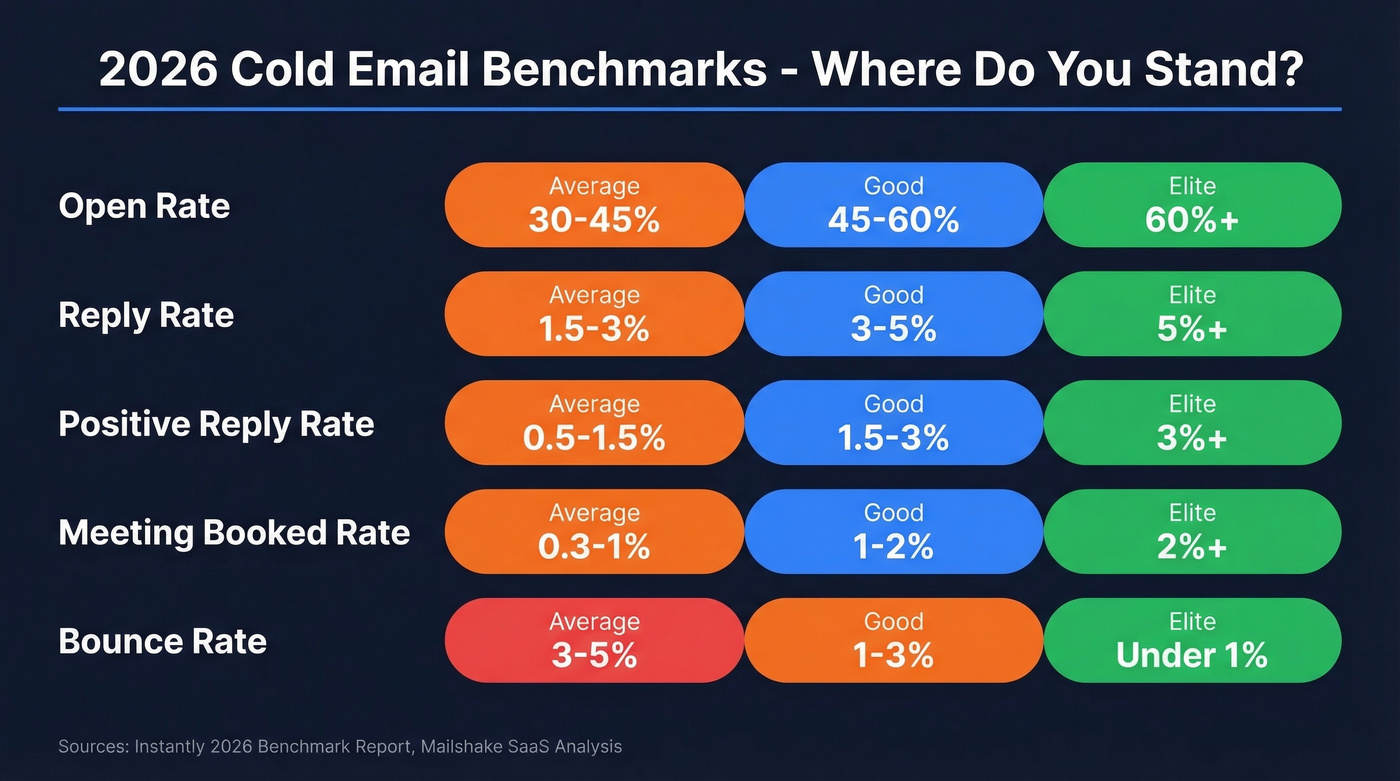
Before optimizing anything, you need to know what "good" actually looks like. Here's how the benchmarks break down across the full funnel, based on Mailshake's SaaS analysis and Instantly's dataset:
| Metric | Average | Good | Elite |
|---|---|---|---|
| Open rate | 30-45% | 45-60% | 60%+ |
| Reply rate | 1.5-3% | 3-5% | 5%+ |
| Positive reply | 0.5-1.5% | 1.5-3% | 3%+ |
| Meeting booked | 0.3-1% | 1-2% | 2%+ |
| Bounce rate | 3-5% | 1-3% | <1% |

A separate analysis of 1.37M emails found a 2.09% average reply rate - benchmarks vary by dataset and methodology, so focus on your own trend line rather than chasing someone else's number.
Here's the thing: if you're running a 2-4% reply rate at scale, you're genuinely performing well. As one r/coldemail poster put it, "double-digit reply rates are usually small-sample or cherry-picked." Don't let some guru's screenshot make you feel like your 3% is broken.
The more useful diagnostic is your bounce rate. Above 3%? Your copy doesn't matter yet. Fix the data first (and tighten your email deliverability basics).
Mistakes That Kill Your Emails
You've sent 500 emails. Three replies. Two are unsubscribes. Before you rewrite your subject line for the fourteenth time, check whether the problem is actually your copy - or the infrastructure underneath it.
Deliverability Mistakes
These kill your emails before anyone reads them:
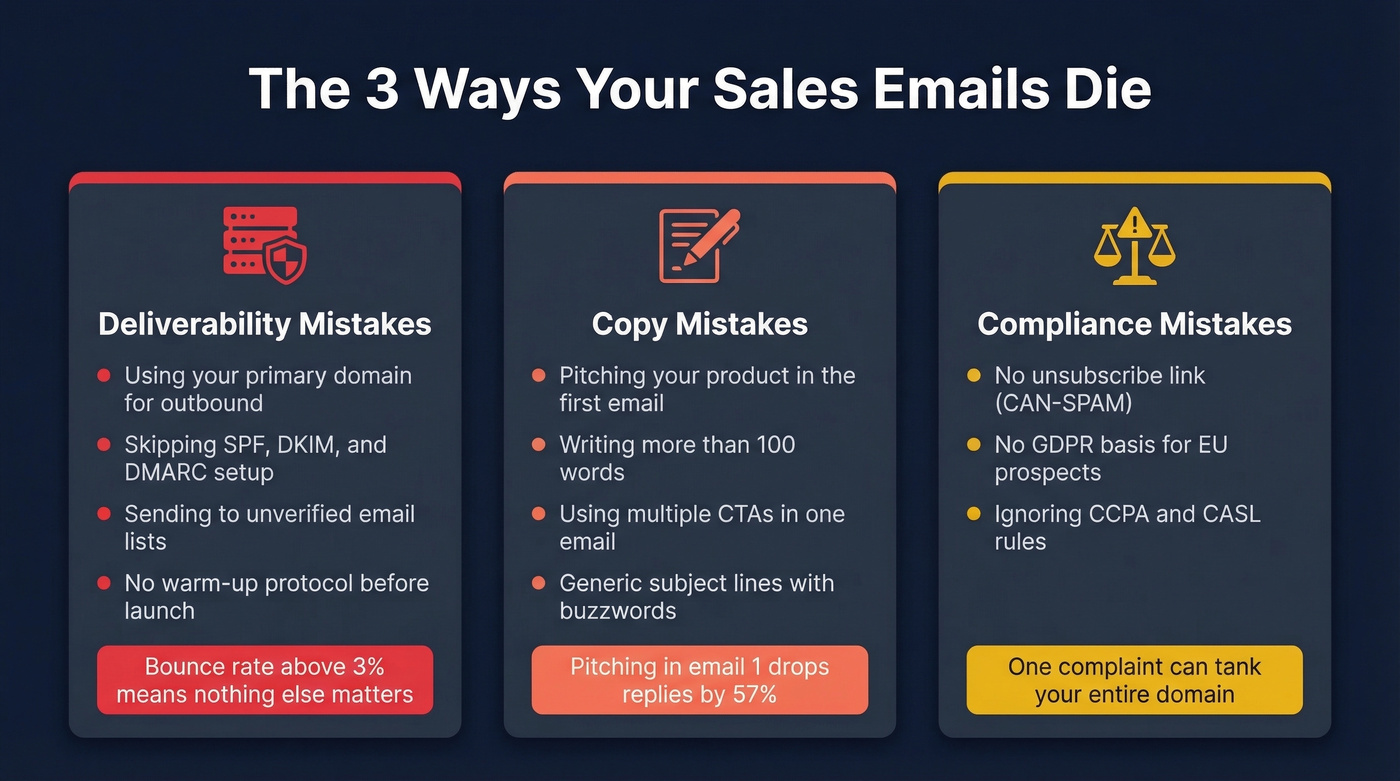
- Using your primary domain for outbound. One spam complaint and your entire company's email reputation tanks. Practitioners on r/coldemail recommend 10-12 secondary domains for ~400 emails/day, with 2-3 accounts per domain and a 21-day warm-up.
- Skipping SPF/DKIM/DMARC. Every sending domain needs all three configured. No exceptions. Set up BIMI while you're at it - it displays your logo next to your email in supported inboxes and signals legitimacy to mailbox providers.
- Sending to unverified lists. High bounce rates tank your domain reputation fast. One customer, Meritt, dropped their bounce rate from 35% to under 4% and tripled their pipeline from $100K to $300K/week after switching to verified data with a 7-day refresh cycle.
- No warm-up protocol. Run 21 days of warm-up before sending, and keep warm-up active after launch. (If you’re scaling, watch email velocity too.)
- Exceeding 30-50 sends per mailbox per day. More than that and you're begging for the spam folder.
Copy Mistakes
Pitching in the first email is the biggest offender. An analysis of 28M+ emails found it drops reply rates by up to 57%. Multiple CTAs split attention and kill response rates. And emails over 100 words consistently underperform - the highest reply rates come from 3-4 sentence emails.
Persuasion in cold email starts with restraint, not cleverness. (If you want a deeper craft breakdown, see email copywriting.)
Compliance Mistakes
- No unsubscribe link. Required under CAN-SPAM and increasingly enforced by inbox providers.
- No GDPR consideration for EU prospects. GDPR requires a lawful basis and an easy opt-out.
- Ignoring CCPA and CASL. If you email prospects in California or Canada, make sure your outbound process meets those requirements too.
Anatomy of a High-Converting Email
"Write a good email" isn't advice. Let's break down each component with the data behind it.
Subject Lines
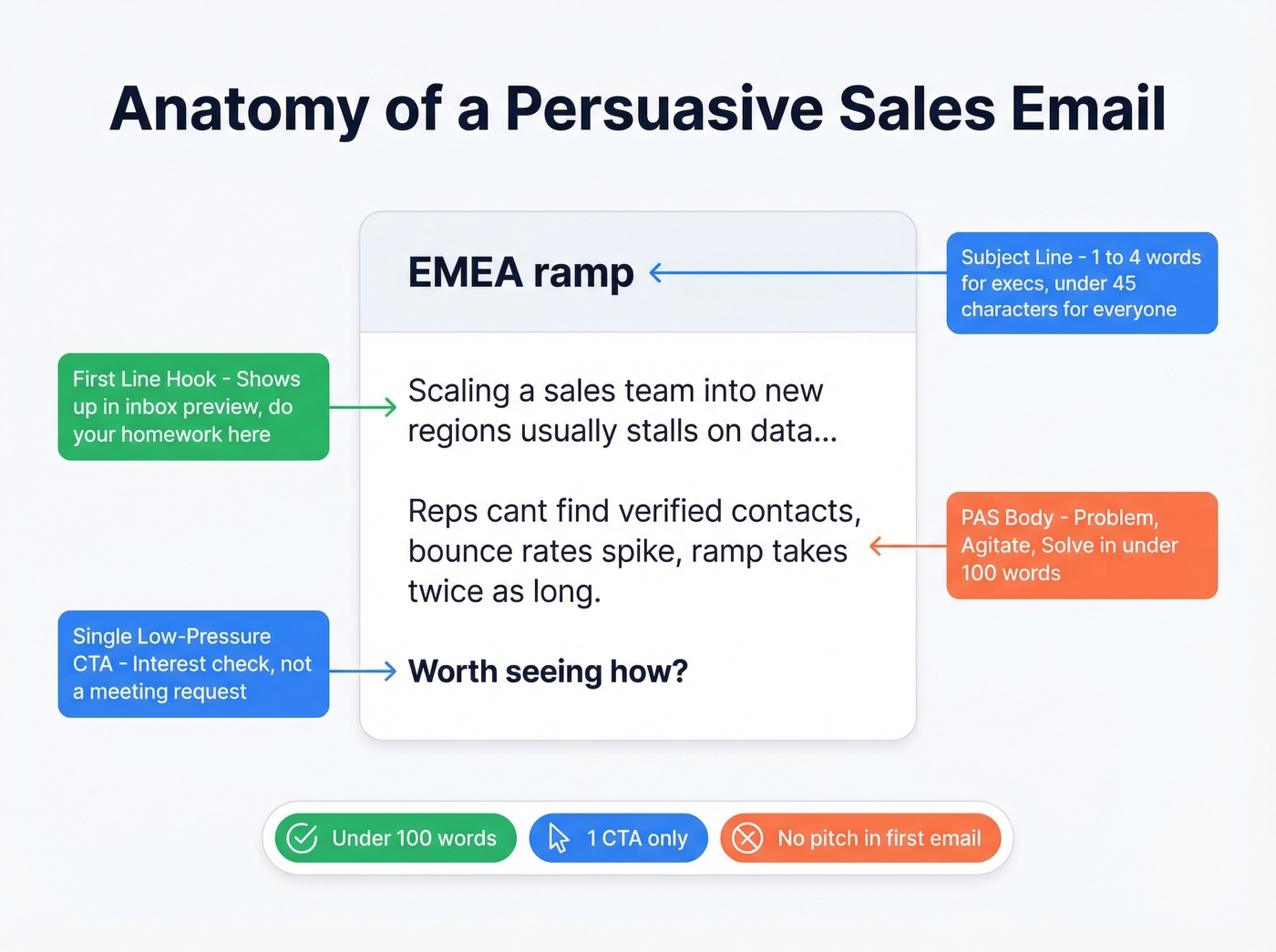
Keep them short. For executives, 1-4 words perform best. For everyone else, aim for 25-45 characters to avoid mobile truncation - many mobile clients cut off around 33-43 characters. (If you need a swipe file, use these cold email subject line examples.)
Buzzwords and numbers in subject lines reduce open rates by up to 17.9%. "Revolutionize your pipeline with 5 proven strategies" is exactly the kind of subject line that gets archived unread.
Personalized subject lines pull a 46% open rate versus 35% without personalization. When you A/B test - which you should - use 250+ contacts per variant. Anything less and you're reading noise.
First Lines That Hook
Your first line shows up in the inbox preview on Gmail, Apple Mail, and Outlook. It's your second hook after the subject line, and most reps waste it on "I hope this email finds you well."
There's a useful taxonomy from Datablist worth knowing:
- Observation-based openers reference something specific you noticed ("Saw you just opened a second office in Austin").
- Signal-based openers tie to a trigger event ("Congrats on the Series B").
- Question-led openers create curiosity ("How are you handling X with the new team structure?").
- Problem-led openers name the pain directly ("Most VPs of Sales at companies your size tell us Y").
The key is using information that isn't in every standard database - number of locations, recent product launches, media mentions. These signal you actually did homework, not just mail-merged a first name. (For more ways to source signals, see sales prospecting techniques.)
Body Copy Under 100 Words
Highest reply rates come from 3-4 sentence emails under 100 words. Instantly's best-performing campaigns keep emails under 80 words, and a common benchmark range is 50-125 words - but shorter consistently wins.
PAS - Problem, Agitate, Solve - is the framework built for cold email:
- Problem: Name the specific pain your prospect has.
- Agitate: Make the cost of inaction concrete. ("That means your reps are spending 6 hours a week on manual research instead of selling.")
- Solve: Offer your angle - not your product pitch, but the perspective shift.
For warmer sequences where the prospect already knows you, AIDA (Attention, Interest, Desire, Action) works better because you can lean into benefits without seeming presumptuous. (If you want the full breakdown, see the AIDA Sales Funnel.)
In our experience, the biggest reply-rate lever isn't copy at all - it's data quality. A mediocre email sent to the right person at a verified address outperforms brilliant copy that bounces or lands in spam. We've seen this play out across hundreds of campaigns, and it's the single most underrated variable in cold outreach.
One technique most guides miss: bait in the objection. If you know the prospect is likely thinking "we already have a solution for this," address it preemptively. "I know you're probably using [common tool] for this already - most teams at your stage are. The issue we keep hearing is [specific gap]." This disarms the reflex to dismiss and reframes the conversation around a problem they recognize.
CTAs That Don't Scare People Off
Make an offer, not a meeting request. "Would it be worth sharing how [Company X] solved this?" beats "Do you have 15 minutes Thursday?" every time. The interest-check CTA works because it's low-friction - the prospect isn't committing to a calendar hold, they're saying "sure, send it over." That's a completely different ask. (More CTA patterns here: email call to action.)
One CTA per email. Not two. Not "reply or book a time here." One.
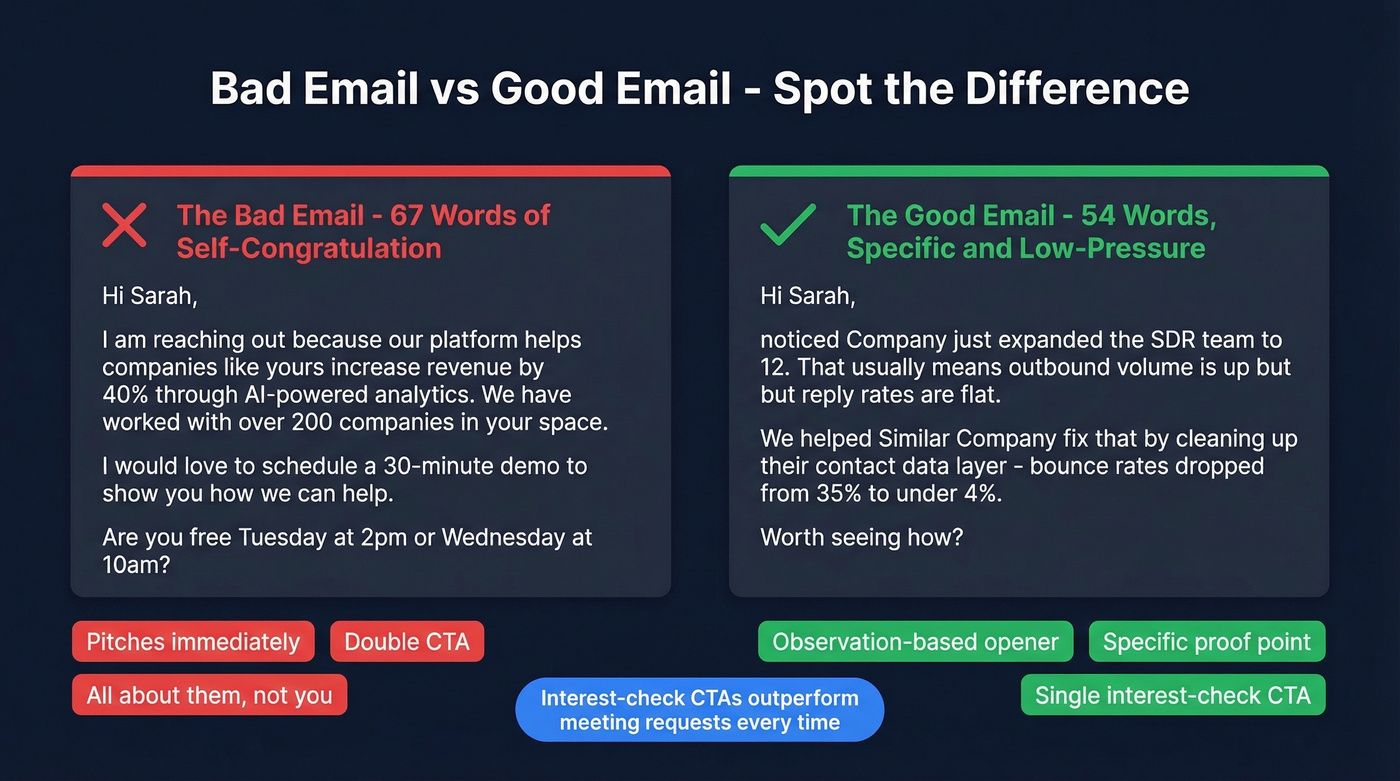
Here's what a bad email versus a good one looks like in practice:
Bad: Hi Sarah, I'm reaching out because our platform helps companies like yours increase revenue by 40% through AI-powered analytics. We've worked with over 200 companies in your space. I'd love to schedule a 30-minute demo to show you how we can help. Are you free Tuesday at 2pm or Wednesday at 10am?
Good: Hi Sarah, noticed {{Company}} just expanded the SDR team to 12. That usually means outbound volume is up but reply rates are flat. We helped [Similar Company] fix that by cleaning up their contact data layer - bounce rates dropped from 35% to under 4%. Worth seeing how?
The bad version is 67 words of self-congratulation with a double CTA. The good version is 54 words, names a specific situation, offers proof, and makes a single low-pressure ask.

Meritt dropped their bounce rate from 35% to under 4% and tripled pipeline to $300K/week - not by rewriting copy, but by switching to Prospeo's 98% accurate emails refreshed every 7 days. Your persuasive sales emails deserve data that actually delivers them.
Stop perfecting copy that never reaches the inbox.
Writing to Executives
C-level execs are 30.2% less likely to reply to cold emails than non-execs. They scan faster, tolerate less, and delete quicker.
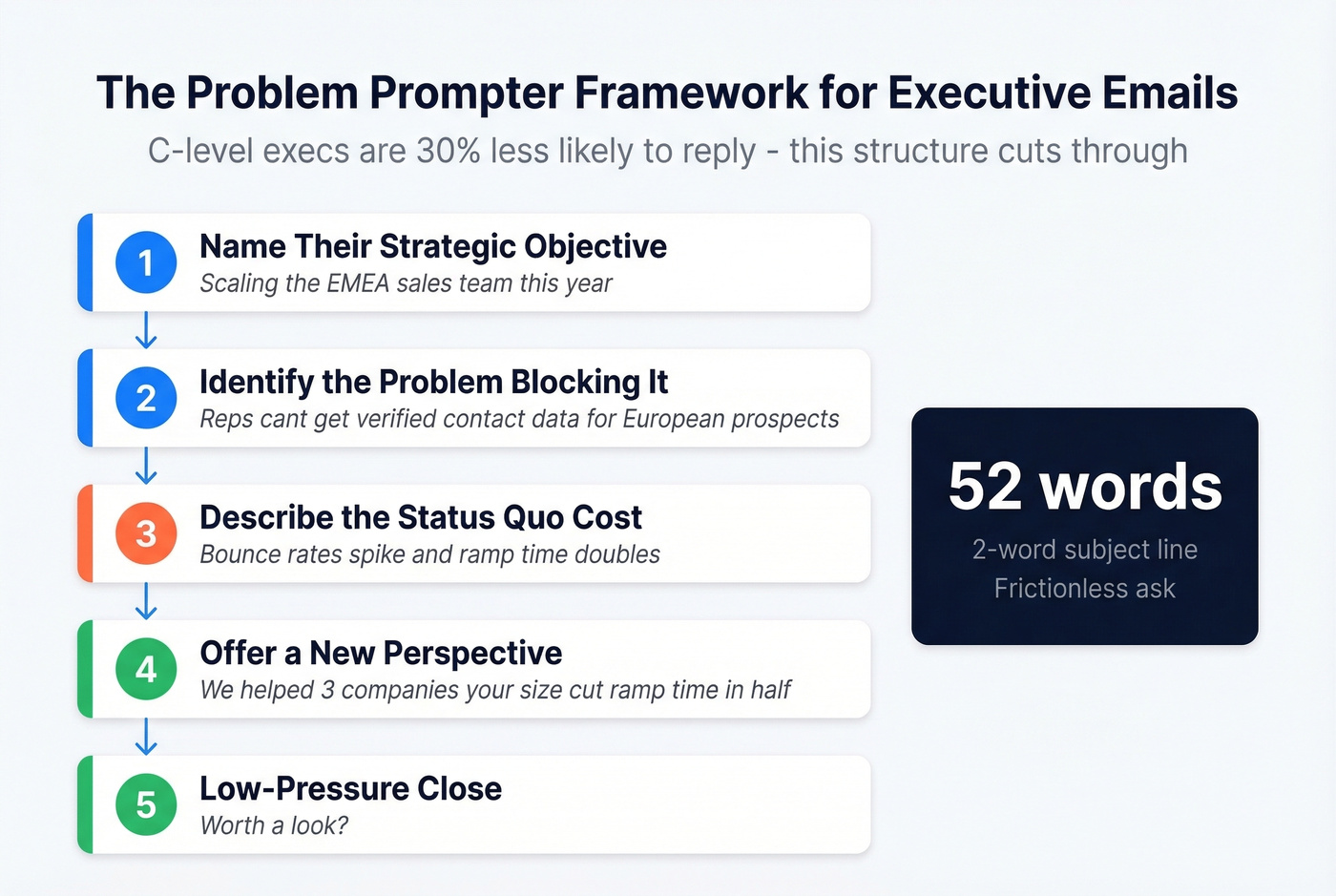
The Problem Prompter Framework is the best structure we've found for exec outreach:
- Name their strategic objective. ("Scaling the EMEA sales team this year.")
- Identify the problem blocking it. ("Most teams hit a wall when reps can't get verified contact data for European prospects.")
- Describe the status quo cost. ("That usually means bounce rates spike, and ramp time doubles.")
- Offer a new perspective. ("We've helped 3 companies your size cut ramp time in half by fixing the data layer first.")
- Low-pressure close. ("Worth a look?")
Subject: EMEA ramp
Hi {{FirstName}},
Scaling a sales team into new regions usually stalls on data - reps can't find verified contacts, bounce rates spike, and ramp takes twice as long.
We helped [Similar Company] cut rep ramp from 8-10 weeks to 4 by fixing the contact data layer first.
Worth seeing how?
That's 52 words. Two-word subject line. Frictionless ask.
Templates You Can Steal
Every template below is under 100 words and built on the frameworks above. Adapt the specifics - never send these verbatim. Think of them as starting structures you reshape for your own ICP and value prop.
Cold Intro (PAS)
Hi {{FirstName}},
{{Company}}'s SDR team is growing fast - which usually means outbound volume is up but reply rates are flat.
Most teams we talk to find the bottleneck isn't messaging. It's sending to outdated contacts that bounce or never reach the inbox.
We helped [Similar Company] cut bounce rates from 35% to under 4% and triple pipeline in 8 weeks.
Would it be useful to see how they did it?
Trigger-Event
Hi {{FirstName}},
Congrats on the {{trigger - funding round / new hire / expansion}}. That usually means {{consequence - scaling outbound / hiring reps / entering new markets}}.
One thing that trips up teams at this stage: contact data quality drops fast when you move into new segments.
Happy to share what's worked for similar companies if it's relevant.
This works because trigger events create a natural reason to reach out. The prospect knows why you're emailing, which removes the "who is this person?" friction that kills most cold intros.
Follow-Up After No Response
Most reps give up here. Don't. Follow-ups are where a huge share of replies happen.
Hi {{FirstName}},
Circling back - I know inboxes are brutal.
Quick version: we help teams like {{Company}} fix the data layer so outbound actually lands. Less bounces, more replies, fewer wasted sequences.
Worth a 5-minute look, or should I check back next quarter?
Re-Engagement (Before/After)
Here's a common re-engagement email and how to fix it:
Before: Hi Sarah, I wanted to follow up on our conversation from last quarter. We've made a lot of exciting updates to our platform that I think you'd find valuable. Would love to reconnect and show you what's new. Let me know if you have time this week!
After: Hi {{FirstName}}, we connected {{timeframe}} ago about {{topic}}. Since then, we've shipped {{relevant update - new feature / case study / benchmark}}. Thought it'd be worth revisiting. Want me to send over the details?
The "before" is vague, self-focused, and asks for a time commitment. The "after" is specific, references shared context, and asks only for permission to share information.
Breakup Email
Skip this if your prospect has actively engaged and just gone quiet - a breakup feels premature when someone's been warm. Save it for sequences where you've gotten zero signal.
Hi {{FirstName}},
I've reached out a few times and haven't heard back - totally understand if the timing's off.
I'll close this thread, but if {{pain point}} becomes a priority, I'm easy to find.
Either way, good luck with {{specific initiative}}.
The Follow-Up System
58% of replies come from Step 1. That means 42% come from follow-ups - and most reps give up after one or two sends. That's leaving nearly half your potential replies on the table.
We've tested dozens of cadence structures, and the 4-7 touch range consistently outperforms longer sequences for standard cold outbound. Some practitioners run 8-12 touches for longer sales cycles, but for most teams, diminishing returns kick in hard after touch seven. (If you want more ready-to-send options, grab these sales follow-up templates.)
Here's a sample 8-touch, 12-day cadence adapted from Sybill's framework:
| Day | Touch | Purpose |
|---|---|---|
| 1 | Email 1 | PAS cold intro |
| 3 | Email 2 | Follow-up + social proof |
| 5 | Phone | Direct dial attempt |
| 6 | Email 3 | New angle / case study |
| 8 | Social touch | Comment or connect |
| 9 | Email 4 | Objection handling |
| 11 | Phone | Second dial attempt |
| 12 | Email 5 | Breakup |
Space touches 2-3 days apart. Timing to a trigger event (product launch, funding round, new hire) beats timing to a day of the week - though if you're scheduling blind, Tuesday-Wednesday tends to be the peak window.
The cadence structure matters less than the discipline to actually run it. Most sequences die at touch 2 because reps get busy or discouraged. Automate what you can. (If you’re building a full sequence, start with a B2B cold email sequence.)
Testing and Measuring
The reps who book 8.1x more meetings than average aren't writing better emails from day one. They're testing and iterating faster.
A/B test one variable at a time - subject line, first line, CTA, or email length. Never test two variables simultaneously or you won't know what moved the needle. Use 250+ contacts per variant minimum.
Open rate is a vanity metric. Apple Mail Privacy Protection inflates it, and a clickbait subject line can spike opens while tanking replies. The metric that matters is positive reply rate. After that, track the full funnel: open to reply to positive reply to meeting booked. (If you want a clean KPI set, use these funnel metrics.)
If your positive reply rate is above 1.5%, you're in "good" territory. Above 3%, you're elite. Below 0.5%, the problem is almost always targeting or data quality, not copy. Crafting persuasive sales emails is only half the equation - measuring what works and iterating on the data is the other half.
The system is targeting, then data, then copy, then cadence, then measurement. Get each layer right and the templates take care of themselves.
You just learned that 42% of replies come from follow-ups - but follow-ups only work when every email in your sequence lands. Prospeo's 5-step verification with catch-all handling and spam-trap removal keeps your bounce rate under 1%, so your 4-7 touch cadence actually connects.
Build sequences on data that won't wreck your domain reputation.
FAQ
How long should a sales email be?
Under 100 words - ideally 3-4 sentences. An analysis of 28M+ emails confirms this is the sweet spot for reply rates. For executives, aim tighter: 50-60 words. Every word past 100 needs to earn its place.
How many follow-ups should I send?
Four to seven touchpoints hit the sweet spot for most outbound teams. 42% of total replies come from follow-ups, not the first email. Beyond seven touches, returns diminish sharply unless each new message adds a fresh case study, different angle, or relevant trigger event.
What's the biggest mistake in cold email outreach?
Sending to unverified contact lists. Bad data causes bounces that destroy domain reputation, which means even perfectly written emails never reach the inbox. Fixing this one problem - getting accurate, recently verified contact data - is the single highest-ROI change most teams can make.
Do subject line formulas actually work?
Short, personalized subject lines outperform formulas. Personalization lifts open rates from 35% to 46%, while buzzwords and numbers reduce opens by up to 17.9%. For executives, keep subject lines to 1-4 words. Test with 250+ contacts per variant to get statistically meaningful results.