

Polite Follow-Up Email Samples for a Request That Actually Get Replies
You sent a perfectly reasonable request three days ago. Now you're staring at a blank compose window, cursor blinking, wondering how to nudge someone without sounding passive-aggressive or desperate. You're not being annoying - most emails get buried, not ignored. Rebecca Zucker wrote a full HBR guide on following up with non-responders, and the core idea is simple: don't take silence personally, and follow up with clarity.
An analysis of 16.5 million cold emails found the first email pulls just an 8.4% reply rate, and it only drops from there. The good news: a well-crafted follow-up can recover what silence left on the table.
What You Need (Quick Version)
- Keep follow-ups under 60 words. One practitioner on r/Entrepreneur cut emails from 141 to under 56 words and doubled their reply rate from 3% to 6%.
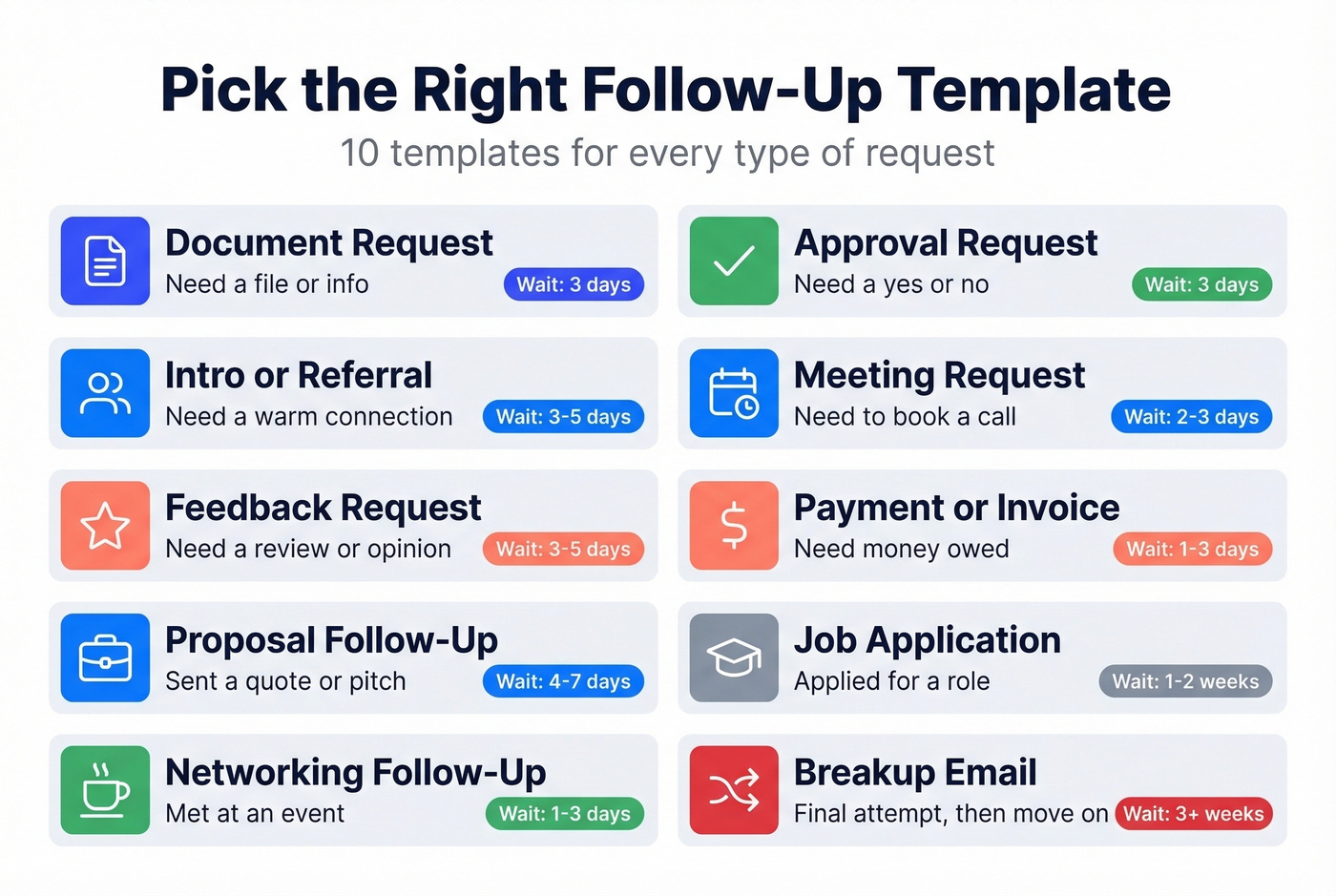
- Send 3 business days after your initial request. Sooner for urgent asks, 1-2 weeks for job applications or proposals.
- Reference the original request specifically - never "just checking in." (If you need alternatives, see just checking in professionally.)
- Make the subject line state what you need: "Approval needed: Q3 budget by Friday." (More ideas: email subject line examples.)
- Initial email + 2 follow-ups max. After that, send a breakup email and move on.
| Urgency Level | Wait Before Following Up |
|---|---|
| Urgent / active thread | Same day or next day |
| Standard business request | 3 business days |
| Proposals and quotes | 4-7 business days |
| Job applications | 1-2 weeks |
| Last-resort breakup email | 3+ weeks after initial send |
What 16.5M Emails Reveal About Follow-Ups
A 2024 analysis of 16.5 million cold emails across 93 business domains tells a clear story: less is more, and brevity wins.
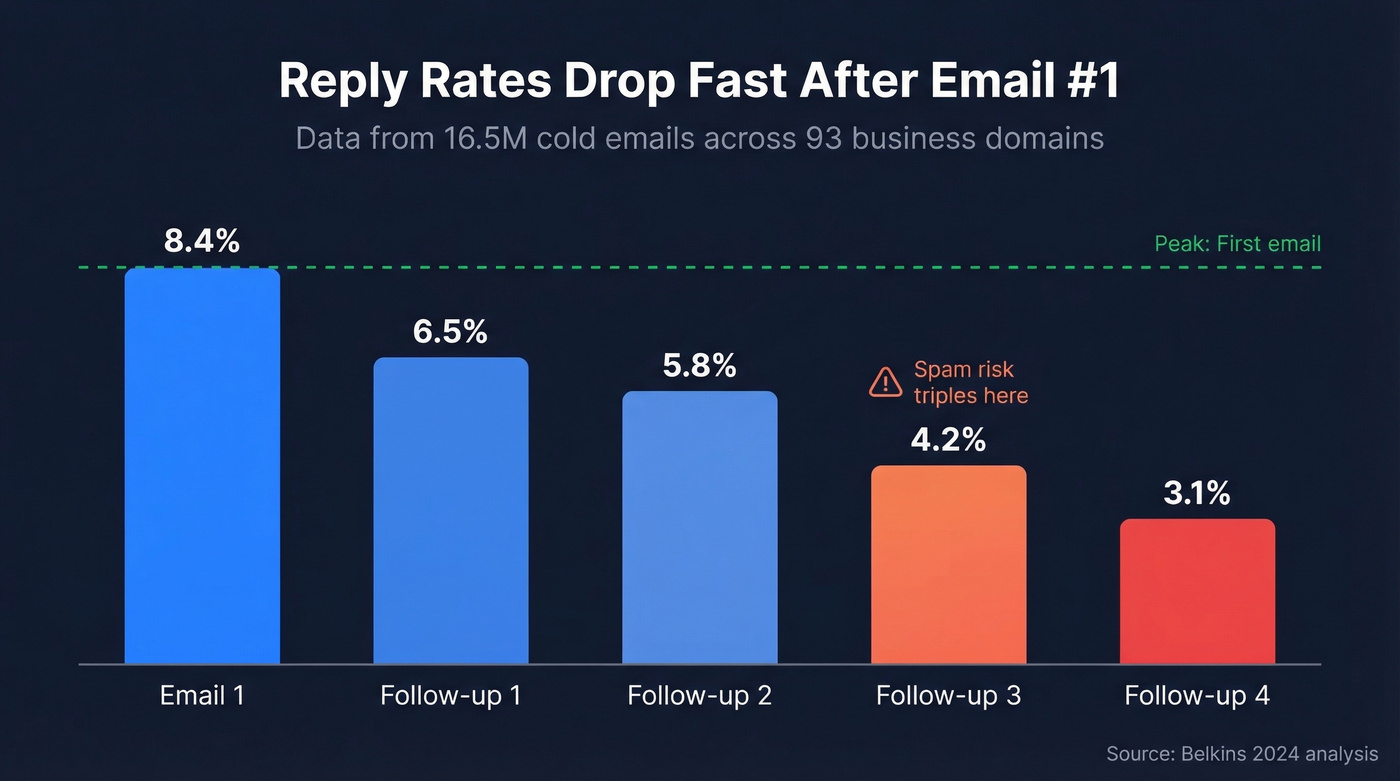
The highest reply rate - 8.4% - comes from the first email alone. Every subsequent follow-up chips away at that number. By the fourth follow-up, unsubscribe rates triple and the spam-mark rate more than triples. That's not a gradual decline. That's a cliff.
Company size matters too. Small businesses with 2-50 employees are more forgiving - reply rates start at 9.2%, dip to 8% on the first follow-up, then actually bounce back to 8.4% on the second. Enterprise contacts at 1,000+ employees ghost quickly and punish persistence. If you're emailing a VP at a Fortune 500, you get two shots, maybe three. Emailing founders? You'll see a slight bump on the second follow-up at 6.94%, but by the fourth, reply rates crater to 3%.
Industry patterns matter too. Manufacturing contacts hold steady at 6.67%-6.77% across sequences, while solar contacts start at 6.73% and drop fast. Know your audience's tolerance before you plan your cadence. (If you're building sequences, this helps: sequence management.)
Here's the thing: the Reddit practitioner who cut emails from 141 words to under 56 didn't just improve reply rates. They also dropped their bounce rate from 11% to under 2% after tightening list quality - they stopped buying lists and manually verified contacts using company sites and other web sources. Length and data quality are the two levers most people ignore while obsessing over word choice. In our experience, bad data wastes more follow-ups than bad writing ever will. (Related: email bounce rate.)
The Rule of Three: Send your initial request, follow up twice, then send a breakup email. Four or more emails in a sequence triples your spam risk. Respect the threshold.
Anatomy of a Polite Request Follow-Up
Every effective follow-up has five parts. Miss one and you're gambling on goodwill alone.
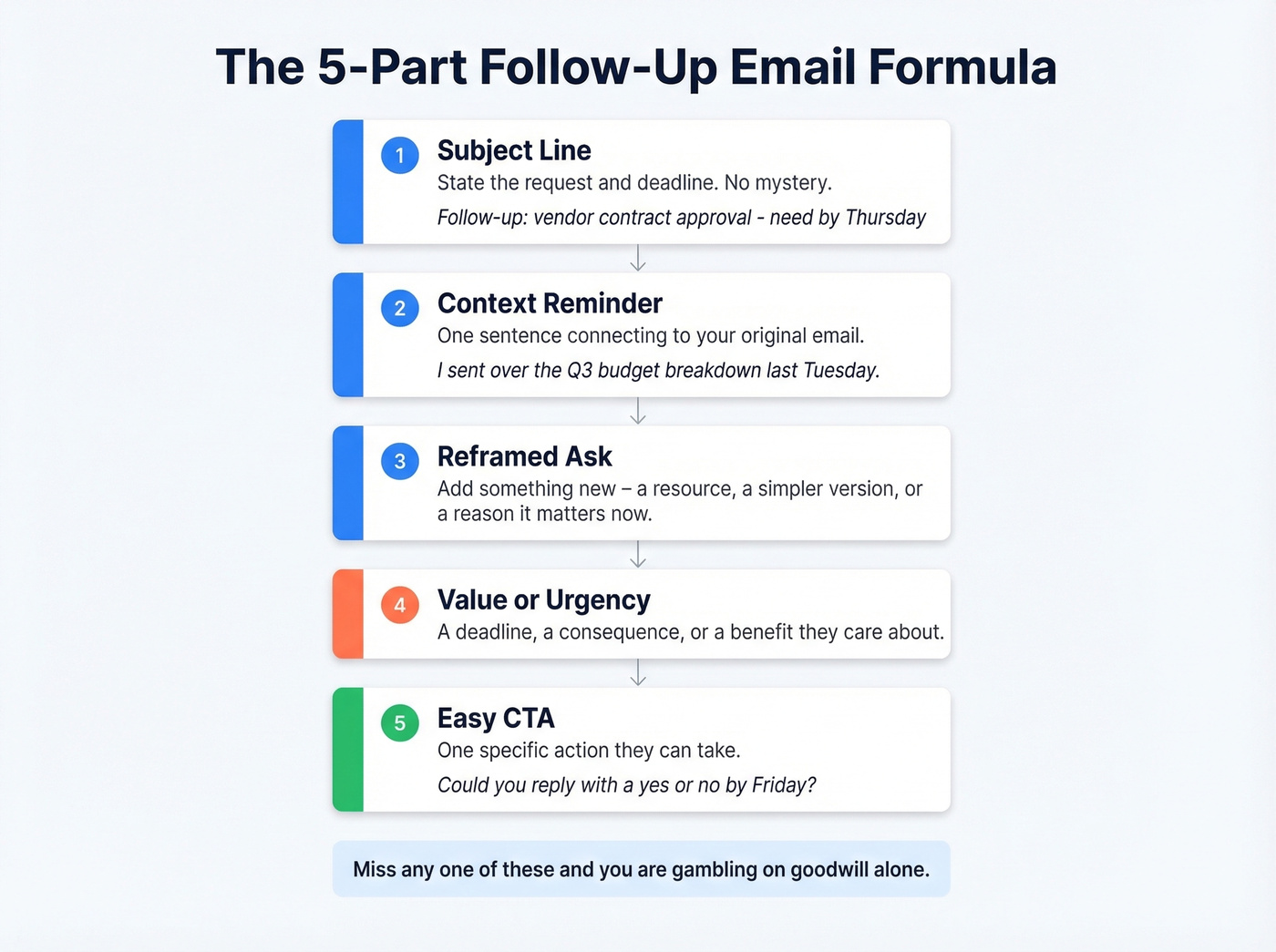
- Subject line - State the request and deadline. No mystery, no cleverness. "Follow-up: vendor contract approval - need by Thursday."
- Context reminder - One sentence connecting to your original email. "I sent over the Q3 budget breakdown last Tuesday."
- Reframed ask - Don't copy-paste your original request. Add something new: a resource, a simplified version, a reason it matters now. This includes your subject line - don't just re-send with the same one.
- Value or urgency - Why should they act today? A deadline, a consequence, or a benefit they care about.
- Easy CTA - One specific action. "Could you reply with a yes/no by Friday?" Not "let me know your thoughts." (More on CTAs: email call to action.)
Paras Mughal, founder of ParaSocialz, puts it well: ask for their perspective and position them as the expert rather than just pushing a request. People respond when they feel consulted, not cornered.
The distinction between a follow-up on a request and a generic "checking in" email is fundamental. You're not nurturing a relationship. You need something. Be clear about what it is. (If you want more ready-to-send options, use these sales follow-up templates.)
Subject Lines That Get Opened
Kabir Sehgal wrote in HBR about military-precision subject lines - state the purpose, state what you need, leave zero ambiguity. That principle applies perfectly to request follow-ups.
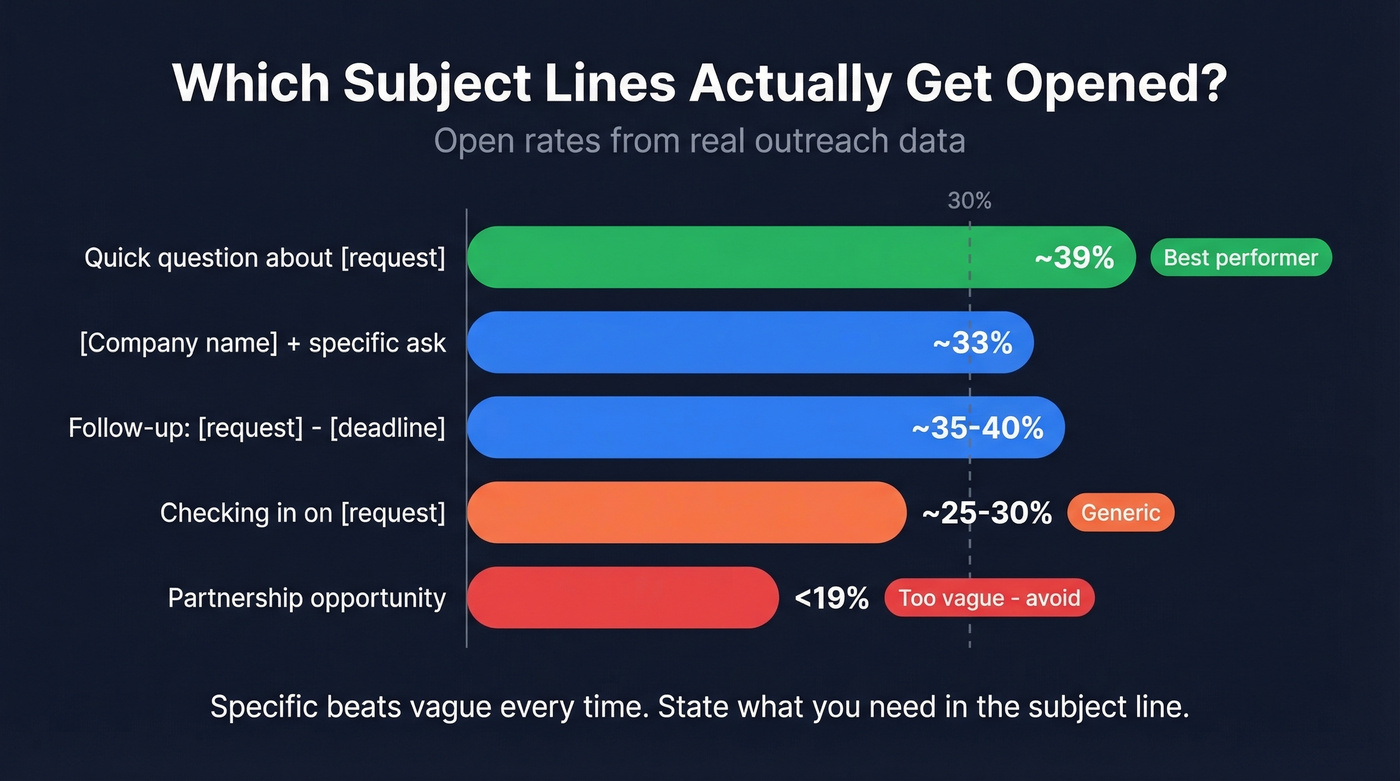
One Reddit practitioner's outreach results back this up. "Quick question" pulled ~39% open rates. Including the company name landed around 33%. "Partnership opportunity"? Under 19%. Vague loses. Specific wins. (More data-backed angles: subject lines that get opened.)
| Subject Line Type | Open Rate | Use When |
|---|---|---|
| "Quick question about [request]" | ~39% | Casual asks, warm contacts |
| [Company name] + specific ask | ~33% | Semi-cold outreach |
| "Follow-up: [request] - [deadline]" | ~35-40% | Time-sensitive approvals |
| "Checking in on [request]" | ~25-30% | Standard, no urgency |
| "Partnership opportunity" | <19% | Avoid - too vague |
A few more subject lines worth stealing for request follow-ups:
- "Still need: signed NDA by Friday"
- "Q3 report - can you review by EOD Wednesday?"
- "Quick follow-up: intro to [Name] at [Company]"
- "Invoice #4821 - payment due this week"
- "Any update on the proposal I sent Tuesday?"

That Reddit practitioner cut bounce rates from 11% to under 2% by manually verifying contacts. Prospeo does that automatically - 98% email accuracy, 5-step verification, catch-all handling - so every follow-up you send reaches a real inbox instead of bouncing into the void.
Fix your data before you fix your follow-up copy.
10 Samples for Every Type of Request
Every template below stays under 60 words in the body. Copy, adjust the brackets, send.
Document or Information Request
Subject: Still need: [document name] for [purpose]
Hi [Name], I sent over a request for [document] on [date]. We need it to finalize [project/deliverable] by [deadline]. Could you send it over today, or let me know if someone else handles this? Happy to simplify what's needed if that helps. Thanks, [Your name]
This works because it references the original ask, adds a deadline, and offers an easy out if they're the wrong person. Most ignored document requests aren't being ignored - they're sitting in someone's "I'll get to it" pile. The deadline moves it to "I need to do this now."
Approval or Sign-Off Request
Most approval requests stall because the recipient assumes they need to write a thoughtful response. They don't. Lower the effort bar and watch replies come in.
Subject: Approval needed: [item] by [date]
Hi [Name], following up on this request for [item] approval that I sent on [date]. We're holding [next step] until we get the green light. A quick yes/no reply works - no need for a detailed response. Thanks, [Your name]
Introduction or Referral Request
The common mistake with intro requests: people send open-ended asks that put all the social burden on the recipient. Give them two concrete options and a graceful exit instead.
Subject: Quick follow-up: intro to [Person] at [Company]
Hi [Name], I reached out last [day] about a possible intro to [Person]. Totally understand if the timing isn't right - just wanted to check before I try another route. Would a quick email intro work, or would you prefer I mention your name directly? Thanks, [Your name]
Meeting or Call Request
Before (vague): "Would love to find time to chat about this. Let me know when works!"
After (specific): 👇
Subject: Trying to lock in a time - does [day] work?
Hi [Name], I'm finalizing my schedule for next week and wanted to follow up on the [meeting topic] I mentioned on [date]. Does [specific day/time] work for a 15-minute call? If not, I'm flexible Tuesday through Thursday. [Your name]
The "schedule constraint" framing - borrowed from a tactic r/sales practitioners swear by - creates natural urgency without pressure.
Feedback or Review Request
Subject: Would value your take on [item] - 10 min max
Hi [Name], I sent [document/draft] on [date] and would really value your perspective. You're closer to [relevant area] than anyone on the team. Even a quick gut reaction helps - doesn't need to be polished. Could you take a look by [date]? Thanks, [Your name]
Positioning them as the expert and setting a time cap reduces perceived effort. We've seen this framing outperform generic "please review" requests consistently.
Payment or Invoice Request
Payment follow-ups are the one category where directness isn't just acceptable - it's expected. No one respects a wishy-washy invoice reminder.
Subject: Invoice #[number] - payment due [date]
Hi [Name], friendly reminder that invoice #[number] for [amount] was due on [date]. I've reattached it for convenience. Could you confirm it's been processed or let me know if anything's holding it up? Appreciate it, [Your name]
Proposal or Quote Follow-Up
Subject: Any questions on the [proposal/quote] from [date]?
Hi [Name], wanted to follow up on the proposal I sent on [date]. Happy to walk through any questions or adjust scope if priorities have shifted. Would a 10-minute call this week help move things forward? [Your name]
This opens the door for objections instead of just asking "did you see it?" If they have budget concerns or need a different scope, you want to hear that, not get silence.
Job Application Follow-Up
Subject: Following up: [Job Title] application - [Your Name]
Hi [Name], I applied for the [Job Title] role on [date] and wanted to reiterate my interest. My background in [relevant skill] aligns well with [specific requirement from the listing]. I'd welcome the chance to discuss how I can contribute. Is there a timeline for next steps? Best, [Your name]
Wait the full 1-2 weeks before sending this one. Hiring processes move slower than you think, and a follow-up on day three signals impatience, not enthusiasm. This template also doubles as a follow-up letter you can adapt for internships or freelance applications.
Networking Follow-Up
Subject: Great meeting you at [event] - one quick ask
Hi [Name], really enjoyed our conversation about [topic] at [event]. You mentioned [specific thing they said], and I'd love to continue that discussion. Would you be open to a 20-minute coffee chat next week? [Your name]
Referencing something specific from the interaction proves you were actually listening - and separates you from the pile of "great to connect!" emails everyone else at the event sent.
Final "Breakup" Follow-Up
Subject: Closing the loop on [request]
Hi [Name], I've followed up a couple of times on [request] and haven't heard back - totally understand things get buried. I'll assume the timing isn't right and won't follow up again. If this comes back on your radar, I'm here. All the best, [Your name]
The breakup email is the most underrated email in any sequence. In practice, it often pulls more replies than a standard nudge. Something about "I won't follow up again" triggers a response that three polite reminders couldn't. Use it.
Words That Kill Your Follow-Up
Some phrases feel polite but actively hurt your chances. "Just following up" strips your email of purpose - it tells the recipient nothing about what you need or why it matters now. Replace it with "Following up on [specific request]" and you've already given them a reason to keep reading.
"Kindly" deserves special attention. In US and UK business English, it reads as passive-aggressive - the email equivalent of a tight smile. A Reddit etiquette thread flagged this exact issue, and the consensus was clear: drop it. Use "when you get a chance" or simply state the request directly.
"Per my last email" is the nuclear option - it signals frustration, not professionalism. Say "As I mentioned on [date]" instead. And "sorry to bother you"? Stop apologizing for following up. If your request wasn't important, you wouldn't be sending the email. That phrase signals your own ask doesn't matter. Delete it every time.
"Gentle reminder" falls into the same trap. It's not gentle - it's patronizing. "Quick reminder" works, or better yet, skip the label entirely and just restate what you need.
For tone calibration, match the context. Legal, finance, and enterprise? Keep it formal. Tech, startups, and existing relationships? Match their energy. When in doubt, mirror the tone of their last email to you.
5 Mistakes That Guarantee No Reply
1. Bumping with no new information. "Just making sure you saw this" adds nothing. Every follow-up needs to bring something new - a simplified ask, a deadline, a resource. GMass's follow-up research calls this the number one killer.
2. Ignoring potential objections. They aren't necessarily ignoring you - they may have a reason they haven't said yes. Address it head-on: "If the timeline doesn't work, I can adjust" or "If this needs someone else's sign-off, happy to loop them in."
3. Sending emails that look like templates. Short, plain-text, reply-in-thread messages look real. Formatted HTML newsletters with headers and footers look automated. People reply to people. (If you're writing at scale, this helps: email copywriting.)
4. Wrong frequency. Three days is the standard gap. Same-day follow-ups are only appropriate for clarifications on active threads. Anything more aggressive and you're training their spam finger. Best send window: Tuesday through Thursday, 8-11 AM in the recipient's timezone. One practitioner reported a 16% open rate improvement from timing alone. (More on timing: best time to send cold emails.)
5. Following up to the wrong inbox. This one's invisible and devastating. If the email address is invalid or outdated, your perfectly crafted message lands nowhere. Verify the address before your second follow-up - tools like Prospeo run real-time verification at 98% accuracy across 143M+ verified addresses. Bad data wastes more follow-ups than bad wording ever will. (If you want the full deliverability picture, see our email deliverability guide.)
Let's be honest: when email isn't working at all, consider switching channels. The 16.5M-email dataset shows that combining messages with profile visits on professional networks can hit 11.87% reply rates - higher than most email sequences.
Pre-Send Checklist
Run through this before every follow-up:
- ☐ Waited at least 3 business days (same-day only for clarifications; 1-2 weeks for applications)
- ☐ Email body is under 60 words
- ☐ Subject line states the specific request and deadline
- ☐ Added something new since the last email
- ☐ CTA is one clear action (not "let me know your thoughts")
- ☐ Tone matches the relationship and industry
- ☐ No "kindly," "gentle reminder," or "sorry to bother you"
- ☐ Email address is verified and deliverable
That last item matters more than most people realize. If you're following up on a request and getting zero response - not even a "not interested" - the problem often isn't your wording. It's your data.

You get two shots with enterprise contacts before they ghost you. Don't waste either on an outdated email address. Prospeo refreshes 300M+ profiles every 7 days - not every 6 weeks like competitors - so your follow-ups reach the right person at the right address.
Bad data wastes more follow-ups than bad writing ever will.
FAQ
How many follow-up emails is too many?
Three follow-ups maximum, so four total emails including the original. The 16.5M-email dataset shows that a fifth message triples spam complaints and unsubscribe rates. After three follow-ups, send a breakup email and move on.
How long should I wait before following up on a request?
Three business days for standard requests. Same-day only for active-thread clarifications. For job applications and proposals, wait one to two weeks - hiring and procurement cycles are slower than you think.
Is "just following up" a good subject line?
No - it's one of the weakest performers. State what you need: "Approval needed: Q3 budget by Friday" outperforms vague subject lines by 10-15 percentage points in open rates.
What if my follow-ups keep getting no response?
First, verify the email address is correct and active. Then check whether you're landing in spam - a poor sender reputation tanks inbox placement regardless of how polite your message is. If both check out, switch channels or send a breakup email and move on.
Does "kindly" sound condescending in a follow-up?
In US and UK business English, yes - it reads as passive-aggressive to most recipients. Replace with "when you get a chance" or state the request directly without any softening label.