

Predictable Prospecting: The Complete Guide for 2026
You sent 5,000 cold emails last quarter. 1,800 bounced. Another 2,000 landed in spam. The 47 replies you got weren't enough to fill a single AE's calendar - let alone hit the team's pipeline target. That's not a volume problem. It's a targeting and data quality problem disguised as one, and the framework for fixing it has existed since 2016. It's called predictable prospecting.
The framework has three phases - Target (build your ideal account profile), Engage (multitouch campaigns matched to buying stages), and Optimize (pipeline math and health metrics). The book is a decade old, but roughly 80% of it is timeless. The 20% that's outdated - tools, channel mix, and data assumptions - gets updated below.
What Is Predictable Prospecting?
The term comes from the book Predictable Prospecting by Marylou Tyler and Jeremey Donovan, published by McGraw-Hill on July 25, 2016. The methodology builds repeatable, measurable B2B sales pipeline by systematically targeting the right accounts, engaging prospects through stage-appropriate outreach, and optimizing every conversion point with data.
It breaks into three phases: Target, Engage, and Optimize. Target is about knowing exactly who to pursue - building ideal account profiles and prospect personas before you touch a single lead. Engage covers multitouch, multichannel campaigns that move prospects through defined buying stages. Optimize is the pipeline math that tells you whether the machine is working or breaking.
This book is planning-heavy. About 30% of it is profiling and preparation before a single email goes out. One of the most repeated lines: "planning is cheap, execution is expensive." Most teams get this backwards - they start blasting emails before they've defined who should receive them, then wonder why reply rates sit below 3%. The entire philosophy is built on intentional outreach where every action ties to a defined target, a clear message, and a measurable outcome. The book also popularized practical constructs like the Ideal Account Profile (IAP), the "AWAF" qualification concept" (Are We A Fit?), and a content-to-buying-stage mapping system that still holds up.
Predictable Prospecting vs. Predictable Revenue
These two books get confused constantly, so let's clear it up.
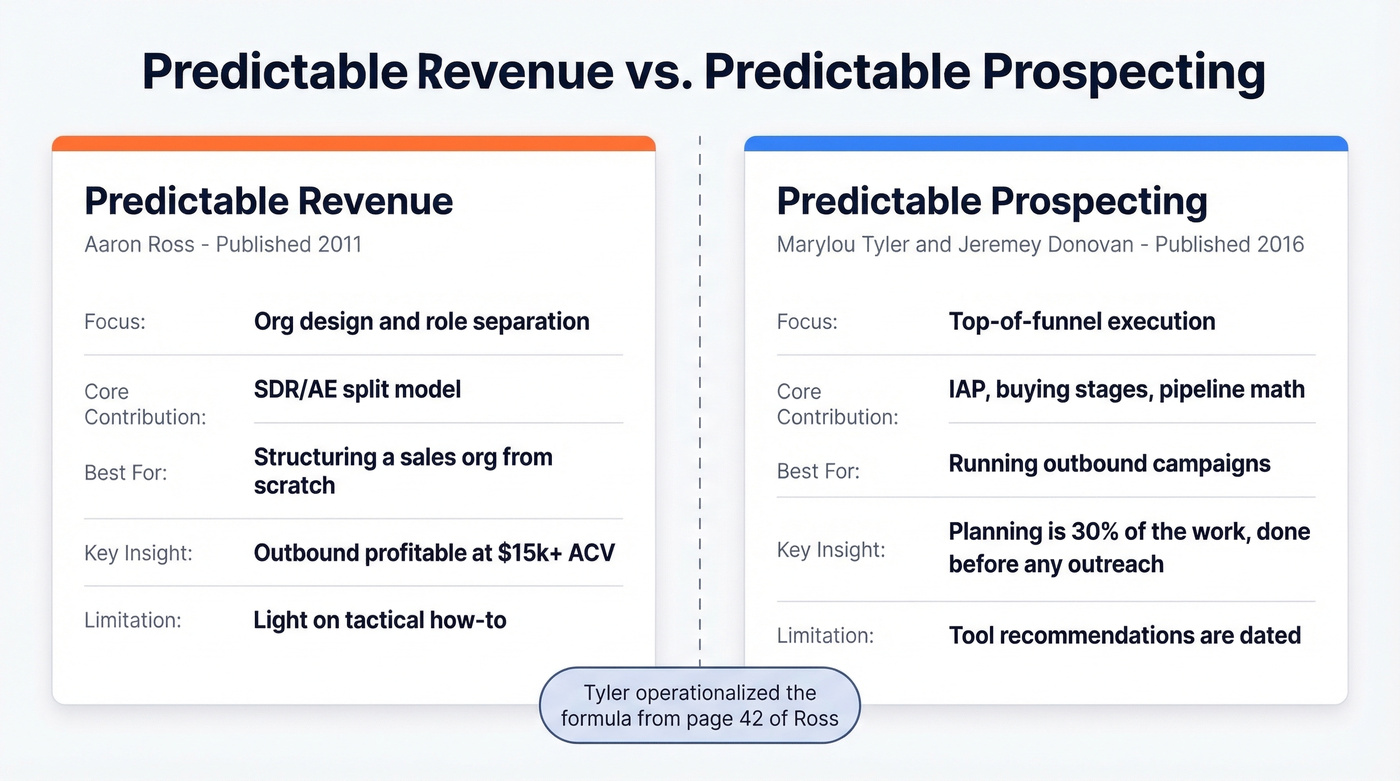
Predictable Revenue by Aaron Ross established the role-separation model that most modern SDR/AE org charts are built on. It sold 50,000+ copies and fundamentally changed how B2B companies structure outbound teams. Predictable Prospecting came about five years later to operationalize the top-of-funnel piece. The methodology traces back to the formula on page 42 of Predictable Revenue, then got refined over five years of client work. Where Ross told you what roles to create, Tyler and Donovan told you how those roles should actually prospect - the targeting, messaging, campaign design, and pipeline metrics that turn activity into revenue.
One useful threshold from the Predictable Revenue methodology: outbound sales development tends to be profitable when your ACV hits $15,000+. Below that, the unit economics of dedicated SDRs get shaky. Keep that number in mind as you evaluate whether this framework fits your business. If you're closing deals under $8k, you probably don't need this level of rigor.
| Dimension | Predictable Revenue | Predictable Prospecting |
|---|---|---|
| Focus | Org design & role separation | Top-of-funnel execution |
| Published | 2011 | July 2016 |
| Core contribution | SDR/AE split model | IAP, buying stages, pipeline math |
| Best for | Structuring a sales org | Running outbound campaigns |
| Key limitation | Light on tactical how-to | Tool recs are dated |
The Framework: Target, Engage, Optimize
Target - Precision Starts Here
This is where most teams cut corners, and it's where the framework earns its keep. Tyler and Donovan start with a Six-Factor SWOT to internalize your competitive position before you build a single prospect list. The six factors: your 4Ps (product, price, place, promotion), reputation, internal resources, external forces, trends, and VUCA (volatility, uncertainty, complexity, ambiguity). They recommend refreshing this quarterly - not annually, not "when we get around to it."
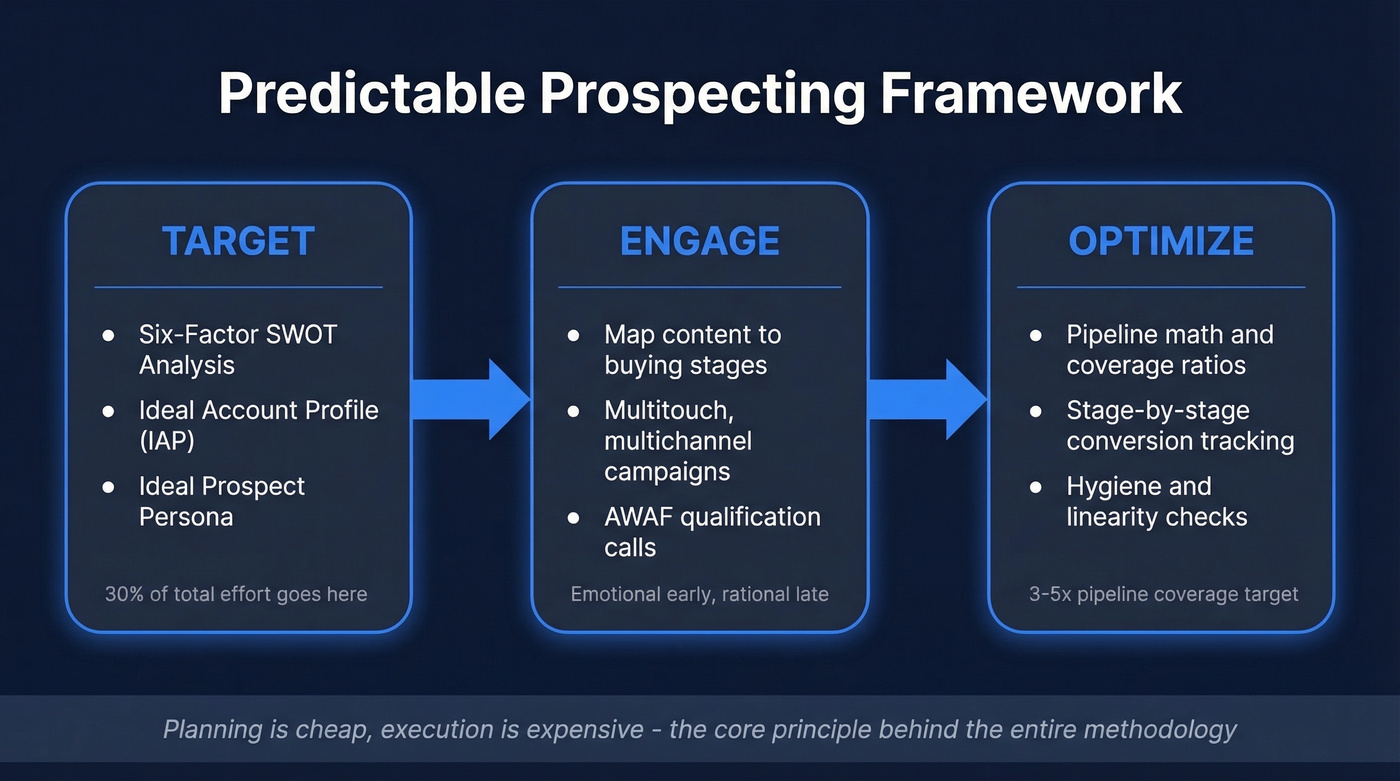
From there, you build your Ideal Account Profile across three factor groups:
| IAP Factor Group | What It Covers | Example Criteria |
|---|---|---|
| Firmographic | Company-level attributes | Industry, size, geography |
| Operational | How they buy and operate | Tech stack, budget cycles |
| Situational | Timing and context | New exec hires, funding events |
The IAP tells you which companies to pursue. The Ideal Prospect Persona tells you which people inside those companies to reach. Persona components include the decision maker's title and function, their professional objectives (pro tip: mine job postings for this), and an influence map covering direct influencers, gatekeepers, and indirect influencers.
Here's the thing: 15 personas is too many. We've seen this kill campaigns over and over. If you can't prioritize ruthlessly, you'll spread your outreach so thin that nothing converts. Three to five personas is the sweet spot for most teams.
For each persona, map the core objections using the Need/Trust/Urgency framework: Why change? (Need), Why you? (Trust), Why now? (Urgency). Every piece of outreach should address at least one of these.
In our experience, teams that skip the IAP step waste 30-40% of their outreach budget on accounts that'll never close. Your IAP is only as good as the contact data behind it - if 35% of emails bounce, your targeting is fiction regardless of how precise your profile is. Data quality is the invisible foundation of the entire framework, and it's the piece most teams underinvest in by a wide margin. (If you want a broader view of options, see data enrichment services.)

Engage - Match Message to Buying Stage
The Engage phase maps your outreach to six buying-cycle stages: unaware, aware, interested, evaluating, purchase, and post-purchase. The goal of every touchpoint is to move the prospect one stage deeper - not to close the deal in a single email.
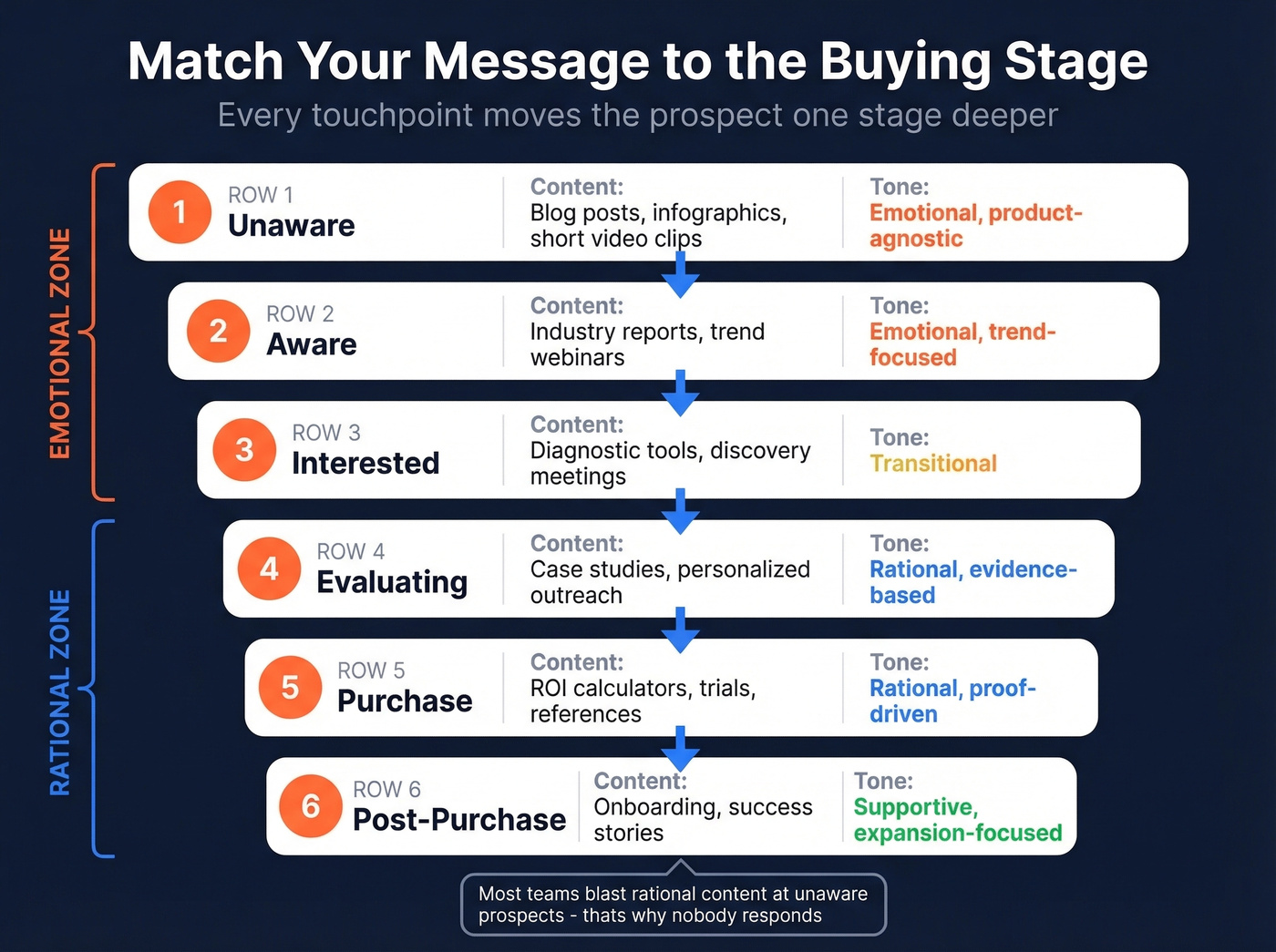
Tyler and Donovan's tone guidance is one of the most underappreciated parts of the book. Early-stage messaging (unaware to aware, aware to interested) should be emotional - connect with the prospect's world, not your product. Later stages shift to rational - ROI calculators, case studies, references. Most outbound teams blast rational content at unaware prospects and wonder why nobody responds. We've audited sequences where every single email led with product features, sent to prospects who didn't even know they had the problem yet. That's the gap this framework closes. (For more practical outreach patterns, see sales prospecting techniques.)
| Buying Stage | Content Type | Tone |
|---|---|---|
| Unaware to Aware | Blog posts, infographics, video clips | Emotional, product-agnostic |
| Aware to Interested | Reports, webinars, diagnostic tools | Emotional, trend-focused |
| Interested to Evaluating | Case studies, discovery meetings | Transitional |
| Evaluating to Purchase | Personalized outreach, trials, ROI calcs | Rational, evidence-based |
Each message follows the "3 Os" structure: Obstacle (what's in the prospect's way), Outcome (what success looks like), and Opportunity (a single CTA - never two). Tyler also provides a story-planning framework she calls "Compel with Connect," built around four prompts: For whom? To do what? In order to? By what means? It keeps messaging focused on the prospect's world instead of drifting into product-speak. (If you need help tightening CTAs, see email call to action.)
Campaigns should be multitouch and multichannel, with email and phone as the most reliable channels. One caveat: the book's examples skew North American and Northern European. For teams selling into APAC or Latin America, the tone guidance and outreach cadence need cultural adaptation.
The book assumes your leads don't have an active need. The first objective isn't to pitch - it's to qualify. Tyler calls this AWAF ("Are We A Fit?"). Phone calls are expensive, so you call when probability of fit is high, not as a spray-and-pray tactic. Use Question Trees to reduce cognitive load during calls so you can actually listen instead of scrambling for the next thing to say. (If your team is rebuilding call motions, start with a cold calling system.)
On lead sources, the hierarchy is clear: house lists are best, rented lists are second, purchased lists are a last resort. The speed-to-lead data is still staggering - the odds of contacting a lead are 100x higher in the first 5 minutes versus 30 minutes. If your team isn't treating inbound leads like perishable goods, you're leaving pipeline on the table.
Optimize - Pipeline Math That Holds
The Optimize phase is where the framework earns its name. Tyler emphasizes measuring what matters and maximizing return-on-effort - not just tracking activity for activity's sake.
Modern pipeline health breaks into five dimensions: creation, coverage, velocity, hygiene, and linearity. Coverage ratio is the one most teams get wrong. You need 3-5x qualified pipeline relative to your target, depending on win rate and cycle length. If you're carrying 2x coverage and your win rate is 25%, the math doesn't work. Full stop. (To go deeper on what to track, see pipeline health.)
Linearity is the silent killer. When 60-80% of your revenue closes in the last 10 days of the quarter, your process is broken - you're relying on heroics, not a system. Hygiene red flags include deals with no scheduled next step, accounts untouched for 14-30 days, and repeated close-date slippage without buyer confirmation. The principle is straightforward: measure conversion at every stage, identify the bottleneck, fix it, then move to the next one. Don't try to optimize everything simultaneously. (If you're seeing recurring breakdowns, review common sales pipeline challenges.)

The IAP framework only works when your contact data is real. If 35% of emails bounce, your targeting is fiction. Prospeo delivers 98% email accuracy with a 7-day refresh cycle - so every account on your list actually gets your message.
Stop building perfect prospect profiles on top of broken data.
Pipeline Benchmarks for 2026
These benchmarks reflect current outbound performance ranges across B2B teams. Use them to diagnose where your pipeline is leaking.
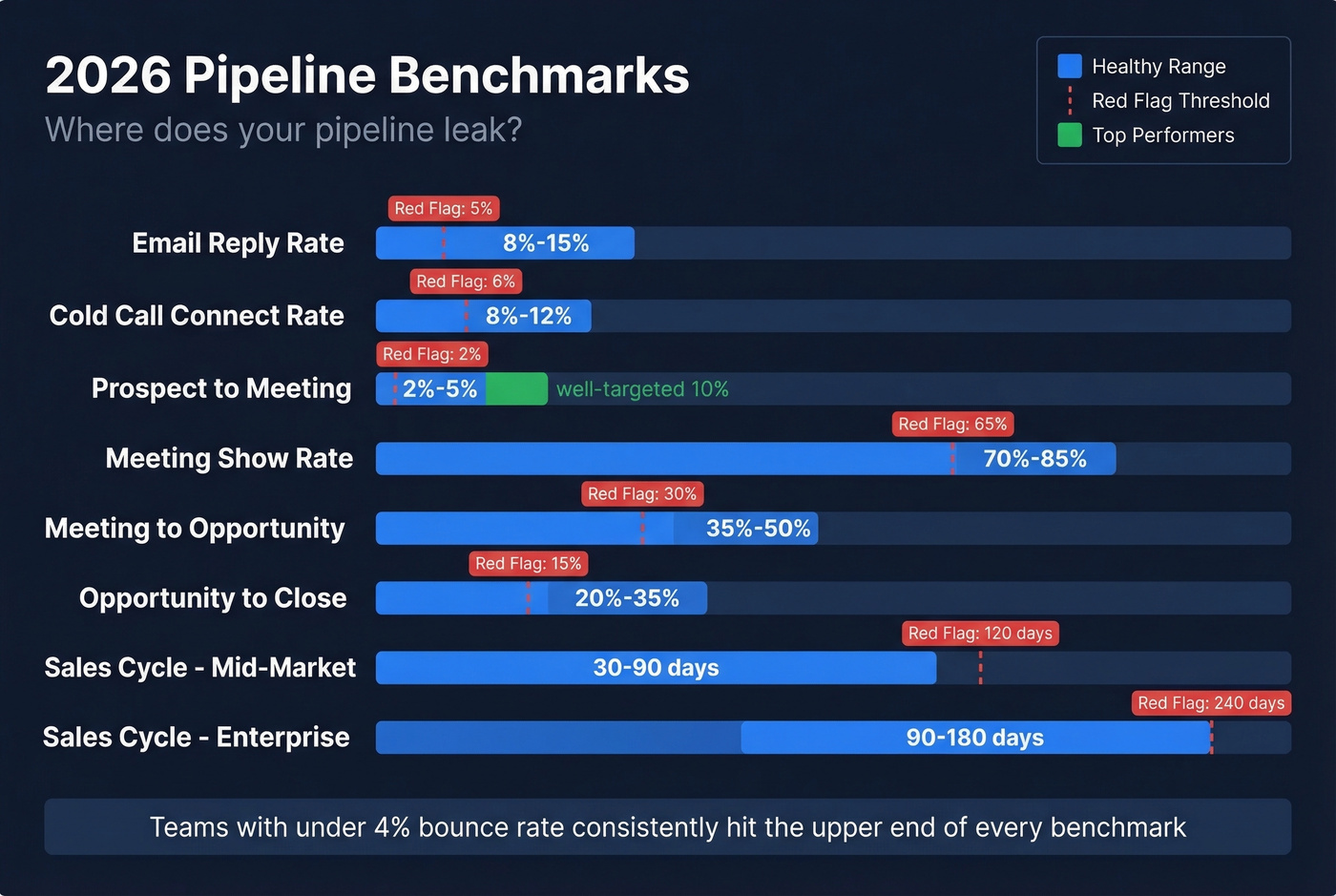
| Pipeline Stage | Benchmark Range | Red Flag Threshold |
|---|---|---|
| Email reply rate | 8-15% | Below 5% |
| Cold call connect rate | 8-12% | Below 6% |
| Prospect to meeting | 2-5% (7-10% well-targeted) | Below 2% |
| Meeting show rate | 70-85% | Below 65% |
| Meeting to opportunity | 35-50% | Below 30% |
| Opportunity to close | 20-35% | Below 15% |
| Sales cycle (mid-market) | 30-90 days | Over 120 days |
| Sales cycle (enterprise) | 90-180 days | Over 240 days |
Teams running verified contact data consistently hit the upper end of these benchmarks because prospects actually receive the outreach. When your bounce rate is under 4% instead of 35%, every other metric in the table improves downstream. We've watched this pattern repeat across dozens of outbound teams - clean data is the single highest-leverage fix for underperforming pipelines. The consensus on r/sales backs this up: threads about "fixing reply rates" almost always trace back to list quality, not copy. (If you're diagnosing bounces specifically, see email bounce rate.)
The Modern Tool Stack
A common critique of the book is its Salesforce-centricity. Fair point. The tool landscape has changed completely since 2016, and plenty of teams run outbound without Salesforce. Here's what the framework phases map to now.
Data & Targeting is the foundation. You've defined your IAP - now you need to find every matching contact with verified data. Prospeo's B2B database covers this with 300M+ professional profiles, 143M+ verified emails at 98% accuracy, and 125M+ verified mobile numbers. The 30+ search filters map directly to IAP criteria: buyer intent, technographics, job changes, funding events, and revenue ranges. Data refreshes every 7 days versus the 6-week industry average, which matters because a single bad week of data can tank deliverability. Pricing is self-serve and credit-based at roughly $0.01 per email, with a free tier of 75 verified emails plus 100 Chrome extension credits per month. No contracts, no sales calls required. (If you're comparing vendors, start with sales prospecting databases.)

CRM: HubSpot's free CRM tier handles pipeline tracking for most SMB teams. Sales Hub runs around $20-$100+/seat/month depending on tier. Salesforce is typically $25-$330/user/month - overkill for teams under 20 reps, but the integration ecosystem is unmatched at scale. (If you want a broader pricing view, see examples of a CRM.)
Sequencing: Smartlead and Instantly are typically in the $39-$99/month range and handle warm-up, rotation, and multichannel sequences. Lemlist runs around $59-$99/user/month and adds personalization features. Skip Lemlist if you're running high-volume agency campaigns - it's better suited for teams that want deep personalization on smaller lists. (More options here: SDR tools.)
Intent Data: If you want standalone intent, expect $30-100k+/year for enterprise platforms like 6sense or Demandbase. For teams that don't need a six-figure commitment, Prospeo includes intent data powered by Bombora across 15,000 topics, layered directly into the prospecting workflow.
The book itself: Hardcover runs about $12-$25, Kindle $11.37, and audiobook $13-$15. Read it before buying anything else.
Predictable pipeline math breaks when bad data inflates your denominator. Prospeo's 5-step verification eliminates bounces, spam traps, and dead contacts - so your conversion rates reflect real outreach performance, not data decay.
Make your pipeline math actually predictable at $0.01 per verified email.
Where the Framework Is Heading
Tyler hasn't stood still since 2016. In a 2025 conversation on the Membrain podcast, she described how AI is shifting outbound from volume-based to personalized, signal-driven engagement. Instead of blasting the same sequence to 10,000 contacts, modern teams build custom sequences based on prospect preferences, timing, and awareness stage. (If you're implementing this shift, see AI cold email outreach.)
The most interesting evolution is the concept of micro-signals - non-response patterns, stage velocity changes, and engagement drops that AI agents can flag before a deal stalls. Tyler envisions agentic AI as specialized single-task agents working with shared context protocols, not one monolithic AI doing everything. But human trust and empathy still drive complex B2B sales. AI should reduce busywork and improve conversation quality, not replace the conversations themselves.
Tyler expanded the original book framework into a 28-step system taught through PredictableEDU.com, covering the full cycle from account profiling through pipeline optimization with analytics at each stage.
Let's be honest about where this lands: the framework's core - define your target, match your message to the buying stage, measure every conversion point - is more relevant in 2026 than it was in 2016. The noise level in B2B outbound has increased dramatically, which means disciplined targeting and data quality separate the teams that hit quota from the ones drowning in activity metrics that go nowhere. Doing fewer things with more rigor beats high-volume spray-and-pray every time.
One area gaining traction is whitespace prospecting: identifying untapped segments, departments, or use cases within accounts you already serve. The IAP framework adapts naturally here - instead of building profiles for net-new logos, you apply the same firmographic, operational, and situational filters to expansion opportunities inside your existing book of business.
FAQ
Is this framework still relevant in 2026?
Yes. The targeting and qualification principles are timeless. The 2016 tool recommendations need updating, but the core insight that planning beats execution in ROI hasn't changed. Combining Tyler's methodology with modern verified data and AI-driven intent signals makes it more powerful than the original version.
How does this differ from Predictable Revenue?
Predictable Revenue established the SDR/AE role-separation model for scaling outbound teams. Predictable Prospecting operationalizes the actual top-of-funnel work: account targeting via IAPs, buying-stage messaging, and pipeline math that tells you whether your system is healthy.
What is an Ideal Account Profile?
An IAP defines best-fit customer characteristics across firmographic, operational, and situational dimensions. It prevents your team from chasing accounts that'll never close. Tools with 30+ search filters - including technographics, funding events, and buyer intent - map directly to IAP criteria, making list-building dramatically faster than manual research.
What tools do I need to implement the framework?
Four categories: a verified data platform for building IAP-matched lists, a CRM (HubSpot's free tier works), a sequencing tool ($39-$99/month), and optionally an intent data layer. Total cost ranges from under $200/month to $2,000+/month depending on team size and data volume.
What is the 28-step process Tyler teaches?
Tyler expanded the original three-phase framework into a 28-step system taught through PredictableEDU.com. The steps cover account profiling, persona development, campaign design, and pipeline optimization - each with analytics checkpoints built in.