

Product Go-to-Market Strategy: The 2026 Playbook
You've got 90 days to launch. The product roadmap is locked, Slack is full of opinions about positioning, and every team has a different idea of who the customer is. Meanwhile, only 13% of SaaS companies reach $10M ARR after 10 years. The difference between the 13% and everyone else isn't the product - it's the product go-to-market strategy behind it.
Most GTM plans fail because they're actually marketing calendars wearing a strategy costume. This playbook gives you the framework, the templates, and the benchmarks to build a real GTM strategy that converts.
The quick version - 8 steps, one line each:
- Identify the problem you solve (one sentence a prospect would nod at)
- Define and validate your ICP (15 interviews - skip this and nothing else matters)
- Research competition and demand signals
- Craft your positioning (use the canvas below - 60 seconds)
- Design pricing and packaging tied to your GTM motion
- Choose channels based on economics, not gut feel
- Build your sales plan with enablement materials
- Set goals, launch, and iterate weekly
The ICP card template and positioning canvas are in Sections 5.2 and 5.4. If you skip the 15 customer interviews, nothing else in this guide matters.
What Is a Go-to-Market Strategy?
A product go-to-market strategy is a sequential system that answers five questions in order: Who's the buyer? How do we position against alternatives? Which channels reach them? What sales motion fits? And how do we measure success? It's cross-functional - product, marketing, sales, and customer success all own pieces.
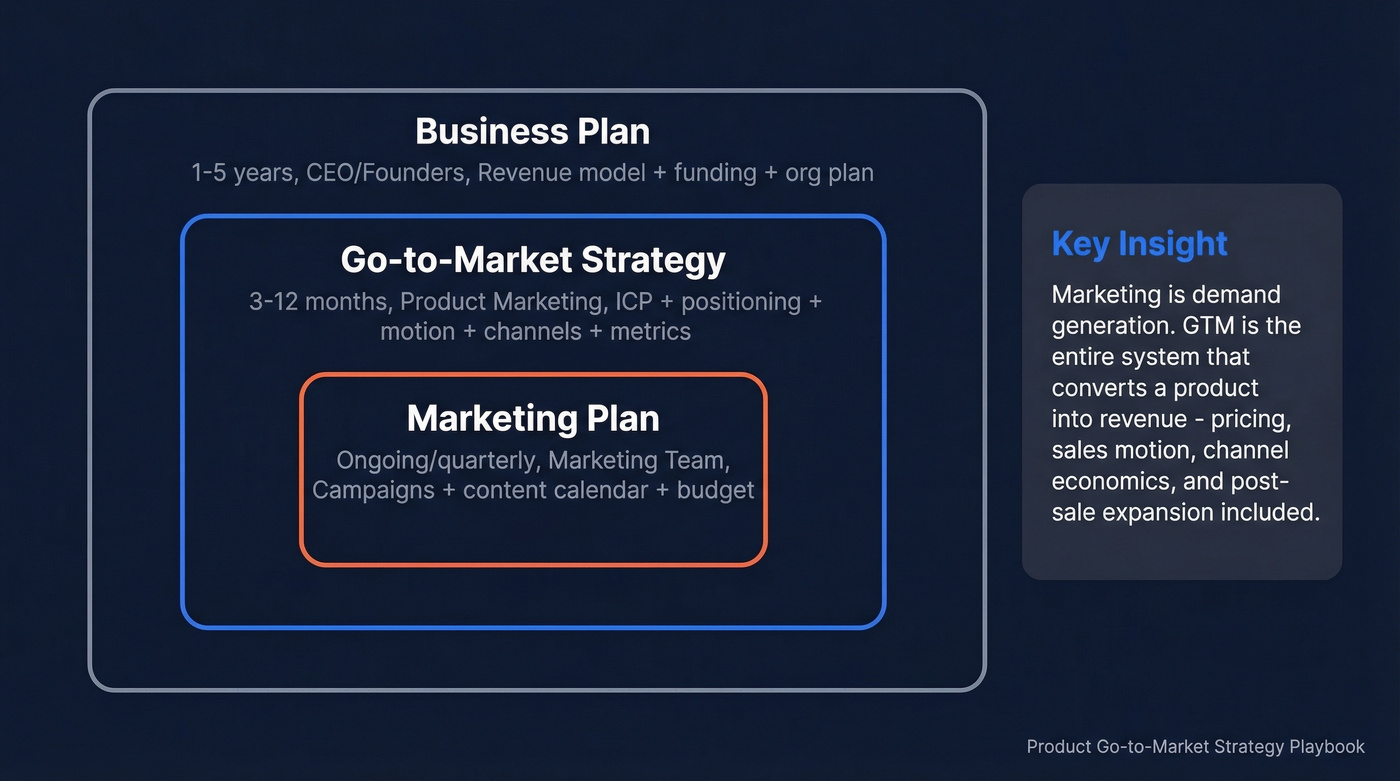
If your GTM is a list of campaigns, you have a marketing calendar, not a launch strategy.
| GTM Strategy | Marketing Plan | Business Plan | |
|---|---|---|---|
| Scope | Full launch system | Demand gen & awareness | Entire company |
| Timeframe | 3-12 months | Ongoing / quarterly | 1-5 years |
| Owner | Product marketing | Marketing team | CEO / founders |
| Key Outputs | ICP, positioning, motion, channels, metrics | Campaigns, content calendar, budget | Revenue model, funding, org plan |
A GTM strategy aligns sales, marketing, enablement, and RevOps across every stage from messaging to expansion. The marketing plan is one component. The business plan is the container. The go-to-market strategy is the engine that turns a product into revenue.
People argue whether GTM is just "marketing with extra steps." It's not. Marketing is demand generation. GTM is the entire system that converts a product into a business - pricing, sales motion, channel economics, and post-sale expansion included.
B2B vs. B2C GTM Differences
The mechanics of B2B and B2C go-to-market diverge on three axes: decision-makers, timeline, and buying motivation. B2B buying involves 6-10 stakeholders and 6-12 month cycles. B2C? One decision-maker, minutes to days, driven by emotion and friction reduction.
| Dimension | B2B | B2C |
|---|---|---|
| Decision-makers | 6-10 stakeholders | 1 person |
| Cycle length | 6-12 months | Minutes to days |
| Decision driver | Committee consensus | Emotion & convenience |
| Evaluation lens | ROI, security, workflow | Price, UX, brand |
The real complexity in B2B is that every stakeholder evaluates your product through a different lens. The CFO cares about TCO and financial impact. IT wants to know about integration and security. Operations focuses on workflow and adoption. Legal reviews terms and compliance. End users just want something that doesn't make their day harder. Your go-to-market plan needs to address every person in that buying committee, not just the end user who'll demo the product.
These frameworks apply beyond SaaS, too. When Oatly expanded in the U.S., its revenue grew ten-fold between 2017 and 2018. The principle holds in any market: find the people whose endorsement unlocks the next layer of adoption.
Choose Your GTM Motion
This is the highest-leverage decision in your entire GTM plan. Get the motion wrong and you'll burn cash for months before realizing the unit economics don't work. SaaS companies already spend $2 in sales and marketing for every $1 of new ARR, and that ratio is up 14% year-over-year.
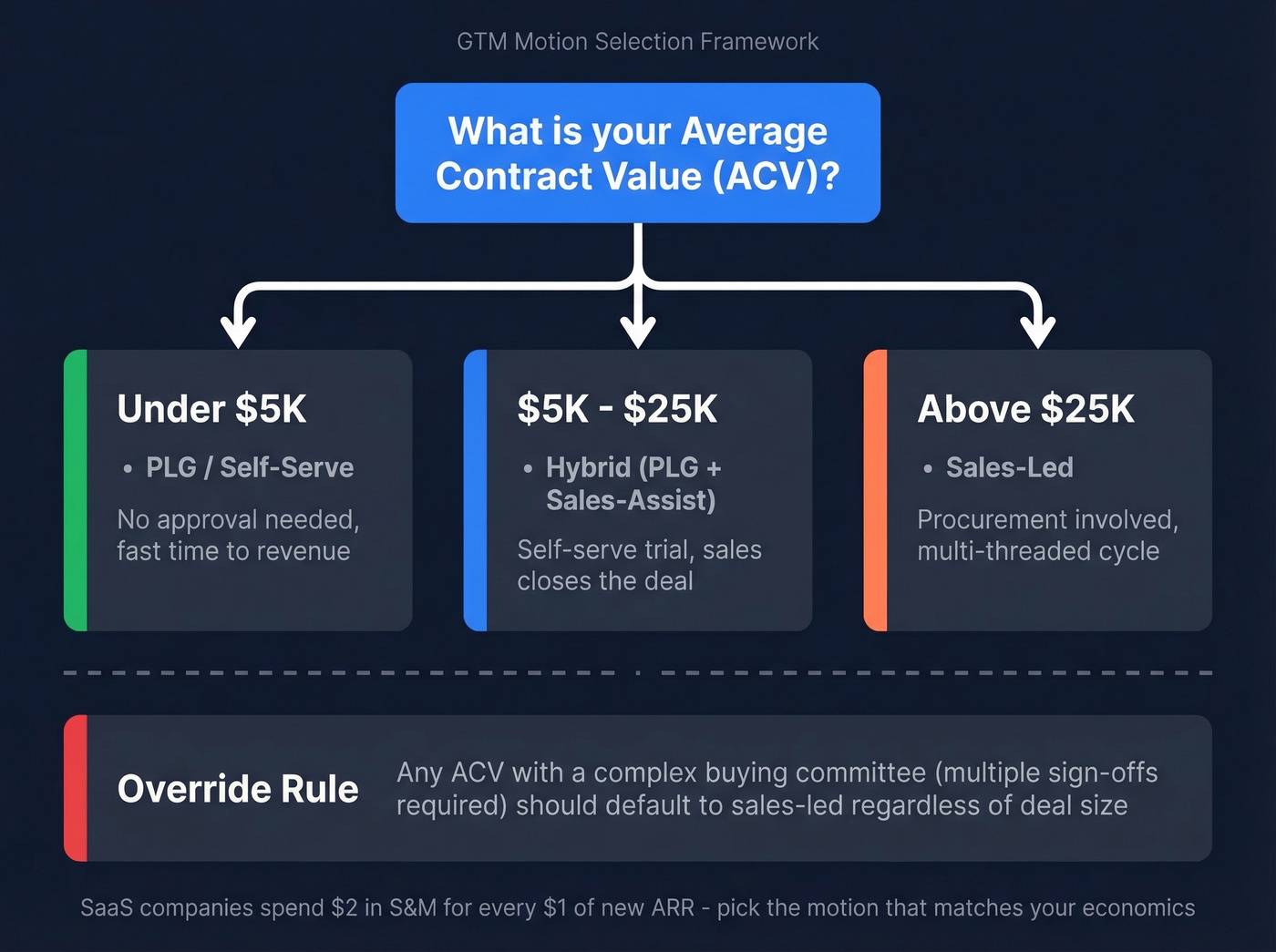
| ACV Range | Recommended Motion | Key Signal |
|---|---|---|
| Under $5K | PLG / self-serve | No approval needed |
| $5K-$25K | Hybrid (PLG + sales-assist) | Self-serve trial, sales closes |
| Above $25K | Sales-led | Procurement involved |
| Any ACV, complex committee | Sales-led regardless | Multiple sign-offs required |
Here's the thing: if your average deal is in the four-figure range and you're running a sales-led motion with SDRs, AEs, and a 90-day cycle, you're lighting money on fire. The math doesn't work. PLG or self-serve gets you to revenue faster at that price point, and you can layer sales on top once expansion deals justify the headcount.
Most B2B companies default to sales-led because it feels safer. It's not safer - it's just more expensive. If your deal size doesn't justify a security review and a multi-threaded sales cycle, start with self-serve and add sales when the data tells you to, not when your board tells you to. Let your GTM strategy follow the data, not the org chart.

Your GTM strategy dies the moment your sales team hits a 35% bounce rate. Prospeo delivers 98% email accuracy and 125M+ verified mobile numbers with a 30% pickup rate - so every channel in your go-to-market plan actually connects to real buyers. Teams using Prospeo book 26% more meetings than ZoomInfo users.
Stop building GTM plans on bad data. Start with contacts that connect.
How to Build a Go-to-Market Strategy for a New Product
Identify the Problem
Write one sentence that a prospect would nod at. Not a feature list, not a mission statement - a problem statement. "Our sales team wastes 6 hours a week finding contact data that bounces anyway." If your target buyer wouldn't say those exact words in a meeting, rewrite it until they would.
This sentence becomes the foundation for everything downstream.
Define and Validate Your ICP
Your ICP isn't a persona slide with a stock photo and a name like "Marketing Mary." It's a research-backed profile that tells your team exactly who to target and why. If you need a starting point, use an ICP scoring rubric before you interview.
ICP Card Template
Company: Industry | Employee count | ARR range | Tech stack | Geography
Buyer: Title | Reports to | Budget authority
Trigger: What event makes them start looking? (funding round, new hire, tool contract renewal)
Pain: The specific problem, in their words
Dream: What does success look like 12 months after buying?
Proof: Case study, metric, or reference that makes them believe
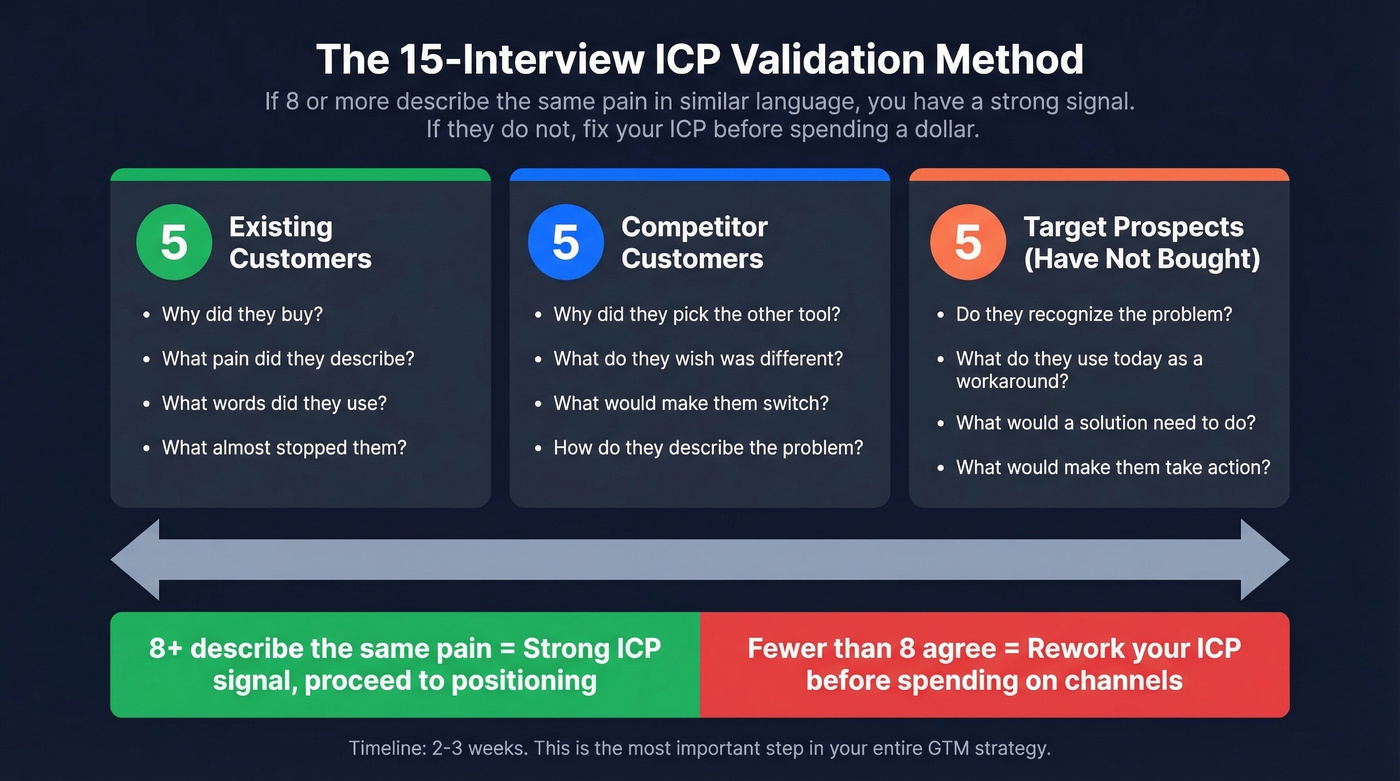
Now validate it. The 15-interview method works: talk to 5 existing customers, 5 competitor customers, and 5 target-market prospects who haven't bought anything yet. If 8 or more of the 15 describe the same pain in similar language, you've got a strong signal. If they don't, your ICP needs work before you spend a dollar on channels.
We've seen teams skip this step and launch campaigns targeting three different segments with the same pitch. It never works. The interviews take 2-3 weeks. Do them. Whether you're launching something new or repositioning an existing product, validation is non-negotiable.
Research Competition and Demand
Map the competitive field before you position. Who are the direct alternatives? What do prospects use today as a workaround? Validate demand with search volume trends, community activity in relevant subreddits and forums, and competitor traction signals like hiring patterns and funding rounds.
This is where AI tools have changed things in 2026. Use LLMs to mine call transcripts for competitive mentions, run AI-assisted account research to surface technographic and intent signals at scale, and A/B test positioning messages with AI-generated variants before committing to a direction. If you want a structured approach, borrow a competitive intelligence workflow.
If nobody's searching for the problem you solve, you either have a category-creation challenge or a problem that doesn't exist at scale.
Craft Your Positioning
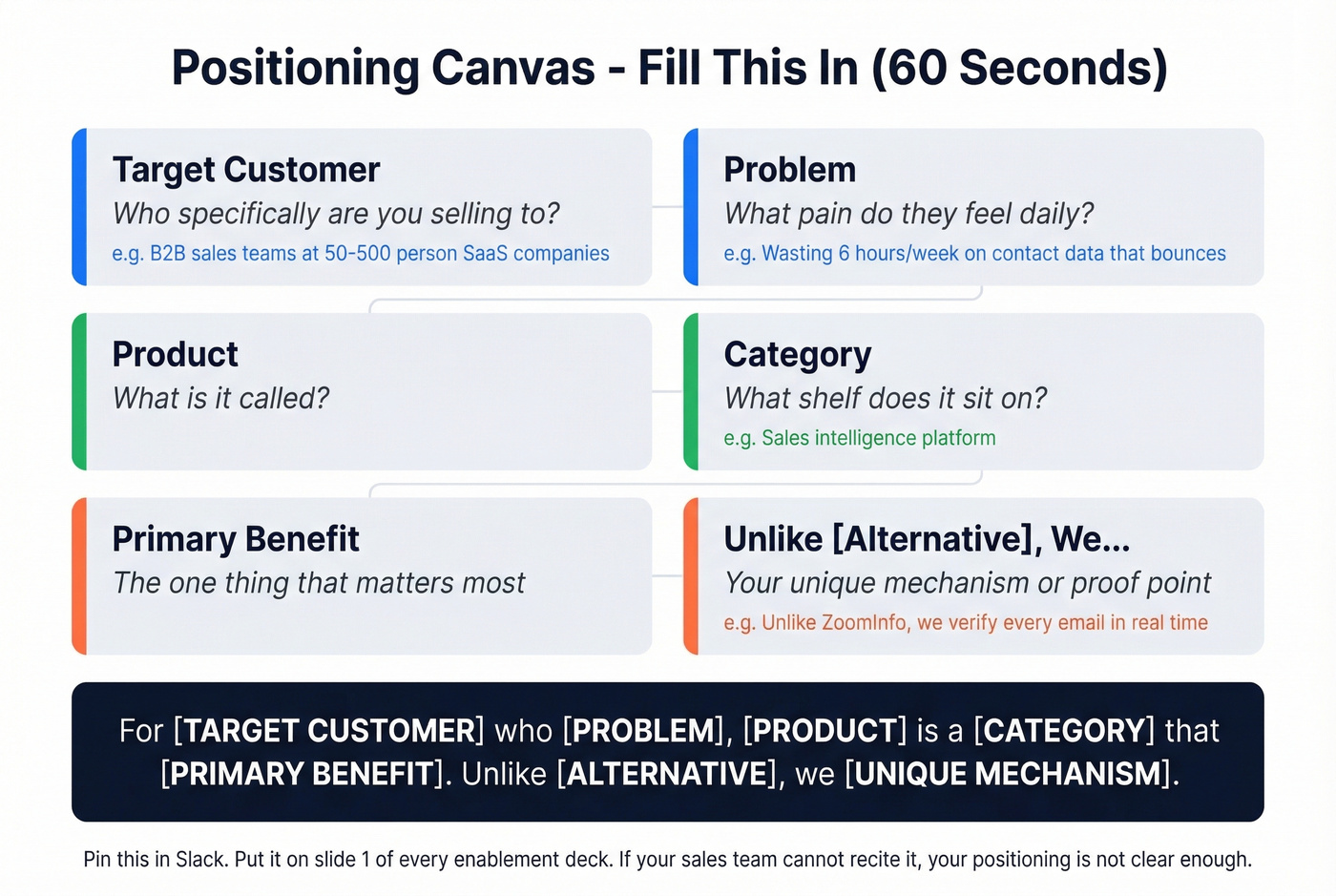
You've read five GTM articles and still don't have a positioning statement. Fill this in - 60 seconds:
Positioning Canvas
For [TARGET CUSTOMER] who [PROBLEM],
[PRODUCT] is a [CATEGORY] that [PRIMARY BENEFIT].
Unlike [ALTERNATIVE], we [UNIQUE MECHANISM / PROOF].
This isn't a tagline. It's an internal alignment tool that keeps every team telling the same story. Pin it in Slack. Put it on the first slide of every enablement deck. If your sales team can't recite it from memory, your positioning isn't clear enough. (If you want to go deeper, use a B2B brand positioning framework.)
Design Pricing and Packaging
Pricing is a value signal, not a math exercise. Price too low and prospects assume low quality - we've watched this happen with early-stage tools that undercut the market by 80% and then couldn't close enterprise deals because buyers didn't trust the price point.
Run willingness-to-pay research during your ICP interviews. Ask what they pay now, what they'd expect to pay, and what price would make them question quality. Then tie your pricing to the GTM motion you chose: self-serve needs transparent pricing on the website, hybrid needs a free tier with a clear upgrade path, and sales-led needs custom quoting with value-based anchoring.
Choose Your Channels
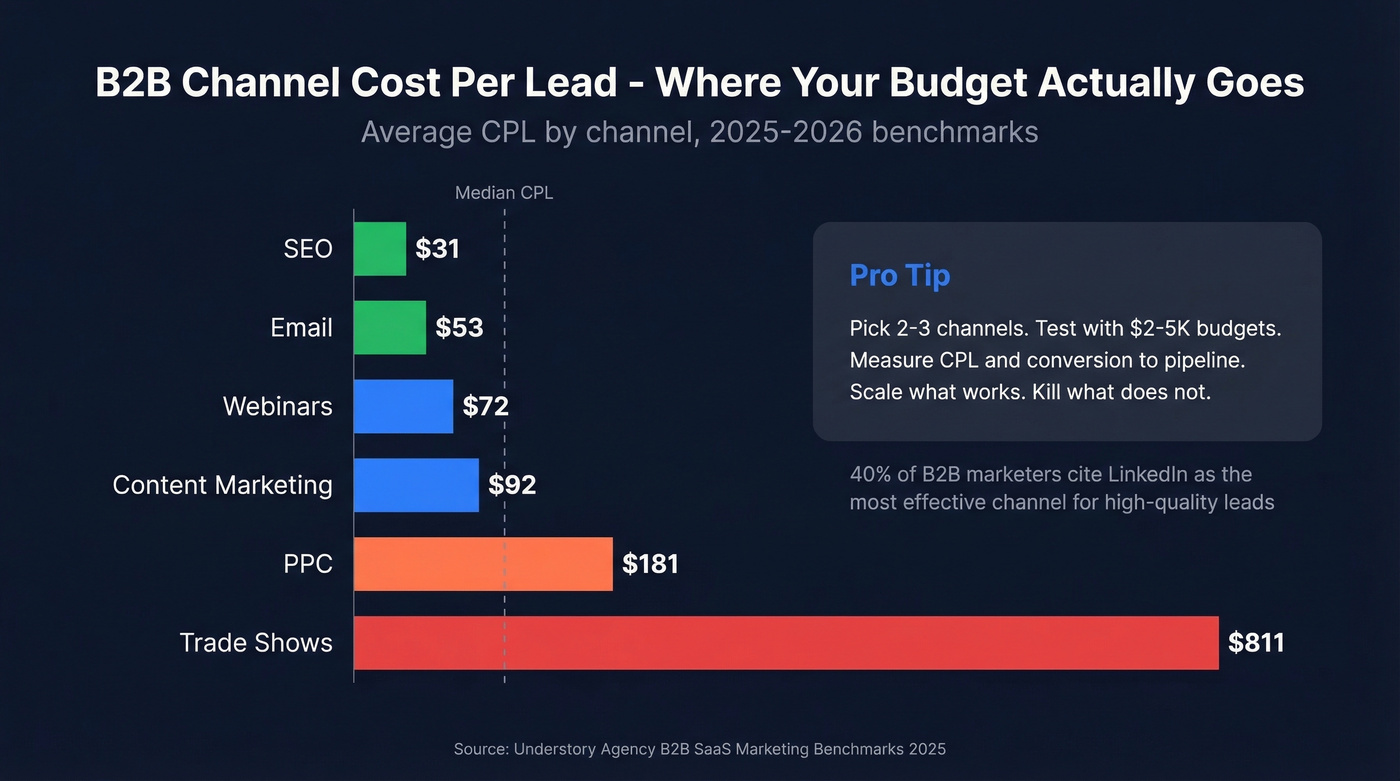
Channel selection should be economics-driven, not gut-driven. Here's what B2B channels actually cost per lead:
| Channel | Avg. CPL |
|---|---|
| SEO | $31 |
| $53 | |
| Webinars | $72 |
| Content marketing | $92 |
| PPC | $181 |
| Trade shows | $811 |
40% of B2B marketers cite LinkedIn as the most effective channel for high-quality leads. But effectiveness depends on execution, not just channel choice.
Pick 2-3 channels, run small-scale tests with $2-5K budgets, measure CPL and conversion to pipeline, then scale what works. Kill what doesn't. Don't spread budget across seven channels hoping something sticks. To keep measurement clean, define your lead generation metrics up front.
For outbound specifically, channel economics collapse if your contact data is bad. High bounce rates don't just waste budget - they damage deliverability and burn rep time before a single conversation happens. At Snyk, 50 AEs had a 35-40% bounce rate before switching to Prospeo. Bounces dropped below 5%, and AE-sourced pipeline increased 180%. Outbound only works when you're reaching real inboxes.
Build Your Sales Plan
Your sales plan bridges strategy and execution. Build three things before launch: a sales playbook with talk tracks that mirror your positioning canvas, battle cards for every major competitor, and an objection-handling guide based on what you heard in those 15 ICP interviews. (If you need a template, start with sales battle cards.)
The most common derailer we see? Teams operating in silos. Marketing builds messaging in isolation, sales creates their own talk tracks, and the customer hears two different stories. If marketing says "we save you 10 hours a week" and sales pitches "we increase revenue 30%," prospects get confused and deals stall. Product marketing owns the bridge - make sure the talk tracks and the landing pages tell the same story.
Let's be honest: this alignment is what separates a real GTM strategy from a collection of disconnected tactics, and it's where most launches quietly fall apart.
Feed your call recordings into transcript-mining tools to surface the objections reps actually face, then build battle cards around real conversations instead of hypothetical ones. For the interview portion, a structured set of discovery questions helps keep patterns comparable.
Set Goals, Launch, and Iterate
Set SMART goals tied to unit economics, not vanity metrics. "Generate 500 MQLs" means nothing if your MQL-to-SQL conversion is 3%. Better: "Achieve 15% demo-to-close rate in Q1" or "Reach CAC payback under 12 months by month 6." If you need a refresher on CAC math, use this cost to acquire customer guide.
Pre-launch readiness checklist:
- Sales playbooks and battle cards finalized
- Partner kits shipped (if channel GTM)
- Press and content queued for launch week
- Real-time dashboard configured (pipeline, activation, churn signals)
First 72 hours: Run daily optimization standups with marketing, sales, and product. Monitor activation metrics hourly, not daily. Adjust messaging and channel spend in real time based on early signals.
Post-launch cadence: Weekly reviews for the first month covering pipeline velocity, conversion rates, and channel CPL. Then shift to quarterly RevOps-led reviews to catch shifting buyer patterns and prevent execution drift.
GTM Metrics - What Good Looks Like
Every GTM guide tells you to "define your metrics." None tell you what the targets should be.
| Metric | Early-Stage Target | Growth-Stage Target |
|---|---|---|
| LTV:CAC | > 3:1 | > 4:1 |
| Monthly churn | 3-5% | < 3% |
| Demo-to-close | 15-20% | > 25% |
| MQL-to-SQL | 10-15% | > 20% |
| CAC payback | < 12 months | < 8 months |
| Net Revenue Retention | > 100% | > 110% |
| Gross Revenue Retention | > 85% | > 90% |
SaaS companies reinvest 40-60% of revenue into sales and marketing. That's not a problem if the unit economics hold. It is a problem if you're spending that much without tracking whether it's working.
One stat that should reshape how you think about GTM lifecycle: for companies above $50M ARR, 60% of new revenue comes from existing customers. Your product go-to-market strategy isn't just an acquisition plan - it's a retention and expansion plan. If you're only measuring top-of-funnel, you're measuring the wrong thing. The median NRR across SaaS sits at 101%, which means half the market is barely treading water on expansion. The companies winning at GTM are the ones treating post-sale as a growth engine, not an afterthought. If you want to operationalize this, start with a churn analysis process.
7 GTM Mistakes That Sink Launches
1. Confusing GTM with marketing. "Our GTM is LinkedIn ads plus weekly blog posts." That's a content calendar. A go-to-market strategy covers product, pricing, sales motion, channels, and metrics - marketing is one slice.
2. Targeting too broadly. Trying to sell to SMBs and enterprise with the same pitch, the same pricing, and the same sales motion. Pick one. Win it. Expand later.
3. Skipping channel validation. Your first channel works great at small scale. Then you pour budget in and CAC spikes 3x because you've exhausted the early-adopter pool. Test before you scale.
4. Neglecting pricing strategy. Pricing too low doesn't win deals - it signals low quality. Prospects who buy on price alone churn fastest.
5. Ignoring sales motion fit. You assumed self-serve would work, but your buyer's company has a procurement process, a security review, and a legal team. Now you need an AE and you don't have one.
6. Focusing only on acquisition. The leaky bucket problem. You're spending everything on new logos while existing customers churn at 8% monthly. Bad prospect data makes this worse - bounce rates waste rep time and hurt deliverability before a single conversation starts. Verify emails before you send and you solve this at the source. (If you're diagnosing this, start with email bounce rate benchmarks and fixes.)
7. Scaling before product-market fit. Spending your seed round on growth marketing while NPS is underwater and monthly churn is 8%. Fix the product first. Growth amplifies what's already there - good or bad.
Real-World GTM Examples
HubSpot - Content as the Engine
HubSpot didn't just sell marketing software - they invented a category. The inbound marketing methodology became the GTM engine: free educational content attracted marketers, a free CRM tier lowered the barrier to entry, and the product expanded into sales, service, and ops. HubSpot hit $100M ARR by 2012, six years after launch.
The lesson: content-led GTM works when you're genuinely teaching your buyer something new. Top-performing B2B companies reach 1,000 subscribers in 11 months versus a median of about two years - HubSpot was in that top tier because the content was the product marketing.
Slack - The Product Sold Itself
Slack's launch strategy was the product itself. 8,000 users signed up in the first 24 hours. They hit a $1B valuation in 1.25 years. No outbound sales team, no enterprise marketing - just a product so good that teams adopted it bottom-up and then pulled it into org-wide deployments. The viral loop was built into the experience: every message sent was an invitation for someone else to join.
Real talk: this only works when the product delivers immediate, obvious value to the end user. Most B2B products don't have that luxury, which is why pure PLG is rarer than the hype suggests.
Zoom - Freemium to Enterprise
Zoom's 2019 10-K revealed that 55% of customers contributing $100K+ in revenue started with at least one free host. Individual users adopted the free tier, proved the value internally, and then the company upgraded to a paid plan with admin controls and compliance features. Zoom layered a sales-assisted motion on top of PLG - reps didn't cold-call; they reached out to accounts already showing expansion signals.
The GTM motion matched the buying behavior, not the other way around. Skip this if you're building a product that requires top-down buy-in from day one - freemium only works when individual users can experience value without a committee approving a purchase order first.
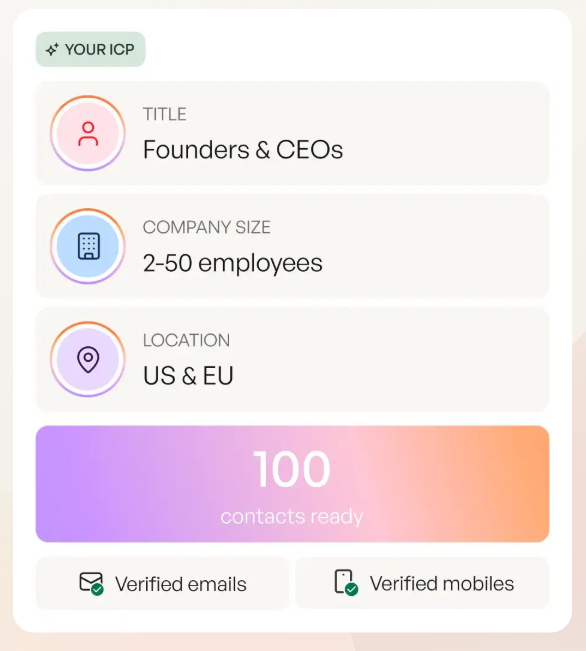
You just built your ICP card. Now you need to find those exact buyers. Prospeo's 30+ search filters - buyer intent, technographics, funding, headcount growth, job changes - let you turn your ICP into a targeted list of verified contacts in minutes, not weeks. All refreshed every 7 days, starting at $0.01 per email.
Turn your ICP research into pipeline today, not next quarter.
FAQ
What's the difference between a GTM strategy and a marketing strategy?
A GTM strategy is a cross-functional launch plan covering positioning, pricing, sales motion, channel selection, and success metrics - owned jointly by product marketing, sales, and RevOps. A marketing strategy is one component focused on demand generation and brand awareness. Your go-to-market plan includes marketing, but marketing alone isn't a GTM strategy.
Who owns the GTM strategy?
Product marketing leads it, but execution requires active buy-in from sales, product, customer success, and the executive team. RevOps coordinates ongoing measurement. If no single person owns it, nobody owns it - and it falls apart at launch.
How long does GTM planning take?
A full product go-to-market strategy for a new launch takes 6-12 weeks. A feature release or market expansion takes 2-4 weeks. The ICP validation interviews alone take 2-3 weeks, which is why teams that skip them feel faster - until they launch to the wrong audience.
What is a product-qualified lead (PQL)?
A PQL is a user who's experienced product value through a free tier or trial and signals readiness for a paid conversation - the PLG equivalent of an MQL. Typical signals include hitting usage limits, inviting teammates, or activating premium features during a trial.
How do I build a prospect list for outbound GTM?
Define your ICP first, then use a B2B data platform to find verified contacts matching your filters - industry, title, company size, technographics, and intent signals. Tools like Prospeo offer 30+ search filters and a 7-day data refresh cycle, which means fewer bounces and fresher records than most providers. Start with a free tier to test outbound before committing budget.