

How to Build a Product Pitch That Actually Lands
You spent three weeks on the deck. You rehearsed in the shower. You sent it to 50 people. Twelve emails bounced, eight went to someone who left the company in January, and the rest sat unopened. The pitch wasn't the problem - the delivery infrastructure was.
Let's fix both.
What You Need (Quick Version)
- Nail your one-sentence pitch first. If you can't explain it in one sentence, you can't explain it in fifteen minutes.
- Build a 10-15 slide deck that moves your audience through Understanding, Interest, and Belief.
- Verify your prospect list before you send anything. A bounced email wastes your best material and tanks your sender reputation.
Why Most Pitches Fail Before They Start
96% of prospects already research your company before they'll talk to you. Another 71% prefer doing that research alone. Your pitch isn't competing with other pitches - it's competing with whatever your prospect already found on their own.
A product pitch in 2026 has to do something your website can't: compress your value proposition into a narrative that creates urgency and earns the next conversation. Not the close. The next meeting.
Most pitches fail because they try to do too much - dumping features, inflating market sizes, skipping the part where the audience actually understands the problem. 81% of revenue leaders say deals are more complex than two years ago, which means your pitch needs to match that complexity with clarity, not volume.
What Is a Product Pitch?
A product pitch explains what you've built, who it's for, and why it matters - in a format tight enough to hold attention and structured enough to build conviction. It's different from a sales pitch. Selling is persuasive; pitching is explanatory. A product pitch opens doors. A sales pitch walks through them.
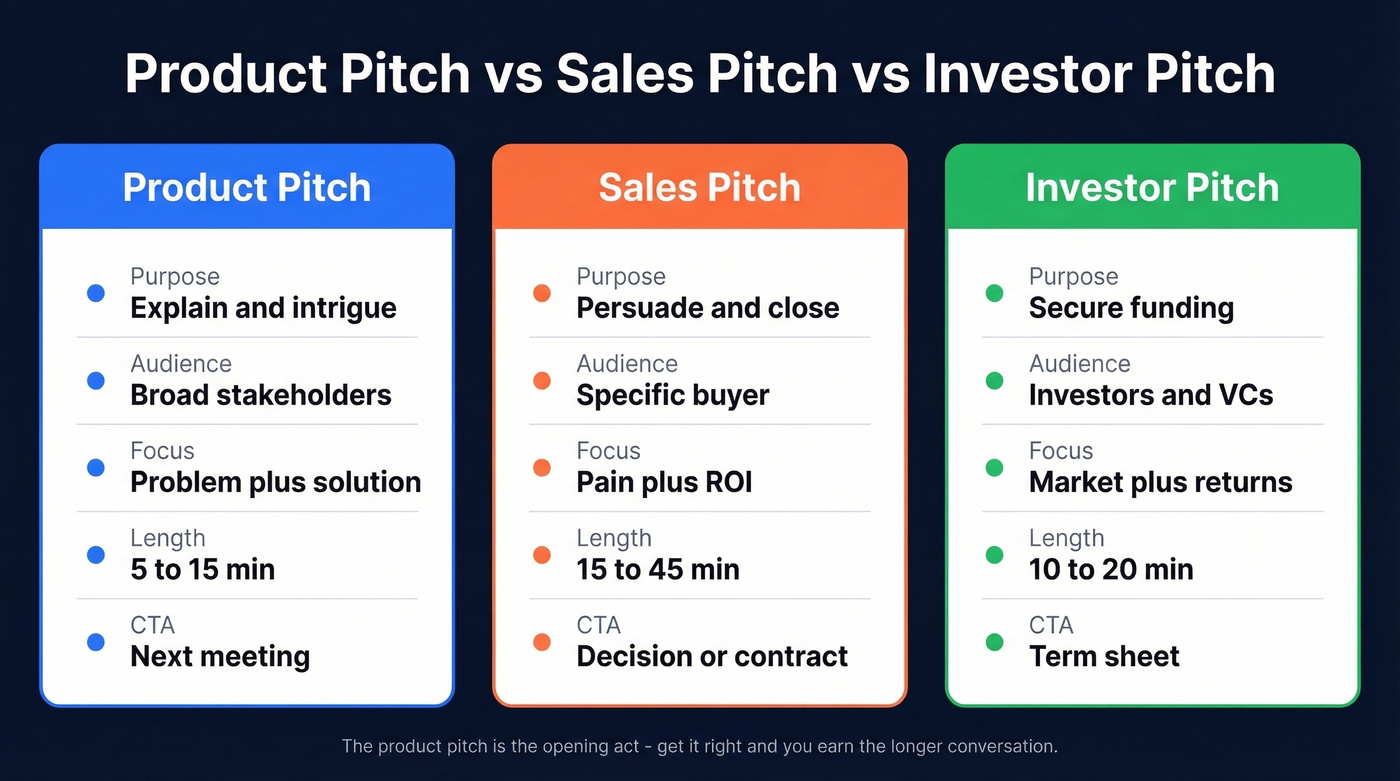
The confusion between pitch types wastes real time. You show up with a sales deck when the audience wanted a product story, or you deliver a vision pitch when the buyer needed proof points.
| Dimension | Product Pitch | Sales Pitch | Investor Pitch |
|---|---|---|---|
| Purpose | Explain and intrigue | Persuade and close | Secure funding |
| Audience | Broad stakeholders | Specific buyer | Investors/VCs |
| Focus | Problem + solution | Pain + ROI | Market + returns |
| Length | 5-15 min | 15-45 min | 10-20 min |
| CTA | Next meeting | Decision/contract | Term sheet |
The product pitch is the opening act. Get it right and you earn the longer conversation where sales and investor pitches happen.
The One-Sentence Pitch Formula
Before you build a deck or write an email, you need one sentence that works. The Founder Institute's fill-in-the-blank formula is the cleanest we've found:
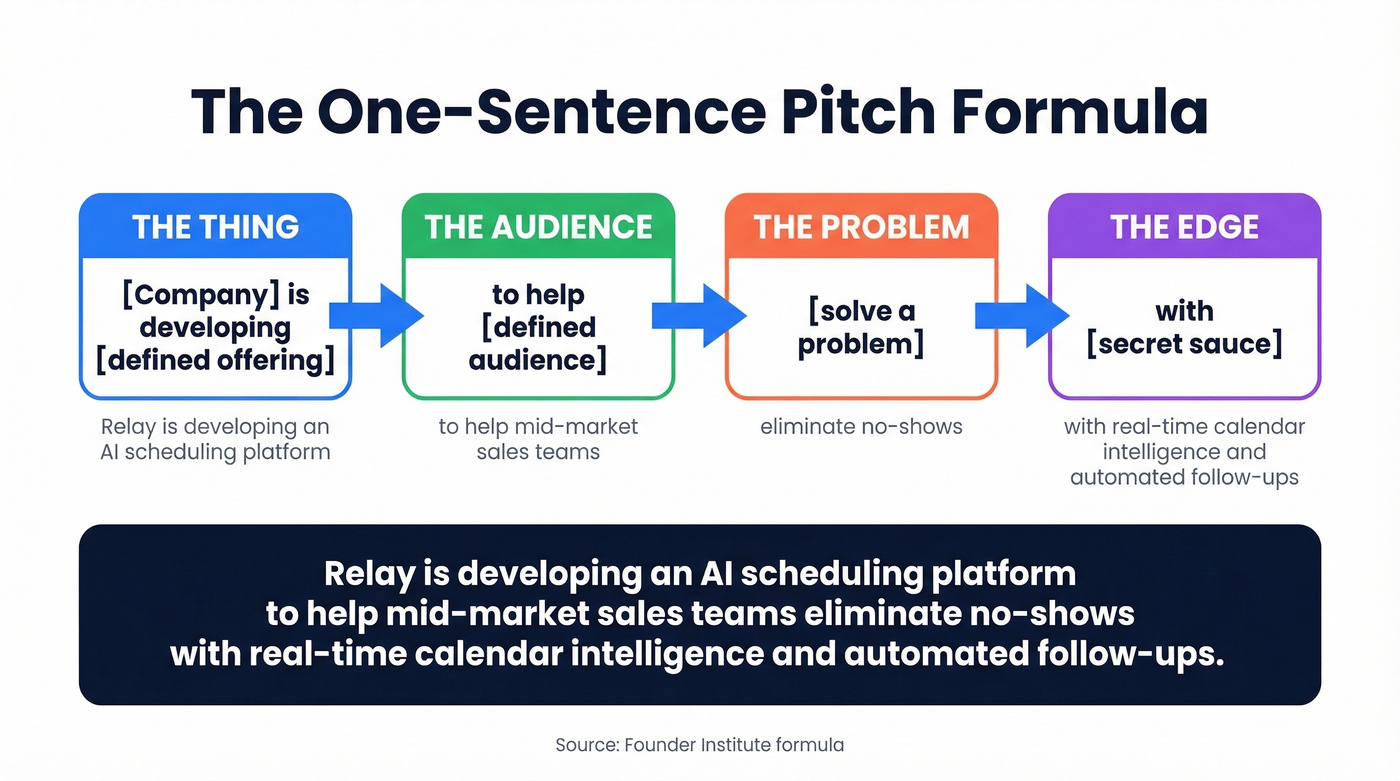
"[Company] is developing [defined offering] to help [defined audience] [solve a problem] with [secret sauce]."
Three completed examples:
- SaaS: "Relay is developing an AI scheduling platform to help mid-market sales teams eliminate no-shows with real-time calendar intelligence and automated follow-ups."
- Hardware: "AirFrame is developing a portable air quality monitor to help parents of asthmatic children track indoor pollutants with medical-grade sensors at consumer pricing."
- Service: "BridgeCFO is developing fractional finance services to help Series A startups pass due diligence with investor-ready reporting built in 48 hours."
Each one names the thing, names the audience, names the problem, and names the edge. No jargon. No "revolutionary platform." Your one-sentence pitch should aim for the clarity Steve Jobs had when he introduced the iPhone - not by listing specs, but by telling people Apple was reinventing the phone - not by listing specs, but by telling people Apple was reinventing the phone.
How to Structure Your Pitch Outline
The format changes depending on context. An elevator pitch, a cold email, and a demo presentation are three different animals, and having a clear outline before you start building slides or drafting copy saves hours of revision.
Elevator Pitch (30-60 Seconds)
Think Shark Tank. You're standing in front of investors at a conference. You have seconds before they check their phones. The Grammarly framework breaks it into four parts: Introduction, Explanation, Unique Value Proposition, and Call to Action. Fifty to 200 words, delivered in under a minute.
Here's the thing most people get wrong: they cram their entire deck into 60 seconds. Don't. The elevator pitch has one job - make the listener say "tell me more." Lead with the problem, not your product. State your edge in plain language. End with a specific ask. "Can I send you a two-page overview?" beats "Let me know if you're interested" every time.
Email Pitch (Under 200 Words)
Cold email is where most pitches go to die. Not because the pitch is bad, but because the infrastructure fails. 48% of cold email senders report bounce rates between 2-5%, which means even a modest 200-email campaign can see 4-10 messages hit dead inboxes.
A template that works:
- Subject line: [Specific result] for [their company/role]
- Opener (1 sentence): Reference something specific - a recent hire, a funding round, a job posting that signals the problem you solve.
- One-sentence pitch: Use the Founder Institute formula.
- Proof point (1 sentence): One customer result with a number.
- CTA (1 sentence): Ask for 15 minutes, not a demo.
Before you hit send, verify the email. A bounced pitch damages your domain reputation and wastes your best material. We've seen teams run their lists through Prospeo's real-time verification and cut bounce rates from 35% to under 4% overnight - that's the difference between a campaign that builds momentum and one that burns your domain. (If you want the deeper deliverability mechanics, start with bounce rates and sender reputation.)
In-Person or Demo Pitch (Under 15 Minutes)
The Hearts-Minds-Wallets framework is the best narrative structure we've found for live presentations. It works in three movements:
- Hearts: Make them care. Open with the human problem, not the technical solution. A story about a real user struggling beats a market-size slide every time.
- Minds: Help them understand. Walk through how your product works, why it's different, and what evidence supports it.
- Wallets: Give them a reason to believe. Traction, unit economics, customer results - whatever proves this isn't just a good idea but a working business.
Rehearse until you can deliver the full pitch in under 15 minutes. If you can't, you have too many slides or too little clarity. And remember the mindset that separates good pitchers from desperate ones: the goal of your pitch is the next meeting, not the close.
Hot take: If your average deal size is under $10K, you probably don't need a 15-slide deck at all. A tight email pitch and a 3-minute Loom video will outperform a polished deck that nobody opens. Save the deck for deals worth the production time. (For a repeatable workflow, see Loom video and cold email outreach.)

You just spent hours perfecting your pitch - don't waste it on bounced emails and outdated contacts. Prospeo verifies emails in real time with 98% accuracy and refreshes data every 7 days, so your pitch reaches the right person at the right company. Teams cut bounce rates from 35% to under 4% overnight.
Stop burning your best pitch on dead inboxes.
Pitch Deck - Slide by Slide
The 10-Slide Framework
A pitch deck typically runs 10-15 slides. These patterns come from analyzing 100+ real pitch decks from startups that collectively raised over $2B. Here's the 10-slide structure mapped to the Understanding, Interest, Belief psychology model:
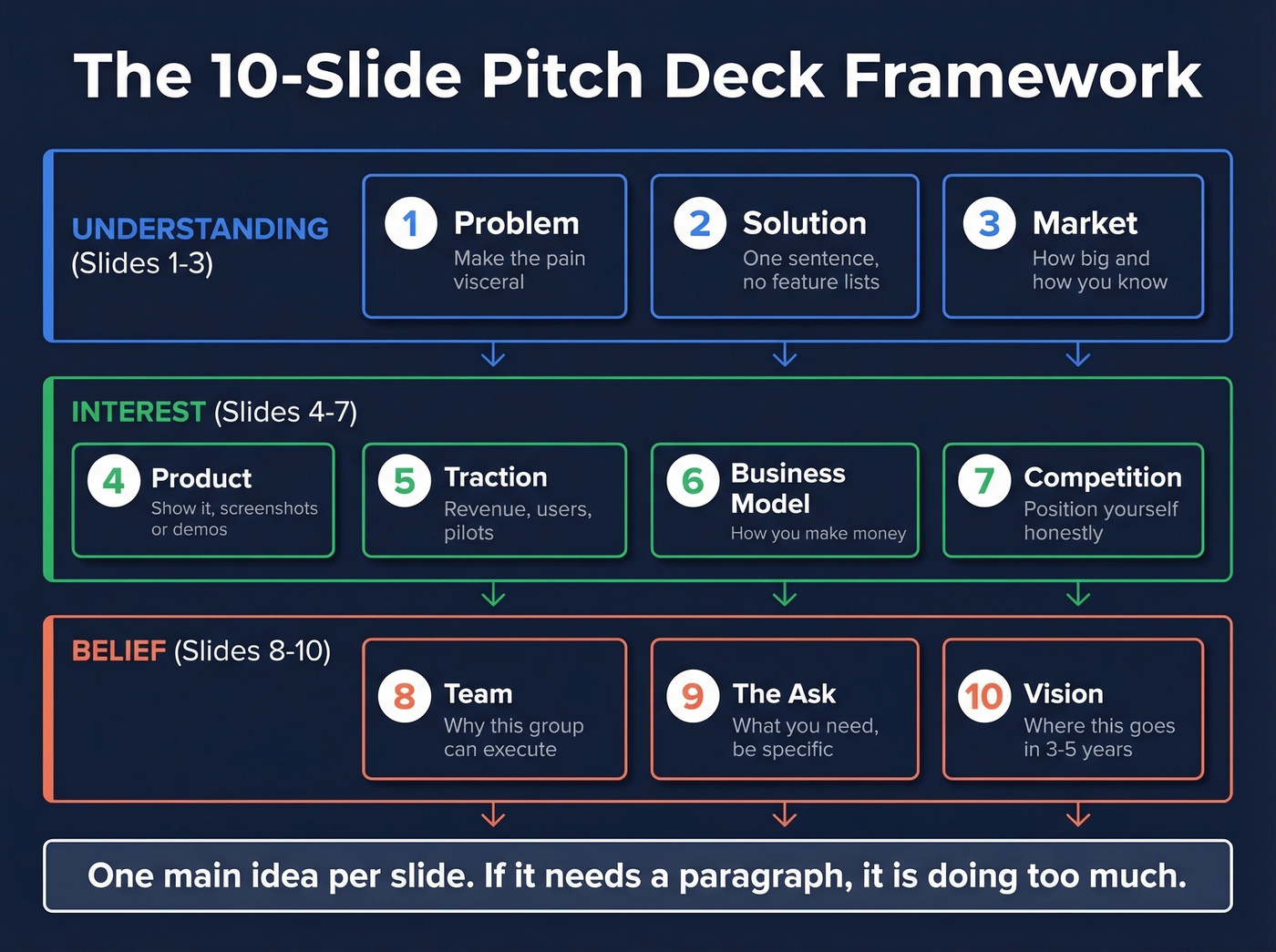
Understanding (slides 1-3):
- Problem - The pain your audience recognizes. Make it visceral, not abstract.
- Solution - What you've built, in one sentence. No feature lists yet.
- Market Opportunity - How big is this, and how do you know? (If you need a clean way to frame it, use TAM, SAM, SOM.)
Interest (slides 4-7): 4. Product - Show it. Screenshots, demo GIFs, architecture diagram. 5. Traction - Revenue, users, pilots, LOIs, waitlist - whatever you have. Honesty wins. 6. Business Model - How you make money. Pricing, unit economics, expansion revenue. 7. Competition - Position yourself honestly. A 2x2 matrix works if it's not rigged.
Belief (slides 8-10): 8. Team - Why this group can execute. Relevant experience, not resume padding. 9. The Ask - What you need and what you'll do with it. Be specific. 10. Vision - Where this goes in 3-5 years. End on ambition, not logistics.
One main idea per slide. If a slide needs a paragraph of explanation, it's doing too much. Need a starting point? 24Slides offers free pitch deck templates in multiple formats.
Stage-Based Adjustments
Not every deck needs the same depth:
| Stage | Slides | Primary Emphasis |
|---|---|---|
| Pre-seed | 10-14 | Problem + founder fit |
| Seed | 12-16 | Traction mandatory |
| Series A | 14-18 | ARR, retention, efficiency |
| Series B+ | 16-20 | Unit economics (CAC, LTV) |
Pre-seed decks can lean on vision and founder-market fit. By Series A, investors want numbers that prove the model works. By Series B+, they're looking at contribution margins and CAC payback periods.
What Investors and Buyers Expect in 2026
The growth-at-all-costs era is over. Investors and enterprise buyers both want the same thing: proof that your economics work. The benchmark everyone's using is LTV:CAC of at least 3:1. If yours is below that, fix the economics before you pitch - no deck design will paper over bad unit economics. (If you need to sanity-check the inputs, start with CAC.)
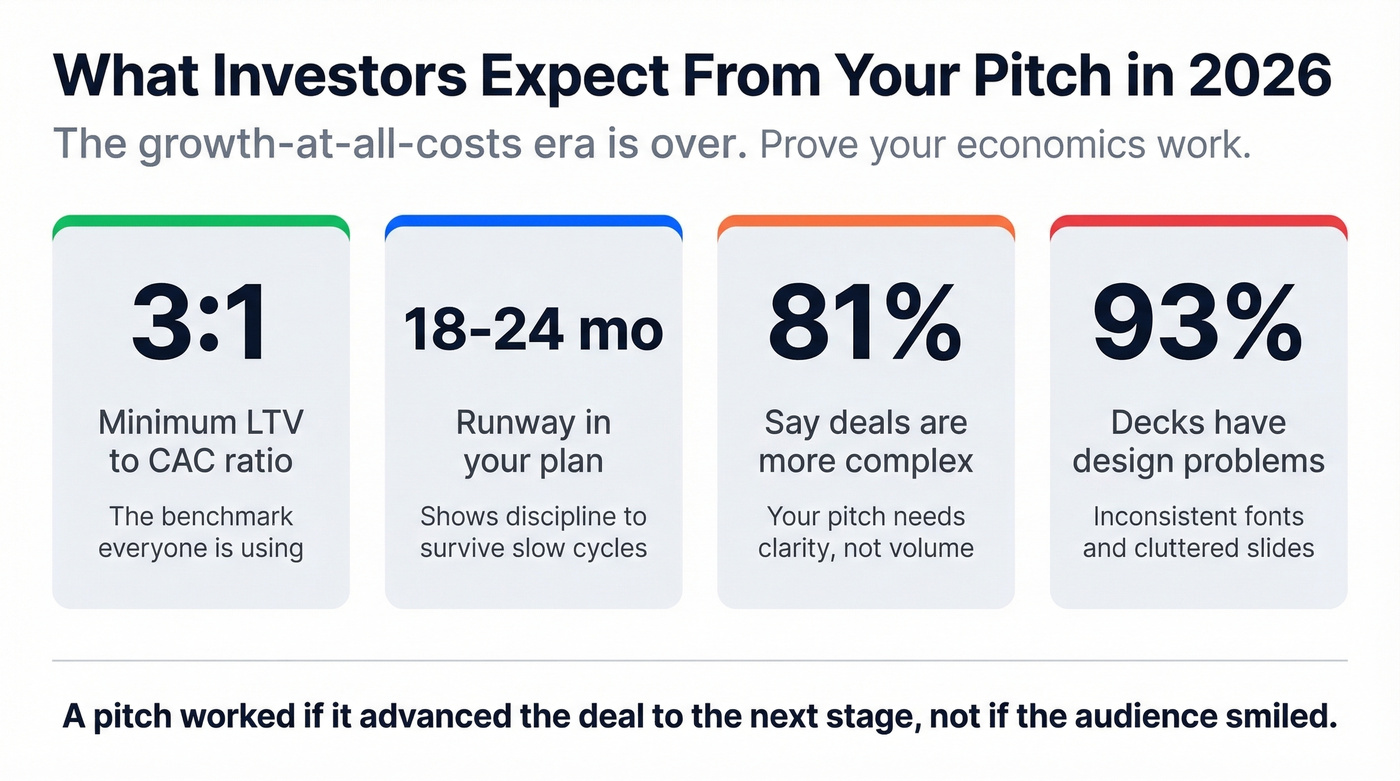
Investors also want to see 18-24 months of runway in your plan. That's not just a financial signal - it's a judgment call about whether you're disciplined enough to survive a slow fundraising cycle.
One thing most pitch advice ignores: how do you know if your pitch actually worked? The answer isn't "they seemed interested." A pitch worked if it advanced the deal to the next stage - a follow-up meeting booked, a technical review scheduled, a term sheet discussion opened. Track stage advancement, not audience smiles.
Mistakes That Kill Deals
93% of pitch decks have design working against the founder - inconsistent fonts, cluttered slides, chaotic visuals. That's the first impression problem. But design is just the surface.
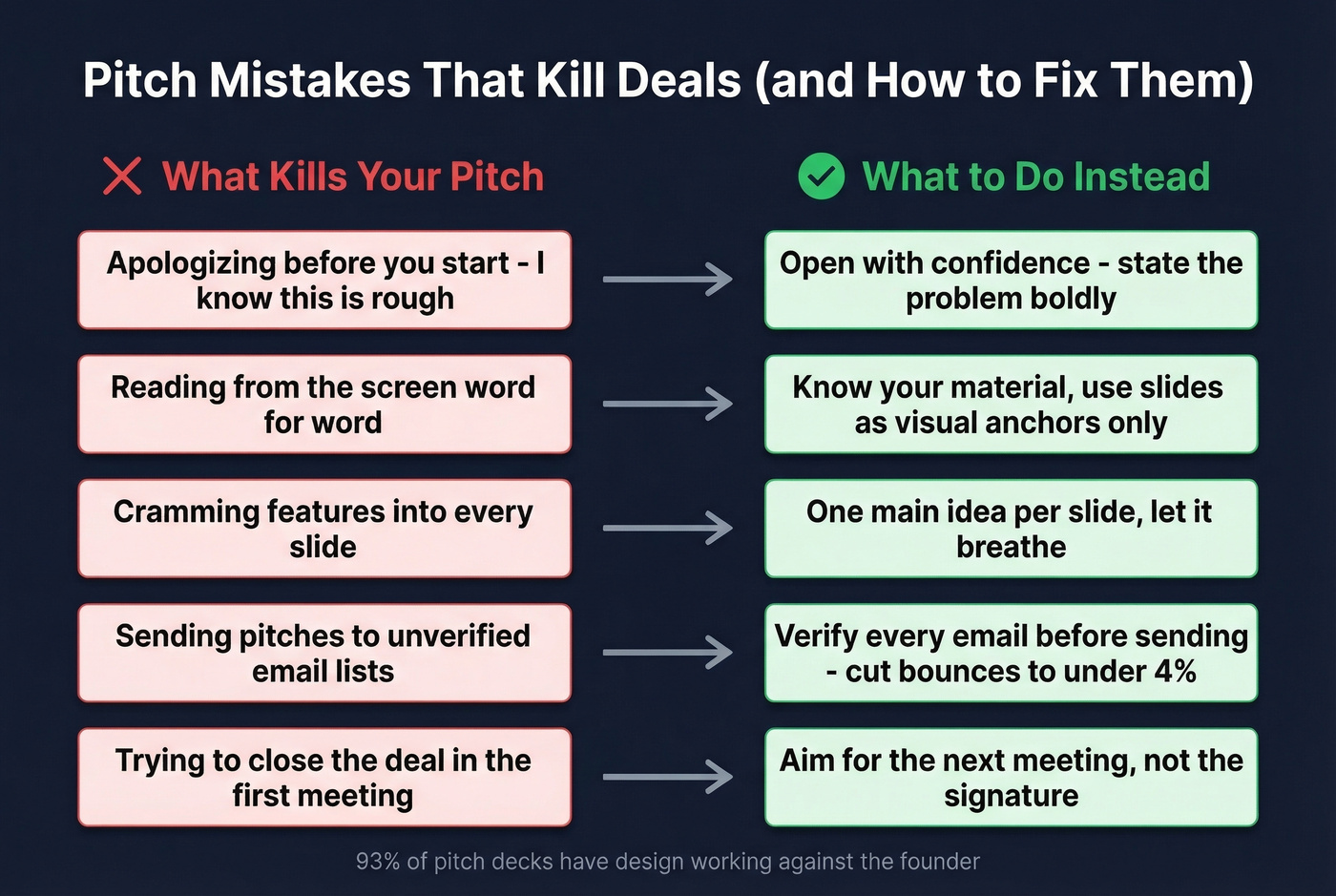
The deeper mistakes are behavioral. Apologizing before you start - "I know this is rough" or "We're still early" - signals you don't believe in what you're presenting. Reading from the screen tells the audience you don't know your own material, and they'll check out in 30 seconds. The biggest mistake we see founders make is data dumping: fifteen metrics on one slide doesn't make you look rigorous. It makes you look unfocused. Pick the three numbers that matter.
Then there are the credibility killers. Claiming "no competitors" is the fastest way to lose an investor's trust - it means you haven't done the research or you're being dishonest. Hype language like "revolutionary" and "game-changing" destroys credibility instantly. And fuzzy market sizing - "The global SaaS market is $200B" - means nothing. Show the slice you can actually capture.
Two practical failures that are entirely preventable: never pitch without a video backup and print copies for when Wi-Fi dies, and always leave Q&A time. If you pitch for 14 minutes and 50 seconds of a 15-minute slot, you've told the audience their questions don't matter.
Your deck is a proxy for how you run a company. Sloppy slides suggest sloppy operations. (If you want a tighter narrative, borrow from sales deck storytelling.)
Delivering Your Pitch to the Right Person
Here's a pattern we see constantly: a team spends weeks perfecting their deck, sends it out, and watches their open rate flatline. The pitch was strong. The prospect list was garbage.
The best product pitch in the world doesn't matter if it lands in the wrong inbox - or no inbox at all.
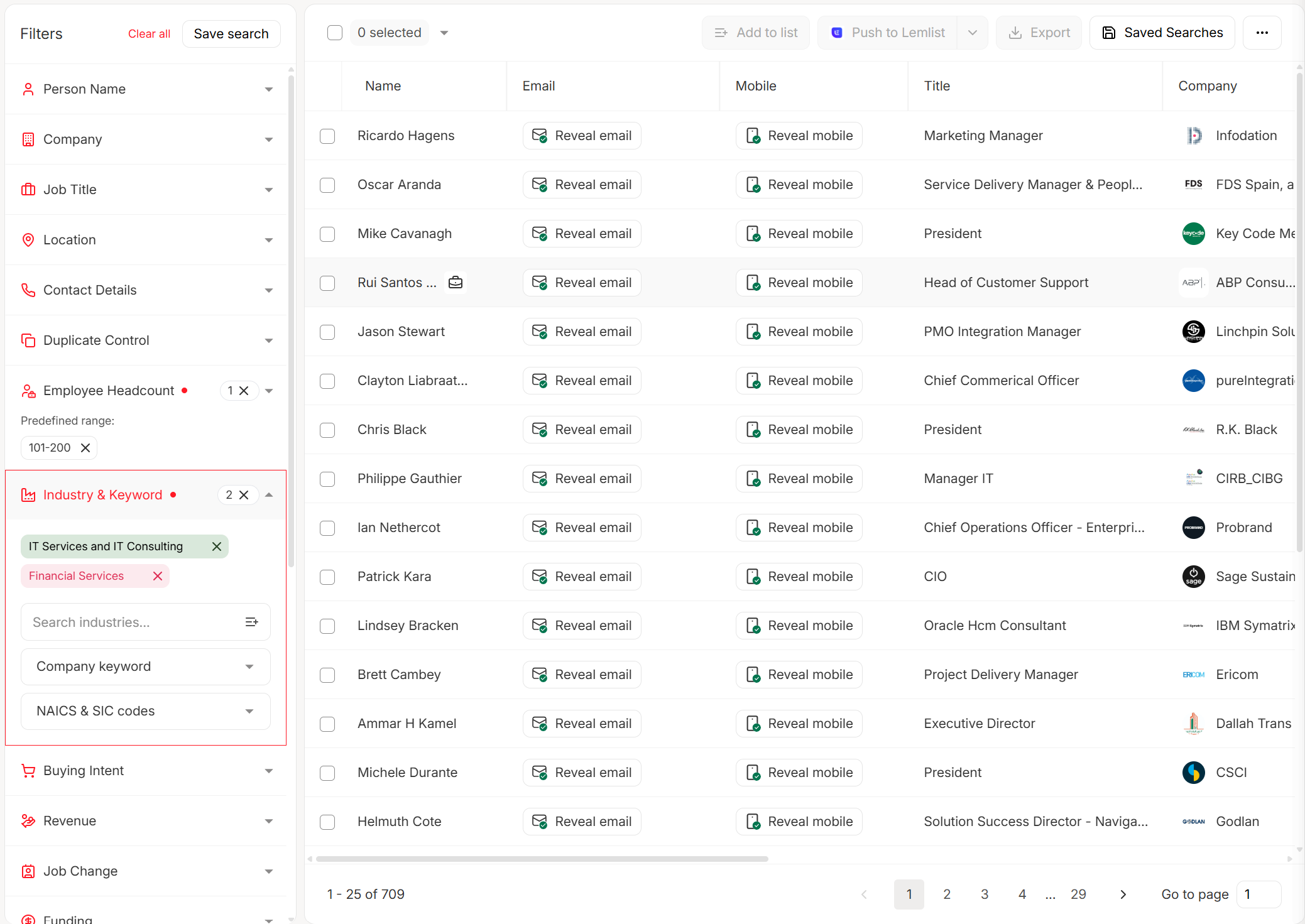
Prospeo's database covers 300M+ professional profiles with 143M+ verified emails at 98% accuracy and 125M+ verified mobile numbers. A 7-day data refresh cycle means you're not pitching someone who changed jobs weeks ago, and buyer intent signals help you find decision-makers actively researching solutions in your category. The results speak for themselves: one team tripled their pipeline from $100K to $300K per week after switching, with bounce rates dropping from 35% to under 4%.
Skip this step if you enjoy watching your best pitch material bounce into the void. (For more ways to tighten list quality, see data enrichment services and sales prospecting techniques.)
Product Pitch Template (Copy and Use)
One-Sentence Pitch
"[Company] is developing [defined offering] to help [defined audience] [solve a problem] with [secret sauce]."
Elevator Pitch (30-60 Seconds)
Introduction: "I'm [Name], [role] at [Company]." Explanation: "We [what you do] for [who you serve]." Unique Value Proposition: "Unlike [alternative], we [key differentiator] which means [specific outcome]." Call to Action: "I'd love to send you a two-page overview - what's the best email?"
Email Pitch (Under 200 Words)
Subject: [Specific result] for [their company]
Hi [First Name],
[One sentence referencing something specific about their company - a hire, a funding round, a job posting.]
[One-sentence pitch using the formula above.]
[One proof point: "We helped [customer] achieve [result] in [timeframe]."]
Worth 15 minutes this week?
[Your name]
Keep all three versions in a shared doc. Update the proof point quarterly. And always verify the recipient's email before sending - one bounce on a pitch email is one too many. (If you want higher opens, start with email subject lines and prospecting email subject lines.)
A perfect product pitch means nothing if you're sending it to someone who left the company in January. Prospeo's 300M+ profile database with 30+ filters - including job changes, funding rounds, and buyer intent - lets you find the exact decision-makers your pitch was built for. At $0.01 per email, list quality stops being a budget problem.
Build a verified prospect list in minutes, not days.
FAQ
How long should a product pitch be?
Thirty to sixty seconds for an elevator pitch (roughly 50-200 words spoken aloud), 10-15 slides for a deck delivered in under 15 minutes, and under 200 words for email. If you can't deliver it in the allotted time with room for Q&A, cut slides until you can.
What's the difference between a product pitch and a sales pitch?
A product pitch explains what you've built and why it matters - it's designed to earn the next meeting. A sales pitch persuades a specific buyer to close a deal now, focusing on pain points, ROI, and pricing. The product pitch opens doors; the sales pitch walks through them.
How many slides should a pitch deck have?
Ten to fifteen for most stages. Pre-seed decks skew shorter (10-14 slides) emphasizing problem insight and founder credibility. Series B+ decks run 16-20 slides with heavy emphasis on unit economics. Stick to one idea per slide - if you can't present the full deck in 15 minutes, cut.
How do I make sure my pitch reaches the right person?
Use a verified contact database instead of guessing at email addresses. Look for tools that offer real-time verification and frequent data refreshes so you're reaching current decision-makers, not former employees. Pair that with buyer intent filters to target prospects actively researching your category.