

How to Write a Professional Email to Ask for a Meeting That Gets Replies
You spent 20 minutes crafting the perfect email to a VP of Engineering. Personalized opener, clear ask, three time slots. You hit send. It bounces. The address was wrong, and your sender reputation took a hit for nothing.
Writing a professional email to ask for a meeting isn't just about great copy - it's about the foundation underneath it. Get the words right but the address wrong, and you've wasted more than time.
The average cold email reply rate sits at 4.5% across 31 million emails. When surveyed, 65% of decision-makers say cold emails fail because they're too sales-focused, 61% say they're irrelevant, and 48% call out generic, impersonal messaging. You've probably read a dozen guides that all say "be clear, be professional, propose a time." Here's what actually moves the needle.
The Essentials (Quick Version)
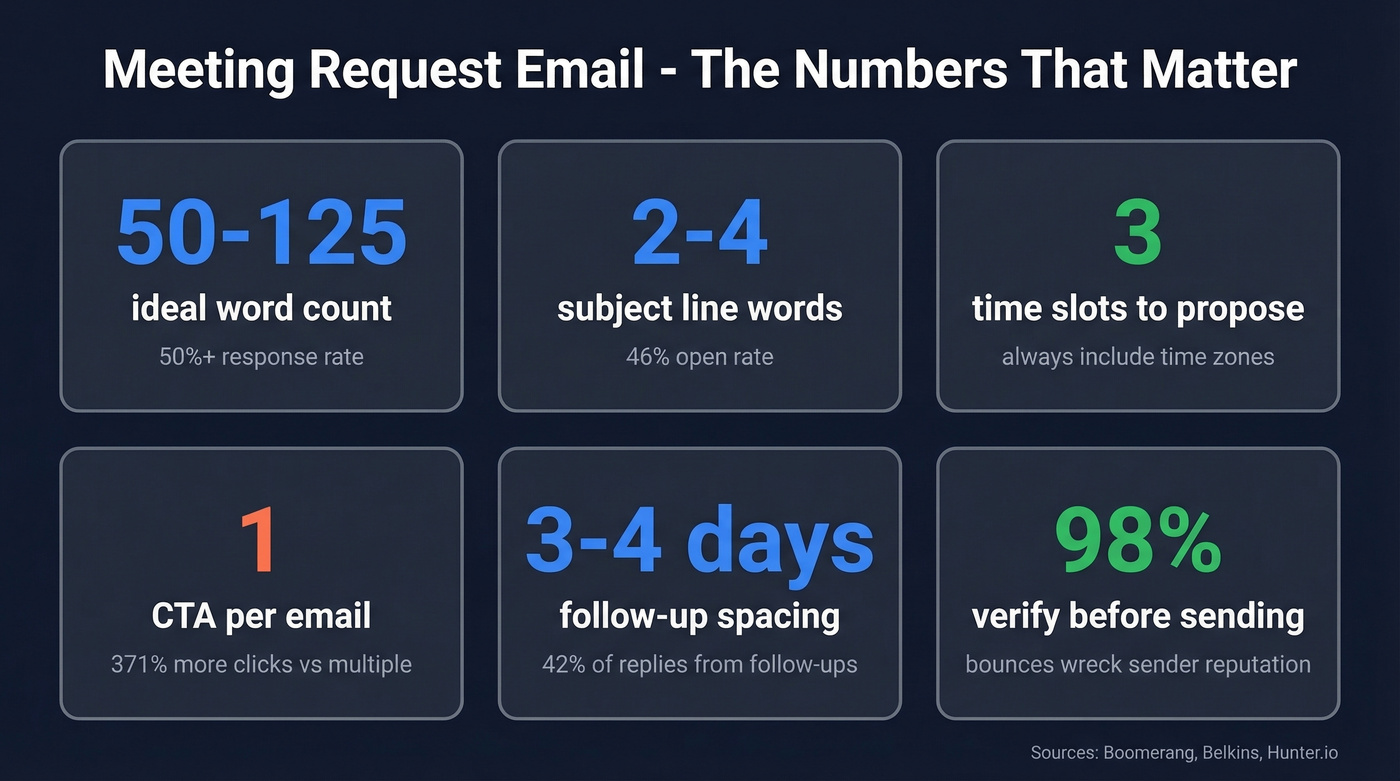
- 50-125 words. Emails in this range produce response rates above 50% per Boomerang's analysis of 40M+ emails.
- Subject line: 2-4 words, personalized. Belkins' 5.5M-email study found this length hits a 46% open rate. (For more ideas, see our subject line examples.)
- Propose 3 time slots with time zones.
- One CTA only. Not two. Not "let me know or feel free to call." (More on writing a single, clear CTA: email call to action.)
- Follow up 3-4 days later. 42% of replies come from follow-ups. (If you need copy, use these sales follow-up templates.)
- Verify the email address first. A bounced email is worse than no email. (Related: email bounce rate.)
Templates are below - jump to them if that's all you need.
Anatomy of a Meeting Email That Works
Subject Line (2-4 Words)
Most guides tell you to write 5-9 word subject lines. Belkins' analysis of 5.5M emails tells a different story: 2-4 words hit 46% open rates, and performance drops after 7 words. Personalized subject lines drive 7% reply rates vs 3% without - a 133% relative lift. If you're building a full outreach flow, pair this with a simple B2B cold email sequence.
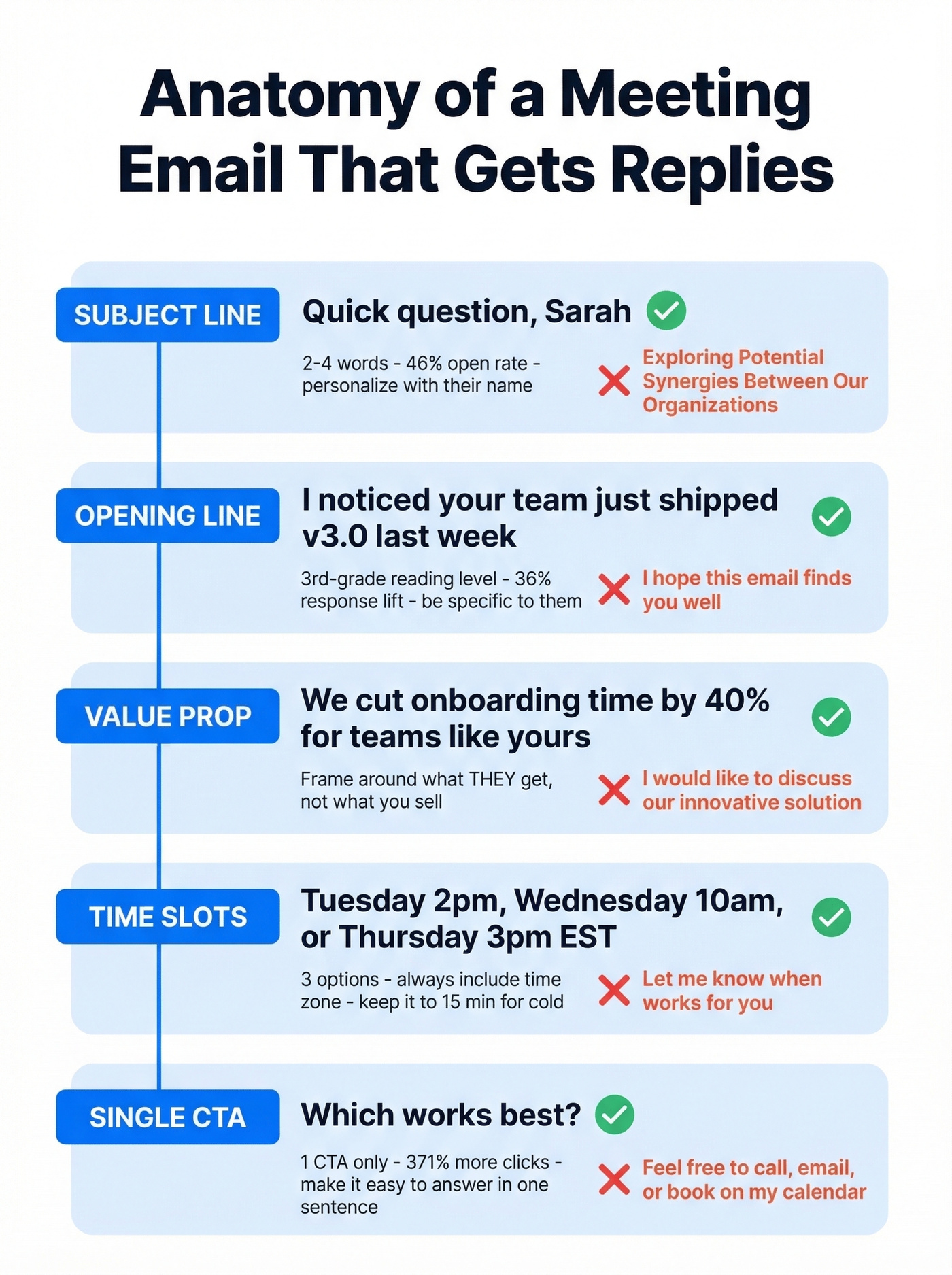
Think "Quick question, Sarah." Not "Exploring Potential Synergies Between Our Organizations."
Opening Line (Ditch the Cliche)
Write at a 3rd-grade reading level. That's not dumbing it down - it's respecting someone's time. Boomerang found a 36% response lift for simple language. Slightly positive or negative tone outperforms neutral by 10-15%, so a line like "I noticed your team just lost their VP of Sales - that's a tough spot" beats bland neutrality every time. Lead with something specific to them. (More frameworks: email copywriting.)
The Ask and Time Slots
One sentence, framed around what they get. "I'd love to show you how we cut onboarding time by 40% for teams like yours" beats "I'd like to schedule a call to discuss our product." Then propose three time slots with time zones - "Tuesday 2pm" means nothing when you're in EST and they're in PST.
One CTA, Easy to Answer
Emails with a single clear CTA get 371% more clicks than those with multiple competing asks. Your CTA should be answerable in one sentence. Keep the ask small: don't request 30 minutes from a stranger if 15 will do. Make it effortless to say yes.
5 Meeting Request Email Templates
You don't need 25 templates. You need five good ones and the discipline to personalize each one. The structure stays the same whether you're emailing a prospect cold or following up with an existing contact - only the context changes. If you want more variations, use these cold email follow-up templates.
Cold Outreach to a Prospect
Subject: Quick question, [First Name]
Hi [First Name], I noticed [specific observation]. We help [similar companies] [specific result]. Would a 15-minute call make sense? I'm free [Day 1] at [Time], [Day 2] at [Time], or [Day 3] at [Time] [Time Zone]. Which works?
Warm Intro via Mutual Connection
[Mutual Contact] suggested I reach out, [First Name]. They mentioned you're working on [initiative]. We helped [similar company] with [relevant result] - would love to share what worked. Open to 20 minutes [Day 1], [Day 2], or [Day 3]?
Internal Meeting Request
Subject: Input needed on [project]
Hi [Name], I'm finalizing [project] and need your perspective on [topic]. Could we grab 30 minutes this week? I'm open [Day 1] at [Time], [Day 2] at [Time], or [Day 3] at [Time].
Executive / C-Suite (3-Bullet Format)
Subject: [Your company] + [their company]
Hi [First Name],
- [One-line credibility statement]
- [One-line relevant result for similar company]
- [One-line reason this matters now]
Worth a 15-minute call? I'm free [three slots]. If not, no worries.
In our experience, the 3-bullet format works best for C-suite outreach. Executives scan. They don't read paragraphs from strangers.
Follow-Up After No Response
Subject: Re: [original subject]
Hi [First Name], bumping this. I know [time of year] is hectic. Still happy to share how [result] if timing's better now. Pick a slot: [calendar link].

You just wrote the perfect meeting request. Don't let it bounce. Prospeo finds and verifies professional emails with 98% accuracy - catching invalid addresses, catch-all domains, and spam traps before they torch your sender reputation. Start with 75 free verifications.
Every bounced meeting request is a conversation that never happened.
Before You Hit Send
Here's the thing: none of these templates matter if the email never arrives.
Sending from a custom domain instead of Gmail boosts reply rates by 108%. But even a custom domain can't save you from a bad address. A bounced email damages your sender reputation, which tanks deliverability for every future message you send - not just the one that bounced. (If you want to go deeper, read our email deliverability guide and how to improve sender reputation.) Before any outreach, run your prospect's address through a real-time verification tool. Prospeo's email finder checks addresses with 98% accuracy, catching invalid addresses, catch-all domains, and spam traps. The free tier gives you 75 verifications per month to start.

Two more things we've tested that most guides skip. Turn off open tracking - campaigns without it see 68% higher reply rates (7.4% vs 4.4%), because tracking pixels trigger spam filters. (Technical breakdown: email tracking pixel.) And segment your outreach: campaigns targeting 21-50 recipients get 158% higher reply rates than blasts to 500+. Smaller batches force better personalization, and the numbers prove it.
Let's be honest: if your deal size is under five figures, you probably don't need a 12-touch automated sequence. Three well-written, manually personalized emails will outperform a 25-step drip campaign every time.
How to Follow Up Without Being Annoying
58% of replies come from the first email. That means 42% come from follow-ups, and most people give up after one attempt. A 3-message sequence produces 106% more replies than a single email.
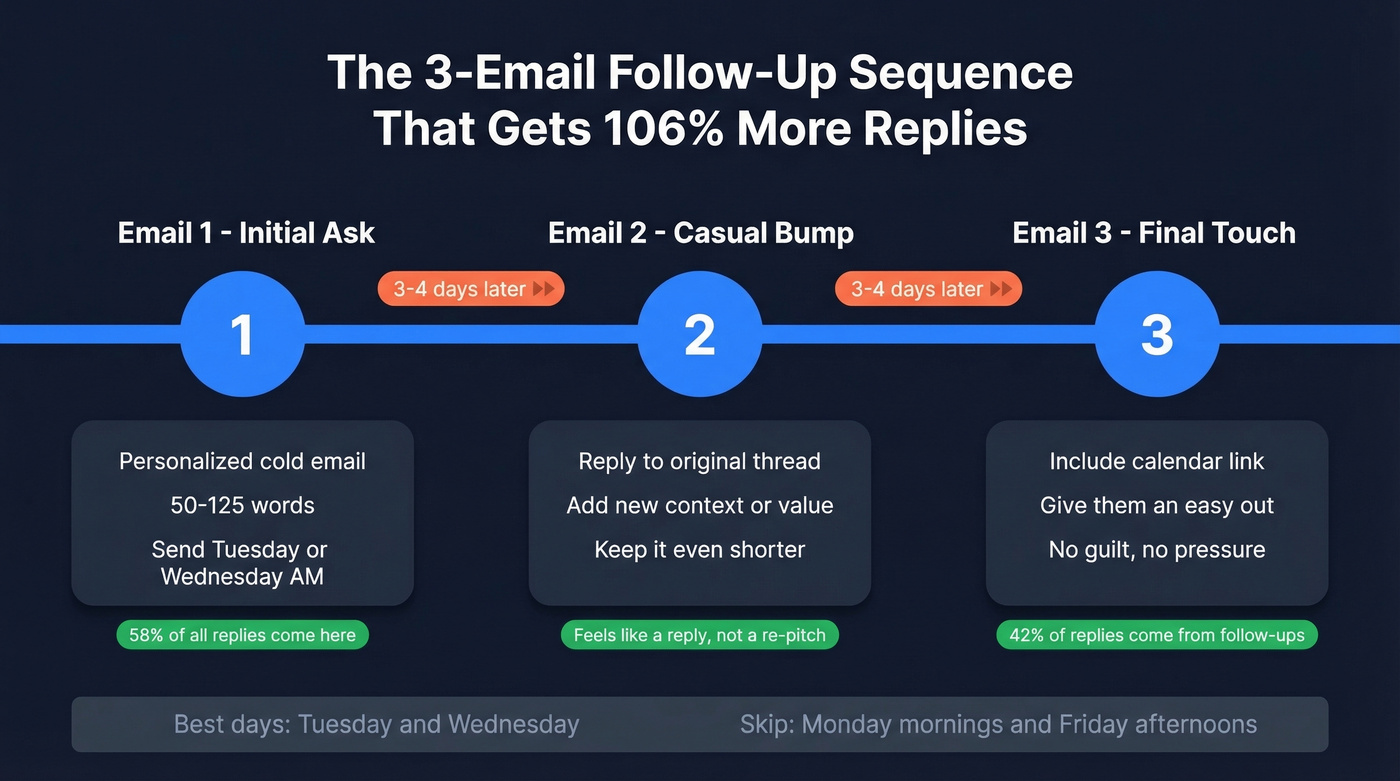
The sweet spot is 4-7 touchpoints, spaced 3-4 days apart. Your second email should feel like a casual reply, not a formal re-pitch. Send on Tuesday or Wednesday - Instantly's data shows these days peak for reply rates. Skip Monday mornings (inbox triage mode) and Friday afternoons (mentally checked out). If you're unsure about timing, see when should i follow up on an email.
Mistakes That Kill Your Reply Rate
The biggest reply killer is multiple CTAs. Every additional ask dilutes the one that matters - one CTA gets 371% more clicks. Right behind that: sending from a freemail address. Custom domains produce 108% higher reply rates. If you're emailing from a Gmail address, you're starting at a disadvantage before anyone reads a word.
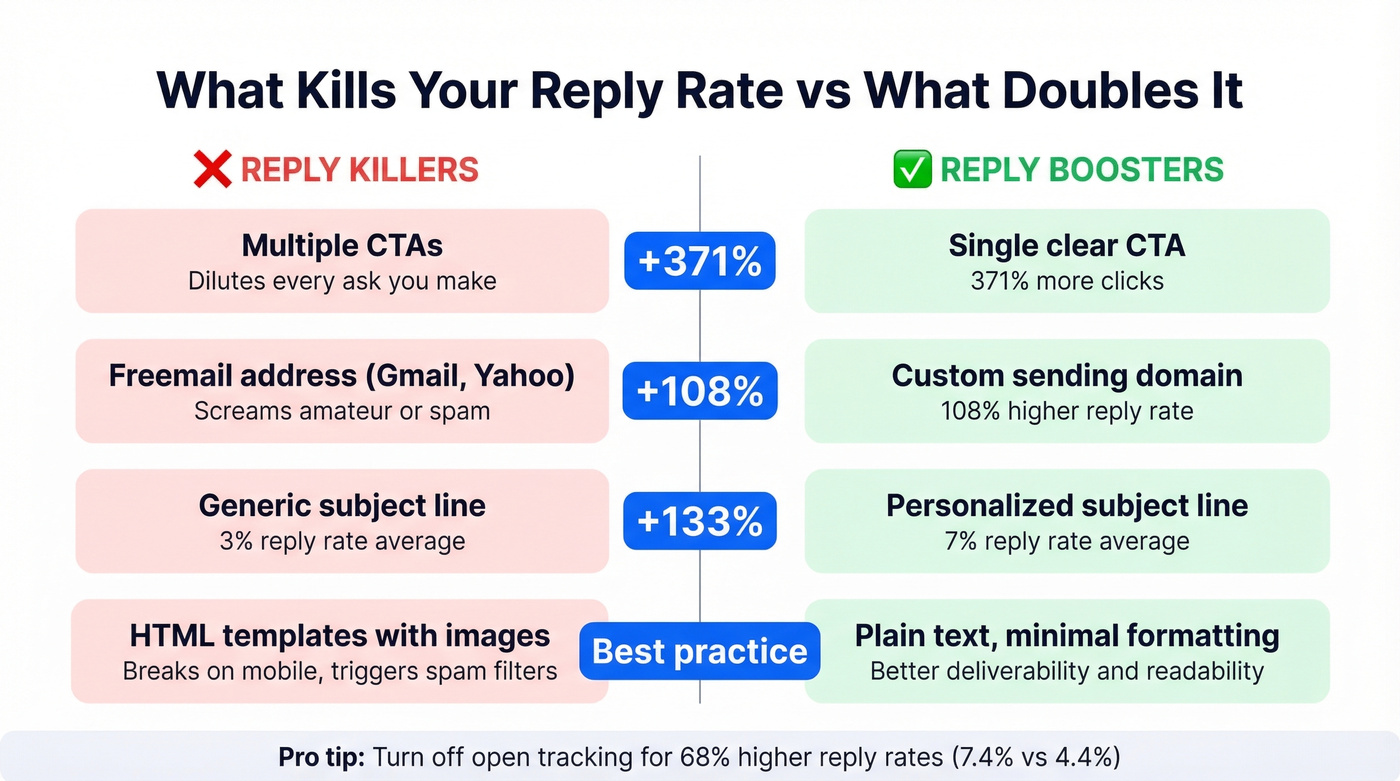
Zero personalization is the third killer. Personalized subject lines drive 7% reply rates vs 3% without - that's not a nice-to-have, it's a 133% difference. And don't overlook formatting: most emails are opened on mobile. Heavy HTML and image-laden layouts break rendering and trigger spam filters. Stick to plain text or minimal formatting. The consensus on r/sales backs this up - plain text consistently outperforms designed templates for cold outreach.
Skip fancy email builders entirely for meeting requests. A clean, short, text-only email from a verified custom domain will outperform a beautifully designed HTML email that lands in promotions or spam.
Smaller, targeted campaigns get 158% higher reply rates - but only if every address lands. Prospeo's email finder covers 300M+ professionals and refreshes every 7 days, so the VP you're emailing this week has a current, verified address. At $0.01 per email, bad data is no longer an excuse.
Stop crafting perfect emails to wrong addresses.
FAQ
How long should a meeting request email be?
Between 50 and 125 words. For cold outreach specifically, under 80 words performs best - Boomerang's 40M-email study confirms response rates above 50% in that range. Shorter emails force you to cut the filler that kills replies.
When's the best time to send a meeting request email?
Tuesday and Wednesday mornings in the recipient's time zone consistently produce the highest reply rates, according to Instantly's 2026 benchmark data. Test in two-week sprints and measure reply rates, not open rates - opens are unreliable with Apple Mail Privacy Protection and similar features.
How do I avoid sounding too formal or stiff?
Skip phrases like "I would like to request a meeting" - they add words without adding value. Try "Would a 15-minute call make sense?" or "Are you open to a quick chat this week?" Direct, conversational language consistently outperforms formal requests in cold email reply data. Read your draft out loud. If it sounds like a legal brief, rewrite it.
How do I make sure my meeting request actually arrives?
Verify the email address before you send. Use a custom sending domain, disable open tracking, and keep formatting minimal. Plain text outperforms HTML on mobile. If you're sending more than a handful of meeting requests per week, batch them in groups of 21-50 rather than blasting hundreds at once - smaller sends produce dramatically better results.