

How to Write a Professional Follow-Up Email That Actually Gets a Reply
You sent the proposal three days ago. The meeting went well. And now - nothing. Radio silence. You're staring at your inbox wondering if the email even landed.
Here's the paradox: 55% of all cold email replies come from follow-ups, yet most professional follow-up emails are so generic they deserve to be ignored. The difference between a reply and a delete isn't luck - it's structure, timing, and knowing when to stop.
What You Need (Quick Version)
- Graduated cadence: 2 days, then 4, then 7, then 14. Static spacing looks automated and hurts deliverability.
- Every follow-up adds something new. A case study, a relevant stat, a different angle. Never send "just checking in" with nothing attached. (If you need better phrasing, see just checking in.)
- Three follow-ups is the ceiling. Belkins' data shows the 4th follow-up triples your unsubscribe rate and more than triples spam complaints.
Now let's break down the data, the timing, the templates, and the mistakes.
What 16.5 Million Emails Tell Us
Belkins analyzed 16.5 million cold emails across 93 business domains from January through December 2024, and the results challenge common assumptions. Sequences with just one email - no follow-ups - showed the highest per-email reply rate at 8.4%. But that doesn't mean follow-ups are useless.
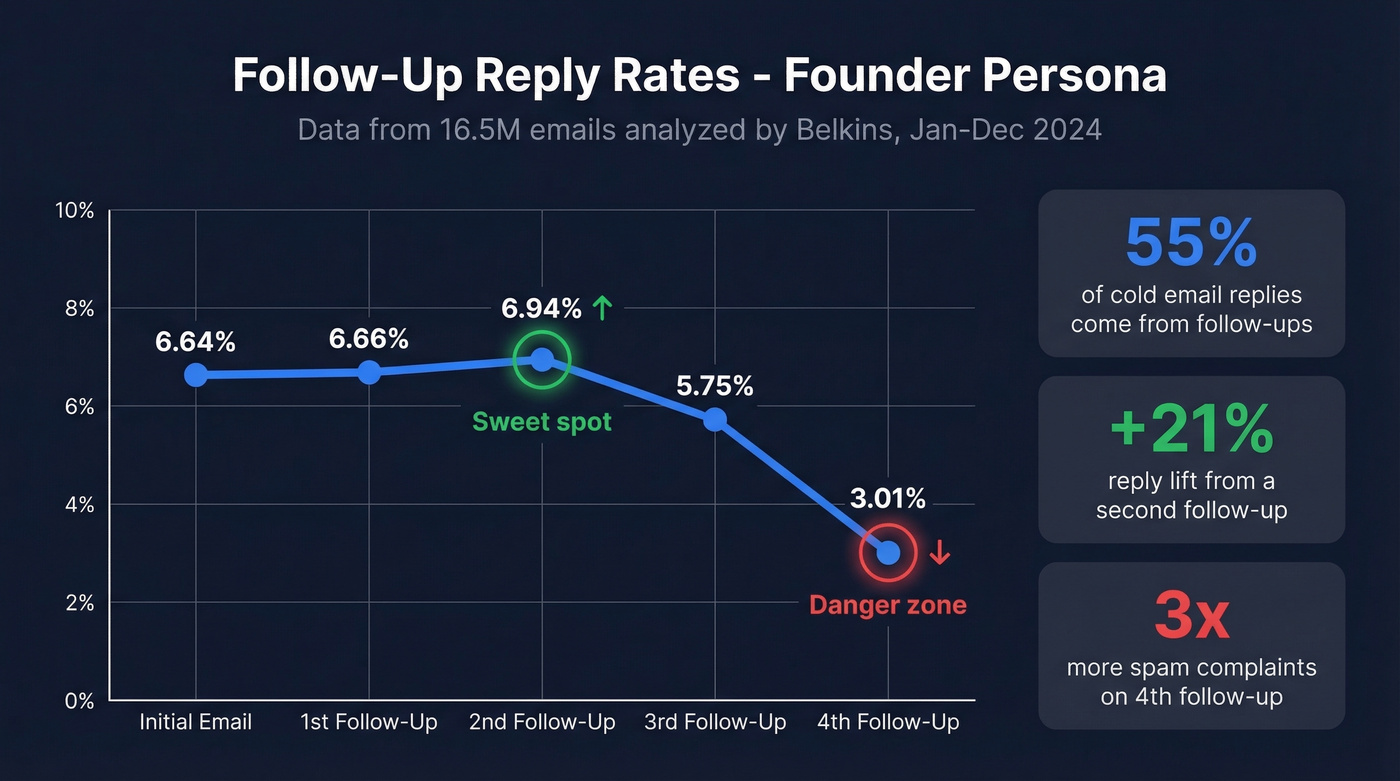
One follow-up boosts response rates from 9% to 13%, and a second can lift replies by another 21%. The math is clear: you should follow up. You just shouldn't overdo it. (For more benchmarks, see reply rate.)
The founder persona curve tells the most interesting story. Founders reply at 6.64% on the initial email and hold steady at 6.66% after one follow-up. They actually increase to 6.94% after the second. Then they crater - 5.75% on the third and 3.01% on the fourth. That second follow-up is doing real work. The fourth is doing real damage.
Company size matters too. Small businesses (2-50 employees) start at 9.2% and stay tolerant through two follow-ups, while enterprise contacts (1,000+) ghost quickly and punish persistence. If you're selling into large orgs, tighten your cadence and cut it shorter (especially in enterprise B2B sales).
When to Send and How to Space It
The best send window for B2B follow-ups is Tuesday through Thursday, 9-11 AM in the recipient's local time. That's the consistent finding across multiple datasets. (More timing data: best time to send cold emails.)
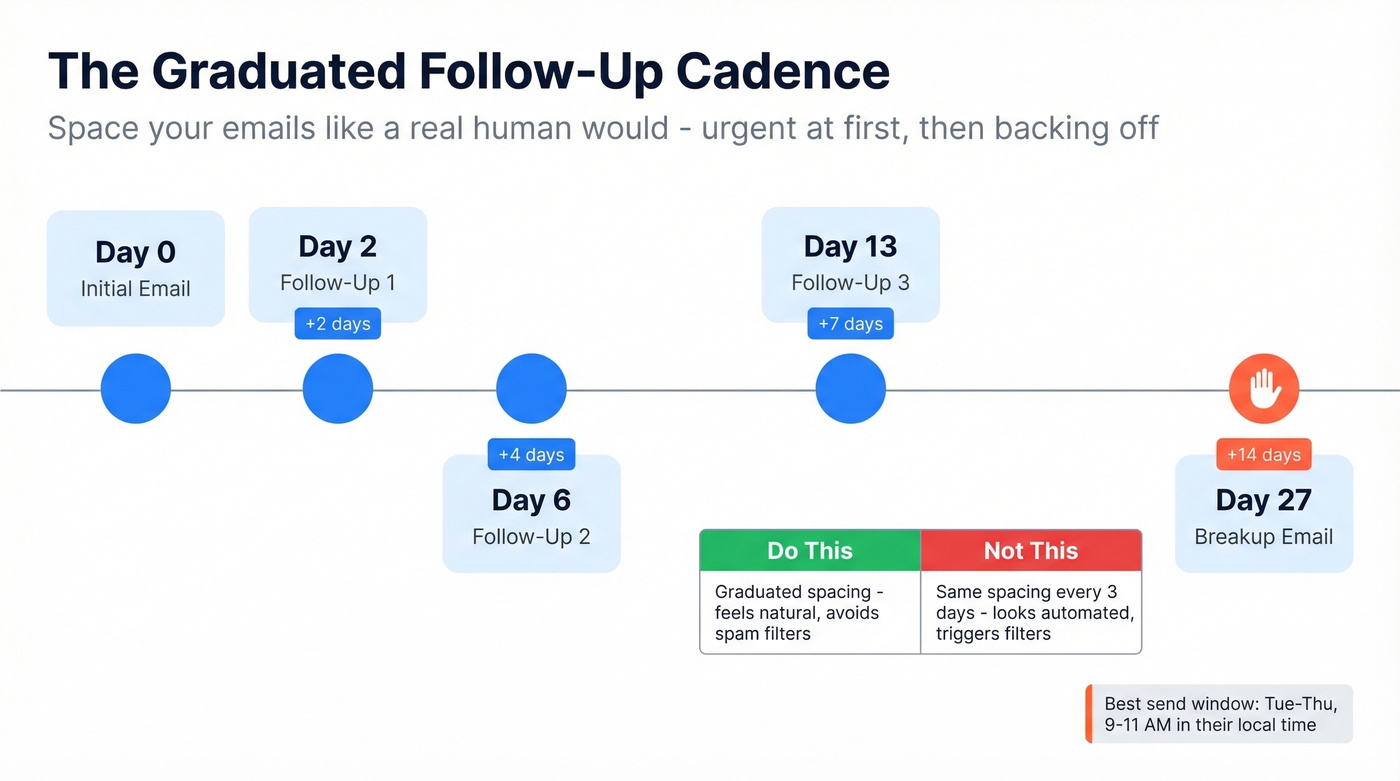
More important than the day is the spacing. Graduated intervals - 2, 4, 7, 14 days - feel natural because they mimic how a real person would follow up: more urgently at first, then backing off. Static spacing, every 3 days like clockwork, signals automation and can trigger spam filters.
For inbound leads, the rules are completely different. Contacting within five minutes makes you 100x more likely to connect than waiting an hour. Speed wins.
| Scenario | First Follow-Up | Second | Third | Thread |
|---|---|---|---|---|
| Cold outreach | 2-3 days | +4 days | +7 days | Same thread |
| Post-meeting | 24 hours | +4 days | +7 days | Same thread |
| Post-interview | 24 hours | +5 days | +7 days | Same thread |
| Networking event | Next morning | +5 days | +14 days | New thread OK |
| Invoice/payment | 3 days past due | +7 days | +14 days | Same thread |
| Internal request | 2 days | +3 days | +5 days | Same thread |
Reply in the same thread for ongoing conversations. Start a new thread only if the topic has changed completely or it's been 30+ days since the last exchange.
Anatomy of a Great Follow-Up
Subject Lines That Get Opened
Instantly's benchmarks show cold email open rates dropped from 36% in 2023 to 27.7% in 2024 - your subject line is doing more heavy lifting than ever. (If you want more options, see subject line examples.)
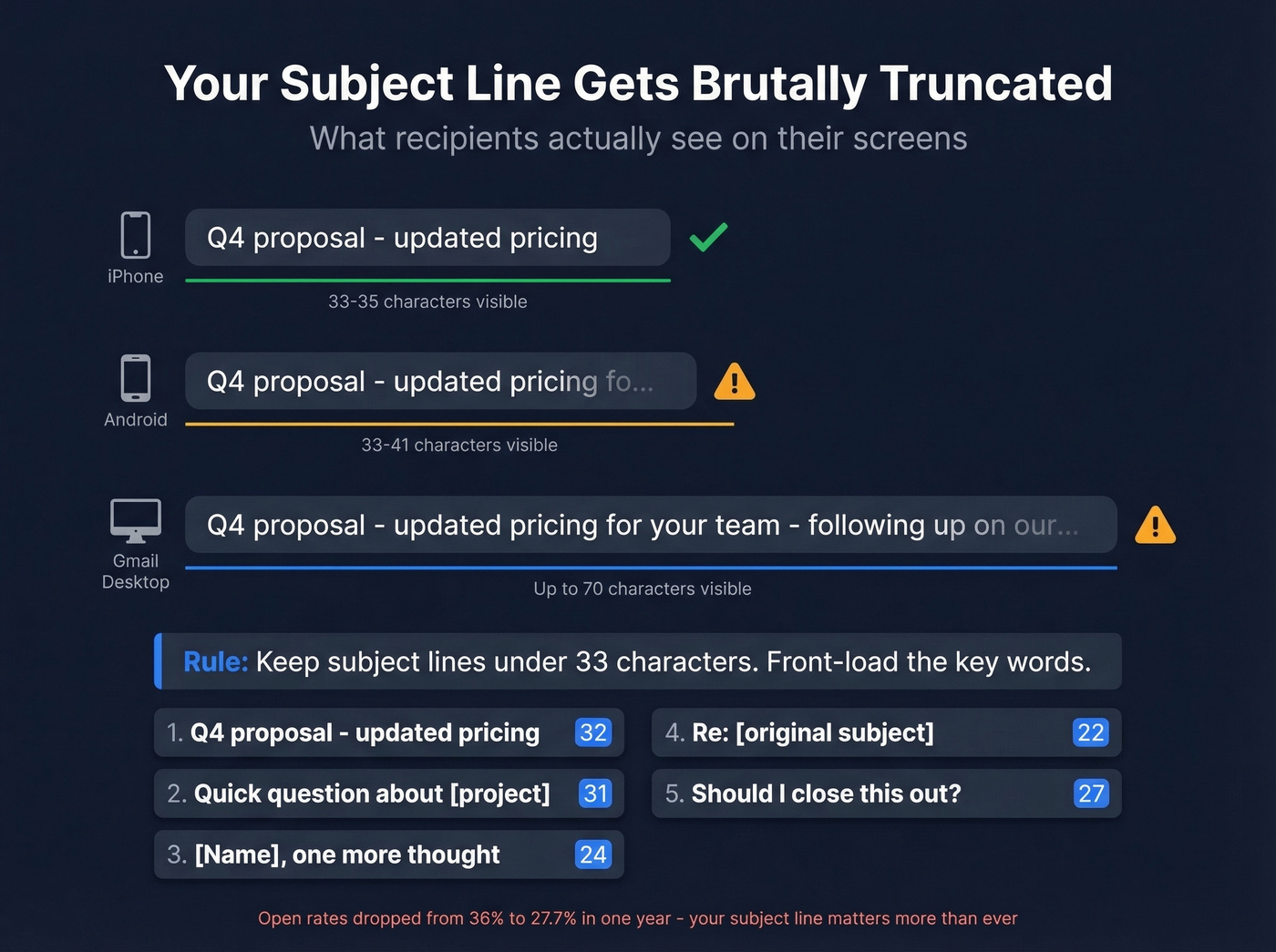
On mobile, where most business email gets read first, your subject line gets brutally truncated. iPhones show roughly 33-35 characters. Android displays 33-41. Even Gmail desktop caps around 70. Keep subject lines under 33 characters and front-load the key words.
Five that work:
- "Q4 proposal - updated pricing" - specific, under 33 chars
- "Quick question about [project]" - low-friction, curiosity-driven
- "[Name], one more thought" - personal, implies brevity
- "Re: [original subject]" - signals continuity, not a cold pitch
- "Should I close this out?" - breakup framing, triggers loss aversion
Avoid spam triggers like "Free," "Guarantee," or excessive punctuation. And test variants - measure by reply rate, not open rate. Open rate tracking is increasingly unreliable; reply rate tells you what actually resonated.
The Opening Line
Reference something specific. A detail from your last conversation, a recent company announcement, something they posted. A specific thank-you or reference builds connection far faster than a generic "great meeting you." The opening line proves you're a real person who paid attention, not a sequence firing on autopilot.
Add Value, Not Words
Each follow-up needs to justify itself. Share a relevant case study. Forward a useful article. Offer a new data point. Address a concern they haven't voiced yet. If you can't articulate what's new in this email compared to the last one, don't send it. Professionalism in follow-ups is measured by the value you bring, not the number of times you ping someone's inbox. (This is the core of sales communication.)
One Clear Ask
Every follow-up needs exactly one call to action. Not three options. Not an open-ended "let me know your thoughts." One specific, low-friction ask: "Do you have 15 minutes Thursday afternoon?" or "Would it help if I sent the ROI calculator?" The smaller the ask, the higher the response rate. Keep the whole email to 50-125 words in plain text - no HTML templates, no images. (More on CTAs: call to action.)

Follow-up cadence and copy only matter if you're reaching the right inbox. 35% bounce rates kill your domain reputation and your sequence before it starts. Prospeo delivers 98% email accuracy with 5-step verification - so every follow-up actually lands.
Stop perfecting emails that bounce. Start with verified data.
Templates by Scenario
Sales and Outreach
No response to initial outreach:
Subject: Re: [original subject]
Hi [Name], I shared some thoughts on [specific problem] last week. Since then, I came across [relevant stat or case study] that might change the math for your team. Worth a quick look? Happy to walk through it in 15 minutes.
Post-demo follow-up:
Subject: Re: [Demo subject]
[Name], thanks for the time yesterday. You mentioned [specific pain point they raised] - I pulled together a one-pager showing how [Company X] solved that exact issue. Attached. Does Thursday work to discuss next steps?
Breakup email:
In our experience, the breakup email actually gets more replies than the second or third follow-up. Something about closing the loop triggers a response.
Subject: Should I close this out?
[Name], I've reached out a few times and haven't heard back - totally understand if the timing isn't right. I'll close this out on my end, but if things change, I'm here.
Job Search
A well-timed professional follow-up email can separate you from hundreds of other candidates. Hiring managers are busy - a concise message keeps your name at the top of the pile.
Post-application (no response):
Subject: Following up - [Job Title] application
Hi [Name], I applied for the [Job Title] role on [date] and wanted to reiterate my interest. My background in [specific skill] maps directly to [something from the job description]. I'd love the chance to discuss how I can contribute. Is there a good time this week?
Post-interview:
Subject: Re: [Interview subject]
[Name], thank you again for the conversation on [day]. I'm especially excited about [specific project or challenge they mentioned]. I've been thinking about [brief relevant idea] and would love to explore it further with the team.
Networking
Here's the thing about networking follow-ups: speed matters more than polish. A Reddit thread from a recruiting insider described how a firm's team emailed attorneys by 10:30 AM the morning after an event asking who stood out - candidates who hadn't followed up by then were already forgotten. Write your follow-up the night of the event, then schedule it for 9 AM the next morning.
Subject: Great meeting you at [Event]
[Name], really enjoyed our conversation about [specific topic]. Your point about [specific detail] stuck with me. I'd love to continue over coffee - are you free in the next couple weeks?
Business Operations
Invoice/payment reminder:
Subject: Re: Invoice #[number] - payment reminder
Hi [Name], just a quick note that Invoice #[number] for [amount] was due on [date]. I've re-attached it here for convenience. Could you confirm when we can expect payment?
Meeting recap:
Subject: Re: [Meeting subject] - recap + next steps
[Name], thanks for today's discussion. Quick recap: we agreed on [decision 1] and [decision 2], with [Name] owning [action item] by [date]. Let me know if I missed anything.
Use any of these as a starting point, then customize the details - generic copy-paste messages are easy to spot. (If you want more variations, use these sales follow-up templates.)
The Objection Rotation Framework
Most people send the same follow-up three times with slightly different words. That's not a sequence - it's repetition. A better approach: rotate through the five core objections that keep someone from replying. (This pairs well with a solid B2B cold email sequence.)
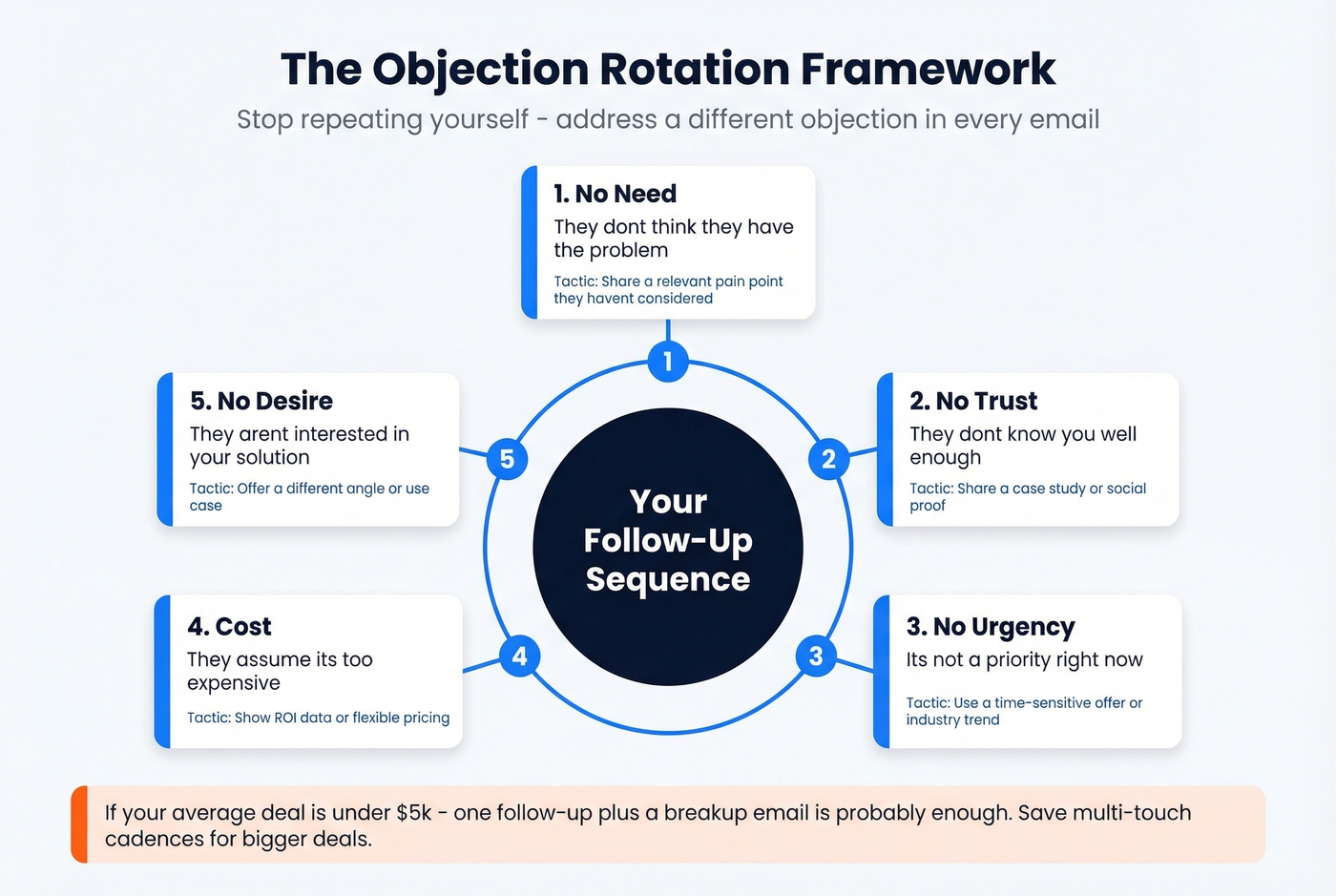
- No need - they don't think they have the problem you solve
- Cost - they assume it's too expensive
- No urgency - it's not a priority right now
- No desire - they aren't interested in your specific solution
- No trust - they don't know you well enough
Email one tackles need by sharing a relevant pain point. Email two builds trust with a case study or social proof. Email three creates urgency through a time-sensitive offer or industry trend. Every email adds a genuinely new angle instead of restating the same pitch.
Look, if your average deal size is under $5k, three follow-ups is generous. One follow-up with a breakup email is probably the right sequence. Save the multi-touch cadences for deals worth the effort.
Mistakes That Kill Reply Rates
The fastest way to destroy a follow-up sequence is opening with "just checking in" and offering zero new information. Reference a specific detail from your last interaction instead. We've seen reply rates double when the opening line proves the sender actually read the previous thread.
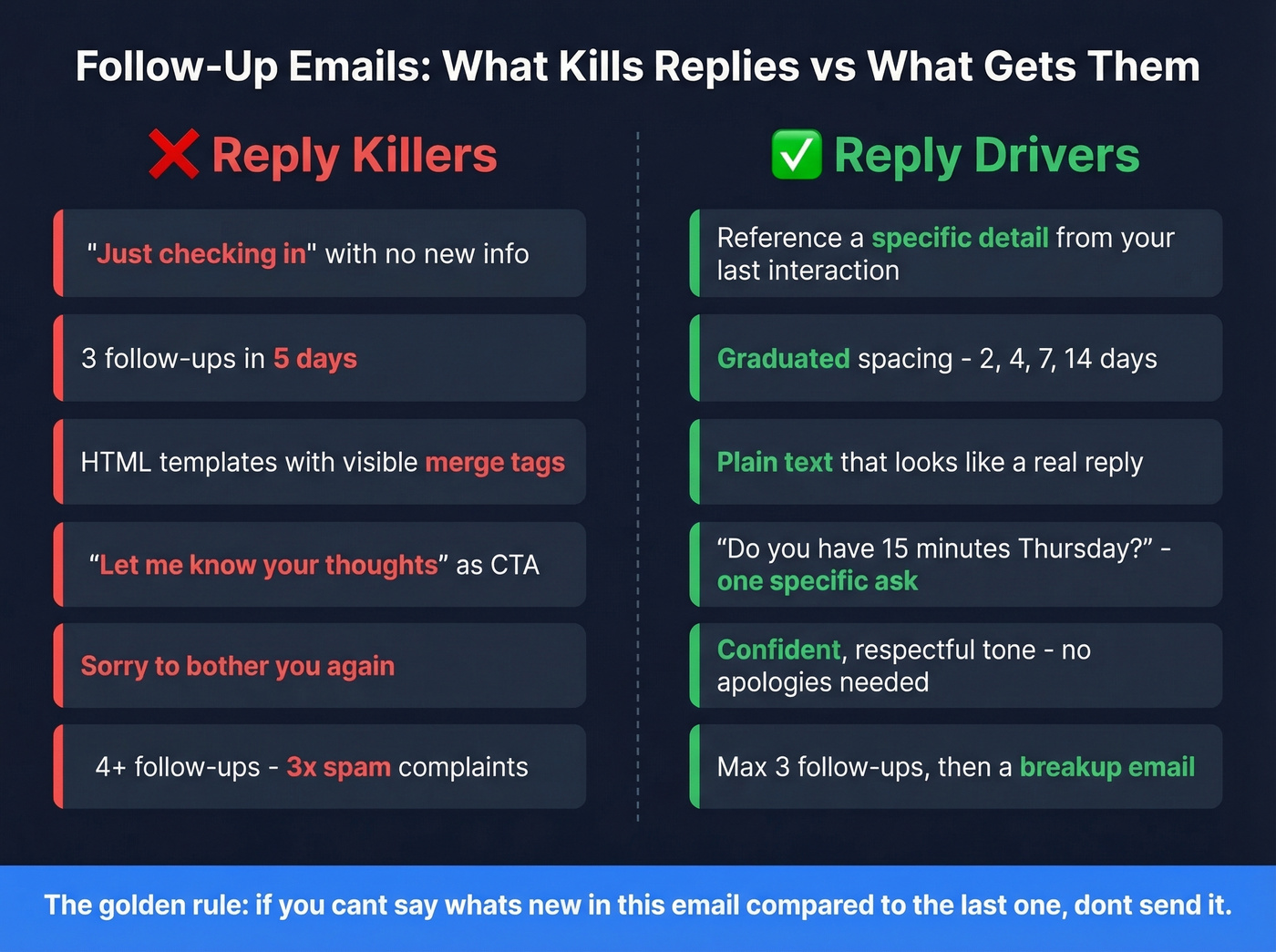
Spacing matters just as much as content. Three follow-ups in five days will get you flagged. The 4th follow-up triples unsubscribe rates, and your sender reputation takes months to recover. Stick to graduated cadences. (If you're troubleshooting deliverability, start with email deliverability.)
Write in plain text that looks like a real reply - HTML-heavy templates with visible merge tags get treated as spam. Include one clear, specific ask, not "let me know your thoughts." And stop apologizing. "Sorry to bother you again" signals that you think your email isn't worth reading. Confidence is more respectful than apology.
Skip the multi-touch cadence entirely if you're emailing someone who explicitly said "not interested." That's not persistence - it's spam.
Clean Data Before You Follow Up
Your follow-ups aren't failing because of copy. They're failing because of data.
If a third of your emails never reach an inbox, your carefully crafted professional follow-up email performs for an audience of zero. We've seen teams cut bounce rates in half just by verifying their list before launching a sequence. Snyk's 50-person sales team dropped from 35-40% bounces to under 5% after cleaning their data, and AE-sourced pipeline jumped 180%. Prospeo's 5-step verification catches bad addresses, catch-all domains, spam traps, and honeypots before they torch your domain reputation - and the free tier gives you 75 emails plus 100 Chrome extension credits per month to test before you commit. (Related: email bounce rate.)

The data is clear: your second and third follow-ups drive real pipeline - but only if you're emailing real people at valid addresses. Prospeo's 300M+ profiles refresh every 7 days, so you're never following up on stale data that triggers spam filters.
Build follow-up sequences on data you can trust for $0.01 per email.
FAQ
How long should a follow-up email be?
50-125 words. That's short enough to read on a mobile screen in under 30 seconds. If your follow-up requires scrolling, it's too long - trim ruthlessly and keep one ask per message.
How many follow-ups should I send?
Three is the maximum for most scenarios. Belkins' 16.5-million-email study found the 4th follow-up triples unsubscribe rates and more than triples spam complaints. The ROI turns negative fast after three touches.
Should I reply in the same thread or start a new one?
Same thread for ongoing conversations - it preserves context and makes it easy for the recipient to catch up. Start a new thread only if the topic has changed completely or more than 30 days have passed.
What's the best day and time to send a follow-up?
Tuesday through Thursday, 9-11 AM in the recipient's local time zone. This window consistently outperforms other slots across multiple B2B datasets. Avoid Mondays (inbox overload) and Fridays (checked-out mode).
How do I follow up without sounding pushy?
Lead with new value - a relevant resource, a fresh data point, or a specific question - rather than restating your original ask. Keep the tone conversational, limit yourself to one clear call to action, and use graduated spacing so each message feels intentional rather than automated. If you've sent three messages with no response, a brief breakup email is the most respectful way to close the loop.