

How to Build a Prospect List That Doesn't Destroy Your Domain
It's 9 PM. You've been building tomorrow's call list for two hours after a full day of dials. Your eyes are crossing, you're toggling between three browser tabs, and a chunk of that spreadsheet will already be wrong by the time you open it in the morning. This is the prospect list building problem nobody talks about - it's not a strategy problem, it's a survival problem.
Reps spend 68% of their time on non-selling activities. List building is one of the biggest culprits. And when the list you built at 9 PM bounces 20% of your emails the next day, you've damaged your domain reputation on top of wasting your evening.
What You Need (Quick Version)
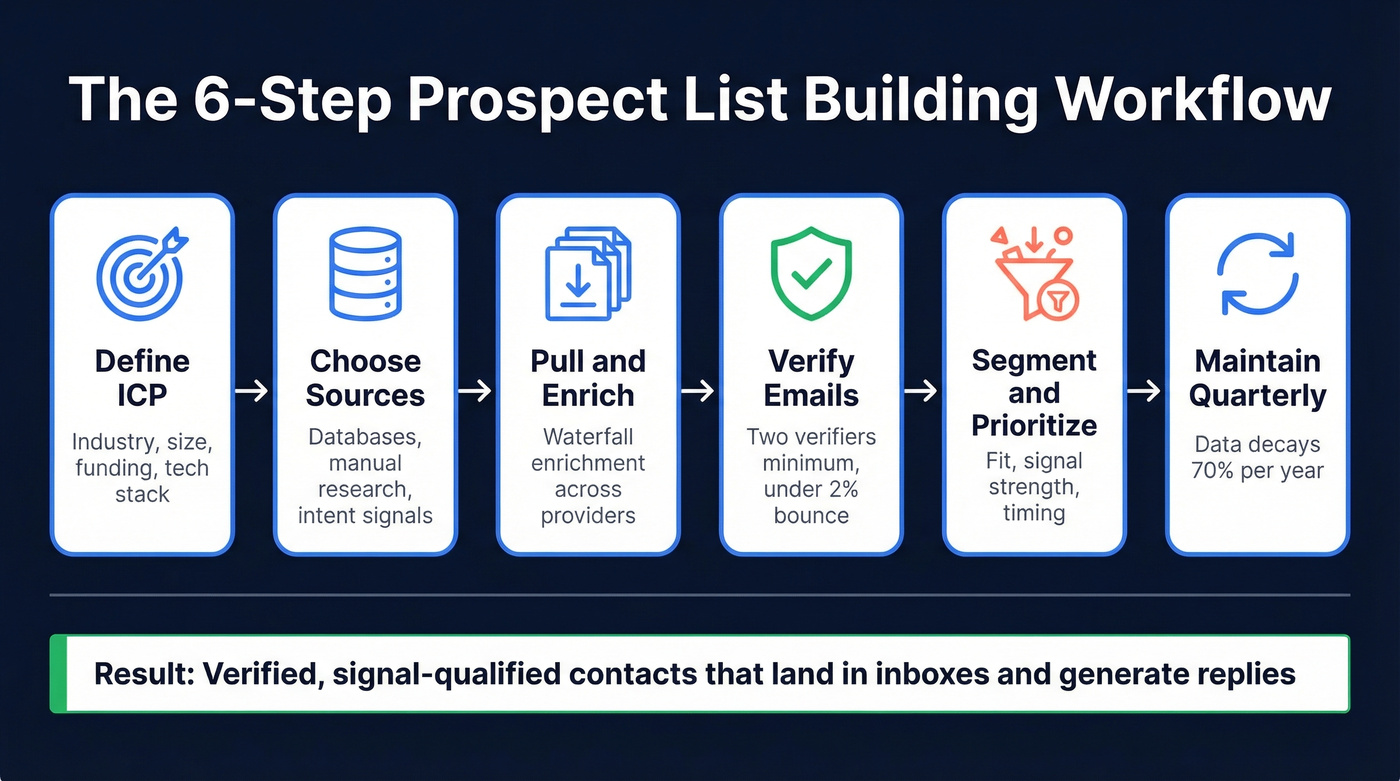
- Define your ICP with real filters - industry, headcount, funding stage, tech stack. Not vibes.
- Pull from 1-2 data sources, then layer enrichment on top.
- Verify through at least two tools. Run every email through multi-step verification before it touches a sequence.
- Segment by signal strength - a company that just raised a Series B matters more than one that's been static for two years.
- Maintain quarterly. B2B data decays 70.3% annually. Your list is rotting right now.
What a Prospect List Actually Is
A prospect list isn't a lead list. Leads are anyone who's shown vague interest - downloaded a whitepaper, visited your pricing page, filled out a form. Prospects are people you've actively identified as fitting your ideal customer profile and who you intend to reach out to directly.
Here's the thing: if your deal size sits below $10K, you probably don't need a 10,000-contact database. Two hundred verified, signal-qualified contacts will outperform 10,000 scraped emails every single time. The scraped list will bounce 15-20%, trigger spam filters, and burn your sending domain. The verified list will land in inboxes and generate replies. Volume isn't a strategy. Precision is.
How to Build a Prospecting List (Step-by-Step)
Define Your ICP With Teeth
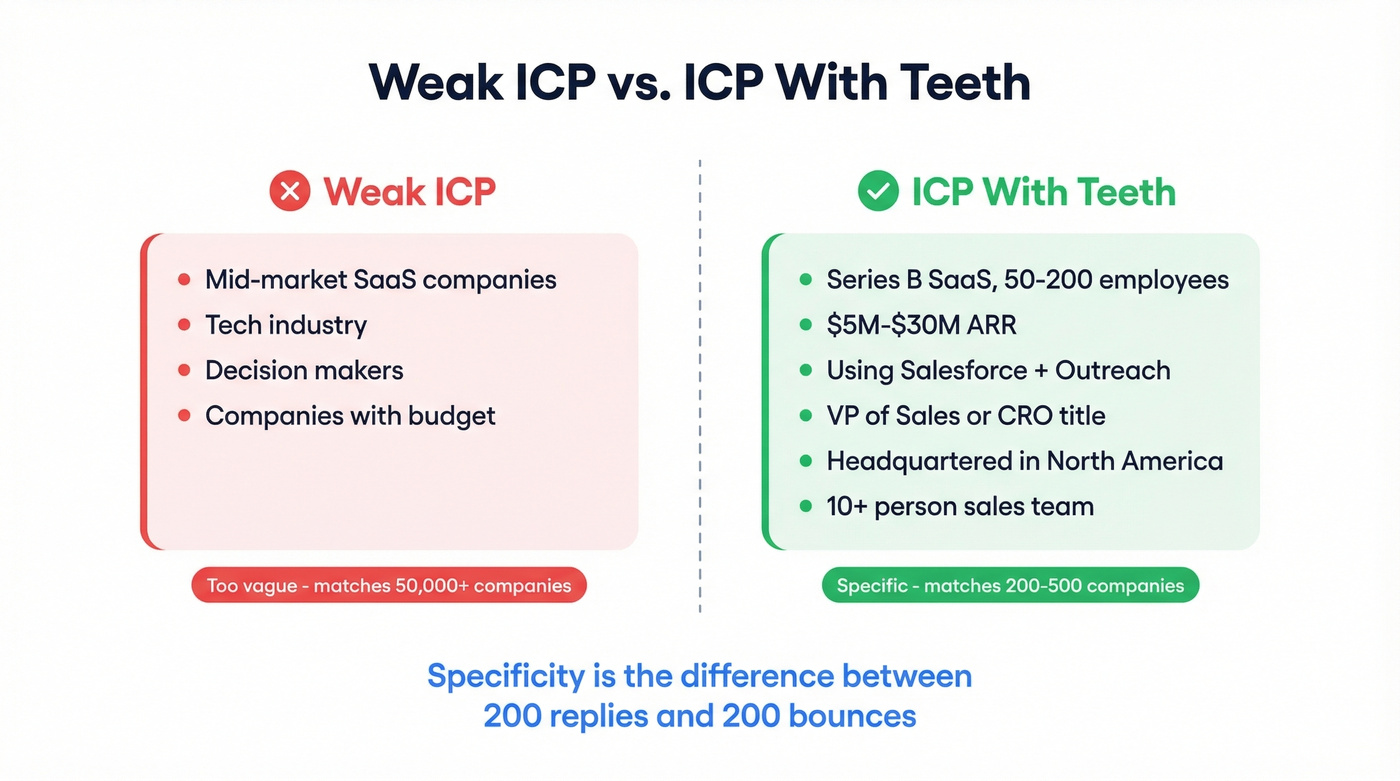
Most teams define their ICP as "mid-market SaaS companies." That's not an ICP - that's a category. A real ICP has teeth:
- Industry and sub-vertical - not just "tech" but "B2B SaaS selling to healthcare"
- Company size - employee count range, not just "mid-market"
- Revenue thresholds - $5M-$50M ARR narrows the field fast
- Tech stack signals - a company running Salesforce + Outreach is a likely buyer for your integration
- Funding stage - Series B-C companies have budget and urgency
- Department headcount - selling to marketing? You want companies with 10+ marketers
Concrete example: Series B SaaS companies, 50-200 employees, $5M-$30M ARR, using Salesforce + Outreach, headquartered in North America. That's an ICP with teeth.
The cross-referencing step is where most teams skip ahead too fast. Combine professional profile data with funding data from sources like Crunchbase to confirm budget authority. A VP of Sales at a company that just raised $20M is a fundamentally different prospect than the same title at a bootstrapped 8-person shop - and your messaging should reflect that gap.
Choose Your Data Sources
Three approaches, each with honest tradeoffs.
Manual/organic research. Best for niches where databases have poor coverage - local services, niche manufacturing, emerging verticals. This also works well when finding ecommerce companies to sell to, since many smaller DTC brands aren't well-covered in standard B2B databases. Skip this if you need more than 50 contacts per week. It doesn't scale.
Database platforms. Best if you need volume with filters. Skip this if you're going to dump 5,000 contacts into a sequence without verification - you'll burn your domain and blame the tool.
Intent-based signals. Best for reaching companies at the moment they're most likely to buy - funding rounds, leadership changes, hiring surges. Skip this if your budget is under $500/mo, because intent data tools run pricier.
The practitioner consensus on Reddit is that big databases alone are broken - contacts are outdated, full of generic inboxes like info@ and marketing@, and overused by competitors emailing the same people. The modern approach layers intent signals on top of database pulls to filter for timing, not just fit.
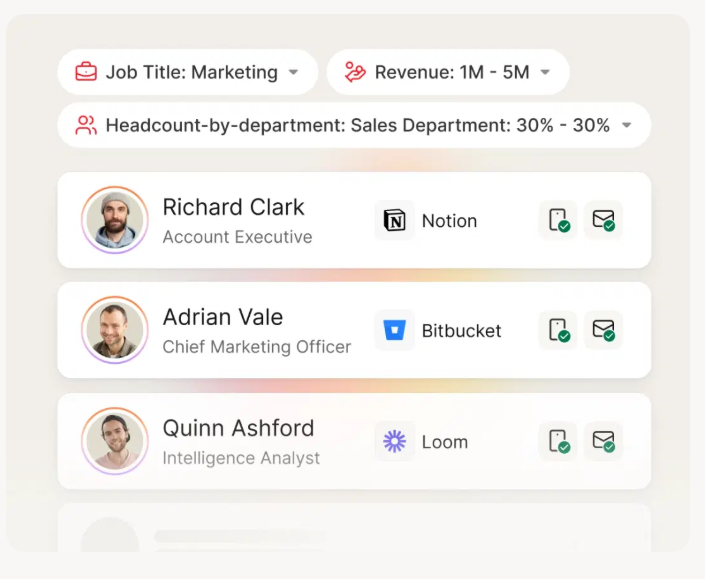
Whatever tool you choose, build your stack around three non-negotiables: filtered search across headcount growth (including by department), funding, and tech stack; lists that auto-update when new matches appear; and CSV export plus API access so you're not copy-pasting records one at a time.
Pull and Enrich Your List
The standard workflow - find companies and people through a search tool, extract profiles, enrich with emails and phone numbers, push to CRM - breaks at scale without auto-updates, API access, and a verification layer.
The smarter approach is a waterfall: start with one or two core data providers, layer an enrichment tool like Clay on top to fill gaps, verify everything, then push only scored, ICP-fit records into your sequencer or CRM. We've seen teams go from 20-30 leads per rep per week to 150-200 per week with this kind of generative AI lead generation waterfall prospecting in place.
Don't just build net-new lists in isolation. Combine your CRM's existing contacts with fresh prospects in one view so you're not emailing someone your AE already closed last quarter.
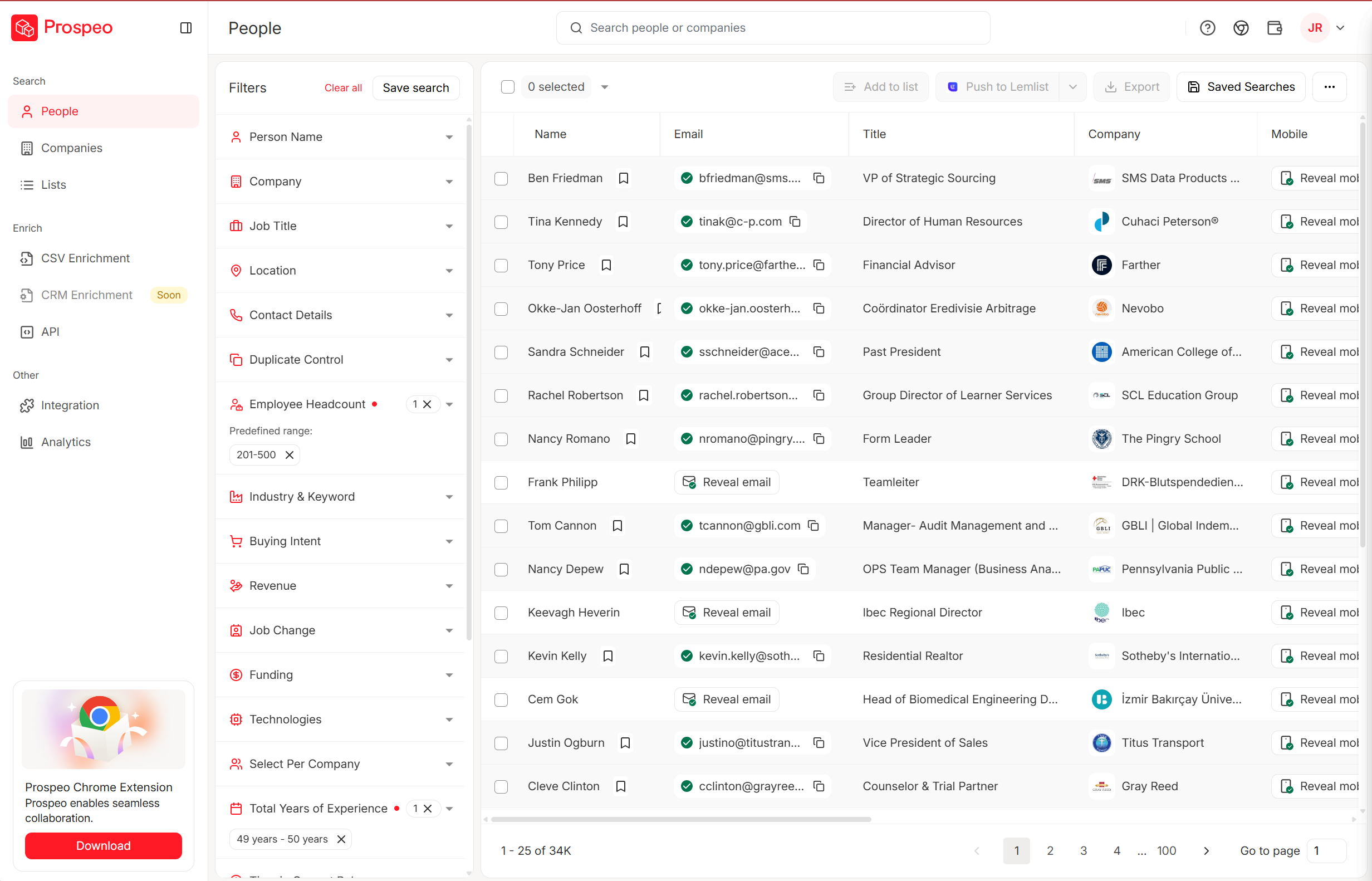
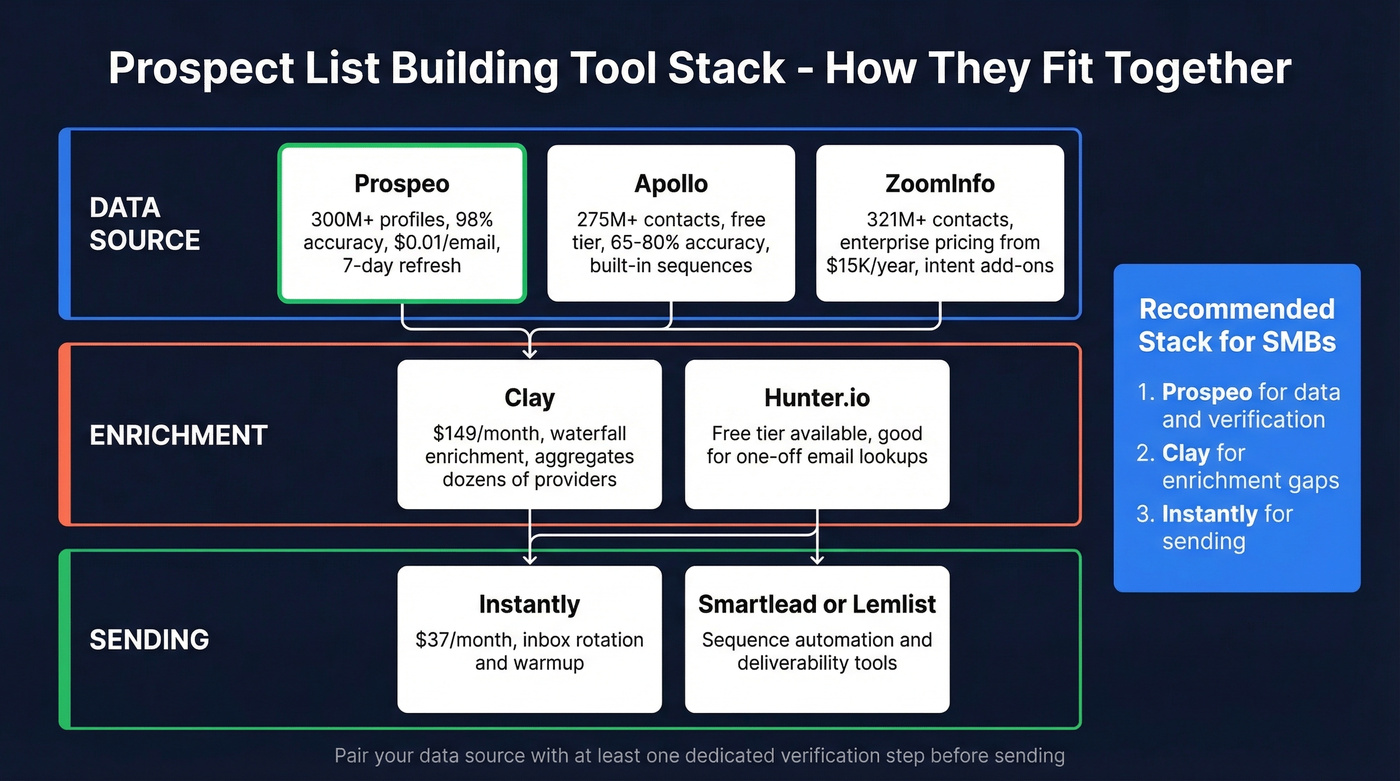
Prospeo fits into this workflow as both the data source and the verification layer - 300M+ professional profiles, 30+ search filters including buyer intent, technographics, job change, headcount growth, and funding, with 98% email accuracy. The Chrome extension lets you prospect from any website or CRM with one click, then export to CSV, sync via Salesforce or HubSpot, or pipe through the API into Clay or your sequencer.
Verify Everything
This is where most prospect lists go to die.
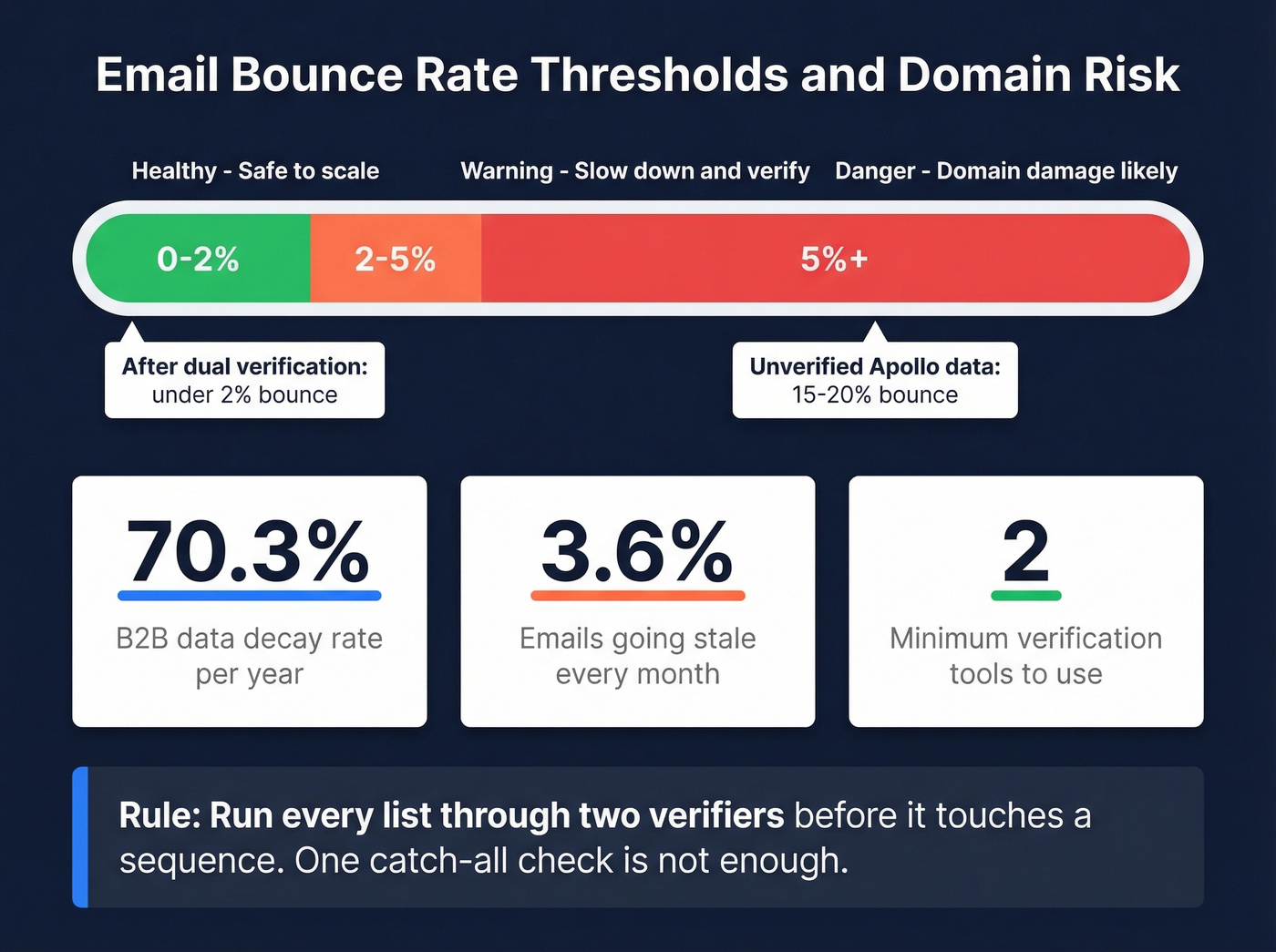
You pull 2,000 contacts, load them into Instantly or Smartlead, and fire off sequences without verifying a single email. Then your bounce rate hits 15%, Gmail flags your domain, and your deliverability craters for months. We've watched this happen to teams that should know better - it's painful every time.
The thresholds are clear: under 2% bounce rate is healthy. Above 5% risks real domain damage. B2B contact data decays up to 70.3% annually - roughly 3.6% of email addresses going stale every month. Apollo users report 15-20% bounce rates without additional verification. With proper verification, that drops below 5%.
The practitioner rule: run your list through two verifiers minimum. One catch-all check isn't enough. You need multi-step verification that handles catch-all domains, removes spam traps, and filters honeypots. Tools like Kickbox or NeverBounce work well as a second verification layer on top of your primary data source. If you want the deeper mechanics, see our guide to email bounce rate and spam trap removal.
Segment and Prioritize
A flat list is a lazy list. Once you've pulled and verified your contacts, segment them before they hit a sequence.
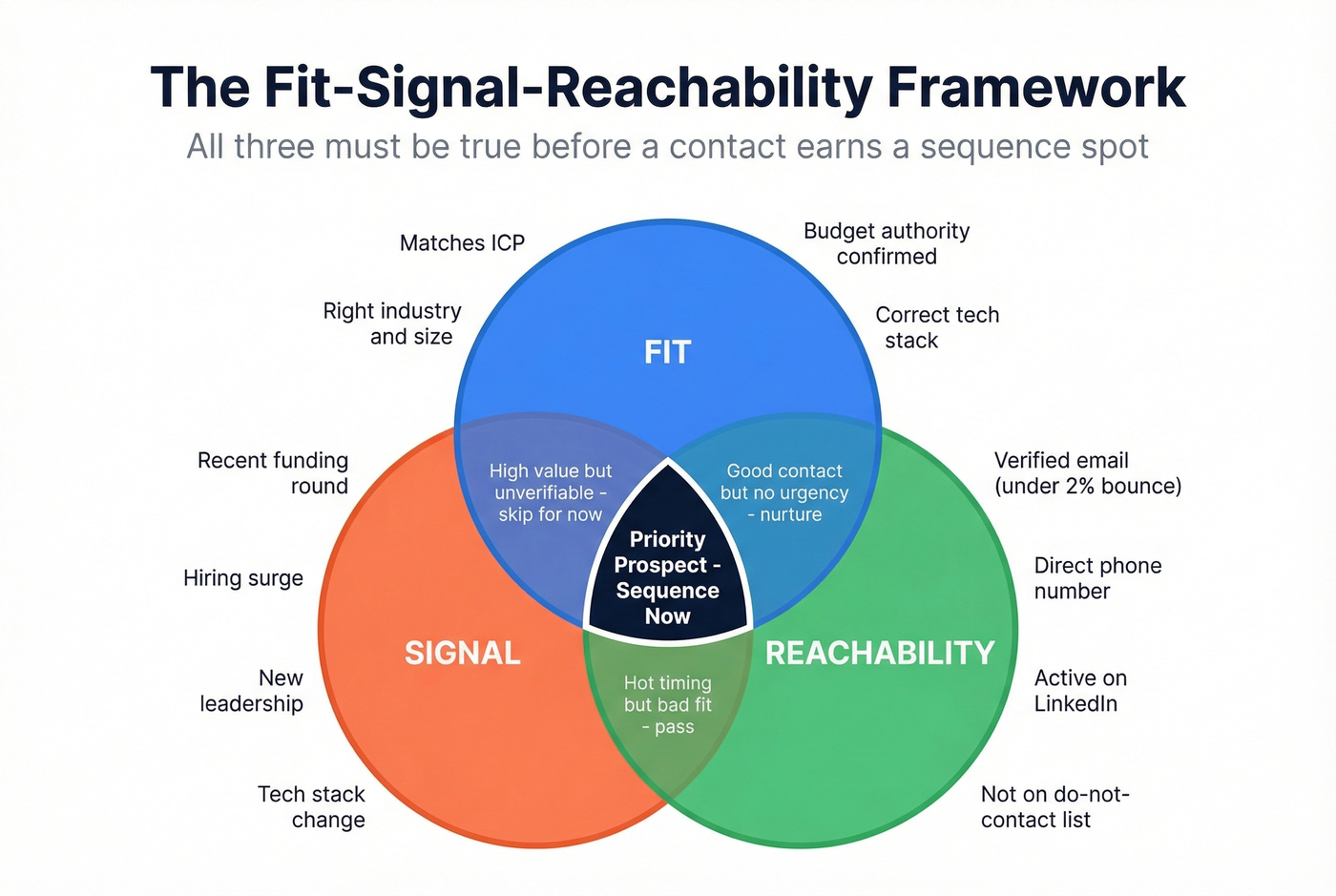
One useful mental model is the Fit-Signal-Reachability framework: does the prospect match your ICP (fit), are they showing buying behavior right now (signal), and can you actually reach them with verified contact data (reachability)? All three need to be true before a contact earns a spot in your sequence.
By persona: C-suite prospects get ROI-focused messaging. Department heads respond to efficiency and ease of implementation. Individual contributors care about how the tool makes their daily work easier. (If you need more angles, borrow from these sales prospecting techniques.)
By signal strength: A company that just closed a funding round is hotter than one that changed its tech stack six months ago. Rank your signals - funding > hiring > tech stack changes > leadership changes - and prioritize accordingly. For a more operational approach, use a simple lead scoring model.
By timing: Someone who just started a new role is in buying mode for the first 90 days. A company that just posted 5 SDR job listings is scaling outbound and needs tools. Match your outreach to the moment.
Maintain Your Lists Long-Term
Your prospect list starts decaying the moment you build it. Quarterly audits are the minimum - remove bounced contacts, update job titles for people who've moved, and refresh company data like revenue, headcount, and funding status.
The difference between tools matters here. Most databases refresh data every 4-6 weeks. Tools with weekly refresh cycles close the gap between "verified last month" and "verified this week" - and that gap is the difference between a 3% bounce rate and a 12% bounce rate over a quarter. If deliverability is a recurring issue, use an email deliverability guide and keep an eye on email reputation tools.
Best Tools for Prospect List Building
| Tool | Best For | Starting Price | Database Size | Key Note |
|---|---|---|---|---|
| Prospeo | Email accuracy + verification | Free; ~$0.01/email | 300M+ profiles | 98% accuracy, 7-day refresh |
| Apollo | Budget all-in-one | Free; $49/user/mo | 275M+ contacts | Built-in sequences; 15-20% bounce without extra verification |
| ZoomInfo | Enterprise + intent | ~$15K/year | 321M+ contacts | Add-on pricing model |
| Clay | Enrichment workflows | $149/mo | Aggregator | Waterfall enrichment across dozens of providers |
| Instantly | Sending infrastructure | $37/mo | N/A | Inbox rotation + warmup |
| Hunter.io | Email finding | Free tier | N/A | Good for one-off lookups |
| Snov.io | Email + sequences | $39/mo | N/A | Budget-friendly combo |
| UpLead | Verified B2B data | $99/mo | N/A | Real-time verification on export |
Prospeo
Use this if you care about data accuracy above all else and want a single platform for finding, verifying, and enriching contacts. The 98% email accuracy rate is the highest we've seen in production, and 125M+ verified mobile numbers deliver a 30% pickup rate across regions. Intent data powered by 15,000 Bombora topics lets you filter for companies actively researching your category. The free tier gives you 75 verified emails and 100 Chrome extension credits per month - enough to test the workflow before committing.
Real results: Snyk's 50-person AE team went from a 35-40% bounce rate to under 5% after switching, generating 200+ new opportunities per month. That's not a marginal improvement - that's a completely different pipeline.
Pair Prospeo with Instantly, Smartlead, or Lemlist for the sending layer. It's designed to be the data backbone of your stack, not an all-in-one.
Apollo
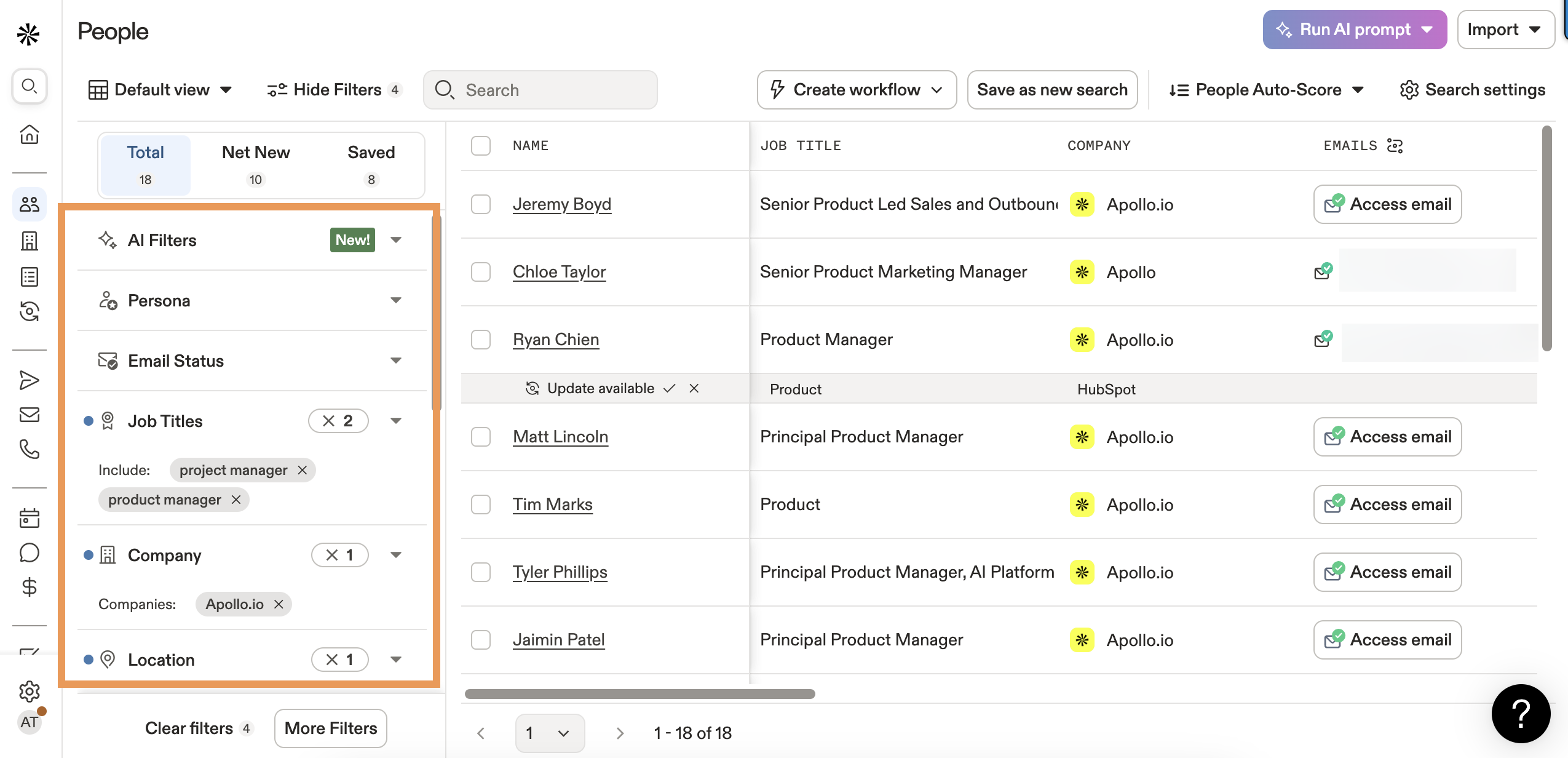
Apollo's 275M+ contacts and free tier with 60 credits/month make it the obvious starting point for SMB teams with tight budgets. Paid plans run $49-$119/user/month, and the built-in sequence builder means you don't need a separate outreach tool. The tradeoff: user-reported accuracy runs 65-80%, and we've consistently seen 15-20% bounce rates on Apollo-sourced emails without running them through a separate verifier. Budget for a verification layer on top.
ZoomInfo
The price tag tells you who this is for: a basic package starts around $15K/year, and enterprise contracts with add-ons like Engage can exceed $40K. For that money, you get one of the deepest databases at 321M+ contacts, plus intent signals, org charts, and workflow integrations. Accuracy runs 75-85% per user reports. If you're a seed-stage company that needs 3 seats, this isn't your tool. If you're running a 50-person sales org, it might be.
Clay, Instantly, and the Rest
Clay ($149/mo, credit-based) isn't a database - it's an enrichment orchestration layer that pulls data from dozens of providers in a waterfall sequence. Think of it as the glue in a modern prospecting stack, not the foundation. For more options, compare data enrichment services.
Instantly ($37/mo) handles sending infrastructure: inbox rotation, warmup, and campaign management. Not a data tool - it's where your verified list goes to get sent.
Hunter.io (free tier) is best for one-off email lookups and domain searches. Snov.io ($39/mo) combines email finding with basic sequences - solid for solo founders who need both in one place. UpLead ($99/mo) provides real-time verification on export, a mid-tier option without the ZoomInfo price tag.

You just read that B2B data decays 70.3% annually. Prospeo refreshes every 7 days - not every 6 weeks like competitors. 300M+ profiles, 30+ filters including buyer intent, technographics, and funding stage, with 98% email accuracy. Build prospect lists that land in inboxes, not spam folders.
Stop rotting your lists. Start with data that's verified this week.
Teams using Prospeo cut bounce rates from 35% to under 4% and tripled pipeline output. With 5-step email verification, catch-all handling, and spam-trap removal built in, you skip the two-verifier workaround entirely. One platform handles the pull, the enrichment, and the verification - at $0.01 per email.
Protect your domain and your evening. Build lists that actually convert.
Cold Email Benchmarks for 2026
Before you send that first sequence, know what good looks like. Based on Smartlead's dataset of 14.3B cold email sends:
| Metric | Global Average | Small Senders (<10K/mo) | Large Senders (>100K/mo) |
|---|---|---|---|
| Open rate | ~42% | 50-60% | 30-40% |
| Reply rate | ~3% | 5-10% | 1-3% |
| Meetings booked | ~1% | - | - |
| Bounce rate | ~7.5% | ~3% | ~8% |
That 7.5% average bounce rate is terrible - it means most teams aren't verifying their lists. Small senders dramatically outperform large senders on reply rates, which reinforces the precision-over-volume argument. And 60% of replies come after the first follow-up, so plan for 4-7 emails over 14-21 days. If you need copy, start with these cold email follow-up templates.
Compliance Essentials
GDPR fines had already hit EUR 5.65B by early 2025, and enforcement is only accelerating.
Green (safe): Work email, job title, company name, public professional URLs. Standard B2B prospecting data.
Yellow (proceed with care): Personal email, mobile numbers, inferred intent scores. In the EU/UK, you need documented legitimate interest or consent. In the US, clear notice and easy opt-out.
Red (don't touch): Sensitive categories - health data, ethnicity, union membership, political affiliation.
For GDPR-compliant cold email, you need four things: transparency about who you are and why you're emailing, genuine personalization showing relevance, an easy opt-out mechanism, and disclosure of how you obtained their email. Gmail and Yahoo also enforce a 0.3% spam complaint threshold for bulk senders - exceed that and your deliverability tanks regardless of compliance.
Common Mistakes That Kill Your List
Buying lists without verification. Purchased lists typically bounce 15-20% and are full of generic inboxes. Build your own.
Over-researching prospects. If you're spending 3 minutes per prospect on research before the first touch, you're leaving dials on the table. Batch your research, then batch your outreach.
Ignoring data decay. That list you built in January is 25% stale by April. Set a quarterly refresh cadence or use tools with auto-refresh.
Skipping compliance. "We're a US company, GDPR doesn't apply to us" is wrong if you're emailing anyone in the EU. And it's not just fines - it's deliverability.
Emailing from a single domain at scale. Sending 500+ cold emails per day from one domain is asking for trouble. Split across multiple domains and warm each one properly. For safer scaling, follow an email velocity framework.
Scaling Without Sacrificing Quality
Once you have a working system - ICP defined, sources chosen, verification in place, segments built - the next challenge is growing your pipeline without letting accuracy slip. BDR lists tend to stagnate when reps rely on a single data source or a single ICP definition.
Let's break down the proven expansion plays:
Expand adjacent verticals. If you're closing deals in B2B SaaS selling to healthcare, test B2B SaaS selling to fintech with the same playbook. The ICP structure transfers; only the vertical changes.
Find alumni at scale. Target former employees of your best customers - they already understand the problem you solve and carry that context to their new companies. This is one of the highest-converting angles we've tested.
Build an investors list. If your product serves startups, targeting the portfolio companies of specific VC firms gives you a warm angle and a natural clustering of ICP-fit companies.
Layer new intent signals. Add hiring surge data or tech stack changes to your existing filters to surface companies you missed on the first pass. A company that wasn't hiring SDRs last quarter but just posted five listings is a different prospect now.
Revisit closed-lost deals. Prospects from 6-12 months ago are worth a second look. Circumstances change - new budget cycles, new leadership, new pain points.
FAQ
How many prospects should be on my list?
200-500 verified, signal-qualified contacts per campaign outperform 5,000+ scraped emails. Match your list size to your actual outreach capacity - a 5,000-contact list means stale data by the time you reach the bottom.
How often should I update my prospect list?
Quarterly at minimum. B2B contact data decays 70.3% annually - roughly 3.6% of emails going stale every month. Tools with weekly auto-refresh cycles reduce the manual maintenance burden significantly.
Should I buy a prospect list?
Almost never. Purchased lists carry 15-20% bounce rates, contain generic inboxes, and include contacts every competitor has already emailed. Build your own from verified sources - the extra effort pays for itself in deliverability alone.
What's a good bounce rate for cold email?
Under 2% is healthy. Above 5% risks domain damage that can take weeks to recover from. If you're consistently above 3%, re-verify your list through a tool with multi-step verification before sending another sequence.
What's the minimum tool stack for prospect list building?
One data source with verification, a CRM, and a sending tool like Instantly or Smartlead. That's a complete stack for under $100/month - solid data without the enterprise price tag.